
BuddhistCatholicContemplativeEvangelicalGeneral ChristianHinduJewishLatter-day SaintMuslimNew VisionsProgressive Christian
Beliefs
- Buddhist
- Catholic
- Contemplative
- Evangelical
- General Christian
- Hindu
- Jewish
- Latter-day Saint
- More Voices
- Muslim
- New Visions
- Pagan
- Progressive Christian
Topics
- Religion News
- Food and Religion
- Sports and Religion
- Religious Art
- Religious Music and Entertainment
- Religious Events
- History and Religion
- Style and Religion
- Politics and Religion
- Women in Religion
- Recreation Outdoors and Religion
- Business Finance and Religion
- Careers Workplace and Religion
- Education and Religion
- Family Parenting and Religion
- Health Fitness and Religion
- Home and Religion
- Relationships and Religion
- Technology and Religion
- Travel and Religion
Columnists
- Buddhist Columnists
- Business Finance and Religion Columnists
- Careers Workplace and Religion Columnists
- Catholic Columnists
- Contemplative Columnists
- Education and Religion Columnists
- Evangelists Columnists
- Family Parenting and Religion Columnists
- General Christian Columnists
- Health Fitness and Religion Columnists
- Hindu Columnists
- History and Religion Columnists
- Home and Religion Columnists
- Jewish Columnists
- More Voices Columnists
- Latter Day Columnists
- Muslim Columnists
- New Visions Columnists
- Nonreligious Columnists
- Pagan Columnists
- Politics and Religion Columnists
- Progressive Columnists
- Recreation Outdoors and Religion Columnists
- Relationships and Religion Columnists
- Religion News Columnists
- Religious Art Columnists
- Religious Events Columnists
- Religious Music and Entertainment Columnists
- Sports and Religion Columnists
- Style and Religion Columnists
- Technology and Religion Columnists
- Travel and Religion Columnists
- Women in Religion Columnists
Resource Library
- 2026 Calendar
- Library of World Religions
- The 100 Most Holy Places on Earth
- Patheos Answers
- Podcasts
- Videos
- Faith Leaders Database
- Anglican Episcopalian
- Bahai
- Baptist
- Buddhism
- Christianity
- Confucianism
- Eastern Orthodoxy
- Hinduism
- Holiness and Pentecostal
- ISKCON
- Islam
- Judaism
- Lutheran
- Methodist
- The Church of Jesus Christ of Latter-day Saints
- New Age
- Paganism
- Presbytarian and Reformed
- Protestantism
- Religion Behind the Scenes
- Roman Catholic
- Scientology
- Shia Islam
- Sikhism
- Sufism
- Sunni Islam
- Taoism
- Zen
- See all religions
Research Tools
 Ad-Free & Subscriber Log-In Subscription Support
Ad-Free & Subscriber Log-In Subscription Support
Follow Patheos 

- Trending:
- Forgiveness
- |
- Marriage
- |
- Consciousness
- |
- Death Penalty
- |
- Election
- |
- Halloween

-
About
-
Catholic Apologetics
-
Church History
-
Great Apologists
-
Christian Worldview
-
Protestantism & Misc.
- Home
- Catholic
- History and Religion
- Ecclesial Infallibility: Reply to an Anti-Catholic
Ecclesial Infallibility: Reply to an Anti-Catholic
Last updated on: June 6, 2026 at 12:51 am by Dave Armstrong
Ecclesial Infallibility: Reply to an Anti-Catholic 2026-06-06T00:51:32-04:00 Dave Armstrong
Patheos Explore the world's faith through different perspectives on religion and spirituality! Patheos has the views of the prevalent religions and spiritualities of the world.
“Please Hit ‘Subscribe’”! If you have received benefit from this or any of my other 4,600+ articles, please follow this blog by signing up (with your email address) on the sidebar to the right (you may have to scroll down a bit), above where there is an icon bar, “Sign Me Up!”: to receive notice when I post a new blog article. This is the equivalent of subscribing to a YouTube channel. Please also consider following me on Twitter / X and purchasing one or more of my 55 books. All of this helps me get more exposure, and (however little!) more income for my full-time apologetics work. Thanks so much and happy reading!
***
I am responding to the book, Plain Reasons Against Joining the Church of Rome (London: Society for Promoting Christian Knowledge, 1880), by Richard Frederick Littledale (1833-1890), an Anglo-Irish clergyman and prolific author. He received LL.B. and LL.D. degrees from Trinity College Dublin, in 1862, and a D.C.L. from Oxford. He was renowned as a father confessor, and next to Edward Pusey is said to have heard more confessions than any other priest of the church of England. His Plain Reasons Against Joining the Church of Rome, a volume of which thirty-six thousand copies were issued in 1880 and following years, evoked replies from the Rev. W. Horsfall, the Rev. A. Mills, Oxoniensis, and H. I. D. Ryder. I’ll be addressing his argument against the infallibility of the Church. His words will be in blue.
***
there is in Scripture no promise of infallibility to the Church at any given time. (p. 148; his italics)
Acts 15:28-29 (RSV) For it has seemed good to the Holy Spirit and to us to lay upon you no greater burden than these necessary things: [29] that you abstain from what has been sacrificed to idols and from blood and from what is strangled and from unchastity. If you keep yourselves from these, you will do well. Farewell.
This has to do with the Jerusalem Council, which was a meeting of apostles and elders in the Church, including Peter, Paul, James, and Barnabas (Acts 15:2, 4, 6, 22-23; 16:4). If the Holy Spirit agreed with it (as He did), it’s infallible, and, I contend, also inspired. And it is that whether it eventually wound up in Scripture or not (just as Jesus’ or [no doubt many of] Paul’s words that didn’t make it to the Bible also were, in and of themselves). When the decree was made, the ones who made it didn’t know that it was to become part of Scripture. It doesn’t follow that it wasn’t what it was, or that it didn’t have the authority that it did.
The fact that the dealings and decree of the council are in the Bible actually makes my argument stronger, because now we have the assurance that the recorded words can be absolutely trusted as accurate, since they’re in the inspired revelation of Scripture. Therefore, an infallible decree was made (it couldn’t be otherwise, with the Holy Spirit involved, and Luke couldn’t have falsely recorded this, in his inspired words) by an official council of the Church, with its greatest leaders of the time, and it was promulgated throughout Asia Minor (Turkey) as binding by the Apostle Paul (Acts 16:4). This state of affairs utterly contradicts sola Scriptura, since that false doctrine claims that there can be no such thing as an infallible Church council and that only the Bible is an infallible authority.
If all that doesn’t demonstrate infallibility and an infallible Church, I don’t know what conceivable thing does. It couldn’t be more clear than it is. And it couldn’t be more contradictory to sola Scriptura than it is. The second biblical argument in this regard is equally decisive and unanswerable:
1 Timothy 3:15 . . . the household of God, which is the church of the living God, the pillar and bulwark of the truth.
Remember, this is inspired Scripture, and it has a great significance, since it is a description of an essential characteristic of the Church by the great Apostle Paul. He was making a general statement about the nature of the Church and proclaiming that the Church is central in the matter of ascertaining and determining truth in theological and spiritual matters.
Pillars and foundations support things and prevent them from collapsing. To be a “bulwark” of the truth, means to be a “safety net” against truth turning into falsity. If the Church could err, it could not be what Scripture says it is. God’s truth would be the house built on a foundation of sand in Jesus’ parable. For this passage of Scripture to be true, the Church could not err — it must be infallible. A similar passage may cast further light on 1 Timothy 3:15:
Ephesians 2:19-21 . . . you are fellow citizens with the saints and members of the household of God, [20] built upon the foundation of the apostles and prophets, Christ Jesus himself being the cornerstone, [21] in whom the whole structure is joined together and grows into a holy temple in the Lord;
1 Timothy 3:15 defines “household of God” as “the church of the living God.” Therefore, we know that Ephesians 2:19-21 is also referring to the Church, even though that word is not present. Here the Church’s own “foundation” is “the apostles and prophets, Christ Jesus himself being the cornerstone.” The foundation of the Church itself is Jesus and apostles and prophets.
Prophets spoke “in the name of the Lord” (1 Chron 21:19; 2 Chron 33:18; Jer 26:9), and commonly introduced their utterances with “thus says the Lord” (Is 10:24; Jer 4:3; 26:4; Ezek 13:8; Amos 3:11-12; and many more). They spoke the “word of the Lord” (Is 1:10; 38:4; Jer 1:2; 13:3, 8; 14:1; Ezek 13:1-2; Hos 1:1; Joel 1:1; Jon 1:1; Mic 1:1, et cetera). These communications cannot contain any untruths insofar as they truly originate from God, with the prophet serving as a spokesman or intermediary of God (Jer 2:2; 26:8; Ezek 11:5; Zech 1:6; and many more). Likewise, apostles proclaimed truth unmixed with error (1 Cor 2:7-13; 1 Tim 2:7; 2 Tim 1:11-14; 2 Pet 1:12-21).
Does this foundation have any faults or cracks? Since Jesus is the cornerstone, he can hardly be a faulty foundation. Neither can the apostles or prophets err when teaching the inspired gospel message or proclaiming God’s word. In the way that apostles and prophets are infallible, so is the Church set up by our Lord Jesus Christ. We ourselves (all Christians) are incorporated into the Church (following the metaphor), on top of the foundation.
1 Peter 2:4-9 Come to him, to that living stone, rejected by men but in God’s sight chosen and precious; [5] and like living stones be yourselves built into a spiritual house, to be a holy priesthood, to offer spiritual sacrifices acceptable to God through Jesus Christ. [6] For it stands in scripture: “Behold, I am laying in Zion a stone, a cornerstone chosen and precious, and he who believes in him will not be put to shame.” [7] To you therefore who believe, he is precious, but for those who do not believe, “The very stone which the builders rejected has become the head of the corner,” [8] and “A stone that will make men stumble, a rock that will make them fall”; for they stumble because they disobey the word, as they were destined to do. [9] But you are a chosen race, a royal priesthood, a holy nation, God’s own people, that you may declare the wonderful deeds of him who called you out of darkness into his marvelous light. (cf. Isa 28:16)
Jesus is without fault or untruth, and he is the cornerstone of the Church. The Church is also more than once even identified with Jesus himself, by being called his “Body” (Acts 9:5 cf. with 22:4 and 26:11; 1 Cor 12:27; Eph 1:22-23; 4:12; 5:23, 30; Col 1:24). That the Church is so intimately connected with Jesus, who is infallible, is itself a strong argument that the Church is also infallible and without error.
Therefore, the Church is built on the foundation of Jesus (perfect in all knowledge), and the prophets and apostles (who spoke infallible truth, often recorded in inspired, infallible Scripture). Moreover, it is the very “Body of Christ.” It stands to reason that the Church herself is infallible, by the same token. In the Bible, nowhere is truth presented as anything less than pure truth, unmixed with error. That was certainly how Paul conceived his own “tradition” that he received and passed down.
Knowing what truth is, how can its own foundation or pillar be something less than total truth (since truth itself contains no falsehoods, untruths, lies, or errors)? It cannot. It is impossible. It is a straightforward matter of logic and plain observation. A stream cannot rise above its source. What is built upon a foundation cannot be greater than the foundation. If it were, the whole structure would collapse.
If an elephant stood on the shoulders of a man as its foundation, that foundation would collapse. The base of a skyscraper has to hold the weight above it. The foundations of a suspension bridge over a river have to be strong enough to support that bridge.
Therefore, we must conclude that if the Church is the foundation of truth, the Church must be infallible, since truth is infallible, and the foundation cannot be lesser than that which is built upon it. And since there is another infallible authority apart from Scripture, sola scriptura must be false.
The Roman argument, that if God have given a revelation at all to men, He must also have provided an authority on earth which shall infallibly interpret its meaning so as to avoid all error, is one of those examples of man’s attempting to dictate what God ought to do; not an account of what God has done. (p. 149)
Nonsense. God the Holy Spirit did do this by ensuring that the results of the Jerusalem Council were infallible. It’s right in Scripture. We know it happened because infallible, inerrant, inspired revelation told us so. First God communicated with St. Peter in a dream, about clean foods and the Gentiles, then it was institutionally and historically enshrined in the decrees of the council of apostles and elders, with the express consent of God the Holy Spirit. That’s authority! After the apostles died out (basically the end of the first century), the elders continued the same process in ecumenical councils.
Dr. Littledale himself noted that “What is promised is, that the Holy Spirit will guide us into all truth (St. John xvi. 13)” (p. 148). Indeed, this is the case, and Acts 15:28 and the Jerusalem Council provide a literal, concrete example of that very thing happening: the Holy Spirit guiding an authoritative council of the early Church, that issued binding decrees (via St. Paul and Barnabas and others) to Christians far and wide. And God had directly guided Peter in a related vision (Acts 10:9-20) too. Sound familiar? Only one Church keeps doing that today, as it always has, following this inspired biblical model.
God also inspired Paul to proclaim that the Church was “the pillar and bulwark of the truth.” This is the same thing as what Dr. Littledale calls “an authority on earth which shall infallibly interpret.” It does exist, and the Bible says so. Would that Dr. Littledale had read his Bible more closely, instead of picking and choosing what he likes and ignoring or discarding or irresponsibly misinterpreting what doesn’t conform to the many false man-made traditions of Protestantism. We’re not left as orphans (“I will not leave you desolate; I will come to you”: Jn 14:18).
One very plain disproof of the Roman a priori argument is, that God gave a revelation to the Jews fifteen hundred years before Christ, but no one pretends that they ever had an infallible living voice to keep them from all error regarding the law of Moses. (p. 150)
Actually they did have infallible guides — even arguably inspired ones (many of their words having been recorded in Holy Scripture) — : the prophets. A biblical argument can be made, as well, for the indefectibility of the Old Testament proto-church.
*
***
*
Practical Matters: Perhaps some of my 4,600+ free online articles (the most comprehensive “one-stop” Catholic apologetics site) or fifty-five books have helped you (by God’s grace) to decide to become Catholic or to return to the Church, or better understand some doctrines and why we believe them.
Or you may believe my work is worthy to support for the purpose of apologetics and evangelism in general. If so, please seriously consider a much-needed financial contribution. I’m always in need of more funds: especially monthly support. “The laborer is worthy of his wages” (1 Tim 5:18, NKJV). 1 December 2021 was my 20th anniversary as a full-time Catholic apologist, and February 2022 marked the 25th anniversary of my blog.
PayPal donations are the easiest: just send to my email address: [email protected]. Here’s also a second page to get to PayPal. You’ll see the term “Catholic Used Book Service”, which is my old side-business. To learn about the different methods of contributing (including Zelle), see my page: About Catholic Apologist Dave Armstrong / Donation Information. Thanks a million from the bottom of my heart!
*
***
*
***
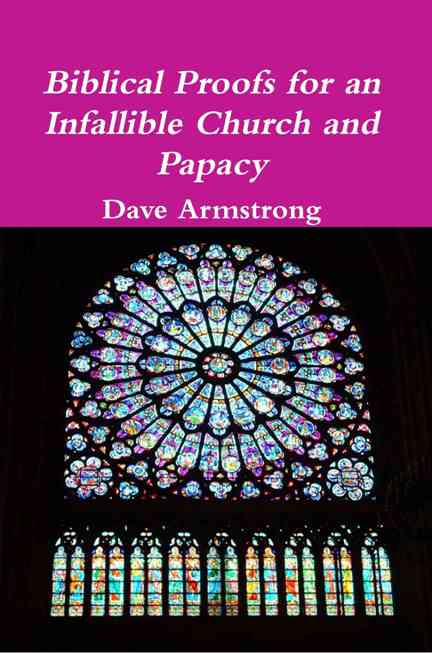
Photo credit: cover of my book, Biblical Proofs for an Infallible Church and Papacy (March 2012, 150 pages). See book info, and purchase options at the link to the left.
Summary: Anglican polemicist Richard Frederick Littledale (1833-1890) made a dubious claim about no [?] biblical data for an infallible Church. I refute it from the Bible.
Holy Spirit's guidance of the Church
Previous Post

May 22, 2024
Defense of the Communion of Saints & Images
Next Post
May 23, 2024 Bible on Bishops' Authority Over Local Pastors
Recent Comments
"And lastly, I belong to no denomination and am free to serve God as He ..."
Is Venerating Men & Angels Worship? ..."
"And obeisance doesn't mean "worship". It means "respect", "obey", or "submission". Very weird that you ..."
Is Venerating Men & Angels Worship? ..."
"Many of these scriptures you have noted have been taken out of context. With Daniel, ..."
Is Venerating Men & Angels Worship? ..."
""Protestants often point out that Jesus is now triumphant in heaven and object to Catholics ..."
Three More Anti-Catholic Lies About Catholicism ..."
Browse Our Archives
Select a Category & Last Things About Me Anti-Catholicism Atheism & Agnosticism Baptism and Sacramentalism Bible and Tradition Blessed Virgin Mary Books by Dave Armstrong C. S. Lewis Calvinism & General Protestantism Catholic Apologetics Catholic Apologists Catholic conversion Catholic converts Christmas Church (Ecclesiology) Church History Conversion and Converts Development of Doctrine Eastern Orthodoxy Ecumenism & Christian Unity Eucharist & Liturgy Fathers of the Church French Translations G. K. Chesterton Hell Hell & Satan Hell & Satan & Last Things Heresies & Comparative Religion Holistic Health Inquisition & Crusades & Scandals James White Jews & Judaism & Old Testament John Calvin John Henry Newman Liberal / Modernist Theology Life Issues Literary Resume Lutheranism Mariology Martin Luther Music Orthodoxy Papacy & Infallibility Personal Page Philosophy & Science Political & Ethical & Moral Issues Protestant Persecution & Intolerance Protestantism Purgatory Purgatory & Penance Romantic & Imaginative Theology Saints & Purgatory & Penance Salvation Salvation & Justification Satan & Last Things Sexuality and Gender Issues Spanish Translations Traditionalism vs. Radical Catholic Reactionaries Traducciones al español / tradução para português Trinitarianism & Christology Uncategorized Videos
Select a Month October 2026 September 2026 August 2026 July 2026 June 2026 May 2026 April 2026 March 2026 February 2026 January 2026 December 2025 November 2025 October 2025 September 2025 August 2025 July 2025 June 2025 May 2025 April 2025 March 2025 February 2025 January 2025 December 2024 November 2024 October 2024 September 2024 August 2024 July 2024 June 2024 May 2024 April 2024 March 2024 February 2024 January 2024 December 2023 November 2023 October 2023 September 2023 August 2023 July 2023 June 2023 May 2023 April 2023 March 2023 February 2023 January 2023 December 2022 November 2022 October 2022 September 2022 August 2022 July 2022 June 2022 May 2022 April 2022 March 2022 February 2022 January 2022 December 2021 November 2021 October 2021 September 2021 August 2021 July 2021 June 2021 May 2021 April 2021 March 2021 February 2021 January 2021 December 2020 November 2020 October 2020 September 2020 August 2020 July 2020 June 2020 May 2020 April 2020 March 2020 February 2020 January 2020 December 2019 November 2019 October 2019 September 2019 August 2019 July 2019 June 2019 May 2019 April 2019 March 2019 February 2019 January 2019 December 2018 November 2018 October 2018 September 2018 August 2018 July 2018 June 2018 May 2018 April 2018 March 2018 February 2018 January 2018 December 2017 November 2017 October 2017 September 2017 August 2017 July 2017 June 2017 May 2017 April 2017 March 2017 February 2017 January 2017 December 2016 November 2016 October 2016 September 2016 August 2016 July 2016 June 2016 May 2016 April 2016 March 2016 February 2016 January 2016 December 2015 November 2015 October 2015 September 2015 August 2015 July 2015 June 2015 May 2015 April 2015 March 2015 February 2015 January 2015 December 2014 November 2014 October 2014 September 2014 August 2014 July 2014 June 2014 April 2014 March 2014 February 2014 January 2014 December 2013 November 2013 October 2013 September 2013 August 2013 July 2013 June 2013 April 2013 March 2013 February 2013 January 2013 December 2012 November 2012 October 2012 September 2012 August 2012 July 2012 June 2012 May 2012 April 2012 March 2012 February 2012 January 2012 December 2011 November 2011 October 2011 September 2011 August 2011 July 2011 June 2011 April 2011 March 2011 February 2011 October 2010 September 2010 August 2010 July 2010 April 2010 March 2010 December 2009 October 2009 August 2009 July 2009 June 2009 May 2009 March 2009 February 2009 October 2008 September 2008 April 2008 March 2008 February 2008 January 2008 December 2007 November 2007 October 2007 May 2007 March 2007 February 2007 January 2007 November 2006 October 2006 September 2006 August 2006 July 2006 June 2006 May 2006 April 2006 March 2006 February 2006 October 2005 June 2005 April 2005 February 2005 July 2004 May 2004 April 2004
Follow Us!
TAKE THE
Religious Wisdom Quiz
Who prayed for rain after a long drought and sent his servant to look seven times?
Select your answer to see how you score.
Elijah Isaiah Samuel Hosea
Books by This Author Books by Dave Armstrong
Related posts from Biblical Evidence for Catholicism

Jesus Founded the [Catholic] Church. If Not Him,...
Biblical Evidence for Catholicism

Jerusalem Council vs. James White & Sola Scriptura
Biblical Evidence for Catholicism

Biblical Perspicuity: Absurd Anti-Catholic "Defense"
Biblical Evidence for Catholicism

50 Biblical Disproofs of "Evident Clearness" of the...
Biblical Evidence for Catholicism
TRENDING AT PATHEOS Catholic

I was strolling through the top floor of the brand new Parthenon...

What Does Gêvâh Mean For Kimberley Guifoyle &...
This week, a lot of the news is focused on Kimberly Guilfoyle....

INNER CIRCLE: Profound Mystery (Of Christ In All...
Ephesians 5:31-32 “For this reason, a man will leave his father and...

Do Not Rejoice When Your Enemy Falls: The...
Turning an execution into a public spectacle is a disturbing expression of...

'The Chosen' S6 Trailer: The Passion Gets Very...
Not many watching 'The Chosen' worry about spoilers, but just because they...

The purpose-driven labor priest
A labor activist reads Rick Warren and it gets me wondering about...
view all Catholic blogs
What Are Your Thoughts?leave a comment
Ad-Free & Subscriber Log-In Subscription Support
- About Us
- 2026 Calendar
- Videos
- Podcasts
- Library of World Religions
- Faith In Media Tracker
- Advertise With Us
- Write for Us
- Privacy Policy
- Terms of Service
- Do Not Sell My Data
- Contact Us
- Radiant Digital
- Manage Newsletter Subscriptions
- Unsubscribe From Notifications
- Sitemap
Copyright 2008-2026, Patheos. All rights reserved.
Subscription Support Ad-Free & Subscriber Log-In
Follow Patheos