
BuddhistCatholicContemplativeEvangelicalGeneral ChristianHinduJewishLatter-day SaintMuslimNew VisionsProgressive Christian
Beliefs
- Buddhist
- Catholic
- Contemplative
- Evangelical
- General Christian
- Hindu
- Jewish
- Latter-day Saint
- More Voices
- Muslim
- New Visions
- Pagan
- Progressive Christian
Topics
- Religion News
- Food and Religion
- Sports and Religion
- Religious Art
- Religious Music and Entertainment
- Religious Events
- History and Religion
- Style and Religion
- Politics and Religion
- Women in Religion
- Recreation Outdoors and Religion
- Business Finance and Religion
- Careers Workplace and Religion
- Education and Religion
- Family Parenting and Religion
- Health Fitness and Religion
- Home and Religion
- Relationships and Religion
- Technology and Religion
- Travel and Religion
Columnists
- Buddhist Columnists
- Business Finance and Religion Columnists
- Careers Workplace and Religion Columnists
- Catholic Columnists
- Contemplative Columnists
- Education and Religion Columnists
- Evangelists Columnists
- Family Parenting and Religion Columnists
- General Christian Columnists
- Health Fitness and Religion Columnists
- Hindu Columnists
- History and Religion Columnists
- Home and Religion Columnists
- Jewish Columnists
- More Voices Columnists
- Latter Day Columnists
- Muslim Columnists
- New Visions Columnists
- Nonreligious Columnists
- Pagan Columnists
- Politics and Religion Columnists
- Progressive Columnists
- Recreation Outdoors and Religion Columnists
- Relationships and Religion Columnists
- Religion News Columnists
- Religious Art Columnists
- Religious Events Columnists
- Religious Music and Entertainment Columnists
- Sports and Religion Columnists
- Style and Religion Columnists
- Technology and Religion Columnists
- Travel and Religion Columnists
- Women in Religion Columnists
Resource Library
- 2026 Calendar
- Library of World Religions
- The 100 Most Holy Places on Earth
- Patheos Answers
- Podcasts
- Videos
- Faith Leaders Database
- Anglican Episcopalian
- Bahai
- Baptist
- Buddhism
- Christianity
- Confucianism
- Eastern Orthodoxy
- Hinduism
- Holiness and Pentecostal
- ISKCON
- Islam
- Judaism
- Lutheran
- Methodist
- The Church of Jesus Christ of Latter-day Saints
- New Age
- Paganism
- Presbytarian and Reformed
- Protestantism
- Religion Behind the Scenes
- Roman Catholic
- Scientology
- Shia Islam
- Sikhism
- Sufism
- Sunni Islam
- Taoism
- Zen
- See all religions
Research Tools
 Ad-Free & Subscriber Log-In Subscription Support
Ad-Free & Subscriber Log-In Subscription Support
Follow Patheos 

- Trending:
- Forgiveness
- |
- Marriage
- |
- Consciousness
- |
- Death Penalty
- |
- Election
- |
- Halloween

-
About
-
Catholic Apologetics
-
Church History
-
Great Apologists
-
Christian Worldview
-
Protestantism & Misc.
- Home
- Catholic
- History and Religion
- Calvin & Cranmer: Councils Necessary for Doctrinal Unity
Calvin & Cranmer: Councils Necessary for Doctrinal Unity
Last updated on: May 8, 2024 at 4:25 pm by Dave Armstrong
Calvin & Cranmer: Councils Necessary for Doctrinal Unity 2024-05-08T16:25:51-04:00 Dave Armstrong
Patheos Explore the world's faith through different perspectives on religion and spirituality! Patheos has the views of the prevalent religions and spiritualities of the world.
“Please Hit ‘Subscribe’”! If you have received benefit from this or any of my other 4,600+ articles, please follow this blog by signing up (with your email address) on the sidebar to the right (you may have to scroll down a bit), above where there is an icon bar, “Sign Me Up!”: to receive notice when I post a new blog article. This is the equivalent of subscribing to a YouTube channel. Please also consider following me on Twitter / X and purchasing one or more of my 55 books. All of this helps me get more exposure, and (however little!) more income for my full-time apologetics work. Thanks so much and happy reading!
***
Thomas Cranmer to John Calvin: 20 March 1552 [complete]
As nothing tends more injuriously to the separation of the Churches than heresies and disputes respecting the doctrines of religion, so nothing tends more effectually to unite the Churches of God, and more powerfully to defend the fold of Christ, than the pure teaching of the Gospel and harmony of doctrine. Wherefore I have often wished, and still continue to do so, that learned and godly men, who are eminent for erudition and judgment, might meet together, and, comparing their respective opinions, might handle all the heads of ecclesiastical doctrine, and hand down to posterity, under the weight of their authority, some work not only upon the subjects themselves, but upon the forms of expressing them. Our adversaries are now holding their councils at Trent, for the establishment of their errors; and shall we neglect to call together a godly synod, for the refutation of error, and for restoring and propagating the truth?
They are, as I am informed, making decrees respecting the worship of the host; wherefore we ought to leave no stone unturned, not only that we may guard others against this idolatry, but also that we may ourselves come to an agreement upon the doctrine of this sacrament. It cannot escape your prudence how exceedingly the Church of God has been injured by dissensions and varieties of opinion respecting the sacrament of unity; and though they are now in some measure removed, yet I could wish for an agreement in this doctrine, not only as regards the subject itself, but also with respect to the words and forms of expression. You have now my wish, about which I have also written to Masters Philip [Melanchthon] and Bullinger; and I pray you to deliberate among yourselves as to the means by which this synod can be assembled with the greatest convenience. Farewell. (Letters of John Calvin, Vol. II, edited by Jules Bonnet and translated from Latin and French by David Constable, Edinburgh: Thomas Constable & Co., 1857, pp. 330-331; my bolding and paragraph break)
Calvin to Cranmer: April 1552 [complete]
Your opinion, most distinguished Sir, is indeed just and wise, that in the present disordered condition of the Church, no remedy can be devised more suitable than if a general meeting were held of the devout and the prudent, of those properly exercised in the school of God, and of those who are confessedly at one on the doctrine of holiness. For we see how Satan is attempting, by various devices, to extinguish the light of the Gospel, which, by the wonderful goodness of God, having risen upon us, is shining in many a quarter. The hireling dogs of the Pope cease not to bark, in order to prevent the pure Gospel of Christ from being heard: so great is the licentiousness that is here and there breaking forth, and the ungodliness that is spreading abroad, that religion is become a mere mockery; and those who are not professed enemies of the truth, nevertheless conduct themselves with an impropriety which will create in a short time, unless it be obviated, terrible disorder among us. And not only among the common herd of men here does the distemper of a stupid inquisitiveness alternate with that of fearless extravagance, but, what is more lamentable, in the ranks of the pastors also the malady is now gaining ground. It is too well known with what mad actions Osiander is deceiving himself and deluding certain others. Yet the Lord, as he has done even from the beginning of the world; will preserve in a miraculous manner, and in a way unknown to us, the unity of a pure faith from being destroyed by the dissensions of men.
And those whom He has placed on His watchtower He wishes least of all to be inactive, seeing that He has appointed them to be His ministers, through whose labours He may preserve from all corruptions sound doctrine in the Church, and transmit it safe to posterity. Especially, most illustrious Archbishop, is it necessary for you, in proportion to the distinguished position you occupy, to turn your attention as you are doing towards this object. I do not say this as if to spur you on to greater exertions, who are not only, of your own accord, in advance of others, but are also, as a voluntary encourager, urging them on; I say it in order that, by my congratulations, you may be strengthened in a pursuit so auspicious and noble. I hear that the success of the Gospel in England is indeed cheering; but you will experience there also, I doubt not, what Paul experienced in his time, that by means of the door that has been opened for the reception of pure doctrine, many enemies will suddenly rise up against it. Although I am really ignorant of how many suitable defenders you may have at hand to repel the lies of Satan, still the ungodliness of those who are wholly taken up in creating disturbances, causes the assiduity of the well-disposed to be at no time either too much or superfluous.
And then I am aware that English matters are not so all-important in your eyes, but that you, at the same time, regard the interests of the whole world. Moreover, the rare piety of the English King, as well as his noble disposition, is worthy of the highest commendation, in that, of his own inclination, he entertains the pious design of holding a convention of the nature referred to, and offers a place for it also in his own kingdom. And would that it were attainable to bring together into some place, from various Churches, men eminent for their learning, and that after having carefully discussed the main points of belief one by one, they should, from their united judgments, hand down to posterity the true doctrine of Scripture. This other thing also is to be ranked among the chief evils of our time, viz., that the Churches are so divided, that human fellowship is scarcely now in any repute amongst us, far less that Christian intercourse which all make a profession of, but few sincerely practise. If men of learning conduct themselves with more reserve than is seemly, the very heaviest blame attaches to the leaders themselves, who, either engrossed in their own sinful pursuits, are indifferent to the safety and entire piety of the Church, or who, individually satisfied with their own private peace, have no regard for others.
Thus it is that the members of the Church being severed, the body lies bleeding. So much does this concern me, that, could I be of any service, I would not grudge to cross even ten seas, if need were, on account of it. If it were but a question regarding the rendering of assistance to the kingdom of England, such a motive would at present be to me a sufficiently just one. Now, seeing that a serious and properly adjusted agreement between men of learning upon the rule of Scripture is still a desideratum, by means of which Churches, though divided on other questions, might be made to unite, I think it right for me, at whatever cost of toil and trouble, to seek to obtain this object. But I hope my own insignificance will cause me to be passed by. If I earnestly pray that it may be undertaken by others, I hope I shall have discharged my duty. Mr. Philip [Melanchthon] is at too great a distance to admit of a speedy interchange of letters. Mr. Bullinger has likely written you before this time. Would that I were as able as I am willing to exert myself! Moreover, the very difficulty of the thing which you feel, compels me to do what, at the outset, I affirmed I would not do, viz., not only to encourage, but also to implore you to increase your exertions, until something at least shall have been accomplished, if not all that we could desire. Adieu, very distinguished Archbishop, deserving of my hearty reverence. May the Lord continue to guide you by His Spirit, and to bless your holy labours! (Ibid., pp. 330-333; my bolding and paragraph breaks)
Calvin to Cranmer: July 1552
Seeing that, at the present time, that which is most of all to be desired is least likely to be attained, viz., that an assembly of the most eminent men of learning, from all the various Churches which have embraced the pure doctrine of the Gospel, after having discussed separately the controverted topics of the day, might transmit to posterity, out of the pure Word of God, a true and distinct confession; . . . (Ibid., p. 341; my bolding)
I would contend that these sentiments are rather obviously in glaring contradiction to sola Scriptura as the rule of faith, since they recommend what might be called, or is in effect a “de facto infallibility.” Sola Scriptura, after all, denies infallibility to anything besides Holy Scripture. But clearly, here they are expressing the notion that Scripture by itself can’t bring about doctrinal unity.
*
Accordingly, Calvin opines that such councils are required to “hand down to posterity the true doctrine of Scripture.” Thus, they fall back on what Catholics have always believed: authoritative, infallible ecumenical councils. Cranmer even refers to the Council of Trent, and argues that Protestants (feeling inadequate, are we?) ought to have their own, to counter the Catholic Church.
*
I’ve made this argument over against both Protestants and Eastern Orthodox, for 33 years. Luther wanted to ditch [infallible] councils in 1521 at the Diet of Worms, and here is John Calvin, the second most influential Protestant founder — along with the Anglican Cranmer — , arguing for the dire need of essentially infallible councils, a mere 31 years later. Truth is stranger than fiction. Scripture alone was good enough for Luther, but not for Calvin and Cranmer.
*
Yet here we are 507 years after Luther began his revolution, and alas, still no Protestant councils providing certain and unquestionable theological truth for all of us peasants! And still no end in sight for proliferating Protestant denominations in the many hundreds.
*
***
*
Practical Matters: Perhaps some of my 4,600+ free online articles (the most comprehensive “one-stop” Catholic apologetics site) or fifty-five books have helped you (by God’s grace) to decide to become Catholic or to return to the Church, or better understand some doctrines and why we believe them.
Or you may believe my work is worthy to support for the purpose of apologetics and evangelism in general. If so, please seriously consider a much-needed financial contribution. I’m always in need of more funds: especially monthly support. “The laborer is worthy of his wages” (1 Tim 5:18, NKJV). 1 December 2021 was my 20th anniversary as a full-time Catholic apologist, and February 2022 marked the 25th anniversary of my blog.
PayPal donations are the easiest: just send to my email address: [email protected]. Here’s also a second page to get to PayPal. You’ll see the term “Catholic Used Book Service”, which is my old side-business. To learn about the different methods of contributing (including Zelle), see my page: About Catholic Apologist Dave Armstrong / Donation Information. Thanks a million from the bottom of my heart!
*
***
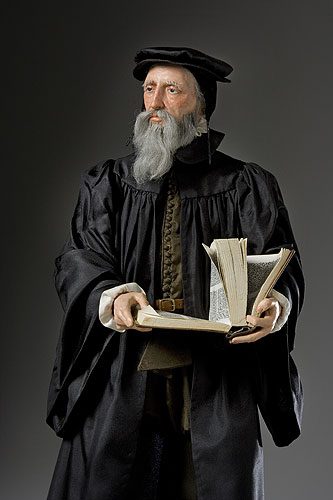
Photo credit: Historical mixed media figure of John Calvin produced by artist/historian George S. Stuart and photographed by Peter d’Aprix: from the George S. Stuart Gallery of Historical Figures archive [Wikimedia Commons / Creative CommonsAttribution-Share Alike 3.0 Unported license]

Summary: Early Protestant leaders John Calvin & Thomas Cranmer thought that councils were necessary in order to promulgate true Christianity and to attain a proper unity.
Calvinism & General Protestantism
Councils Necessary for Doctrinal Unity
Previous Post
May 7, 2024
Vs. Turretin #10: Sanctification
Next Post
May 9, 2024 Catholic-Protestant Dialogue: Recommended Books
Recent Comments
"Special pleading, and not a serious response to my arguments . . ."
Is Venerating Men & Angels Worship? ..."
""no man needs to teach us."Didn't you just teach us?"
Is Venerating Men & Angels Worship? ..."
""Catholics say they are the only church that can lead people into heaven."In fact, we ..."
Is Venerating Men & Angels Worship? ..."
"And lastly, I belong to no denomination and am free to serve God as He ..."
Is Venerating Men & Angels Worship? ..."
Browse Our Archives
Select a Category & Last Things About Me Anti-Catholicism Atheism & Agnosticism Baptism and Sacramentalism Bible and Tradition Blessed Virgin Mary Books by Dave Armstrong C. S. Lewis Calvinism & General Protestantism Catholic Apologetics Catholic Apologists Catholic conversion Catholic converts Christmas Church (Ecclesiology) Church History Conversion and Converts Development of Doctrine Eastern Orthodoxy Ecumenism & Christian Unity Eucharist & Liturgy Fathers of the Church French Translations G. K. Chesterton Hell Hell & Satan Hell & Satan & Last Things Heresies & Comparative Religion Holistic Health Inquisition & Crusades & Scandals James White Jews & Judaism & Old Testament John Calvin John Henry Newman Liberal / Modernist Theology Life Issues Literary Resume Lutheranism Mariology Martin Luther Music Orthodoxy Papacy & Infallibility Personal Page Philosophy & Science Political & Ethical & Moral Issues Protestant Persecution & Intolerance Protestantism Purgatory Purgatory & Penance Romantic & Imaginative Theology Saints & Purgatory & Penance Salvation Salvation & Justification Satan & Last Things Sexuality and Gender Issues Spanish Translations Traditionalism vs. Radical Catholic Reactionaries Traducciones al español / tradução para português Trinitarianism & Christology Uncategorized Videos
Select a Month October 2026 September 2026 August 2026 July 2026 June 2026 May 2026 April 2026 March 2026 February 2026 January 2026 December 2025 November 2025 October 2025 September 2025 August 2025 July 2025 June 2025 May 2025 April 2025 March 2025 February 2025 January 2025 December 2024 November 2024 October 2024 September 2024 August 2024 July 2024 June 2024 May 2024 April 2024 March 2024 February 2024 January 2024 December 2023 November 2023 October 2023 September 2023 August 2023 July 2023 June 2023 May 2023 April 2023 March 2023 February 2023 January 2023 December 2022 November 2022 October 2022 September 2022 August 2022 July 2022 June 2022 May 2022 April 2022 March 2022 February 2022 January 2022 December 2021 November 2021 October 2021 September 2021 August 2021 July 2021 June 2021 May 2021 April 2021 March 2021 February 2021 January 2021 December 2020 November 2020 October 2020 September 2020 August 2020 July 2020 June 2020 May 2020 April 2020 March 2020 February 2020 January 2020 December 2019 November 2019 October 2019 September 2019 August 2019 July 2019 June 2019 May 2019 April 2019 March 2019 February 2019 January 2019 December 2018 November 2018 October 2018 September 2018 August 2018 July 2018 June 2018 May 2018 April 2018 March 2018 February 2018 January 2018 December 2017 November 2017 October 2017 September 2017 August 2017 July 2017 June 2017 May 2017 April 2017 March 2017 February 2017 January 2017 December 2016 November 2016 October 2016 September 2016 August 2016 July 2016 June 2016 May 2016 April 2016 March 2016 February 2016 January 2016 December 2015 November 2015 October 2015 September 2015 August 2015 July 2015 June 2015 May 2015 April 2015 March 2015 February 2015 January 2015 December 2014 November 2014 October 2014 September 2014 August 2014 July 2014 June 2014 April 2014 March 2014 February 2014 January 2014 December 2013 November 2013 October 2013 September 2013 August 2013 July 2013 June 2013 April 2013 March 2013 February 2013 January 2013 December 2012 November 2012 October 2012 September 2012 August 2012 July 2012 June 2012 May 2012 April 2012 March 2012 February 2012 January 2012 December 2011 November 2011 October 2011 September 2011 August 2011 July 2011 June 2011 April 2011 March 2011 February 2011 October 2010 September 2010 August 2010 July 2010 April 2010 March 2010 December 2009 October 2009 August 2009 July 2009 June 2009 May 2009 March 2009 February 2009 October 2008 September 2008 April 2008 March 2008 February 2008 January 2008 December 2007 November 2007 October 2007 May 2007 March 2007 February 2007 January 2007 November 2006 October 2006 September 2006 August 2006 July 2006 June 2006 May 2006 April 2006 March 2006 February 2006 October 2005 June 2005 April 2005 February 2005 July 2004 May 2004 April 2004
Follow Us!
TAKE THE
Religious Wisdom Quiz
Who was the strongest man mentioned in the Bible?
Select your answer to see how you score.
David Saul Goliath Samson
Books by This Author Books by Dave Armstrong
Related posts from Biblical Evidence for Catholicism

On Protestant Explanations of Catholic Conversion
Biblical Evidence for Catholicism

Protestant Confessions & "Ever-Virgin" Mary
Biblical Evidence for Catholicism

Jesus Founded the [Catholic] Church. If Not Him,...
Biblical Evidence for Catholicism

A Few "Worst" & "Best" Arguments vs. Protestantism
Biblical Evidence for Catholicism
TRENDING AT PATHEOS Catholic

The Sermon on the Mount, Part I: Matthew...
The Sermon on the Mount, Part I (Matthew 4:12-5:12) St. Matthew moves...

What's up from Crossway: Reviewing some of their latest A few weeks...

Janie Learns the Way of the Cross: A...
Teaching children about Jesus' Passion can be challenging. Many parents and educators...

Looking For Good Catholic Writing - October 2026
He alone extends the heavens, and he walks upon the waves of...

In "Irreplaceable," our book on vocation and technology, Trevor Sutton and I...

I was strolling through the top floor of the brand new Parthenon...
view all Catholic blogs
What Are Your Thoughts?leave a comment
Ad-Free & Subscriber Log-In Subscription Support
- About Us
- 2026 Calendar
- Videos
- Podcasts
- Library of World Religions
- Faith In Media Tracker
- Advertise With Us
- Write for Us
- Privacy Policy
- Terms of Service
- Do Not Sell My Data
- Contact Us
- Radiant Digital
- Manage Newsletter Subscriptions
- Unsubscribe From Notifications
- Sitemap
Copyright 2008-2026, Patheos. All rights reserved.
Subscription Support Ad-Free & Subscriber Log-In
Follow Patheos