
BuddhistCatholicContemplativeEvangelicalGeneral ChristianHinduJewishLatter-day SaintMuslimNew VisionsProgressive Christian
Beliefs
- Buddhist
- Catholic
- Contemplative
- Evangelical
- General Christian
- Hindu
- Jewish
- Latter-day Saint
- More Voices
- Muslim
- New Visions
- Pagan
- Progressive Christian
Topics
- Religion News
- Food and Religion
- Sports and Religion
- Religious Art
- Religious Music and Entertainment
- Religious Events
- History and Religion
- Style and Religion
- Politics and Religion
- Women in Religion
- Recreation Outdoors and Religion
- Business Finance and Religion
- Careers Workplace and Religion
- Education and Religion
- Family Parenting and Religion
- Health Fitness and Religion
- Home and Religion
- Relationships and Religion
- Technology and Religion
- Travel and Religion
Columnists
- Buddhist Columnists
- Business Finance and Religion Columnists
- Careers Workplace and Religion Columnists
- Catholic Columnists
- Contemplative Columnists
- Education and Religion Columnists
- Evangelists Columnists
- Family Parenting and Religion Columnists
- General Christian Columnists
- Health Fitness and Religion Columnists
- Hindu Columnists
- History and Religion Columnists
- Home and Religion Columnists
- Jewish Columnists
- More Voices Columnists
- Latter Day Columnists
- Muslim Columnists
- New Visions Columnists
- Nonreligious Columnists
- Pagan Columnists
- Politics and Religion Columnists
- Progressive Columnists
- Recreation Outdoors and Religion Columnists
- Relationships and Religion Columnists
- Religion News Columnists
- Religious Art Columnists
- Religious Events Columnists
- Religious Music and Entertainment Columnists
- Sports and Religion Columnists
- Style and Religion Columnists
- Technology and Religion Columnists
- Travel and Religion Columnists
- Women in Religion Columnists
Resource Library
- 2026 Calendar
- Library of World Religions
- The 100 Most Holy Places on Earth
- Patheos Answers
- Podcasts
- Videos
- Faith Leaders Database
- Anglican Episcopalian
- Bahai
- Baptist
- Buddhism
- Christianity
- Confucianism
- Eastern Orthodoxy
- Hinduism
- Holiness and Pentecostal
- ISKCON
- Islam
- Judaism
- Lutheran
- Methodist
- The Church of Jesus Christ of Latter-day Saints
- New Age
- Paganism
- Presbytarian and Reformed
- Protestantism
- Religion Behind the Scenes
- Roman Catholic
- Scientology
- Shia Islam
- Sikhism
- Sufism
- Sunni Islam
- Taoism
- Zen
- See all religions
Research Tools
 Ad-Free & Subscriber Log-In Subscription Support
Ad-Free & Subscriber Log-In Subscription Support
Follow Patheos 

- Trending:
- Forgiveness
- |
- Marriage
- |
- Consciousness
- |
- Death Penalty
- |
- Election
- |
- Halloween

-
About
-
Catholic Apologetics
-
Church History
-
Great Apologists
-
Christian Worldview
-
Protestantism & Misc.
- Home
- Catholic
- History and Religion
- St. Irenaeus (130-202) vs. “Faith Alone” (Sola Fide)
St. Irenaeus (130-202) vs. “Faith Alone” (Sola Fide)
Last updated on: June 6, 2026 at 12:03 am by Dave Armstrong
St. Irenaeus (130-202) vs. “Faith Alone” (Sola Fide) 2026-06-06T00:03:55-04:00 Dave Armstrong
Patheos Explore the world's faith through different perspectives on religion and spirituality! Patheos has the views of the prevalent religions and spiritualities of the world.
“Please Hit ‘Subscribe’”! If you’ve received benefit from this or any of my 4,500+ articles, please follow this blog by signing up (email address) on the sidebar to the right, above the icon bar, “Sign Me Up!”: to receive notice when I post a new blog article. This is the equivalent of subscribing to a YouTube channel. Please also consider following me on Twitter / X and purchasing one or more of my 55 books. All of this helps me get more exposure and concretely supports my full-time apologetics work. Thanks so much and happy reading!
*****
[all citations from Against Heresies, dated from between 174 and 189, and consisting of five books. I will use Roman numerals for the book (I-V), and regular numbers for chapters and sections of chapters. I’m using the translation from the famous Schaff set of 38 volumes]
***
Grace Alone / Denial of Works-Salvation (Pelagianism)
. . . men are saved through his grace, and not on account of their own righteous actions. (I, 23, 3)
For life does not arise from us, nor from our own nature; but it is bestowed according to the grace of God. (II, 34, 3)
For as it was not possible that the man who had once for all been conquered, and who had been destroyed through disobedience, could reform himself, and obtain the prize of victory; and as it was also impossible that he could attain to salvation who had fallen under the power of sin — the Son effected both these things, being the Word of God, descending from the Father, becoming incarnate, stooping low, even to death, and consummating the arranged plan of our salvation, . . . (III, 18, 2)
. . . unless it had been God who had freely given salvation, we could never have possessed it securely. (III, 18, 7)
. . . the Lord Himself, who is Emmanuel from the Virgin, [Isaiah 7:4] is the sign of our salvation, since it was the Lord Himself who saved them, because they could not be saved by their own instrumentality; and, therefore, when Paul sets forth human infirmity, he says: For I know that there dwells in my flesh no good thing, [Romans 7:18] showing that the good thing of our salvation is not from us, but from God. . . . Then he introduces the Deliverer, [saying,] The grace of Jesus Christ our Lord. And Isaiah declares this also, [when he says:] Be strengthened, you hands that hang down, and you feeble knees; be encouraged, you feeble-minded; be comforted, fear not: behold, our God has given judgment with retribution, and shall recompense: He will come Himself, and will save us. [Isaiah 25:3] Here we see, that not by ourselves, but by the help of God, we must be saved. (III, 20, 3)
. . . men can be saved in no other way from the old wound of the serpent than by believing in Him who, in the likeness of sinful flesh, is lifted up from the earth upon the tree of martyrdom, and draws all things to Himself, [John 12:32; 3:14] and vivifies the dead. (IV, 2, 8)
. . . no one, indeed, while placed out of reach of the Lord’s benefits, has power to procure for himself the means of salvation . . . (IV, 13, 3)
. . . how can they be saved unless it was God who wrought out their salvation upon earth? Or how shall man pass into God, unless God has [first] passed into man? And how shall he (man) escape from the generation subject to death, if not by means of a new generation, given in a wonderful and unexpected manner (but as a sign of salvation) by God— [I mean] that regeneration which flows from the virgin through faith? (IV, 33, 4)
. . . through the flesh of our Lord, and through His blood, we have been saved. (V, 14, 3)
. . . man, who had been led captive in times past, was rescued from the grasp of his possessor, according to the tender mercy of God the Father, who had compassion on His own handiwork, and gave to it salvation, restoring it by means of the Word — that is, by Christ — in order that men might learn by actual proof that he receives incorruptibility not of himself, but by the free gift of God. (V, 21, 3)
Infused Justification (Including Sanctification)
. . . for this cause does the apostle, explaining himself, make it clear that the saved man is a complete man as well as a spiritual man; saying thus in the first Epistle to the Thessalonians, Now the God of peace sanctify you perfect (perfectos); and may your spirit, and soul, and body be preserved whole without complaint to the coming of the Lord Jesus Christ. [1 Thess 5:23] . . . Those, then, are the perfect who have had the Spirit of God remaining in them, and have preserved their souls and bodies blameless, holding fast the faith of God, that is, that faith which is [directed] towards God, and maintaining righteous dealings with respect to their neighbours. (V, 6, 1)
Faith and Meritorious Good Works Organically Connected in Those Who Are Saved (Our Cooperation with God’s Grace)
He . . . may, in the exercise of His grace, confer immortality on the righteous, and holy, and those who have kept His commandments, and have persevered in His love, some from the beginning [of their Christian course], and others from [the date of] their repentance, and may surround them with everlasting glory. (I, 10, 1)
We are saved, indeed, by means of faith and love; . . . (I, 25, 5)
That, then, was called the day of retribution on which the Lord will render to every one according to his works — that is, the judgment. (II, 22, 2)
. . . if there were really no such thing as good and evil, but certain things were deemed righteous, and certain others unrighteous, in human opinion only, He never would have expressed Himself thus in His teaching: The righteous shall shine forth as the sun in the kingdom of their Father; [Matthew 13:43] but He shall send the unrighteous, and those who do not the works of righteousness, into everlasting fire, where their worm shall not die, and the fire shall not be quenched. [Matthew 25:41; Mark 9:44] (II, 32, 1)
As in the law, therefore, and in the Gospel [likewise], the first and greatest commandment is, to love the Lord God with the whole heart, and then there follows a commandment like to it, to love one’s neighbour as one’s self; the author of the law and the Gospel is shown to be one and the same. For the precepts of an absolutely perfect life, since they are the same in each Testament, have pointed out [to us] the same God, who certainly has promulgated particular laws adapted for each; but the more prominent and the greatest [commandments], without which salvation cannot [be attained], He has exhorted [us to observe] the same in both. (IV, 12, 3)
And that the Lord did not abrogate the natural [precepts] of the law, by which man is justified, which also those who were justified by faith, and who pleased God, did observe previous to the giving of the law, but that He extended and fulfilled them, is shown from His words. For, He remarks, it has been said to them of old time, Do not commit adultery. But I say unto you, That every one who has looked upon a woman to lust after her, has committed adultery with her already in his heart. [Matthew 5:27-28] And again: It has been said, You shall not kill. But I say unto you, Every one who is angry with his brother without a cause, shall be in danger of the judgment. [Matthew 5:21-22] And, It has been said, You shall not forswear yourself. But I say unto you, Swear not at all; but let your conversation be, Yea, yea, and Nay, nay. [Matthew 5:33, etc.] And other statements of a like nature. For all these do not contain or imply an opposition to and an overturning of the [precepts] of the past, as Marcion’s followers do strenuously maintain; but [they exhibit] a fulfilling and an extension of them, as He does Himself declare: Unless your righteousness shall exceed that of the scribes and Pharisees, you shall not enter into the kingdom of heaven. [Matthew 5:20] For what meant the excess referred to? In the first place, [we must] believe not only in the Father, but also in His Son now revealed; for He it is who leads man into fellowship and unity with God. In the next place, [we must] not only say, but we must do; for they said, but did not. And [we must] not only abstain from evil deeds, but even from the desires after them. (IV, 13, 1)
He grants to those who follow and serve Him life and incorruption and eternal glory, bestowing benefit upon those who serve [Him], because they do serve Him, and on His followers, because they do follow Him . . . (IV, 14, 1)
. . . the Decalogue [Ten Commandments] (which, if any one does not observe, he has no salvation) . . . (IV, 15, 1)
He continues, exhorting them to what pertained to salvation: Wash you, make you clean, take away wickedness from your hearts from before my eyes: cease from your evil ways, learn to do well, seek judgment, relieve the oppressed, judge the fatherless, plead for the widow; and come, let us reason together, says the Lord.(IV, 17, 1)
God, who stands in need of nothing, takes our good works to Himself for this purpose, that He may grant us a recompense of His own good things, as our Lord says: Come, you blessed of My Father, receive the kingdom prepared for you. For I was an hungered, and you gave Me to eat: I was thirsty, and you gave Me drink: I was a stranger, and you took Me in: naked, and you clothed Me; sick, and you visited Me; in prison, and you came to Me. [Matthew 25:34, etc.] As, therefore, He does not stand in need of these [services], yet does desire that we should render them for our own benefit, . . . (IV, 18, 6)
He saved those that were obedient . . . who are they that have been saved and received the inheritance? Those, doubtless, who do believe God, and who have continued in His love . . . But who are they that are saved now, and receive life eternal? Is it not those who love God, and who believe His promises, and who in malice have become as little children? [1 Corinthians 14:20] (IV, 28, 3)
. . . those who believe God and follow His word receive that salvation which flows from Him. Those, on the other hand, who depart from Him, and despise His precepts, and by their deeds bring dishonour on Him who made them, and by their opinions blaspheme Him who nourishes them, heap up against themselves most righteous judgment. (IV, 33, 15)
Still further did He also make it manifest, that we ought, after our calling, to be also adorned with works of righteousness, so that the Spirit of God may rest upon us; for this is the wedding garment, of which also the apostle speaks, Not for that we would be unclothed, but clothed upon, that mortality might be swallowed up by immortality. [2 Corinthians 5:4] But those who have indeed been called to God’s supper, yet have not received the Holy Spirit, because of their wicked conduct shall be, He declares, cast into outer darkness. [Matthew 22:13] He thus clearly shows that the very same King who gathered from all quarters the faithful to the marriage of His Son, and who grants them the incorruptible banquet, [also] orders that man to be cast into outer darkness who has not on a wedding garment, that is, one who despises it. For as in the former covenant, with many of them was He not well pleased; [1 Corinthians 10:5] so also is it the case here, that many are called, but few chosen. [Matthew 22:14] . . . But it is one and the same God, the Father of our Lord, from whom also the prophets had their mission, who does indeed, through His infinite kindness, call the unworthy; but He examines those who are called, [to ascertain] if they have on the garment fit and proper for the marriage of His Son, because nothing unbecoming or evil pleases Him. This is in accordance with what the Lord said to the man who had been healed: Behold, you are made whole; sin no more, lest a worse thing come unto you. [John 5:14] For he who is good, and righteous, and pure, and spotless, will endure nothing evil, nor unjust, nor detestable in His wedding chamber. (IV, 36, 6)
. . . this is plainly an indication of all heretics, and of those who do not meditate on the words of God, neither are adorned with works of righteousness; to whom also the Lord says, Why do you call Me Lord, Lord, and do not the things which I say to you? [Luke 6:46] For men of this stamp do indeed say that they believe in the Father and the Son, but they never meditate as they should upon the things of God, neither are they adorned with works of righteousness; . . . (V, 8, 4)
. . . therefore, he who has gone forward to the better things, and has brought forth the fruit of the Spirit, is saved altogether because of the communion of the Spirit; so also he who has continued in the aforesaid works of the flesh, being truly reckoned as carnal, because he did not receive the Spirit of God, shall not have power to inherit the kingdom of heaven. . . . the things which save are the name of our Lord Jesus Christ, and the Spirit of our God. (V, 11, 1)
**
Related Reading
Polycarp vs. “Faith Alone” (vs. Jason Engwer) [1-27-23]
*
St. Polycarp, Who Learned the Faith From an Apostle, Did Not Believe in ‘Faith Alone’ [National Catholic Register, 2-26-23]
*
*
*
Clement of Alexandria (c. 150 – c. 215) vs. “Faith Alone” [3-27-24]
*
Theophilus of Antioch (d. c. 180) vs. “Faith Alone” [3-27-24]
*
St. Justin Martyr (100-165) vs. “Faith Alone” (Sola Fide) [4-1-24]
*
Shepherd of Hermas (c. 150) vs. “Faith Alone” (Sola Fide) [4-2-24]
*
Tertullian (d. c. 220) vs. “Faith Alone” [4-2-24]
*
Hippolytus (d. c. 235) vs. “Faith Alone” [4-3-24]
*
Origen (c. 185 – c. 253) vs. “Faith Alone” [4-3-24]
*
St. Cyprian (210-258) vs. “Faith Alone” (Sola Fide) [4-8-24]
*
Church Fathers vs. “Faith Alone”: Handy Capsule Proofs [4-8-24]
*
***
*
Practical Matters: Perhaps some of my 4,600+ free online articles (the most comprehensive “one-stop” Catholic apologetics site) or fifty-five books have helped you (by God’s grace) to decide to become Catholic or to return to the Church, or better understand some doctrines and why we believe them.
Or you may believe my work is worthy to support for the purpose of apologetics and evangelism in general. If so, please seriously consider a much-needed financial contribution. I’m always in need of more funds: especially monthly support. “The laborer is worthy of his wages” (1 Tim 5:18, NKJV). 1 December 2021 was my 20th anniversary as a full-time Catholic apologist, and February 2022 marked the 25th anniversary of my blog.
PayPal donations are the easiest: just send to my email address: [email protected]. Here’s also a second page to get to PayPal. You’ll see the term “Catholic Used Book Service”, which is my old side-business. To learn about the different methods of contributing (including Zelle), see my page: About Catholic Apologist Dave Armstrong / Donation Information. Thanks a million from the bottom of my heart!
*
***
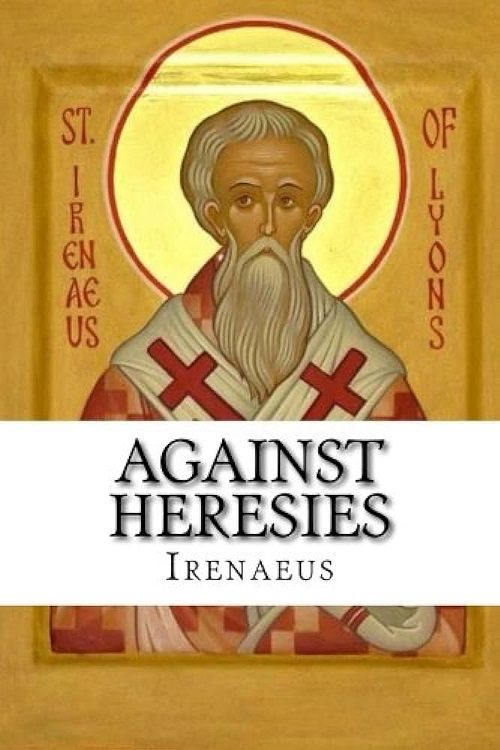
Photo credit: image of the book cover of Against Heresies, published by Beloved publishing in 2014 [Amazon page]
Summary: St. Irenaeus denied the novel Protestant doctrine of “faith alone” or sola fide, like — scholars tell us — all of the Church fathers did. He was (surprise!) a Catholic.
Previous Post

March 27, 2024
Theophilus of Antioch (d. c. 180) vs. "Faith Alone"
Next Post
April 1, 2024 St. Justin Martyr (100-165) vs. "Faith Alone" (Sola Fide)
Recent Comments
"And lastly, I belong to no denomination and am free to serve God as He ..."
Is Venerating Men & Angels Worship? ..."
"And obeisance doesn't mean "worship". It means "respect", "obey", or "submission". Very weird that you ..."
Is Venerating Men & Angels Worship? ..."
"Many of these scriptures you have noted have been taken out of context. With Daniel, ..."
Is Venerating Men & Angels Worship? ..."
""Protestants often point out that Jesus is now triumphant in heaven and object to Catholics ..."
Three More Anti-Catholic Lies About Catholicism ..."
Browse Our Archives
Select a Category & Last Things About Me Anti-Catholicism Atheism & Agnosticism Baptism and Sacramentalism Bible and Tradition Blessed Virgin Mary Books by Dave Armstrong C. S. Lewis Calvinism & General Protestantism Catholic Apologetics Catholic Apologists Catholic conversion Catholic converts Christmas Church (Ecclesiology) Church History Conversion and Converts Development of Doctrine Eastern Orthodoxy Ecumenism & Christian Unity Eucharist & Liturgy Fathers of the Church French Translations G. K. Chesterton Hell Hell & Satan Hell & Satan & Last Things Heresies & Comparative Religion Holistic Health Inquisition & Crusades & Scandals James White Jews & Judaism & Old Testament John Calvin John Henry Newman Liberal / Modernist Theology Life Issues Literary Resume Lutheranism Mariology Martin Luther Music Orthodoxy Papacy & Infallibility Personal Page Philosophy & Science Political & Ethical & Moral Issues Protestant Persecution & Intolerance Protestantism Purgatory Purgatory & Penance Romantic & Imaginative Theology Saints & Purgatory & Penance Salvation Salvation & Justification Satan & Last Things Sexuality and Gender Issues Spanish Translations Traditionalism vs. Radical Catholic Reactionaries Traducciones al español / tradução para português Trinitarianism & Christology Uncategorized Videos
Select a Month October 2026 September 2026 August 2026 July 2026 June 2026 May 2026 April 2026 March 2026 February 2026 January 2026 December 2025 November 2025 October 2025 September 2025 August 2025 July 2025 June 2025 May 2025 April 2025 March 2025 February 2025 January 2025 December 2024 November 2024 October 2024 September 2024 August 2024 July 2024 June 2024 May 2024 April 2024 March 2024 February 2024 January 2024 December 2023 November 2023 October 2023 September 2023 August 2023 July 2023 June 2023 May 2023 April 2023 March 2023 February 2023 January 2023 December 2022 November 2022 October 2022 September 2022 August 2022 July 2022 June 2022 May 2022 April 2022 March 2022 February 2022 January 2022 December 2021 November 2021 October 2021 September 2021 August 2021 July 2021 June 2021 May 2021 April 2021 March 2021 February 2021 January 2021 December 2020 November 2020 October 2020 September 2020 August 2020 July 2020 June 2020 May 2020 April 2020 March 2020 February 2020 January 2020 December 2019 November 2019 October 2019 September 2019 August 2019 July 2019 June 2019 May 2019 April 2019 March 2019 February 2019 January 2019 December 2018 November 2018 October 2018 September 2018 August 2018 July 2018 June 2018 May 2018 April 2018 March 2018 February 2018 January 2018 December 2017 November 2017 October 2017 September 2017 August 2017 July 2017 June 2017 May 2017 April 2017 March 2017 February 2017 January 2017 December 2016 November 2016 October 2016 September 2016 August 2016 July 2016 June 2016 May 2016 April 2016 March 2016 February 2016 January 2016 December 2015 November 2015 October 2015 September 2015 August 2015 July 2015 June 2015 May 2015 April 2015 March 2015 February 2015 January 2015 December 2014 November 2014 October 2014 September 2014 August 2014 July 2014 June 2014 April 2014 March 2014 February 2014 January 2014 December 2013 November 2013 October 2013 September 2013 August 2013 July 2013 June 2013 April 2013 March 2013 February 2013 January 2013 December 2012 November 2012 October 2012 September 2012 August 2012 July 2012 June 2012 May 2012 April 2012 March 2012 February 2012 January 2012 December 2011 November 2011 October 2011 September 2011 August 2011 July 2011 June 2011 April 2011 March 2011 February 2011 October 2010 September 2010 August 2010 July 2010 April 2010 March 2010 December 2009 October 2009 August 2009 July 2009 June 2009 May 2009 March 2009 February 2009 October 2008 September 2008 April 2008 March 2008 February 2008 January 2008 December 2007 November 2007 October 2007 May 2007 March 2007 February 2007 January 2007 November 2006 October 2006 September 2006 August 2006 July 2006 June 2006 May 2006 April 2006 March 2006 February 2006 October 2005 June 2005 April 2005 February 2005 July 2004 May 2004 April 2004
Follow Us!
TAKE THE
Religious Wisdom Quiz
Who prayed for rain after a long drought and sent his servant to look seven times?
Select your answer to see how you score.
Elijah Isaiah Samuel Hosea
Books by This Author Books by Dave Armstrong
Related posts from Biblical Evidence for Catholicism

"Faith Alone" Dialogue with a Calvinist
Biblical Evidence for Catholicism

Exegesis of 75 NT Faith [Alone?] & Works...
Biblical Evidence for Catholicism

Does Romans 2 Prove "Faith Alone"? (Mini-Debate)
Biblical Evidence for Catholicism
Faith & Works: Harmonizing the Bible (Dialogue)
Biblical Evidence for Catholicism
TRENDING AT PATHEOS Catholic

I was strolling through the top floor of the brand new Parthenon...

What Does Gêvâh Mean For Kimberley Guifoyle &...
This week, a lot of the news is focused on Kimberly Guilfoyle....

INNER CIRCLE: Profound Mystery (Of Christ In All...
Ephesians 5:31-32 “For this reason, a man will leave his father and...

Do Not Rejoice When Your Enemy Falls: The...
Turning an execution into a public spectacle is a disturbing expression of...

'The Chosen' S6 Trailer: The Passion Gets Very...
Not many watching 'The Chosen' worry about spoilers, but just because they...

The purpose-driven labor priest
A labor activist reads Rick Warren and it gets me wondering about...
view all Catholic blogs
What Are Your Thoughts?leave a comment
Ad-Free & Subscriber Log-In Subscription Support
- About Us
- 2026 Calendar
- Videos
- Podcasts
- Library of World Religions
- Faith In Media Tracker
- Advertise With Us
- Write for Us
- Privacy Policy
- Terms of Service
- Do Not Sell My Data
- Contact Us
- Radiant Digital
- Manage Newsletter Subscriptions
- Unsubscribe From Notifications
- Sitemap
Copyright 2008-2026, Patheos. All rights reserved.
Subscription Support Ad-Free & Subscriber Log-In
Follow Patheos