
BuddhistCatholicContemplativeEvangelicalGeneral ChristianHinduJewishLatter-day SaintMuslimNew VisionsProgressive Christian
Beliefs
- Buddhist
- Catholic
- Contemplative
- Evangelical
- General Christian
- Hindu
- Jewish
- Latter-day Saint
- More Voices
- Muslim
- New Visions
- Pagan
- Progressive Christian
Topics
- Religion News
- Food and Religion
- Sports and Religion
- Religious Art
- Religious Music and Entertainment
- Religious Events
- History and Religion
- Style and Religion
- Politics and Religion
- Women in Religion
- Recreation Outdoors and Religion
- Business Finance and Religion
- Careers Workplace and Religion
- Education and Religion
- Family Parenting and Religion
- Health Fitness and Religion
- Home and Religion
- Relationships and Religion
- Technology and Religion
- Travel and Religion
Columnists
- Buddhist Columnists
- Business Finance and Religion Columnists
- Careers Workplace and Religion Columnists
- Catholic Columnists
- Contemplative Columnists
- Education and Religion Columnists
- Evangelists Columnists
- Family Parenting and Religion Columnists
- General Christian Columnists
- Health Fitness and Religion Columnists
- Hindu Columnists
- History and Religion Columnists
- Home and Religion Columnists
- Jewish Columnists
- More Voices Columnists
- Latter Day Columnists
- Muslim Columnists
- New Visions Columnists
- Nonreligious Columnists
- Pagan Columnists
- Politics and Religion Columnists
- Progressive Columnists
- Recreation Outdoors and Religion Columnists
- Relationships and Religion Columnists
- Religion News Columnists
- Religious Art Columnists
- Religious Events Columnists
- Religious Music and Entertainment Columnists
- Sports and Religion Columnists
- Style and Religion Columnists
- Technology and Religion Columnists
- Travel and Religion Columnists
- Women in Religion Columnists
Resource Library
- 2026 Calendar
- Library of World Religions
- The 100 Most Holy Places on Earth
- Patheos Answers
- Podcasts
- Videos
- Faith Leaders Database
- Anglican Episcopalian
- Bahai
- Baptist
- Buddhism
- Christianity
- Confucianism
- Eastern Orthodoxy
- Hinduism
- Holiness and Pentecostal
- ISKCON
- Islam
- Judaism
- Lutheran
- Methodist
- The Church of Jesus Christ of Latter-day Saints
- New Age
- Paganism
- Presbytarian and Reformed
- Protestantism
- Religion Behind the Scenes
- Roman Catholic
- Scientology
- Shia Islam
- Sikhism
- Sufism
- Sunni Islam
- Taoism
- Zen
- See all religions
Research Tools
 Ad-Free & Subscriber Log-In Subscription Support
Ad-Free & Subscriber Log-In Subscription Support
Follow Patheos 

- Trending:
- Forgiveness
- |
- Marriage
- |
- Consciousness
- |
- Death Penalty
- |
- Election
- |
- Halloween

-
About
-
Catholic Apologetics
-
Church History
-
Great Apologists
-
Christian Worldview
-
Protestantism & Misc.
- Home
- Catholic
- History and Religion
- Yes, Jesus Founded the Catholic Church (vs. Jordan Cooper)
Yes, Jesus Founded the Catholic Church (vs. Jordan Cooper)
Last updated on: March 6, 2024 at 8:03 pm by Dave Armstrong
Yes, Jesus Founded the Catholic Church (vs. Jordan Cooper) 2024-03-06T20:03:24-04:00 Dave Armstrong
Patheos Explore the world's faith through different perspectives on religion and spirituality! Patheos has the views of the prevalent religions and spiritualities of the world.
Rev. Dr. Jordan B. Cooper is a Lutheran pastor, adjunct professor of Systematic Theology, Executive Director of the popular Just & Sinner YouTube channel, and the President of the American Lutheran Theological Seminary (which holds to a doctrinally traditional Lutheranism, similar to the Lutheran Church – Missouri Synod). He has authored several books, as well as theological articles in a variety of publications. All my Bible citations are from RSV, unless otherwise indicated. Jordan’s words will be in blue.
This is my 9th reply to Jordan (many more to come, because I want to interact with the best, most informed Protestant opponents). All of these respectful critiques can be found in the “Replies to Jordan Cooper” section of my Lutheranism web page.
*****
This is a response to Jordan’s YouTube video, “Did Jesus Found the Roman Catholic Church?” (5-13-19).
0:00 Someone else asked me to interact with the the claim that often shows up popularly among Roman Catholics: that their founder is Jesus Christ and our founder is Martin Luther. So they were founded by Jesus himself and we were founded by just some guy in the 16th century.
First of all, it is historical fact that Lutheranism was founded by Martin Luther (a mere monk with no inherent Church-wide authority) in either 1517 (when he posted his 95 Theses) or 1521 (Diet of Worms and his excommunication). It’s historically identifiable. Now, Jordan and Lutherans will quickly point out that Luther didn’t claiming to be a starting new Church, but merely reforming the existing one (hence the biased title of the revolutionary movement: “Protestant Reformation”). Jordan confirms this at 6:49: “the view of Lutheranism is not that Martin Luther started a new church. . . . it was a claim that the church had corruption in it that need[ed] to be dealt with.”
I understand that this is the claim made. But the changes were so many that it can hardly be considered merely a “variant” or “revised / reformed version” of what went before. Though still Christian and in agreement with Catholicism on many counts, it was radically novel in many ways, and Lutherans themselves claim to have restored the true gospel and the (supposedly hidden and suppressed) Bible and to have highlighted faith alone (soteriology) and Scripture alone (rule of faith and authority), even grace alone (as if we ever denied that!).
In fact, I note in one of my papers that Luther had rejected no less than fifty Catholic doctrines or practices by 1520. Protestant scholars McGrath, Geisler, and Schaff all confess that “faith alone” in the Lutheran sense was nonexistent from Paul to Luther (and I contend that St. Paul didn’t teach it, either). Therefore, it was a novel innovation in theology and history, not a “reform” (going back to what supposedly was). It was the same with sola Scriptura: where no Church father can be proven to have believed it. I have massively documented this myself (see my Fathers of the Church web page; search “sola Scriptura“). These are the two “pillars of the Reformation” — yet both are nonexistent in the Church fathers. The best they can come up with are scores of fathers saying that the Bible is wonderful and inspired and unique: which of course, no Catholic ever disagreed with.
Catholicism, on the other hand, is like a person tracing himself back to his conception in his mother’s womb. There is no logical or plausible starting-point except for Jesus’ commission to St. Peter:
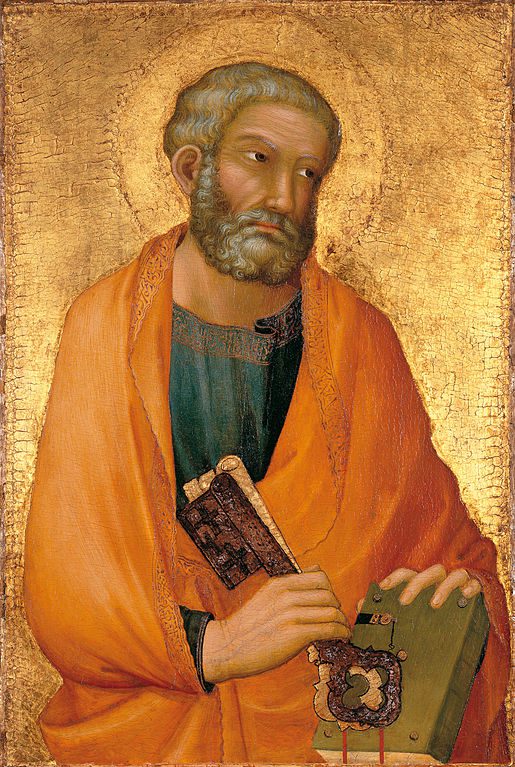
Matthew 16:16-19 Simon Peter replied, “You are the Christ, the Son of the living God.” [17] And Jesus answered him, “Blessed are you, Simon Bar-Jona! For flesh and blood has not revealed this to you, but my Father who is in heaven. [18] And I tell you, you are Peter, and on this rock I will build my church, and the powers of death shall not prevail against it. [19] I will give you the keys of the kingdom of heaven, and whatever you bind on earth shall be bound in heaven, and whatever you loose on earth shall be loosed in heaven.”
Peter is presented as the leader of the disciples and of the early Church in the Bible. He is the key figure in the first council of the Church in Jerusalem (Acts 15), where a decree was made, guided by the Holy Spirit (Acts 15:28), which was then decreed far and wide by no less than the Apostle Paul (Acts 16:4). After Peter, we know of a succession of the bishops of Rome, which is well-attested in early Church fathers. Thus, if Jesus began His Church with Peter as leader, then it follows straightforwardly that if there is an unbroken succession of popes from Peter till now, that the Catholic Church was founded by Jesus. Protestants, of course, have various ways to try to evade this conclusion, but none of them are successful or even plausible as an alternative.
0:40 you’re presuming that Jesus created the Catholic Church not just the Catholic Church, but the Roman Catholic Church
Yes we are, for the biblical and historical reasons summarized above. There is an entity called “My Church” by our Lord Jesus Himself. It means something. It’s not mere some dreamy, ethereal, invisible, abstract thing, but institutional and historical and geographical: in space and time. Peter was the first leader. He went to Rome and became the bishop there, and Paul went to Rome, too. Both were martyred. Rome became the center of the Church — starting with those events (the two leading apostles ending up and being martyred there) — by God’s design, since it was the center of the political and cultural world at that time. It was to be “baptized” and made the Christian center of operations rather than the pagan one.
Protestants play games by always calling us “Roman Catholic”. This started with the Anglicans, as I understand it, so they could remove the pope and still act as if they were “Catholic”. Protestants try to make it provincial (centered at Rome, as if it is merely local), whereas it is in fact universal (the Church of the entire world led by the Roman See and bishop). The leader had to be somewhere, and in God’s providence that place was Rome.
0:46 obviously if I accepted that Jesus Christ founded the Roman Catholic Church specifically, then I would be a Roman Catholic.
Yes, that’s the point. So since Jordan doesn’t want to be a Catholic, he has to come up with a way to contend that Jesus didn’t found the Catholic Church, and argue that someone else did. Usually the theories are that it was Constantine (4th century) , or Pope St. Leo the Great (5th century) or Pope St. Gregory the Great (6th century). Some actually trace the present Catholic Church to the Council of Trent (16th century), claiming that it “anathematized the Gospel” and placed Catholicism outside of Christianity altogether.
The less ecumenical Orthodox claim that Catholicism ceased being the one true Church — or the western part of it — in the 11th century, when they decided to split off and go their own way. They discarded ecumenical councils, which they had previously agreed with, and all Protestants followed. Anglicans cast off the pope, which they had previously accepted also, and all Protestants followed that lead, too. Catholicism continues with both the papacy and ecumenical councils, just as it had always been in the first 1000 years of the Christian Catholic Church (another two arguments for our unbroken historical continuity). We’ll see what tack Jordan tries. I am answering as I read (my usual custom) so I don’t yet know what he’s gonna argue.
1:02 to argue that Jesus is the founder of the Roman Catholic Church is to argue that Jesus appointed Peter as the first pope
At the very least he was clearly intended to be the leader of the new Church, of which he was even said to be the foundation (“Rock”). Whether one wants to call that a pope or not is up to them. But if it walks like a duck, smells like a duck . . . Protestant T. W. Manson, in his book, The sayings of Jesus: as recorded in the Gospels according to St. Matthew and St. Luke (London: SCM Press, 1949) stated that Peter was by Jesus’ words intended to be “God’s vicegerent . . . The authority of Peter is an authority to declare what is right and wrong for the Christian community. His decisions will be confirmed by God” (1954 ed., p. 205). That sounds pretty “papal,” doesn’t it? Yet it’s a commentary from a Protestant on the New Testament text (words of Jesus). Here are what other Protestants say, along similar lines:
The great scholar F. F. Bruce stated that “in the new community which Jesus was about to build, Peter would be, so to speak, chief steward” (The Hard Sayings of Jesus [Downers Grove, Illinois: Intervarsity, 1983], 143-144).
Craig S. Keener wrote: “The image of keys (plural) perhaps suggests not so much the porter, who controls admission to the house, as the steward, who regulates its administration / probably refers primarily to a legislative authority in the church” (The IVP Bible Background Commentary New Testament [Downer’s Grove, Illinois: Intervarsity Press, 1993], 256, 90).
R. T. France, widely considered to be one of the best NT exegetes, stated: “Not only is Peter to have a leading role, but this role involves a daunting degree of authority . . . The image of ‘keys’ (plural) perhaps suggests . . . the steward, who regulates its [the house’s] administration . . . an authority derived from a ‘delegation’ of God’s sovereignty” (Vol. 1: Matthew, in Leon Morris, General Editor., Tyndale New Testament Commentaries, Leicester, England: Inter-Varsity Press/Grand Rapids, Michigan: Eerdmans Pub. Co., 1985, 256).
Lutheran Oscar Cullman described Peter as the “administrator of the house” (Peter: Disciple, Apostle, Martyr, translated by Floyd V. Filson, [Philadelphia: Westminster, 1953], 203).
1:09 and that Peter was given instructions to then lay hands on another individual after him who would also be the next pope and Vicar of Christ
*
That would follow. seeing that we have the model of Judas being formally replaced by Matthias (Acts 1:20-26). If one of the disciples who wasn’t the leader, was replaced in such a way (highly suggesting apostolic succession), then it stands to reason that the leader of the disciples and the early Church (appointed by Jesus Himself as such) would have a successor as well. I wrote in a paper on the topic in 2018:
Why would there be a leader of the Church only for the lifetime of Peter? No one ever thinks like that about other offices of leadership. If a country is a monarchy, it has a succession of kings. We have a succession of Presidents in America. No one would think in 1789 that we should have George Washington to be our one and only President and then we would no longer need a President at all. Sports teams have successions of coaches. Corporations have a succession of CEOs, cities have mayors, schools have principals, etc. The offices or positions don’t simply end.
Yet when it comes to the papacy, people think like that. It’s absurd from common sense and analogy alone, but we also have biblical data that expressly contradicts it. Protestants even acknowledge other biblical Church offices of leadership that continue (pastors and deacons, and in some cases, bishops), yet they balk at accepting even a theoretical notion of a papal succession.
St. Paul teaches the notion of succession, when addressing Timothy:
*
2 Timothy 2:1-2 You then, my son, be strong in the grace that is in Christ Jesus, [2] and what you have heard from me before many witnesses entrust to faithful men who will be able to teach others also.
Moreover, we have early testimony as to the Roman succession of bishops / popes:
St. Irenaeus (130-202) wrote:
The blessed apostles, then, having founded and built up the Church, committed into the hands of Linus the office of the episcopate. Of this Linus [start of reign: 64-68], Paul makes mention in the Epistles to Timothy [2 Tim 4:21]. To him succeeded Anacletus [r. c. 79 – c. 92]; and after him, in the third place from the apostles, Clement [r. 88-99] was allotted the bishopric. . . . To this Clement there succeeded Evaristus [r. c. 99 – c. 107]. Alexander [r. c. 107 – c. 115] followed Evaristus; then, sixth from the apostles, Sixtus [r. c. 115 – c. 124] was appointed; after him, Telephorus [or, Telesphorus; c. 126 – c. 137], who was gloriously martyred; then Hyginus [r. c. 136 – c. 142]; after him, Pius [r. c. 140 – c. 154]; then after him, Anicetus [r. c. 157- c. 168]. Soter having succeeded Anicetus, Eleutherius [r. c. 174-189] does now, in the twelfth place from the apostles, hold the inheritance of the episcopate. In this order, and by this succession, the ecclesiastical tradition from the apostles, and the preaching of the truth, have come down to us. And this is most abundant proof that there is one and the same vivifying faith, which has been preserved in the Church from the apostles until now, and handed down in truth. (Against Heresies, Bk III, 3, 3; my own links in the text; cited in Eusebius, Ecclesiastical History, Bk V, 6, 1-5)
The Muratorian Canon [c. 180-200], the oldest list of New Testament writings, stated, “The Pastor, moreover, did Hermas write very recently in our times in the city of Rome, while his brother bishop Pius sat in the chair of the Church of Rome.” Pius reigned as pope and bishop of Rome from c. 140 to c. 154.
*
Tertullian, around 200, referred to “the church of Rome, which makes Clement to have been ordained in like manner by Peter” (Prescription against Heretics, 32). The first Church historian, Eusebius, wrote around 300: “Clement also, who was appointed third bishop of the church at Rome, was, as Paul testifies, his co-laborer [Phil 4:3] . . . (EH, Bk III, 4, 10) and: “In the twelfth year of the same reign [92/93] Clement succeeded Anencletus after the latter had been bishop of the church of Rome for twelve years.” (EH, Bk III, 15, 1; cf. Bk III, 21, 1-3 and 34, 1). The second pope Linus may have been mentioned in 2 Timothy 4:21 by Paul. St. Irenaeus was of that opinion. Clement was mentioned by Paul in Philippians 4:3 as one of his “fellow workers.”
*
For a more general treatment, see: Monarchical Bishops (Early Fathers & Eusebius) [1-29-24]. The above data represents some serious patristic corroboration (some have a different order for the earliest popes). But Jordan wants to deny this succession and make out that it’s just “Catholic triumphalistic polemics” or some such? Let’s see his argument against it, then.
*
1:35 that’s the question: did Jesus found the Roman Catholic Church? . . . that’s the whole point of why we’re not Roman Catholic, because we don’t think he did.
*
On what basis? If He didn’t, who did, and why is that believed? When did the “Roman Catholic Church” begin? It’s here now; it obviously had to have an origin in some point of time. If in fact Lutheranism merely reformed the one true Church during its time, which is the claim made, then obviously that Church had to have a history and an origin; and Lutherans claim they are following the Church fathers, so that takes it back to the first five centuries or so. There had to have been some “Church” in existence. What was it, and when did it begin? It’s not good enough to just blast the other guy’s opinion. One has to come up with a credible, plausible alternative. I have provided the Catholic arguments in brief.
*
2:13 I think that as Christians we all can look at the early church and say this is our heritage, which is why we can have a kind of unity over certain things like confessing the early Creeds of the church, and we we can find common ground in the early church fathers that we all claim
and we do all branch out of that church, which was the early church so all of us have our roots there.
*
Exactly! So Jordan now needs to tell us what this early Church is, and how and where it began. He refers to it, so I assume he must have some conception in his mind of its nature and origin. The Church fathers were real people; likewise, the Church that they constantly referred to was a real thing with an origin in actual history.
*
2:40 I don’t make claims that the early church was the Lutheran Church. I don’t make claims that the early church was that Roman
Catholic or Eastern Orthodox or Anglican Church. The early church was the early church. Those other traditions have all come out of that early church.
*
When and how did this early Church begin? If it began at some point it had to continue on through history, since it can’t die (being guarded by the Holy Spirit; what is called indefectibility). It seems utterly clear that it did with Jesus’ commission of Peter. So whether we can rightly call it “Catholic” depends on the issue of succession. I’ve already provided biblical and patristic proofs of that. Jordan needs to deal with them. The salient question is: what Church today has the most plausible claim to be identified with this “early Church” that goes all the way back to Christ? Which one continues the beliefs that were held in those early days? For example, there were popes and councils in the fifth century (I picked a date where this can’t possibly be denied, given Pope Leo the Great and the Council of Chalcedon).
*
Who continues those two entities and who gave them up? There is but one Church and one faith according to Scripture (Eph 4:5), and Christians are to be one as the Father and the Son are one (which includes perfect agreement in doctrine: see John 17). And how can one argue that the folks who gave up the status quo in the early Church somehow continue that early Church? I don’t expect that any of these questions will actually be answered, but they need to be.
*
We know from the record what this “early Church” taught on a number of issues. For example, the earliest fathers were universally against contraception and divorce (because the Bible is). Who continues those two moral traditions? That’s right. Apart from a few dinky Protestant denominations here and there, it’s the Catholic Church. Even the Orthodox have caved on both of them. The Anglican “Church” actually began as a result of King Henry VIII wanting to get an annulment from the pope; failing that, a divorce, and splitting from the papacy and Catholicism (not just “Roman” Catholicism) in order to get the divorce and fulfill his lustful desires with the woman he beheaded shortly thereafter (how profoundly spiritual and holy).
*
This is our argument. Anglicanism clearly isn’t continuing the ancient Church because it ditched the papacy and the prohibition of divorce and began under morally absurd and outrageous circumstances. Orthodoxy ditched ecumenical councils, no divorce, and the papacy. Protestantism ditched a host of things. The one true Church is that which continues the biblical teaching, the apostolic deposit, and the patristic legacy of theological consensus. Only one Church fits all those “bills”. And I am defending it; and these are some of the major reasons why I became a Catholic in 1990 (formerly Arminian evangelical).
*
7:56 but that doesn’t mean that we’re not consistent with the church before
*
In several important ways, yes; in many other ways, no. It’s different enough so that it can’t credibly make the claim that it was merely reforming what was before and not changing several essential elements of what existed. Take the two “pillars” for example. Sola fide involves a completely novel re-definition of justification that hadn’t been held in the entire history of the Church. Even Luther didn’t introduce it. It was his successor, Philip Melanchthon. The Protestant scholars who specialize in the history of the question confirm this. Alister McGrath wrote the history of the doctrine of justification that is universally considered the last word on the subject, and he agrees with what I’m saying (even though he apparently accepts sola fide himself). He’s honest about the undeniable facts of history. That’s not an unimportant or secondary change only. It is a change in the very fabric of soteriology: what we must do to be saved.
*
It’s the same state of affairs regarding sola Scriptura. It’s a completely new approach to the rule of faith: a denial of the infallibility of ecumenical councils and of the Church and apostolic tradition, which had never been believed before. That fundamentally changes the nature of Christian authority and epistemology in a way that is profoundly contradictory to what was. One must ask at that point: do you guys really believe that it took Christians 1500 years to figure out these basic, elementary things: what is infallible and how one is saved? It’s not a plausible or biblical or coherent view. In fact, it’s ahistorical. It denies the tradition that Chesterton delightfully described as “the democracy of the dead.”
*
All of the great Christians for 1500 years got soteriology wrong, and Luther’s successor Philip Melanchthon figured it out? Melanchthon: the wavering straw in the wind that he was? This is a man who called for the execution of those who denied the Real Presence in the Eucharist, and then later adopted the same view himself. He had, more and more as he got older, the typical theologically liberal mentality. But he figured out justification in a way no one ever had before?
*
8:09 it’s one of those . . . saying[s] that people throw out there to avoid an actual discussion about church history or the issues that really matter, to just say “well my church was founded by Jesus himself and yours wasn’t.”
*
I agree that it’s a serious discussion, which is why I have spent several hours on it today. It needs to be discussed in depth and at length, rather than avoided or dealt with only superficially, by citing the worst thinking of the other side rather than the best. Jordan has only barely scratched the surface and in my opinion — with all due respect — hasn’t really proven his position at all. I invite him to discuss the issue with me and to grapple with the hard questions for his side, just as I have grappled with his, and to interact with our arguments for why we believe as we do. If his position is the superior one, he should have nothing to fear, and should welcome the opportunity. Jordan agrees with me in a general sense about the need to talk more in-depth. In discussing how Catholics inflate without adequate proof the number of Protestant denominations to 33,000 he wrote:
*
9:38 there are a lot of kind of popular level Roman Catholic apologetic arguments like this that I think really just work on a surface level, but I prefer to really look at it more in depth issue-by-issue, instead of just making sweeping claims.
*
Amen! That’s what I’m calling for, too (music to my ears!). As I incidentally mentioned in my last reply to Jordan, concerning this:
I objected to this number [33,000] and explained exactly why, almost twenty years ago: 33,000 Protestant Denominations? No! [9-4-04].
If Jordan wants to engage in serious Lutheran-Catholic discussion, without the nonsense and misrepresentations and ignorance (or even anti-Protestant prejudice), I’m one of those, I think, who can help him achieve that goal, as a published Catholic apologist with over 33 years’ experience. I hope we can actually engage in friendly, mutually respectful back-and-forth interaction.
*
***
*
Practical Matters: Perhaps some of my 4,500+ free online articles (the most comprehensive “one-stop” Catholic apologetics site) or fifty-five books have helped you (by God’s grace) to decide to become Catholic or to return to the Church, or better understand some doctrines and why we believe them.
Or you may believe my work is worthy to support for the purpose of apologetics and evangelism in general. If so, please seriously consider a much-needed financial contribution. I’m always in need of more funds: especially monthly support. “The laborer is worthy of his wages” (1 Tim 5:18, NKJV). 1 December 2021 was my 20th anniversary as a full-time Catholic apologist, and February 2022 marked the 25th anniversary of my blog.
PayPal donations are the easiest: just send to my email address: [email protected]. Here’s also a second page to get to PayPal. You’ll see the term “Catholic Used Book Service”, which is my old side-business. To learn about the different methods of contributing (including Zelle), see my page: About Catholic Apologist Dave Armstrong / Donation Information. Thanks a million from the bottom of my heart!
*
***
Photo credit: St. Peter (1326), by Simone Martini (1285-1344) [public domain / Wikimedia Commons]

Summary: Lutheran apologist Jordan Cooper makes rather basic objections to the notion of the Catholic Church being founded by Christ. I go in-depth from the Bible & history.
Jesus Founded the Catholic Church
Previous Post

March 5, 2024
Unbiblical, Illogical Sola Scriptura: Reply to Jordan Cooper
Next Post
March 7, 2024 Church Fathers & Sola Fide (vs. Jordan Cooper)
Recent Comments
"And lastly, I belong to no denomination and am free to serve God as He ..."
Is Venerating Men & Angels Worship? ..."
"And obeisance doesn't mean "worship". It means "respect", "obey", or "submission". Very weird that you ..."
Is Venerating Men & Angels Worship? ..."
"Many of these scriptures you have noted have been taken out of context. With Daniel, ..."
Is Venerating Men & Angels Worship? ..."
""Protestants often point out that Jesus is now triumphant in heaven and object to Catholics ..."
Three More Anti-Catholic Lies About Catholicism ..."
Browse Our Archives
Select a Category & Last Things About Me Anti-Catholicism Atheism & Agnosticism Baptism and Sacramentalism Bible and Tradition Blessed Virgin Mary Books by Dave Armstrong C. S. Lewis Calvinism & General Protestantism Catholic Apologetics Catholic Apologists Catholic conversion Catholic converts Christmas Church (Ecclesiology) Church History Conversion and Converts Development of Doctrine Eastern Orthodoxy Ecumenism & Christian Unity Eucharist & Liturgy Fathers of the Church French Translations G. K. Chesterton Hell Hell & Satan Hell & Satan & Last Things Heresies & Comparative Religion Holistic Health Inquisition & Crusades & Scandals James White Jews & Judaism & Old Testament John Calvin John Henry Newman Liberal / Modernist Theology Life Issues Literary Resume Lutheranism Mariology Martin Luther Music Orthodoxy Papacy & Infallibility Personal Page Philosophy & Science Political & Ethical & Moral Issues Protestant Persecution & Intolerance Protestantism Purgatory Purgatory & Penance Romantic & Imaginative Theology Saints & Purgatory & Penance Salvation Salvation & Justification Satan & Last Things Sexuality and Gender Issues Spanish Translations Traditionalism vs. Radical Catholic Reactionaries Traducciones al español / tradução para português Trinitarianism & Christology Uncategorized Videos
Select a Month October 2026 September 2026 August 2026 July 2026 June 2026 May 2026 April 2026 March 2026 February 2026 January 2026 December 2025 November 2025 October 2025 September 2025 August 2025 July 2025 June 2025 May 2025 April 2025 March 2025 February 2025 January 2025 December 2024 November 2024 October 2024 September 2024 August 2024 July 2024 June 2024 May 2024 April 2024 March 2024 February 2024 January 2024 December 2023 November 2023 October 2023 September 2023 August 2023 July 2023 June 2023 May 2023 April 2023 March 2023 February 2023 January 2023 December 2022 November 2022 October 2022 September 2022 August 2022 July 2022 June 2022 May 2022 April 2022 March 2022 February 2022 January 2022 December 2021 November 2021 October 2021 September 2021 August 2021 July 2021 June 2021 May 2021 April 2021 March 2021 February 2021 January 2021 December 2020 November 2020 October 2020 September 2020 August 2020 July 2020 June 2020 May 2020 April 2020 March 2020 February 2020 January 2020 December 2019 November 2019 October 2019 September 2019 August 2019 July 2019 June 2019 May 2019 April 2019 March 2019 February 2019 January 2019 December 2018 November 2018 October 2018 September 2018 August 2018 July 2018 June 2018 May 2018 April 2018 March 2018 February 2018 January 2018 December 2017 November 2017 October 2017 September 2017 August 2017 July 2017 June 2017 May 2017 April 2017 March 2017 February 2017 January 2017 December 2016 November 2016 October 2016 September 2016 August 2016 July 2016 June 2016 May 2016 April 2016 March 2016 February 2016 January 2016 December 2015 November 2015 October 2015 September 2015 August 2015 July 2015 June 2015 May 2015 April 2015 March 2015 February 2015 January 2015 December 2014 November 2014 October 2014 September 2014 August 2014 July 2014 June 2014 April 2014 March 2014 February 2014 January 2014 December 2013 November 2013 October 2013 September 2013 August 2013 July 2013 June 2013 April 2013 March 2013 February 2013 January 2013 December 2012 November 2012 October 2012 September 2012 August 2012 July 2012 June 2012 May 2012 April 2012 March 2012 February 2012 January 2012 December 2011 November 2011 October 2011 September 2011 August 2011 July 2011 June 2011 April 2011 March 2011 February 2011 October 2010 September 2010 August 2010 July 2010 April 2010 March 2010 December 2009 October 2009 August 2009 July 2009 June 2009 May 2009 March 2009 February 2009 October 2008 September 2008 April 2008 March 2008 February 2008 January 2008 December 2007 November 2007 October 2007 May 2007 March 2007 February 2007 January 2007 November 2006 October 2006 September 2006 August 2006 July 2006 June 2006 May 2006 April 2006 March 2006 February 2006 October 2005 June 2005 April 2005 February 2005 July 2004 May 2004 April 2004
Follow Us!
TAKE THE
Religious Wisdom Quiz
What was Paul’s profession before becoming an apostle?
Select your answer to see how you score.
Tentmaker Tax Collector Fisherman Carpenter
Books by This Author Books by Dave Armstrong
Related posts from Biblical Evidence for Catholicism

Does Catholic Intercession of Saints Require Omniscience?
Biblical Evidence for Catholicism

Was Peter "Any Old" Apostle? 10 Anti-Papal Arguments
Biblical Evidence for Catholicism

Protestant Confessions & "Ever-Virgin" Mary
Biblical Evidence for Catholicism

Jesus Founded the [Catholic] Church. If Not Him,...
Biblical Evidence for Catholicism
TRENDING AT PATHEOS Catholic

I was strolling through the top floor of the brand new Parthenon...

What Does Gêvâh Mean For Kimberley Guifoyle &...
This week, a lot of the news is focused on Kimberly Guilfoyle....

INNER CIRCLE: Profound Mystery (Of Christ In All...
Ephesians 5:31-32 “For this reason, a man will leave his father and...

Do Not Rejoice When Your Enemy Falls: The...
Turning an execution into a public spectacle is a disturbing expression of...

'The Chosen' S6 Trailer: The Passion Gets Very...
Not many watching 'The Chosen' worry about spoilers, but just because they...

The purpose-driven labor priest
A labor activist reads Rick Warren and it gets me wondering about...
view all Catholic blogs
What Are Your Thoughts?leave a comment
Ad-Free & Subscriber Log-In Subscription Support
- About Us
- 2026 Calendar
- Videos
- Podcasts
- Library of World Religions
- Faith In Media Tracker
- Advertise With Us
- Write for Us
- Privacy Policy
- Terms of Service
- Do Not Sell My Data
- Contact Us
- Radiant Digital
- Manage Newsletter Subscriptions
- Unsubscribe From Notifications
- Sitemap
Copyright 2008-2026, Patheos. All rights reserved.
Subscription Support Ad-Free & Subscriber Log-In
Follow Patheos