
BuddhistCatholicContemplativeEvangelicalGeneral ChristianHinduJewishLatter-day SaintMuslimNew VisionsProgressive Christian
Beliefs
- Buddhist
- Catholic
- Contemplative
- Evangelical
- General Christian
- Hindu
- Jewish
- Latter-day Saint
- More Voices
- Muslim
- New Visions
- Pagan
- Progressive Christian
Topics
- Religion News
- Food and Religion
- Sports and Religion
- Religious Art
- Religious Music and Entertainment
- Religious Events
- History and Religion
- Style and Religion
- Politics and Religion
- Women in Religion
- Recreation Outdoors and Religion
- Business Finance and Religion
- Careers Workplace and Religion
- Education and Religion
- Family Parenting and Religion
- Health Fitness and Religion
- Home and Religion
- Relationships and Religion
- Technology and Religion
- Travel and Religion
Columnists
- Buddhist Columnists
- Business Finance and Religion Columnists
- Careers Workplace and Religion Columnists
- Catholic Columnists
- Contemplative Columnists
- Education and Religion Columnists
- Evangelists Columnists
- Family Parenting and Religion Columnists
- General Christian Columnists
- Health Fitness and Religion Columnists
- Hindu Columnists
- History and Religion Columnists
- Home and Religion Columnists
- Jewish Columnists
- More Voices Columnists
- Latter Day Columnists
- Muslim Columnists
- New Visions Columnists
- Nonreligious Columnists
- Pagan Columnists
- Politics and Religion Columnists
- Progressive Columnists
- Recreation Outdoors and Religion Columnists
- Relationships and Religion Columnists
- Religion News Columnists
- Religious Art Columnists
- Religious Events Columnists
- Religious Music and Entertainment Columnists
- Sports and Religion Columnists
- Style and Religion Columnists
- Technology and Religion Columnists
- Travel and Religion Columnists
- Women in Religion Columnists
Resource Library
- 2026 Calendar
- Library of World Religions
- The 100 Most Holy Places on Earth
- Patheos Answers
- Podcasts
- Videos
- Faith Leaders Database
- Anglican Episcopalian
- Bahai
- Baptist
- Buddhism
- Christianity
- Confucianism
- Eastern Orthodoxy
- Hinduism
- Holiness and Pentecostal
- ISKCON
- Islam
- Judaism
- Lutheran
- Methodist
- The Church of Jesus Christ of Latter-day Saints
- New Age
- Paganism
- Presbytarian and Reformed
- Protestantism
- Religion Behind the Scenes
- Roman Catholic
- Scientology
- Shia Islam
- Sikhism
- Sufism
- Sunni Islam
- Taoism
- Zen
- See all religions
Research Tools
 Ad-Free & Subscriber Log-In Subscription Support
Ad-Free & Subscriber Log-In Subscription Support
Follow Patheos 

- Trending:
- Forgiveness
- |
- Marriage
- |
- Consciousness
- |
- Death Penalty
- |
- Election
- |
- Halloween

-
About
-
Catholic Apologetics
-
Church History
-
Great Apologists
-
Christian Worldview
-
Protestantism & Misc.
- Home
- Catholic
- History and Religion
- Mary, Mother of the Church (by Dr. Robert Fastiggi)
Mary, Mother of the Church (by Dr. Robert Fastiggi)
Last updated on: June 6, 2026 at 12:03 am by Dave Armstrong
Mary, Mother of the Church (by Dr. Robert Fastiggi) 2026-06-06T00:03:55-04:00 Dave Armstrong
Patheos Explore the world's faith through different perspectives on religion and spirituality! Patheos has the views of the prevalent religions and spiritualities of the world.
This is a guest post from Catholic theologian, Dr. Robert Fastiggi. He holds the Bishop Kevin M. Britt Chair of Christology, Professor of Dogmatic Theology at Sacred Heart Major Seminary in Detroit, Michigan. Dr. Fastiggi received an M.A. in Theology from Fordham University in 1976; and a Ph.D. in Historical Theology from Fordham in 1987. At Sacred Heart, he has taught courses on Ecclesiology, Christian Anthropology, Christology, Mariology, Moral Theology, and the Sacramental Life of the Church. He is a member of the Society for Catholic Liturgy and has been president of the Mariological Society of America.
Dr. Fastiggi has served as the executive editor of the 2009-2013 supplements to the New Catholic Encyclopedia and as co-editor and translator of the English translation of the 43rd edition of the Denzinger-Hünermann Enchiridion Symbolorum (Ignatius Press: 2012): the standard compendium of Catholic doctrines and dogmas. He has also translated and updated the German revised edition of Ludwig Ott’s well-known reference work, Fundamentals of Catholic Dogma (Baronius Press, 2018). He has written many articles for Catholic websites / magazines such as Where Peter Is, The Catholic World Report, and my own blog.
*****
“Please Hit ‘Subscribe’”! If you have received benefit from this or any of my other 4,500+ articles, please follow this blog by signing up (w your email address) on the sidebar to the right, above where there is an icon bar, “Sign Me Up!”: to receive notice when I post a new blog article. This is the equivalent of subscribing to a YouTube channel. Please also consider following me on Twitter / X and purchasing one or more of my 55 books. All of this helps me get more exposure, and a bit more income for my full-time apologetics work. Thanks so much and happy reading!
*****
[Full title: “Mary Mother of the Church highlights Mary’s Spiritual Motherhood”]
Introduction
In a Decree dated Feb. 11, 2018 (but released March 3), Cardinal Robert Sarah, Prefect of the Congregation for Divine Worship and the Discipline of the Sacraments, announced that “Pope Francis has decreed that the Memorial of the Blessed Virgin Mary, Mother of the Church, should be inscribed in the Roman calendar on the Monday after Pentecost and be celebrated every year.” This means that in the Latin Rite, the celebration of the Blessed Virgin Mary, Mother of the Church—as an obligatory Memorial—will have precedence over any other memorial of a Saint or Blessed on the Monday following Pentecost.
The foundation for the new obligatory memorial
In the Feb. 11, 2018 Decree, Cardinal Sarah points to St. Paul VI’s Nov. 21, 1964 Address at the conclusion of the Third Session of the Second Vatican Council as the clear foundation for the memorial of Mary, Mother of the Church. During this address, Paul VI declared the Blessed Virgin Mary to be “Mother of the Church that is to say of all Christian people, the faithful as well as the pastors, who call her the most loving Mother.” He also established that “the Mother of God should be further honored and invoked by the entire Christian people by this most tender of titles”. Because of Paul VI’s 1964 proclamation, a votive Mass in honor of “Blessed Mary Mother of the Church” (Beata Maria Ecclesiæ Matre) was proposed during the 1975 “Holy Year of Reconciliation” and later inserted into the Roman Missal. In 1980, the title of Mary as “Mother of the Church” was added to the Litany of Loreto with papal approval. In the 1986 “Collection of Masses of the Blessed Virgin Mary” three formularies for the celebration of “the Blessed Virgin Mary, Image and Mother of the Church” were included. Some countries, dioceses, and religious families have already been celebrating the memorial of Mary, Mother of the Church, with approval from the Holy See.
Scriptural and theological foundations
The recognition of Mary as “Mother of the Church” has deep biblical roots. As the New Eve and “mother of the living’ (Gen 3:20), Mary takes on a maternal role toward all humanity, especially the faithful. As Mother of the Incarnate Word, Mary is the Mother of all the faithful who are joined to the Mystical Body of Christ, which is the Church (cf. Rom 12:5; 1 Cor 10:16–17; 12:12–31; Eph 1:22–23, 5:23 –30; and Col 1:18–24). In his Nov. 21, 1964 address, Blessed Paul VI notes that, as soon as Christ took on a human nature in Mary’s virginal womb, He united to himself, as its head, his Mystical Body, which is the Church.” Therefore, “Mary, as the Mother of Christ, must be regarded as the Mother of all the faithful and pastors, which means the Church.”
In his Feb. 11, 2018 Decree, Cardinal Sarah points to John 19:25–27 for understanding Mary as Mother of the Church:
… the Mother standing beneath the cross (cf. Jn 19:25), accepted her Son’s testament of love and welcomed all people in the person of the beloved disciple as sons and daughters to be reborn unto life eternal. She thus became the tender Mother of the Church which Christ begot on the cross handing on the Spirit.
St. John Paul II likewise sees John 19:25–27 as instrumental for understanding Mary as Mother of the Church. In his General Audience of Sept. 17, 1997, he observes: “On Calvary, Mary united herself to the sacrifice of her Son and made her own maternal contribution to the work of salvation, which took the form of labor pains, the birth of the new humanity.” He goes on to say that “in addressing the words ‘Woman, behold your son’ to Mary, the Crucified One proclaims her motherhood not only in relation to the Apostle John but also to every disciple.”
The Assumption of the Blessed Virgin Mary into heaven also manifests Mary as the spiritual Mother of the Church. After being assumed into heaven, Mary, “by her constant intercession” continues to bring us the gifts of eternal salvation, and “by her maternal charity,” she cares for us “who still journey on earth surrounded by dangers and difficulties” until we are led into the happiness of our “true home” (Lumen Gentium, 62).
Mary, therefore, is Mother of the Church because she is the Mother of Christ, who is the head of the Mystical Body, the Church. Given to us as our Mother by the dying Lord on the Cross, Mary continues to intercede for us with maternal love from heaven. In a special way Mary’s spiritual motherhood is linked to Pentecost because, as the mystical Spouse of the Holy Spirit, Mary joins with the Church in prayer, and she is “the perfect image of what it means to be a disciple of Christ,” the “mirror of all the virtues,” and “the definitive model for the perfect imitation of Christ” (Paul VI, Nov. 21, 1964). As the Mother of the faithful, Mary is the exalted “type” or exemplar of the Church because “in the most holy Virgin the Church has already reached that perfection whereby she is without spot or wrinkle” (Lumen Gentium, 65).
Historical witness to the title, “Mother of the Church”
The title “Mother of the Church” has roots in Fathers of the Church. St. Augustine (354–430) sees Mary as “the mother of the members of Christ . . . having cooperated by charity so the faithful might be born in the Church, who are members of that Head” (De sancta Virginitate, 6; cited in LG, 53). St. Leo the Great (c. 400–461) states that “Christ’s generation is the origin of the Christian people; and Christ’s birth as head is also the birth of his Mystical Body” (Sermon 6 on the Nativity of the Lord). In the Middle Ages, St. Anselm (1033–1109) speaks of Mary as “the Mother of justification and the justified; the Mother of reconciliation and the reconciled; the Mother of salvation and of the saved (Or 52, 8). Pope Benedict XIV, in his Sept. 27, 1748 bull, Gloriosae Dominae, states that Mary on Calvary is “in the proper sense Mother of the Church, a gift the Church received from lips of her dying Bridegroom” (Bullararium 2, 428). Pope Leo XIII, in his Sept. 5, 1895 encyclical, Adiutricem, extols Mary as “the Mother of the Church, the Teacher and Queen of the Apostles” (no. 6).
After Leo XIII, popes refer to Mary as Mother of the Church explicitly or in equivalent terms. In his address of Dec. 4, 1963, at the close of the Second Session of Vatican II, Paul VI expressed his hope that Mary would be honored with the title, “Mother of the Church” in the Constitution of the Church (cf. no. 21 in the address). An earlier title of what would be chapter VIII of Lumen Gentium was: “On the Blessed Virgin Mary, Mother of the Church.” This title, though, was changed to its present one, “On the Blessed Virgin Mary, Mother of God, in the Mystery of Christ and the Church.” About 200 bishops asked that the earlier title be restored, but the Theological Commission responded by noting that the revised title better corresponded to the contents of the chapter. Moreover, Mary, as Mother of the Church, is expressed in equivalent terms in LG, 53, which states that “The Catholic Church, taught by the Holy Spirit, honors [Mary] with filial affection and piety as a most beloved mother.” Some Council fathers also had ecumenical concerns that referring to Mary as “Mother of the Church” might imply that the Church owes its existence to her and not to Christ. A good number of bishops—most notably Cardinal Wyszynski and the bishops of Poland—appealed to Pope Paul VI to proclaim Mary as Mother of the Church on his own authority. The Holy Father responded to this request favorably, and he solemnly proclaimed Mary as “Mother of the Church” in his address of Nov. 21, 1964.
The hoped-for fruits of the Memorial of Mary, Mother of the Church
In his Commentary on the Feb. 11, 2018 Decree, Cardinal Sarah states that Pope Francis believes this new obligatory memorial will highlight “the mystery of Mary’s spiritual motherhood, which from the awaiting of the Spirit at Pentecost has never ceased to take motherly care of the pilgrim Church on earth.” The Holy Father also hopes that the memorial will help us root our spiritual lives “firmly on three great realities: the Cross, the Eucharist, and the Mother of God.” Celebrating Mary as Mother of the Church on the Monday after Pentecost will help us all realize how important Mary, the mystical spouse of the Holy Spirit, is to our lives as Christian. She is truly “our Mother in the order of grace” (Lumen Gentium, 61), She is united to Christ, the Head of the Church “by a close and indissoluble bond” (Lumen Gentium, 53), and she is united to us as our spiritual Mother, the Mother of the Church.
*
***
*
Practical Matters: Perhaps some of my 4,500+ free online articles (the most comprehensive “one-stop” Catholic apologetics site) or fifty-five books have helped you (by God’s grace) to decide to become Catholic or to return to the Church, or better understand some doctrines and why we believe them.
Or you may believe my work is worthy to support for the purpose of apologetics and evangelism in general. If so, please seriously consider a much-needed financial contribution. I’m always in need of more funds: especially monthly support. “The laborer is worthy of his wages” (1 Tim 5:18, NKJV). 1 December 2021 was my 20th anniversary as a full-time Catholic apologist, and February 2022 marked the 25th anniversary of my blog.
PayPal donations are the easiest: just send to my email address: [email protected]. Here’s also a second page to get to PayPal. You’ll see the term “Catholic Used Book Service”, which is my old side-business. To learn about the different methods of contributing (including Zelle), see my page: About Catholic Apologist Dave Armstrong / Donation Information. Thanks a million from the bottom of my heart!
*
***
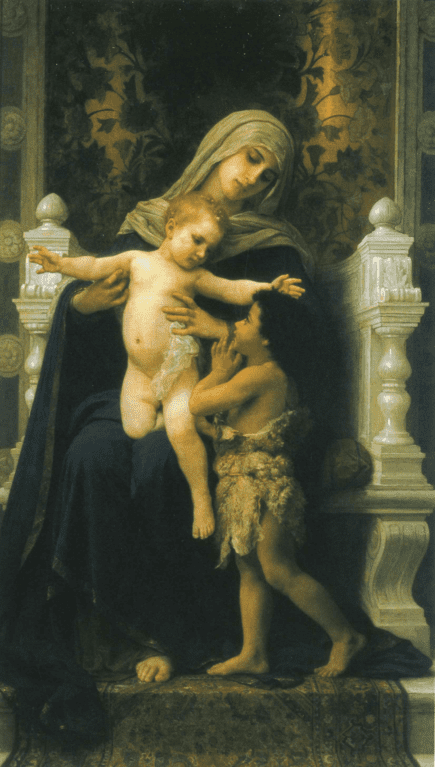
Photo credit: The Virgin, the Child Jesus, and St John the Baptist (1881), by William-Adolphe Bouguereau (1825-1905) [public domain / Wikimedia Commons]

Summary: Catholic theologian Robert Fastiggi summarizes the background of this description of the Blessed Virgin, which was highlighted (not introduced!) at Vatican II.
Previous Post
March 18, 2024
Church Fathers & Images: NO Evidence? (Vs. Gavin Ortlund)
Next Post
March 19, 2024 Early Church Fathers & Invoking Saints (vs. Jordan Cooper)
Recent Comments
"Special pleading, and not a serious response to my arguments . . ."
Is Venerating Men & Angels Worship? ..."
""no man needs to teach us."Didn't you just teach us?"
Is Venerating Men & Angels Worship? ..."
""Catholics say they are the only church that can lead people into heaven."In fact, we ..."
Is Venerating Men & Angels Worship? ..."
"And lastly, I belong to no denomination and am free to serve God as He ..."
Is Venerating Men & Angels Worship? ..."
Browse Our Archives
Select a Category & Last Things About Me Anti-Catholicism Atheism & Agnosticism Baptism and Sacramentalism Bible and Tradition Blessed Virgin Mary Books by Dave Armstrong C. S. Lewis Calvinism & General Protestantism Catholic Apologetics Catholic Apologists Catholic conversion Catholic converts Christmas Church (Ecclesiology) Church History Conversion and Converts Development of Doctrine Eastern Orthodoxy Ecumenism & Christian Unity Eucharist & Liturgy Fathers of the Church French Translations G. K. Chesterton Hell Hell & Satan Hell & Satan & Last Things Heresies & Comparative Religion Holistic Health Inquisition & Crusades & Scandals James White Jews & Judaism & Old Testament John Calvin John Henry Newman Liberal / Modernist Theology Life Issues Literary Resume Lutheranism Mariology Martin Luther Music Orthodoxy Papacy & Infallibility Personal Page Philosophy & Science Political & Ethical & Moral Issues Protestant Persecution & Intolerance Protestantism Purgatory Purgatory & Penance Romantic & Imaginative Theology Saints & Purgatory & Penance Salvation Salvation & Justification Satan & Last Things Sexuality and Gender Issues Spanish Translations Traditionalism vs. Radical Catholic Reactionaries Traducciones al español / tradução para português Trinitarianism & Christology Uncategorized Videos
Select a Month October 2026 September 2026 August 2026 July 2026 June 2026 May 2026 April 2026 March 2026 February 2026 January 2026 December 2025 November 2025 October 2025 September 2025 August 2025 July 2025 June 2025 May 2025 April 2025 March 2025 February 2025 January 2025 December 2024 November 2024 October 2024 September 2024 August 2024 July 2024 June 2024 May 2024 April 2024 March 2024 February 2024 January 2024 December 2023 November 2023 October 2023 September 2023 August 2023 July 2023 June 2023 May 2023 April 2023 March 2023 February 2023 January 2023 December 2022 November 2022 October 2022 September 2022 August 2022 July 2022 June 2022 May 2022 April 2022 March 2022 February 2022 January 2022 December 2021 November 2021 October 2021 September 2021 August 2021 July 2021 June 2021 May 2021 April 2021 March 2021 February 2021 January 2021 December 2020 November 2020 October 2020 September 2020 August 2020 July 2020 June 2020 May 2020 April 2020 March 2020 February 2020 January 2020 December 2019 November 2019 October 2019 September 2019 August 2019 July 2019 June 2019 May 2019 April 2019 March 2019 February 2019 January 2019 December 2018 November 2018 October 2018 September 2018 August 2018 July 2018 June 2018 May 2018 April 2018 March 2018 February 2018 January 2018 December 2017 November 2017 October 2017 September 2017 August 2017 July 2017 June 2017 May 2017 April 2017 March 2017 February 2017 January 2017 December 2016 November 2016 October 2016 September 2016 August 2016 July 2016 June 2016 May 2016 April 2016 March 2016 February 2016 January 2016 December 2015 November 2015 October 2015 September 2015 August 2015 July 2015 June 2015 May 2015 April 2015 March 2015 February 2015 January 2015 December 2014 November 2014 October 2014 September 2014 August 2014 July 2014 June 2014 April 2014 March 2014 February 2014 January 2014 December 2013 November 2013 October 2013 September 2013 August 2013 July 2013 June 2013 April 2013 March 2013 February 2013 January 2013 December 2012 November 2012 October 2012 September 2012 August 2012 July 2012 June 2012 May 2012 April 2012 March 2012 February 2012 January 2012 December 2011 November 2011 October 2011 September 2011 August 2011 July 2011 June 2011 April 2011 March 2011 February 2011 October 2010 September 2010 August 2010 July 2010 April 2010 March 2010 December 2009 October 2009 August 2009 July 2009 June 2009 May 2009 March 2009 February 2009 October 2008 September 2008 April 2008 March 2008 February 2008 January 2008 December 2007 November 2007 October 2007 May 2007 March 2007 February 2007 January 2007 November 2006 October 2006 September 2006 August 2006 July 2006 June 2006 May 2006 April 2006 March 2006 February 2006 October 2005 June 2005 April 2005 February 2005 July 2004 May 2004 April 2004
Follow Us!
TAKE THE
Religious Wisdom Quiz
Who prayed in a den of lions?
Select your answer to see how you score.
Elijah Noah Daniel David
Books by This Author Books by Dave Armstrong
Related posts from Biblical Evidence for Catholicism

Holy Ground: Why Mary Had NO Other Children...
Biblical Evidence for Catholicism
Protestant Confessions & "Ever-Virgin" Mary
Biblical Evidence for Catholicism

Mary Wife of Clopas (Jn 19:25): Mary's Sister-in-Law?
Biblical Evidence for Catholicism

Jesus Had Four Brothers? The Bible Sez No!
Biblical Evidence for Catholicism
TRENDING AT PATHEOS Catholic

Swimfan: Forgotten Aughts Pleasures
This is a recovery effort. In 2002, My Big Fat Greek Wedding...

Top Three Anti-Catholic Lies About Catholicism
This is my initial transcript for the video, "THE 3 WORST...

Pope Leo Celebrates Mass for Nurses & Docs...
I don't have any idea how he did it, but Pope Leo...

The Sermon on the Mount, Part I: Matthew...
The Sermon on the Mount, Part I (Matthew 4:12-5:12) St. Matthew moves...

What's up from Crossway: Reviewing some of their latest A few weeks...

Janie Learns the Way of the Cross: A...
Teaching children about Jesus' Passion can be challenging. Many parents and educators...
view all Catholic blogs
What Are Your Thoughts?leave a comment
Ad-Free & Subscriber Log-In Subscription Support
- About Us
- 2026 Calendar
- Videos
- Podcasts
- Library of World Religions
- Faith In Media Tracker
- Advertise With Us
- Write for Us
- Privacy Policy
- Terms of Service
- Do Not Sell My Data
- Contact Us
- Radiant Digital
- Manage Newsletter Subscriptions
- Unsubscribe From Notifications
- Sitemap
Copyright 2008-2026, Patheos. All rights reserved.
Subscription Support Ad-Free & Subscriber Log-In
Follow Patheos