
BuddhistCatholicContemplativeEvangelicalGeneral ChristianHinduJewishLatter-day SaintMuslimNew VisionsProgressive Christian
Beliefs
- Buddhist
- Catholic
- Contemplative
- Evangelical
- General Christian
- Hindu
- Jewish
- Latter-day Saint
- More Voices
- Muslim
- New Visions
- Pagan
- Progressive Christian
Topics
- Religion News
- Food and Religion
- Sports and Religion
- Religious Art
- Religious Music and Entertainment
- Religious Events
- History and Religion
- Style and Religion
- Politics and Religion
- Women in Religion
- Recreation Outdoors and Religion
- Business Finance and Religion
- Careers Workplace and Religion
- Education and Religion
- Family Parenting and Religion
- Health Fitness and Religion
- Home and Religion
- Relationships and Religion
- Technology and Religion
- Travel and Religion
Columnists
- Buddhist Columnists
- Business Finance and Religion Columnists
- Careers Workplace and Religion Columnists
- Catholic Columnists
- Contemplative Columnists
- Education and Religion Columnists
- Evangelists Columnists
- Family Parenting and Religion Columnists
- General Christian Columnists
- Health Fitness and Religion Columnists
- Hindu Columnists
- History and Religion Columnists
- Home and Religion Columnists
- Jewish Columnists
- More Voices Columnists
- Latter Day Columnists
- Muslim Columnists
- New Visions Columnists
- Nonreligious Columnists
- Pagan Columnists
- Politics and Religion Columnists
- Progressive Columnists
- Recreation Outdoors and Religion Columnists
- Relationships and Religion Columnists
- Religion News Columnists
- Religious Art Columnists
- Religious Events Columnists
- Religious Music and Entertainment Columnists
- Sports and Religion Columnists
- Style and Religion Columnists
- Technology and Religion Columnists
- Travel and Religion Columnists
- Women in Religion Columnists
Resource Library
- 2026 Calendar
- Library of World Religions
- The 100 Most Holy Places on Earth
- Patheos Answers
- Podcasts
- Videos
- Faith Leaders Database
- Anglican Episcopalian
- Bahai
- Baptist
- Buddhism
- Christianity
- Confucianism
- Eastern Orthodoxy
- Hinduism
- Holiness and Pentecostal
- ISKCON
- Islam
- Judaism
- Lutheran
- Methodist
- The Church of Jesus Christ of Latter-day Saints
- New Age
- Paganism
- Presbytarian and Reformed
- Protestantism
- Religion Behind the Scenes
- Roman Catholic
- Scientology
- Shia Islam
- Sikhism
- Sufism
- Sunni Islam
- Taoism
- Zen
- See all religions
Research Tools
 Ad-Free & Subscriber Log-In Subscription Support
Ad-Free & Subscriber Log-In Subscription Support
Follow Patheos 

- Trending:
- Forgiveness
- |
- Marriage
- |
- Consciousness
- |
- Death Penalty
- |
- Election
- |
- Halloween

-
About
-
Catholic Apologetics
-
Church History
-
Great Apologists
-
Christian Worldview
-
Protestantism & Misc.
- Home
- Catholic
- History and Religion
- Biblical Arguments for the Papacy: Reply to Gavin Ortlund
Biblical Arguments for the Papacy: Reply to Gavin Ortlund
Last updated on: March 18, 2024 at 2:59 pm by Dave Armstrong
Biblical Arguments for the Papacy: Reply to Gavin Ortlund 2024-03-18T14:59:57-04:00 Dave Armstrong
Patheos Explore the world's faith through different perspectives on religion and spirituality! Patheos has the views of the prevalent religions and spiritualities of the world.
Including Gavin’s Exceptionally Ecumenical & Irenic Statements About the Catholic Church & Catholics
Dr. Gavin Ortlund is a Reformed Baptist author, speaker, pastor, scholar, and apologist for the Christian faith. He has a Ph.D. from Fuller Theological Seminary in historical theology, and an M.Div from Covenant Theological Seminary. Gavin is the author of seven books as well as numerous academic and popular articles. For a list of publications, see his CV. He runs the very popular YouTube channel Truth Unites, which seeks to provide an “irenic” voice on theology, apologetics, and the Christian life. See also his website, Truth Unites and his blog.
In my opinion, he is currently the best and most influential popular-level Protestant apologist, who (especially) interacts with and offers thoughtful critiques of Catholic positions, from a refreshing ecumenical (not anti-Catholic), but nevertheless solidly Protestant perspective. That’s what I want to interact with, so I have issued many replies to Gavin and will continue to do so. I use RSV for all Bible passages unless otherwise specified.
All of my replies to Gavin are collected on the top of my Calvinism & General Protestantism web page in the section, “Replies to Reformed Baptist Gavin Ortlund.” Gavin’s words will be in blue.
This is my 25th reply to his material.
*****
I will be responding to roughly the first half of Gavin’s video, “Why I Don’t Accept The Papacy” (1-1-21).
0:43 Let me just say at the beginning here — because I’m going to be criticizing Roman Catholic theology — I want to start off by saying several things that I admire about my Roman Catholic friends and about the Catholic tradition. . . . “irenic” means aiming for peace and that is really important to me now. Irenicism doesn’t mean that we don’t contend for truth . . . I think arguing for truth is really healthy, but it’s really important to me to have these conversations in as peaceable a way as possible. Part of that is just the state of dialogue in our culture right now. I think those of us who are followers of Christ need to model something better . . . I think that’s what the gospel calls us to do. . . . I need to be gracious and I need to be kind because of what God has done for me . . . I know I talk about that a lot, but it’s not just sort of a stylistic thing for me or icing on the cake . . . First Corinthians 13 says without love we’re a “resounding cymbal or clanging gong.” Love is essential for these conversations. I really believe that.
Amen! I appreciate this very much, and I’m sure many Catholics do. So often critiques of Catholicism and/or Catholics (and vice versa) are done in a spirit of both ignorance and (usually also) malice and hostility. Well done! I’ve always thought, too, that we can and should have these theological discussions in a jovial, mutually respective manner, and learn from each other, while we are also defending our own views and critiquing the other side’s position. I have sought to use the same approach in my 27 years online, and before. So it’s refreshing to see this. Music to my ears . . .
2:39 Catholics — generally speaking (obviously these are generalizations) — do better than Protestants [in] philosophy and logic; especially in the Thomist tradition, and a lot of evangelicals are kind of iffy on philosophy, which is unfortunate. Number two [and three]: literature and the arts. Almost all [of] my favorite writers are Catholic: Malcolm Muggeridge, G. K. Chesterton, Dorothy Sayers [she was actually Anglican], J. R. R. Tolkien, many others; architecture and liturgy and . . . the aesthetics of worship. Not all Protestants are bad at that, but many are. Number four: history and Latin. Latin is my favorite language, . . . and number five: social and political philosophy and even certain areas of moral philosophy . . . whatever you think about the Roman Catholic view on contraception, they’ve thought about that way more than many evangelicals have, and I admire their consistency and I admire [the fact] that they don’t just move with the times.
Excellent. Returning the “favor,” I would point to my own articles, My Respect for Protestants / Catholic Ecumenical Principles [2001; addendum: 1-8-03] ,Gratefulness for My Evangelical Protestant Background [3-18-08], and What I Like About Calvinism and Calvinists [June 2009].
3:41 I don’t know if it’s weird to mention those things, but I’m just trying to be as productive as possible in the way we talk about these things.
I really do admire those things but it’s also not contrary to irenicism or contrary to love to argue for truth and to use reasons to argue for the truth, as best we see it. In fact, I think arguing is healthy. There are few things that I respect more than forceful but calm disagreement, and just the ability to just talk about those disagreements.
*
I couldn’t agree more. I’ve been making exactly this point over the 43 years I’ve been engaged in apologetics.
*
4:24 The issue of the papacy is about as important as a theological issue can be. If you become a Christian, this is a fork in the road very early on, that will affect the flavor of Christianity for you, the whole rest of the pathway. If you think that there is a teaching office in the church that has the ability under certain conditions to offer infallible verdicts that bind the conscience of every Christian on earth then that will have a massive impact upon what your life is like following Jesus. So this is really important.
*
Indeed it is. If such a teaching office actually exists, then every Christian would be bound to follow it. When Luther began his revolt against the existing Church, he changed the principle of authority and rejected the infallibility of the Church, ecumenical councils, and tradition. That’s how sola Scriptura began as the Protestant rule of faith. The funny thing is that he was “backed into” the position, almost against his will, in debate with John Eck in the 18-day Leipzig Debate of 1519. I submit that this is not the way to originate a major reformulation of Christian authority: because one is pressed into it and backed into a corner in a debate. It has to be determined from the Bible and history. But that is what happened. And so, just like that (with the addition of Henry VIII’s lust and rejection of the pope’s refusal to grant him an annulment, starting in 1527), there was no pope in Protestantism from the outset.
*
5:13 [My] biblical argument . . . would be that the biblical evidence for the papacy is slender and ambiguous . . . there’s not many texts that are at play and those that are are unclear; they’re not explicit in what they’re teaching us
*
First of all, that’s actually the case for many doctrines that Catholics and Protestants both accept, such as, for example, original sin and the virgin birth. But there is solid evidence, and I would say that the strength is that of many cumulative evidences; maybe not all that strong or compelling by themselves, but very strong together, like a rope made up of many strands (even including lots of corroboration from Protestant scholars). First we have the many things in the Bible concerning Petrine primacy. I found fifty. Then there is a lot more evidence when we look more closely at each individual facet. I went over some of the major arguments in a recent article: Papal Authority In The NT And The Fathers (Vs. Mike Winger): Incl. “Papal” & Patristic Exegesis of Matthew 16 and John 21; Relationship of the Bible & the Church [3-9-24].
*
In my most recent offering, I delved into the NT concept of spiritual fatherhood, which yielded some more support for the papacy that was basically a new argument to me, after 33 years of writing Catholic apologetics: History Of The Word “Pope” & Spiritual Fatherhood In The NT [3-11-24]. My scores and scores of arguments defending the papacy (mostly from the Bible but also from the fathers), can be read on my Papacy & Infallibility web page. There’s much more than most Protestants (and most Catholics) are aware of: and it all leads in one direction. That’s the strength.
*
5:44 the main text I think that is at play when we’re talking about the papacy is Matthew 16. And the thing that’s been so helpful for me
in interpreting this passage is looking at what the church fathers had to say
*
I just cited many of them in the paper above (“Papal Authority in the NT . . .”).
*
5:57 I do think it’s clear that Peter is given some kind of leadership role in the Bible
*
Good. That’s the beginning of seeing the papacy in Scripture.
*
6:00 But the papacy: the idea that there’s this office that’s universal head of the church such that what is given to Peter can be handed down successively to the other bishops of Rome after him; it’s really a tough case to make
*
It developed, of course, as all doctrines do, but there is more than enough in the Bible to establish a strong case. First of all, Jesus established His Church on Peter as the foundation. That’s why He renamed him — and only him — “Rock” (the meaning of Peter). Moreover, He gave only to him the “keys of the kingdom of heaven,” which hearkens back to Isaiah 22, as many Protestant commentators fully recognize. When one person is singled out like that, it means something very significant. I would ask Gavin and Protestants: what is a stronger way to say that someone is a leader of something than to say that that thing was “built” on this person, as its foundation? I think that’s quite strong and explicit. It’s not “slender and ambiguous” at all. Peter is “the man.”
*
And if he is the leader of the Church at its beginning, why should there not be successors to him, just as with any other organization? Why should the Church be different? We’re to believe that it had a leader for 30-40 years, till Peter was martyred, and then, no more leader?! That makes no sense. If we come to believe that the Bible asserts a leader of the Church, then it seems to me that it follows straightforwardly in logic and common sense that this leader would have successors and that the office would exist in perpetuity. When Judas defected and killed himself, the disciples chose a successor, Matthias, and the Bible actually uses the word episkopos (“bishop”) to describe the office involved (a key argument for apostolic succession). So why wouldn’t Peter, similarly, also have a successor? How is that parallel or analogy overcome?
*
6:32 one of the big questions is what is this rock? Is it Peter as a person or in his office, [or] is it the confession Peter just made or is it Jesus, and then if it’s Peter, is it Peter in such a way that could support the doctrine of the papacy or something that would get you to the doctrine of the papacy
*
In my many treatments of this topic, I have cited many Protestants in support of Peter being the Rock. This is believed by a remarkable number of eminent Protestant exegetes and reference sources, including New Bible Dictionary, Word Studies in the New Testament (Marvin Vincent), Wycliffe Bible Commentary, New Bible Commentary, Anchor Bible (William F. Albright and C. S. Mann), Tyndale New Testament Commentaries (R. T. France), Expositor’s Bible Commentary (D. A. Carson), Eerdmans Bible Commentary, Henry Alford, Herman N. Ridderbos, Albert Barnes, David Hill, M. Eugene Boring, William Hendriksen, John A. Broadus, Carl Friedrich Keil, Gerhard Kittel, Oscar Cullmann, Peake’s Commentary, Gerhard Maier, J. Knox Chamblin, Craig L. Blomberg, William E. McCumber, Donald A. Hagner, Philip Schaff, Lange’s Commentary on the Holy Scriptures: The Gospel According to Matthew, vol. 8, The Layman’s Bible Commentary, Encyclopaedia Britannica (1985; article by D. W. O’Connor, a Protestant), Robert McAfee Brown, and Richard Baumann.
*
If we want to look at the claim that Jesus’ phrase “keys of the kingdom” has Isaiah 22 in mind, the following Protestants agree with that: W. F. Albright and C. S. Mann, Roland de Vaux, Craig S. Keener, M. Eugene Boring, The Interpreter’s Bible, S. T. Lachs, R. T. France, Ralph Earle (Beacon Bible Commentary), J. Jeremias, F. F. Bruce, Oscar Cullman, New Bible Dictionary, T. W. Manson, Eerdmans Bible Dictionary, Jamieson-Fausset-Brown Bible Commentary, Adam Clarke’s Commentary, Martin Luther, New Bible Commentary.
F. F. Bruce, perhaps the most famous and well-regarded of the above group, wrote:
The keys of a royal or noble establishment were entrusted to the chief steward or majordomo; he carried them on his shoulder in earlier times, and there they served as a badge of the authority entrusted to him. About 700 B.C. an oracle from God announced that this authority in the royal palace in Jerusalem was to be conferred on a man called Eliakim . . . . (Isaiah 22:22). So in the new community which Jesus was about to build, Peter would be, so to speak, chief steward. (The Hard Sayings of Jesus [Downers Grove, Illinois: Intervarsity, 1983], 143-144)
If the argument is indeed so weak, as Gavin thinks, why do so many Protestant scholars agree with key and essential elements of it? They may deny papal succession, but that is a separate discussion. I think they have inadequate reasons to deny the succession and that it follows logically from Petrine primacy.
6:57 you need infallible teaching coming from this office
Acts 15:28: “For it has seemed good to the Holy Spirit and to us.” That’s not only infallible; it’s inspired. Peter was the key figure at the council. After “there had been much debate” (15:7), Peter spoke about how God revealed to him the inclusion of the Gentiles and stated, “by my mouth the Gentiles should hear the word of the gospel” (15:7). And he led because God had given him — as the leader — a vision, described a few chapters earlier. When he was done the text says, “And all the assembly kept silence” (15:12). Then James the bishop of Jerusalem, acting in effect as master of ceremonies, says, “Simeon has related how God first visited the Gentiles” (15:14) and “with this the words of the prophets agree” (15:15). He adds nothing to Peter’s declaration; he only reiterated it. The “apostles and elders” worked together in the council with Peter, just as ecumenical councils function. Paul then went out and proclaimed the decree of the Jerusalem Council far and wide (Acts 16:4).
7:02 among the Church fathers you have all three of those major views represented: that the rock is Jesus, that the rock is Peter, [and] that the rock is Peter’s confession, and then what’s so interesting is you have a lot of hybrid views where it’s some combination thereof. And when we get into that we need to be asking what’s the logical relationship between these, so if it’s both Peter and Jesus how is that the case; how is it both of them and why is it both of them?
Jesus is the ultimate leader of the Church, of course, but Peter is the human leader on earth, who has successors. See my paper, Can Christ & Peter Both be “Rocks”? [4-21-22]. Gavin then mentions different views among the Church fathers concerning who the “rock” is. I would make note of two of the most respected Protestant exegetes of our time:
R. T. France wrote:
Jesus now sums up Peter’s significance in a name, Peter . . . The word-play, and the whole structure of the passage, demands that this verse is every bit as much Jesus’ declaration about Peter as v. 16 was Peter’s declaration about Jesus . . . It is to Peter, not to his confession, that the rock metaphor is applied . . . (in Leon Morris, General Editor, Tyndale New Testament Commentaries, Leicester, England: Inter-Varsity Press/Grand Rapids, Michigan: Eerdmans Pub. Co., 1985, vol. 1: Matthew, 254, 256)
D. A. Carson, another highly respected Protestant exegete, observed:
[I]f it were not for Protestant reactions against extremes of Roman Catholic interpretation, it is doubtful whether many would have taken ‘rock’ to be anything or anyone other than Peter . . . In this passage Jesus is the builder of the church and it would be a strange mixture of metaphors that also sees him within the same clauses as its foundation . . .” (in Frank E. Gaebelein, General Editor, Expositor’s Bible Commentary, Grand Rapids, Michigan: Zondervan, 1984, vol. 8: Matthew, Mark, Luke [Matthew: D. A. Carson], 368)
Here are fourteen explicit examples of Church fathers calling Peter the rock (one could also say that he was the rock based on his confession of faith; but nevertheless, he was the rock upon which the Church was established; that both things were true; also that Jesus was the rock, too, but in a different sense):
Tertullian, writing around 200-220, stated that “Peter . . . is called the Rock whereon the Church was to be built” (Prescription against Heretics, 22).
Origen writing around 230-250, called Peter “that great foundation of the Church, and most solid rock, upon which Christ founded the Church” (In Exod. Hom. v. n. 4, tom. ii) and “Upon him (Peter) . . . the Church was founded” (In Epist. ad Rom. lib. v. c. 10, tom. iv) and “Peter upon whom is built Christ’s Church” (T. iv. In Joan. Tom. v.).
St. Cyprian, c. 246, wrote about “Peter, upon whom by the same Lord the Church had been built” (Epistle 54 to Cornelius, 7).
Firmilian, c. 254, wrote about “one Church, which was once first established by Christ on a Rock” (Inter Ep. S. Cyp. Ep. lxxv).
Aphraates (c. 336) stated that “the Lord . . . set him up as the foundation, called him the rock and structure of the Church” (Homily 7:15, De Paenitentibus).
St. Ephraem (c. 350-370) called Peter “the foundation of the holy Church” (Homilies 4:1).
St. Hilary of Poitiers in 360 held that Peter was “the foundation-stone of the Church” (On the Trinity, Bk. VI, 20).
St. Gregory of Nazianzen (370) stated that Peter “is entrusted with the Foundations of the Church” (T. i. or. xxxii. n. 18).
St. Gregory of Nyssa (371) wrote that Peter was “the Head of the Apostles . . . (upon him) is the Church of God firmly established. . . . that unbroken and most firm Rock upon which the Lord built His Church” (Alt. Or. De S. Steph.).
St. Basil the Great (371) stated that Peter “received on himself the building of the Church” (Adversus Eunomius 2:4).
St. Epiphanius (c. 385): “upon which (Rock) the Church is in every way built . . . Foundation of the house of God” (Adv. Haeres.).
St. Ambrose (c. 385-389): “whom when He styles a Rock, He pointed out the Foundation of the Church” (T. ii. l. iv. De Fide, c. v. n. 56).
St. John Chrysostom (c. 387): “Head or Crown of the Apostles, the First in the Church . . . that unbroken Rock, that firm Foundation, the Great Apostle, the First of the disciples” (T. ii. Hom. iii. de Paenit. n. 4).
St. Jerome (385): “Peter, upon whom the Lord has founded the Church” (Letters 41, 2).
St. Augustine got this wrong, as Gavin noted. We don’t regard Church fathers as infallible.
10:13 there’s many other passages that identify Jesus as the rock on which the church is built
Yes, because He’s God. I cited five of these passages in my paper about there being two “Rocks”. It doesn’t preclude an earthly leader. Jesus calls Himself the Good Shepherd. Does that mean there are no pastors (“shepherds”) because Jesus is the Ultimate One? No. The Bible doesn’t employ false dichotomies and the “either/or” approach that Protestants do. Christians were called “living stones” by Peter in 1 Peter 2:5. Paul writes about “the household of God, built upon the foundation of the apostles and prophets, Christ Jesus himself being the cornerstone” (Eph 2:19-20).
Thus, “apostles and prophets” being the foundation doesn’t contradict Jesus also being the foundation. Then we come back to the question of, “who was the foremost apostle”? In terms of leadership, Peter was, because Jesus commissioned Him by name, even changing his name to symbolize this leadership, and made him the preeminent human foundation of the Church. We are “co-workers” with God (“we are God’s fellow workers”: 1 Cor 3:9; “Working together with him”: 2 Cor 6:1; “the Lord worked with them”: Mk 16:20).
Gavin mentioned that Epiphanius thought the rock was Peter’s confession (10:34), but I just showed above how he thought Peter was the rock, too (both things can be true, because they don’t exclude each other). The fathers thought in biblical and Hebraic “both/and” terms. They didn’t think like Greek rationalists.
10:42 when people go that route they almost always identify Peter as the rock because of his confession
Yes, of course they do, because that is what the passage strongly implies. Peter proclaimed that Jesus was “the Christ, the Son of the living God” (Mt 16:16). Then Jesus replied, “Blessed are you, Simon Bar-Jona! For flesh and blood has not revealed this to you” (Mt 16:17). Then Jesus told him, “you are Peter [“Rock”], and on this rock I will build my church” (Mt 16:18). It looks — at least prima facie — like Peter was made the rock upon whom the Church was built because he exhibited the sort of faith that the leader of the Church would necessarily have to have. Both things are true. We don’t have to choose. So if so many fathers highlighted his faith, and so many focused on Peter himself, both were right! And those who say that Jesus is the rock are also right; but that is expressed in other passages, not this one.
Moreover, we see Peter exercising his role as leader in the early Church, after Pentecost. Now that He had received the indwelling Holy Spirit, he could really fulfill his role as Jesus intended, with power and zeal: Peter is regarded by the Jews (Acts 4:1-13) as the leader and spokesman of Christianity, and by the common people in the same way (Acts 2:37-41; 5:15). Peter’s words are the first recorded and most important in the upper room before Pentecost (Acts 1:15-22). He takes the lead in calling for a replacement for Judas (Acts 1:22). He’s the first person to speak (and only one recorded) after Pentecost, so he was the first Christian to “preach the gospel” in the Church era (Acts 2:14-36). This sermon contained a fully authoritative interpretation of Scripture, a doctrinal decision and a disciplinary decree concerning members of the “House of Israel” (2:36) – an example of “binding and loosing.” He works the first miracle of the Church Age, healing a lame man (Acts 3:6-12). He utters the first anathema (Ananias and Sapphira) emphatically affirmed by God (Acts 5:2-11).
His shadow works miracles (Acts 5:15). Peter is the first person after Christ to raise the dead (Acts 9:40). Cornelius is told by an angel to seek out Peter for instruction in Christianity (Acts 10:1-6). Peter is the first to receive the Gentiles, after a revelation from God (Acts 10:9-48). He is the object of the first divine interposition on behalf of an individual in the Church Age (an angel delivers him from prison – Acts 12:1-17). The whole Church (strongly implied) offers “earnest prayer” for Peter when he is imprisoned (Acts 12:5). He’s the first to recognize and refute heresy, in Simon Magus (Acts 8:14-24). Peter is the first to preach Christian repentance and baptism (Acts 2:38). He takes the lead in the first recorded mass baptism (Acts 2:41). He commanded the first Gentile Christians to be baptized (Acts 10:44-48). He was the first traveling missionary, and first exercised what would now be called “visitation of the churches” (Acts 9:32-38, 43).
If all of that doesn’t indicate that he was the leader, what in the world would prove it, pray tell? The Catholic view harmonizes perfectly with the biblical data. The Bible clearly presents him as both the leader of the disciples and of the early Church. St. Paul’s the foremost evangelist and theologian. But he’s not leading the entire Church (in terms of an office) as Peter did. Jesus didn’t say He would build His Church upon Paul. Rather, God said, “he is a chosen instrument of mine to carry my name before the Gentiles and kings and the sons of Israel” (Acts 9:15). Peter is called the foundation of the Church and told to feed Jesus’ sheep. And Jesus prayed for him specifically, that his faith wouldn’t fail. And he gave him (only) the “keys of the kingdom of heaven.” It goes on and on.
13:44 the other passages that are generally brought into discussion — John 21 and Luke 22 for example — these passages just aren’t clear or explicit, and I’ve looked at the fathers on these as well and none of them are correlating these texts with peter’s rank or status within the church or something like that. Pretty consistently they’re looking at these passages as having to do with Peter’s restoration after his
denials of Christ. [my italics and bolding]
*
Protestant YouTuber Mike Winger likewise claimed in one of his videos (at 8:57) that “the earliest interpretation where someone says that this is papal in John 21 is from 680 AD.” Despite these sweeping proclamations from both him and Gavin, I managed to find nine Church fathers who did what these two men claimed “none” did:
Origen (c. 216): “the Chief Authority as regards the feeding of the sheep was delivered to Peter” (T. iv. l. 5, in Ep. ad Rom. n. 1).
St. Cyprian (c. 246): “to the same [Peter] He says, after His resurrection, Feed my sheep. And although to all the apostles, after His resurrection, He gives an equal power, . . . yet, that He might set forth unity, He arranged by His authority the origin of that unity, as beginning from one.” (Treatise 1: On the Unity of the Church, 4).
St. Ephraem (c. 350-370): “The Lord . . . delivered his flock to Simon . . . Three pledges he took from him as shepherd, that with love he should shepherd his lambs, and should visit his sheep with mercy, and should guard his ewes with fear.” (HVirg. 36, 6; CSCO 223, Syr. 94).
Ambrosiaster (c. 380-384): “After the Saviour all were included in Peter; for He constituted him to be their head, that he might be the shepherd of the Lord’s flock” (Quaest. 75, ex N. Test. in App. St. August. tom. iii. 2894).
St. Ambrose (385): Therefore did Christ also commit to Peter to feed His flock” (Ib. in. Ps. cxviii. [Mem] n. 3).
St. Epiphanius (c. 385): “He heard from the same God, ‘Peter, feed My lambs;’ to him was intrusted the flock; he leads the way admirably in the power of his own Master.” (Tom. ii. In Anchorat. n. 9).
St. John Chrysostom (c. 387): “He puts into his hands the presidency over the brethren . . . [and] says, ‘If Thou lovest Me, preside over the brethren’ . . . He sets the presidency over his own sheep . . . He appointed this man (Peter) teacher . . . of the world.” (In Joan. Hom. lxxxviii. n. 1, tom. viii.).
“What advantage, pray, could be greater than to be seen doing those things which Christ with his own lips declared to be proofs of love to Himself? For addressing the leader of the apostles He said, Peter, do you love me? and when he confessed that he did, the Lord added, if you love me tend my sheep. The Master asked the disciple if He was loved by him, not in order to get information (how should He who penetrates the hearts of all men?), but in order to teach us how great an interest He takes in the superintendence of these sheep. This being plain, it will likewise be manifest that a great and unspeakable reward will be reserved for him whose labors are concerned with these sheep, upon which Christ places such a high value. . . . For what purpose did He shed His blood? It was that He might win these sheep which He entrusted to Peter and his successors. . . . Will you, then, still contend that you were not rightly deceived, when you are about to superintend the things which belong to God, and are doing that which when Peter did the Lord said he should be able to surpass the rest of the apostles, for His words were, Peter, do you love me more than these? . . . one is required to preside over the Church, and to be entrusted with the care of so many souls . . .” (On the Priesthood, Book II, 1-2)
St. Augustine (c. 400): “. . . the Lord commended his sheep to Peter himself to feed . . . when Christ speaks to one, unity is commended — and to Peter for the first time, because Peter is first among the apostles.” (Sermo. 295).
“[T]here are many other things which most justly keep me in her bosom. The consent of peoples and nations keeps me in the Church; so does her authority, inaugurated by miracles, nourished by hope, enlarged by love, established by age. The succession of priests keeps me, beginning from the very seat of the Apostle Peter, to whom the Lord, after His resurrection, gave it in charge to feed His sheep, down to the present episcopate. And so, lastly, does the name itself of Catholic, which, not without reason, amid so many heresies, the Church has thus retained; so that, though all heretics wish to be called Catholics, yet when a stranger asks where the Catholic Church meets, no heretic will venture to point to his own chapel or house.” (Against the Fundamental Epistle of Manichaeus, ch. 4, 5).
“The Lord, indeed, had told His disciples to carry a sword; but He did not tell them to use it. But that after this sin Peter should become a pastor of the Church was no more improper than that Moses, after smiting the Egyptian, should become the leader of the congregation.” (Contra Faustum, Book XXII, 70).
“And again the Lord asked this question, and a third time He asked it. And when he asserted in reply his love, He commended to him the flock. For each several time the Lord Jesus said to Peter, as he said, I love you; Feed My lambs, feed My little sheep. In this one Peter was figured the unity of all pastors . . .” (Sermon 97 on the New Testament, 2).
“Peter generally stands for a figure of the Church.” (Sermon 25 on the New Testament, 10; cf. Sermon 96; Sermon 88, 4).
“For He says to Peter, in whom singly He forms the Church; Peter, do you love Me? He answered, Lord, I do love You. Feed My sheep. ” (Sermon 87 on the New Testament, 3).
St. Peter Chrysologus (432): “He commends His sheep to be fed by Peter, in His stead” (Serm. vi. In Ps. xcix).
Here is a summary of these claims. Peter is called:
Chief Authority; head; shepherd of the Lord’s flock; presidency over the brethren; teacher . . . of the world; leader of the apostles; superintendence of these sheep; sheep which He entrusted to Peter and his successors; surpass the rest of the apostles; one is required to preside over the Church; entrusted with the care of so many souls; first among the apostles; charge to feed His sheep down to the present episcopate; pastor of the Church; the leader [like Moses] of the congregation; In this one Peter was figured the unity of all pastors; Peter generally stands for a figure of the Church; Peter, in whom singly He forms the Church; His sheep to be fed by Peter, in His stead.
It’s significant that Jesus uses an agricultural shepherd and sheep parallel, which is a metaphor for being a pastor. The word “shepherd” is used 15 times in the NT in this fashion. So what does Jesus do in John 21? He was with seven of the disciples (Jn 21:2) in a post-Resurrection appearance. But He singled out Peter and charged him to “feed my lambs” (21:15) and “tend my sheep” (21:16) and “feed my sheep” (21:17), which could quite plausibly be taken to mean His entire Church, since He uses the words “the sheep” or “sheep” 14 times in John 10: meaning, believers in the Church. There He was talking about Himself as the Ultimate Shepherd. But there are also earthly shepherds (pastors or priests or bishops). Jesus didn’t say this to all seven disciples present. He said it to Peter only. That must have some significance. It fits into the scenario of him being the leader of the Church.
It’s the same sort of thing in Luke 22:32, where Jesus says, “I have prayed for you that your faith may not fail” and “strengthen your brethren” to Peter alone. I believe it’s the only time Jesus is said to have prayed for one person, who is named. And guess who it is? Just a “coincidence”: it’s once again Peter. Gavin says that the fathers taught that Peter was singled out and asked three times if he loved Jesus, because he denied Jesus three times; and many Protestant commentators take this tack. That may very well be true, but if so, it doesn’t follow that my interpretation is null and void. He still encouraged him to be a pastor of what is arguably the entire Church; and it goes along with Luke 22:32 and Matthew 16:18-19. Moreover, the parallel to the denials would be when Jesus asked him three times, “do you love Me?” But the other parts are not parallels to the denials. Thus, this attempted dismissal of the larger “papal” meaning of the passage fails in its evasive purpose. Again, both things can simultaneously be true, without contradiction.
14:11 It would be a it would be a proof of the papacy perhaps if Jesus said to Peter in John 21, “feed my sheep as my vicar” or if he said in Luke
“when you have turned back strengthen your brothers as their head” or something like that.
*
But this level of specificity is not absolutely required for these things to be evidences of the papacy. It demands too much in the effort to deny the evidential significance. Jesus had already changed Peter’s name to “Rock” (i.e., the foundation of the Church that He built upon him). That was enough, along with all of the other indications. As I said, none of the individual proofs are ironclad or explicit; but all considered together is a very strong argument, because all of it points to Peter, and no one could possibly miss the fact that they do. They are “Peter-centric” verses. What’s significant in John 21 is the fact that Jesus specifically tells Peter to feed His sheep, and not the other six disciples who were present. If it meant no more than “be a pastor of whatever congregation you have” then it would have been expressed to all. But because it was meant to be an exhortation to feed all the sheep, it was directed towards Peter only. The meaning is in the entire scene and Jesus’ words. He doesn’t have to say “head” or “vicar” or what not for the meaning to be clear.
*
When Jesus says, “I have prayed for you that your faith may not fail; and when you have turned again, strengthen your brethren” (Lk 22:32), this was at the Last Supper, with all the disciples present. Why does Jesus say this only to Peter, then? That’s the significance. If Peter wasn’t special and the leader, it seems to me that He would have said it to all of them. After all, most of His words at the Last Supper were directed to all of His disciples. Peter’s faith, as I have noted several times in my writings, failed for maybe 10-15 minutes, when he made his denials: in the face of possible imprisonment and/or death (i.e., strong coercion or danger). He lost his nerve. Then he heard the cock crow and immediately repented. Contrast that with Paul, who was persecuting and killing Christians for an extended period of time, and had to be more or less forced by God to repent.
*
Peter wasn’t constantly wavering in his faith. He wasn’t doubting Thomas. He wasn’t any worse than the other disciples (only one — John — was with Jesus at the crucifixion). He seemed to have the most understanding and zeal among the disciples before Pentecost. Peter was the one (not the others) who jumped into the stormy sea with Jesus, to walk on the water, etc. Sure, he sunk soon after, but at least he jumped in in the first place. Jesus said this and prayed for Peter precisely because he was the leader, which was also indicated by the verse preceding: “Satan demanded to have you, that he might sift you like wheat” (22:31). Why Peter? Why not all of the disciples? It’s because — as always! — Peter was the leader. That’s why Satan was after him: so much so that Luke made it a note to record that Jesus pray specifically for him. Satan thought he had defeated Jesus, so Peter was the next target, because a movement is rooted out by killing its leaders.
*
14:28 all it’s saying is, [in] all these, all that’s explicit in these passages is that Jesus is restoring Peter to his ministry as an apostle
*
That’s too simplistic because there’s a lot more going on in them than simply this one dynamic. Moreover, once again, we’re not forced to choose between that motif and the “papal” ones. They can exist side-by-side with no contradiction whatsoever. But Gavin and Protestants generally want to highlight the one thing and ignore other equally — or even more — obvious elements. The “restoration / undoing of the denials” theme is a reasonable, plausible take, and I myself agree that it’s present in both passages. But asking Peter to feed His sheep and praying that his faith wouldn’t fail are two things that fit right in with a belief (grounded in many passages and indications) that he was the leader of the Church, and that this was also a reason why Jesus said those specific things. It was a double application. In other words, I submit that the “papal” aspects are as clear and evident as the “restoration” aspects in both passages. But we need not choose between them in the first place.
*
***
*
Practical Matters: Perhaps some of my 4,500+ free online articles (the most comprehensive “one-stop” Catholic apologetics site) or fifty-five books have helped you (by God’s grace) to decide to become Catholic or to return to the Church, or better understand some doctrines and why we believe them.
Or you may believe my work is worthy to support for the purpose of apologetics and evangelism in general. If so, please seriously consider a much-needed financial contribution. I’m always in need of more funds: especially monthly support. “The laborer is worthy of his wages” (1 Tim 5:18, NKJV). 1 December 2021 was my 20th anniversary as a full-time Catholic apologist, and February 2022 marked the 25th anniversary of my blog.
PayPal donations are the easiest: just send to my email address: [email protected]. Here’s also a second page to get to PayPal. You’ll see the term “Catholic Used Book Service”, which is my old side-business. To learn about the different methods of contributing (including Zelle), see my page: About Catholic Apologist Dave Armstrong / Donation Information. Thanks a million from the bottom of my heart!
*
***
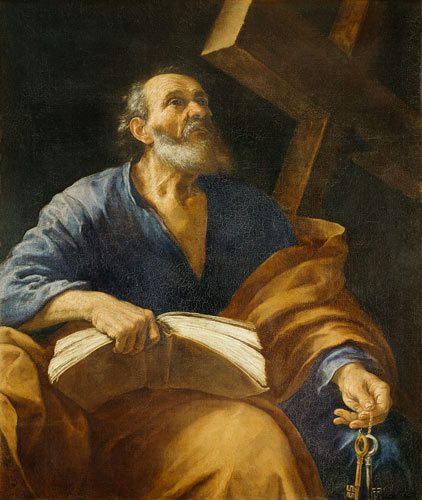
Photo credit: St. Peter, by Paolo Emilio Besenzi (1608-1656) [public domain / Wikimedia Commons]

Summary: I reply to Baptist apologist Gavin Ortlund’s arguments against the papacy: his analyses of Matthew 16 and John 21. I note the cumulative NT evidence for the papacy.
Calvinism & General Protestantism
Biblical Arguments for the Papacy
Previous Post
March 11, 2024
History of the Word "Pope" & Spiritual Fatherhood in the NT
Next Post

March 13, 2024 Origen & Interceding Saints & Angels (vs. Gavin Ortlund)
Recent Comments
"Special pleading, and not a serious response to my arguments . . ."
Is Venerating Men & Angels Worship? ..."
""no man needs to teach us."Didn't you just teach us?"
Is Venerating Men & Angels Worship? ..."
""Catholics say they are the only church that can lead people into heaven."In fact, we ..."
Is Venerating Men & Angels Worship? ..."
"And lastly, I belong to no denomination and am free to serve God as He ..."
Is Venerating Men & Angels Worship? ..."
Browse Our Archives
Select a Category & Last Things About Me Anti-Catholicism Atheism & Agnosticism Baptism and Sacramentalism Bible and Tradition Blessed Virgin Mary Books by Dave Armstrong C. S. Lewis Calvinism & General Protestantism Catholic Apologetics Catholic Apologists Catholic conversion Catholic converts Christmas Church (Ecclesiology) Church History Conversion and Converts Development of Doctrine Eastern Orthodoxy Ecumenism & Christian Unity Eucharist & Liturgy Fathers of the Church French Translations G. K. Chesterton Hell Hell & Satan Hell & Satan & Last Things Heresies & Comparative Religion Holistic Health Inquisition & Crusades & Scandals James White Jews & Judaism & Old Testament John Calvin John Henry Newman Liberal / Modernist Theology Life Issues Literary Resume Lutheranism Mariology Martin Luther Music Orthodoxy Papacy & Infallibility Personal Page Philosophy & Science Political & Ethical & Moral Issues Protestant Persecution & Intolerance Protestantism Purgatory Purgatory & Penance Romantic & Imaginative Theology Saints & Purgatory & Penance Salvation Salvation & Justification Satan & Last Things Sexuality and Gender Issues Spanish Translations Traditionalism vs. Radical Catholic Reactionaries Traducciones al español / tradução para português Trinitarianism & Christology Uncategorized Videos
Select a Month October 2026 September 2026 August 2026 July 2026 June 2026 May 2026 April 2026 March 2026 February 2026 January 2026 December 2025 November 2025 October 2025 September 2025 August 2025 July 2025 June 2025 May 2025 April 2025 March 2025 February 2025 January 2025 December 2024 November 2024 October 2024 September 2024 August 2024 July 2024 June 2024 May 2024 April 2024 March 2024 February 2024 January 2024 December 2023 November 2023 October 2023 September 2023 August 2023 July 2023 June 2023 May 2023 April 2023 March 2023 February 2023 January 2023 December 2022 November 2022 October 2022 September 2022 August 2022 July 2022 June 2022 May 2022 April 2022 March 2022 February 2022 January 2022 December 2021 November 2021 October 2021 September 2021 August 2021 July 2021 June 2021 May 2021 April 2021 March 2021 February 2021 January 2021 December 2020 November 2020 October 2020 September 2020 August 2020 July 2020 June 2020 May 2020 April 2020 March 2020 February 2020 January 2020 December 2019 November 2019 October 2019 September 2019 August 2019 July 2019 June 2019 May 2019 April 2019 March 2019 February 2019 January 2019 December 2018 November 2018 October 2018 September 2018 August 2018 July 2018 June 2018 May 2018 April 2018 March 2018 February 2018 January 2018 December 2017 November 2017 October 2017 September 2017 August 2017 July 2017 June 2017 May 2017 April 2017 March 2017 February 2017 January 2017 December 2016 November 2016 October 2016 September 2016 August 2016 July 2016 June 2016 May 2016 April 2016 March 2016 February 2016 January 2016 December 2015 November 2015 October 2015 September 2015 August 2015 July 2015 June 2015 May 2015 April 2015 March 2015 February 2015 January 2015 December 2014 November 2014 October 2014 September 2014 August 2014 July 2014 June 2014 April 2014 March 2014 February 2014 January 2014 December 2013 November 2013 October 2013 September 2013 August 2013 July 2013 June 2013 April 2013 March 2013 February 2013 January 2013 December 2012 November 2012 October 2012 September 2012 August 2012 July 2012 June 2012 May 2012 April 2012 March 2012 February 2012 January 2012 December 2011 November 2011 October 2011 September 2011 August 2011 July 2011 June 2011 April 2011 March 2011 February 2011 October 2010 September 2010 August 2010 July 2010 April 2010 March 2010 December 2009 October 2009 August 2009 July 2009 June 2009 May 2009 March 2009 February 2009 October 2008 September 2008 April 2008 March 2008 February 2008 January 2008 December 2007 November 2007 October 2007 May 2007 March 2007 February 2007 January 2007 November 2006 October 2006 September 2006 August 2006 July 2006 June 2006 May 2006 April 2006 March 2006 February 2006 October 2005 June 2005 April 2005 February 2005 July 2004 May 2004 April 2004
Follow Us!
TAKE THE
Religious Wisdom Quiz
True or False: Daniel interpreted King Nebuchadnezzar's dream about a statue made of different metals.
Select your answer to see how you score.
FALSE TRUE
Books by This Author Books by Dave Armstrong
Related posts from Biblical Evidence for Catholicism

On Protestant Explanations of Catholic Conversion
Biblical Evidence for Catholicism

Was Peter "Any Old" Apostle? 10 Anti-Papal Arguments
Biblical Evidence for Catholicism

Protestant Confessions & "Ever-Virgin" Mary
Biblical Evidence for Catholicism

A Few "Worst" & "Best" Arguments vs. Protestantism
Biblical Evidence for Catholicism
TRENDING AT PATHEOS Catholic

Methodist Central Hall and Westminster Abbey
Situated on the same square is Methodist Central Hall and Westminster Abbey. ...

57th Dove Awards Honor Dolly Parton, Crown New...
On gospel music’s biggest night, the 57th annual GMA Dove Awards honored...

The First Eucharistic Controversy: Christ’s Real Presence
For Catholics, the Eucharist is the source and summit of the Christian...

What a Stop Sign Can Teach Us About...
How to Make a Decision When You Can't Hear God Main point:...

Archdiocese Hosts Military Marriage Retreat in Germany
RASTATT, Germany — The transient military lifestyle, with its frequent deployments and...

Nearly every morning, I make the drive to Detroit with my high-school-age...
view all Catholic blogs
What Are Your Thoughts?leave a comment
Ad-Free & Subscriber Log-In Subscription Support
- About Us
- 2026 Calendar
- Videos
- Podcasts
- Library of World Religions
- Faith In Media Tracker
- Advertise With Us
- Write for Us
- Privacy Policy
- Terms of Service
- Do Not Sell My Data
- Contact Us
- Radiant Digital
- Manage Newsletter Subscriptions
- Unsubscribe From Notifications
- Sitemap
Copyright 2008-2026, Patheos. All rights reserved.
Subscription Support Ad-Free & Subscriber Log-In
Follow Patheos