
BuddhistCatholicContemplativeEvangelicalGeneral ChristianHinduJewishLatter-day SaintMuslimNew VisionsProgressive Christian
Beliefs
- Buddhist
- Catholic
- Contemplative
- Evangelical
- General Christian
- Hindu
- Jewish
- Latter-day Saint
- More Voices
- Muslim
- New Visions
- Pagan
- Progressive Christian
Topics
- Religion News
- Food and Religion
- Sports and Religion
- Religious Art
- Religious Music and Entertainment
- Religious Events
- History and Religion
- Style and Religion
- Politics and Religion
- Women in Religion
- Recreation Outdoors and Religion
- Business Finance and Religion
- Careers Workplace and Religion
- Education and Religion
- Family Parenting and Religion
- Health Fitness and Religion
- Home and Religion
- Relationships and Religion
- Technology and Religion
- Travel and Religion
Columnists
- Buddhist Columnists
- Business Finance and Religion Columnists
- Careers Workplace and Religion Columnists
- Catholic Columnists
- Contemplative Columnists
- Education and Religion Columnists
- Evangelists Columnists
- Family Parenting and Religion Columnists
- General Christian Columnists
- Health Fitness and Religion Columnists
- Hindu Columnists
- History and Religion Columnists
- Home and Religion Columnists
- Jewish Columnists
- More Voices Columnists
- Latter Day Columnists
- Muslim Columnists
- New Visions Columnists
- Nonreligious Columnists
- Pagan Columnists
- Politics and Religion Columnists
- Progressive Columnists
- Recreation Outdoors and Religion Columnists
- Relationships and Religion Columnists
- Religion News Columnists
- Religious Art Columnists
- Religious Events Columnists
- Religious Music and Entertainment Columnists
- Sports and Religion Columnists
- Style and Religion Columnists
- Technology and Religion Columnists
- Travel and Religion Columnists
- Women in Religion Columnists
Resource Library
- 2026 Calendar
- Library of World Religions
- The 100 Most Holy Places on Earth
- Patheos Answers
- Podcasts
- Videos
- Faith Leaders Database
- Anglican Episcopalian
- Bahai
- Baptist
- Buddhism
- Christianity
- Confucianism
- Eastern Orthodoxy
- Hinduism
- Holiness and Pentecostal
- ISKCON
- Islam
- Judaism
- Lutheran
- Methodist
- The Church of Jesus Christ of Latter-day Saints
- New Age
- Paganism
- Presbytarian and Reformed
- Protestantism
- Religion Behind the Scenes
- Roman Catholic
- Scientology
- Shia Islam
- Sikhism
- Sufism
- Sunni Islam
- Taoism
- Zen
- See all religions
Research Tools
 Ad-Free & Subscriber Log-In Subscription Support
Ad-Free & Subscriber Log-In Subscription Support
Follow Patheos 

- Trending:
- Forgiveness
- |
- Marriage
- |
- Consciousness
- |
- Death Penalty
- |
- Election
- |
- Halloween

-
About
-
Catholic Apologetics
-
Church History
-
Great Apologists
-
Christian Worldview
-
Protestantism & Misc.
- Home
- Catholic
- History and Religion
- Why Protestants Become Catholics (w Gavin Ortlund)
Why Protestants Become Catholics (w Gavin Ortlund)
Last updated on: June 6, 2026 at 12:03 am by Dave Armstrong
Why Protestants Become Catholics (w Gavin Ortlund) 2026-06-06T00:03:36-04:00 Dave Armstrong
Patheos Explore the world's faith through different perspectives on religion and spirituality! Patheos has the views of the prevalent religions and spiritualities of the world.
Dr. Gavin Ortlund is a Reformed Baptist author, speaker, pastor, scholar, and apologist for the Christian faith. He has a Ph.D. from Fuller Theological Seminary in historical theology, and an M.Div from Covenant Theological Seminary. Gavin is the author of seven books as well as numerous academic and popular articles. For a list of publications, see his CV. He runs the very popular YouTube channel Truth Unites, which seeks to provide an “irenic” voice on theology, apologetics, and the Christian life. See also his website, Truth Unites and his blog.
In my opinion, he is currently the best and most influential popular-level Protestant apologist, who (especially) interacts with and offers thoughtful critiques of Catholic positions, from a refreshing ecumenical (not anti-Catholic), but nevertheless solidly Protestant perspective. That’s what I want to interact with, so I have done many replies to Gavin and will continue to do so. His words will be in blue. I use RSV for all Bible passages unless otherwise specified.
All of my replies to Gavin are collected in one place on my Calvinism & General Protestantism web page, near the top in the section, “Replies to Reformed Baptist Gavin Ortlund.”
This is my 21st reply to his material.
*****
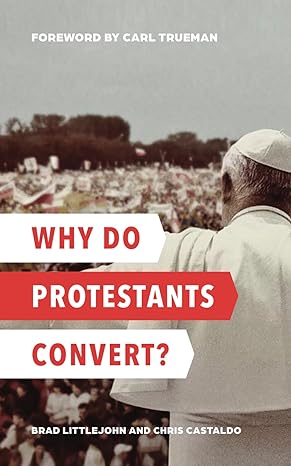
This is a response to Gavin’s video, Why Do Protestants Convert? With Brad Littlejohn and Chris Castaldo (1-22-24), devoted to discussing the book of the same title with its two co-authors. Brad’s words will be in green; Chris’s in purple.
Gavin endorsed the book written by his two guests, writing (in a screenshot in this video at 0:46), “They do not trivialize, oversimplify, or condescend to this phenomenon. On the contrary, they take it with the utmost seriousness and show it must not be dismissed.”
1:31 it’s not condescending; it doesn’t psychoanalyze people, but it gives some plausible reasons and then helps us respond, and a lot of that is going to be on us as Protestants to reform our own practice where we need to according to the Scripture.
I deeply appreciate this approach, as a convert myself (1990). I have replied to many critiques of my own conversion or those of others (see my web page devoted to Catholic converts and conversion). Almost invariably, they were condescending, insulting, blatantly prejudiced, fact-challenged, unserious, etc., whereas I have written articles like, “Gratefulness for My Evangelical Protestant Background” [3-18-08] and “My Respect for Protestants / Catholic Ecumenical Principles” [2001; addendum: 1-8-03].
What was attacked the most, if memory serves, were the motives of converts like myself. I would say that the vast majority of those sorts of supposedly “mind-reading” attacks come from anti-Catholics: folks who don’t consider Catholics Christians at all. Therefore, for Protestants to become Catholics is the same to these folks as apostasy: leaving the faith altogether. And of course they can’t look favorably on that, and so anything goes when they analyze someone who made that change. We must be the scum of the earth.
Gavin is not an anti-Catholic, and it appears that his two guests are not, either (they’re all scholars), and they lack the ubiquitous hostility, inevitably leading to irrationality and unfruitful discussion. It becomes a conversation between brothers and sisters in Christ (and if Gavin responds to this, it will continue in the same manner. I’m delighted to have the opportunity to join that sort of discussion. Praise God that it exists. It’s been a long time coming online . . .
1:08 there’s a trend toward that right now [Protestants converting to Catholicism or Orthodoxy]. This is a phenomenon that needs to be interpreted . . .
It’s fascinating to see such a statement from a Protestant, and it will be intensely interesting to me to see how they talk about the causes for this. From where I sit, I would say (predictably) that there is movement because we believe that we have the fullness of Christian truth. It’s not going from evil to good (the anti-Protestant mentality) or from light to darkness (the anti-Catholic mentality), but to what one feels is a fuller, more complete and history-based version of Christianity, without necessarily decrying what one has already learned and gained in Protestantism. Likewise, former Catholic Protestants say that they found things that they believed to be absent in Catholicism and that they chose the path that they felt had relatively more Christian truth in it.
I (like very many Catholic converts) saw my conversion as going from “very good” to “best.” I sincerely thank God every day for what I learned in evangelical Protestant circles. It was almost all very good. I have a deep respect and affection for my Protestant brothers and sisters. I simply discovered that there was more to Christianity, and I wanted that. I wanted all I could get. I viewed it as part of loving God with all of my heart, soul, strength, and mind. Both sides agree that we all have to follow our own consciences and best lights. We need to assume that “the other guy” is doing that, too.
3:47 I’ve just found that a lot of Protestants assume Protestantism and don’t necessarily have good reflection about why they are a Protestant.
This is the overwhelming tendency on both sides (though I would say that Catholics, sadly, tend to be far more ignorant in this regard than Protestants), and many depart one belief-system for another as a result of rejecting straw men or not being aware of the resources and thought available, whereby they may have reconsidered conversion. To put it more bluntly, ignorance is at a premium among Christians as a whole, and the apologist for Christianity in general or for a particular Christian belief-system, provide reasons for why we believe what we believe. That’s where there is a need for adequate education all-around, and apologists can offer some input and help.
10:20 one of the things I appreciated about your book is, you guys aren’t sort of psychoanalyzing people at an individual level, where you’re saying, “we know someone’s motives.” We don’t know people’s motives. We can’t read someone’s heart at an individual level. We’re going to leave those judgments to God. . . . you hear these silly things too of like, “oh they’re doing it for the money . . .”
Amen and bravo! I make a great effort in my apologetics to try to never do that. If I disagree with someone, I’ll give the theological, historical, apologetic reasons why I do, with all due respect, and minus a sense of “you’re a moron because you believe so-and-so” or “you’re being deliberately dishonest,” etc. I sometimes can be very passionate, but it’s never personal; it’s not seeking to attack persons and motives; only their beliefs that I have honest disagreements with.
One person (a famous Protestant apologist who shall remain unnamed), was at first absolutely convinced that I converted out of stupefying ignorance of Protestant theology. I was dumber than a doornail, and dumb people do a lot of dumb things. Then I produced a list of Protestant books that I had read (most of which were or still are in my own personal library). Without missing a beat, he then stated that my case was one of “knowing deception.” If I wasn’t ignorant, than I just had to be an evil person and a deceiver. There couldn’t possibly be a praiseworthy or spiritual or truly Christian motive or reasoning: not when a Protestant goes Catholic. I can’t describe how refreshing it is to se an analysis that is not typified by that sort of disdainful slop. We can agree on a lot of non-theological things in this discussion.
14:18 we’re all interested in . . . explaining Protestant beliefs, defending Protestant beliefs, trying to remove caricatures from Protestant beliefs that are very common . . .
And I do the same on my end as a catholic apologist. Defeating misinformation and miscomprehensions or distortions is a net gain for everyone. My goal is not only to explain and defend authentic Catholicism, but also to explain authentic Protestantism, and to oppose distortions and falsehoods about it, which do not help Catholics make their case. We must all do our best to be absolutely honest and accurate. There is an old adage in middle school debate teams, that one must know the view of one’s opponent even better than they know it themselves.
14:30 in your discussion of the theology of conversions you discuss the quest for certainty . . . I do suspect that this is commonly out there and I do see this a lot especially right now in our world, where there’s so much uncertainty and anxiety. I sometimes think people are looking to a church tradition to meet this particular need in the heart for certainty.
This is a common “psychological / epistemological” sort of analysis often made of the Catholic convert. I think it is more correct to say that many of us simply thought that we were searching for more Christian truth and found it: a bit like the pearl of great price in the Bible. The Catholic contends that in the NT (especially Paul’s letters) “truth” is greatly emphasized. The phrase “the truth” appears in the NT 70 times. I have collected 295 Bible passages about notions like “the faith” and “the truth” and “the doctrine” and “teaching” and “the message”: all essentially synonymous.
We object to Protestantism relegating whole areas of theology (notably, baptism and the Eucharist or Lord’s Supper) and ecclesiology to the individual’s arbitrary choice, as if views that contradict each other are fine and dandy, leading inevitably to a sort of doctrinal relativism and institutional chaos, which is reflected in ever-proliferating Protestant denominations. This appears to us to run counter to what one might call “the spirit of certainty and truth” that seems to be presupposed in the NT. And perhaps this is what many Catholic converts sense and no longer agree with. The “quest for certainty” analysis of Catholic converts continues, but I submit that the table can be turned, and objections made to “the quest for uncertainty” or the “non-quest for certainty” that prevails in Protestantism as a whole. I have written about it several times:
The Protestant “Non-Quest” for Certainty [3-15-06; abridged and links added on 7-12-20]
Glorying in Uncertainty in Modern Protestantism (Dialogue with a Calvinist) [11-11-09]
Radically Unbiblical Protestant “Quest for Uncertainty” [2-12-14]
Gavin seems to agree with my pint to some extent when he states at 15:09: “I really do believe the Holy Spirit has a ministry of assurance to the human heart through faith in Christ, and He communicates a powerful sense of assurance to our heart . . .” He may be talking only about assurance of salvation; maybe not. But we would apply this to all Christian doctrines, according to Jesus’ teaching that the Holy Spirit “will teach you all things” (Jn 14:26) and “guide you into all the truth” (Jn 16:13). St. Paul referred to “words not taught by human wisdom but taught by the Spirit, interpreting spiritual truths to those who possess the Spirit” (1 Cor 2:13) and he also wrote: “guard the truth that has been entrusted to you by the Holy Spirit who dwells within us” (2 Tim 1:14).
16:50 you know I follow [Fr.] James Martin on Twitter X, whose feed is clad in rainbows, and I also follow Robbie George who is a champion for conservative conviction. Both of them insist on the magisterium who is right. In other words, it seems like there the magisterium itself needs to be interpreted and there you will have different understandings, different conclusions among Catholics.
This is easily answered. Everyone pretty much knows (i.e., both those who agree and disagree with it) that the Catholic Church teaches that homosexual sexual acts are “intrinsically disordered” and “contrary to the natural law.” Here is what the Catechism states:
2357 Homosexuality refers to relations between men or between women who experience an exclusive or predominant sexual attraction toward persons of the same sex. It has taken a great variety of forms through the centuries and in different cultures. Its psychological genesis remains largely unexplained. Basing itself on Sacred Scripture, which presents homosexual acts as acts of grave depravity, tradition has always declared that “homosexual acts are intrinsically disordered.” They are contrary to the natural law. They close the sexual act to the gift of life. They do not proceed from a genuine affective and sexual complementarity. Under no circumstances can they be approved.
2358 The number of men and women who have deep-seated homosexual tendencies is not negligible. This inclination, which is objectively disordered, constitutes for most of them a trial. They must be accepted with respect, compassion, and sensitivity. Every sign of unjust discrimination in their regard should be avoided. These persons are called to fulfill God’s will in their lives and, if they are Christians, to unite to the sacrifice of the Lord’s Cross the difficulties they may encounter from their condition.
2359 Homosexual persons are called to chastity. By the virtues of self-mastery that teach them inner freedom, at times by the support of disinterested friendship, by prayer and sacramental grace, they can and should gradually and resolutely approach Christian perfection.
There is no dispute whatsoever about this. Fr. James Martin, like all theological liberals, simply wants to change Church teaching on it, but there is no sign whatsoever of that happening. To observe those sorts of compromising changes (and sanction of serious sin), we must look at hundreds of Protestant denominations who now see nothing wrong whatsoever with same-sex so-called “marriage”. Fr. Martin wants to change the Catholic view of marriage because he doesn’t agree with it. He picks and chooses what he will believe in Catholic teaching. And he questions the Bible itself. Hence he wrote on 23 October 2019 on his Twitter page: “Where the Bible mentions [same-sex sexual] behavior at all, it clearly condemns it. I freely grant that. The issue is precisely whether the biblical judgment is correct.”
This is the very quintessence of theological liberalism (with whom both Protestants and Catholics are “blessed”). They start by attacking the Bible. Then they will attack the Christian traditions that they claim to be part of. The problem, in other words, is not with the Catholic magisterium, which is quite clear and unequivocal on this issue. The problem is with the flawed methodologies of religiously dissident, heterodox theological liberals. Let’s place the blame where it squarely lies.
This is a variation of another common argument against Catholic authority, which has been called “the infallibility regress.” It, too, fails, as I think I demonstrate in several papers (the above example is a classic case of it failing):
Church Authority & Certainty (The “Infallibility Regress”) [July 2000; some revisions on 12-8-11]
Ecclesiological Certainty (?) & the “Infallibility Regress” [5-22-03 and 10-7-08]
Does Church Infallibility Require Infallible Catholics? [6-8-10]
“How Can we Find a List of Infallible Catholic Doctrines?” [12-15-18]
22:55 any spectrum of opinions that you can find within Protestantism, you can basically find the same spectrum of opinions within Roman Catholicism.
See my papers:
Dissident Catholics: Disproof of Catholic Doctrinal Unity? [6-3-96]
*
Have Heterodox Catholics Overthrown Official Doctrine? (vs. Eric Svendsen, James White, Phillip Johnson, & Andrew Webb) [6-3-96]
*
The essential difference here is that Protestantism institutionalizes sin on a massive basis, whereas Catholic liberals are in opposition to their own Church’s teachings. Most of the Lutheran and Presbyterian denominations and the Anglicans and Episcopalians and Methodists now accept same-sex “marriage” and abortion as perfectly moral acts. They didn’t used to. They changed and started calling good what they formerly regarded as evil. That’s not following the Bible and apostles and Church fathers. Catholicism, meanwhile, continues teaching that both are immoral, just as it always has, following the Bible and apostles and Church fathers.
*
This was a major reason why I became a Catholic. It wasn’t a “quest for certainty” so much as it was a “quest for which Church body had continued adhering to — or at least came the closest to — biblical and apostolic teaching as always previously understood.” Orthodoxy came close, but it caved on divorce and contraception: both disallowed in the early Church (and I would say, the Bible also). All Christians thought contraception was gravely evil until 1930, when the Anglicans said it was okay in “hard cases” only. The essential difference here between Catholicism and everyone else is obvious. And this can adequately account for many Protestants deciding to become Catholics, on the basis of moral theology. I submit that it’s a perfectly legitimate and understandable reason.
*
21:51 you can drive down Main Street and have a Presbyterian church and an Anglican church and a Bible church and a Methodist Church and inasmuch as they all maintain the gospel of scripture they enjoy true unity. . . .
*
But of course they don’t do that. Three of the four redefine marriage to include two of the same sex getting married, and sodomy as perfectly acceptable, moral sexual practice. The fourth doesn’t. In that respect, the Bible church has maintained tradition and the other three have not. They have caved into modern secularism and the sexual revolution. They have conformed to the world (whereas Paul said that we should not do that). Same thing with abortion. Redefining what a human being is and what marriage is, is not in harmony with the Christian gospel; sorry. So where he refers to supposed Protestant “unity”; in fact it is not unified.
*
Nor do these denominations even agree on a thing even as basic as baptism. Three of the four practice infant baptism, the fourth, adult believer’s baptism. One of them thinks baptism regenerates a person; the other three disagree. They essentially disagree on the nature of the Lord’s Supper. One of them — or at least sub-groups of Anglicanism — holds that the real presence of Jesus’ body occurs in the Holy Eucharist. The other three deny it. And so forth and so on. But we are told that they have “unity” . . .
*
45:43 I cannot name a single — not one — Church Father who said there are seven sacraments; not a single one you can find. Some will say there are more than two or use the word sacrament more broadly, but never seven to my awareness. And I’ve not found anybody who’s pushed
back and given me an example of that yet.
*
I have documented myself how St. Augustine used the word to describe five of the seven Catholic sacraments. A few sources I read stated that he regarded penance as a sacrament, too, but I couldn’t nail down a definite citation to that effect. He described rites of penance and extreme unction (“last rites” / sacrament of anointing) in ways that seem “sacramental”: as I also documented. I couldn’t find an instance of him calling the later a “sacrament”. But Pope Innocent I referred to the sacrament of anointing in a letter in 416, during St. Augustine’s lifetime. Tertullian (c. 160-c. 225) is said to have referred to five of the seven Catholic sacraments (baptism, confirmation, the Eucharist, holy orders and marriage: the same five that I have documented with regard to Augustine).
*
I would ask, “why does Gavin feel that it’s necessary for one father to mention all seven; anymore than it is necessary for a Church father to identify all 27 New Testament books in one place, which no one did till St. Athanasius in 367?” Protestants don’t require that to believe in the canon of the NT before 367. So why do they require it concerning seven sacraments? It’s sufficient that they are in the Bible (I’ve defended all of them from Scripture) and that “we find them all mentioned here and there by the Fathers” (Catholic Encyclopedia, “Sacraments” / “Number of the sacraments”). It took the Church almost 400 years to finalize the biblical canon, and when it did, it included seven books that Protestants decided to reject. By the same token, we should expect less than comprehensive indication of the number of sacraments.
*
The precise number of sacraments was simply not a patristic issue, and was only seriously and definitively discussed and dogmatized after 1100 AD:
*
The Council of Trent solemnly defined that there are seven sacraments of the New Law, truly and properly so called, viz., Baptism, Confirmation, Holy Eucharist, Penance, Extreme Unction, Orders, and Matrimony. The same enumeration had been made in the Decree for the Armenians by the Council of Florence (1439), in the Profession of Faith of Michael Palaelogus, offered to Gregory X in the Council of Lyons (1274) and in the council held at London, in 1237, under Otto, legate of the Holy See. According to some writers Otto of Bamberg (1139), the Apostle of Pomerania, was the first who clearly adopted the number seven. . . Most probably this honour belongs to Peter Lombard (d. 1164) who in his fourth Book of Sentences . . . defines a sacrament as a sacred sign which not only signifies but also causes grace, and then . . . enumerates the seven sacraments. (Catholic Encyclopedia, “Sacraments” / “Number of the sacraments”)
45:27 I just think the Protestant case that there are two sacraments rather than seven is simply correct, and I think it’s just so well
attested in the New Testament and the early church, [as] I I’ve said many times.
*
Why, then, was Martin Luther calling absolution a sacrament in 1529?:
*
Why dost thou desire to receive the Sacrament?
Because I desire to strengthen my soul with God’s word and tokens and to obtain grace.
But in this Office thou dost obtain forgiveness of sin.
And why not? But I want to add God’s token also to the Word; and to seek God’s Word frequently is much the better. (A Short Method of Confessing to the Priest, For the Use of Simple Folk, Works of Martin Luther, edited and translated by C.M. Jacobs and A. T. W. Steinhaeuser et al; Philadelphia: A.J. Holman Co. and the Castle Press, 1930, six volumes; also reprinted by Baker Book House, Grand Rapids, Michigan, 1982, Vol. VI, 215-216)
The year before, he had written:
Penance also is to be reckoned as a sacrament – all sacraments are a kind of penance. There are other reasons, too, for calling it a sacrament, but they need not be recounted here. (Instructions for the Visitors of Parish Pastors in Electoral Saxony, Jan. 1528, tr. Conrad Bergendoff; in Luther’s Works, vol. 40)
And why did his successor, Philip Melanchthon, state the same, in the Apology for the Augsburg Confession, written in 1531, and supposedly binding on all Lutherans as part of their confessions on their Book of Concord?:
Therefore Baptism, the Lord’s Supper, and Absolution, which is the Sacrament of Repentance, are truly Sacraments. For these rites have God’s command and the promise of grace, which is peculiar to the New Testament. For when we are baptized, when we eat the Lord’s body, when we are absolved, our hearts must be firmly assured that God truly forgives us . . . (Article XIII [VII]: Of the Number and Use of the Sacraments; from Triglot Concordia: The Symbolical Books of the Evangelical Lutheran Church: German-Latin-English, translated by F. Bente and W.H.T. Dau, St. Louis: Concordia Publishing House, 1921)
And why did John Calvin state in 1559 in his Institutes of the Christian Religion, that “laying on of hands” was “a sacrament in true and legitimate ordination” (Book IV, 19:31)? All of a sudden things aren’t so crystal clear, according to the two most important early Protestant leaders, and even the book of Lutheran confessions.
*
***
*
Practical Matters: Perhaps some of my 4,500+ free online articles (the most comprehensive “one-stop” Catholic apologetics site) or fifty-five books have helped you (by God’s grace) to decide to become Catholic or to return to the Church, or better understand some doctrines and why we believe them.
Or you may believe my work is worthy to support for the purpose of apologetics and evangelism in general. If so, please seriously consider a much-needed financial contribution. I’m always in need of more funds: especially monthly support. “The laborer is worthy of his wages” (1 Tim 5:18, NKJV). 1 December 2021 was my 20th anniversary as a full-time Catholic apologist, and February 2022 marked the 25th anniversary of my blog.
PayPal donations are the easiest: just send to my email address: [email protected]. Here’s also a second page to get to PayPal. You’ll see the term “Catholic Used Book Service”, which is my old side-business. To learn about the different methods of contributing (including Zelle), see my page: About Catholic Apologist Dave Armstrong / Donation Information. Thanks a million from the bottom of my heart!
*
***
Photo credit: cover of the book, Why Do Protestants Convert?, by Brad Littlejohn and Chris Castaldo, from its Amazon book page.
Summary: I discuss with Gavin Ortlund & two others several aspects of the process of conversion from Protestant to Catholic, agreeing in some ways & disagreeing in others.
Calvinism & General Protestantism
Why Protestants Become Catholics
Previous Post
February 21, 2024
"The Chosen": Best Cinematic Gospel Ever
Next Post

February 22, 2024 My Deep Respect for Gavin Ortlund as a Protestant Apologist
Recent Comments
"Special pleading, and not a serious response to my arguments . . ."
Is Venerating Men & Angels Worship? ..."
""no man needs to teach us."Didn't you just teach us?"
Is Venerating Men & Angels Worship? ..."
""Catholics say they are the only church that can lead people into heaven."In fact, we ..."
Is Venerating Men & Angels Worship? ..."
"And lastly, I belong to no denomination and am free to serve God as He ..."
Is Venerating Men & Angels Worship? ..."
Browse Our Archives
Select a Category & Last Things About Me Anti-Catholicism Atheism & Agnosticism Baptism and Sacramentalism Bible and Tradition Blessed Virgin Mary Books by Dave Armstrong C. S. Lewis Calvinism & General Protestantism Catholic Apologetics Catholic Apologists Catholic conversion Catholic converts Christmas Church (Ecclesiology) Church History Conversion and Converts Development of Doctrine Eastern Orthodoxy Ecumenism & Christian Unity Eucharist & Liturgy Fathers of the Church French Translations G. K. Chesterton Hell Hell & Satan Hell & Satan & Last Things Heresies & Comparative Religion Holistic Health Inquisition & Crusades & Scandals James White Jews & Judaism & Old Testament John Calvin John Henry Newman Liberal / Modernist Theology Life Issues Literary Resume Lutheranism Mariology Martin Luther Music Orthodoxy Papacy & Infallibility Personal Page Philosophy & Science Political & Ethical & Moral Issues Protestant Persecution & Intolerance Protestantism Purgatory Purgatory & Penance Romantic & Imaginative Theology Saints & Purgatory & Penance Salvation Salvation & Justification Satan & Last Things Sexuality and Gender Issues Spanish Translations Traditionalism vs. Radical Catholic Reactionaries Traducciones al español / tradução para português Trinitarianism & Christology Uncategorized Videos
Select a Month October 2026 September 2026 August 2026 July 2026 June 2026 May 2026 April 2026 March 2026 February 2026 January 2026 December 2025 November 2025 October 2025 September 2025 August 2025 July 2025 June 2025 May 2025 April 2025 March 2025 February 2025 January 2025 December 2024 November 2024 October 2024 September 2024 August 2024 July 2024 June 2024 May 2024 April 2024 March 2024 February 2024 January 2024 December 2023 November 2023 October 2023 September 2023 August 2023 July 2023 June 2023 May 2023 April 2023 March 2023 February 2023 January 2023 December 2022 November 2022 October 2022 September 2022 August 2022 July 2022 June 2022 May 2022 April 2022 March 2022 February 2022 January 2022 December 2021 November 2021 October 2021 September 2021 August 2021 July 2021 June 2021 May 2021 April 2021 March 2021 February 2021 January 2021 December 2020 November 2020 October 2020 September 2020 August 2020 July 2020 June 2020 May 2020 April 2020 March 2020 February 2020 January 2020 December 2019 November 2019 October 2019 September 2019 August 2019 July 2019 June 2019 May 2019 April 2019 March 2019 February 2019 January 2019 December 2018 November 2018 October 2018 September 2018 August 2018 July 2018 June 2018 May 2018 April 2018 March 2018 February 2018 January 2018 December 2017 November 2017 October 2017 September 2017 August 2017 July 2017 June 2017 May 2017 April 2017 March 2017 February 2017 January 2017 December 2016 November 2016 October 2016 September 2016 August 2016 July 2016 June 2016 May 2016 April 2016 March 2016 February 2016 January 2016 December 2015 November 2015 October 2015 September 2015 August 2015 July 2015 June 2015 May 2015 April 2015 March 2015 February 2015 January 2015 December 2014 November 2014 October 2014 September 2014 August 2014 July 2014 June 2014 April 2014 March 2014 February 2014 January 2014 December 2013 November 2013 October 2013 September 2013 August 2013 July 2013 June 2013 April 2013 March 2013 February 2013 January 2013 December 2012 November 2012 October 2012 September 2012 August 2012 July 2012 June 2012 May 2012 April 2012 March 2012 February 2012 January 2012 December 2011 November 2011 October 2011 September 2011 August 2011 July 2011 June 2011 April 2011 March 2011 February 2011 October 2010 September 2010 August 2010 July 2010 April 2010 March 2010 December 2009 October 2009 August 2009 July 2009 June 2009 May 2009 March 2009 February 2009 October 2008 September 2008 April 2008 March 2008 February 2008 January 2008 December 2007 November 2007 October 2007 May 2007 March 2007 February 2007 January 2007 November 2006 October 2006 September 2006 August 2006 July 2006 June 2006 May 2006 April 2006 March 2006 February 2006 October 2005 June 2005 April 2005 February 2005 July 2004 May 2004 April 2004
Follow Us!
TAKE THE
Religious Wisdom Quiz
Proverbs warns against what kind of woman as a symbol of temptation?
Select your answer to see how you score.
Widow Mother-in-law Queen Adulterous woman
Books by This Author Books by Dave Armstrong
Related posts from Biblical Evidence for Catholicism

On Protestant Explanations of Catholic Conversion
Biblical Evidence for Catholicism

Protestant Confessions & "Ever-Virgin" Mary
Biblical Evidence for Catholicism

A Few "Worst" & "Best" Arguments vs. Protestantism
Biblical Evidence for Catholicism
Reply to Anglican Sean Luke on Denominationalism
Biblical Evidence for Catholicism
TRENDING AT PATHEOS Catholic

The Sermon on the Mount, Part I: Matthew...
The Sermon on the Mount, Part I (Matthew 4:12-5:12) St. Matthew moves...

What's up from Crossway: Reviewing some of their latest A few weeks...

Janie Learns the Way of the Cross: A...
Teaching children about Jesus' Passion can be challenging. Many parents and educators...

Looking For Good Catholic Writing - October 2026
He alone extends the heavens, and he walks upon the waves of...

In "Irreplaceable," our book on vocation and technology, Trevor Sutton and I...

I was strolling through the top floor of the brand new Parthenon...
view all Catholic blogs
What Are Your Thoughts?leave a comment
Ad-Free & Subscriber Log-In Subscription Support
- About Us
- 2026 Calendar
- Videos
- Podcasts
- Library of World Religions
- Faith In Media Tracker
- Advertise With Us
- Write for Us
- Privacy Policy
- Terms of Service
- Do Not Sell My Data
- Contact Us
- Radiant Digital
- Manage Newsletter Subscriptions
- Unsubscribe From Notifications
- Sitemap
Copyright 2008-2026, Patheos. All rights reserved.
Subscription Support Ad-Free & Subscriber Log-In
Follow Patheos