
BuddhistCatholicContemplativeEvangelicalGeneral ChristianHinduJewishLatter-day SaintMuslimNew VisionsProgressive Christian
Beliefs
- Buddhist
- Catholic
- Contemplative
- Evangelical
- General Christian
- Hindu
- Jewish
- Latter-day Saint
- More Voices
- Muslim
- New Visions
- Pagan
- Progressive Christian
Topics
- Religion News
- Food and Religion
- Sports and Religion
- Religious Art
- Religious Music and Entertainment
- Religious Events
- History and Religion
- Style and Religion
- Politics and Religion
- Women in Religion
- Recreation Outdoors and Religion
- Business Finance and Religion
- Careers Workplace and Religion
- Education and Religion
- Family Parenting and Religion
- Health Fitness and Religion
- Home and Religion
- Relationships and Religion
- Technology and Religion
- Travel and Religion
Columnists
- Buddhist Columnists
- Business Finance and Religion Columnists
- Careers Workplace and Religion Columnists
- Catholic Columnists
- Contemplative Columnists
- Education and Religion Columnists
- Evangelists Columnists
- Family Parenting and Religion Columnists
- General Christian Columnists
- Health Fitness and Religion Columnists
- Hindu Columnists
- History and Religion Columnists
- Home and Religion Columnists
- Jewish Columnists
- More Voices Columnists
- Latter Day Columnists
- Muslim Columnists
- New Visions Columnists
- Nonreligious Columnists
- Pagan Columnists
- Politics and Religion Columnists
- Progressive Columnists
- Recreation Outdoors and Religion Columnists
- Relationships and Religion Columnists
- Religion News Columnists
- Religious Art Columnists
- Religious Events Columnists
- Religious Music and Entertainment Columnists
- Sports and Religion Columnists
- Style and Religion Columnists
- Technology and Religion Columnists
- Travel and Religion Columnists
- Women in Religion Columnists
Resource Library
- 2026 Calendar
- Library of World Religions
- The 100 Most Holy Places on Earth
- Patheos Answers
- Podcasts
- Videos
- Faith Leaders Database
- Anglican Episcopalian
- Bahai
- Baptist
- Buddhism
- Christianity
- Confucianism
- Eastern Orthodoxy
- Hinduism
- Holiness and Pentecostal
- ISKCON
- Islam
- Judaism
- Lutheran
- Methodist
- The Church of Jesus Christ of Latter-day Saints
- New Age
- Paganism
- Presbytarian and Reformed
- Protestantism
- Religion Behind the Scenes
- Roman Catholic
- Scientology
- Shia Islam
- Sikhism
- Sufism
- Sunni Islam
- Taoism
- Zen
- See all religions
Research Tools
 Ad-Free & Subscriber Log-In Subscription Support
Ad-Free & Subscriber Log-In Subscription Support
Follow Patheos 

- Trending:
- Forgiveness
- |
- Marriage
- |
- Consciousness
- |
- Death Penalty
- |
- Election
- |
- Halloween

-
About
-
Catholic Apologetics
-
Church History
-
Great Apologists
-
Christian Worldview
-
Protestantism & Misc.
- Home
- Catholic
- History and Religion
- Vs. Turretin #6: Communion Of Saints 6 (Images)
Vs. Turretin #6: Communion Of Saints 6 (Images)
Last updated on: June 6, 2026 at 12:03 am by Dave Armstrong
Vs. Turretin #6: Communion Of Saints 6 (Images) 2026-06-06T00:03:19-04:00 Dave Armstrong
Patheos Explore the world's faith through different perspectives on religion and spirituality! Patheos has the views of the prevalent religions and spiritualities of the world.
François Turretin (1623-1687) was a Genevan-Italian Reformed scholastic theologian and renowned defender of the Calvinistic (Reformed) orthodoxy represented by the Synod of Dort, and was one of the authors of the Helvetic Consensus (1675). He is generally considered to be the best Calvinist apologist besides John Calvin himself. His Institutes of Elenctic Theology (three volumes, Geneva, 1679–1685) used the scholastic method. “Elenctic” means “refuting an argument by proving the falsehood of its conclusion.” Turretin contended against the conflicting Christian perspectives of Catholicism and Arminianism. It was a popular textbook; notably at Princeton Theological Seminary, until it was replaced by Charles Hodge‘s Systematic Theology in the late 19th century. Turretin also greatly influenced the Puritans.
This is a reply to a portion of Institutes of Elenctic Theology (Vol. 2, Eleventh Topic: The Law of God, Ninth Question: The Second Commandment — The Worship of Images and Tenth Question: Whether not only the worship but also the formation and use of religious
images in sacred places is prohibited by the second commandment. We affirm against the Lutherans). I utilize the edition translated by George Musgrave Giger and edited by James T. Dennison, Jr. (Presbyterian and Reformed Publishing Company, Phillipsburg, New Jersey: 1992 / 1994 / 1997; 2320 pages). It uses the KJV for Bible verses. I will use RSV unless otherwise indicated. All installments of this series of replies can be found on my Calvinism & General Protestantism web page, under the category, “Replies to Francois Turretin (1632-1687).” Turretin’s words will be in blue.
*****
Is it lawful to religiously worship images of God, the holy Trinity, Christ, the virgin and other saints? We deny against the papists
Again, he plays with the word “worship” in order to covey the notion that we worship images of saints in the same sense that we worship God (which is idolatry). Of course it isn’t true, as I have demonstrated again and again. In this installment, as in my others, I will prove that Turretin’s view (Calvinism) regarding religious images is massively — even astonishingly — unbiblical and wrongheaded.
[T]he question is Should any religious worship (whether called adoration or veneration) be paid to images of God and the saints made by
the hand of men? Among our opponents, there is no agreement on this point, some roundly showing adoration, others however, to avoid odium, urging only veneration. But this is an empty distinction. Since religious worship is only one and does not admit of various species, it is equally such by whatever name it may be designated.
This is flat-out dishonest, and he couldn’t possibly not know that it is. The Catholic Church doesn’t espouse the adoration of images as idols, intended to replace God. Then he trots out the nonsense that there couldn’t possibly be honor or veneration directed towards images. The Bible teaches otherwise. His own arbitrary limitations pertaining to what we can and can’t do clash miserably with the Bible, which is a huge problem for him and for Calvinism. Catholics believe that in such cases, we must follow the Bible, not false man-made traditions.
The opinion of the papists can be gathered in no better way than from the decree of the Council of Trent. For although here, as elsewhere, they speak hesitatingly and ambiguously, so as to satisfy as far as possible each of the dissenting parties; yet they sufficiently disclose their meaning, . . .
Isn’t that fascinating? Here the anti-Catholic Protestant argues that an ecumenical council (Trent) uses ambiguous language, in order to pacify warring parties. This is exactly how radical Catholic reactionaries (those on the far right of the spectrum) argue about Vatican II and even Vatican I; and about papal documents that they dislike or are unable to comprehend, in their self-imposed stupefaction. I’ve always said that they think like Protestants. This is Exhibit #462 of that. Trent dealt with the question of images in its 25th session. Here is the primary portion (see if you think it is “ambiguous”):
Moreover, that the images of Christ, of the Virgin Mother of God, and of the other saints, are to be had and retained particularly in temples, and that due honour and veneration are to be given them; not that any divinity, or virtue, is believed to be in them, on account of which they are to be worshipped; or that anything is to be asked of them; or, that trust is to be reposed in images, as was of old done by the Gentiles who placed their hope in idols; but because the honour which is shown them is referred to the prototypes which those images represent; in such wise that by the images which we kiss, and before which we uncover the head, and prostrate ourselves, we adore Christ; and we venerate the saints, whose similitude they bear: as, by the decrees of Councils, and especially of the second Synod of Nicaea, has been defined against the opponents of images.
Perfectly clear . . . couldn’t be any more plain and clear than it is. I guess Turretin must classify as “ambiguous” what is too subtle and spiritually and theologically nuanced for him to understand. He’s a victim of his own false philosophical and theological presuppositions. When that happens, anti-Catholics typically trot out insinuations that Catholics are “jesuitical” and devious and clever and deliberately using cynical sophistical techniques to overwhelm outsiders. Nice try. We’re simply thinking Christianly and following the Bible.
What Turretin so violently opposes is the notion of a visual image directly connected to God which is utilized as a means to worship God Himself. God is worshiped and adored through the image. The image is not in competition with God (Trent: “not that any divinity, or virtue, is believed to be in them”), or opposed to him as something foreign or idolatrous. Rather, “the honour which is shown them is referred to the prototypes which those images represent”: through which we can “adore Christ” (Trent, above). Turretin makes note of these images related directly to God, and what Catholics think of them:
Thomas Aquinas wishes the worship of latreia to be given to the cross of Christ, no less than to Christ himself. “Since, therefore, Christ ought to be adored with the adoration of latreia, it follows that his image ought to be adored with the same adoration” (ST, III, Q. 25, Art. 3, p. 2155). As usual, Cajetan follows him and Gabriel Biel—“If there are images of Christ, they should be adored with the same kind of adoration as Christ, viz., that of latreia” (Canonis Misse Expositio 49 [ed. H. Oberman and W. Courtenay, 1965], 2:264). A majority of divines embrace this opinion: Alexander [of Hales], Bonaventure, Richard [of Middleton], Paludanus, Capreolus, Castro, Canisius, Turrianus and many others, whom Vasquez counts up to thirty (De Cultu Adorationis, Bk. 2, Disp. 8.3 [1594], p. 133). . . .
God does not wish to be worshipped in an image (in which he has not put his name) and cannot be represented by a material image . . .
The problem with Turretin’s rejection of this notion is that it is expressly taught in the Bible. For example, the ancient Hebrews worshiped God in the form of a pillar of cloud:
Exodus 33:8-10 Whenever Moses went out to the tent, all the people rose up, and every man stood at his tent door, and looked after Moses, until he had gone into the tent. [9] When Moses entered the tent, the pillar of cloud would descend and stand at the door of the tent, and the LORD would speak with Moses. [10] And when all the people saw the pillar of cloud standing at the door of the tent, all the people would rise up and worship, every man at his tent door.
Note that the pillar of cloud is:
- a creation (water, if a literal cloud);
2) visual, hence an image;
and
- thought to directly represent God Himself.
It’s also a supernatural manifestation, which is a major difference compared to any true idol made by the hands of men; but that would make no difference for those who mistakenly hold that any image whatsoever associated with God is impermissible.
The Bible mentions a pillar of cloud and also a pillar of fire (by night), representing God (see: Ex 13:21-22; 14:24; Num 14:14; Neh 9:12, 19). It doesn’t always state that the people worshiped God through the supernatural image-pillars, but we know from Exodus 33:8-10 that it was entirely permissible to do so; certainly not “idolatry.”
The problem (for certain Christians who don’t like images) comes when God Himself expressly sanctions such images, and worship in conjunction with them, as here. The same iconoclasts (opposers of images) have to explain away things like the burning bush (Ex 3:2-6), which is not only fire, but also called an “angel of the Lord” (Ex 3:2), yet also “God” (3:4, 6, 11, 13-16, 18; 4:5, 7-8) and “the LORD” (3:7, 16, 18; 4:2, 4-6, 10-11, 14) interchangeably.
An angel is a creation (as are fire and cloud); yet God chose to use a created being and inanimate objects to visibly represent Him. Several similar instances occur in the Old Testament. Moreover, the Jews “worshiped” fire as representative of God in the following passage:
2 Chronicles 7:1-4 When Solomon had ended his prayer, fire came down from heaven and consumed the burnt offering and the sacrifices, and the glory of the LORD filled the temple. [2] And the priests could not enter the house of the LORD, because the glory of the LORD filled the LORD’s house. [3] When all the children of Israel saw the fire come down and the glory of the LORD upon the temple, they bowed down with their faces to the earth on the pavement, and worshiped and gave thanks to the LORD, saying, “For he is good, for his steadfast love endures for ever.” [4] Then the king and all the people offered sacrifice before the LORD.
A related argument, not quite as explicit or direct, but still highly relevant, can be made from use of images in worship that are very closely tied to God, such as the tabernacle, temple (1 Kgs 8:44; 2 Chr 6:20; Ps 5:7; 28:2; 138:2), ark of the covenant, and the cross. The Bible teaches that Jewish worship was often directed towards the first three of these holy and sacred objects; therefore, in a large sense, they represented God Himself.
We know that God made Himself specially present in or near all these material objects. He states repeatedly that He is present above the “mercy seat” on the ark of the covenant, between the two carved cherubim (Ex 25:22; 30:6; Lev 16:2; Num 7:89; 1 Sam 4:4; 2 Sam 6:2; 2 Kg 19:15; 1 Chr 13:6; Ps 80:1; 99:1; Is 37:16; Ezek 10:4; Heb 9:5). Therefore, we are informed that the Jews would bow before the ark to pray or worship:
Joshua 7:6 Then Joshua rent his clothes, and fell to the earth upon his face before the ark of the LORD until the evening . . . [proceeds to pray in 7:7-8]
1 Chronicles 16:4 Moreover he appointed certain of the Levites as ministers before the ark of the LORD, to invoke, to thank, and to praise the LORD, the God of Israel.
Yet Turretin wrote a little later in this section: “Therefore he worships idols who bends and bows down before images (Is. 2:8, 9).”
The temple had all sorts of images in it, giving the lie to the notion that houses of worship couldn’t possibly have any images. It had “carved figures of cherubim and palm trees and open flowers” (1 Kgs 6:29).
First, from the law because it contains an express prohibition, when the Lord clearly teaches us neither to make images for the sake of religion, nor to adore and worship them. “Thou shalt not make unto thee any graven image, or any likeness of any thing that is in heaven above, or that is in the earth beneath, or that is in the water under the earth: thou shalt not bow down thyself to them, nor serve them” (Ex. 20:4, 5). This is confirmed: “ye shall make you no idols nor graven image, neither rear you up a standing image, neither shall ye set up any image of stone in your land, to bow down unto it” (Lev. 26:1; cf. Dt. 4:15). In these places they are forbidden to make not only a “graven image” (phsl), but also any “likeness” (thmvnh) whatever (even painted), expressing or representing by copy any shape, whether in heaven or on earth or under the earth.
Are the ark, tabernacle, and temple “graven images”? Are all these instances or prayer, worship, and sacrifice in conjunction with images (cherubim, palm trees, etc.) idolatrous? According to the Bible, obviously not. As for the idea of a “graven image” of Exodus 20:4, what God was specifically forbidding was idolatry: making a stone or block of wood God. The Jews were forbidden to have idols (like all their neighbors had), and God told them not to make an image of Him because He revealed Himself as a spirit. The KJV and RSV Bible versions use the term graven image at Exodus 20:4, but many of the more recent translations render the word as idol (e.g., NASB, NRSV, NIV, CEV).
Context makes it very clear that idolatry is being condemned. The next verse states: “You shall not bow down to them or worship them” (NIV, NRSV). In other words, mere blocks of stone or wood (“them”) are not to be worshiped, as if they literally are God or gods, to the exzclusion of the one true God. That is gross idolatry, since the inanimate objects are not God. This does not absolutely preclude, however, the notion of an icon, where God is worshiped with the help of, or through a visual aid (discussed above).
Idolatry is a matter of disobedience in the heart towards the one true God. We don’t always need an image to have an idol. Most idols today are non-visual: money, sex, lust for power, convenience, our own pride or intellects; there are all sorts of idols. Anything that replaces God as the most important thing in our life and the universe, is an idol. Idolatry is also a “heart issue.” See my article: Biblical Idolatry: Authentic & Counterfeit Conceptions [2015].
Turretin shows that he actually understands this last point:
In the Scriptures indeed images of the true God are called idols (as the golden calf is called an “idol” [Acts 7:41] and its worshippers idolaters, which nevertheless was formed to represent the true God): thus the idol of Micah (Jdg. 17:3, 4) and the calves of Jeroboam (1 K. 12:28).
Where he goes too far is to reject all images of God, because this would take out the pillars of cloud and fire and the burning bush. I’ve written about the idolatry of the Golden Calf and Jeroboam’s idolatry, and condemned them as much as Turretin or anyone else ever has:
Is the Mass Equivalent to OT Golden Calf Worship? [1996]
*
Dialogue: Is the Mass Similar to Jeroboam’s Idolatry? [8-7-04]
*
Golden Calf Idolatry vs. Carved Cherubim on Ark of the Covenant [National Catholic Register, 1-7-21]
*
Again in the law God prohibits not only the images of false things, but also of things existing whether in heaven or on earth, etc. . . .
According to the usage of Scripture . . . an idol is every image made for the sake of religion.
That’s simply not true. We need only take the case of cherubim, which are real creatures (angels), to show how utterly false this claim is. The ark of the covenant was not the only place where carved cherubim appeared, with the express sanction of God. In the first magnificent temple built by Solomon, two giant cherubim (ten cubits, or about fifteen feet high) of wood, covered with gold, stood in the inner sanctuary (1 Ki 6:23-28; 8:6-7; 2 Chr 3:10-13; 5:7-8). Each of their wings was 7-8 feet in length.
Images of cherubim were also carved on the cedar planks of the inner walls of the temple, and on the doors made of olive-wood (1 Ki 6:29, 35; 2 Chr 3:7), as well as on the portable lavers, along with lions and oxen (1 Ki 7:29-36), and woven in the veil of the Holy of Holies (2 Chr 3:14), following the pattern of cherubim in the inner curtain of the tabernacle and the veil (Ex 26:1, 31; 36:8, 35). In the second temple, according to Ezekiel, the inner walls were carved with both palm trees and cherubim, with faces of a lion and a man (Ezek 41:18-25). Likewise, the walls of Herod’s (third) temple were painted with figures of cherubim, according to the Talmud (Yoma’ 54a).
That’s an awful lot of images, in the very place where God was especially present, and worshiped most fervently, commanded by the same God, Who allegedly didn’t want any images of any sort connected with worship. Note that the second temple had “faces of a lion and a man” as well as cherubim.
But then Turretin contradicts himself (a not infrequent occurrence):
The brazen serpent became an idol when the Israelites wished to burn incense to it.
This is exactly my point. Even Turretin admits that the bronze serpent was not originally an idol. It was a permitted image. It later “became” one, and that’s because of how it was regarded, not its inherent quality.
Neither would the Israelites have been idolaters of the golden calf, which they did not suppose to be God. For who can believe them to have been so stupid as to believe the work of their own hands to be that of God who had led them out of Egypt? They intended merely to form for themselves a representation of him that they might worship the true God in this image . . .
This is untrue. They believed exactly that:
Exodus 32:1, 4-5 When the people saw that Moses delayed to come down from the mountain, the people gathered themselves together to Aaron, and said to him, “Up, make us gods, who shall go before us; as for this Moses, the man who brought us up out of the land of Egypt, we do not know what has become of him.” . . . [4] And he received the gold at their hand, and fashioned it with a graving tool, and made a molten calf; and they said, “These are your gods, O Israel, who brought you up out of the land of Egypt!” [5] When Aaron saw this, he built an altar before it; and Aaron made proclamation and said, “Tomorrow shall be a feast to the LORD.”
Exodus 32:22-24 And Aaron said, “Let not the anger of my lord burn hot; you know the people, that they are set on evil. [23] For they said to me, ‘Make us gods, who shall go before us; as for this Moses, the man who brought us up out of the land of Egypt, we do not know what has become of him.’ [24] And I said to them, ‘Let any who have gold take it off’; so they gave it to me, and I threw it into the fire, and there came out this calf.”
This is idolatry and otherwise sinful, on many counts:
It represents not even the one God, but “gods,” so that it falls under the absolute prohibition of polytheism which was known to any observant Hebrew (see, e.g., Psalm 106:19-23; cf. Habakkuk 2:18).
Nowhere are the Jews permitted to build a calf as an “image” of God. This was an outright violation of the injunctions against “molten images” (Exodus 34:17; Leviticus 19:4; Numbers 33:52; Deuteronomy 27:15). All these passages condemn such idols, using the same Hebrew word which appears in Exodus 32:4, 8, 17: massekah).
Aaron built an altar before what the people regarded as “gods,” thus blaspheming the true God. Even the earliest portions of the Bible (and all portions) were monotheistic, as I documented at length in an article of mine.
Lies were told and believed about “gods,” not God, liberating the Hebrews from Egyptian slavery.
Bible translations NASB, NKJV, NRSV, KJV, RSV, NIV, NEB, & REB read “god” at Exodus 32:4 (not even capitalized), so that is clearly not intended as a reference to the one true God, YHWH, according to the accepted practice of all Bible translations.
Exodus 32:1 is revealing as to the state of mind of these idolaters. They ask Aaron to “make” them “gods.” Obviously, they could not have the biblical God, YHWH in mind at that point, since they must have at least known that He is not “made by hands” and is eternal. Then they say these gods “shall go before” them; that is, the golden calf would be carried before them. Therefore, they must have regarded the calf as a pure idol of their own making, not as a mere representation of the true God, which is verified by another passage:
Psalm 106:19-21 They made a calf in Horeb and worshiped a molten image. [20] They exchanged the glory of God for the image of an ox that eats grass. [21] They forgot God, their Savior, who had done great things in Egypt,
It was a deadly heretical mixture of orthodox and heterodox elements (as heretical departures invariably are). Aaron refers to “gods” as supposedly the ones who liberated the Hebrews from Egyptian slavery, builds an altar to the calf who represents them, then speaks of a “festival to the LORD” (YHWH): Exodus 32:4-5. It’s classic heterodox syncretism: that Judaism and Christianity have been “blessed” with since time immemorial. King Jeroboam later repeated essentially the same sort of idolatry (1 Kings 12:28, 32; 14:9: “made for yourself other gods,” “sacrificing to the calves that he had made” etc.).
Rebellion and heterodoxy never make any sense, because they originate in grace-deprived hearts filled with disbelief and lack of faith in and gratefulness to God.
From the cherubim and the brazen serpent the consequent does not hold good to images. The one is a symbol, emblem and type of something
(as the brazen serpent was a type of Christ); the other an image. (2) Neither the cherubim, nor the brazen serpent was adored (Vasquez himself confessing). God indeed promised that he would answer Moses from between the cherubim (Ex. 25:22), but nowhere commands him to worship them; . . .
This is exactly one of the points we make, but Turretin contradicts it in his extreme prohibitive language (“in the law God prohibits not only the images of false things, but also of things existing,” “an idol is every image made for the sake of religion,” etc.).
. . . they [cherubim] were out of sight of the people above the ark in the holy of holies.
This is untrue. They were, among other visible places (see the descriptions above, from Scripture), on the doors made of olive-wood (1 Ki 6:29, 35; 2 Chr 3:7).
***
In the preceding question we treated of the worship of images. It remains to inquire further concerning their use—whether by the precept concerning images, besides the adoration, the making of them is also prohibited. Here we come into collision not only with papists, but also with Lutherans who (although they are opposed to and condemn the worship of images as unlawful and superstitious) endeavor to defend the making of images (eikonopoiian) and their use in sacred places as legitimate (if not for worship, at least for history and as the reminders of events). . . .
[T]he question is whether it is lawful to represent God himself and the persons of the Trinity by any image.
God already did that in the incarnation, the pillars of fire and cloud, and the burning bush. The New Testament also refers to God the Holy Spirit represented in the image of a dove (“the Holy Spirit descended upon him in bodily form, as a dove”: Lk 3:22; cf. Mt 3:16; Mk 1:10, and esp. Jn 1:32: “And John bore witness, ‘I saw the Spirit descend as a dove from heaven, and it remained on him.'” And God the Father is also pictured in the imagery of Daniel 7:9 (“the hair of his head like pure wool”). So, for example, if a Christian painted the burning bush or the two pillars or a dove at Jesus’ baptism, he or she would be doing nothing more than God already did (all permitted images according to inspired revelation and God).
Second, God, being boundless (apeiros) and invisible (aoratos), can be represented by no image: “To whom will ye liken God? or what likeness” (or “image” as the Vulgate has it) “will ye compare unto him” (Is. 40:18). . . . God in promulgating the law wished to set forth no likeness of himself, . . .
Then why are five images of God described above — before we even get to the incarnation and Jesus – sanctioned by God in Scripture?
Paul refers to this in Acts 17:29: “Forasmuch then as we are the offspring of God, we ought not to think that the Godhead is like unto gold, or silver, or stone, graven by art and man’s device.”
That’s why none of the permitted images of God above are anything like that. When that was done (like the Golden Calf), it was utterly condemned.
This the apostle condemns in the Gentiles “who changed the glory of the incorruptible God into an image made like to corruptible man, and to birds, . . . (Rom. 1:23). . . . Thus Antiphanes: “God is not discerned by an image, is not seen by the eyes, is like to no one, wherefore no one can learn him from an image” (De Deo+).
If they imply that this is all of God or all that God is, it’s idolatry. But God willed to show the Holy Spirit as a bird: a dove. St. John saw it himself. And I have noted several other God-willed images representing God the Father.
Now images in sacred places do not belong to the worship of God, since indeed God has expressly removed them from his worship by the law and they are connected with the most imminent danger of idolatry. . . .
Images are prohibited not only inasmuch as they are the object or the means of worship, but inasmuch as they are made simply for the sake of religion or are set up in sacred places.
One wonders, then, why God commanded that the tabernacle and temple and ark of the covenant be covered with cherubim. Why would he risk idolatry? Doesn’t God know (as part of His omniscience) what infallible Calvinism teaches?
Although God sometimes manifested himself in a visible form and in such an appearance is described to us in Scripture (when members and bodily actions are ascribed to him), it does not follow that it is lawful to represent him by an image.
I see. And what logical sense does this make?
The same God who thus appeared nevertheless strongly forbade the Israelites to fabricate any representation of him (to wit, God could employ speech, bodies and symbols, in order to testify his special presence; yet not on that account may man make unto God an image and statue in which he may exhibit himself to man).
We agree so far. But if there is a statue of Jesus or a crucifix, Catholics don’t think that is idolatry, because we worship the one true God through it.
It is one thing to speak metaphorically concerning God in accommodation to our conceptions; another to form a visible representation of him as if true and proper and exhibit it publicly to the eyes of all.
Yet that was done with the dove representing the Holy Spirit “in bodily form” (Lk 3:22), at Jesus’ baptism, in front of “all the country of Judea, and all the people of Jerusalem” (Mk 1:5) and “Jerusalem and all Judea and all the region about the Jordan” (Mt 3:5) and “multitudes” (Lk 3:7, 10). This is public and in the eyes of all. Didn’t God know how scandalous and impermissible such a thing was? Too bad Calvin and Turretin weren’t born yet so that they could correct Him.
*
*****
*
Practical Matters: Perhaps some of my 4,500+ free online articles (the most comprehensive “one-stop” Catholic apologetics site) or fifty-five books have helped you (by God’s grace) to decide to become Catholic or to return to the Church, or better understand some doctrines and why we believe them.
Or you may believe my work is worthy to support for the purpose of apologetics and evangelism in general. If so, please seriously consider a much-needed financial contribution. I’m always in need of more funds: especially monthly support. “The laborer is worthy of his wages” (1 Tim 5:18, NKJV). 1 December 2021 was my 20th anniversary as a full-time Catholic apologist, and February 2022 marked the 25th anniversary of my blog.
PayPal donations are the easiest: just send to my email address: [email protected]. Here’s also a second page to get to PayPal. You’ll see the term “Catholic Used Book Service”, which is my old side-business. To learn about the different methods of contributing (including Zelle), see my page: About Catholic Apologist Dave Armstrong / Donation Information. Thanks a million from the bottom of my heart!
*
***
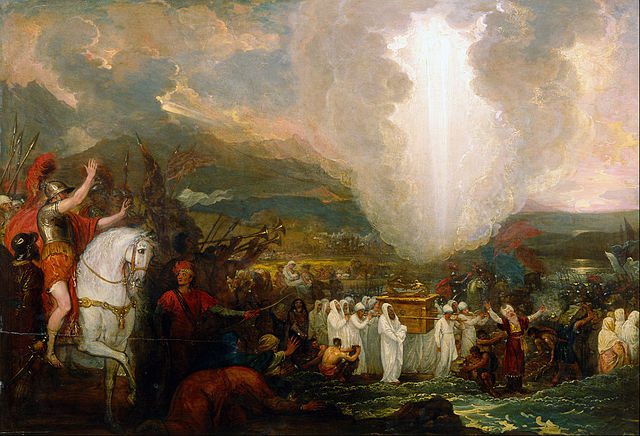
Photo credit: Joshua passing the River Jordan with the Ark of the Covenant (1800), by Benjamin West (1738-1820) [Wikimedia Commons / public domain]

Summary: As part of my series of replies to Calvinist Francois Turretin, I address the communion of saints, particularly the biblical basis for the veneration of images.
Calvinism & General Protestantism
Institutes of Elenctic Theology
Previous Post
December 27, 2023
Vs. Turretin #5: Communion Of Saints 5 (Relics)
Next Post

December 29, 2023 Vs. Turretin #7: Intercession & Veneration of Angels
Recent Comments
"And lastly, I belong to no denomination and am free to serve God as He ..."
Is Venerating Men & Angels Worship? ..."
"And obeisance doesn't mean "worship". It means "respect", "obey", or "submission". Very weird that you ..."
Is Venerating Men & Angels Worship? ..."
"Many of these scriptures you have noted have been taken out of context. With Daniel, ..."
Is Venerating Men & Angels Worship? ..."
""Protestants often point out that Jesus is now triumphant in heaven and object to Catholics ..."
Three More Anti-Catholic Lies About Catholicism ..."
Browse Our Archives
Select a Category & Last Things About Me Anti-Catholicism Atheism & Agnosticism Baptism and Sacramentalism Bible and Tradition Blessed Virgin Mary Books by Dave Armstrong C. S. Lewis Calvinism & General Protestantism Catholic Apologetics Catholic Apologists Catholic conversion Catholic converts Christmas Church (Ecclesiology) Church History Conversion and Converts Development of Doctrine Eastern Orthodoxy Ecumenism & Christian Unity Eucharist & Liturgy Fathers of the Church French Translations G. K. Chesterton Hell Hell & Satan Hell & Satan & Last Things Heresies & Comparative Religion Holistic Health Inquisition & Crusades & Scandals James White Jews & Judaism & Old Testament John Calvin John Henry Newman Liberal / Modernist Theology Life Issues Literary Resume Lutheranism Mariology Martin Luther Music Orthodoxy Papacy & Infallibility Personal Page Philosophy & Science Political & Ethical & Moral Issues Protestant Persecution & Intolerance Protestantism Purgatory Purgatory & Penance Romantic & Imaginative Theology Saints & Purgatory & Penance Salvation Salvation & Justification Satan & Last Things Sexuality and Gender Issues Spanish Translations Traditionalism vs. Radical Catholic Reactionaries Traducciones al español / tradução para português Trinitarianism & Christology Uncategorized Videos
Select a Month October 2026 September 2026 August 2026 July 2026 June 2026 May 2026 April 2026 March 2026 February 2026 January 2026 December 2025 November 2025 October 2025 September 2025 August 2025 July 2025 June 2025 May 2025 April 2025 March 2025 February 2025 January 2025 December 2024 November 2024 October 2024 September 2024 August 2024 July 2024 June 2024 May 2024 April 2024 March 2024 February 2024 January 2024 December 2023 November 2023 October 2023 September 2023 August 2023 July 2023 June 2023 May 2023 April 2023 March 2023 February 2023 January 2023 December 2022 November 2022 October 2022 September 2022 August 2022 July 2022 June 2022 May 2022 April 2022 March 2022 February 2022 January 2022 December 2021 November 2021 October 2021 September 2021 August 2021 July 2021 June 2021 May 2021 April 2021 March 2021 February 2021 January 2021 December 2020 November 2020 October 2020 September 2020 August 2020 July 2020 June 2020 May 2020 April 2020 March 2020 February 2020 January 2020 December 2019 November 2019 October 2019 September 2019 August 2019 July 2019 June 2019 May 2019 April 2019 March 2019 February 2019 January 2019 December 2018 November 2018 October 2018 September 2018 August 2018 July 2018 June 2018 May 2018 April 2018 March 2018 February 2018 January 2018 December 2017 November 2017 October 2017 September 2017 August 2017 July 2017 June 2017 May 2017 April 2017 March 2017 February 2017 January 2017 December 2016 November 2016 October 2016 September 2016 August 2016 July 2016 June 2016 May 2016 April 2016 March 2016 February 2016 January 2016 December 2015 November 2015 October 2015 September 2015 August 2015 July 2015 June 2015 May 2015 April 2015 March 2015 February 2015 January 2015 December 2014 November 2014 October 2014 September 2014 August 2014 July 2014 June 2014 April 2014 March 2014 February 2014 January 2014 December 2013 November 2013 October 2013 September 2013 August 2013 July 2013 June 2013 April 2013 March 2013 February 2013 January 2013 December 2012 November 2012 October 2012 September 2012 August 2012 July 2012 June 2012 May 2012 April 2012 March 2012 February 2012 January 2012 December 2011 November 2011 October 2011 September 2011 August 2011 July 2011 June 2011 April 2011 March 2011 February 2011 October 2010 September 2010 August 2010 July 2010 April 2010 March 2010 December 2009 October 2009 August 2009 July 2009 June 2009 May 2009 March 2009 February 2009 October 2008 September 2008 April 2008 March 2008 February 2008 January 2008 December 2007 November 2007 October 2007 May 2007 March 2007 February 2007 January 2007 November 2006 October 2006 September 2006 August 2006 July 2006 June 2006 May 2006 April 2006 March 2006 February 2006 October 2005 June 2005 April 2005 February 2005 July 2004 May 2004 April 2004
Follow Us!
TAKE THE
Religious Wisdom Quiz
Who asked Jesus, "What is truth?"
Select your answer to see how you score.
Caiaphas Pilate Nicodemus Herod
Books by This Author Books by Dave Armstrong
Related posts from Biblical Evidence for Catholicism

On Protestant Explanations of Catholic Conversion
Biblical Evidence for Catholicism

Bible & Catholicism on Mortal Sin (vs. John...
Biblical Evidence for Catholicism

Does Catholic Intercession of Saints Require Omniscience?
Biblical Evidence for Catholicism

Capabilities of Heavenly Saints: Protestant Commentaries
Biblical Evidence for Catholicism
TRENDING AT PATHEOS Catholic

I was strolling through the top floor of the brand new Parthenon...

What Does Gêvâh Mean For Kimberley Guifoyle &...
This week, a lot of the news is focused on Kimberly Guilfoyle....

INNER CIRCLE: Profound Mystery (Of Christ In All...
Ephesians 5:31-32 “For this reason, a man will leave his father and...

Do Not Rejoice When Your Enemy Falls: The...
Turning an execution into a public spectacle is a disturbing expression of...

'The Chosen' S6 Trailer: The Passion Gets Very...
Not many watching 'The Chosen' worry about spoilers, but just because they...

The purpose-driven labor priest
A labor activist reads Rick Warren and it gets me wondering about...
view all Catholic blogs
What Are Your Thoughts?leave a comment
Ad-Free & Subscriber Log-In Subscription Support
- About Us
- 2026 Calendar
- Videos
- Podcasts
- Library of World Religions
- Faith In Media Tracker
- Advertise With Us
- Write for Us
- Privacy Policy
- Terms of Service
- Do Not Sell My Data
- Contact Us
- Radiant Digital
- Manage Newsletter Subscriptions
- Unsubscribe From Notifications
- Sitemap
Copyright 2008-2026, Patheos. All rights reserved.
Subscription Support Ad-Free & Subscriber Log-In
Follow Patheos