
BuddhistCatholicContemplativeEvangelicalGeneral ChristianHinduJewishLatter-day SaintMuslimNew VisionsProgressive Christian
Beliefs
- Buddhist
- Catholic
- Contemplative
- Evangelical
- General Christian
- Hindu
- Jewish
- Latter-day Saint
- More Voices
- Muslim
- New Visions
- Pagan
- Progressive Christian
Topics
- Religion News
- Food and Religion
- Sports and Religion
- Religious Art
- Religious Music and Entertainment
- Religious Events
- History and Religion
- Style and Religion
- Politics and Religion
- Women in Religion
- Recreation Outdoors and Religion
- Business Finance and Religion
- Careers Workplace and Religion
- Education and Religion
- Family Parenting and Religion
- Health Fitness and Religion
- Home and Religion
- Relationships and Religion
- Technology and Religion
- Travel and Religion
Columnists
- Buddhist Columnists
- Business Finance and Religion Columnists
- Careers Workplace and Religion Columnists
- Catholic Columnists
- Contemplative Columnists
- Education and Religion Columnists
- Evangelists Columnists
- Family Parenting and Religion Columnists
- General Christian Columnists
- Health Fitness and Religion Columnists
- Hindu Columnists
- History and Religion Columnists
- Home and Religion Columnists
- Jewish Columnists
- More Voices Columnists
- Latter Day Columnists
- Muslim Columnists
- New Visions Columnists
- Nonreligious Columnists
- Pagan Columnists
- Politics and Religion Columnists
- Progressive Columnists
- Recreation Outdoors and Religion Columnists
- Relationships and Religion Columnists
- Religion News Columnists
- Religious Art Columnists
- Religious Events Columnists
- Religious Music and Entertainment Columnists
- Sports and Religion Columnists
- Style and Religion Columnists
- Technology and Religion Columnists
- Travel and Religion Columnists
- Women in Religion Columnists
Resource Library
- 2026 Calendar
- Library of World Religions
- The 100 Most Holy Places on Earth
- Patheos Answers
- Podcasts
- Videos
- Faith Leaders Database
- Anglican Episcopalian
- Bahai
- Baptist
- Buddhism
- Christianity
- Confucianism
- Eastern Orthodoxy
- Hinduism
- Holiness and Pentecostal
- ISKCON
- Islam
- Judaism
- Lutheran
- Methodist
- The Church of Jesus Christ of Latter-day Saints
- New Age
- Paganism
- Presbytarian and Reformed
- Protestantism
- Religion Behind the Scenes
- Roman Catholic
- Scientology
- Shia Islam
- Sikhism
- Sufism
- Sunni Islam
- Taoism
- Zen
- See all religions
Research Tools
 Ad-Free & Subscriber Log-In Subscription Support
Ad-Free & Subscriber Log-In Subscription Support
Follow Patheos 

- Trending:
- Forgiveness
- |
- Marriage
- |
- Consciousness
- |
- Death Penalty
- |
- Election
- |
- Halloween

-
About
-
Catholic Apologetics
-
Church History
-
Great Apologists
-
Christian Worldview
-
Protestantism & Misc.
- Home
- Catholic
- History and Religion
- Pedro Gabriel’s Masterful “Heresy Disguised as Tradition”
Pedro Gabriel’s Masterful “Heresy Disguised as Tradition”
Last updated on: June 6, 2026 at 12:50 am by Dave Armstrong
Pedro Gabriel’s Masterful “Heresy Disguised as Tradition” 2026-06-06T00:50:16-04:00 Dave Armstrong
Patheos Explore the world's faith through different perspectives on religion and spirituality! Patheos has the views of the prevalent religions and spiritualities of the world.
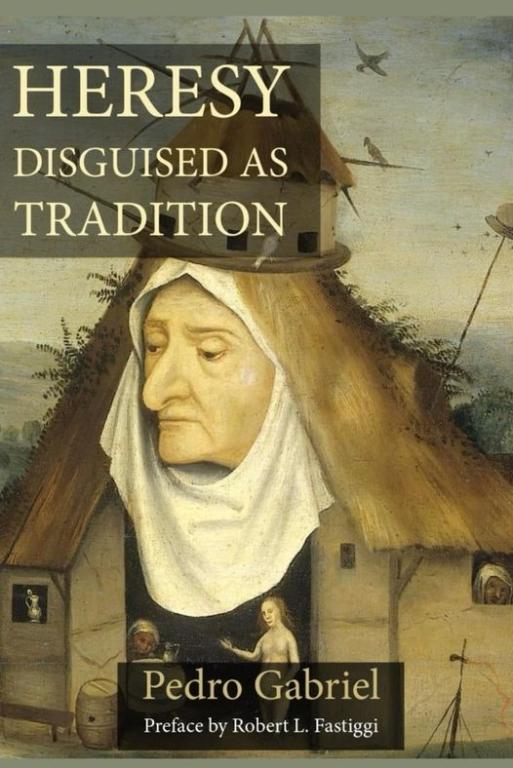
[purchase directly from the publisher]
[purchase from Amazon]
*****
Pedro Gabriel is an oncologist who is also a very fine Catholic apologist. In this book, he pinpoints the serious underlying and presuppositional problems of the extreme sectors of the traditionalist movement in Catholicism, by use of brilliant Newmanesque analogies from past historical movements related to the Catholic Church. He demonstrates how, ironically, these reactionaries are tragically attempting to defend what they deem to be “tradition” when in fact, they have actually embraced heresy — particularly the denial of the indefectibility of the pope and ecumenical councils. Dr. Gabriel does not write, however, as someone who is opposed to tradition per se. Quite the contrary, as he makes clear in the book’s Introduction:
Tradition . . . is a treasure of priceless value that I wish to see appreciated in its unadulterated entirety—including the traditions of papal primacy and Church indefectibility, so attacked during recent years. (p. 16)
This disposes of the very common complaint that every critic of traditionalist extremes is supposedly not approaching the matter from a standpoint of orthodoxy, but rather, as modernists or theological liberals. So, for example, on page 23 he observes, “the traditionalists have claimed the word ‘tradition’ for themselves and labeled any disagreement with them as ‘anti-traditional,’ even if it comes from a priest or bishop.” This is not true in general and it isn’t in Dr. Gabriel’s own case. He draws a very important distinction in this regard on page 34:
Modernism affirms that parts of divine tradition must be abandoned to fit with modern times. On the contrary, Catholicism says that tradition must remain unchanged, but the way tradition is expressed can change. Modernism postulates that we must get on with the times because nothing is eternal. Catholicism firmly asserts that there are eternal realities, but they must be conveyed in a way the temporal will understand.
Orthodox tradition develops what is always essentially present, whereas modernist counterfeit so-called “tradition” evolves into something different from what was before. Likewise, on page 43, Dr. Gabriel identifies the “major premise” of his book, that is, “those who seek a more profound tradition are often seen as being anti-tradition.” He rhetorically flips this on its head, in stating, “it would be equally anti-traditional to discard the Second Vatican Council’s developments, for these too belong to the entirety of tradition . . . part of the unbroken chain of living tradition going back to the apostles” (p. 50). Later in his book, he summarizes:
The thesis of this book is that those who dissent from orthodoxy as defined by the Catholic Church often claim that they are the ones holding to the traditional position. (p. 176)
And even more eloquently, after painstakingly providing many historical parallels, he writes alone the same lines, in a delightfully Chestertonian fashion:
[W]e have seen . . . a tradition running deeper than mere restatements of ancient texts and pronouncements. This is the tradition of doctrinal development, always expanding, even in surprising directions, . . .
However, alongside this venerable tradition, we have also seen another counter-parallel tradition—or rather, an anti-tradition. It is the anti-traditional tradition of traditionalism. Whenever a development is at hand, forces of resistance will inevitably emerge to stifle the growth of living tradition, while non-authoritatively claiming guardianship over tradition. (p. 252)
Dr. Gabriel in his Introduction also grapples with the equally important and controversial issue of distinguishing between different parties within traditionalism:
I want to clarify an ambiguity that may arise from my use of the word “traditionalist.” Sometimes, the word “traditionalist” is employed simply to denote a Catholic who likes to attend an older form of the Roman rite. Such a Catholic is not necessarily against the current magisterium and may be faithfully obedient to the specifications laid out by the present pope. Therefore, I have made a distinction between “traditionalists” and “radical traditionalists” elsewhere. Other authors have made similar distinctions. [here he cites yours truly] The former would be Catholics who exercise their liturgical preferences in perfect harmony with Pope and Council. The latter would be the Catholics who reject, in some way or another, the current pope or Vatican II.
I have nothing but sympathy for the legitimate traditionalists . . . My book is concerned solely with so-called radical traditionalists. (pp. 16-17)
Here I would respectfully offer a slight or minor criticism of methodology only. Dr. Gabriel drew the important distinction between different kinds of traditionalists, but then decided to use the term “traditionalist” throughout his book (it appears 172 times), meaning, specifically, “radical traditionalist” (i.e., one who rejects popes and councils, etc.). I think in so doing, he leaves himself open to massive misunderstanding, as legitimate traditionalists will see his use of the word “traditionalist” — especially if the book is cited elsewhere — and think that he is referring to them — to the larger movement as a whole — rather than to only the radicals.
I personally know a lot about this phenomenon because I have been subject to such criticisms myself, for over 25 years, while I sought, as a Catholic apologist, to critique radical traditionalism. It was for this reason that I coined the term radical Catholic reactionary (also shortened to reactionary) in 2012, precisely in order to prevent insulting those traditionalists towards whom I have a great affinity and affection, as Dr. Gabriel does. I also wanted to make it clear in my coined term that I didn’t deny that such folks were Catholics. Descriptions and labels are necessary so that crucial distinctions are made clear. I hope terminology doesn’t become a frustrating issue for Dr. Gabriel, as he receives critical feedback regarding this excellent book.
In chapter 4, Dr. Gabriel hones in on a very disturbing, and indeed sinful widespread characteristic of the severe critics of Pope Francis, utilizing his prototype of a radical traditionalist, “Tom”:
Tom knew that Pope Francis would say something orthodox once in a while. His traditionalist friends had explained that this was all a part of Bergoglio’s strategy. By being ambiguous, Francis could allow his liberal friends to wreak havoc on the Church, while maintaining a certain plausible deniability that he had ever said anything heterodox. A diabolical strategy! —so Tom would say. Soon, his traditionalist friends were telling him that a similar strategy of weaponized ambiguity had also been employed during Vatican II to promote modernist teachings that went against the perennial teaching of the Church. (pp. 64-65)
I had noticed this as a prominent tendency and glaring fault in Phil Lawler’s pope-bashing book, Lost Shepherd, which I critiqued in considerable depth in January 2018. I noticed a technique that Lawler repeatedly employed: he would second-guess the pope and question his motives. This allowed him to make charges that were independent of objective fact; thus opening the door to virtually any charge at all. This quintessentially subjective, postmodernist mentality has now — very sadly and tragically — become virtually ubiquitous among the vehement pope-bashers, who will often write things along the lines of, “well, he [the pope] really means so-and-so [some imagined heterodox or subversive belief]; we can’t just go by what he wrote in document X . . .,” etc.
Needless to say, this is an exceedingly sinful outlook and spirit; all the more so when applied to the Holy Father of the Catholic Church. And as Dr. Gabriel noted, the same subjectivist mush has also frequently been employed as a weapon against Vatican II. Moreover, in my dealings with this thinking, I have made analogies to atheists’ criticism of the Bible, which they regard as not only “ambiguous” but also massively self-contradicting.
How ironic, then, that the hallmark of radical traditionalist or reactionary thought today is a postmodernist, atheist-like cynical skepticism. What atheists apply to the Bible and Christianity as a whole, radical traditionalists apply to popes and councils. This is all utterly contrary to St. Paul’s biblical injunctions to “in humility count others better than yourselves” (Phil 2:3, RSV), and to exercise love, which “believes all things, hopes all things” (1 Cor 13:7), and his sweeping advice: “You shall not speak evil of a ruler of your people” (Acts 23:5; citing Ex 22:28). Indeed, St. Paul teaches that “revilers” will not even “inherit the kingdom of God” (1 Cor 6:10).
The pope-bashers of today are nothing if not revilers. They endanger their own souls, because they make holy things their specific targets (the pope and ecumenical councils, now including also Vatican I), which is blasphemy (a thing not confined only to God). Jude states that those who “set up divisions” are “worldly people, devoid of the Spirit” (Jude 1:9). St. Paul adds, “take note of those who create dissensions and difficulties, in opposition to the doctrine which you have been taught; avoid them” (Rom 16:17).
These are not trifles. It’s a very serious business. And Dr. Gabriel is providing a crucially important — and loving — service, in exposing these momentous errors and hence, helping people to avoid viewpoints that may very well ensnare their very souls and lead them — and those who follow them — away from a robust, confident faith in God and in God’s guidance of His holy Church.
Another common thread of reactionary anti-Francis thought is the belief that this pope is, well, not very theologically advanced. Dr. Gabriel takes note of this:
There is a prevalent belief among his critics that Francis is theologically unsophisticated. His supposed lack of theological savviness is contrasted with his predecessor’s theological acumen. Nothing could be further from the truth. (p. 68)
He then provides background information on the Holy Father’s education and formation, to show that this, too, is a lie.
In chapter 6, Dr. Gabriel addresses the vexed question of capital punishment. It’s claimed by critics of the pope in this regard (notably, Catholic philosopher Ed Feser, who wrote an entire book about it) that Pope Francis has dramatically contradicted past Catholic tradition, and is now asserting that the death penalty is inherently immoral. But this is a falsehood, as Dr. Gabriel explains:
The Church had traditionally taught that states could take recourse to the death penalty! How could she now be declaring that the death penalty was intrinsically evil?
Justin very calmly pointed out that “intrinsically evil” and “inadmissible” were not synonymous. The former referred to an act that could never be morally justified, not even in principle, whereas the latter referred to all its practical applications at a given time. This was, in fact, what John Paul II had tried to do. Francis had simply moved from “practically non-existent” to “non-existent in practice.” (p. 113)
The distinction involved here is not “rocket science.” Yet Dr. Feser even subtly tries to equate “intrinsically evil” and “inadmissible”. Commenting on the revised Catechism’s use of the word “inadmissible” he recently wrote:
This might be read as implying that capital punishment is intrinsically wrong, which would contradict scripture and two thousand years of magisterial teaching.
“Might be read”?! This is just silly and an embarrassment. The two words clearly have different meanings. If we look up “admissible” on Dictionary.com, the definition given is “that may be allowed or conceded; allowable” and “capable or worthy of being admitted.” On Thesaurus.com, the strongest synonyms listed are “allowed, justifiable, permissible, pertinent, relevant.” Likewise, “inadmissible” is defined as “not admissible; not allowable.” And its strongest synonyms are “immaterial, improper, inappropriate, irrelevant, objectionable, unacceptable, undesirable, unreasonable.”
*
Clearly, none of these definitions imply any remote implication of “intrinsic” qualities. Yet Dr. Feser, a professional philosopher somehow remarkably thinks that there is an implied equation, even though the definition of “intrinsic” at Dictionary.com is “belonging to a thing by its very nature.” And the primary synonym for it is “essentially.” We can either go by the objective definitions of words (the purpose of dictionaries) or we can play the second-guessing or “false equivalence” games in order to promote a false narrative. For a Catholic to do so with regard to a pope is neither logical nor pious.
*
Other Pope Francis critics adopt the tactic I noted above: second-guessing the Holy Father’s “true” motives and in effect accuse him of equivocation, rather than objectively going by what he actually wrote. Dr. Gabriel cited a pathetic, disgraceful instance of this by Fr. George Rutler:
Pope Francis uses the term “inadmissible” to describe the death penalty, although it has no theological substance, and by avoiding words such as “immoral” or “wrong” inflicts on discourse an ambiguity similar to parts of Amoris Laetitia. The obvious meaning is that capital punishment is intrinsically evil, but to say so outright would be too blatant. (p. 113, footnote 16; from his article in The Catholic World Report, dated 12-18-18)
Fr. Rutler doesn’t even stop there. He continues lecturing the pope as if he knows nothing of Catholic tradition. He describes the Holy Father’s views as “incoherent and dangerous” in his title, and writes:
Pope Francis says that his innovative teaching “does not imply any contradiction” of the Church’s tradition but, one has to say reluctantly, it indeed does. The shift cannot be called a legitimate development of doctrine . . .
This is absolutely outrageous, and blatantly contradicts the teaching of Vatican I on papal indefectibility. But even the objection to the word “inadmissible” is an empty charge. Dr. Gabriel cites (on p. 113, footnote 18) an article from his colleague, Mike Lewis, that disposed of this groundless objection, too. Lewis cites examples of eight people, including Fr. Rutler, who objected to the term “inadmissible” as non-magisterial, “ambiguous,” a “novel term with no fixed meaning,” “new,” and “a solecism in moral theology.” One person claimed that the word didn’t appear elsewhere in the Catechism. This is untrue. Different translations of #2296 (having to do with certain issues regarding organ transplants and organ donors) have “inadmissible” or “Not morally admissible” (see also a second example).
*
Lewis then provided examples of past use of the word, in Pope Pius XI, Pope St. Paul VI (three times: one / two / three), Pope St. John Paul II (five times: one / two / three / four / five), and twice (one / two) from Pope Benedict XVI. In an update, Lewis noted that folks had complained that he “only cited one pre-1970 magisterial reference.” So he did some more searching and found 17 references in St. Thomas Aquinas’ Summa Theologica, one from Ven. Pope Pius XII in 1950, and a second use from Pope Pius XI in 1931. I myself also found fifteen usages of “inadmissible” in the Church fathers.
Moreover, I searched the word “intrinsic” on the Holy See website for Pope Francis only, and got 66 hits. The pope is not averse to the word at all. If his actual intention were to describe the death penalty in that way, there is little reason to believe that he wouldn’t have done so. He also has used “intrinsically immoral” four times and “intrinsically evil” 17 times.
Dr. Gabriel draws many instructive analogies in his book, but the most striking is when he starts providing examples of our Lord Jesus and His conflicts with the Pharisees in chapter 11:
The Pharisees . . . boasted of being perfect in the observance of the law. Now this Jesus had come along, telling ordinary people that they could exceed the Pharisees, all the while calling their inner faults out in public! But let us forget this for a moment. Let us rather focus on the confusion that these apparently self-contradictory assertions must have caused. Jesus said He did not come to destroy the law, but He also urged His disciples to break the law. He said that not one iota of the law would be changed, but He constantly flipped the law on its head. Was Jesus being deliberately ambiguous, trying to undermine the foundations of the law while preemptively defending Himself from the accusations of doing so by issuing some fig-leaf disclaimers here and there? Was Jesus being a sophist, . . . holding two conflicting statements at the same time? (pp. 263-264)
He continues expounding upon Jesus’ falsely perceived “innovations” or “novelties”:
*
For example, when justifying His disciples’ gleaning on sabbath, Jesus brought up a historical precedent, connecting His actions to the line of King David [cites Mk 2:25-27] . . .
*
In other words, Jesus did not make His maxim up out of thin air. The utterance “the sabbath was made for man, not man for the sabbath” had been grounded on King David eating the holy loaves of the temple. [footnote: 1 Sam 21:3-6] These loaves had a connection with the sabbath, for they should be changed every Saturday and could only be eaten by a priest within the sanctuary. [footnote: Lev 24:5-9] But David and his companions ate them anyway. Jesus had retrieved a forgotten and ancient tradition to substantiate His behavior. The reason why this tradition had been forgotten was because it had been practiced only by King David, who had divine permission to act this way. (pp. 264-265)
*
Dr. Gabriel then brings to mind Jesus’ argument with the Pharisees about divorce (Mt 19:4-8), and observes:
*
Once again, Jesus appeals to an ancient and forgotten tradition, a tradition older than Moses’s concessions, a tradition hearkening back to Adam and Eve. Nothing could be more primordial than that. (p. 265)
*
In other words, the Pharisees thought that Jesus was an unorthodox radical, with regard to received Judaism (just as reactionaries today view Pope Francis in relation to traditional Catholicism). But He was not. His perspective was much deeper and profound than theirs and reached to the very heart and spirit (or essence) of the Law, whereas they were legalistically stuck in “the letter of the law.” Jesus graphically noted this in saying,
Woe to you, scribes and Pharisees, hypocrites! for you tithe mint and dill and cummin, and have neglected the weightier matters of the law, justice and mercy and faith; these you ought to have done, without neglecting the others. (Matthew 23:23)
Dr. Gabriel explains this:
Jesus establishes a series of antitheses, wherein He contrasts external behaviors with internal attitudes. So, not only must one not kill, but one must also not be angry with one’s brother. Not only must one not commit adultery, but one must also not look lustfully at a woman. To do otherwise makes one a murderer or an adulterer in one’s own heart.
It is interesting that, in His antitheses, Jesus does not disagree with what “is written,” but with “you have heard.” So, we can see that Jesus did not abrogate the commandments, but reinterpreted them, so that the inward obedience to the law would take precedence over the outward and material obedience. The law remains authoritative. . . . Jesus combats legalistic behavior because, as we have seen with the errors of the Pharisees, this formalism breaks the law under the pretext of upholding it. (pp. 267-268)
Despite Jesus’s clarifications, they saw Him as an innovator, just like they had done with John the Baptist before Him. During the beginning of Jesus’s ministry, we can hear the Pharisees asking each other in bewilderment: “What thing is this? What is this new doctrine?” [footnote: Mk 1:27] (p. 272; my italics added)
Then Dr. Gabriel relates all this to the current controversy over the pope’s authority: “Jesus . . . certainly can bequeath some of this authority to someone else, that this person may act as His representative” (p. 281) He then delves into matters of the infallibility of the ordinary magisterium, and observes:
*
It is significant that no official Church document has ever said that the ordinary magisterium can contain error. Donum Veritatis [1990; overseen by Cdl. Ratzinger] admits that, in matters of the prudential order, it can happen that some magisterial documents might not “be free from all deficiencies.” [sec. 24] But deficiencies do not necessarily equate with error. (p. 298)
*
Dr. Gabriel makes a great point about the absurd, ultra-biased reactionary claim that Pope Francis is almost invariably wrong:
[I]s it probable that the Church was so immaculately protected from the blemish of heresy for nearly 2,000 years, only to be utterly transformed into a den of heresy in current days? Is it not more likely that we are once again experiencing what has been a predictable routine in Church history since the beginning: that some Catholics have preferred to rely in simplistic personal interpretations of tradition instead of relying in the less obvious, but more authoritative magisterial interpretation? (p. 313)
I have marveled, along these lines, at one of the statements of pope-basher Ed Feser, who referred to “this lunatic period in history that we’re living through” and claimed that “Usually, errant popes exhibit serious failings of only one or two sorts. But Pope Francis seems intent on achieving a kind of synthesis of all possible papal errors” (“Pope Victor redux?” [7-18-21]).
*
Dr. Gabriel notes in his Conclusion that: “Not only can tradition be confused with novelty, but heresy can also be confused with tradition, . . . Historical precedent for this error is aplenty, and I have gathered examples . . .” (p. 351)
*
Pedro Gabriel emerges from this extraordinary book as a gifted expositor on legitimate development of doctrine, the Mind of the Church, and “radical orthodoxy.” Like St. John Henry Cardinal Newman in his famous and influential works, Apologia pro vita sua and Essay on the Development of Christian Doctrine, he brings forth many helpful historical and biblical analogies to make a larger point (a comparison with today’s radical traditionalists).
*
I didn’t delve into those for lack of space in a review article, but they arguably constitute the heart of his book. And like G. K. Chesterton in his masterpieces, Orthodoxy, Saint Francis of Assisi, and Saint Thomas Aquinas, Dr. Gabriel has the ability to capture the spirit or essence of orthodoxy in an engaging fashion.
*
The great tragedy of today is the fact that so many millions of dissidents on the “right” and relentless critics of Pope Francis (most seemingly in the US) are fundamentally wrong-headed and in error, due to the propaganda and manufactured false narrative that has swirled around him (anything goes). But the good news is that readers who are fair-minded, open-minded, still in possession of critical faculties (in the best sense of that term), and who dare to buck the pessimistic, faith-challenged, cynical narrative and fashionable bandwagon, can overcome this error and blind spot.
*
Dr. Gabriel’s desperately needed book is one sure way — perhaps the best way — to do that. I recommend it as highly as I have ever recommended any book. It’s as profound as it is timely; an instant classic. Heresy Disguised as Tradition is a tour de force and is poised to become the book on radical traditionalism in our time.
*
***
For highly related supplementary reading, see my articles:
*
*
Papal Indefectibility: Dr. Fastiggi vs. Fr. Z [3-11-21]
*
The “Spirit of Defectibility” & “Quasi-Defectibility” [Catholic365, 11-22-23]
*
*
Reflections on Radical Catholic Reactionaries (Dec. 2002 / rev. Aug. 2013; Nov. 2023; my book which is now available for free online)
*
Mass Movements: Radical Catholic Reactionaries, the New Mass, and Ecumenism (Dec. 2012; my second book on this topic)
*
*****
*
Practical Matters: Perhaps some of my 4,500+ free online articles (the most comprehensive “one-stop” Catholic apologetics site) or fifty-five books have helped you (by God’s grace) to decide to become Catholic or to return to the Church, or better understand some doctrines and why we believe them.
*
Or you may believe my work is worthy to support for the purpose of apologetics and evangelism in general. If so, please seriously consider a much-needed financial contribution. I’m always in need of more funds: especially monthly support. “The laborer is worthy of his wages” (1 Tim 5:18, NKJV). 1 December 2021 was my 20th anniversary as a full-time Catholic apologist, and February 2022 marked the 25th anniversary of my blog.
*
PayPal donations are the easiest: just send to my email address: [email protected]. Here’s also a second page to get to PayPal. You’ll see the term “Catholic Used Book Service”, which is my old side-business. To learn about the different methods of contributing (including Zelle), see my page: About Catholic Apologist Dave Armstrong / Donation Information. Thanks a million from the bottom of my heart!
*
***
Photo Credit: photograph of the book cover, The Temptation of St Anthony, Hieronymus Bosch (manner of) c. 1550 – c. 1600, from its Amazon page.
***
Summary: Pedro Gabriel emerges from this book as a gifted and much-needed expositor on legitimate development of doctrine, the Mind of the Church, and “radical orthodoxy.”
Traditionalism vs. Radical Catholic Reactionaries
Previous Post

December 11, 2023
Bible on Marriage and Sexuality
Next Post
December 21, 2023 Vs. Turretin #1: Communion of Saints 1 (Preliminaries)
Recent Comments
"And lastly, I belong to no denomination and am free to serve God as He ..."
Is Venerating Men & Angels Worship? ..."
"And obeisance doesn't mean "worship". It means "respect", "obey", or "submission". Very weird that you ..."
Is Venerating Men & Angels Worship? ..."
"Many of these scriptures you have noted have been taken out of context. With Daniel, ..."
Is Venerating Men & Angels Worship? ..."
""Protestants often point out that Jesus is now triumphant in heaven and object to Catholics ..."
Three More Anti-Catholic Lies About Catholicism ..."
Browse Our Archives
Select a Category & Last Things About Me Anti-Catholicism Atheism & Agnosticism Baptism and Sacramentalism Bible and Tradition Blessed Virgin Mary Books by Dave Armstrong C. S. Lewis Calvinism & General Protestantism Catholic Apologetics Catholic Apologists Catholic conversion Catholic converts Christmas Church (Ecclesiology) Church History Conversion and Converts Development of Doctrine Eastern Orthodoxy Ecumenism & Christian Unity Eucharist & Liturgy Fathers of the Church French Translations G. K. Chesterton Hell Hell & Satan Hell & Satan & Last Things Heresies & Comparative Religion Holistic Health Inquisition & Crusades & Scandals James White Jews & Judaism & Old Testament John Calvin John Henry Newman Liberal / Modernist Theology Life Issues Literary Resume Lutheranism Mariology Martin Luther Music Orthodoxy Papacy & Infallibility Personal Page Philosophy & Science Political & Ethical & Moral Issues Protestant Persecution & Intolerance Protestantism Purgatory Purgatory & Penance Romantic & Imaginative Theology Saints & Purgatory & Penance Salvation Salvation & Justification Satan & Last Things Sexuality and Gender Issues Spanish Translations Traditionalism vs. Radical Catholic Reactionaries Traducciones al español / tradução para português Trinitarianism & Christology Uncategorized Videos
Select a Month October 2026 September 2026 August 2026 July 2026 June 2026 May 2026 April 2026 March 2026 February 2026 January 2026 December 2025 November 2025 October 2025 September 2025 August 2025 July 2025 June 2025 May 2025 April 2025 March 2025 February 2025 January 2025 December 2024 November 2024 October 2024 September 2024 August 2024 July 2024 June 2024 May 2024 April 2024 March 2024 February 2024 January 2024 December 2023 November 2023 October 2023 September 2023 August 2023 July 2023 June 2023 May 2023 April 2023 March 2023 February 2023 January 2023 December 2022 November 2022 October 2022 September 2022 August 2022 July 2022 June 2022 May 2022 April 2022 March 2022 February 2022 January 2022 December 2021 November 2021 October 2021 September 2021 August 2021 July 2021 June 2021 May 2021 April 2021 March 2021 February 2021 January 2021 December 2020 November 2020 October 2020 September 2020 August 2020 July 2020 June 2020 May 2020 April 2020 March 2020 February 2020 January 2020 December 2019 November 2019 October 2019 September 2019 August 2019 July 2019 June 2019 May 2019 April 2019 March 2019 February 2019 January 2019 December 2018 November 2018 October 2018 September 2018 August 2018 July 2018 June 2018 May 2018 April 2018 March 2018 February 2018 January 2018 December 2017 November 2017 October 2017 September 2017 August 2017 July 2017 June 2017 May 2017 April 2017 March 2017 February 2017 January 2017 December 2016 November 2016 October 2016 September 2016 August 2016 July 2016 June 2016 May 2016 April 2016 March 2016 February 2016 January 2016 December 2015 November 2015 October 2015 September 2015 August 2015 July 2015 June 2015 May 2015 April 2015 March 2015 February 2015 January 2015 December 2014 November 2014 October 2014 September 2014 August 2014 July 2014 June 2014 April 2014 March 2014 February 2014 January 2014 December 2013 November 2013 October 2013 September 2013 August 2013 July 2013 June 2013 April 2013 March 2013 February 2013 January 2013 December 2012 November 2012 October 2012 September 2012 August 2012 July 2012 June 2012 May 2012 April 2012 March 2012 February 2012 January 2012 December 2011 November 2011 October 2011 September 2011 August 2011 July 2011 June 2011 April 2011 March 2011 February 2011 October 2010 September 2010 August 2010 July 2010 April 2010 March 2010 December 2009 October 2009 August 2009 July 2009 June 2009 May 2009 March 2009 February 2009 October 2008 September 2008 April 2008 March 2008 February 2008 January 2008 December 2007 November 2007 October 2007 May 2007 March 2007 February 2007 January 2007 November 2006 October 2006 September 2006 August 2006 July 2006 June 2006 May 2006 April 2006 March 2006 February 2006 October 2005 June 2005 April 2005 February 2005 July 2004 May 2004 April 2004
Follow Us!
TAKE THE
Religious Wisdom Quiz
I am a sea that parted to let my people cross on dry ground but drowned their enemies. What am I?
Select your answer to see how you score.
The Red Sea The Sea of Galilee The Jordan River The Mediterranean Sea
Books by This Author Books by Dave Armstrong
Related posts from Biblical Evidence for Catholicism
Foreword: "Ignorance of Things Divine" (Andrew Mioni)
Biblical Evidence for Catholicism
John Martignoni: "What the Heck is Papal Indefectibility?"
Biblical Evidence for Catholicism
Must the Gospel be Preached at Every Time...
Biblical Evidence for Catholicism

Is the Onan Story About Contraception?
Biblical Evidence for Catholicism
TRENDING AT PATHEOS Catholic

In "Irreplaceable," our book on vocation and technology, Trevor Sutton and I...

I was strolling through the top floor of the brand new Parthenon...

What Does Gêvâh Mean For Kimberley Guifoyle &...
This week, a lot of the news is focused on Kimberly Guilfoyle....

INNER CIRCLE: Profound Mystery (Of Christ In All...
Ephesians 5:31-32 “For this reason, a man will leave his father and...

Do Not Rejoice When Your Enemy Falls: The...
Turning an execution into a public spectacle is a disturbing expression of...

'The Chosen' S6 Trailer: The Passion Gets Very...
Not many watching 'The Chosen' worry about spoilers, but just because they...
view all Catholic blogs
What Are Your Thoughts?leave a comment
Ad-Free & Subscriber Log-In Subscription Support
- About Us
- 2026 Calendar
- Videos
- Podcasts
- Library of World Religions
- Faith In Media Tracker
- Advertise With Us
- Write for Us
- Privacy Policy
- Terms of Service
- Do Not Sell My Data
- Contact Us
- Radiant Digital
- Manage Newsletter Subscriptions
- Unsubscribe From Notifications
- Sitemap
Copyright 2008-2026, Patheos. All rights reserved.
Subscription Support Ad-Free & Subscriber Log-In
Follow Patheos