
BuddhistCatholicContemplativeEvangelicalGeneral ChristianHinduJewishLatter-day SaintMuslimNew VisionsProgressive Christian
Beliefs
- Buddhist
- Catholic
- Contemplative
- Evangelical
- General Christian
- Hindu
- Jewish
- Latter-day Saint
- More Voices
- Muslim
- New Visions
- Pagan
- Progressive Christian
Topics
- Religion News
- Food and Religion
- Sports and Religion
- Religious Art
- Religious Music and Entertainment
- Religious Events
- History and Religion
- Style and Religion
- Politics and Religion
- Women in Religion
- Recreation Outdoors and Religion
- Business Finance and Religion
- Careers Workplace and Religion
- Education and Religion
- Family Parenting and Religion
- Health Fitness and Religion
- Home and Religion
- Relationships and Religion
- Technology and Religion
- Travel and Religion
Columnists
- Buddhist Columnists
- Business Finance and Religion Columnists
- Careers Workplace and Religion Columnists
- Catholic Columnists
- Contemplative Columnists
- Education and Religion Columnists
- Evangelists Columnists
- Family Parenting and Religion Columnists
- General Christian Columnists
- Health Fitness and Religion Columnists
- Hindu Columnists
- History and Religion Columnists
- Home and Religion Columnists
- Jewish Columnists
- More Voices Columnists
- Latter Day Columnists
- Muslim Columnists
- New Visions Columnists
- Nonreligious Columnists
- Pagan Columnists
- Politics and Religion Columnists
- Progressive Columnists
- Recreation Outdoors and Religion Columnists
- Relationships and Religion Columnists
- Religion News Columnists
- Religious Art Columnists
- Religious Events Columnists
- Religious Music and Entertainment Columnists
- Sports and Religion Columnists
- Style and Religion Columnists
- Technology and Religion Columnists
- Travel and Religion Columnists
- Women in Religion Columnists
Resource Library
- 2026 Calendar
- Library of World Religions
- The 100 Most Holy Places on Earth
- Patheos Answers
- Podcasts
- Videos
- Faith Leaders Database
- Anglican Episcopalian
- Bahai
- Baptist
- Buddhism
- Christianity
- Confucianism
- Eastern Orthodoxy
- Hinduism
- Holiness and Pentecostal
- ISKCON
- Islam
- Judaism
- Lutheran
- Methodist
- The Church of Jesus Christ of Latter-day Saints
- New Age
- Paganism
- Presbytarian and Reformed
- Protestantism
- Religion Behind the Scenes
- Roman Catholic
- Scientology
- Shia Islam
- Sikhism
- Sufism
- Sunni Islam
- Taoism
- Zen
- See all religions
Research Tools
 Ad-Free & Subscriber Log-In Subscription Support
Ad-Free & Subscriber Log-In Subscription Support
Follow Patheos 

- Trending:
- Forgiveness
- |
- Marriage
- |
- Consciousness
- |
- Death Penalty
- |
- Election
- |
- Halloween

-
About
-
Catholic Apologetics
-
Church History
-
Great Apologists
-
Christian Worldview
-
Protestantism & Misc.
- Home
- Catholic
- History and Religion
- “Catholic Verses” #8: Tradition, Pt. 3
“Catholic Verses” #8: Tradition, Pt. 3
Last updated on: June 6, 2026 at 12:49 am by Dave Armstrong
“Catholic Verses” #8: Tradition, Pt. 3 2026-06-06T00:49:39-04:00 Dave Armstrong
Patheos Explore the world's faith through different perspectives on religion and spirituality! Patheos has the views of the prevalent religions and spiritualities of the world.
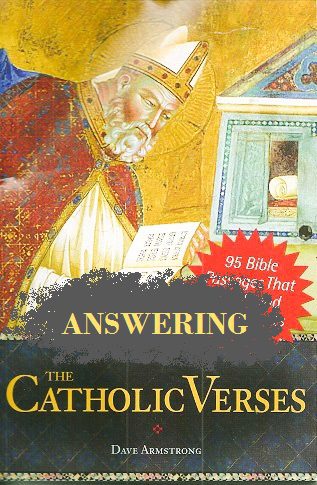
[see book and purchase information for The Catholic Verses]
“excatholic4christ” (Tom) was raised Catholic, lost his faith in high school, attended Mass for a while after he married and had children, and then “accepted Jesus Christ” as his Savior, leading to his sole attendance at an independent fundamental Baptist church for eight years. He claims that the “legalism” of this church and the fact that his “trust had been in men rather than God” caused him to “walk away from the Lord for 23 years.” He “returned to the Lord” in 2014. As of April 2020, Tom stated that he was “somewhere in the middle of the Calvinism-Arminianism debate,” but “closer to Calvinism.” I couldn’t determine his denomination. See Tom’s index of all of his replies. I will systematically refute them. His words will be in blue. When he cites my words, they will be in black. I use RSV, unless otherwise specified.
*****
This is a reply to Tom’s article, The Authority of Sacred Tradition? – Part 3 (10-1-18).
Citing the two passages below, Armstrong makes the case for “oral and extrabiblical tradition in the New Testament”:
Matthew 2:23 “And he went and dwelt in a city called Nazareth, that what was spoken by the prophets might be fulfilled, ‘He shall be called a Nazarene.’”
Matthew 23:1-3 “Then said Jesus to the crowds and to his disciples, ‘The scribes and the Pharisees sit on Moses’ seat; so practice and observe whatever they tell you, but not what they do; for they preach, but do not practice.’”
Beneath these two passages, Armstrong writes, “Catholics believe that the tradition found in the Bible also includes an oral component. The reference in Matthew 2:23 – “He shall be called a Nazarene” – cannot be found in the Old Testament, yet it was passed down by the prophets. Thus a prophecy, which is considered to be God’s Word was passed down orally rather than through Scripture. Likewise, Matthew 23:1-3: Jesus teaches that the scribes and Pharisees have a legitimate, binding authority, based on Moses’ seat, which phrase (or idea) cannot be found anywhere in the Old Testament. It is found in the (originally oral) Mishna, where a sort of teaching succession from Moses on down is taught. Thus, apostolic succession, whereby the Catholic Church, in its priests and bishops and popes, claims to be merely the custodian of an inherited apostolic Tradition, is also prefigured by Jewish oral tradition, as approved (at least partially) by Jesus himself.” – pp. 43-44.
There’s no doubt that Matthew 2:23, with its reference to a prophecy that the Messiah would be called a Nazarene, has its difficulties. Nowhere in the Old Testament is there such a recorded prophecy.
And with this statement, Tom concedes the entire argument (whether he realized it or not). He just admitted that what the inspired New Testament described as a saying “spoken by the prophets” (hence, “God’s Word” or “Word of the Lord” [used 243 times in the OT] in the larger sense), is absent from the Old Testament. Therefore, the only reasonable choice is that it is extrabiblical tradition, which began orally (“spoke”) and may have later been written down before the NT cited it. But Tom provides the usual “keep it in the Bible” explanation:
Messiah as the “shoot” or “branch” – The words for “branch/sprout” and “Nazareth” are extremely similar, in both Hebrew and Aramaic, hence Matthew could have been referring to such prophecies as Isaiah 11:1: “There shall come forth a shoot from the stump of Jesse, and a branch from his roots shall bear fruit.”
I addressed this explanation in the chapter, but Tom ignores anything but the “Catholic Verses” throughout his critiques. So he’s not really addressing (let alone refuting) my book; only relatively small portions of it. But some Catholic scholars (and an apologist I shall cite below) also argue that the saying is a summary of several prophetic utterances.
To claim that Matthew was referencing an unwritten, prophetic oral tradition as Armstrong does is fanciful speculation without any foundation whatsoever.
Not at all. It’s referred to as from the “prophets” (hence, a prophecy). And even Tom — following virtually all Protestant commentators — grants that it is not in the Old Testament. There are only so many choices left. As I showed in the same chapter, at the very least five other NT passages drew from “extrabiblical and oral tradition”:
- 1 Corinthians 10:4, where St. Paul refers to a rock which “followed” the Jews through the Sinai wilderness. The Old Testament says nothing about such miraculous movement, in the related passages about Moses striking the rock to produce water (Exod. 17:1-7; Num. 20:2-13). Rabbinic tradition, however, does.
- 1 Peter 3:19, where St. Peter describes Christ’s journey to Sheol/Hades (“he went and preached to the spirits in prison“), draws directly from the Jewish apocalyptic book 1 Enoch (12-16). Jude 14-15 directly quotes from 1 Enoch 1:9, and even states that Enoch prophesied.
- Jude 9, which concerns a dispute between Michael the archangel and Satan over Moses’ body, cannot be paralleled in the Old Testament, and appears to be a recounting of an oral Jewish tradition.
- In 2 Timothy 3:8, the reference to Jannes and Jambres cannot be found in the related Old Testament passage (Exod. 7:8 ff.).
- James 5:17 mentions a lack of rain for three years, which is likewise absent from the relevant Old Testament passage in 1 Kings 17.
Since Jesus and the Apostles acknowledge authoritative Jewish oral tradition (in so doing, raising some of it literally to the level of written revelation), we are hardly at liberty to assert that it is altogether illegitimate. (p. 44)
If these passages all engaged in this practice, then it can’t be ruled out as a plausible interpretation, that St. Matthew did the same thing, in writing verse 2:23 of his Gospel. Bengel’s Gnomen, a classic Protestant commentator, offers some sensible thoughts on this verse:
Although at what time that prophet flourished by whom this prediction was uttered; whether the town of Nazareth, of which no other mention occurs in the Old Testament, was then of any account or not; whether that prophet was himself a Nazarene, and deposited this remarkable verse at Nazareth, or whether he left it to posterity, conveyed by word of mouth alone, or also committed to writing, whence St Matthew obtained it, who knows? . . .
And, rightly, many have long since denied that this verse exists in the Scriptures of the Old Testament. Its condition, therefore, is the same as that of the prophecy of Enoch, introduced at length by St Jude into the Scriptures of the New Testament, and thus stamped with the seal of inspiration; the same as that of the apothegm, which, though delivered by our Lord, does not occur in the Gospels, but is quoted by the mouth of St Paul, and the pen of St Luke, Acts 20:35. Nor have the Jews any ground of accusation, because anything is quoted in the New Testament which does not exist in the Old; for they relate many ancient things which equally are not to be found there. Where lay hid the Proverbs of Solomon from ch. Matthew 25:1; the prophecy of Azariah (2 Chronicles 15:2, etc.); the epistle of Elijah (2 Chronicles 21:12), until they were inserted in the books of the Old Testament, many ages after they were delivered? . . .
Those who interpret this important verse more vaguely, so as to make out that it is contained here or there in the Scriptures of the Old Testament, in truth take away one from the ancient prophecies; whereas those who consider . . . “He shall he called a Nazarene,” to have been expressly uttered of old, recognise a homogeneous portion of the entire testimony of prophecy, and thus in truth maintain the integrity and defend the simplicity of Scripture . . .
My friend, Catholic apologist Jimmy Akin (fascinating, insightful, and educational, as always) provides further possible explanations, in an article on Matthew 2:23:
What was Matthew quoting?
Was it a source that had been lost?
We know that there were many prophets in ancient Israel who genuinely spoke for God, even though their prophecies are not recorded in the Old Testament. 1 Kings even indicates that there were as many as a hundred prophets at once!
And Ahab called Obadi’ah, who was over the household. (Now Obadi’ah revered the LORD greatly; and when Jez’ebel cut off the prophets of the LORD, Obadi’ah took a hundred prophets and hid them by fifties in a cave, and fed them with bread and water) [1 Kings 18:3-4].
Could it be that some of this material was passed down in the form of oral tradition, and this is what Matthew was referring to?
Possibly, but there is another option . . .
Lost Books?
We even know that some of them wrote books, because the Old Testament refers to them. Consider these verses:
As for the events of King David’s reign, from beginning to end, they are written in the records of Samuel the seer, the records of Nathan the prophet and the records of Gad the seer [1 Chron. 29:29].
As for the other events of Solomon’s reign, from beginning to end, are they not written in the records of Nathan the prophet, in the prophecy of Ahijah the Shilonite and in the visions of Iddo the seer concerning Jeroboam son of Nebat? [2 Chron. 9:29].
As for the events of Rehoboam’s reign, from beginning to end, are they not written in the records of Shemaiah the prophet and of Iddo the seer that deal with genealogies? There was continual warfare between Rehoboam and Jeroboam [2 Chron. 12:15].
The other events of Abijah’s reign, what he did and what he said, are written in the annotations of the prophet Iddo [2 Chron. 13:22].
These books apparently were around at the time Chronicles was written, but under God’s providence they did not become part of the canon of Scripture.
Why that was, and what the exact status of these books was, we cannot know. But the books apparently were known in antiquity.
Could Matthew have known them, or at least some of their contents, and could that have been the source he was referring to?
Possibly, . . . (“Did Matthew Invent A Prophecy About Jesus?,” National Catholic Register, 10-24-12; bolding his own)
His own opinion, however, is the following:
You’ll note that Matthew doesn’t attribute the statement about Jesus being called a Nazarene to a specific prophet. Instead, he says it was said “through the prophets” (Greek, dia ton propheton).
That suggests that he’s thinking of it more as a general theme in the prophets, not a specific passage, and that suggests that it would be better not to render it as a quotation.
Thus Bible scholars tend to take the passage not as a quotation but as a summary expressing a prophetic theme that could be found in more than one place. . . .
[T]he wordplay Matthew uses can be taken as a summary of what the prophets said regarding the Messiah. . . .
While it’s possible that Matthew was drawing on an oral tradition from the Old Testament prophets or that he was quoting a book by a prophet which God chose not to have in the canon, it’s more likely that he’s just summarizing a theme found in multiple prophets and noting that Jesus’ life story resonates with this theme and thus fulfills it.
The difference between Akin’s commentary and that of many classical Protestant commentators and Tom, is that Akin isn’t dogmatic about it. He allows more than one possibility, and he doesn’t rule out extrabiblical traditions and prophecies being involved. But Tom is dogmatic and anti-Catholic and pretends that anything extrabiblical being in play here is impossible, calling such opinions “fanciful speculation without any foundation whatsoever.”
In Matthew 23:1-3, the apostle refers to the scribes and Pharisees as sitting in “Moses’ seat” and Armstrong presents this statement as extra-Biblical revelation by which Jesus was recognizing the tradition/claims of the scribes and Pharisees to Mosaic succession. In contrast, evangelical Bible scholars suggest that “Moses’ seat” probably refers to the seat in the synagogue from which the Law (i.e., the writings of Moses) and the Prophets were read by the presiding rabbi. From this passage, Armstrong attempts to extrapolate parallel justifications for Roman Catholicism’s elaborate hierarchy and its claim to apostolic succession, but once again we find him grasping at straws. Jesus was simply encouraging his disciples and those in the crowd to listen to the Pharisaic rabbis’ readings of the Law and the Prophets, but not to follow their practices.
While Armstrong points to Matthew 2:23 and Matthew 23:1-3 as irrefutable “Catholic verses” and examples of Scripture-sanctioned oral and extra-Biblical traditions that set a precedent for Catholicism’s “Sacred Tradition,” we find instead that these verses do nothing of the sort.
My friend, Catholic apologist Steve Ray addressed Matthew 23:2 and “Moses’ Seat”:
[T]he Mishnah . . . is a compilation of Jewish tradition around the time of Christ. It could of course be dismissed because it was after the time of Christ, but it is certainly a good thermometer for Jewish thought, not just after Christ, but also during his time and earlier. It was an attempt to put down the traditions and teachings of the rabbis down through their past. The Mishnah states,
ABOT 1:1 A: Moses received Torah at Sinai and handed it on to Joshua, Joshua to elders, and elders to prophets. B And prophets handed it on to the men of the great assembly.
One cannot dismiss this out of hand because it was after the destruction of the Temple since the Targums and Mishnah [were] the effort of the post-Temple Jews to recall and document the earlier customs and traditions of the Jews.
There was always an office to go to inquire of God. It was always assumed this office as handed down in succession would speak the true word of God. (” ‘Chair of Moses – Chair of Peter’ – a lengthy debate,” Defenders of the Catholic Faith, Sep. 2022 [part 2 in a PDF file] )
This is a wonderful article from Steve, that gets into great depth, with plenty of documentation. Some argue that there was an actual seat, or more than one, referred to here; others that it is symbolic of a teaching office. But pretty much all agree (Tom didn’t render an opinion this time) that it’s not in the Old Testament. And that was my central point. It comes from an extrabiblical tradition, any way one looks at it.
Meyer’s NT Commentary opines that that the phrase “is intended as a figurative mode of describing the functions of one who ‘acts as a public teacher of the Mosaic law,’ in discharging which functions the teacher may be regarded as the representative and successor of Moses.”
Expositor’s Greek Testament states that it is “short for, on the seat of a teacher whose function it was to interpret the Mosaic Law. The Jews spoke of the teacher’s seat as we speak of a professor’s chair.”
Cambridge Bible for Schools and Colleges says that the phrase means “i. e. succeed him as teachers. For sitting as the posture of a teacher cp. ch. Matthew 5:1 [‘. . . when he sat down his disciples came to him.’].”
Bengel’s Gnomen adds that it is “Representing Moses, reading and interpreting his law, and even urging more than he enjoined.”
*
Jonathan Andrew Brown (“The Seat of Moses,” Torah Apologetics, 3-22-16), states: “Think of it in modern terms. When there is an election in the United States, we say, “oh there are three senate seats that are up for re-election.” It is an idiomatic expression. It does not mean that the literal seat or chair of a certain senator is up for re-election, it means that the office or position of the senator is.”
*
Craig S. Keener thinks that it means “they have adopted the role of the law’s interpreters, since instructors sat to teach.” (Commentary on the Gospel of Matthew, Grand Rapids, Michigan: Eerdmans, 1999, p. 541)
*
Related Reading
“Moses’ Seat” & Jesus vs. Sola Scriptura (vs. James White) [12-27-03]
*
Pharisees, “Moses’ Seat”, Tradition & Catholicism [Dec. 2003 and May 2005; a condensed, re-edited, and mildly revised version: 5-1-22]
*
Refutation of James White: Moses’ Seat, the Bible, and Tradition (Introduction: #1) (+Part II | Part III | Part IV | Part V | Part VI) [5-12-05]
*
*
***
*
Practical Matters: Perhaps some of my 4,500+ free online articles (the most comprehensive “one-stop” Catholic apologetics site) or fifty-three books have helped you (by God’s grace) to decide to become Catholic or to return to the Church, or better understand some doctrines and why we believe them.
*
Or you may believe my work is worthy to support for the purpose of apologetics and evangelism in general. If so, please seriously consider a much-needed financial contribution. I’m always in need of more funds: especially monthly support. “The laborer is worthy of his wages” (1 Tim 5:18, NKJV). 1 December 2021 was my 20th anniversary as a full-time Catholic apologist, and February 2022 marked the 25th anniversary of my blog.
*
PayPal donations are the easiest: just send to my email address: [email protected]. You’ll see the term “Catholic Used Book Service”, which is my old side-business. To learn about the different methods of contributing, including 100% tax deduction, etc., see my page: About Catholic Apologist Dave Armstrong / Donation Information. Thanks a million from the bottom of my heart!
*
***
*
Summary: Tom tries to besmirch tradition, regarding the terms “Nazarene” and “Moses’ Seat.” He fails abysmally to prove that there couldn’t possibly be an extrabiblical tradition.
Previous Post
November 1, 2023
“Catholic Verses” #7: Tradition, Pt. 2
Next Post
November 2, 2023 “Catholic Verses” #9: The Papacy
Recent Comments
"Special pleading, and not a serious response to my arguments . . ."
Is Venerating Men & Angels Worship? ..."
""no man needs to teach us."Didn't you just teach us?"
Is Venerating Men & Angels Worship? ..."
""Catholics say they are the only church that can lead people into heaven."In fact, we ..."
Is Venerating Men & Angels Worship? ..."
"And lastly, I belong to no denomination and am free to serve God as He ..."
Is Venerating Men & Angels Worship? ..."
Browse Our Archives
Select a Category & Last Things About Me Anti-Catholicism Atheism & Agnosticism Baptism and Sacramentalism Bible and Tradition Blessed Virgin Mary Books by Dave Armstrong C. S. Lewis Calvinism & General Protestantism Catholic Apologetics Catholic Apologists Catholic conversion Catholic converts Christmas Church (Ecclesiology) Church History Conversion and Converts Development of Doctrine Eastern Orthodoxy Ecumenism & Christian Unity Eucharist & Liturgy Fathers of the Church French Translations G. K. Chesterton Hell Hell & Satan Hell & Satan & Last Things Heresies & Comparative Religion Holistic Health Inquisition & Crusades & Scandals James White Jews & Judaism & Old Testament John Calvin John Henry Newman Liberal / Modernist Theology Life Issues Literary Resume Lutheranism Mariology Martin Luther Music Orthodoxy Papacy & Infallibility Personal Page Philosophy & Science Political & Ethical & Moral Issues Protestant Persecution & Intolerance Protestantism Purgatory Purgatory & Penance Romantic & Imaginative Theology Saints & Purgatory & Penance Salvation Salvation & Justification Satan & Last Things Sexuality and Gender Issues Spanish Translations Traditionalism vs. Radical Catholic Reactionaries Traducciones al español / tradução para português Trinitarianism & Christology Uncategorized Videos
Select a Month October 2026 September 2026 August 2026 July 2026 June 2026 May 2026 April 2026 March 2026 February 2026 January 2026 December 2025 November 2025 October 2025 September 2025 August 2025 July 2025 June 2025 May 2025 April 2025 March 2025 February 2025 January 2025 December 2024 November 2024 October 2024 September 2024 August 2024 July 2024 June 2024 May 2024 April 2024 March 2024 February 2024 January 2024 December 2023 November 2023 October 2023 September 2023 August 2023 July 2023 June 2023 May 2023 April 2023 March 2023 February 2023 January 2023 December 2022 November 2022 October 2022 September 2022 August 2022 July 2022 June 2022 May 2022 April 2022 March 2022 February 2022 January 2022 December 2021 November 2021 October 2021 September 2021 August 2021 July 2021 June 2021 May 2021 April 2021 March 2021 February 2021 January 2021 December 2020 November 2020 October 2020 September 2020 August 2020 July 2020 June 2020 May 2020 April 2020 March 2020 February 2020 January 2020 December 2019 November 2019 October 2019 September 2019 August 2019 July 2019 June 2019 May 2019 April 2019 March 2019 February 2019 January 2019 December 2018 November 2018 October 2018 September 2018 August 2018 July 2018 June 2018 May 2018 April 2018 March 2018 February 2018 January 2018 December 2017 November 2017 October 2017 September 2017 August 2017 July 2017 June 2017 May 2017 April 2017 March 2017 February 2017 January 2017 December 2016 November 2016 October 2016 September 2016 August 2016 July 2016 June 2016 May 2016 April 2016 March 2016 February 2016 January 2016 December 2015 November 2015 October 2015 September 2015 August 2015 July 2015 June 2015 May 2015 April 2015 March 2015 February 2015 January 2015 December 2014 November 2014 October 2014 September 2014 August 2014 July 2014 June 2014 April 2014 March 2014 February 2014 January 2014 December 2013 November 2013 October 2013 September 2013 August 2013 July 2013 June 2013 April 2013 March 2013 February 2013 January 2013 December 2012 November 2012 October 2012 September 2012 August 2012 July 2012 June 2012 May 2012 April 2012 March 2012 February 2012 January 2012 December 2011 November 2011 October 2011 September 2011 August 2011 July 2011 June 2011 April 2011 March 2011 February 2011 October 2010 September 2010 August 2010 July 2010 April 2010 March 2010 December 2009 October 2009 August 2009 July 2009 June 2009 May 2009 March 2009 February 2009 October 2008 September 2008 April 2008 March 2008 February 2008 January 2008 December 2007 November 2007 October 2007 May 2007 March 2007 February 2007 January 2007 November 2006 October 2006 September 2006 August 2006 July 2006 June 2006 May 2006 April 2006 March 2006 February 2006 October 2005 June 2005 April 2005 February 2005 July 2004 May 2004 April 2004
Follow Us!
TAKE THE
Religious Wisdom Quiz
Which book of the Bible contains the most direct prophecies about the Messiah?
Select your answer to see how you score.
Micah Isaiah Zechariah Psalms
Books by This Author Books by Dave Armstrong
Related posts from Biblical Evidence for Catholicism

Three More Anti-Catholic Lies About Catholicism (#6-4)
Biblical Evidence for Catholicism

Top Ten Anti-Catholic Lies (#10-7)
Biblical Evidence for Catholicism

A Few "Worst" & "Best" Arguments vs. Protestantism
Biblical Evidence for Catholicism

"Baptism" & Romans 10 (Engwer's Silly Word Games)
Biblical Evidence for Catholicism
TRENDING AT PATHEOS Catholic

The Sermon on the Mount, Part I: Matthew...
The Sermon on the Mount, Part I (Matthew 4:12-5:12) St. Matthew moves...

What's up from Crossway: Reviewing some of their latest A few weeks...

Janie Learns the Way of the Cross: A...
Teaching children about Jesus' Passion can be challenging. Many parents and educators...

Looking For Good Catholic Writing - October 2026
He alone extends the heavens, and he walks upon the waves of...

In "Irreplaceable," our book on vocation and technology, Trevor Sutton and I...

I was strolling through the top floor of the brand new Parthenon...
view all Catholic blogs
What Are Your Thoughts?leave a comment
Ad-Free & Subscriber Log-In Subscription Support
- About Us
- 2026 Calendar
- Videos
- Podcasts
- Library of World Religions
- Faith In Media Tracker
- Advertise With Us
- Write for Us
- Privacy Policy
- Terms of Service
- Do Not Sell My Data
- Contact Us
- Radiant Digital
- Manage Newsletter Subscriptions
- Unsubscribe From Notifications
- Sitemap
Copyright 2008-2026, Patheos. All rights reserved.
Subscription Support Ad-Free & Subscriber Log-In
Follow Patheos