
BuddhistCatholicContemplativeEvangelicalGeneral ChristianHinduJewishLatter-day SaintMuslimNew VisionsProgressive Christian
Beliefs
- Buddhist
- Catholic
- Contemplative
- Evangelical
- General Christian
- Hindu
- Jewish
- Latter-day Saint
- More Voices
- Muslim
- New Visions
- Pagan
- Progressive Christian
Topics
- Religion News
- Food and Religion
- Sports and Religion
- Religious Art
- Religious Music and Entertainment
- Religious Events
- History and Religion
- Style and Religion
- Politics and Religion
- Women in Religion
- Recreation Outdoors and Religion
- Business Finance and Religion
- Careers Workplace and Religion
- Education and Religion
- Family Parenting and Religion
- Health Fitness and Religion
- Home and Religion
- Relationships and Religion
- Technology and Religion
- Travel and Religion
Columnists
- Buddhist Columnists
- Business Finance and Religion Columnists
- Careers Workplace and Religion Columnists
- Catholic Columnists
- Contemplative Columnists
- Education and Religion Columnists
- Evangelists Columnists
- Family Parenting and Religion Columnists
- General Christian Columnists
- Health Fitness and Religion Columnists
- Hindu Columnists
- History and Religion Columnists
- Home and Religion Columnists
- Jewish Columnists
- More Voices Columnists
- Latter Day Columnists
- Muslim Columnists
- New Visions Columnists
- Nonreligious Columnists
- Pagan Columnists
- Politics and Religion Columnists
- Progressive Columnists
- Recreation Outdoors and Religion Columnists
- Relationships and Religion Columnists
- Religion News Columnists
- Religious Art Columnists
- Religious Events Columnists
- Religious Music and Entertainment Columnists
- Sports and Religion Columnists
- Style and Religion Columnists
- Technology and Religion Columnists
- Travel and Religion Columnists
- Women in Religion Columnists
Resource Library
- 2026 Calendar
- Library of World Religions
- The 100 Most Holy Places on Earth
- Patheos Answers
- Podcasts
- Videos
- Faith Leaders Database
- Anglican Episcopalian
- Bahai
- Baptist
- Buddhism
- Christianity
- Confucianism
- Eastern Orthodoxy
- Hinduism
- Holiness and Pentecostal
- ISKCON
- Islam
- Judaism
- Lutheran
- Methodist
- The Church of Jesus Christ of Latter-day Saints
- New Age
- Paganism
- Presbytarian and Reformed
- Protestantism
- Religion Behind the Scenes
- Roman Catholic
- Scientology
- Shia Islam
- Sikhism
- Sufism
- Sunni Islam
- Taoism
- Zen
- See all religions
Research Tools
 Ad-Free & Subscriber Log-In Subscription Support
Follow Patheos 

- Trending:
- Advent
- |
- Forgiveness
- |
- Thanksgiving
- |
- Election
- |
- Seasonal Holidays
- |
- Marriage

-
About
-
Catholic Apologetics
-
Church History
-
Great Apologists
-
Christian Worldview
-
Protestantism & Misc.
- Home
- Catholic
- History and Religion
- “Catholic Verses” #4: Sinners in the Church
“Catholic Verses” #4: Sinners in the Church
Last updated on: June 6, 2026 at 12:49 am by Dave Armstrong
“Catholic Verses” #4: Sinners in the Church 2026-06-06T00:49:39-04:00 Dave Armstrong
Patheos Explore the world's faith through different perspectives on religion and spirituality! Patheos has the views of the prevalent religions and spiritualities of the world.
Including the Biblical Conception of “Saints” and “Sinners”
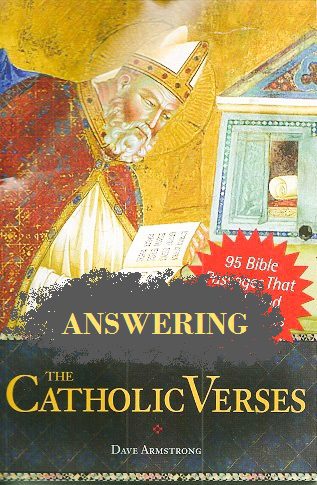
[see book and purchase information for The Catholic Verses]
“excatholic4christ” (Tom) was raised Catholic, lost his faith in high school, attended Mass for a while after he married and had children, and then “accepted Jesus Christ” as his Savior, leading to his sole attendance at an independent fundamental Baptist church for eight years. He claims that the “legalism” of this church and the fact that his “trust had been in men rather than God” caused him to “walk away from the Lord for 23 years.” He “returned to the Lord” in 2014. As of April 2020, Tom stated that he was “somewhere in the middle of the Calvinism-Arminianism debate,” but “closer to Calvinism.” I couldn’t determine his denomination. See Tom’s index of all of his replies. I will now systematically refute them. His words will be in blue. When he cites my words, they will be in black. I use RSV, unless otherwise specified.
*****
This is a reply to Tom’s article, Sinners in the Church? (9-3-18).
With the three passages below, Armstrong argues that both “saints” and “sinners” reside within the church:
2 Corinthians 11:2-4 I feel a divine jealousy for you, for I betrothed you to Christ to present you as a pure bride to her one husband. But I am afraid that as the serpent deceived Eve by his cunning, your thoughts will be led astray from a sincere and pure devotion to Christ. For if someone comes and preaches another Jesus than the one we preached, or if you receive a different spirit from the one you received, or if you accept a different gospel from the one you accepted, you submit to it readily enough.
Galatians 1:1-6 Paul an apostle—not from men nor through man, but through Jesus Christ and God the Father, who raised him from the dead— and all the brethren who are with me, to the churches of Galatia: Grace to you and peace from God the Father and our Lord Jesus Christ, who gave himself for our sins to deliver us from the present evil age, according to the will of our God and Father; to whom be the glory for ever and ever. Amen. I am astonished that you are so quickly deserting him who called you in the grace of Christ and turning to a different gospel.
Revelation 3:1-6 And to the angel of the church in Sardis write: ‘The words of him who has the seven spirits of God and the seven stars. “‘I know your works; you have the name of being alive, and you are dead. Awake, and strengthen what remains and is on the point of death, for I have not found your works perfect in the sight of my God. Remember then what you received and heard; keep that, and repent. If you will not awake, I will come like a thief, and you will not know at what hour I will come upon you. Yet you have still a few names in Sardis, people who have not soiled their garments; and they shall walk with me in white, for they are worthy. He who conquers shall be clad thus in white garments, and I will not blot his name out of the book of life; I will confess his name before my Father and before his angels. He who has an ear, let him hear what the Spirit says to the churches.’
Directly beneath these passages, Armstrong writes, “…(these verses show) the Catholic position: there are sinners in the Church alongside “saints,” as in the parable of the wheat and the tares (Matt. 13:24-30). Many Protestants persist in believing that the Christian Church can be pure and without sinners or instances of hypocrisy, even though these passages show that this was not anticipated by the apostles our by our Lord Jesus.” pp. 16-17.
Armstrong has set up a semi-“straw man” here. To start with, evangelicals refer to the church both in the general sense of all genuine believers around the world who make up the Body of Christ and in the particular sense of a local congregation. Evangelicals certainly believe that when they gather together as a local church (Greek eccleisa [should be ecclesia] “called-out assembly or congregation”), there may be some included who have not genuinely accepted Jesus Christ as their Savior by faith alone.
Only God knows who is of the class of the elect or not. Human beings don’t have certain, infallible knowledge of individuals’ eternal destiny. Even John Calvin agreed with this observation.
But of course Catholics and evangelicals disagree fundamentally on the terms, “sinners” and “saints,” as Armstrong’s comments indicate. We evangelicals believe all people are sinners and deserve eternal punishment,
Catholics hold to original sin as strongly as Protestants do.
but that everyone who repents of their sin and accepts Jesus Christ as their Savior by faith alone are saved and become saints (Latin sanctus, Greek hagios “separated ones“).
Scripture uses the term “saints” in the generic sense of Christian believer (see many examples of this), but at the same time it also notes that there are exceptional people (in effect, saints in the Catholic sense of “exceptionally, heroically holy”) who are more righteous and holier than others:
“All Have Sinned” vs. a Sinless, Immaculate Mary? [1996; revised and posted at National Catholic Register on 12-11-17]
The Bible Is Clear: Some Holy People Are Holier Than Others [National Catholic Register, 9-19-22]
Sinless Creatures in the Bible: Actual & Potential (Including a Listing of Many Biblical Passages About Sin, Holiness, Blamelessness, Righteousness, Godliness, Perfection, and Sanctity) [10-20-22; greatly expanded on 7-27-23]
The Bible presupposes, for example, that there are exceptionally righteous people — such as the prophet Elijah — and that their prayers are more powerful than the prayers of those who are less righteous. James (5:16-18) gave the example of Elijah as “a righteous man” (5:16). noting that “he prayed fervently that it might not rain, and for three years and six months it did not rain on the earth” (5:17). I don’t know of any Protestants (who may think they are so holy and eternally justified since their theology holds that they were merely declared righteous, when in fact they are not) who have successfully prayed such a prayer:
Bible on the Power of Prayers of the Righteous [11-16-22]
I noted in my Reply #2 in this series, the Bible’s reference to “blameless” people:
Zechariah and his wife Elizabeth . . . [are described] as “righteous before God, walking in all the commandments and ordinances of the Lord blameless” (Lk 1:6; cf. other “blameless” men: Noah [Gen 6:9]; King David [2 Sam 22:24]; King Asa [2 Chr 15:17]; Job [Job 1:1, 8; 2:3], and Daniel [Dan 6:22]). And all of this was even before Jesus died on the cross for our salvation and before the Holy Spirit came to dwell inside of all believers!
The book of Hebrews describes the people that Catholics call “saints” in the following passage:
Hebrews 11:32-38 . . . For time would fail me to tell of Gideon, Barak, Samson, Jephthah, of David and Samuel and the prophets — [33] who through faith conquered kingdoms, enforced justice, received promises, stopped the mouths of lions, [34] quenched raging fire, escaped the edge of the sword, won strength out of weakness, became mighty in war, put foreign armies to flight. [35] Women received their dead by resurrection. Some were tortured, refusing to accept release, that they might rise again to a better life. [36] Others suffered mocking and scourging, and even chains and imprisonment. [37] They were stoned, they were sawn in two, they were killed with the sword; they went about in skins of sheep and goats, destitute, afflicted, ill-treated — [38] of whom the world was not worthy — wandering over deserts and mountains, and in dens and caves of the earth.
The word “saint” isn’t used, but it is clearly describing the second use of the word, as Catholics use it. The word “Trinity” and several other common Christian terms aren’t in the Bible, either. St. Paul differentiates between varying levels of devotion to the Lord, including heroic self-sacrifice, in noting (as a generalization, but reflecting reality) that the unmarried man is “anxious about the affairs of the Lord, how to please the Lord” (1 Cor 7:32) and that “the unmarried woman or girl is anxious about the affairs of the Lord, how to be holy in body and spirit” (7:34) and that both exhibit an “undivided devotion to the Lord” (7:35).
Although we are saints because of Christ’s imputed perfect righteousness,
No; we are “saints” in the first, biblical sense if we have professed allegiance to Jesus Christ as our Lord and Savior and are “believers” (see 12 NT uses of that term).
we still have a sinful nature and follow the Lord only imperfectly.
Catholics say that we have a sinful inclination (subject to constant concupiscence, which, if indulged in, leads to temptation and/or sin). But the imperfect following of Jesus and our continued sinning is where we can agree (setting aside for a moment the vexed issue of the nature of justification), and what I am discussing when addressing the topic of “sinners in the Church.” It’s an apologetics topic because some Protestants use the “argument from sin” to claim that the Catholic Church can’t possibly be God’s one true — historically continuous and institutional — Church, founded by Jesus Himself. I in turn argue from the Bible that we are to fully expect and not be surprised at all at the existence of such sinners in the one true Church (because it has always been this way, from the beginning).
Catholic belief, as Armstrong presents it here, generally regards all of those who are not striving to be “good,” those both inside and outside the church, as sinners,
This is untrue. A “sinner” as we define it, is simply one who is presently sinning (as determined by a good examination of one’s own conscience). If a person, for example, steals a coat or visits a house of prostitution, or is a prostitute, then he or she is sinning, and hence, a sinner while they are engaging in those sins. Hence, Jesus said (in agreement with Catholics), “I came not to call the righteous, but sinners” (Mt 9:13); “the Son of man is betrayed into the hands of sinners” (Mt 26:45). “Tax collectors” are often regarded in the NT as synonymous with “sinners” (because they almost universally cheated their own people, as agents of Rome). See Matthew 9:10; Luke 15:1; 18:13.
St. Paul does indeed use the word “sinners” in the sense of “subject to original sin” (Rom 5:8, 19), but he also uses the word in the Catholic sense:
1 Timothy 1:9 understanding this, that the law is not laid down for the just but for the lawless and disobedient, for the ungodly and sinners, for the unholy and profane, for murderers of fathers and murderers of mothers, for manslayers,
The author of Hebrews does the same:
Hebrews 12:3 Consider him who endured from sinners such hostility against himself, so that you may not grow weary or fainthearted.
James is writing to Christians in his letter (“brethren”: 1:2, and 14 other times in the book, including “my beloved brethren”: 1:16, 19; 2:5). Yet at the same time he can call them (at least some of them) “sinners”:
James 4:8 Draw near to God and he will draw near to you. Cleanse your hands, you sinners, and purify your hearts, you men of double mind.
St. Paul states in the present tense: “I am the foremost of sinners” (1 Tim 1:15) because in his past he “persecuted the church of God” (1 Cor 15:9; Gal 1:13). This utterly destroys the notion that the Bible describes as “sinners” only those who are not professed believers, or the “saved” as Protestants say (wrongly thinking that they are certain of their eternal destiny).
and those who have achieved or are on their way to achieving a super-sanctimonious “state of grace,” as saints.
This is incorrect, too. We believe that those who are in a “state of grace” are those who are 1) regenerated (at baptism) and 2) who are not currently engaged in serious, or mortal sin (a biblical distinction). We refer to people as “saints” in the second meaning, who have been determined (by a long “canonization” process of study in the Church) as ones who exhibited heroic, self-sacrificing, extraordinary sanctity. The Bible teaches that there exist differing levels of grace among human beings (even among believers), too.
But what is Armstrong REALLY trying to address here? It’s obvious he’s responding to Protestant objections to Catholic popes, cardinals, bishops, and priests for the copious instances of outrageous immorality, corruption, and cruelty down through the ages.
Yes, and another way I address this much-abused and much misunderstood topic is to note that all Christian groups — including Protestants — have been guilty of great sin, even including murder and persecution of fellow Christians (sanctioned at the highest levels by folks like Luther and Calvin). This renders the entire discussion a “wash.” Nothing is learned or accomplished by it.
It’s apparent to every thinking reader why Armstrong declines to cite that corruption directly in an apologetics book such as this. He’s not going to voluntarily bring up Catholicism’s embarrassing history if he can avoid it, but still feels he must address the Protestant criticism.
Our history is no better or worse than any other Christian group’s history, but it should be noted that we’ve also been around since the time of Christ, whereas Protestantism was invented fifteen centuries after Him; so we simply have much more history — four times as much — that includes sinners in it as well as saints (as we would fully expect, human beings being what they are: mixtures of good and evil).
As for my supposedly attempting to avoid bringing up unpleasant instances in Catholic history, I direct Tom and anyone to my extensive web page, “Inquisition, Crusades, & ‘Catholic Scandals’ “. That’s an odd way of trying to supposedly hide such things. I address it in many places in my writings, including in some of the variants of my conversion story — since objection to the Inquisition was one of my own most strenuous objections to the Catholic Church.
I also have a section entitled, “Papal Scandals / ‘Bad Popes’ ” on my Papacy & Infallibility web page. It contains 18 articles. I’m more than happy to address the issue of “scandals in Catholic history”, but Protestants are always very reluctant to talk about the many “skeletons in their own closet and the glaring scandals that occurred during their so-called “Reformation.”
Protestants know full well that all men sin, even after accepting Christ as Savior by faith alone. What Protestants can’t abide is Catholicism’s boast that popes, in concert with their cardinals and bishops, are infallibly guided in all important matters touching upon faith and morals in the face of such blatant corruption.
The Bible doesn’t teach that authority and infallibility must coincide with personal sinlessness or impeccability. Jesus chose a man (Peter) who denied He was Christ three times, to be the first leader of His Church. Peter wrote part of the New Testament, too. Then He chose Paul to be the preeminent evangelist of all time and one who wrote half or more of the New Testament: a man who had persecuted and murdered Christians before his conversion.
God made an eternal covenant with King David, knowing from all eternity that David would have a man killed so that he could marry his wife, that he was already having sex with. But David repented, and the Bible describes him as “a man after his [i.e., God’s] own heart” (1 Sam 13:14). David became the prototype of the Messiah (Jesus) and wrote most of the Psalms. Moses wrote the first five books of the Bible, but he had murdered a man as well (Ex 2:12). Many more such biblical examples exist. If sinful men could write an inerrant, inspired Bible with the help of God’s grace (a greater gift), then certainly it’s not implausible (let alone impossible) for sinful men to be protected from error when they are popes proclaiming binding doctrine (a far lesser gift than biblical inspiration).
So some popes were notorious sinners? Very few were, in fact, but in any event, this poses no problem at all, in terms of the office possessing infallibility in carefully prescribed conditions. The two things are distinct. Even Jesus had one bad disciple, Judas, who is called a “disciple” several times in the Bible.
***
Related Reading
Sins and Sinners in the Catholic Church [1998]
Are Sinful Church Leaders a Disproof of Catholicism? [1998]
*
How Can the One True Church Have Sinners in it? [2002]
*
“Bad Popes”: How Many Were There? [12-17-07]
*
Bad Popes: Replies to a Sincere Inquirer [5-27-08]
*
Sinners in the Church & God’s Mercy (vs. Calvin #8) [5-15-09]
*
Some Bad Popes = Ditch the Papacy? (vs. Calvin #22) [6-29-09]
*
St. Paul on Sinners in the Church (Notorious Galatians) [12-20-11]
*
Catholic Sinners & Corruption: the “Jesus, Paul, & Revelation” Retort [5-25-17]
*
Don’t Confuse Papal Infallibility with Impeccability [Facebook, 8-31-18]
*
*****
*
Practical Matters: Perhaps some of my 4,500+ free online articles (the most comprehensive “one-stop” Catholic apologetics site) or fifty-three books have helped you (by God’s grace) to decide to become Catholic or to return to the Church, or better understand some doctrines and why we believe them.
*
Or you may believe my work is worthy to support for the purpose of apologetics and evangelism in general. If so, please seriously consider a much-needed financial contribution. I’m always in need of more funds: especially monthly support. “The laborer is worthy of his wages” (1 Tim 5:18, NKJV). 1 December 2021 was my 20th anniversary as a full-time Catholic apologist, and February 2022 marked the 25th anniversary of my blog.
*
PayPal donations are the easiest: just send to my email address: [email protected]. You’ll see the term “Catholic Used Book Service”, which is my old side-business. To learn about the different methods of contributing, including 100% tax deduction, etc., see my page: About Catholic Apologist Dave Armstrong / Donation Information. Thanks a million from the bottom of my heart!
*
***
*
Summary: Anti-Catholic Tom is out to sea in his brief examination of the issue of “sinners in the Church.” I take a deeper look at the Bible’s teaching regarding “sinners” & “saints.”
Inquisition & Crusades & Scandals
Previous Post
October 26, 2023
“Catholic Verses” #3: Tradition, Pt. 1
Next Post
October 27, 2023 “Catholic Verses” #5: Denominationalism
Recent Comments
"Special pleading, and not a serious response to my arguments . . ."
Is Venerating Men & Angels Worship? ..."
""no man needs to teach us."Didn't you just teach us?"
Is Venerating Men & Angels Worship? ..."
""Catholics say they are the only church that can lead people into heaven."In fact, we ..."
Is Venerating Men & Angels Worship? ..."
"And lastly, I belong to no denomination and am free to serve God as He ..."
Is Venerating Men & Angels Worship? ..."
Browse Our Archives
Select a Category & Last Things About Me Anti-Catholicism Atheism & Agnosticism Baptism and Sacramentalism Bible and Tradition Blessed Virgin Mary Books by Dave Armstrong C. S. Lewis Calvinism & General Protestantism Catholic Apologetics Catholic Apologists Catholic conversion Catholic converts Christmas Church (Ecclesiology) Church History Conversion and Converts Development of Doctrine Eastern Orthodoxy Ecumenism & Christian Unity Eucharist & Liturgy Fathers of the Church French Translations G. K. Chesterton Hell Hell & Satan Hell & Satan & Last Things Heresies & Comparative Religion Holistic Health Inquisition & Crusades & Scandals James White Jews & Judaism & Old Testament John Calvin John Henry Newman Liberal / Modernist Theology Life Issues Literary Resume Lutheranism Mariology Martin Luther Music Orthodoxy Papacy & Infallibility Personal Page Philosophy & Science Political & Ethical & Moral Issues Protestant Persecution & Intolerance Protestantism Purgatory Purgatory & Penance Romantic & Imaginative Theology Saints & Purgatory & Penance Salvation Salvation & Justification Satan & Last Things Sexuality and Gender Issues Spanish Translations Traditionalism vs. Radical Catholic Reactionaries Traducciones al español / tradução para português Trinitarianism & Christology Uncategorized Videos
Select a Month November 2026 October 2026 September 2026 August 2026 July 2026 June 2026 May 2026 April 2026 March 2026 February 2026 January 2026 December 2025 November 2025 October 2025 September 2025 August 2025 July 2025 June 2025 May 2025 April 2025 March 2025 February 2025 January 2025 December 2024 November 2024 October 2024 September 2024 August 2024 July 2024 June 2024 May 2024 April 2024 March 2024 February 2024 January 2024 December 2023 November 2023 October 2023 September 2023 August 2023 July 2023 June 2023 May 2023 April 2023 March 2023 February 2023 January 2023 December 2022 November 2022 October 2022 September 2022 August 2022 July 2022 June 2022 May 2022 April 2022 March 2022 February 2022 January 2022 December 2021 November 2021 October 2021 September 2021 August 2021 July 2021 June 2021 May 2021 April 2021 March 2021 February 2021 January 2021 December 2020 November 2020 October 2020 September 2020 August 2020 July 2020 June 2020 May 2020 April 2020 March 2020 February 2020 January 2020 December 2019 November 2019 October 2019 September 2019 August 2019 July 2019 June 2019 May 2019 April 2019 March 2019 February 2019 January 2019 December 2018 November 2018 October 2018 September 2018 August 2018 July 2018 June 2018 May 2018 April 2018 March 2018 February 2018 January 2018 December 2017 November 2017 October 2017 September 2017 August 2017 July 2017 June 2017 May 2017 April 2017 March 2017 February 2017 January 2017 December 2016 November 2016 October 2016 September 2016 August 2016 July 2016 June 2016 May 2016 April 2016 March 2016 February 2016 January 2016 December 2015 November 2015 October 2015 September 2015 August 2015 July 2015 June 2015 May 2015 April 2015 March 2015 February 2015 January 2015 December 2014 November 2014 October 2014 September 2014 August 2014 July 2014 June 2014 April 2014 March 2014 February 2014 January 2014 December 2013 November 2013 October 2013 September 2013 August 2013 July 2013 June 2013 April 2013 March 2013 February 2013 January 2013 December 2012 November 2012 October 2012 September 2012 August 2012 July 2012 June 2012 May 2012 April 2012 March 2012 February 2012 January 2012 December 2011 November 2011 October 2011 September 2011 August 2011 July 2011 June 2011 April 2011 March 2011 February 2011 October 2010 September 2010 August 2010 July 2010 April 2010 March 2010 December 2009 October 2009 August 2009 July 2009 June 2009 May 2009 March 2009 February 2009 October 2008 September 2008 April 2008 March 2008 February 2008 January 2008 December 2007 November 2007 October 2007 May 2007 March 2007 February 2007 January 2007 November 2006 October 2006 September 2006 August 2006 July 2006 June 2006 May 2006 April 2006 March 2006 February 2006 October 2005 June 2005 April 2005 February 2005 July 2004 May 2004 April 2004
Follow Us!
TAKE THE
Religious Wisdom Quiz
Which king saw "the handwriting on the wall"?
Select your answer to see how you score.
Belshazzar Artaxerxes Nebuchadnezzar Cyrus
Books by This Author Books by Dave Armstrong
Related posts from Biblical Evidence for Catholicism
Top Three Anti-Catholic Lies About Catholicism
Biblical Evidence for Catholicism
Three More Anti-Catholic Lies About Catholicism (#6-4)
Biblical Evidence for Catholicism
Bible & Catholicism on Mortal Sin (vs. John...
Biblical Evidence for Catholicism
Top Ten Anti-Catholic Lies (#10-7)
Biblical Evidence for Catholicism
TRENDING AT PATHEOS Catholic

Smart people saying smart things (11.24.26)
Please take time to listen to Perry Bacon, Sarah Posner, Adam Serwer,...

The Contingency of Our Technology
Last week we were hit with a raft of massive technology outages....

In 1939, President Franklin D. Roosevelt moved Thanksgiving from November 30 to...

Reasons for Restraint: Ricardo Gonzalez, Florida and Dec...
The Morning of January 3 I begin with the dead. On the...

I published this column for Thanksgiving 2012 in the Deseret News....

For many years, Catholicism has been caught up in division over the...
view all Catholic blogs
What Are Your Thoughts?leave a comment
Ad-Free & Subscriber Log-In Subscription Support
- About Us
- 2026 Calendar
- Videos
- Podcasts
- Library of World Religions
- Faith In Media Tracker
- Advertise With Us
- Write for Us
- Privacy Policy
- Terms of Service
- Do Not Sell My Data
- Contact Us
- Radiant Digital
- Manage Newsletter Subscriptions
- Unsubscribe From Notifications
- Sitemap
Copyright 2008-2026, Patheos, part of the Radiant Digital network of media brands. All rights reserved.
Subscription Support Ad-Free & Subscriber Log-In
Follow Patheos