
BuddhistCatholicContemplativeEvangelicalGeneral ChristianHinduJewishLatter-day SaintMuslimNew VisionsProgressive Christian
Beliefs
- Buddhist
- Catholic
- Contemplative
- Evangelical
- General Christian
- Hindu
- Jewish
- Latter-day Saint
- More Voices
- Muslim
- New Visions
- Pagan
- Progressive Christian
Topics
- Religion News
- Food and Religion
- Sports and Religion
- Religious Art
- Religious Music and Entertainment
- Religious Events
- History and Religion
- Style and Religion
- Politics and Religion
- Women in Religion
- Recreation Outdoors and Religion
- Business Finance and Religion
- Careers Workplace and Religion
- Education and Religion
- Family Parenting and Religion
- Health Fitness and Religion
- Home and Religion
- Relationships and Religion
- Technology and Religion
- Travel and Religion
Columnists
- Buddhist Columnists
- Business Finance and Religion Columnists
- Careers Workplace and Religion Columnists
- Catholic Columnists
- Contemplative Columnists
- Education and Religion Columnists
- Evangelists Columnists
- Family Parenting and Religion Columnists
- General Christian Columnists
- Health Fitness and Religion Columnists
- Hindu Columnists
- History and Religion Columnists
- Home and Religion Columnists
- Jewish Columnists
- More Voices Columnists
- Latter Day Columnists
- Muslim Columnists
- New Visions Columnists
- Nonreligious Columnists
- Pagan Columnists
- Politics and Religion Columnists
- Progressive Columnists
- Recreation Outdoors and Religion Columnists
- Relationships and Religion Columnists
- Religion News Columnists
- Religious Art Columnists
- Religious Events Columnists
- Religious Music and Entertainment Columnists
- Sports and Religion Columnists
- Style and Religion Columnists
- Technology and Religion Columnists
- Travel and Religion Columnists
- Women in Religion Columnists
Resource Library
- 2026 Calendar
- Library of World Religions
- The 100 Most Holy Places on Earth
- Patheos Answers
- Podcasts
- Videos
- Faith Leaders Database
- Anglican Episcopalian
- Bahai
- Baptist
- Buddhism
- Christianity
- Confucianism
- Eastern Orthodoxy
- Hinduism
- Holiness and Pentecostal
- ISKCON
- Islam
- Judaism
- Lutheran
- Methodist
- The Church of Jesus Christ of Latter-day Saints
- New Age
- Paganism
- Presbytarian and Reformed
- Protestantism
- Religion Behind the Scenes
- Roman Catholic
- Scientology
- Shia Islam
- Sikhism
- Sufism
- Sunni Islam
- Taoism
- Zen
- See all religions
Research Tools
 Ad-Free & Subscriber Log-In Subscription Support
Follow Patheos 

- Trending:
- Advent
- |
- Forgiveness
- |
- Thanksgiving
- |
- Election
- |
- Seasonal Holidays
- |
- Marriage

-
About
-
Catholic Apologetics
-
Church History
-
Great Apologists
-
Christian Worldview
-
Protestantism & Misc.
- Home
- Catholic
- History and Religion
- “Catholic Verses” #1: 1 Tim 3:15 (Church)
“Catholic Verses” #1: 1 Tim 3:15 (Church)
Last updated on: June 6, 2026 at 12:49 am by Dave Armstrong
“Catholic Verses” #1: 1 Tim 3:15 (Church) 2026-06-06T00:49:39-04:00 Dave Armstrong
Patheos Explore the world's faith through different perspectives on religion and spirituality! Patheos has the views of the prevalent religions and spiritualities of the world.
Also, the Biblical Definition of the Gospel
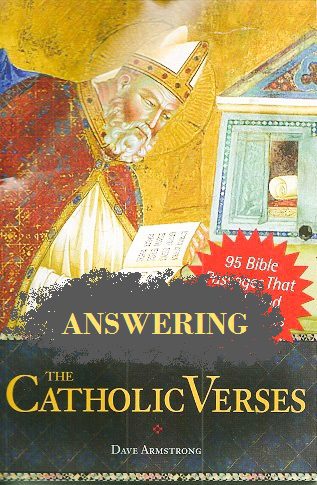
[see book and purchase information for The Catholic Verses]
“excatholic4christ” (Tom) was raised Catholic, lost his faith in high school, attended Mass for a while after he married and had children, and then “accepted Jesus Christ” as his Savior, leading to his sole attendance at an independent fundamental Baptist church for eight years. He claims that the “legalism” of this church and the fact that his “trust had been in men rather than God” caused him to “walk away from the Lord for 23 years.” He “returned to the Lord” in 2014.
By August 2018 he felt he was able and equipped to offer refutations of this book of mine (see his index of all replies; I am banned from commenting on his site). It took him eight months to answer all of my “Catholic verses” (actually 104 in total). At least he did deal with every one, which is commendable. I will now systematically refute them. As of April 2020, Tom stated that he was “somewhere in the middle of the Calvinism-Arminianism debate,” but “closer to Calvinism.” We know neither his name nor his denomination (which is very unimpressive, in my book). His words will be in blue. When he cites my words, they will be in black. I use RSV, unless otherwise specified.
*****
#1: The Church is the Pillar of All Truth? (8-13-18)
I completely agree with Armstrong’s argument that the gospel preached by Catholicism (salvation by sacramental grace and merit) and the Gospel preached by Biblical Christianity (salvation by God’s grace through faith in Jesus Christ alone) are not the same, but are, in fact, diametrically opposed.
Except for the small detail that I have never made such an argument. I have maintained — both as a Protestant and Catholic apologist, since 1981 — that the gospel, as it is defined in the Bible itself, is held by Protestants, Orthodox, and Catholics alike. St. Paul defines the gospel in Acts 13:16-41 as the resurrection of Jesus (vss. 32-33), and in 1 Corinthians 15:1-8, the “gospel” (15:1) that he “preached” (1:1) was that “Christ died for our sins” (15:3), was “was raised on the third day” (15:4), and appeared to Peter, the disciples, the apostles, and “more than five hundred brethren” (15:5-8).
We must define the “gospel” from the Bible. I just did so, and anyone who knows basic Christian theology knows that all three great branches of Christianity completely concur in these things. We do have other differences, of course. Catholics agree with Protestants that we are ultimately saved by Christ alone (Jn 11:25-26; 12:46; Rom 5:9-10), through grace alone (e.g., Rom 3:24; Gal 1:15; Eph 2:8; 2 Tim 1:9), and by and through faith (Rom 3:28; 5:1; Gal 2:16; 3:24), because those are biblical teachings. We disagree that salvation is by faith alone because that is not a biblical teaching:
Matthew 7:21 Not every one who says to me, ‘Lord, Lord,’ shall enter the kingdom of heaven, but he who does the will of my Father who is in heaven.
John 14:12 Truly, truly, I say to you, he who believes in me will also do the works that I do; and greater works than these will he do, because I go to the Father.
Romans 2:13 For it is not the hearers of the law who are righteous before God, but the doers of the law who will be justified.
James 1:22 But be doers of the word, and not hearers only, deceiving yourselves.
James 2:14 What does it profit, my brethren, if a man says he has faith but has not works? Can his faith save him? (cf. 2:24)
The Catholic Church teaches that Protestants believe in the same gospel as we do in stating that Protestants, “as members of corporate groups . . . have heard the Gospel . . . The sacred Council gladly notes all this” (Vatican II, Decree on Ecumenism [Unitatis Redintegratio], 21 November 1964).
. . . let’s look at the first of the [sic] Armstrong’s “Catholic” verses by which he claims the church is the pillar of the truth:
I didn’t “claim” anything here. It was St. Paul in the inspired, inerrant revelation of Scripture who claimed that, in 1 Timothy 3:15. I merely defend what he wrote (“. . . the household of God, which is the church of the living God, the pillar and bulwark of the truth”).
From this verse, Armstrong argues that the Catholic church “is the [ . . . ] foundation [ . . . ] of truth; it is infallible; it is specially protected by the Holy Spirit so that it can be the Guardian and Preserver of apostolic tradition and truth and doctrine” (p. 3).
Tom improperly abridged my words without noting it, as indicated by the bracketed ellipses. The meaning wasn’t changed, but it is still a sloppy and inaccurate citation.
But is it reasonable to construe all of those claims from this verse?
Yes; it’s perfectly reasonable and solid exegesis.
Catholicism is prone to greatly overreach with its Bible interpretations as we shall see going forward.
I actually made a much more elaborate analysis of the passage eight years later in my book, 100 Biblical Arguments Against Sola Scriptura (2012, pp. 104-107, #82):
Pillars and foundations support things and prevent them from collapsing. To be a “bulwark” of the truth, means to be a “safety net” against truth turning into falsity. If the Church could err, it could not be what Scripture says it is. God’s truth would be the house built on a foundation of sand in Jesus’ parable. For this passage of Scripture to be true, the Church could not err — it must be infallible. A similar passage may cast further light on 1 Timothy 3:15:
Ephesians 2:19-21 . . . you are fellow citizens with the saints and members of the household of God, [20] built upon the foundation of the apostles and prophets, Christ Jesus himself being the cornerstone, [21] in whom the whole structure is joined together and grows into a holy temple in the Lord;
1 Timothy 3:15 defines “household of God” as “the church of the living God.” Therefore, we know that Ephesians 2:19-21 is also referring to the Church, even though that word is not present. Here the Church’s own “foundation” is “the apostles and prophets, Christ Jesus himself being the cornerstone.” The foundation of the Church itself is Jesus and apostles and prophets.
Prophets spoke “in the name of the Lord” (1 Chron 21:19; 2 Chron 33:18; Jer 26:9), and commonly introduced their utterances with “thus says the Lord” (Is 10:24; Jer 4:3; 26:4; Ezek 13:8; Amos 3:11-12; and many more). They spoke the “word of the Lord” (Is 1:10; 38:4; Jer 1:2; 13:3, 8; 14:1; Ezek 13:1-2; Hos 1:1; Joel 1:1; Jon 1:1; Mic 1:1, et cetera). These communications cannot contain any untruths insofar as they truly originate from God, with the prophet serving as a spokesman or intermediary of God (Jer 2:2; 26:8; Ezek 11:5; Zech 1:6; and many more). Likewise, apostles proclaimed truth unmixed with error (1 Cor 2:7-13; 1 Tim 2:7; 2 Tim 1:11-14; 2 Pet 1:12-21).
Does this foundation have any faults or cracks? Since Jesus is the cornerstone, he can hardly be a faulty foundation. Neither can the apostles or prophets err when teaching the inspired gospel message or proclaiming God’s word. In the way that apostles and prophets are infallible, so is the Church set up by our Lord Jesus Christ. We ourselves (all Christians) are incorporated into the Church (following the metaphor), on top of the foundation.
1 Peter 2:4-9 Come to him, to that living stone, rejected by men but in God’s sight chosen and precious; [5] and like living stones be yourselves built into a spiritual house, to be a holy priesthood, to offer spiritual sacrifices acceptable to God through Jesus Christ. [6] For it stands in scripture: “Behold, I am laying in Zion a stone, a cornerstone chosen and precious, and he who believes in him will not be put to shame.” [7] To you therefore who believe, he is precious, but for those who do not believe, “The very stone which the builders rejected has become the head of the corner,” [8] and “A stone that will make men stumble, a rock that will make them fall”; for they stumble because they disobey the word, as they were destined to do. [9] But you are a chosen race, a royal priesthood, a holy nation, God’s own people, that you may declare the wonderful deeds of him who called you out of darkness into his marvelous light. (cf. Isa 28:16)
Jesus is without fault or untruth, and he is the cornerstone of the Church. The Church is also more than once even identified with Jesus himself, by being called his “Body” (Acts 9:5 cf. with 22:4 and 26:11; 1 Cor 12:27; Eph 1:22-23; 4:12; 5:23, 30; Col 1:24). That the Church is so intimately connected with Jesus, who is infallible, is itself a strong argument that the Church is also infallible and without error.
Therefore, the Church is built on the foundation of Jesus (perfect in all knowledge), and the prophets and apostles (who spoke infallible truth, often recorded in inspired, infallible Scripture). Moreover, it is the very “Body of Christ.” It stands to reason that the Church herself is infallible, by the same token. In the Bible, nowhere is truth presented as anything less than pure truth, unmixed with error. That was certainly how Paul conceived his own “tradition” that he received and passed down.
Knowing what truth is, how can its own foundation or pillar be something less than total truth (since truth itself contains no falsehoods, untruths, lies, or errors)? It cannot. It is impossible. It is a straightforward matter of logic and plain observation. A stream cannot rise above its source. What is built upon a foundation cannot be greater than the foundation. If it were, the whole structure would collapse.
If an elephant stood on the shoulders of a man as its foundation, that foundation would collapse. The base of a skyscraper has to hold the weight above it. The foundations of a suspension bridge over a river have to be strong enough to support that bridge.
Therefore, we must conclude that if the Church is the foundation of truth, the Church must be infallible, since truth is infallible, and the foundation cannot be lesser than that which is built upon it. And since there is another infallible authority apart from Scripture, sola scriptura must be false.
If Tom cares to counter-respond and actually engage in back-and-forth, one-on-one dialogue and debate, I’d love to see him grapple with all that. I understand that this was from a different book, but nevertheless it’s my more detailed and thought-through argumentation and reasoning regarding the same passage. In any event, what he views as “overreach”, I regard as a rather straightforward logical conclusion (as just explained).
If we examine the original Greek used in this verse, we find that the words for pillar and foundation, stulos and hedraioma, mean “pillar, column, prop, or support” and “prop or support” respectively.
That’s right. Stylos is Strong’s Greek word #4769 and hedraiōma is Strong’s Greek word #1477. I have drawn out the logical implications of the two words. Stylos appears 138 times in 99 passages in the Septuagint (LXX): the 3rd c. BC Greek translation of the Old Testament. It was used, for example, twice with regard to the pillars that Samson broke apart, bringing down the house on his Philistine enemies:
Judges 16:26 . . . the pillars on which the house rests . . .
Judges 16:29 And Samson grasped the two middle pillars upon which the house rested, . . .
Likewise, in 1 Timothy 3:15, the Church is the stylos of the truth. If it collapses, the truth goes with it. But we know that the Church is indefectible and will never collapse or depart from apostolic, spiritual, biblical, and theological truth. The same word was used with regard to Solomon’s house, which “was covered with cedar above the chambers that were upon the forty-five pillars, fifteen in each row” (1 Kgs 7:3). The pillars support the chambers. The Church supports and upholds the truth, and to do so it must be infallible, as I argued above.
I like how hedraiōma is translated in Tom’s own NIV: “foundation.” What does it mean to be the “foundation” of the truth? I have elaborated upon what I think it means. On the Bible Gateway site that provides many translations for a given Bible verse, for our passage it lists no less than 32 versions that render hedraiōma as “foundation”, sixteen use “support” and eleven translate it as “ground.” There is no mystery as to what is meant in this passage. Protestants simply don’t like what it means — what the implications would be — (notably, the death of sola Scriptura as a rule of faith), and so they desperately seek to define it away.
The church (all genuine believers in Christ, not just leaders) is not the foundation of the truth, but is the steward of the truth, which we have in God’s Word. . . .
Paul makes it repeatedly clear throughout his epistles that Scripture is our standard, not weak, fallible men inside the church.
This is ridiculous argumentation. Tom sees the verse before us, but brazenly ignores the clear implications of its meaning and proclaims his own eisegetical “interpretation” which has nothing to do with the passage itself; denying that the Church is the foundation of the truth, even though Paul in the Bible plainly states that it is. This is not proper exegesis. It is a deliberate twisting of God’s Word. Sadly, there is no other way to describe it. He has to grapple with the passage itself, as I have (more fully in my other book). If it doesn’t fit his theology, so much the worse for his theology . . .
For Catholics, Scripture is the foundation of the truth, too. There is no false dichotomy or either/or. Our rule of faith is the so-called “three-legged stool” of Bible-Tradition-Church. Though a different Greek word is used, Jesus expressed the same principle that the “house . . . without a foundation . . . fell, and the ruin . . . was great” (Lk 6:49; cf. the “house upon the sand”: Mt 7:26, as opposed to the “house upon the rock”: 7:24). In Solomon’s house, the “foundation” consisted of “huge stones, stones of eight and ten cubits” (1 Kgs 7:10). So what does the Bible describe as the “pillar and bulwark / ground / support / foundation” of the truth? The Church . . . I searched in both testaments and never do “word” and “pillar” or “foundation” appear together, as “church” and those terms do in 1 Timothy 3:15.
The pope and his bishops have set themselves up as the foundation and source of belief, leading to the creation of a plethora of spurious traditions throughout the centuries, but it is Jesus Christ and His Word that are our spiritual foundation.
More boilerplate obfuscation. To repeat, it’s the Bible (His Word, last time I checked) that plainly refers to “the church of the living God, the pillar and bulwark of the truth”. God stated this; communicated it to us through the inspired (literally “God-breathed”) writing of the apostle Paul. Catholics didn’t make this up. And this passages demolishes sola Scriptura in one fell swoop and entirely, dramatically supports the Catholic “three-legged stool” rule of faith. The Church is always in harmony with the biblical revelation, and supports the tradition, which is also in harmony with the Bible.
Tom flatly refuses to exegete the passage, and it is a pathetic, pitiful display and a disgrace to the often venerable enterprise of Protestant apologetics.
“For no one can lay a foundation other than that which is laid, which is Jesus Christ.” – 1 Corinthians 3:11
According to Tom’s convoluted “reasoning” the Bible contradicts itself when it describes the Church as the “foundation” of truth. But inspired, inerrant documents cannot do that. It’s clear that there are different senses of “foundation” involved. That’s why Ephesians 2:20 (cited above from my other book) not only mentions Jesus as the “cornerstone” of “the household of God” but also in the same verse, that the Church is “built upon the foundation of the apostles and prophets.” The biblical and Hebraic outlook is “both/and.” The Church is built upon Jesus and also apostles and prophets. That’s what the Bible teaches, no matter how much Tom may hate it. I don’t hate or try to wish away any biblical teaching. I conform my beliefs and my behavior to all of biblical teaching.
Throughout these replies, I will refuse to go down the usual rabbit trails and 101 diversions / “Bible hopscotch” games that anti-Catholics habitually employ. Tom is no different, and he attempted that in this reply. I will stick to the topic at hand. I did, however (as an exception to what will be my rule), address the issue of the nature of the gospel above, because that is fundamental and presuppositional in the overall discussion.
At the end, Tom cited two articles on this topic, to which he is “indebted.” At first I thought I would dismantle them, too, but on second thought I decided that if Tom wants to draw from other sources (which is perfectly fine), let him at least incorporate their thoughts and make the argument in his own words, which I would in turn deal with. As it is, he scarcely made any argument at all. If this reply is typical of what is to come in the next 103 installments, surely I will need ample prayer for heroic patience, to endure the almost unendurable tedium and relentless inanities entailed.
*
*****
*
Practical Matters: Perhaps some of my 4,500+ free online articles (the most comprehensive “one-stop” Catholic apologetics site) or fifty-three books have helped you (by God’s grace) to decide to become Catholic or to return to the Church, or better understand some doctrines and why we believe them.
*
Or you may believe my work is worthy to support for the purpose of apologetics and evangelism in general. If so, please seriously consider a much-needed financial contribution. I’m always in need of more funds: especially monthly support. “The laborer is worthy of his wages” (1 Tim 5:18, NKJV). 1 December 2021 was my 20th anniversary as a full-time Catholic apologist, and February 2022 marked the 25th anniversary of my blog.
*
PayPal donations are the easiest: just send to my email address: [email protected]. You’ll see the term “Catholic Used Book Service”, which is my old side-business. To learn about the different methods of contributing, including 100% tax deduction, etc., see my page: About Catholic Apologist Dave Armstrong / Donation Information. Thanks a million from the bottom of my heart!
*
***
*
Summary: I dismantle anti-Catholic Tom’s virtual “dissing” of an inspired Bible verse: 1 Timothy 3:15. He offers no exegesis whatsoever. I offer extensive and systematic exegesis.
Previous Post
October 19, 2023
Holy Eucharist & Sacrifice of the Mass
Next Post
October 25, 2023 “Catholic Verses” #2: Jerusalem Council
Recent Comments
"Special pleading, and not a serious response to my arguments . . ."
Is Venerating Men & Angels Worship? ..."
""no man needs to teach us."Didn't you just teach us?"
Is Venerating Men & Angels Worship? ..."
""Catholics say they are the only church that can lead people into heaven."In fact, we ..."
Is Venerating Men & Angels Worship? ..."
"And lastly, I belong to no denomination and am free to serve God as He ..."
Is Venerating Men & Angels Worship? ..."
Browse Our Archives
Select a Category & Last Things About Me Anti-Catholicism Atheism & Agnosticism Baptism and Sacramentalism Bible and Tradition Blessed Virgin Mary Books by Dave Armstrong C. S. Lewis Calvinism & General Protestantism Catholic Apologetics Catholic Apologists Catholic conversion Catholic converts Christmas Church (Ecclesiology) Church History Conversion and Converts Development of Doctrine Eastern Orthodoxy Ecumenism & Christian Unity Eucharist & Liturgy Fathers of the Church French Translations G. K. Chesterton Hell Hell & Satan Hell & Satan & Last Things Heresies & Comparative Religion Holistic Health Inquisition & Crusades & Scandals James White Jews & Judaism & Old Testament John Calvin John Henry Newman Liberal / Modernist Theology Life Issues Literary Resume Lutheranism Mariology Martin Luther Music Orthodoxy Papacy & Infallibility Personal Page Philosophy & Science Political & Ethical & Moral Issues Protestant Persecution & Intolerance Protestantism Purgatory Purgatory & Penance Romantic & Imaginative Theology Saints & Purgatory & Penance Salvation Salvation & Justification Satan & Last Things Sexuality and Gender Issues Spanish Translations Traditionalism vs. Radical Catholic Reactionaries Traducciones al español / tradução para português Trinitarianism & Christology Uncategorized Videos
Select a Month November 2026 October 2026 September 2026 August 2026 July 2026 June 2026 May 2026 April 2026 March 2026 February 2026 January 2026 December 2025 November 2025 October 2025 September 2025 August 2025 July 2025 June 2025 May 2025 April 2025 March 2025 February 2025 January 2025 December 2024 November 2024 October 2024 September 2024 August 2024 July 2024 June 2024 May 2024 April 2024 March 2024 February 2024 January 2024 December 2023 November 2023 October 2023 September 2023 August 2023 July 2023 June 2023 May 2023 April 2023 March 2023 February 2023 January 2023 December 2022 November 2022 October 2022 September 2022 August 2022 July 2022 June 2022 May 2022 April 2022 March 2022 February 2022 January 2022 December 2021 November 2021 October 2021 September 2021 August 2021 July 2021 June 2021 May 2021 April 2021 March 2021 February 2021 January 2021 December 2020 November 2020 October 2020 September 2020 August 2020 July 2020 June 2020 May 2020 April 2020 March 2020 February 2020 January 2020 December 2019 November 2019 October 2019 September 2019 August 2019 July 2019 June 2019 May 2019 April 2019 March 2019 February 2019 January 2019 December 2018 November 2018 October 2018 September 2018 August 2018 July 2018 June 2018 May 2018 April 2018 March 2018 February 2018 January 2018 December 2017 November 2017 October 2017 September 2017 August 2017 July 2017 June 2017 May 2017 April 2017 March 2017 February 2017 January 2017 December 2016 November 2016 October 2016 September 2016 August 2016 July 2016 June 2016 May 2016 April 2016 March 2016 February 2016 January 2016 December 2015 November 2015 October 2015 September 2015 August 2015 July 2015 June 2015 May 2015 April 2015 March 2015 February 2015 January 2015 December 2014 November 2014 October 2014 September 2014 August 2014 July 2014 June 2014 April 2014 March 2014 February 2014 January 2014 December 2013 November 2013 October 2013 September 2013 August 2013 July 2013 June 2013 April 2013 March 2013 February 2013 January 2013 December 2012 November 2012 October 2012 September 2012 August 2012 July 2012 June 2012 May 2012 April 2012 March 2012 February 2012 January 2012 December 2011 November 2011 October 2011 September 2011 August 2011 July 2011 June 2011 April 2011 March 2011 February 2011 October 2010 September 2010 August 2010 July 2010 April 2010 March 2010 December 2009 October 2009 August 2009 July 2009 June 2009 May 2009 March 2009 February 2009 October 2008 September 2008 April 2008 March 2008 February 2008 January 2008 December 2007 November 2007 October 2007 May 2007 March 2007 February 2007 January 2007 November 2006 October 2006 September 2006 August 2006 July 2006 June 2006 May 2006 April 2006 March 2006 February 2006 October 2005 June 2005 April 2005 February 2005 July 2004 May 2004 April 2004
Follow Us!
TAKE THE
Religious Wisdom Quiz
Who was the ruler of Egypt during Joseph's time?
Select your answer to see how you score.
Caesar Cyrus Nebuchadnezzar Pharaoh
Books by This Author Books by Dave Armstrong
Related posts from Biblical Evidence for Catholicism
Top Three Anti-Catholic Lies About Catholicism
Biblical Evidence for Catholicism
Three More Anti-Catholic Lies About Catholicism (#6-4)
Biblical Evidence for Catholicism
Top Ten Anti-Catholic Lies (#10-7)
Biblical Evidence for Catholicism
Jesus Founded the [Catholic] Church. If Not Him,...
Biblical Evidence for Catholicism
TRENDING AT PATHEOS Catholic

Book III, Chapter 3: Christ "Classic" (Matt. 9:9-34)
Book III, Chapter 3: Christ "Classic" (Matt. 9:9-34) In honor of tomorrow's...

Jesus explicitly mentions the book of Jonah twice, but he retells the...

Peggy Sue Got Married: Coppola’s Always Been Like...
I enjoyed Megalopolis (2024). It’s a mess, but I enjoyed it. The...

My dissertation The Place of Mysticism in the Late Middle Ages concerns...

God and the Contingency of This World
The great Catholic philosopher Aquinas and the great Lutheran philosopher Leibniz developed...

Pope Francis and The Devil – A Pagan...
According to his private diaries, Pope Francis saw visions of the devil...
view all Catholic blogs
What Are Your Thoughts?leave a comment
Ad-Free & Subscriber Log-In Subscription Support
- About Us
- 2026 Calendar
- Videos
- Podcasts
- Library of World Religions
- Faith In Media Tracker
- Advertise With Us
- Write for Us
- Privacy Policy
- Terms of Service
- Do Not Sell My Data
- Contact Us
- Radiant Digital
- Manage Newsletter Subscriptions
- Unsubscribe From Notifications
- Sitemap
Copyright 2008-2026, Patheos, part of the Radiant Digital network of media brands. All rights reserved.
Subscription Support Ad-Free & Subscriber Log-In
Follow Patheos