
BuddhistCatholicContemplativeEvangelicalGeneral ChristianHinduJewishLatter-day SaintMuslimNew VisionsProgressive Christian
Beliefs
- Buddhist
- Catholic
- Contemplative
- Evangelical
- General Christian
- Hindu
- Jewish
- Latter-day Saint
- More Voices
- Muslim
- New Visions
- Pagan
- Progressive Christian
Topics
- Religion News
- Food and Religion
- Sports and Religion
- Religious Art
- Religious Music and Entertainment
- Religious Events
- History and Religion
- Style and Religion
- Politics and Religion
- Women in Religion
- Recreation Outdoors and Religion
- Business Finance and Religion
- Careers Workplace and Religion
- Education and Religion
- Family Parenting and Religion
- Health Fitness and Religion
- Home and Religion
- Relationships and Religion
- Technology and Religion
- Travel and Religion
Columnists
- Buddhist Columnists
- Business Finance and Religion Columnists
- Careers Workplace and Religion Columnists
- Catholic Columnists
- Contemplative Columnists
- Education and Religion Columnists
- Evangelists Columnists
- Family Parenting and Religion Columnists
- General Christian Columnists
- Health Fitness and Religion Columnists
- Hindu Columnists
- History and Religion Columnists
- Home and Religion Columnists
- Jewish Columnists
- More Voices Columnists
- Latter Day Columnists
- Muslim Columnists
- New Visions Columnists
- Nonreligious Columnists
- Pagan Columnists
- Politics and Religion Columnists
- Progressive Columnists
- Recreation Outdoors and Religion Columnists
- Relationships and Religion Columnists
- Religion News Columnists
- Religious Art Columnists
- Religious Events Columnists
- Religious Music and Entertainment Columnists
- Sports and Religion Columnists
- Style and Religion Columnists
- Technology and Religion Columnists
- Travel and Religion Columnists
- Women in Religion Columnists
Resource Library
- 2026 Calendar
- Library of World Religions
- The 100 Most Holy Places on Earth
- Patheos Answers
- Podcasts
- Videos
- Faith Leaders Database
- Anglican Episcopalian
- Bahai
- Baptist
- Buddhism
- Christianity
- Confucianism
- Eastern Orthodoxy
- Hinduism
- Holiness and Pentecostal
- ISKCON
- Islam
- Judaism
- Lutheran
- Methodist
- The Church of Jesus Christ of Latter-day Saints
- New Age
- Paganism
- Presbytarian and Reformed
- Protestantism
- Religion Behind the Scenes
- Roman Catholic
- Scientology
- Shia Islam
- Sikhism
- Sufism
- Sunni Islam
- Taoism
- Zen
- See all religions
Research Tools
 Ad-Free & Subscriber Log-In Subscription Support
Ad-Free & Subscriber Log-In Subscription Support
Follow Patheos 

- Trending:
- Forgiveness
- |
- Marriage
- |
- Consciousness
- |
- Death Penalty
- |
- Election
- |
- Halloween

-
About
-
Catholic Apologetics
-
Church History
-
Great Apologists
-
Christian Worldview
-
Protestantism & Misc.
- Home
- Catholic
- History and Religion
- Bp. Butler’s Refutation of Anti-Catholic George Salmon, Pt. 4
Bp. Butler’s Refutation of Anti-Catholic George Salmon, Pt. 4
Last updated on: June 6, 2026 at 12:02 am by Dave Armstrong
Bp. Butler’s Refutation of Anti-Catholic George Salmon, Pt. 4 2026-06-06T00:02:24-04:00 Dave Armstrong
Patheos Explore the world's faith through different perspectives on religion and spirituality! Patheos has the views of the prevalent religions and spiritualities of the world.
Roman Primacy in the Early Church; First Clement; Ignatius & Cyprian on the Papacy; Pope Liberius; Sozomen & Socrates on Papal Primacy; Pope Honorius
The Infallibility of the Church (1888), a book written by Anglican anti-Catholic polemicist George Salmon (1819-1904), may be one of the most extensive and detailed — as well as influential — critiques of the Catholic Church ever written. But, as usual with these sorts of works, it’s abominably argued and relentlessly ignorant and/or dishonest, as the critiques listed below amply demonstrate and document.
*
The most influential and effective anti-Catholic Protestant polemicist today, “Dr” [???] James White, cites Salmon several times in his written materials, and regards his magnum opus as an “excellent” work. In a letter dated 2 November 1959, C. S. Lewis recommended the book to a reader, Michael Edwards, who was “vexed” about papal infallibility (see: The Collected Letters of C. S. Lewis, Volume 3: Narnia, Cambridge, and Joy, 1950 – 1963, edited by Walter Hooper, New York: HarperCollins, 2007, p. 1133, footnote 24). Russell P. Spittler, professor of New Testament at Fuller Theological Seminary, wrote that “From an evangelical standpoint,” the book “has been standard since first published in 1888” (Cults and Isms, Baker Book House, 1973, 117). Well-known Baptist apologist Edward James Carnell called it the “best answer to Roman Catholicism” in a 1959 book. I think we can safely say that it is widely admired among theological (as well as “emotional”) opponents of the Catholic Church.
*
Prominent Protestant apologist Norman Geisler and his co-author Ralph MacKenzie triumphantly but falsely claim, in a major critique of Catholicism, Roman Catholics and Evangelicals: Agreements and Differences (Grand Rapids, Michigan: Baker Books, 1995, 206-207, 459), that Salmon’s book has “never really been answered by the Catholic Church,” and call it the “classic refutation of papal infallibility,” which also offers “a penetrating critique of Newman’s theory.”
*
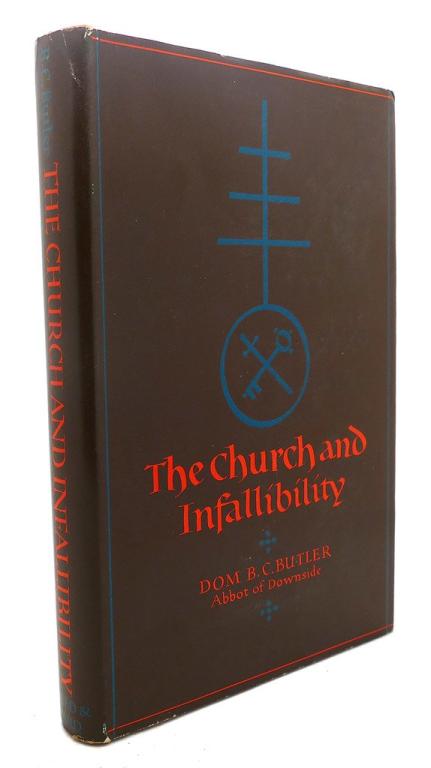
Salmon’s tome, however, has been roundly refuted at least twice: first, by Rev. Dr. Jeremiah Murphy in The Irish Ecclesiastical Record (March / May / July / September / November 1901 and January / March 1902): a response (see the original sources) — which I’ve now transcribed almost in its totality: adding up to more than 73,000 words, or approximately 257 pages (last two installments abridged a bit); secondly, by Bishop Basil Christopher Butler (1902-1986) in his book, The Church and Infallibility: A Reply to the Abridged ‘Salmon’ (New York: Sheed & Ward, 1954, 230 pages). See all of these replies — and any further ones that I make — listed under “George Salmon” on my Anti-Catholicism web page.
*
See also my thorough refutation of Salmon’s false and scurrilous accusation of St. Cardinal Newman, regarding papal infallibility: John Henry Newman’s Alleged Disbelief in Papal Infallibility Prior to 1870, and Supposed Intellectual Dishonesty Afterwards [8-11-11]
*
Bishop Butler’s book is partially available (8 chapters of 11) in old Internet Archive files (see chapters one / two / three / four / five / six / seven) and another web page with Chapter Ten. Most of these files will eventually be inaccessible, so I have decided to select highlights of all of these chapters, and also from chapters eight, nine, and eleven, from my own hardcover copy of the book. The words below are all from Bishop Butler, edited and abridged by myself. I will indicate which chapter excerpts are from, but not page numbers. George Salmon’s words will be in blue.
*
*****
*
See other installments of this series:
*
*
*
*
*****
Chapter Eight: The Church and See of Rome in Antiquity
*
I agree with Salmon that it is a question of tracing a development. This is not tantamount to “abandoning Tradition as a basis for the doctrine of Papal Supremacy” ([Salmon], p. 152), any more than to trace he development of a human character from childhood to maturity is to renounce the effort to see his life as a historical unity.
*
He often mentions “the Church”, but never seems to face squarely the question: What is the Church?
*
I . . . quote two dicta of the great liberal Protestant scholar Harnack: “The (local) Christian churches became a real confederation under the primacy of the Roman Church (and later under the leadership of the bishop of that Church)” [Dogmengeschichte, 4th ed., vol. I, p. 489]. And again: “The Roman Church from the end of the first century possessed a de facto primacy in Christendom” [Mission und Ausbrietung, 2nd ed., 1906, vol. I, p. 398].
*
[T]he Epistle of Clement . . . is a striking intervention on the part of Rome in the affairs of the Church of Corinth, . . . but Salmon thinks, “could clearly not be regarded as an attempt by Rome to domineer over provincial Churches” [p. 163]. But the great Anglican scholar Lightfoot (in 1890) wrote of this Epistle as follows:
*
It is . . . instructive to observe the urgent and almost imperious tone which the Romans adopt in addressing their Corinthian brethren during the closing years of the first century . . . It may perhaps seem strange to describe this noble remonstrance as the first step towards papal domination. And yet undoubtedly this is the case. [St. Clement of Rome, 1890, vol. I, p. 698]
Harnack, once again, is worth quoting:
*
This letter to the Corinthians proves that already at the end of the first century the Roman church . . . kept watch with maternal care for distant churches, and that at that date she knew how to utter the word that is an expression of duty, of love, and of authority at the same time. [Dogmengeschichte, 4th ed., vol. I, p. 485]
[Dave: see my articles: Pope St. Clement of Rome & Papal Authority [7-28-21] / Is First Clement Non-Papal? (vs. Jason Engwer) [4-19-22] ]
*
It is surely somewhat remarkable that, in the eyes of good scholars, both 1 Clement and the only slightly later letter of Ignatius to the Romans should alike bear witness, just before and just after the end of the apostolic ages, to the primacy, not to say the authority, of the Roman Church. . . . [T]here is no hint that Ignatius respected the Church of Rome precisely because of the prestige of the capital city. And both epistles speak of Peter and Paul in a way which at least suggests that this apostolic origin is the real source of the Roman Church’s pre-eminence.
*
[I]t should be noticed — and Salmon is silent on this point — that before (apparently) the baptismal controversy Cyprian had urged the Bishop of Rome . . . to send to Gaul and excommunicate the Bishop of Arles and supply a successor [Ep. 68, 3].
*
It [also] appears that Cyprian had accepted and proclaimed, before the baptismal controversy, the principle that to be in communion with the Catholic Church (i.e., to be within the ark of salvation) one must be in communion with the See of Rome.
*
Chapter Nine: Empire and Papacy
*
The “fall of Liberius” is discussed by Salmon (pp. 206-209), and the question of its extent must occupy us in a moment. But it seems fitting to remark first that, even if Salmon’s version is accepted as true, papal infallibility as defined by the Vatican Council is not involved. Not only is it to be considered highly doubtful whether Liberius (in exile and under imperial pressure) could have any intention of making an ex cathedra pronouncement: but it cannot be shown that he signed anything that was positively erroneous. Salmon himself states [p. 208]: the “worst of the formulas”, one of which Liberius is supposed to have signed, “did not assert anything untrue, but merely omitted the phrases which the orthodox used to exclude the Arians.”
*
Salmon . . . gives a minimal interpretation of Julius’s letter vindicating Athanasius, and states that “the Greek historians, Socrates and Sozomen, appear simply to report what had been said by Julius” [p. 195]. As a matter of fact Socrates says that Julius reproved the Easterns, “since the ecclesiastical canon orders that the churches shall not make canons against the judgment of the Bishop of Rome” (ii, 17), and Sozomen (following Socrates), that Julius blamed them, “saying that it was a sacerdotal law that what was done against the will of the Roman bishop was null and void” (iii, 10).
*
Salmon . . . fails to make it clear that the ultimate victory in doctrinal disputes from A.D. 451 onwards always lay with the side that had Rome with it.
*
Chapter Ten: The Sixth Century and Beyond
*
So we pass on to the celebrated affair of Pope Honorius and his condemnation in the seventh century [Salmon, pp. 213-15, 220-2. See Chapman’s The Condemnation of Pope Honorius, which I follow closely]. The bare and essential facts of this affair may be briefly stated, once the theological issue has been made clear. The Council of Chalcedon had defined that Jesus Christ was one person (hypostasis) in two perfect natures, one divine (by which he was the Son of God) and one human (whereby he was the Son of Mary). The Monophysites, and among them almost the whole of Egyptian Christianity, had rejected this definition and affirmed that there was “one nature” of the incarnate Word of God; in consequence they were excommunicate. About A.D. 630 a “considerable section” [Chapman, from whom the following unassigned quotations are taken] of the Egyptian Monophysites were reconciled to the Church on acceptance of the proposition that Christ’s works, alike the human and divine, are wrought by “one theandric [i.e. divino-human] operation” — the main thesis of the Monothelite heresy. The Catholic truth is that Christ has a divine will but also a human will (two wills, then), and that each will has its own “operation” or working.
The Emperor and Sergius, Patriarch of Constantinople, welcomed the reconciliation of the Monophysites; but on receiving a protest against the teaching of “one operation” from a Palestinian monk named Sophronius, Sergius “took the obvious course of laying the whole matter before the Pope”, Honorius by name. Honorius replied to the effect that the expression “one operation” was objectionable. “But he goes on to admit one will, because our Lord took to himself a human nature free from original sin. The reason given implies that our Lord has a human will, only not also a corrupt lower human will… The Pope declares that to teach one operation will seem Eutychian”, i.e. Monophysite, “while to teach two will seem Nestorian. Both expressions are consequently to be avoided.” He also told Cyrus, Patriarch of Alexandria, that the expressions “one” or “two” operations are to be dropped, as it is “very silly” to use such expressions.
The result was that the Emperor Heraclius decreed (in the so-called Ecthesis) that all his subjects “are to confess one will of our Lord, but to avoid the expressions ‘one or two operations’” — precisely agreeing with Honorius’s letter to Sergius. But, Honorius being dead, Pope John IV condemned the Emperor’s Ecthesis and in about A.D. 648 Pope Theodore [I] pronounced the deposition of the Monothelite Paul of Constantinople (Sergius being by now also dead), and in 649 Pope Martin I at a Lateran Council condemned Cyrus, Sergius, Paul, the ecthesis and the Typus (an imperial decree replacing the ecthesis and forbidding the expressions “one” and “two” operations). We are back at the situation under the Henotikon, the Emperor and the Bishop of Constantinople ranged against the Bishop of Rome. And it was not till 680 that, under a new Emperor [Constantine IV, called Pogonatus], the Sixth Ecumencial Council met at Constantinople and Pope Agatho’s ruling on the disputed points, which of course agrees with that of the Lateran Council of 649, was accepted by all save the Monothelite Macarius, Patriarch of Antioch, who was in consequence deposed.
But Macarius had sent the Emperor a packet of documents, of which the seal was broken in the Council, and amongst these documents, read out before the Council, was the letter of Honorius to Sergius, which thus for the first time came under conciliar cognizance (it had not been read at the Lateran Council). It would seem that neither Emperor nor papal legates, nor even the Eastern episcopate as a whole, but only Macarius was responsible for this thunderbolt. There was nothing for it. If Cyrus, Sergius and Paul were to be condemned, it was impossible to spare the name of Honorius; and after anathematizing the other leading Monothelites the Council judged: “And in addition to these we decide that Honorius also, who was Pope of elder Rome, be with them cast out of the holy Church of God, and be anathematized with them, because we have found by his letter to Sergius that he followed his opinion in all things and confirmed his wicked dogmas.”
[Footnote: To some it may seem that it was all a storm in a teacup. Provided the definition of Chalcedon was accepted on all hands, why worry about such “foolish” novelties as “one” or “two” operations in Christ? And it is true that though Monothelitism is contrary to the implications of the Chalcedonian definition, the doctrine of two wills and two operations in Christ had not been explicitly defined in Honorius’s time — not indeed till the Lateran Council of 649. But the Church has felt instinctively that the fullness of the Incarnation is to be insisted upon and must not in any way be watered down. From primitive Docetism (the heresy which affirmed that Christ had only a phantom body) through Apollinarianism and Eutychianism down to Monothelitism the human reason has sought to detract from the fullness of Christ’s manhood. And this is to detract, more or less, from the full sweep of that love which moved God to “identify” himself with man in the Incarnation — as love ever identifies the lover with the object of his love. It also detracts from the redeemed sacredness of creatures, if God has not fully entered into the conditions of the creature. Monothelitism is a slighter error than Monophysitism, but as Thomas of Aquinas says on another subject, a small error in the beginning leads to great error in the end. Hence the Church has always been acutely sensitive to doctrinal inaccuracies which may have baneful effects far outside the purview of the theologians who originate them, effects in the spiritual life and moral effort of the faithful.]
The Acts of the Council were approved by Pope Leo II, and among those whom he anathematizes is “also Honorius, who did not attempt to sanctify this Apostolic Church with the teaching of apostolic tradition, but by profane treachery permitted its purity to be polluted”. Honorius is included by the Seventh Ecumenical Council in its list of heretics; “the oath taken by every new Pope from the eighth century till the eleventh adds these words to the list of Monothelites condemned: ‘Together with Honorius, who added fuel to their wicked assertions’”; and Honorius was mentioned as a heretic in the Roman Breviary till the eighteenth century.
The first and most important observation that must be made on this episode is that the doctrine of papal infallibility, as defined by the Vatican Council, is not contradicted by Honorius’s lapse or by his post-mortem condemnation. As Chapman writes:
It is, of course, absurd to regard the letter of Honorius as a definition ex cathedra…. It was natural to exaggerate at the time of the Vatican Council, but today the decree [of 1870] is better understood. If the letter of Honorius to Sergius is to be ex cathedra, a fortiori all papal encyclicals addressed to the whole Church at the present day must be ex cathedra, quod est absurdum. [“which thing is absurd”]
And again, after reminding the reader that the Vatican Council explains that the Pope speaks ex cathedra when, in the exercise of his function as shepherd and teacher of all Christians, in virtue of his supreme apostolic authority he defines a doctrine on faith or morals to be held by the whole Church, Chapman proceeds, with reference to Honorius’s letter:
In this case not even the first condition is certainly fulfilled, for Honorius addresses Sergius alone, and it is by no means evident that he intended his letter to be published as a decree. Further, he does not appeal, as Popes habitually appealed on solemn occasions, to his apostolic authority, to the promise to Peter, to the tradition of his Church. Lastly, he neither defines nor condemns, utters no anathema or warning, but merely approves a policy of silence.
To these important paragraphs it may be appropriate to add the following from the same author:
Infallibility is, as it were, the apex of a pyramid. The more solemn the utterances of the Apostolic See, the more we can be certain of their truth. When they reach the maximum of solemnity, that is, when they are strictly ex cathedra, the possibility of error is wholly eliminated. The authority of a Pope, even on those occasions when he is not actually infallible, is to be implicitly followed and reverenced. That it should be on the wrong side is a contingency shown by faith and history to be possible, but by history as well as by faith to be so remote that it is not usually to be taken into consideration. There are three or four examples in history.
And again:
The infallibility of the Pope is for the sake of the Church. Wherever his fall would necessarily involve the Church in the same error, he is infallible. Therefore he is infallible whenever he binds the Church by his [supreme and definitive] authority to accept his ruling, and only then. It is a matter of history that no Pope has ever involved the whole Church in error. It is a matter of history that Pope after Pope has solemnly defined the truth and bound the Church to accept it. It is a matter of history that Pope after Pope has confirmed the Councils which decided rightly and has annulled those which decided wrongly. It is a matter of history that Rome has always retained the true faith. If this was wonderful in the 7th century, it is more wonderful after thirteen more centuries have passed.
The affairs of Liberius, Honorius and Galileo may be taken as “limiting cases” in the question of papal infallibility. They are therefore invaluable as illustrations to explain to non-Catholics what the Vatican definition [of papal infallibility, in 1870] does not imply. They are also invaluable as warnings to Catholics to be sober and moderate and therefore truly loyal in their application of the dogma. I hope that it is not now necessary to spend long on Salmon’s treatment of the affair of Honorius. The fact is that Salmon actually first tells us what would be his own (Salmon’s) doctrine of papal infallibility, if he believed in it at all (p. 215), adding that he would take it as involving papal inspiration (p. 217), which has never been officially claimed by the Popes themselves; he then leaves us to infer that, since the affair of Honorius contradicts Salmon’s own doctrine of infallibility, therefore the Catholic doctrine of infallibility is disproved.
We can imagine a man visiting some country which enjoys a constitutional monarchy like our own [i.e., like that of Great Britain]. He is told that the whole political structure is built upon the principle that “the king can do no wrong”. Thereupon he publishes a number of authentic records, how one king was a drunkard, another a liar, a third the father of illegitimate children and a fourth almost brought the State toppling to disaster by his imprudent use of the royal prerogative: and, strong in the knowledge that his facts are correct, he pours ridicule on the constitution — unaware of the fact that he has made himself a little laughable. The “rules” (Salmon, p. 215) “invented for distinguishing when the pope speaks ex cathedra” are not arbitrary; and they are embodied (most of them) in the Vatican definition itself. Can it be that Salmon had already worked the Honorius affair into his brief before the definition was promulgated, and was a little taken aback to find that he had been tilting at a windmill?
But perhaps the main value of Honorius’s condemnation, in Salmon’s eyes, is that it proves that “as late as the seventh century no suspicion had entered the mind of the Church” that it was impossible for a Pope to be a heretic (Salmon, p. 221). The short answer to this inference is that the Church’s mind is still quite free of that suspicion. It is not taught that his office makes a Pope immune from personal error, but that God will not allow him to commit the Church definitively to public error.
It may not, however, be amiss to point out how clearly the seventh-century conviction, that the Pope is the de jure [Latin, “according to law, by right”] teacher and guardian of the universal Church, emerges from the whole affair of Honorius. The following is a selection from the evidence [from Dom John Chapman]:
(1) Sergius, the Patriarch of Constantinople, was not prepared to give more than a provisional decision on the lawfulness of the expression “one operation” till he had put the question to the Pope, whom in fact he asks “if there has been anything wanting in what has been said, to fill this up… and with your holy syllables… to signify your opinion on the matter.”
(2) The reply of Honorius was apparently in fact what gave the Emperor, with the patriarch of Constantinople behind him, the courage to publish his Ecthesis.
(3) Stephen of Dora (in Palestine) told Martin I at the Lateran Council of a conversation he had had with Sophronius, the Patriarch of Jerusalem, who had raised the alarm against Monothelitism, but died forty years before the [Third] Council of Constantinople. Stephen says that in the patriarchate they had asked for “the wings of a dove… that we might fly away and announce these things [their troubles consequent upon the heresy] to the Chair which rules and presides over all, I mean to yours, the head and highest, for the healing of the whole wound. For this it has been accustomed to do from of old… with power by its canonical or apostolical authority, because… Peter, head of the Apostles, was clearly thought worthy not only to be entrusted with the keys of heaven, alone, apart from the rest… but because he was also first commissioned to feed the sheep of the whole Catholic Church… and again because he had… a faith in the Lord stronger than all and unchangeable, to be converted and to confirm his… spiritual brethren… as having been adorned by God himself, incarnate for us, with power and sacerdotal authority.” Thus Stephen bases the universal rule of the Papacy upon the three chief Petrine texts. The fact that he is addressing a Pope in a Roman Council does not evacuate the significance of this papalism on the lips of an orthodox bishop from Palestine.
(4) He states that Sophronius had adjured him to go to the Apostolic See, where are the foundations of the holy doctrine.
(5) Maximus, once a secretary of the Emperor Heraclius and later a monk at Chrysopolis, who took refuge from Monothelitism at Rome, speaks of “the most great and Apostolic Church at Rome” as the “truly firm and immovable rock”.
(6) A council held in Cyprus, A.D. 643, wrote to the Pope {Theodore I} to persuade him to “destroy the insolence of the new heretics”: “Thou… art Peter, and upon thy foundations the pillars of the Church have been fixed…. Thou art set as the destroyer of profane heresies, as… leader of the orthodox and unsullied faith….”
(7) Maximus again, writing to an official in the East, says: “If the Roman See recognises Pyrrhus [formerly Patriarch of Constantinople] to be not only a reprobate but a heretic, it is certainly plain that every one who anathematizes those who have rejected Pyrrhus, anathematizes the See of Rome, that is, he anathematizes the Catholic Church. I need hardly add that he excommunicates himself also, if indeed he is in communion with the Roman See and the Catholic Church of God.” In the same letter he speaks of “the Apostolic See, which from the incarnate Son of God himself, and also by all holy synods, according to the holy canons and definitions, has received universal and supreme dominion, authority and power of binding and loosing over all the holy Churches of God which are in the whole world”.
(8) Martin I appointed the Bishop of Philadelphia in Palestine as his vicar in the East in all ecclesiastical functions and offices, to appoint bishops, priests and deacons in all the cities subject to the patriarchates of Jerusalem and Antioch, the appointments of Macarius as Patriarch of Antioch and Peter as Patriarch of Alexandria being null.
(9) Pope Agatho, in a letter read at the [Third] Council of Constantinople (the Sixth Ecumenical Council), after instancing various unsatisfactory doctrinal statements of Eastern prelates, wrote: “The holy Church of God… must be freed from errors like these, and the whole number of prelates and priests, and clergy and people… must confess with us the formula of truth and apostolic tradition, the evangelical and apostolic rule of faith, which is founded upon the firm Rock of blessed Peter, the prince of the Apostles, which by his favour remains free from all error.”
(10) The Emperor [Constantine IV] asked the assembled bishops whether they agreed with Agatho’s letter. George of Constantinople replied that he had found the testimonies from the Fathers, adduced by Agatho, to be accurate, “and so I profess and believe”. Fifteen individual assents followed, and then others in a body assented. Thus, while the evidence adduced by the Pope is verified, his dogma is accepted as it stands. As the bishops said in acclamation: “It is Peter who speaks through Agatho.”
(11) The Council, in its final decree, speaks of itself as “faithfully and with uplifted hands greeting the letter of the most holy and blessed Pope of elder Rome, Agatho, to our most faithful Emperor Constantine [IV]”.
(12) In its address to the Emperor the Council includes this remarkable piece of historical writing: “Constantine [I]… and the famous Silvester [I] [bishop of Rome]… assembled the great and illustrious [First] Council of Nicaea….” Similarly against Macedonius (i.e. at the [First] Council of Constantinople, the Second Ecumenical) “Theodosius [I] and Damasus [I] the adamant of the faith, immediately resisted him”. So “Celestine [I] and Cyril” resisted Nestorius (at Ephesus, 431); Leo [I] roared like a lion against Eutyches (sc. at the Council of Chalcedon); and “Vigilius agreed with the all-pious Justinian [I]” at the Fifth Ecumenical Council. We note that the Emperor [Theodosius II] had been supporting Nestorius at Ephesus, so that in that case a Bishop of Alexandria [Cyril] is mentioned beside the Pope [Damasus I]. But each of the other four previous Ecumenical Councils is described, by implication, as the achievement of the Emperor as civil head and of the Pope — obviously as ecclesiastical head. This is impressive as coming from an Ecumenical Council, and one which had had the Emperor [Constantine IV] as president and had accepted the dogmatic letter of the Pope [Agatho], a letter which, after expounding the true faith on the point at issue, had proceeded to state that, if the Patriarch of Constantinople refused “this irreprehensible rule… let him know that of such contempt he will have to make satisfaction… before the Judge of all, who is in heaven”. This was the letter “greeted with uplifted hands” by the Council, the same Council that denounced Pope Honorius as a heretic.
(13) In a letter to the Pope, the Council asked him to confirm its decision “by an honoured rescript”. This confirmation was granted by Pope Leo II, in A.D. 682.
Is it too much to say that, in this body of evidence, including actions and statements of an Ecumenical Council, we have as much proof as could be expected, from a period nearly twelve hundred years before the [First] Vatican Council, that the juridical and doctrinal primacy of the See of Peter is a genuine element in the faith of the Church? In particular I would urge our Eastern Orthodox and Anglo-Catholic friends to ask themselves, what was the united Catholic episcopate doing in A.D. 451 and again in A.D. 680, if it failed to protest against Papal claims which were already unequivocal, which were brought into play precisely in doctrinal issues which had set the whole East agog, and which nevertheless were (on modern Eastern and Anglican premises) a monstrous distortion of the Christian faith and a malignant cancer within the body of the Church? Yet on any principles purporting to be Catholic, surely the episcopate has a responsibility before God for preserving doctrinal purity and fidelity to “the tradition”….
*
Chapter Eleven: The Body and the Spirit of the Church
I hope I have shown that Salmon did not speak the last word on these episodes and this story; that not only Catholics, but often also writers, more recent than Salmon, who do not acknowledge the truth of the Catholic claims, find nevertheless in some of these episodes a meaning that is compatible with the truth of the Vatican definition.
***
Practical Matters: Perhaps some of my 4,300+ free online articles (the most comprehensive “one-stop” Catholic apologetics site) or fifty-three books have helped you (by God’s grace) to decide to become Catholic or to return to the Church, or better understand some doctrines and why we believe them.
*
Or you may believe my work is worthy to support for the purpose of apologetics and evangelism in general. If so, please seriously consider a much-needed financial contribution. I’m always in need of more funds: especially monthly support. “The laborer is worthy of his wages” (1 Tim 5:18, NKJV). 1 December 2021 was my 20th anniversary as a full-time Catholic apologist, and February 2022 marked the 25th anniversary of my blog.
*
PayPal donations are the easiest: just send to my email address: [email protected]. You’ll see the term “Catholic Used Book Service”, which is my old side-business. To learn about the different methods of contributing, including 100% tax deduction, etc., see my page: About Catholic Apologist Dave Armstrong / Donation Information. Thanks a million from the bottom of my heart!
***
Photo credit: book cover of Butler’s The Church and Infallibility, from its Amazon page.
***
Summary: Bishop B. C. Butler critiqued the anti-infallibility arguments & rampant misrepresentations & quotes out of context, of anti-Catholic George Salmon, in 1954.
infallibility of the Catholic Church
St. John Henry Cardinal Newman
The Church and Infallibility: A Reply to the Abridged "Salmon"
Previous Post

July 6, 2023
Bp. Barron’s Word on Fire Bible (The Pentateuch)
Next Post

July 10, 2023 Exchange w "Traditionalist" Apologist- & Pope-Basher
Recent Comments
"And lastly, I belong to no denomination and am free to serve God as He ..."
Is Venerating Men & Angels Worship? ..."
"And obeisance doesn't mean "worship". It means "respect", "obey", or "submission". Very weird that you ..."
Is Venerating Men & Angels Worship? ..."
"Many of these scriptures you have noted have been taken out of context. With Daniel, ..."
Is Venerating Men & Angels Worship? ..."
""Protestants often point out that Jesus is now triumphant in heaven and object to Catholics ..."
Three More Anti-Catholic Lies About Catholicism ..."
Browse Our Archives
Select a Category & Last Things About Me Anti-Catholicism Atheism & Agnosticism Baptism and Sacramentalism Bible and Tradition Blessed Virgin Mary Books by Dave Armstrong C. S. Lewis Calvinism & General Protestantism Catholic Apologetics Catholic Apologists Catholic conversion Catholic converts Christmas Church (Ecclesiology) Church History Conversion and Converts Development of Doctrine Eastern Orthodoxy Ecumenism & Christian Unity Eucharist & Liturgy Fathers of the Church French Translations G. K. Chesterton Hell Hell & Satan Hell & Satan & Last Things Heresies & Comparative Religion Holistic Health Inquisition & Crusades & Scandals James White Jews & Judaism & Old Testament John Calvin John Henry Newman Liberal / Modernist Theology Life Issues Literary Resume Lutheranism Mariology Martin Luther Music Orthodoxy Papacy & Infallibility Personal Page Philosophy & Science Political & Ethical & Moral Issues Protestant Persecution & Intolerance Protestantism Purgatory Purgatory & Penance Romantic & Imaginative Theology Saints & Purgatory & Penance Salvation Salvation & Justification Satan & Last Things Sexuality and Gender Issues Spanish Translations Traditionalism vs. Radical Catholic Reactionaries Traducciones al español / tradução para português Trinitarianism & Christology Uncategorized Videos
Select a Month October 2026 September 2026 August 2026 July 2026 June 2026 May 2026 April 2026 March 2026 February 2026 January 2026 December 2025 November 2025 October 2025 September 2025 August 2025 July 2025 June 2025 May 2025 April 2025 March 2025 February 2025 January 2025 December 2024 November 2024 October 2024 September 2024 August 2024 July 2024 June 2024 May 2024 April 2024 March 2024 February 2024 January 2024 December 2023 November 2023 October 2023 September 2023 August 2023 July 2023 June 2023 May 2023 April 2023 March 2023 February 2023 January 2023 December 2022 November 2022 October 2022 September 2022 August 2022 July 2022 June 2022 May 2022 April 2022 March 2022 February 2022 January 2022 December 2021 November 2021 October 2021 September 2021 August 2021 July 2021 June 2021 May 2021 April 2021 March 2021 February 2021 January 2021 December 2020 November 2020 October 2020 September 2020 August 2020 July 2020 June 2020 May 2020 April 2020 March 2020 February 2020 January 2020 December 2019 November 2019 October 2019 September 2019 August 2019 July 2019 June 2019 May 2019 April 2019 March 2019 February 2019 January 2019 December 2018 November 2018 October 2018 September 2018 August 2018 July 2018 June 2018 May 2018 April 2018 March 2018 February 2018 January 2018 December 2017 November 2017 October 2017 September 2017 August 2017 July 2017 June 2017 May 2017 April 2017 March 2017 February 2017 January 2017 December 2016 November 2016 October 2016 September 2016 August 2016 July 2016 June 2016 May 2016 April 2016 March 2016 February 2016 January 2016 December 2015 November 2015 October 2015 September 2015 August 2015 July 2015 June 2015 May 2015 April 2015 March 2015 February 2015 January 2015 December 2014 November 2014 October 2014 September 2014 August 2014 July 2014 June 2014 April 2014 March 2014 February 2014 January 2014 December 2013 November 2013 October 2013 September 2013 August 2013 July 2013 June 2013 April 2013 March 2013 February 2013 January 2013 December 2012 November 2012 October 2012 September 2012 August 2012 July 2012 June 2012 May 2012 April 2012 March 2012 February 2012 January 2012 December 2011 November 2011 October 2011 September 2011 August 2011 July 2011 June 2011 April 2011 March 2011 February 2011 October 2010 September 2010 August 2010 July 2010 April 2010 March 2010 December 2009 October 2009 August 2009 July 2009 June 2009 May 2009 March 2009 February 2009 October 2008 September 2008 April 2008 March 2008 February 2008 January 2008 December 2007 November 2007 October 2007 May 2007 March 2007 February 2007 January 2007 November 2006 October 2006 September 2006 August 2006 July 2006 June 2006 May 2006 April 2006 March 2006 February 2006 October 2005 June 2005 April 2005 February 2005 July 2004 May 2004 April 2004
Follow Us!
TAKE THE
Religious Wisdom Quiz
Who asked Jesus, "What is truth?"
Select your answer to see how you score.
Caiaphas Pilate Nicodemus Herod
Books by This Author Books by Dave Armstrong
Related posts from Biblical Evidence for Catholicism

Three More Anti-Catholic Lies About Catholicism (#6-4)
Biblical Evidence for Catholicism

Top Ten Anti-Catholic Lies (#10-7)
Biblical Evidence for Catholicism

Was Peter "Any Old" Apostle? 10 Anti-Papal Arguments
Biblical Evidence for Catholicism

"Baptism" & Romans 10 (Engwer's Silly Word Games)
Biblical Evidence for Catholicism
TRENDING AT PATHEOS Catholic

I was strolling through the top floor of the brand new Parthenon...

What Does Gêvâh Mean For Kimberley Guifoyle &...
This week, a lot of the news is focused on Kimberly Guilfoyle....

INNER CIRCLE: Profound Mystery (Of Christ In All...
Ephesians 5:31-32 “For this reason, a man will leave his father and...

Do Not Rejoice When Your Enemy Falls: The...
Turning an execution into a public spectacle is a disturbing expression of...

'The Chosen' S6 Trailer: The Passion Gets Very...
Not many watching 'The Chosen' worry about spoilers, but just because they...

The purpose-driven labor priest
A labor activist reads Rick Warren and it gets me wondering about...
view all Catholic blogs
What Are Your Thoughts?leave a comment
Ad-Free & Subscriber Log-In Subscription Support
- About Us
- 2026 Calendar
- Videos
- Podcasts
- Library of World Religions
- Faith In Media Tracker
- Advertise With Us
- Write for Us
- Privacy Policy
- Terms of Service
- Do Not Sell My Data
- Contact Us
- Radiant Digital
- Manage Newsletter Subscriptions
- Unsubscribe From Notifications
- Sitemap
Copyright 2008-2026, Patheos. All rights reserved.
Subscription Support Ad-Free & Subscriber Log-In
Follow Patheos