
BuddhistCatholicContemplativeEvangelicalGeneral ChristianHinduJewishLatter-day SaintMuslimNew VisionsProgressive Christian
Beliefs
- Buddhist
- Catholic
- Contemplative
- Evangelical
- General Christian
- Hindu
- Jewish
- Latter-day Saint
- More Voices
- Muslim
- New Visions
- Pagan
- Progressive Christian
Topics
- Religion News
- Food and Religion
- Sports and Religion
- Religious Art
- Religious Music and Entertainment
- Religious Events
- History and Religion
- Style and Religion
- Politics and Religion
- Women in Religion
- Recreation Outdoors and Religion
- Business Finance and Religion
- Careers Workplace and Religion
- Education and Religion
- Family Parenting and Religion
- Health Fitness and Religion
- Home and Religion
- Relationships and Religion
- Technology and Religion
- Travel and Religion
Columnists
- Buddhist Columnists
- Business Finance and Religion Columnists
- Careers Workplace and Religion Columnists
- Catholic Columnists
- Contemplative Columnists
- Education and Religion Columnists
- Evangelists Columnists
- Family Parenting and Religion Columnists
- General Christian Columnists
- Health Fitness and Religion Columnists
- Hindu Columnists
- History and Religion Columnists
- Home and Religion Columnists
- Jewish Columnists
- More Voices Columnists
- Latter Day Columnists
- Muslim Columnists
- New Visions Columnists
- Nonreligious Columnists
- Pagan Columnists
- Politics and Religion Columnists
- Progressive Columnists
- Recreation Outdoors and Religion Columnists
- Relationships and Religion Columnists
- Religion News Columnists
- Religious Art Columnists
- Religious Events Columnists
- Religious Music and Entertainment Columnists
- Sports and Religion Columnists
- Style and Religion Columnists
- Technology and Religion Columnists
- Travel and Religion Columnists
- Women in Religion Columnists
Resource Library
- 2026 Calendar
- Library of World Religions
- The 100 Most Holy Places on Earth
- Patheos Answers
- Podcasts
- Videos
- Faith Leaders Database
- Anglican Episcopalian
- Bahai
- Baptist
- Buddhism
- Christianity
- Confucianism
- Eastern Orthodoxy
- Hinduism
- Holiness and Pentecostal
- ISKCON
- Islam
- Judaism
- Lutheran
- Methodist
- The Church of Jesus Christ of Latter-day Saints
- New Age
- Paganism
- Presbytarian and Reformed
- Protestantism
- Religion Behind the Scenes
- Roman Catholic
- Scientology
- Shia Islam
- Sikhism
- Sufism
- Sunni Islam
- Taoism
- Zen
- See all religions
Research Tools
 Ad-Free & Subscriber Log-In Subscription Support
Follow Patheos 

- Trending:
- Advent
- |
- Forgiveness
- |
- Thanksgiving
- |
- Election
- |
- Seasonal Holidays
- |
- Marriage

-
About
-
Catholic Apologetics
-
Church History
-
Great Apologists
-
Christian Worldview
-
Protestantism & Misc.
- Home
- Catholic
- History and Religion
- Reply to Hays’ “Catholicism” #9
Reply to Hays’ “Catholicism” #9
Last updated on: June 6, 2026 at 12:48 am by Dave Armstrong
Reply to Hays’ “Catholicism” #9 2026-06-06T00:48:21-04:00 Dave Armstrong
Patheos Explore the world's faith through different perspectives on religion and spirituality! Patheos has the views of the prevalent religions and spiritualities of the world.
Rule of Faith; Catholic Mariology
The late Steve Hays (1959-2020) was a Calvinist (and anti-Catholic) apologist, who was very active on his blog, called Triablogue (now continued by Jason Engwer). His 695-page self-published book, Catholicism — a collection of articles from his site — has graciously been made available for free. On 9 September 2006, knowing full well my history of being condemned and vilified by other anti-Catholics (and his buddies) like James White, Eric Svendsen, and James Swan, Hays was quite — almost extraordinarily — charitable towards me. He wrote then:
I don’t think I’ve ever accused him of being a traitor or apostate or infidel. . . . I have nothing to say, one way or the other, regarding his state of grace. But his sincerity is unquestionable. I also don’t dislike him. . . . I don’t think there’s anything malicious about Armstrong—unlike some people who come to mind. In addition, I don’t think I’ve ever said he was unintelligent. For the record, it’s obvious that Armstrong has a quick, nimble mind. . . . The term “apostasy” carries with it a heavy presumption that the apostate is a hell-bound reprobate. I think it’s unwarranted to assume that all Catholics or converts to Catholicism are damned.
Two-and-a-half years later, starting in April 2009 and up through December 2011 (in the following quotations) his opinion radically changed, and he claimed that I have “an evil character,” am “actually evil,” “ego-maniac, narcissist,” “idolater,” “self-idolater,” “hack who pretends to be a professional apologist,” given to “chicanery,” one who doesn’t “do any real research,” “a stalwart enemy of the faith . . . no better than [the atheists] Richard Dawkins or Christopher Hitchens,” with an intent to “destroy faith in God’s word,” “schizophrenic,” “emotionally unhinged,” one who “doesn’t trust in the merit of Christ alone for salvation,” “has no peace of mind,” “a bipolar solipsist,” “split-personality,” and a “bad” man. He wasn’t one to mince words! See more gory details.
I feel no need whatsoever to reciprocate these silly and sinful insults. I just wanted the record to be known. I’ve always maintained that Hays was a very intelligent man, but habitually a sophist in methodology; sincere and well-meaning, but tragically and systematically wrong and misguided regarding Catholicism. That’s what I’m addressing, not the state of his heart and soul (let alone his eternal destiny). It’s a theological discussion. This is one of many planned critiques of his book (see my reasons why I decided to do this). Rather than list them all here, interested readers are directed to the “Steve Hays” section of my Anti-Catholicism web page, where they will all be listed. My Bible citations are from the RSV. Steve’s words will be in blue.
*****
[Chapter 2: Exposition]
Catholicism in the dock, part 2
Why . . . even bother with the text of Scripture when the Catholic distinctive[s] derive, not from Scripture, but from church fathers, church councils, &c? Scripture doesn’t contain the specific claims of developed Catholic theology. [p. 74]
He’s assuming what he needs to prove: “begging the question” or petitio principii fallacy. On the other hand, I deny his false premise: why does he think everything has to come from Scripture, or perhaps (qualifying a bit) explicitly therefrom? Where in the Bible does it teach that this is a requirement? If it’s not taught in Scripture, it’s merely a Protestant extrabiblical tradition. And if that is the case, by Protestant criteria it can’t be infallible; therefore no one is bound to accept it. But Hays is freed from all of this consideration of reason. He simply accepts with blind faith and a complete arbitrariness the notion that “every Christian truth must be laid out in the Bible.”
It’s also a truism that Scripture doesn’t lay out claims of a theology that has undergone up to 1950 years of development. How could it? It can, however, contain the more primitive versions and the essence of doctrines that later came to be more or less fully understood. Even the Holy Trinity and divinity of Jesus, which are very well expressed in the Bible, nevertheless took 500 years to fully develop (as most Protestant Church historians would agree).
That’s why he must supplement the sacred text with extrabiblical texts that do. [p. 74]
Just as Protestants accept many extrabiblical tenets and doctrines. I just explained one of them above. Sola Scriptura, sola fide, and the canon of the New Testament are other ones.
But in that event it’s the extrabiblical texts that actually teach Catholic distinctive. [p. 74]
In my 33 years of Catholic apologetics, I have been able to find, fairly easily, biblical justification for every single Catholic doctrine. It’s one of the major themes of my apostolate, and probably what I am most known for. In those same 33 years, I have yet to see biblical justification for Sola Scriptura and sola fide: the two “pillars” of the so-called Protestant Reformation. In those instances, Protestants simply accept an unbiblical tradition and labor under the illusion that they are taught in the Bible (“somewhere,” as it were). The usual falsehoods employed are equating material and formal sufficiency of the Bible, and equating salvation by grace alone with salvation by faith alone. Lately, I’ve noticed Protestant apologists refreshingly conceding that sola Scriptura is not taught in the Bible itself:
I don’t think the Bible directly, explicitly teaches sola scriptura. Rather, I think sola scriptura is an implication of Biblical teaching. . . . I don’t think 2 Timothy 3:15-17 is saying that Timothy or anybody else at that time should have abided by sola scriptura. Rather, when we combine 2 Timothy 3 with what other sources tell us about scripture and what we know about other factors involved (e.g., ecclesiology), we arrive at the conclusion of sola scriptura.” (Jason Engwer, “How To Argue For Sola Scriptura,” 1-10-18)
I think the question that we have is: do we have to find a particular Scripture that says Scripture is the only authority? And I just don’t think we have to. We don’t. There’s nothing in — you can’t find — in any of Paul’s letters, for example, . . . “by the way, Scripture is the only authority and traditions are not an authority and there is no magisterium that is given some kind of infallible authority to pass on infallible teachings.” (Jordan Cooper, “A Defense of Sola Scriptura“, 3-12-19; from 1:39 to 2:14 on the video)
At best, the biblical texts are merely consistent with subsequent developments, without affirming or entailing subsequent developments. [p. 74]
That’s perfectly consistent with the nature of development of doctrine. Once again, Hays shows that he doesn’t understand the basic definition of development of doctrine. He thinks it is evolution of dogma: a false belief that the Catholic Church has roundly condemned.
But that means they’re consistent with disaffirming subsequent developments. They’re consistent with more than one theological trajectory. [p. 74]
Theoretically, before the fact, yes. But in actuality, after the fact and in retrospect, no.
There’s a sense in which you could say Mary is the new Eve. By the same token, there’s a sense in which you could say Noah’s wife is the new Eve. [p. 75]
I don’t see how. Noah’s wife didn’t say “yes” in a way that Mary’s “yes” reversed the “no” of Eve. There is simply no analogy there. Nor did Noah’s wife bear the incarnate God, which is the whole point of why Mary was greeted by an angel, who said, “Hail, full of grace” and informed Mary that she would bear God the Son. No one claims that Noah’s wife was sinless, either, which was “fitting” for the Mother of God the Son.
A sense in which Noah is the new Adam . . . [p. 75]
There is no such sense, seeing in this case that Holy Scripture itself calls Jesus Christ the “last Adam” (1 Cor 15:45; cf. the parallelism of 15:22). That’s not even deductive. It flat-out states it.
[T]hat illustrates the risks and limitations of these facile parallels. [p. 75]
His example of Noah as the second Adam certainly is quite “facile.” Even if it was an intended reductio ad absurdum, it was dumb ,because it completely overlooked the refuting passages of 1 Corinthians 15:22, 45. But the “new Eve” motif goes back to at least St. Irenaeus in the second century.
[Pious Catholics are intoxicated by the idea of Catholicism. Swept away by appealing ideas. (Appealing to them.) [p. 75]
As if zealous Protestants are not intoxicated with the “idea” of Protestantism? Well-known Protestant historian Alister McGrath wrote a book entitled, Christianity’s Dangerous Idea: The Protestant Revolution (2007). The blurb on the Google Books page gushes: “The radical idea that individuals could interpret the Bible for themselves spawned a revolution that is still being played out on the world stage today.”
There’s nothing in the Gospels about Mary interceding for sinners. [p. 76]
She intervened, on behalf of the hosts of the wedding reception, for Jesus to miraculously make wine. That’s fairly analogous to intercession. Even Hays state on page 77, half-conceding this very point, that Mary’s intervention “precipitated a public miracle, thereby initiating his ministry, . . .”
Here’s we see the process of legendary embellishment right before our eyes. Notice that [the Catholic] argument [regarding Luke 1:28 and “full of grace” is explicitly dependent on the wording, not of the original text of Luke, but the Vulgate. He’s not even conscious of the problem when he departs from the Greek text to draw his inference from a nuance in the Latin translation that can’t be traced back to the text that Luke actually wrote. That’s not what it means in the Greek–or even the Latin. [p. 76]
I already dealt with this at considerable length in Reply #7 (Hays is dead wrong) but here’s a little more. I cited the linguistic scholars Blass and DeBrunner (Greek Grammar of the New Testament) [pp. 166, 175], and H. W. Smyth (Greek Grammar — Harvard Univ. Press, 1968) in footnote number 188 in my book, A Biblical Defense of Catholicism (2003, Sophia Institute Press, page 178). I wrote on the latter page: “It is permissible, on Greek grammatical and linguistic grounds [footnote], to paraphrase kecharitomene as completely, perfectly, enduringly endowed with grace.” That’s based on Smyth describing kecharitomene as a perfect passive participle, that shows a “completed action with permanent result” and denotes continuance of a completed action (pp. 108-109, section 1852:b).
If you identify Mary as the referent in Rev 12 because she’s the biological mother of Jesus, then you can’t suddenly drop that principle and say she’s the metaphorical mother of Christians, or a symbol of the church. For if the depiction is metaphorical, then you can’t infer that the referent is the mother of Jesus because Mary is his biological mother. The interpretation needs to be consistently literal or consistently figurative on the same plane. The referents must operate on the same level of literality or figurality. If the woman is figuratively the Church, then the manchild can’t literally be Jesus. In this passage, Mary doesn’t personify the church. Rather, the church/Israel is personified by a woman. In the OT, Israel is personified as a mother in labor. [pp. 77-78]
There is no inviolable hermeneutical rule, let alone scriptural prohibition of possible multiple meanings or applications of prophetic-type biblical literature, as I have written about. I explained it to an atheist. I wouldn’t have thought it would be necessary to have to point this out to an educated Calvinist apologist. As for the exegesis of Revelation 12, I have dealt with it many times:
Virgin Mary: Woman of Revelation 12? [4-1-09]
Dialogue on the Woman of Revelation 12 (Mary?) [8-16-11]
Blessed Virgin Mary & Revelation 12: Debate with a Protestant [5-28-12]
Vs. James White #12: Mary the Woman of Revelation 12 [11-7-19]
The Queen Mother & the Bible (vs. James White) [10-8-21]
Although the passage alludes in part to Gen 3, the serpentine/dragonesque imagery also derives from passages in Isaiah and the Psalter regarding the Red Sea crossing (e.g. Ps 74:13-14; Isa 27:1). So that’s not just about Eve, but Israel and the Exodus. [p. 78]
No one denied that it did. It has multiple applications, like many — if not most — prophecies do.
***
Practical Matters: Perhaps some of my 4,200+ free online articles (the most comprehensive “one-stop” Catholic apologetics site) or fifty-one books have helped you (by God’s grace) to decide to become Catholic or to return to the Church, or better understand some doctrines and why we believe them.
Or you may believe my work is worthy to support for the purpose of apologetics and evangelism in general. If so, please seriously consider a much-needed financial contribution. I’m always in need of more funds: especially monthly support. “The laborer is worthy of his wages” (1 Tim 5:18, NKJV). 1 December 2021 was my 20th anniversary as a full-time Catholic apologist, and February 2022 marked the 25th anniversary of my blog.
PayPal donations are the easiest: just send to my email address: [email protected]. You’ll see the term “Catholic Used Book Service”, which is my old side-business. To learn about the different methods of contributing, including 100% tax deduction, etc., see my page: About Catholic Apologist Dave Armstrong / Donation Information. Thanks a million from the bottom of my heart!
***
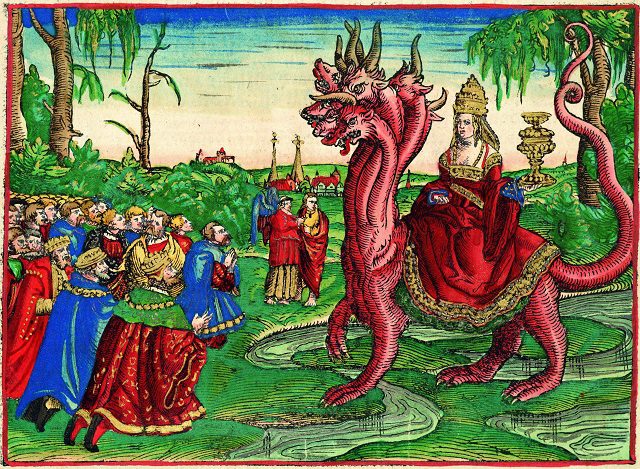
Photo credit: The Whore of Babylon (workshop of Lucas Cranach): colorized illustration from Martin Luther’s 1534 translation of the Bible [public domain / Wikimedia Commons]

***
Summary: The late Steve Hays was a Calvinist and anti-Catholic writer and apologist. This is one of my many critiques of Hays’ “Catholicism”: a 695-page self-published volume.
Previous Post
May 18, 2023
Reply to Hays’ “Catholicism” #8
Next Post
May 20, 2023 Reply to Hays’ “Catholicism” #10
Recent Comments
"Special pleading, and not a serious response to my arguments . . ."
Is Venerating Men & Angels Worship? ..."
""no man needs to teach us."Didn't you just teach us?"
Is Venerating Men & Angels Worship? ..."
""Catholics say they are the only church that can lead people into heaven."In fact, we ..."
Is Venerating Men & Angels Worship? ..."
"And lastly, I belong to no denomination and am free to serve God as He ..."
Is Venerating Men & Angels Worship? ..."
Browse Our Archives
Select a Category & Last Things About Me Anti-Catholicism Atheism & Agnosticism Baptism and Sacramentalism Bible and Tradition Blessed Virgin Mary Books by Dave Armstrong C. S. Lewis Calvinism & General Protestantism Catholic Apologetics Catholic Apologists Catholic conversion Catholic converts Christmas Church (Ecclesiology) Church History Conversion and Converts Development of Doctrine Eastern Orthodoxy Ecumenism & Christian Unity Eucharist & Liturgy Fathers of the Church French Translations G. K. Chesterton Hell Hell & Satan Hell & Satan & Last Things Heresies & Comparative Religion Holistic Health Inquisition & Crusades & Scandals James White Jews & Judaism & Old Testament John Calvin John Henry Newman Liberal / Modernist Theology Life Issues Literary Resume Lutheranism Mariology Martin Luther Music Orthodoxy Papacy & Infallibility Personal Page Philosophy & Science Political & Ethical & Moral Issues Protestant Persecution & Intolerance Protestantism Purgatory Purgatory & Penance Romantic & Imaginative Theology Saints & Purgatory & Penance Salvation Salvation & Justification Satan & Last Things Sexuality and Gender Issues Spanish Translations Traditionalism vs. Radical Catholic Reactionaries Traducciones al español / tradução para português Trinitarianism & Christology Uncategorized Videos
Select a Month November 2026 October 2026 September 2026 August 2026 July 2026 June 2026 May 2026 April 2026 March 2026 February 2026 January 2026 December 2025 November 2025 October 2025 September 2025 August 2025 July 2025 June 2025 May 2025 April 2025 March 2025 February 2025 January 2025 December 2024 November 2024 October 2024 September 2024 August 2024 July 2024 June 2024 May 2024 April 2024 March 2024 February 2024 January 2024 December 2023 November 2023 October 2023 September 2023 August 2023 July 2023 June 2023 May 2023 April 2023 March 2023 February 2023 January 2023 December 2022 November 2022 October 2022 September 2022 August 2022 July 2022 June 2022 May 2022 April 2022 March 2022 February 2022 January 2022 December 2021 November 2021 October 2021 September 2021 August 2021 July 2021 June 2021 May 2021 April 2021 March 2021 February 2021 January 2021 December 2020 November 2020 October 2020 September 2020 August 2020 July 2020 June 2020 May 2020 April 2020 March 2020 February 2020 January 2020 December 2019 November 2019 October 2019 September 2019 August 2019 July 2019 June 2019 May 2019 April 2019 March 2019 February 2019 January 2019 December 2018 November 2018 October 2018 September 2018 August 2018 July 2018 June 2018 May 2018 April 2018 March 2018 February 2018 January 2018 December 2017 November 2017 October 2017 September 2017 August 2017 July 2017 June 2017 May 2017 April 2017 March 2017 February 2017 January 2017 December 2016 November 2016 October 2016 September 2016 August 2016 July 2016 June 2016 May 2016 April 2016 March 2016 February 2016 January 2016 December 2015 November 2015 October 2015 September 2015 August 2015 July 2015 June 2015 May 2015 April 2015 March 2015 February 2015 January 2015 December 2014 November 2014 October 2014 September 2014 August 2014 July 2014 June 2014 April 2014 March 2014 February 2014 January 2014 December 2013 November 2013 October 2013 September 2013 August 2013 July 2013 June 2013 April 2013 March 2013 February 2013 January 2013 December 2012 November 2012 October 2012 September 2012 August 2012 July 2012 June 2012 May 2012 April 2012 March 2012 February 2012 January 2012 December 2011 November 2011 October 2011 September 2011 August 2011 July 2011 June 2011 April 2011 March 2011 February 2011 October 2010 September 2010 August 2010 July 2010 April 2010 March 2010 December 2009 October 2009 August 2009 July 2009 June 2009 May 2009 March 2009 February 2009 October 2008 September 2008 April 2008 March 2008 February 2008 January 2008 December 2007 November 2007 October 2007 May 2007 March 2007 February 2007 January 2007 November 2006 October 2006 September 2006 August 2006 July 2006 June 2006 May 2006 April 2006 March 2006 February 2006 October 2005 June 2005 April 2005 February 2005 July 2004 May 2004 April 2004
Follow Us!
TAKE THE
Religious Wisdom Quiz
Who was called out of Ur to go to a land God would show him?
Select your answer to see how you score.
Jacob Isaac Moses Abraham
Books by This Author Books by Dave Armstrong
Related posts from Biblical Evidence for Catholicism
Top Three Anti-Catholic Lies About Catholicism
Biblical Evidence for Catholicism
Three More Anti-Catholic Lies About Catholicism (#6-4)
Biblical Evidence for Catholicism
Top Ten Anti-Catholic Lies (#10-7)
Biblical Evidence for Catholicism
"Baptism" & Romans 10 (Engwer's Silly Word Games)
Biblical Evidence for Catholicism
TRENDING AT PATHEOS Catholic

For many years, Catholicism has been caught up in division over the...

'Statements of Faith' never get shorter
Nothing demonstrates a conservative commitment to faith and faithfulness like a "statement...

Michele's Reviews - Future Grace by John Piper
In God's Place, at God's Pace, by Future Grace Impatience is...

Bama Gramma's Blackout Christmas: the Power of Light...
Another Christmas Skit: I have an alter ego: Bama Gramma. She shows...

Thanksgiving as a Way of Life: A Christian...
Each year, Thanksgiving brings families and friends together to share meals, stories,...

Two Women Doctors Who Went Against the Current
Women physicians who transformed healthcare for "Indians" “I shall have an advantage...
view all Catholic blogs
What Are Your Thoughts?leave a comment
Ad-Free & Subscriber Log-In Subscription Support
- About Us
- 2026 Calendar
- Videos
- Podcasts
- Library of World Religions
- Faith In Media Tracker
- Advertise With Us
- Write for Us
- Privacy Policy
- Terms of Service
- Do Not Sell My Data
- Contact Us
- Radiant Digital
- Manage Newsletter Subscriptions
- Unsubscribe From Notifications
- Sitemap
Copyright 2008-2026, Patheos, part of the Radiant Digital network of media brands. All rights reserved.
Subscription Support Ad-Free & Subscriber Log-In
Follow Patheos