
BuddhistCatholicContemplativeEvangelicalGeneral ChristianHinduJewishLatter-day SaintMuslimNew VisionsProgressive Christian
Beliefs
- Buddhist
- Catholic
- Contemplative
- Evangelical
- General Christian
- Hindu
- Jewish
- Latter-day Saint
- More Voices
- Muslim
- New Visions
- Pagan
- Progressive Christian
Topics
- Religion News
- Food and Religion
- Sports and Religion
- Religious Art
- Religious Music and Entertainment
- Religious Events
- History and Religion
- Style and Religion
- Politics and Religion
- Women in Religion
- Recreation Outdoors and Religion
- Business Finance and Religion
- Careers Workplace and Religion
- Education and Religion
- Family Parenting and Religion
- Health Fitness and Religion
- Home and Religion
- Relationships and Religion
- Technology and Religion
- Travel and Religion
Columnists
- Buddhist Columnists
- Business Finance and Religion Columnists
- Careers Workplace and Religion Columnists
- Catholic Columnists
- Contemplative Columnists
- Education and Religion Columnists
- Evangelists Columnists
- Family Parenting and Religion Columnists
- General Christian Columnists
- Health Fitness and Religion Columnists
- Hindu Columnists
- History and Religion Columnists
- Home and Religion Columnists
- Jewish Columnists
- More Voices Columnists
- Latter Day Columnists
- Muslim Columnists
- New Visions Columnists
- Nonreligious Columnists
- Pagan Columnists
- Politics and Religion Columnists
- Progressive Columnists
- Recreation Outdoors and Religion Columnists
- Relationships and Religion Columnists
- Religion News Columnists
- Religious Art Columnists
- Religious Events Columnists
- Religious Music and Entertainment Columnists
- Sports and Religion Columnists
- Style and Religion Columnists
- Technology and Religion Columnists
- Travel and Religion Columnists
- Women in Religion Columnists
Resource Library
- 2026 Calendar
- Library of World Religions
- The 100 Most Holy Places on Earth
- Patheos Answers
- Podcasts
- Videos
- Faith Leaders Database
- Anglican Episcopalian
- Bahai
- Baptist
- Buddhism
- Christianity
- Confucianism
- Eastern Orthodoxy
- Hinduism
- Holiness and Pentecostal
- ISKCON
- Islam
- Judaism
- Lutheran
- Methodist
- The Church of Jesus Christ of Latter-day Saints
- New Age
- Paganism
- Presbytarian and Reformed
- Protestantism
- Religion Behind the Scenes
- Roman Catholic
- Scientology
- Shia Islam
- Sikhism
- Sufism
- Sunni Islam
- Taoism
- Zen
- See all religions
Research Tools
 Ad-Free & Subscriber Log-In Subscription Support
Follow Patheos 

- Trending:
- Advent
- |
- Forgiveness
- |
- Thanksgiving
- |
- Election
- |
- Seasonal Holidays
- |
- Marriage

-
About
-
Catholic Apologetics
-
Church History
-
Great Apologists
-
Christian Worldview
-
Protestantism & Misc.
- Home
- Catholic
- History and Religion
- Reply to Hays’ “Catholicism” #6
Reply to Hays’ “Catholicism” #6
Last updated on: May 17, 2023 at 10:22 am by Dave Armstrong
Reply to Hays’ “Catholicism” #6 2023-05-17T10:22:51-04:00 Dave Armstrong
Patheos Explore the world's faith through different perspectives on religion and spirituality! Patheos has the views of the prevalent religions and spiritualities of the world.
Purported Cures from Lourdes
The late Steve Hays (1959-2020) was a Calvinist (and anti-Catholic) apologist, who was very active on his blog, called Triablogue (now continued by Jason Engwer). His 695-page self-published book, Catholicism — a collection of articles from his site — has graciously been made available for free. On 9 September 2006, knowing full well my history of being condemned and vilified by other anti-Catholics (and his buddies) like James White, Eric Svendsen, and James Swan, Hays was quite — almost extraordinarily — charitable towards me. He wrote then:
I don’t think I’ve ever accused him of being a traitor or apostate or infidel. . . . I have nothing to say, one way or the other, regarding his state of grace. But his sincerity is unquestionable. I also don’t dislike him. . . . I don’t think there’s anything malicious about Armstrong—unlike some people who come to mind. In addition, I don’t think I’ve ever said he was unintelligent. For the record, it’s obvious that Armstrong has a quick, nimble mind. . . . The term “apostasy” carries with it a heavy presumption that the apostate is a hell-bound reprobate. I think it’s unwarranted to assume that all Catholics or converts to Catholicism are damned.
Two-and-a-half years later, starting in April 2009 and up through December 2011 (in the following quotations) his opinion radically changed, and he claimed that I have “an evil character,” am “actually evil,” “ego-maniac, narcissist,” “idolater,” “self-idolater,” “hack who pretends to be a professional apologist,” given to “chicanery,” one who doesn’t “do any real research,” “a stalwart enemy of the faith . . . no better than [the atheists] Richard Dawkins or Christopher Hitchens,” with an intent to “destroy faith in God’s word,” “schizophrenic,” “emotionally unhinged,” one who “doesn’t trust in the merit of Christ alone for salvation,” “has no peace of mind,” “a bipolar solipsist,” “split-personality,” and a “bad” man. He wasn’t one to mince words! See more gory details.
I feel no need whatsoever to reciprocate these silly and sinful insults. I just wanted the record to be known. I’ve always maintained that Hays was a very intelligent man, but habitually a sophist in methodology; sincere and well-meaning, but tragically and systematically wrong and misguided regarding Catholicism. That’s what I’m addressing, not the state of his heart and soul (let alone his eternal destiny). It’s a theological discussion. This is one of many planned critiques of his book (see my reasons why I decided to do this). Rather than list them all here, interested readers are directed to the “Steve Hays” section of my Anti-Catholicism web page, where they will all be listed. My Bible citations are from the RSV. Steve’s words will be in blue. Those of Anglican writer Dr. Lydia McGrew (actually a friendly acquaintance of mine) in green, and Christian philosopher Robert Larmer‘s in purple.
*****
[Chapter 1: Miracles]
Assessing Lourdes
This is a post on Lourdes. Lydia McGrew kindly provided feedback on a draft version, so I’m including our exchange (with permission) at the end. [p. 52]
And I will reply to that as well. That should be interesting, seeing that in the past we had a great exchange: Dialogue with an Anglican on “Praying to Mary,” Patron Saints, Etc. [11-10-14]. We’ve been friendly ever since, and I love her work. After that back-and-forth, Hays triumphantly and no doubt jubilantly exclaimed in the title of a post: “Lydia McGrew wallops Dave Armstrong” [11-9-14] This was a real class act on his part, since he cited all of her words and none of mine, didn’t provide a link to the posted dialogue so people could read both sides, and moreover, I had been banned long since on his blog, and so couldn’t reply in context. Very impressive, huh? That’s considered Christian civility, fair play, and self-confidence, I guess, in the anti-Catholic mentality.
It seems to me that there are two different ways we might classify the cures at Lourdes as coincidental. One way, championed by atheists, is to say that in any sufficiently large sample group, it’s statistically inevitable that some medical conditions will natural resolve themselves. This will happen anyway, regardless of prayer. The cliché example is spontaneous remission from cancer. [p. 52]
But this is a very weak “argument” (that’s assuming it can even properly be called one): so self-evidently weak that I don’t think it deserves any further reply.
According to the official site, only 70 cases have been formally confirmed as miraculous healings by the Catholic church: [p. 52] [link]
Yes; of course, these are only the most rigorously examined cases, that the Church felt confident enough to proclaim, with little fear of refutation. It doesn’t follow that there are not a lot more miracles with solid degrees of evidence. Over 7,000 have been purported to take place there. Hays’ arbitrary and unimpressive reasoning appears to be: “only the most medically scrutinized cases are worth looking into at all. We can ignore the 6,930 + other reputed miracles as of no significance or relevance to the discussion.”
[I]n any sample group of 200 million people who pray for miraculous healing, there will be a comparable percentage of naturally impossible cures. [p. 52]
He can play that game if he likes, but it’s silly and proves nothing. Clearly, cases have to be examined individually and considered on their own merits. We’ve done that: at least with seventy cases. And I’m sure there are many more that have been looked into and confirmed at less than the highest level of Church proclamations, to a serious degree. Hays plainly didn’t want to get into that (it would be too “messy” and difficult and time-consuming) and so he quickly devised a way to dismiss literally over 99% of the reputed cures. Pretty handy trick there! But it impresses no one who is not already a sophist and true “anti-Mary” believer, come hell or high water.
Hays could have chosen to start looking in-depth at the 70 most documented cases (providing 70 — or at least some — counter-explanations that he deems more plausible than the opinion of “cure”), if he were actually interested in a serious, open-minded debate; but he wanted no part of that, either. Instead, he devoted all of four pages to the matter, and about 1 1/2 of those were words from Drs. McGrew and Larmer. This is simply not serious interaction. It’s a quick, breezy attempt to dismiss something irrationally thought and decided beforehand to be absurd or impossible, so that he could move on, pretending that he had resolved the subject to everyone’s contentment.
Mind you, that may oversimplify things. [p. 52]
Now that‘s the understatement of the century! But I’m delighted that he made it. It’s always good to be self-aware.
I’d be very surprised if those 7000 are on the order of the restoration of amputated limbs. [p. 53]
Not likely, because that would be among the most extraordinary cures, and is frequently the scenario that atheists bring up.
Verified not to have been hoaxes, as well. It’s important to remember that plenty of people aren’t going to suffer any serious consequences for perpetrating a religious hoax. Nobody is going to crucify them. [p. 53]
This is true, but I state again that the existence a counterfeit is not a disproof of the real thing. Granted, it may whittle down the “7,000” figure a bit. But that doesn’t get Hays off the hook, either. He was till is duty-bound to start examining serious numbers of the reputed miracles of Lourdes, if he wanted to exercise the prerogative of claiming that they are bogus or nonexistent en masse, rather than employing an anti-Catholic variant of David Hume’s weak “classic” argument against miracles (they are very rare, so why not nonexistent altogether?: is basically what it amounts to). Hume had no interest in examining purported miracles anymore than Steve Hays did. They both wanted to declare them impossible (well, only the Catholic ones, for Steve) from their armchairs, as if factual, historical reality bows to their whims and desires. That is simply not possible to do. They have to be grappled with.
It might be argued that the official figure (70 miraculous cures) is artificially low because the criteria are artificially rigorous. Since the Catholic church is putting its reputation on the line, it has stringent standards to vouch a miracle (in the past it wasn’t so scrupulous). [p. 53]
Now he’s finally talking some sense.
If so, then the actual number of miracles is probably higher than the official figure, but because “unexplained” is so vague, without further information about specific cases, we can’t judge if the real figure is at the low end of the 7000, high end, or somewhere in the middle. [p. 53]
Yeah, we’d have to actually get down “in the dirt” and down to brass tacks and start looking at them one-by-one, and offering alternate explanations in every case. Hays never did that, and he likely never would have if he had lived longer. And he didn’t — I submit — because he looked down his nose at it as “silly Catholic junk.” We don’t spend time with things that we think are ridiculous. I think anti-Catholicism on the whole is ridiculous, too. But (dead-wrong as I think it is) I grant that there are articulate and sincere exponents of it, like Steve Hays, that I accord some modicum of respect by actually hearing them out and interacting with their reasoning. Everyone can observe me doing that in this long series, and in hundreds of my articles found on my Anti-Catholicism web page.
I think you are suggesting that God might cure them because they prayed or because he has some other reason to perform a miracle, not because of anything to do with Mary. That’s a legitimate possibility, but it has some problems since God presumably knows that such a miracle will be credited to Mary’s intercession. He could just have cured the person before he left to go to Lourdes. [p. 53]
Good point!
It raises difficult issues regarding providence however we slice it. I wish to avoid a double standard. [p. 53]
I grant his sincere desire; I do not grant a successful promulgation of said desire on his part, in Matters Catholic.
Mind you, a Catholic apologist might accuse me of special pleading because I detach the miracle from Marian claims. [p. 53]
Yes, either that or desperation, if there is a difference.
But a Catholic apologist is in the same situation, only in reverse. Because there are well-documented Protestant and/or charismatic miracles, a Catholic apologist must be able to distance those cases from Protestant claims. [p. 53]
Really? I feel no such need whatsoever. Catholic apologists don’t have to deny all Protestant miracles. We regard Protestants as our brothers-in-Christ, due, among many other things, to their legitimate regenerative baptism (itself supernatural and miraculous in every case). I believed in many “Protestant miracles” when I was a Protestant, and I believe in all those same miracles as a Protestant. The Wesleyan revivals reported many of them. I edited a book of Wesley’s quotations, published by a Wesleyan publisher (Beacon Hill Press). I believe I was healed, myself, and that my wife Judy also was (both occurring while we were Protestants).
So both sides have the conundrum of conceding a miracle but denying that it verifies a sectarian claimant. [pp. 53-54]
I and my “side” have no such “conundrum”. We view such miracles as verifying the power and mercy of God and the presence of the Holy Spirit. It is a matter utterly indifferent to me what denomination someone is in, who presided over a healing. It’s simply not an issue. I’m only concerned with false doctrines, such as that God supposedly always heals by demand: a serious error that I refuted as a charismatic Protestant in 1982, as one of my first apologetics research areas. Hays is only worried about miracles at Lourdes because his false and arbitrary presuppositions don’t allow them. His mind was already made up before examining any purported miracle (which is why he didn’t trouble himself to do so!).
I can’t remember if you consider the distinction important between God’s performing a miracle and God’s refraining from preventing something from happening. I do consider it important. It seems to me less likely that God would refrain from intervening to prevent someone from happening to have an amazing healing at Lourdes (by secondary causes) than that God would perform a miracle to heal someone at Lourdes. So that may be a difference between us. [p. 54]
Another great comment from Lydia. She’s not anti-Catholic as Steve was. It makes a huge difference in how one argues.
Even if we grant the distinction in principle, that breaks down in relation to a healing that is naturally impossible, circumventing secondary causes and natural processes. At best that might apply to a subset of healings that are preternatural or coincidence miracles rather than something contrary to nature that bypasses secondary process. [p. 54]
Can you rephrase that in English, please?
Oh, I agree. If one granted that God had deliberately performed a real miracle (one might say a miracle-miracle) at Lourdes, one would have to deal with the implications of that. I would say in that case it would have some evidential value in favor of Marian doctrines, for the reason I have already given. Because it is not akin to the case of a reflection in a bank window or a pattern on burnt toast or whatever but rather a real miracle.
Of course, we have some evidence for all kinds of things that are false! I think sometimes it’s difficult to bear in mind that “some evidence” doesn’t mean “strong evidence” or “evidence to which there is no counterweight.” I’m quite willing to say that there is probably some evidence for Catholicism in the form of reported miracles, visions, etc., but that it is strongly counterbalanced by the evidence against. Of course, the theoretical arguments for Catholicism are extremely bad, as many of your posts show. The empirical argument is really the basket into which Catholics should place their eggs, as it were. [pp. 54-55]
This is much better argumentation than Steve’s. I see no necessity in this context to respond, however, as it is on an abstract level. I think the skeptic of Lourdes cures needs to examine actual purported miracles with a fine-toothed comb and refute them, if they think they can. Lydia recommends making an “empirical argument.” I agree! In a dialogue with an atheist, I brought up a scientific study of the purported cures at Lourdes, from the Journal of the History of Medicine and Allied Sciences (produced by Oxford University): “The Lourdes Medical Cures Revisited” (2012). These guys did what I am challenging Lourdes critics to do. From the Abstract:
We discuss the clinical criteria of the cures and the reliability of medical records. . . . We studied 411 patients cured in 1909–14 and thoroughly reviewed the twenty-five cures acknowledged between 1947 and 1976. . . . The Lourdes phenomenon, extraordinary in many respects, still awaits scientific explanation.
And the Conclusions:
We have also been struck by a matter-of-fact observation: the occurrence of cures that were not instantaneous but rather required days or weeks. This mode of cure occurred in about one-third of patients cured in 1909–14 and 1947–76. Largely unnoticed and overlooked, this pattern does not square with the usual script of a miracle, nor does it fit with the desiderata of the Church. From the pragmatic standpoint of an agnostic, the Lourdes cures, fewer than originally thought, have been a heterogeneous collection of medical facts, neither impostures nor miracles. Uncanny and weird, the cures are currently beyond our ken but still impressive, incredibly effective, and awaiting a scientific explanation. Creating a theoretical explanatory framework could be within the reach of neurophysiologists in the next decades.
After many mental twists and turns, we reached the same conclusions as Carrel some eighty to hundred years ago: “Instead of being a simple place of miracles, of interest only to the pious, Lourdes presents a considerable scientific interest,” and “Although uncommon, the miraculous cures are evidence of somatic and mental processes we do not know.” Upping the ante, we dare write that understanding these processes could bring about new and effective therapeutic methods.
The Lourdes cures concern science as well as religion.
That is serious and open-minded examination, from medical scholars and scientists. What Steve is attempting in this section is not. The difference is like day and night.
I would even go so far as to say that the conversion story of Wright (he’s a sci-fi author, I can’t remember his first name–John?) is some evidence for Catholicism. He was an atheist. IIRC, he prayed one of those “atheist prayers” (such as “If you’re there, God, show me”). Very shortly thereafter, he had a heart attack and was in a coma or something for a while. During that time he claims that he had visions of the Virgin Mary. I think he says Jesus as well, but my memory is a little hazy. I found his blog increasingly weird and coarse and stopped reading it several years ago. Anyway, he recovered and promptly became Roman Catholic, which I suppose is understandable under the circumstances. [p. 55]
That’s open-minded, and I appreciate it.
“Spontaneous remission” is not an explanation of why someone gets better. It is the admission that no explanation is known. It is probable that some events labelled as ‘spontaneous remission’ are answers to prayer, but that the attending doctors will not countenance a supernatural explanation. I am not claiming there are no spontaneous remissions that have a natural cause. [p. 56]
Agreed.
I agree that some events cannot be plausibly thought to be explicable in terms of natural causes. [p. 56]
Amen!
The criteria for an event being called a miracle at Lourdes are extremely strict. Stanley Jaki in his “Miracles and Physics” references a case where a compound fracture, i.e. bones sticking through the skin, was instantaneously healed, but it did not meet Lourdes’ criteria for calling something a miracle because a medical doctor was not in attendance. Jaki quotes a commentator to the effect that one does not need to be a tailor to tell if a coat is full of holes. [p. 56]
Good and helpful point.
I do not think that healing miracles have to happen at certain special sites, but it does not bother me if God’s providence includes people coming to certain locations to experience healing. If I need to be healed then God may require me to exhibit enough faith to go to a healing meeting being held in a certain location. [p. 56]
Agreed again!
I think God may well perform miracles at Lourdes. That does not to my mind provide strong evidence for Marian doctrine, given that He also performs miracles for people who do not accept Marian doctrine. Both George Whitefield’s and John Wesley’s ministries were distinguished by events I view as miraculous, but Whitefield was Calvinist and Wesley was Arminian. Miracles are evidence of God’s mercy and power, but in His mercy God does not require that we get all our doctrines totally right before He grants a miracle. When Jesus fed the five thousand he did not first ask who accepted him as the Messiah and who did not. [p. 56]
I agree 100% yet again. I’m answering as I read. It’s striking that Dr. Larmer (presumably a Protestant) made some of the very same points that I brought up. I mentioned miracles in the Wesleyan revivals. So did he. I wrote, “We view such miracles as verifying the power and mercy of God.” Dr. Larmer wrote almost identically, “Miracles are evidence of God’s mercy and power.” I stated, “It is a matter utterly indifferent to me what denomination someone is in, who presided over a healing.” Dr. Larmer wrote in a similar vein: “God does not require that we get all our doctrines totally right before He grants a miracle.”
I’m delighted that Steve Hays decided to include these balanced, thoughtful, and persuasive comments from both Lydia McGrew and Robert Larmer.
In the final analysis, then, I see nothing in this section that would cause me to doubt my existing beliefs as to the presence of miraculous cures in Lourdes, and/or as a result of Mary’s intercession for same. It’s simply insufficient and utterly inadequate for the purpose; not within a million miles of being any sort of compelling or even plausible refutation. One marvels at the flat-out weakness and lack of substance in Hays’ presentation, and the thought comes to my surprised and disappointed mind: “this is all you can come up with? This is your best shot?”
***
Practical Matters: Perhaps some of my 4,200+ free online articles (the most comprehensive “one-stop” Catholic apologetics site) or fifty-one books have helped you (by God’s grace) to decide to become Catholic or to return to the Church, or better understand some doctrines and why we believe them.
Or you may believe my work is worthy to support for the purpose of apologetics and evangelism in general. If so, please seriously consider a much-needed financial contribution. I’m always in need of more funds: especially monthly support. “The laborer is worthy of his wages” (1 Tim 5:18, NKJV). 1 December 2021 was my 20th anniversary as a full-time Catholic apologist, and February 2022 marked the 25th anniversary of my blog.
PayPal donations are the easiest: just send to my email address: [email protected]. You’ll see the term “Catholic Used Book Service”, which is my old side-business. To learn about the different methods of contributing, including 100% tax deduction, etc., see my page: About Catholic Apologist Dave Armstrong / Donation Information. Thanks a million from the bottom of my heart!
***
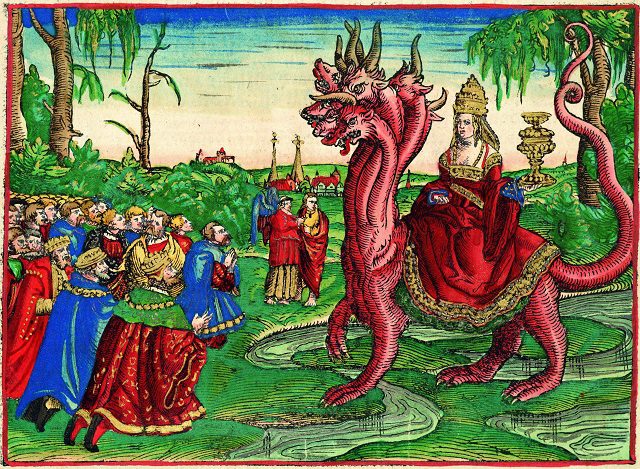
Photo credit: The Whore of Babylon (workshop of Lucas Cranach): colorized illustration from Martin Luther’s 1534 translation of the Bible [public domain / Wikimedia Commons]

***
Summary: The late Steve Hays was a Calvinist and anti-Catholic writer and apologist. This is one of my many critiques of Hays’ “Catholicism”: a 695-page self-published volume.
Previous Post
May 16, 2023
Reply to Hays’ “Catholicism” #5
Next Post
May 17, 2023 Reply to Hays’ “Catholicism” #7
Recent Comments
"Special pleading, and not a serious response to my arguments . . ."
Is Venerating Men & Angels Worship? ..."
""no man needs to teach us."Didn't you just teach us?"
Is Venerating Men & Angels Worship? ..."
""Catholics say they are the only church that can lead people into heaven."In fact, we ..."
Is Venerating Men & Angels Worship? ..."
"And lastly, I belong to no denomination and am free to serve God as He ..."
Is Venerating Men & Angels Worship? ..."
Browse Our Archives
Select a Category & Last Things About Me Anti-Catholicism Atheism & Agnosticism Baptism and Sacramentalism Bible and Tradition Blessed Virgin Mary Books by Dave Armstrong C. S. Lewis Calvinism & General Protestantism Catholic Apologetics Catholic Apologists Catholic conversion Catholic converts Christmas Church (Ecclesiology) Church History Conversion and Converts Development of Doctrine Eastern Orthodoxy Ecumenism & Christian Unity Eucharist & Liturgy Fathers of the Church French Translations G. K. Chesterton Hell Hell & Satan Hell & Satan & Last Things Heresies & Comparative Religion Holistic Health Inquisition & Crusades & Scandals James White Jews & Judaism & Old Testament John Calvin John Henry Newman Liberal / Modernist Theology Life Issues Literary Resume Lutheranism Mariology Martin Luther Music Orthodoxy Papacy & Infallibility Personal Page Philosophy & Science Political & Ethical & Moral Issues Protestant Persecution & Intolerance Protestantism Purgatory Purgatory & Penance Romantic & Imaginative Theology Saints & Purgatory & Penance Salvation Salvation & Justification Satan & Last Things Sexuality and Gender Issues Spanish Translations Traditionalism vs. Radical Catholic Reactionaries Traducciones al español / tradução para português Trinitarianism & Christology Uncategorized Videos
Select a Month November 2026 October 2026 September 2026 August 2026 July 2026 June 2026 May 2026 April 2026 March 2026 February 2026 January 2026 December 2025 November 2025 October 2025 September 2025 August 2025 July 2025 June 2025 May 2025 April 2025 March 2025 February 2025 January 2025 December 2024 November 2024 October 2024 September 2024 August 2024 July 2024 June 2024 May 2024 April 2024 March 2024 February 2024 January 2024 December 2023 November 2023 October 2023 September 2023 August 2023 July 2023 June 2023 May 2023 April 2023 March 2023 February 2023 January 2023 December 2022 November 2022 October 2022 September 2022 August 2022 July 2022 June 2022 May 2022 April 2022 March 2022 February 2022 January 2022 December 2021 November 2021 October 2021 September 2021 August 2021 July 2021 June 2021 May 2021 April 2021 March 2021 February 2021 January 2021 December 2020 November 2020 October 2020 September 2020 August 2020 July 2020 June 2020 May 2020 April 2020 March 2020 February 2020 January 2020 December 2019 November 2019 October 2019 September 2019 August 2019 July 2019 June 2019 May 2019 April 2019 March 2019 February 2019 January 2019 December 2018 November 2018 October 2018 September 2018 August 2018 July 2018 June 2018 May 2018 April 2018 March 2018 February 2018 January 2018 December 2017 November 2017 October 2017 September 2017 August 2017 July 2017 June 2017 May 2017 April 2017 March 2017 February 2017 January 2017 December 2016 November 2016 October 2016 September 2016 August 2016 July 2016 June 2016 May 2016 April 2016 March 2016 February 2016 January 2016 December 2015 November 2015 October 2015 September 2015 August 2015 July 2015 June 2015 May 2015 April 2015 March 2015 February 2015 January 2015 December 2014 November 2014 October 2014 September 2014 August 2014 July 2014 June 2014 April 2014 March 2014 February 2014 January 2014 December 2013 November 2013 October 2013 September 2013 August 2013 July 2013 June 2013 April 2013 March 2013 February 2013 January 2013 December 2012 November 2012 October 2012 September 2012 August 2012 July 2012 June 2012 May 2012 April 2012 March 2012 February 2012 January 2012 December 2011 November 2011 October 2011 September 2011 August 2011 July 2011 June 2011 April 2011 March 2011 February 2011 October 2010 September 2010 August 2010 July 2010 April 2010 March 2010 December 2009 October 2009 August 2009 July 2009 June 2009 May 2009 March 2009 February 2009 October 2008 September 2008 April 2008 March 2008 February 2008 January 2008 December 2007 November 2007 October 2007 May 2007 March 2007 February 2007 January 2007 November 2006 October 2006 September 2006 August 2006 July 2006 June 2006 May 2006 April 2006 March 2006 February 2006 October 2005 June 2005 April 2005 February 2005 July 2004 May 2004 April 2004
Follow Us!
TAKE THE
Religious Wisdom Quiz
Who carried Jesus' cross partway to Golgotha?
Select your answer to see how you score.
Simon of Cyrene A Roman centurion James Peter
Books by This Author Books by Dave Armstrong
Related posts from Biblical Evidence for Catholicism
Top Three Anti-Catholic Lies About Catholicism
Biblical Evidence for Catholicism
Three More Anti-Catholic Lies About Catholicism (#6-4)
Biblical Evidence for Catholicism
Top Ten Anti-Catholic Lies (#10-7)
Biblical Evidence for Catholicism
"Baptism" & Romans 10 (Engwer's Silly Word Games)
Biblical Evidence for Catholicism
TRENDING AT PATHEOS Catholic

Chapter 5, Sarah: The Quest for Safety in...
Open and Relational Theology & Social Psychology About this series: This series...

When Worry Gets You Nowhere, How Can Faith...
Sometimes, we think that by worrying, we can somehow predict the future....

The Wasp And I: Meditations on Repentance
How can we enter the power and joy of the repentant self...
Reflections on the Evangelical Theological Society
As I mentioned before, this year, for the first time since 2005,...

Demmed if it do and demmed if it...
"First Presidency Announces Salt Lake Temple Rededication Date" Apropos of that,...

Stop Making Thanksgiving Problematic And Just Give Thanks
“What if, today, we were grateful for everything?” –Charlie Brown I...
view all Catholic blogs
What Are Your Thoughts?leave a comment
Ad-Free & Subscriber Log-In Subscription Support
- About Us
- 2026 Calendar
- Videos
- Podcasts
- Library of World Religions
- Faith In Media Tracker
- Advertise With Us
- Write for Us
- Privacy Policy
- Terms of Service
- Do Not Sell My Data
- Contact Us
- Radiant Digital
- Manage Newsletter Subscriptions
- Unsubscribe From Notifications
- Sitemap
Copyright 2008-2026, Patheos, part of the Radiant Digital network of media brands. All rights reserved.
Subscription Support Ad-Free & Subscriber Log-In
Follow Patheos