
BuddhistCatholicContemplativeEvangelicalGeneral ChristianHinduJewishLatter-day SaintMuslimNew VisionsProgressive Christian
Beliefs
- Buddhist
- Catholic
- Contemplative
- Evangelical
- General Christian
- Hindu
- Jewish
- Latter-day Saint
- More Voices
- Muslim
- New Visions
- Pagan
- Progressive Christian
Topics
- Religion News
- Food and Religion
- Sports and Religion
- Religious Art
- Religious Music and Entertainment
- Religious Events
- History and Religion
- Style and Religion
- Politics and Religion
- Women in Religion
- Recreation Outdoors and Religion
- Business Finance and Religion
- Careers Workplace and Religion
- Education and Religion
- Family Parenting and Religion
- Health Fitness and Religion
- Home and Religion
- Relationships and Religion
- Technology and Religion
- Travel and Religion
Columnists
- Buddhist Columnists
- Business Finance and Religion Columnists
- Careers Workplace and Religion Columnists
- Catholic Columnists
- Contemplative Columnists
- Education and Religion Columnists
- Evangelists Columnists
- Family Parenting and Religion Columnists
- General Christian Columnists
- Health Fitness and Religion Columnists
- Hindu Columnists
- History and Religion Columnists
- Home and Religion Columnists
- Jewish Columnists
- More Voices Columnists
- Latter Day Columnists
- Muslim Columnists
- New Visions Columnists
- Nonreligious Columnists
- Pagan Columnists
- Politics and Religion Columnists
- Progressive Columnists
- Recreation Outdoors and Religion Columnists
- Relationships and Religion Columnists
- Religion News Columnists
- Religious Art Columnists
- Religious Events Columnists
- Religious Music and Entertainment Columnists
- Sports and Religion Columnists
- Style and Religion Columnists
- Technology and Religion Columnists
- Travel and Religion Columnists
- Women in Religion Columnists
Resource Library
- 2026 Calendar
- Library of World Religions
- The 100 Most Holy Places on Earth
- Patheos Answers
- Podcasts
- Videos
- Faith Leaders Database
- Anglican Episcopalian
- Bahai
- Baptist
- Buddhism
- Christianity
- Confucianism
- Eastern Orthodoxy
- Hinduism
- Holiness and Pentecostal
- ISKCON
- Islam
- Judaism
- Lutheran
- Methodist
- The Church of Jesus Christ of Latter-day Saints
- New Age
- Paganism
- Presbytarian and Reformed
- Protestantism
- Religion Behind the Scenes
- Roman Catholic
- Scientology
- Shia Islam
- Sikhism
- Sufism
- Sunni Islam
- Taoism
- Zen
- See all religions
Research Tools
 Ad-Free & Subscriber Log-In Subscription Support
Ad-Free & Subscriber Log-In Subscription Support
Follow Patheos 

- Trending:
- Forgiveness
- |
- Marriage
- |
- Consciousness
- |
- Death Penalty
- |
- Election
- |
- Halloween

-
About
-
Catholic Apologetics
-
Church History
-
Great Apologists
-
Christian Worldview
-
Protestantism & Misc.
- Home
- Catholic
- History and Religion
- Reply to Hays’ “Catholicism” #5
Reply to Hays’ “Catholicism” #5
Last updated on: May 16, 2023 at 6:45 pm by Dave Armstrong
Reply to Hays’ “Catholicism” #5 2023-05-16T18:45:04-04:00 Dave Armstrong
Patheos Explore the world's faith through different perspectives on religion and spirituality! Patheos has the views of the prevalent religions and spiritualities of the world.
Our Lady of Fatima
The late Steve Hays (1959-2020) was a Calvinist (and anti-Catholic) apologist, who was very active on his blog, called Triablogue (now continued by Jason Engwer). His 695-page self-published book, Catholicism — a collection of articles from his site — has graciously been made available for free. On 9 September 2006, knowing full well my history of being condemned and vilified by other anti-Catholics (and his buddies) like James White, Eric Svendsen, and James Swan, Hays was quite — almost extraordinarily — charitable towards me. He wrote then:
I don’t think I’ve ever accused him of being a traitor or apostate or infidel. . . . I have nothing to say, one way or the other, regarding his state of grace. But his sincerity is unquestionable. I also don’t dislike him. . . . I don’t think there’s anything malicious about Armstrong—unlike some people who come to mind. In addition, I don’t think I’ve ever said he was unintelligent. For the record, it’s obvious that Armstrong has a quick, nimble mind. . . . The term “apostasy” carries with it a heavy presumption that the apostate is a hell-bound reprobate. I think it’s unwarranted to assume that all Catholics or converts to Catholicism are damned.
Two-and-a-half years later, starting in April 2009 and up through December 2011 (in the following quotations) his opinion radically changed, and he claimed that I have “an evil character,” am “actually evil,” “ego-maniac, narcissist,” “idolater,” “self-idolater,” “hack who pretends to be a professional apologist,” given to “chicanery,” one who doesn’t “do any real research,” “a stalwart enemy of the faith . . . no better than [the atheists] Richard Dawkins or Christopher Hitchens,” with an intent to “destroy faith in God’s word,” “schizophrenic,” “emotionally unhinged,” one who “doesn’t trust in the merit of Christ alone for salvation,” “has no peace of mind,” “a bipolar solipsist,” “split-personality,” and a “bad” man. He wasn’t one to mince words! See more gory details.
I feel no need whatsoever to reciprocate these silly and sinful insults. I just wanted the record to be known. I’ve always maintained that Hays was a very intelligent man, but habitually a sophist in methodology; sincere and well-meaning, but tragically and systematically wrong and misguided regarding Catholicism. That’s what I’m addressing, not the state of his heart and soul (let alone his eternal destiny). It’s a theological discussion. This is one of many planned critiques of his book (see my reasons why I decided to do this). Rather than list them all here, interested readers are directed to the “Steve Hays” section of my Anti-Catholicism web page, where they will all be listed. My Bible citations are from the RSV. Steve’s words will be in blue.
*****
[Chapter 1: Miracles]
“Our Lady of Fatima”
I don’t have antecedent objections to angelic apparitions, apparitions of the dead, or visions of Jesus in church history. In a sense I don’t object to “saintly apparitions”. However, by that I mean, not individuals canonized by the church of Rome, [but] crisis apparitions in which a departed Christian might appear to a friend or relative who’s going through an ordeal to lend strategic, timely encouragement at a critical juncture in his life. [p. 50]
This is remarkably unProtestant and semi-Catholic. Hays has no blanket condemnation of ghosts and at least some kinds of apparitions and visions.
[I]n general, I don’t have the same epistemic duty to believe your reported observation than I have to believe my own observations. I’m not necessarily obligated to believe you. [p. 50]
This is a lot of the reason why the Catholic Church is very careful to distinguish private and public revelation. But I hasten to add that public revelation involves eyewitness testimony that was not witnessed firsthand by 100% of all the people alive today, either. We have to exercise faith in order to accept it, and don’t have 100% philosophic “certainty.”
I admit that I rule out Marian apparitions as a matter of principle. I don’t think Mary would appear to people because that usurps devotion to Jesus. Indeed, the Fatima cult is a classic example of Mary supplanting Jesus in the hearts of Catholic devotees. [p. 50]
He starts out reasonably, but now we see the irrationality of an inherent hostility to Mary. It makes no sense, before we even get to the particulars. Hays can conceptualize and accept “angelic apparitions” and these don’t constitute a threat to “devotion to Jesus.” Yet Mary (it appears) must do so — invariably, inherently does so — , in his mind. It’s a classic example of a fundamentally incorrect Protestant “either/or” dichotomous mindset.
And this will “hijack” his analysis from the beginning, because he starts with this false premise: any devotion or honor whatsoever directed towards Mary must constitute idolatry; it must and always mean Mary becomes an idol and takes the place of Jesus “in the hearts of Catholic devotees.” He can’t comprehend any other possible scenario. His false presuppositions don’t allow him to. He’s constitutionally unable to comprehend a non-idolatrous, non-worshipful veneration and honor of even someone as momentous and saintly as the Blessed Virgin Mary, the mother of Jesus, our Lord and Savior and Redeemer. It’s very sad.
And assuredly there are scriptural analogies. The dead Samuel appeared to Saul. Did that detract from “devotion to” God? No. It was God’s will. Samuel gave a true prophecy of Saul’s death the next day. Moses and Elijah appeared with Jesus at the Transfiguration. Did the disciples immediately start worshiping them instead of Jesus? No. Did they “supplant” Jesus in their hearts? No. And they didn’t worship them or make them their idols because there is no such necessity or inclination (save for a very few who go astray).
Many bodies rose from the tombs and started walking around Jerusalem after Jesus’ death (Matthew 27). Does the Bible inform us that everyone started worshiping and adoring them, too instead of God? No (and it certainly would have, if that had actually happened). God even shares His glory with His creatures (as the Bible massively reiterates). How many Protestants are aware of that, and the 26 Bible passages I brought to bear, to prove it beyond any doubt?
These are the sorts of clearly false premises that anti-Catholics (and many ecumenical Protestants) start out with, before they even think about and analyze Catholic beliefs that they reject (above all, our dreaded and despised beliefs about Mary: several of which their own Protestant founders shared). Unless they can be persuaded that their premises are false, they’ll never arrive at these truths. They can’t. It’s like traffic barriers that close off a certain road so that drivers can’t possibly use them. As the old saying goes, “the man convinced against his will retains his original belief still.”
Socrates (and often Jesus) examined people’s premises and presuppositions. That’s often (if not usually) where errors arise. I utilize the same method all the time, and have done so presently. A false notion is accepted on an inadequate basis and becomes the foundation of sand that a lousy unstable house of theology is built upon. The error must be critiqued and exposed at its root.
In effect, Hays then attempts some sort of answer to my objection:
A Catholic might object that I suffer from unfalsifiable skepticism regarding Marian apparitions. No kind of evidence would convince me otherwise. [p. 50]
Yes I would, and did!
In a sense that’s true, but keep in mind that there’s conflicting prima facie evidence. I can’t be equally and simultaneously open to the reputed revelations Muhammad, Swedenborg, Joseph Smith, and Lucia dos Santos. [p. 50]
Now he employs yet another fallacy: besmirching Fatima by associating it with false belief-systems that Catholics and Protestants alike reject. This won’t do, either.
Of course, that doesn’t mean we should discount all reports of supernatural encounters. But it does mean we must bring certain criteria to bear when sifting the putative evidence. [p. 50]
I totally agree. The Catholic Church fully agrees.
And that includes theological criteria (e.g. Deut 13:1-5). [p. 50]
That passage has no direct relevance to a purported apparition of Mary, as I explained in the previous installment. It simply doesn’t refute it. The only doctrine it mentioned is polytheism, where Catholics and Protestants are in full agreement.
[S]ome of the central claims narrow down to a single conduit: the testimony of Lucia. To my knowledge, there’s no independent corroboration for many of her claims. [p. 51]
Likewise, there was “no independent corroboration” of St. Paul having been spoken to by Jesus at his conversion. His companions heard noises but not the words spoken to Paul. There was “no independent corroboration” of God speaking to Abraham on several occasions, and “no independent corroboration” of God speaking to Moses in the burning bush. There was “no independent corroboration” of God speaking to Billy Graham and telling him to believe in the Bible and go preach based on its teachings.
There was “no independent corroboration” of St. Augustine’s experiences leading to his conversion to Catholic Christianity, or of St. Peter seeing the vision of “clean foods” or of Isaiah and Daniel seeing visions of God, or God Himself (take your pick), or the prophets when they (constantly) heard God’s instructions of what to proclaim. Shall I continue?
Hays employs hyper-skeptical atheist methodologies when he approaches “Catholic” topics, in a way that he never would when exactly the same thing applies to prominent biblical or Protestant or patristic figures, as just shown. It’s simply not a disproof. One can attempt to discredit a persons’ credibility, so that their report is suspect (as Hays briefly and unsuccessfully attempted to do with St. Padre Pio earlier in the book), but just because they alone witnessed something is not in and of itself inherently some sort of disproof or reason for the sort of unflinching doubt that Hays extends to Servant of God, Sister Lucia.
He obviously does so because (as he openly admitted) he “rule[s] out Marian apparitions as a matter of principle.” He can’t possibly believe what Lucia reported, with that beginning-point. He must find a way to discredit her report, because the apparition she saw can’t possibly be true (for inadequate reasons, in Hays’ oh-so-skeptical brain). The above attempt miserably fails at that task, too.
In addition, she wrote this down years after the fact. [p. 51]
So did the Gospel writers: the evangelists. Shall we therefore dismiss the Gospels, too? In consistency, we would have to. But one of the constants and hallmarks of anti-Catholicism is its inveterate, relentless double standards and viciously self-defeating propositions.
But even if Mary actually spoke to Lucia, unless Lucia was blessed with verbatim recall, what we’re getting isn’t a statement in Mary’s own words, but in Lucia’s own words. [p. 51]
As in all other such “sole individual” reports, such as the several I mentioned above . . . Again, this is how atheists habitually argue about the Bible itself. Hays draws from a “page” in their antics and directs it inconsistently towards Catholics only.
There’s also the vexed question of how you’d verify a Marian apparition even if you had direct experience of a putative Marian apparition. [p. 51]
There’s also the vexed question of how you’d verify the burning bush [Moses] or the three angels [who appeared to Abraham] or Jesus telling a person to stop persecuting Him [Paul’s conversion] or a vision of being caught up to heaven [Paul] or of the clean foods [Peter] or of any number of Protestant personal conversions involving a profound experience or various spiritual experiences one individual has [I experienced a horrifying vision of hell right before I embarked on my Protestant campus evangelism ministry in 1985], or “after-death” experiences of heaven.
Over 500 people saw the risen Jesus. But how is that “verified” today in the seeming exactitude that Hays demands for Fatima? Atheists simply dismiss it without further thought, as a fairy tale report of an imaginary wish. How is it absolutely proven? It can’t be. It requires faith. Christianity does not consist solely of reason, after all. Hays almost acts as if it does. The excellent Protestant philosopher / apologist Gary Habermas (whom Hays mentioned earlier as having read a section of his book for advisory purposes) just put out a huge defense of Jesus’ resurrection. Only Christians are impressed. Atheists always find a “way” to dismiss any and all such arguments. And to do so, they argue almost exactly as Hays does when trashing Fatima and all Marian apparitions.
But once we grant the realm of the supernatural, there are other candidates who could presumably impersonate Mary. What about a malevolent ghost or fallen angel? [p. 51]
But if so, they wouldn’t tell the truth in the prophecies, as Mary did at Fatima (many things clearly came true in these prophecies or “secrets”). Demons can’t and won’t do that. Like the real Samuel who appeared to Saul (that many Protestants claim was merely an impersonating demon: the Bible says no such thing) and gave a true prophecy, likewise, Mary gives true prophecies, and did so at Fatima. Again, demons don’t do that.
We know how the devil (and by extension, his followers, the demons) speak, by reading his words spoken in the Garden of Eden and with God in the book of Job, or with Jesus at the temptation in the wilderness. C. S. Lewis nailed “demon-speak” in his masterful Screwtape Letters. What Mary said at Fatima is as different in content and spirit from those things as east is from west, or dry is from wet. Mary talks about how souls can be saved. Demons are gonna do that?
If we take the reports at face value, Mary is quite the linguist. She speaks so many different foreign languages, depending on the audience. Does she speak foreign languages with an Aramaic accent? [p. 51]
Well, Paul wrote:
1 Corinthians 13:9-12 For our knowledge is imperfect and our prophecy is imperfect; [10] but when the perfect comes, the imperfect will pass away. [11] When I was a child, I spoke like a child, I thought like a child, I reasoned like a child; when I became a man, I gave up childish ways. [12] For now we see in a mirror dimly, but then face to face. Now I know in part; then I shall understand fully, even as I have been fully understood.
I think “perfect” knowledge and “understand[ing] fully” is an awful lot of knowledge. Languages would be part of this perfect and full understanding and knowledge, and far more than that! What must certainly be our extraordinary knowledge in heaven is hardly fit to be fodder for mockery and belittling. Hays is again being most unbiblical in his rush to always denigrate Mary at all costs. Somehow Moses and Elijah could speak to Jesus, even though their language (from some 1300 and 900 or so years before Jesus) would have been very different. The earliest Aramaic inscriptions date from the 11th century BC: at least a hundred years after Moses’ death.
Language is never a barrier in the Bible that I can recall. God has a way to deal with that, when messages are being proclaimed. So why does Hays find it amusing and not fit for belief that Mary would be able to speak Portugese at Fatima? Wouldn’t that be part of the perfect knowledge and full understanding that all in heaven will be granted by the mercy and power of God?
By the same token, why are major Marian apparitions confined to Catholic witnesses? [p. 51]
I imagine it’s because God knows the entrenched, anti-reason, false-premise-laden mindset that many or most Protestants have about Mary. They simply would dismiss it out of hand, just as Hays has done. So they happen among people who are open to accepting and believing them. As the Bible stated about Jesus: “And he did not do many mighty works there, because of their unbelief” (Mt 13:58).
And that’s all Hays could come up as a “refutation” of the events at Fatima! I thought he was just beginning and all of a sudden this section ended. He has offered nothing whatsoever that casts any legitimate, unquestionable doubt upon what has been reported about the apparitions at Fatima. Literally all he did was play the atheist hyper-skeptical game about everything, and that won’t do at all, because the same mindset takes out the Bible, too.
It’s very shoddy and inadequate thinking. But we have come to always expect that from anti-Catholics, trying in vain to rationalize and explain away All Things Distinctively Catholic. It’s a pathetic, embarrassing enterprise, and never difficult to refute (even to refute from the Bible, as well as by logic).
***
Practical Matters: Perhaps some of my 4,200+ free online articles (the most comprehensive “one-stop” Catholic apologetics site) or fifty-one books have helped you (by God’s grace) to decide to become Catholic or to return to the Church, or better understand some doctrines and why we believe them.
Or you may believe my work is worthy to support for the purpose of apologetics and evangelism in general. If so, please seriously consider a much-needed financial contribution. I’m always in need of more funds: especially monthly support. “The laborer is worthy of his wages” (1 Tim 5:18, NKJV). 1 December 2021 was my 20th anniversary as a full-time Catholic apologist, and February 2022 marked the 25th anniversary of my blog.
PayPal donations are the easiest: just send to my email address: [email protected]. You’ll see the term “Catholic Used Book Service”, which is my old side-business. To learn about the different methods of contributing, including 100% tax deduction, etc., see my page: About Catholic Apologist Dave Armstrong / Donation Information. Thanks a million from the bottom of my heart!
***
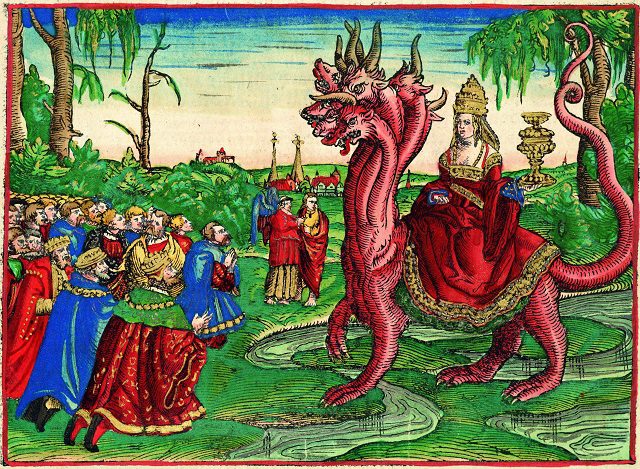
Photo credit: The Whore of Babylon (workshop of Lucas Cranach): colorized illustration from Martin Luther’s 1534 translation of the Bible [public domain / Wikimedia Commons]

***
Summary: The late Steve Hays was a Calvinist and anti-Catholic writer and apologist. This is one of my many critiques of Hays’ “Catholicism”: a 695-page self-published volume.
Previous Post
May 15, 2023
Reply to Hays’ “Catholicism” #4
Next Post
May 17, 2023 Reply to Hays’ “Catholicism” #6
Recent Comments
"Special pleading, and not a serious response to my arguments . . ."
Is Venerating Men & Angels Worship? ..."
""no man needs to teach us."Didn't you just teach us?"
Is Venerating Men & Angels Worship? ..."
""Catholics say they are the only church that can lead people into heaven."In fact, we ..."
Is Venerating Men & Angels Worship? ..."
"And lastly, I belong to no denomination and am free to serve God as He ..."
Is Venerating Men & Angels Worship? ..."
Browse Our Archives
Select a Category & Last Things About Me Anti-Catholicism Atheism & Agnosticism Baptism and Sacramentalism Bible and Tradition Blessed Virgin Mary Books by Dave Armstrong C. S. Lewis Calvinism & General Protestantism Catholic Apologetics Catholic Apologists Catholic conversion Catholic converts Christmas Church (Ecclesiology) Church History Conversion and Converts Development of Doctrine Eastern Orthodoxy Ecumenism & Christian Unity Eucharist & Liturgy Fathers of the Church French Translations G. K. Chesterton Hell Hell & Satan Hell & Satan & Last Things Heresies & Comparative Religion Holistic Health Inquisition & Crusades & Scandals James White Jews & Judaism & Old Testament John Calvin John Henry Newman Liberal / Modernist Theology Life Issues Literary Resume Lutheranism Mariology Martin Luther Music Orthodoxy Papacy & Infallibility Personal Page Philosophy & Science Political & Ethical & Moral Issues Protestant Persecution & Intolerance Protestantism Purgatory Purgatory & Penance Romantic & Imaginative Theology Saints & Purgatory & Penance Salvation Salvation & Justification Satan & Last Things Sexuality and Gender Issues Spanish Translations Traditionalism vs. Radical Catholic Reactionaries Traducciones al español / tradução para português Trinitarianism & Christology Uncategorized Videos
Select a Month October 2026 September 2026 August 2026 July 2026 June 2026 May 2026 April 2026 March 2026 February 2026 January 2026 December 2025 November 2025 October 2025 September 2025 August 2025 July 2025 June 2025 May 2025 April 2025 March 2025 February 2025 January 2025 December 2024 November 2024 October 2024 September 2024 August 2024 July 2024 June 2024 May 2024 April 2024 March 2024 February 2024 January 2024 December 2023 November 2023 October 2023 September 2023 August 2023 July 2023 June 2023 May 2023 April 2023 March 2023 February 2023 January 2023 December 2022 November 2022 October 2022 September 2022 August 2022 July 2022 June 2022 May 2022 April 2022 March 2022 February 2022 January 2022 December 2021 November 2021 October 2021 September 2021 August 2021 July 2021 June 2021 May 2021 April 2021 March 2021 February 2021 January 2021 December 2020 November 2020 October 2020 September 2020 August 2020 July 2020 June 2020 May 2020 April 2020 March 2020 February 2020 January 2020 December 2019 November 2019 October 2019 September 2019 August 2019 July 2019 June 2019 May 2019 April 2019 March 2019 February 2019 January 2019 December 2018 November 2018 October 2018 September 2018 August 2018 July 2018 June 2018 May 2018 April 2018 March 2018 February 2018 January 2018 December 2017 November 2017 October 2017 September 2017 August 2017 July 2017 June 2017 May 2017 April 2017 March 2017 February 2017 January 2017 December 2016 November 2016 October 2016 September 2016 August 2016 July 2016 June 2016 May 2016 April 2016 March 2016 February 2016 January 2016 December 2015 November 2015 October 2015 September 2015 August 2015 July 2015 June 2015 May 2015 April 2015 March 2015 February 2015 January 2015 December 2014 November 2014 October 2014 September 2014 August 2014 July 2014 June 2014 April 2014 March 2014 February 2014 January 2014 December 2013 November 2013 October 2013 September 2013 August 2013 July 2013 June 2013 April 2013 March 2013 February 2013 January 2013 December 2012 November 2012 October 2012 September 2012 August 2012 July 2012 June 2012 May 2012 April 2012 March 2012 February 2012 January 2012 December 2011 November 2011 October 2011 September 2011 August 2011 July 2011 June 2011 April 2011 March 2011 February 2011 October 2010 September 2010 August 2010 July 2010 April 2010 March 2010 December 2009 October 2009 August 2009 July 2009 June 2009 May 2009 March 2009 February 2009 October 2008 September 2008 April 2008 March 2008 February 2008 January 2008 December 2007 November 2007 October 2007 May 2007 March 2007 February 2007 January 2007 November 2006 October 2006 September 2006 August 2006 July 2006 June 2006 May 2006 April 2006 March 2006 February 2006 October 2005 June 2005 April 2005 February 2005 July 2004 May 2004 April 2004
Follow Us!
TAKE THE
Religious Wisdom Quiz
What does "apostle" literally mean in Greek?
Select your answer to see how you score.
Sent one Friend Leader Writer
Books by This Author Books by Dave Armstrong
Related posts from Biblical Evidence for Catholicism

Three More Anti-Catholic Lies About Catholicism (#6-4)
Biblical Evidence for Catholicism

Top Ten Anti-Catholic Lies (#10-7)
Biblical Evidence for Catholicism

Holy Ground: Why Mary Had NO Other Children...
Biblical Evidence for Catholicism
Protestant Confessions & "Ever-Virgin" Mary
Biblical Evidence for Catholicism
TRENDING AT PATHEOS Catholic

The Sermon on the Mount, Part I: Matthew...
The Sermon on the Mount, Part I (Matthew 4:12-5:12) St. Matthew moves...

What's up from Crossway: Reviewing some of their latest A few weeks...

Janie Learns the Way of the Cross: A...
Teaching children about Jesus' Passion can be challenging. Many parents and educators...

Looking For Good Catholic Writing - October 2026
He alone extends the heavens, and he walks upon the waves of...

In "Irreplaceable," our book on vocation and technology, Trevor Sutton and I...

I was strolling through the top floor of the brand new Parthenon...
view all Catholic blogs
What Are Your Thoughts?leave a comment
Ad-Free & Subscriber Log-In Subscription Support
- About Us
- 2026 Calendar
- Videos
- Podcasts
- Library of World Religions
- Faith In Media Tracker
- Advertise With Us
- Write for Us
- Privacy Policy
- Terms of Service
- Do Not Sell My Data
- Contact Us
- Radiant Digital
- Manage Newsletter Subscriptions
- Unsubscribe From Notifications
- Sitemap
Copyright 2008-2026, Patheos. All rights reserved.
Subscription Support Ad-Free & Subscriber Log-In
Follow Patheos