
BuddhistCatholicContemplativeEvangelicalGeneral ChristianHinduJewishLatter-day SaintMuslimNew VisionsProgressive Christian
Beliefs
- Buddhist
- Catholic
- Contemplative
- Evangelical
- General Christian
- Hindu
- Jewish
- Latter-day Saint
- More Voices
- Muslim
- New Visions
- Pagan
- Progressive Christian
Topics
- Religion News
- Food and Religion
- Sports and Religion
- Religious Art
- Religious Music and Entertainment
- Religious Events
- History and Religion
- Style and Religion
- Politics and Religion
- Women in Religion
- Recreation Outdoors and Religion
- Business Finance and Religion
- Careers Workplace and Religion
- Education and Religion
- Family Parenting and Religion
- Health Fitness and Religion
- Home and Religion
- Relationships and Religion
- Technology and Religion
- Travel and Religion
Columnists
- Buddhist Columnists
- Business Finance and Religion Columnists
- Careers Workplace and Religion Columnists
- Catholic Columnists
- Contemplative Columnists
- Education and Religion Columnists
- Evangelists Columnists
- Family Parenting and Religion Columnists
- General Christian Columnists
- Health Fitness and Religion Columnists
- Hindu Columnists
- History and Religion Columnists
- Home and Religion Columnists
- Jewish Columnists
- More Voices Columnists
- Latter Day Columnists
- Muslim Columnists
- New Visions Columnists
- Nonreligious Columnists
- Pagan Columnists
- Politics and Religion Columnists
- Progressive Columnists
- Recreation Outdoors and Religion Columnists
- Relationships and Religion Columnists
- Religion News Columnists
- Religious Art Columnists
- Religious Events Columnists
- Religious Music and Entertainment Columnists
- Sports and Religion Columnists
- Style and Religion Columnists
- Technology and Religion Columnists
- Travel and Religion Columnists
- Women in Religion Columnists
Resource Library
- 2026 Calendar
- Library of World Religions
- The 100 Most Holy Places on Earth
- Patheos Answers
- Podcasts
- Videos
- Faith Leaders Database
- Anglican Episcopalian
- Bahai
- Baptist
- Buddhism
- Christianity
- Confucianism
- Eastern Orthodoxy
- Hinduism
- Holiness and Pentecostal
- ISKCON
- Islam
- Judaism
- Lutheran
- Methodist
- The Church of Jesus Christ of Latter-day Saints
- New Age
- Paganism
- Presbytarian and Reformed
- Protestantism
- Religion Behind the Scenes
- Roman Catholic
- Scientology
- Shia Islam
- Sikhism
- Sufism
- Sunni Islam
- Taoism
- Zen
- See all religions
Research Tools
 Ad-Free & Subscriber Log-In Subscription Support
Ad-Free & Subscriber Log-In Subscription Support
Follow Patheos 

- Trending:
- Forgiveness
- |
- Marriage
- |
- Consciousness
- |
- Death Penalty
- |
- Election
- |
- Halloween

-
About
-
Catholic Apologetics
-
Church History
-
Great Apologists
-
Christian Worldview
-
Protestantism & Misc.
- Home
- Catholic
- History and Religion
- Reply to Hays’ “Catholicism” #3
Reply to Hays’ “Catholicism” #3
Last updated on: May 15, 2023 at 10:25 am by Dave Armstrong
Reply to Hays’ “Catholicism” #3 2023-05-15T10:25:25-04:00 Dave Armstrong
Patheos Explore the world's faith through different perspectives on religion and spirituality! Patheos has the views of the prevalent religions and spiritualities of the world.
Catholic Miracles Unfairly Criticized & Biblically Defended; St. Padre Pio; St. Joseph Cupertino
The late Steve Hays (1959-2020) was a Calvinist (and anti-Catholic) apologist, who was very active on his blog, called Triablogue (now continued by Jason Engwer). His 695-page self-published book, Catholicism — a collection of articles from his site — has graciously been made available for free. On 9 September 2006, knowing full well my history of being condemned and vilified by other anti-Catholics (and his buddies) like James White, Eric Svendsen, and James Swan, Hays was quite — almost extraordinarily — charitable towards me. He wrote then:
I don’t think I’ve ever accused him of being a traitor or apostate or infidel. . . . I have nothing to say, one way or the other, regarding his state of grace. But his sincerity is unquestionable. I also don’t dislike him. . . . I don’t think there’s anything malicious about Armstrong—unlike some people who come to mind. In addition, I don’t think I’ve ever said he was unintelligent. For the record, it’s obvious that Armstrong has a quick, nimble mind. . . . The term “apostasy” carries with it a heavy presumption that the apostate is a hell-bound reprobate. I think it’s unwarranted to assume that all Catholics or converts to Catholicism are damned.
Two-and-a-half years later, starting in April 2009 and up through December 2011 (in the following quotations) his opinion radically changed, and he claimed that I have “an evil character,” am “actually evil,” “ego-maniac, narcissist,” “idolater,” “self-idolater,” “hack who pretends to be a professional apologist,” given to “chicanery,” one who doesn’t “do any real research,” “a stalwart enemy of the faith . . . no better than [the atheists] Richard Dawkins or Christopher Hitchens,” with an intent to “destroy faith in God’s word,” “schizophrenic,” “emotionally unhinged,” one who “doesn’t trust in the merit of Christ alone for salvation,” “has no peace of mind,” “a bipolar solipsist,” “split-personality,” and a “bad” man. He wasn’t one to mince words! See more gory details.
I feel no need whatsoever to reciprocate these silly and sinful insults. I just wanted the record to be known. I’ve always maintained that Hays was a very intelligent man, but habitually a sophist in methodology; sincere and well-meaning, but tragically and systematically wrong and misguided regarding Catholicism. That’s what I’m addressing, not the state of his heart and soul (let alone his eternal destiny). It’s a theological discussion. This is one of many planned critiques of his book (see my reasons why I decided to do this). Rather than list them all here, interested readers are directed to the “Steve Hays” section of my Anti-Catholicism web page, where they will all be listed. My Bible citations are from the RSV. Steve’s words will be in blue.
*****
[Chapter 1: Miracles]
Parsing Catholic miracles
[T]e Martyrdom of Polycarp says he was fireproof when the Romans tried to burn him alive. Assuming that’s true, should that be classified as a Catholic miracle? [p. 16]
Yes.
Was Polycarp Roman Catholic? [p. 16]
Yes, of course.
Or is that an anachronistic designation? [p. 16]
Not at all. He was a member of the one true Church begun by Jesus, under the initial human leadership of St. Peter, and then under his successors to the papal office. That Church is demonstrably historically continuous to this day. Polycarp rejected sola Scriptura and sola fide (faith alone): the two “pillars” of the Protestant Revolution. He regarded Tobit, the Didache, and Ecclesiasticus as Holy Scripture. That’s either being simply a “Catholic” (as I would contend) or (as it seems anyone is obliged to hold) at the very least more Catholic than proto-“Protestant”, since he denied the two pillars which supposedly sum up the main tenets and distinctives of the Protestant revolt, which had to wait until 1362 years after his death.
He wasn’t Catholic in the sense that Ignatius Loyola was Catholic, or Matthias Joseph Scheeben–much less Joseph Ratzinger. [p. 16]
Of course he wasn’t. He lived in the first and second centuries. I could turn it around and say that “Hays wasn’t a Calvinist in the sense that John Calvin was a Calvinist.” But he was still a Calvinist! All those hundreds of years since Polycarp saw much development of doctrine and practice. That’s why he is different from the later figures, but it’s not an essential difference. It’s the difference between an acorn and an oak tree: the former develops inexorably into the latter, and the DNA was the same all along. The acorn is an oak tree in the making, or a “very young” oak tree, as it were.
Consider the cult of Padre Pio. There’s evidence that he used carbonic acid. If so, his stigmata might be the result of self-mutilation. [p. 17]
Prove it, then! Put your money where your mouth is! This is the constant unethical method of anti-Catholic polemicists: to throw out a serious charge but not to take enough time to document it and make the case on the grounds of factuality and plausibility: just as in any other form of honest research. Failing that, it’s simply gossip and rumormongering, which is clearly unethical. Some people will read something like this and never forget it, and never look into it to verify or disprove it. And if it’s false, it was bearing false witness on Hays’ part: a violation of one of the Ten Commandments.
Readers may wish to read a favorable report of St. Pio’s stigmata, and when they began. The date was September 20, 1918. The scurrilous claim is that St. Pio asked for the acid in the “summer of 1919,” some 9-10 months after his stigmata began. The acid could hardly have caused [what would then merely mimic] the stigmata, let alone promulgate a complete fakery. False accusations against St. Padre Pio (like those against Jesus and Paul) are nothing new.
Saints are often persecuted not only by anti-Catholics, but (sadly) by those in the Church. The Holy See in 1931 ordered St. Padre Pio to cease public ministry and offering Mass in public, cease hearing confessions, and to not make any public appearances. He was also accused by some of insanity and fraud. In 1960, the Vatican again restricted his public ministry based on the notion that his popularity had gotten out of control. In that year, one Fr. Carlo Maccari accused the 73-year-old Padre Pio of having sex with female penitents “twice a week.” Fr. Maccari later admitted that he had lied and asked for forgiveness in a public recantation on his deathbed in 1961. St. Pio’s stigmata wounds completely vanished three days before he died.
In principle, some eucharistic miracles might be staged. A homemade communion wafer with ingredients designed to have a chemical reaction that simulates blood when immersed in wine. Or actual human blood could be one of the ingredients. [p. 17]
Yes, maybe so. But this proves absolutely nothing with regard to purported miracles of this sort that produced verified human blood and had strict controls against manipulation by unscrupulous folks. The presence of a counterfeit dollar bill doesn’t disprove all genuine dollar bills. This is not an argument. It’s simply a statement of the obvious truism that there are people out there who may try to fake miracles for a thrill or money or anti-Catholic motives; on a dare, whatever!
The miracles attributed to St. Joseph Copertino include levitation, psychokinesis, poltergeist activity, and materialization of objects. Even if genuine, there’s nothing specifically Christian about that phenomena. . . . there’s nothing specifically divine about such phenomena. If genuine, it’s more like a supernatural stunt. They fail to exhibit divine wisdom, justice, mercy, holiness, and truth. We’d expect a divine miracle to have a certain dignity or fittingness. Not just be something weird or frivolous. From what I’ve read, there’s a connection between possession and levitation. [pp. 17-18]
This is a rather bizarre argument. How is “materialization of objects” different in essence from Jesus multiplying the loaves and the fish? Did not Jesus materialize those two things, in abundance? Was that miracle not “specifically Christian”? Was it not “divine”: having been done by the express will of Jesus, Who is God? Should it be properly described as a “supernatural stunt”? What in the world was Hays thinking here? Or was he not thinking at all when he made the charges, in his ever-present prejudice against Catholicism? Did the feeding of the five and four thousand not “exhibit divine wisdom, justice, mercy, holiness, and truth”? Did it lack “dignity” and “fittingness”? Was it “weird or frivolous”? Talk about rhetorical overkill! We’re gonna see it a lot, believe me, folks, as I go through this book. All of these terms, by direct analogy, would apply to the two feeding miracle-events. Thus, Hay’s argument collapses in a spectacular reductio ad absurdum.
The same reductio amply applies to his bashing of “levitation” as well (which he associates — obviously “poisoning the well” — with “possession”: a nice touch there). That involves a person going up into the air in a supernatural fashion. Elijah did that (with the extra spectacle of a chariot and fire). Our Lord Jesus ascended (I visited the spot in 2014). At the Second Coming, millions of the elect will be “caught up . . . in the clouds to meet the Lord in the air” (1 Thess 4:17). The “two witnesses” of Revelation (11:3) were dead, but then “a breath of life from God entered them, and they stood up on their feet, and great fear fell on those who saw them. Then they heard a loud voice from heaven saying to them, ‘Come up hither!’ And in the sight of their foes they went up to heaven in a cloud” (Revelation 11:11-12).
That’s four scriptural instances of “ascensions” of one sort or another. Certainly these events were more lacking in “dignity” and “fittingness” and “weird or frivolous” than mere levitation, which is a very small analogy to an ascension. Therefore, if instances of levitation are regarded in this hostile fashion, how is it that the four biblical ascensions are not? What is the big difference? Well, the only one that is worth mentioning is that the one thing is said to be specifically “Catholic” and the others aren’t. Therefore, the scorn and derision is heaped on the Catholic miracle, with complete hypocrisy and a double standard (certainly not utilizing reason). When severe bias is always in the picture, this is the sort of incoherent “reasoning” we see. It’s equal parts pitiful and pathetic.
Moreover, “psychokinesis” is the moving of objects by mental activity alone. We have no problem finding many biblical parallels to this, too: Jesus calming the waves and the storm, and causing Lazarus to be raised and to walk out of his tomb, and legs suddenly being able to walk, the stone in front of Jesus’ tomb moving away from the entrance, etc. This means that all the name-calling that Hays made about this and the other “Catholic” miracles should consistently be applied to the analogous biblical events that are even more dramatic and unusual.
As for “poltergeist activity” (noisy or frivolous ghosts), Scripture is filled with that, too, or at least things highly akin or similar. We have Samuel the prophet (not an impersonating demon!, as some claim) appearing to Saul, Moses and Elijah appearing and talking to Jesus at His transfiguration, the two witnesses of Revelation 11, “many bodies of the saints who had fallen asleep” who “were raised, and coming out of the tombs after his resurrection they went into the holy city and appeared to many” (Mt 27:52-53). We have Jesus in effect walking through a wall to appear to His disciples after His resurrection. He eats fish with them. He closes the eyes of witnesses Mary Magdalene and the two disciples on the road to Emmaus, then reveals to them His identity. We have an angel wrestling with Jacob. Are all these phenomena “weird or frivolous” and all the other nonsense that Hays spews about Catholic miracles?
I have provided biblical analogies for all four things he brought up. His rather weak and insubstantial “argument” has now been utterly demolished and pulverized, if I do say so.
***
Practical Matters: Perhaps some of my 4,200+ free online articles (the most comprehensive “one-stop” Catholic apologetics site) or fifty-one books have helped you (by God’s grace) to decide to become Catholic or to return to the Church, or better understand some doctrines and why we believe them.
Or you may believe my work is worthy to support for the purpose of apologetics and evangelism in general. If so, please seriously consider a much-needed financial contribution. I’m always in need of more funds: especially monthly support. “The laborer is worthy of his wages” (1 Tim 5:18, NKJV). 1 December 2021 was my 20th anniversary as a full-time Catholic apologist, and February 2022 marked the 25th anniversary of my blog.
PayPal donations are the easiest: just send to my email address: [email protected]. You’ll see the term “Catholic Used Book Service”, which is my old side-business. To learn about the different methods of contributing, including 100% tax deduction, etc., see my page: About Catholic Apologist Dave Armstrong / Donation Information. Thanks a million from the bottom of my heart!
***
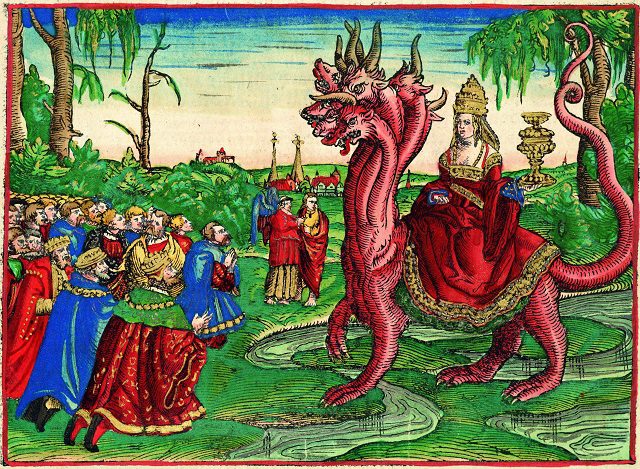
Photo credit: The Whore of Babylon (workshop of Lucas Cranach): colorized illustration from Martin Luther’s 1534 translation of the Bible [public domain / Wikimedia Commons]

***
Summary: The late Steve Hays was a Calvinist and anti-Catholic writer and apologist. This is one of my many critiques of Hays’ “Catholicism”: a 695-page self-published volume.
Previous Post
May 14, 2023
Reply to Hays’ “Catholicism” #2
Next Post
May 15, 2023 Reply to Hays’ “Catholicism” #4
Recent Comments
"Special pleading, and not a serious response to my arguments . . ."
Is Venerating Men & Angels Worship? ..."
""no man needs to teach us."Didn't you just teach us?"
Is Venerating Men & Angels Worship? ..."
""Catholics say they are the only church that can lead people into heaven."In fact, we ..."
Is Venerating Men & Angels Worship? ..."
"And lastly, I belong to no denomination and am free to serve God as He ..."
Is Venerating Men & Angels Worship? ..."
Browse Our Archives
Select a Category & Last Things About Me Anti-Catholicism Atheism & Agnosticism Baptism and Sacramentalism Bible and Tradition Blessed Virgin Mary Books by Dave Armstrong C. S. Lewis Calvinism & General Protestantism Catholic Apologetics Catholic Apologists Catholic conversion Catholic converts Christmas Church (Ecclesiology) Church History Conversion and Converts Development of Doctrine Eastern Orthodoxy Ecumenism & Christian Unity Eucharist & Liturgy Fathers of the Church French Translations G. K. Chesterton Hell Hell & Satan Hell & Satan & Last Things Heresies & Comparative Religion Holistic Health Inquisition & Crusades & Scandals James White Jews & Judaism & Old Testament John Calvin John Henry Newman Liberal / Modernist Theology Life Issues Literary Resume Lutheranism Mariology Martin Luther Music Orthodoxy Papacy & Infallibility Personal Page Philosophy & Science Political & Ethical & Moral Issues Protestant Persecution & Intolerance Protestantism Purgatory Purgatory & Penance Romantic & Imaginative Theology Saints & Purgatory & Penance Salvation Salvation & Justification Satan & Last Things Sexuality and Gender Issues Spanish Translations Traditionalism vs. Radical Catholic Reactionaries Traducciones al español / tradução para português Trinitarianism & Christology Uncategorized Videos
Select a Month October 2026 September 2026 August 2026 July 2026 June 2026 May 2026 April 2026 March 2026 February 2026 January 2026 December 2025 November 2025 October 2025 September 2025 August 2025 July 2025 June 2025 May 2025 April 2025 March 2025 February 2025 January 2025 December 2024 November 2024 October 2024 September 2024 August 2024 July 2024 June 2024 May 2024 April 2024 March 2024 February 2024 January 2024 December 2023 November 2023 October 2023 September 2023 August 2023 July 2023 June 2023 May 2023 April 2023 March 2023 February 2023 January 2023 December 2022 November 2022 October 2022 September 2022 August 2022 July 2022 June 2022 May 2022 April 2022 March 2022 February 2022 January 2022 December 2021 November 2021 October 2021 September 2021 August 2021 July 2021 June 2021 May 2021 April 2021 March 2021 February 2021 January 2021 December 2020 November 2020 October 2020 September 2020 August 2020 July 2020 June 2020 May 2020 April 2020 March 2020 February 2020 January 2020 December 2019 November 2019 October 2019 September 2019 August 2019 July 2019 June 2019 May 2019 April 2019 March 2019 February 2019 January 2019 December 2018 November 2018 October 2018 September 2018 August 2018 July 2018 June 2018 May 2018 April 2018 March 2018 February 2018 January 2018 December 2017 November 2017 October 2017 September 2017 August 2017 July 2017 June 2017 May 2017 April 2017 March 2017 February 2017 January 2017 December 2016 November 2016 October 2016 September 2016 August 2016 July 2016 June 2016 May 2016 April 2016 March 2016 February 2016 January 2016 December 2015 November 2015 October 2015 September 2015 August 2015 July 2015 June 2015 May 2015 April 2015 March 2015 February 2015 January 2015 December 2014 November 2014 October 2014 September 2014 August 2014 July 2014 June 2014 April 2014 March 2014 February 2014 January 2014 December 2013 November 2013 October 2013 September 2013 August 2013 July 2013 June 2013 April 2013 March 2013 February 2013 January 2013 December 2012 November 2012 October 2012 September 2012 August 2012 July 2012 June 2012 May 2012 April 2012 March 2012 February 2012 January 2012 December 2011 November 2011 October 2011 September 2011 August 2011 July 2011 June 2011 April 2011 March 2011 February 2011 October 2010 September 2010 August 2010 July 2010 April 2010 March 2010 December 2009 October 2009 August 2009 July 2009 June 2009 May 2009 March 2009 February 2009 October 2008 September 2008 April 2008 March 2008 February 2008 January 2008 December 2007 November 2007 October 2007 May 2007 March 2007 February 2007 January 2007 November 2006 October 2006 September 2006 August 2006 July 2006 June 2006 May 2006 April 2006 March 2006 February 2006 October 2005 June 2005 April 2005 February 2005 July 2004 May 2004 April 2004
Follow Us!
TAKE THE
Religious Wisdom Quiz
What does the Bible say about greed?
Select your answer to see how you score.
It leads to ruin It is always wise It is best It helps you win
Books by This Author Books by Dave Armstrong
Related posts from Biblical Evidence for Catholicism

Three More Anti-Catholic Lies About Catholicism (#6-4)
Biblical Evidence for Catholicism

Top Ten Anti-Catholic Lies (#10-7)
Biblical Evidence for Catholicism

"Baptism" & Romans 10 (Engwer's Silly Word Games)
Biblical Evidence for Catholicism

Biblical Perspicuity: Absurd Anti-Catholic "Defense"
Biblical Evidence for Catholicism
TRENDING AT PATHEOS Catholic

Janie Learns the Way of the Cross: A...
Teaching children about Jesus' Passion can be challenging. Many parents and educators...

Looking For Good Catholic Writing - October 2026
He alone extends the heavens, and he walks upon the waves of...

In "Irreplaceable," our book on vocation and technology, Trevor Sutton and I...

I was strolling through the top floor of the brand new Parthenon...

What Does Gêvâh Mean For Kimberley Guifoyle &...
This week, a lot of the news is focused on Kimberly Guilfoyle....

INNER CIRCLE: Profound Mystery (Of Christ In All...
Ephesians 5:31-32 “For this reason, a man will leave his father and...
view all Catholic blogs
What Are Your Thoughts?leave a comment
Ad-Free & Subscriber Log-In Subscription Support
- About Us
- 2026 Calendar
- Videos
- Podcasts
- Library of World Religions
- Faith In Media Tracker
- Advertise With Us
- Write for Us
- Privacy Policy
- Terms of Service
- Do Not Sell My Data
- Contact Us
- Radiant Digital
- Manage Newsletter Subscriptions
- Unsubscribe From Notifications
- Sitemap
Copyright 2008-2026, Patheos. All rights reserved.
Subscription Support Ad-Free & Subscriber Log-In
Follow Patheos