
BuddhistCatholicContemplativeEvangelicalGeneral ChristianHinduJewishLatter-day SaintMuslimNew VisionsProgressive Christian
Beliefs
- Buddhist
- Catholic
- Contemplative
- Evangelical
- General Christian
- Hindu
- Jewish
- Latter-day Saint
- More Voices
- Muslim
- New Visions
- Pagan
- Progressive Christian
Topics
- Religion News
- Food and Religion
- Sports and Religion
- Religious Art
- Religious Music and Entertainment
- Religious Events
- History and Religion
- Style and Religion
- Politics and Religion
- Women in Religion
- Recreation Outdoors and Religion
- Business Finance and Religion
- Careers Workplace and Religion
- Education and Religion
- Family Parenting and Religion
- Health Fitness and Religion
- Home and Religion
- Relationships and Religion
- Technology and Religion
- Travel and Religion
Columnists
- Buddhist Columnists
- Business Finance and Religion Columnists
- Careers Workplace and Religion Columnists
- Catholic Columnists
- Contemplative Columnists
- Education and Religion Columnists
- Evangelists Columnists
- Family Parenting and Religion Columnists
- General Christian Columnists
- Health Fitness and Religion Columnists
- Hindu Columnists
- History and Religion Columnists
- Home and Religion Columnists
- Jewish Columnists
- More Voices Columnists
- Latter Day Columnists
- Muslim Columnists
- New Visions Columnists
- Nonreligious Columnists
- Pagan Columnists
- Politics and Religion Columnists
- Progressive Columnists
- Recreation Outdoors and Religion Columnists
- Relationships and Religion Columnists
- Religion News Columnists
- Religious Art Columnists
- Religious Events Columnists
- Religious Music and Entertainment Columnists
- Sports and Religion Columnists
- Style and Religion Columnists
- Technology and Religion Columnists
- Travel and Religion Columnists
- Women in Religion Columnists
Resource Library
- 2026 Calendar
- Library of World Religions
- The 100 Most Holy Places on Earth
- Patheos Answers
- Podcasts
- Videos
- Faith Leaders Database
- Anglican Episcopalian
- Bahai
- Baptist
- Buddhism
- Christianity
- Confucianism
- Eastern Orthodoxy
- Hinduism
- Holiness and Pentecostal
- ISKCON
- Islam
- Judaism
- Lutheran
- Methodist
- The Church of Jesus Christ of Latter-day Saints
- New Age
- Paganism
- Presbytarian and Reformed
- Protestantism
- Religion Behind the Scenes
- Roman Catholic
- Scientology
- Shia Islam
- Sikhism
- Sufism
- Sunni Islam
- Taoism
- Zen
- See all religions
Research Tools
 Ad-Free & Subscriber Log-In Subscription Support
Ad-Free & Subscriber Log-In Subscription Support
Follow Patheos 

- Trending:
- Forgiveness
- |
- Marriage
- |
- Consciousness
- |
- Death Penalty
- |
- Election
- |
- Halloween

-
About
-
Catholic Apologetics
-
Church History
-
Great Apologists
-
Christian Worldview
-
Protestantism & Misc.
- Home
- Catholic
- History and Religion
- Reply to Hays’ “Catholicism” #21
Reply to Hays’ “Catholicism” #21
Last updated on: May 31, 2023 at 5:34 pm by Dave Armstrong
Reply to Hays’ “Catholicism” #21 2023-05-31T17:34:47-04:00 Dave Armstrong
Patheos Explore the world's faith through different perspectives on religion and spirituality! Patheos has the views of the prevalent religions and spiritualities of the world.
Jerusalem Council & Authoritative Bible Interpretation; Protestant Canon Conundrums; Hays’ Obsession with Dissident Catholic Scholars; Bible, Tradition, & Church
The late Steve Hays (1959-2020) was a Calvinist (and anti-Catholic) apologist, who was very active on his blog, called Triablogue (now continued by Jason Engwer). His 695-page self-published book, Catholicism — a collection of articles from his site — has graciously been made available for free. On 9 September 2006, Hays was quite — almost extraordinarily — charitable towards me. He wrote then:
I don’t think I’ve ever accused him of being a traitor or apostate or infidel. . . . I have nothing to say, one way or the other, regarding his state of grace. But his sincerity is unquestionable. I also don’t dislike him. . . . I don’t think there’s anything malicious about Armstrong—unlike some people who come to mind. In addition, I don’t think I’ve ever said he was unintelligent. For the record, it’s obvious that Armstrong has a quick, nimble mind.
Two-and-a-half years later, starting in April 2009 and up through December 2011 (in the following quotations) his opinion radically changed, and he claimed that I have “an evil character,” am “actually evil,” “ego-maniac, narcissist,” “idolater,” “self-idolater,” “hack who pretends to be a professional apologist,” given to “chicanery,” one who doesn’t “do any real research,” “a stalwart enemy of the faith . . . no better than [the atheists] Richard Dawkins or Christopher Hitchens,” with an intent to “destroy faith in God’s word,” “schizophrenic,” “emotionally unhinged,” one who “doesn’t trust in the merit of Christ alone for salvation,” “has no peace of mind,” “a bipolar solipsist,” “split-personality,” and a “bad” man. He wasn’t one to mince words! See more gory details.
I feel no need whatsoever to reciprocate these silly and sinful insults. I just wanted the record to be known. I’ve always maintained that Hays was a very intelligent man, but habitually a sophist in methodology; sincere and well-meaning, but tragically and systematically wrong and misguided regarding Catholicism. That’s what I’m addressing, not the state of his heart and soul (let alone his eternal destiny). It’s a theological discussion. This is one of many planned critiques of his book (see my reasons why I decided to do this). Rather than list them all here, interested readers are directed to the “Steve Hays” section of my Anti-Catholicism web page, where they will all be listed. My Bible citations are from the RSV. Steve’s words will be in blue.
*****
[Chapter 7: Hermeneutics]
Reading Scripture in community
A popular Catholic trope is that, contrary to sola Scriptura, Scripture was meant to be read in community. It can’t be properly understood apart from the interpretive community of faith. To flesh out the argument: the Bible is the Church’s book. [p. 330]
Indeed. I guess this is why the Jerusalem Council (Acts 15) met to declare an authoritative interpretation of the Bible regarding whether circumcision (see Acts 11:2-3; 15:1-2, 5) was required for Gentile converts (it decided that it wasn’t) and the relationship of the Mosaic food requirements for all Christians. The council of apostles and elders (15:2, 4) declared that believers ought to “abstain from what has been sacrificed to idols and from blood and from what is strangled” (Acts 15:29). Peter had already had a vision from God about most foods being clean (Acts 10:9-17; 11:4-9).
But mere visions (even if a pope has them) are not enough to set policy for the entire Church for all time (in other words, this was an example of private revelation, which can’t bind the entire Church). That takes councils getting together, with popes presiding. This is Scripture being “read in community” and “understood” by “the interpretive community of faith.” In other words, it’s a clear example of what Hays opposed; what he thought was not the biblical position. Once the authoritative, infallible decision was reached, Paul and Timothy “went on their way through the cities” and “delivered to them for observance the decisions which had been reached by the apostles and elders who were at Jerusalem” (Acts 16:4). This is Catholic hierarchical, institutional, conciliar and papal authority through and through!, and decidedly not sola Scriptura.
To understand the Bible, you must read it from the viewpoint of the interpretive community. You can’t understand the Bible as an outside observer, but only as an insider. [p. 330]
Ultimately, yes (in terms of correct doctrine). The point is not that no one can possibly understand anything in the Bible on their own, without the Church telling them what to believe. The point is that there is a necessity for authoritative interpretation from the Church on some matters, concerning which there is dissent and confusion and discord. At the time of the Jerusalem Council, very early on in the history of the Church, the big dividing issue was circumcision and the Mosaic dietary requirements. The Church spoke, and the result was that male Christians thereafter were not required to be circumcised, nor were any Christians bound to levitical dietary regulations. There is no way that this can be spun as some form of sola Scriptura.
What’s their reference class for the interpretive community? [p. 330]
The Jerusalem Council, the biblical prototype and model of ecumenical councils led by the pope. Hays himself (whether he was aware of it or not) followed this decision involving conciliar infallibility in the first century. I’m sure he didn’t follow the entire Mosiac collection of dietary laws. And I’m equally sure that no one came around when he was born demanding that he be circumcised in order to fulfill the “entrance rite” for being accepted into the Christian Church.
And there are other biblical indications: the Ethiopian eunuch desiring to “understand” the Bible and saying, “How can I, unless some one guides me?” (Acts 8:30-31). And so Philip (directed by “an angel of the Lord”!: 8:26, 29) helped him understand Isaiah 53: a messianic prophecy (8:31-35). Authoritative interpretation and limits to exegetical and doctrinal speculation were expressed by Pope Peter, in writing about Paul’s epistles: “There are some things in them hard to understand, which the ignorant and unstable twist to their own destruction, as they do the other scriptures” (2 Pet 3:16). It was the same in the Old Testament. When Ezra read the “read” the “law” (Neh 8:2-3) to the populace in Jerusalem, many Levites were present, who “helped the people to understand the law” (Neh 8:7) and who “gave the sense, so that the people understood the reading” (Neh 8:8). There is (again) Hays’ “interpretive community” that he demanded to see. Oh, the blessed assurance that the Church provides!
The Bible and the Church
[Hays is saying that Catholics say:] The Bible can only be understood by the community of faith, within the community of faith. [p. 332]
We would, rather, express this more specifically and precisely as “the Bible can be understood by individuals, but if we are not to have inevitable competing Bible interpretations on important doctrinal and moral issues (where some folks are wrong), there must be a final say in some authoritative Church body. The “buck” has to stop somewhere. It’s necessary because of biblical commands to seek and enjoy a profound unity and the high biblical regard for received and lived-out ‘truth.'”
[T]he contrast between individuals and communities is often deceptive, for communities can be and often are characterized by possessive and aggressive groupthink. Their like-mindedness codifies a particular individual interpretation. Within religious communities, powerful, influential individuals vie for supremacy, to make their particular vision the dominant vision. [p. 332]
Yes, among mere men, thinking carnally, lusting for power and importance and all the rest, but in the Church, such decisions are led by the Holy Spirit, as we saw in Peter’s vision, culminating in the decision of the Jerusalem Council. That was God speaking through men, not men trying to be little gods.
Communal reading
Reading in community is a euphemism for reading the text according to a particular theological and hermeneutical tradition. [p. 334]
Exactly! The one true, apostolic tradition, passed down, as Paul constantly refers to. It is possible to have one truth! Protestants are so conditioned to never believe that they have arrived at final determinations of various and sundry doctrines, that such biblical thinking is almost foreign to them.
In Catholicism, moreover, it isn’t truly communal. Rather, it’s the Magisterium dictating to the laity what the text means. Their role is to listen and obey. [p. 334]
This is the gross anti-Catholic caricature of what I have been trying to explain in this reply. It’s easy to lie about one’s theological opponent, so that folks reading will agree that the straw man created is ridiculous and only worthy to be mocked and derided. In Catholicism there is an ultimate “boundary” of orthodoxy. G. K. Chesterton compared this to a fence on a hill that has drop-off cliffs in all directions. If the fence wasn’t there, children playing on the hill would always be worried about falling off the edge. But when it’s there, they feel both safe and free to carry on with their frolicking. I explained in a past reply that the Catholic Church only requires specific interpretations for 7-9 biblical passages. But she requires orthodoxy of all her followers, for their own good. James wrote:
James 5:19-20 My brethren, if any one among you wanders from the truth and some one brings him back, [20] let him know that whoever brings back a sinner from the error of his way will save his soul from death and will cover a multitude of sins.
Paul wrote:
Romans 2:8 but for those who are factious and do not obey the truth, but obey wickedness, there will be wrath and fury.
2 Timothy 3:2-8 For men will be lovers of self, lovers of money, proud, arrogant, abusive, disobedient to their parents, ungrateful, unholy, [3] inhuman, implacable, slanderers, profligates, fierce, haters of good, [4] treacherous, reckless, swollen with conceit, lovers of pleasure rather than lovers of God, [5] holding the form of religion but denying the power of it. Avoid such people. [6] For among them are those who make their way into households and capture weak women, burdened with sins and swayed by various impulses, [7] who will listen to anybody and can never arrive at a knowledge of the truth. [8] As Jannes and Jambres opposed Moses, so these men also oppose the truth, men of corrupt mind and counterfeit faith;
That’s orthodoxy; the truth, the “oneness” that Jesus prayed at the Last Supper that His followers would possess (John 17). This is what God wants all Christians to believe, for their own good and for their ultimate salvation, and the good of the Body of Christ.
[Chapter 8: Canonics]
An inspired table of contents
Sola scriptura doesn’t rule out the use of supplementary extrabiblical information to identify the canon. [p. 353]
Okay; but the result is that the Protestant is left with a fallible canon, since in their rule of faith only the Bible is an infallible authority. Thus, the Bible is inspired, but in order to identify what is the Bible, the Protestant must submit to fallible “extrabiblical information.” And of course this additional “information” was (drats!) the Catholic Church. It follows, then, that the Protestant has to rely on Catholic authority (regarded by them as fallible) in order to get their Bible. Irony of ironies . . .
So when we tally the internal evidence for the NT canon, it’s pretty easy to compile an inspired table of contents. [p. 355]
I see. Why, then, did no one until St. Athanasius in AD 367 list all 27 of them? All those folks (for 335 years or so after the death of Christ) couldn’t figure out the “internal evidence” that should have made it “pretty easy” to determine the canonicity of the 27 books, according to Steve “hindsight is 20-20” Hays? Why is that?
[The] Catholic apologist . . . asked for an inspired table of contents. Since, by his own admission, the NT writings in question are divinely inspired, if we can derive a table of contents from the self-attributions, then that amounts to an inspired table of contents. His challenge was met. [p. 335]
No it wasn’t at all. If it were that simple, the 27 books would have been accepted and proclaimed by someone at around AD 100. But it took another 267 years. Why can’t Protestants who make up silly arguments like this see that?
Speaking of St. Robert Bellarmine, Hays opines:
[S]ome of his arguments are so ludicrous that they really don’t require comment: to quote them is to refute them. [p. 357]
How often have I had this same feeling during these reviews! And when I do, I skip over the pseudo-“argument” / pablum that Hays regurgitated. This explains some of the jumps in page numbers in my citations.
The problem with that argument from a Catholic standpoint is that modern mainstream Catholic Bible scholarship denies the unity of Scripture. [p. 358]
For Hays, so-called “mainstream” Catholic scholars are synonymous with modernists / progressives / theologically liberal / heterodox / dissidents. Frankly (my dear), who gives a damn what they think? All that matters is what the Church in her magisterium actually teaches. That’s what Catholics are obliged to believe, and what they are bound to. But Hays hardly ever had time to deal with that; in other words, what was required and actually relevant in a discussion such as this. That would make it an intelligent, serious discussion, and rule #1 in anti-Catholic apologetics is to avoid that at all costs.
[A] contemporary Catholic apologist might object that the positions of modern mainstream Catholic scholarship carry no authority. [p. 359]
Indeed they would! Bingo! That is, in cases where they aren’t orthodox and don’t think — and even sadder, deliberately don’t seek to think — with the Mind of the Church, they have no authority. Even if they do express orthodox opinions, its not magisterial and any Catholic is free to disagree with them. Likewise, a bishop speaking on his own has no magisterial authority. He only does in an ecumenical council, in league with the pope.
[T]he fact that Christians disagree on the meaning of Scripture carries no presumption that God has intervened by instituting the Magisterium to clear that up. [p. 360]
The problem here is that inspired Scripture does teach a magisterium, in the example of the Jerusalem Council and in Paul’s description of “the church of the living God” as “the pillar and bulwark of the truth” (1 Tim 3:15).
[T]he Bible can never be evidence for the Magisterium. [p. 362]
I just showed how it is.
It doesn’t occur to Bellarmine that what Jesus told the disciples between the Resurrection and Ascension was incorporated into the sermons in Acts and general epistles. In addition, that can also be reflected in the Gospels, when the narrator says or indicates that something Jesus did fulfills the OT. [p. 368]
There is no reason (and certainly no biblical reason) to believe this. We’re talking about forty days of the risen Jesus’ appearances, and many, many more words spoken by Him during that time than we have in the NT. If there is no reason, then why does Hays assert it? Well, it’s raw, unverified, utterly arbitrary and unsupported extrabiblical tradition recruited for the cause of opposing wicked Catholic tradition.
No doubt the apostles taught some things that were never recorded. That just means it wasn’t necessary for the universal church. [p. 369]
Again, this is completely arbitrary. Where is such a notion in the Bible? Nowhere (I’ll save you the trouble of looking). So why should we accept such a bald, unsubstantiated speculation from Hays? We shouldn’t. It’s absurd, and simply another dogmatic Protestant tradition with no basis.
***
Practical Matters: Perhaps some of my 4,300+ free online articles (the most comprehensive “one-stop” Catholic apologetics site) or fifty-one books have helped you (by God’s grace) to decide to become Catholic or to return to the Church, or better understand some doctrines and why we believe them.
Or you may believe my work is worthy to support for the purpose of apologetics and evangelism in general. If so, please seriously consider a much-needed financial contribution. I’m always in need of more funds: especially monthly support. “The laborer is worthy of his wages” (1 Tim 5:18, NKJV). 1 December 2021 was my 20th anniversary as a full-time Catholic apologist, and February 2022 marked the 25th anniversary of my blog.
PayPal donations are the easiest: just send to my email address: [email protected]. You’ll see the term “Catholic Used Book Service”, which is my old side-business. To learn about the different methods of contributing, including 100% tax deduction, etc., see my page: About Catholic Apologist Dave Armstrong / Donation Information. Thanks a million from the bottom of my heart!
***
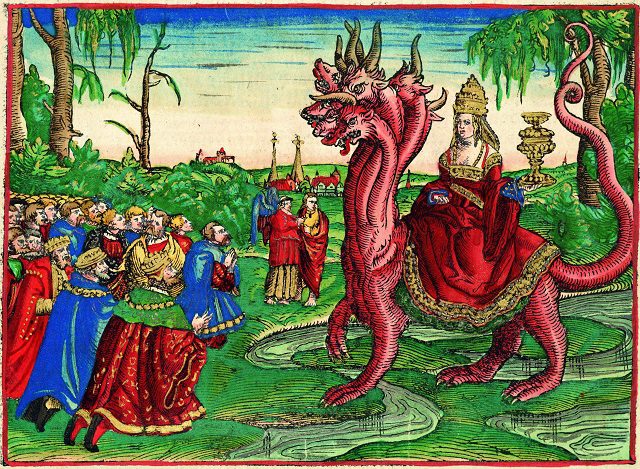
Photo credit: The Whore of Babylon (workshop of Lucas Cranach): colorized illustration from Martin Luther’s 1534 translation of the Bible [public domain / Wikimedia Commons]

***
Summary: The late Steve Hays was a Calvinist and anti-Catholic writer and apologist. This is one of my many critiques of Hays’ “Catholicism”: a 695-page self-published volume.
Previous Post
May 30, 2023
Reply to Hays’ “Catholicism” #20
Next Post
June 1, 2023 Reply to Hays’ “Catholicism” #22
Recent Comments
"And lastly, I belong to no denomination and am free to serve God as He ..."
Is Venerating Men & Angels Worship? ..."
"And obeisance doesn't mean "worship". It means "respect", "obey", or "submission". Very weird that you ..."
Is Venerating Men & Angels Worship? ..."
"Many of these scriptures you have noted have been taken out of context. With Daniel, ..."
Is Venerating Men & Angels Worship? ..."
""Protestants often point out that Jesus is now triumphant in heaven and object to Catholics ..."
Three More Anti-Catholic Lies About Catholicism ..."
Browse Our Archives
Select a Category & Last Things About Me Anti-Catholicism Atheism & Agnosticism Baptism and Sacramentalism Bible and Tradition Blessed Virgin Mary Books by Dave Armstrong C. S. Lewis Calvinism & General Protestantism Catholic Apologetics Catholic Apologists Catholic conversion Catholic converts Christmas Church (Ecclesiology) Church History Conversion and Converts Development of Doctrine Eastern Orthodoxy Ecumenism & Christian Unity Eucharist & Liturgy Fathers of the Church French Translations G. K. Chesterton Hell Hell & Satan Hell & Satan & Last Things Heresies & Comparative Religion Holistic Health Inquisition & Crusades & Scandals James White Jews & Judaism & Old Testament John Calvin John Henry Newman Liberal / Modernist Theology Life Issues Literary Resume Lutheranism Mariology Martin Luther Music Orthodoxy Papacy & Infallibility Personal Page Philosophy & Science Political & Ethical & Moral Issues Protestant Persecution & Intolerance Protestantism Purgatory Purgatory & Penance Romantic & Imaginative Theology Saints & Purgatory & Penance Salvation Salvation & Justification Satan & Last Things Sexuality and Gender Issues Spanish Translations Traditionalism vs. Radical Catholic Reactionaries Traducciones al español / tradução para português Trinitarianism & Christology Uncategorized Videos
Select a Month October 2026 September 2026 August 2026 July 2026 June 2026 May 2026 April 2026 March 2026 February 2026 January 2026 December 2025 November 2025 October 2025 September 2025 August 2025 July 2025 June 2025 May 2025 April 2025 March 2025 February 2025 January 2025 December 2024 November 2024 October 2024 September 2024 August 2024 July 2024 June 2024 May 2024 April 2024 March 2024 February 2024 January 2024 December 2023 November 2023 October 2023 September 2023 August 2023 July 2023 June 2023 May 2023 April 2023 March 2023 February 2023 January 2023 December 2022 November 2022 October 2022 September 2022 August 2022 July 2022 June 2022 May 2022 April 2022 March 2022 February 2022 January 2022 December 2021 November 2021 October 2021 September 2021 August 2021 July 2021 June 2021 May 2021 April 2021 March 2021 February 2021 January 2021 December 2020 November 2020 October 2020 September 2020 August 2020 July 2020 June 2020 May 2020 April 2020 March 2020 February 2020 January 2020 December 2019 November 2019 October 2019 September 2019 August 2019 July 2019 June 2019 May 2019 April 2019 March 2019 February 2019 January 2019 December 2018 November 2018 October 2018 September 2018 August 2018 July 2018 June 2018 May 2018 April 2018 March 2018 February 2018 January 2018 December 2017 November 2017 October 2017 September 2017 August 2017 July 2017 June 2017 May 2017 April 2017 March 2017 February 2017 January 2017 December 2016 November 2016 October 2016 September 2016 August 2016 July 2016 June 2016 May 2016 April 2016 March 2016 February 2016 January 2016 December 2015 November 2015 October 2015 September 2015 August 2015 July 2015 June 2015 May 2015 April 2015 March 2015 February 2015 January 2015 December 2014 November 2014 October 2014 September 2014 August 2014 July 2014 June 2014 April 2014 March 2014 February 2014 January 2014 December 2013 November 2013 October 2013 September 2013 August 2013 July 2013 June 2013 April 2013 March 2013 February 2013 January 2013 December 2012 November 2012 October 2012 September 2012 August 2012 July 2012 June 2012 May 2012 April 2012 March 2012 February 2012 January 2012 December 2011 November 2011 October 2011 September 2011 August 2011 July 2011 June 2011 April 2011 March 2011 February 2011 October 2010 September 2010 August 2010 July 2010 April 2010 March 2010 December 2009 October 2009 August 2009 July 2009 June 2009 May 2009 March 2009 February 2009 October 2008 September 2008 April 2008 March 2008 February 2008 January 2008 December 2007 November 2007 October 2007 May 2007 March 2007 February 2007 January 2007 November 2006 October 2006 September 2006 August 2006 July 2006 June 2006 May 2006 April 2006 March 2006 February 2006 October 2005 June 2005 April 2005 February 2005 July 2004 May 2004 April 2004
Follow Us!
TAKE THE
Religious Wisdom Quiz
Who prayed for rain after a long drought and sent his servant to look seven times?
Select your answer to see how you score.
Elijah Isaiah Samuel Hosea
Books by This Author Books by Dave Armstrong
Related posts from Biblical Evidence for Catholicism

Three More Anti-Catholic Lies About Catholicism (#6-4)
Biblical Evidence for Catholicism

Top Ten Anti-Catholic Lies (#10-7)
Biblical Evidence for Catholicism

"Baptism" & Romans 10 (Engwer's Silly Word Games)
Biblical Evidence for Catholicism

Biblical Perspicuity: Absurd Anti-Catholic "Defense"
Biblical Evidence for Catholicism
TRENDING AT PATHEOS Catholic

I was strolling through the top floor of the brand new Parthenon...

What Does Gêvâh Mean For Kimberley Guifoyle &...
This week, a lot of the news is focused on Kimberly Guilfoyle....

INNER CIRCLE: Profound Mystery (Of Christ In All...
Ephesians 5:31-32 “For this reason, a man will leave his father and...

Do Not Rejoice When Your Enemy Falls: The...
Turning an execution into a public spectacle is a disturbing expression of...

'The Chosen' S6 Trailer: The Passion Gets Very...
Not many watching 'The Chosen' worry about spoilers, but just because they...

The purpose-driven labor priest
A labor activist reads Rick Warren and it gets me wondering about...
view all Catholic blogs
What Are Your Thoughts?leave a comment
Ad-Free & Subscriber Log-In Subscription Support
- About Us
- 2026 Calendar
- Videos
- Podcasts
- Library of World Religions
- Faith In Media Tracker
- Advertise With Us
- Write for Us
- Privacy Policy
- Terms of Service
- Do Not Sell My Data
- Contact Us
- Radiant Digital
- Manage Newsletter Subscriptions
- Unsubscribe From Notifications
- Sitemap
Copyright 2008-2026, Patheos. All rights reserved.
Subscription Support Ad-Free & Subscriber Log-In
Follow Patheos