
BuddhistCatholicContemplativeEvangelicalGeneral ChristianHinduJewishLatter-day SaintMuslimNew VisionsProgressive Christian
Beliefs
- Buddhist
- Catholic
- Contemplative
- Evangelical
- General Christian
- Hindu
- Jewish
- Latter-day Saint
- More Voices
- Muslim
- New Visions
- Pagan
- Progressive Christian
Topics
- Religion News
- Food and Religion
- Sports and Religion
- Religious Art
- Religious Music and Entertainment
- Religious Events
- History and Religion
- Style and Religion
- Politics and Religion
- Women in Religion
- Recreation Outdoors and Religion
- Business Finance and Religion
- Careers Workplace and Religion
- Education and Religion
- Family Parenting and Religion
- Health Fitness and Religion
- Home and Religion
- Relationships and Religion
- Technology and Religion
- Travel and Religion
Columnists
- Buddhist Columnists
- Business Finance and Religion Columnists
- Careers Workplace and Religion Columnists
- Catholic Columnists
- Contemplative Columnists
- Education and Religion Columnists
- Evangelists Columnists
- Family Parenting and Religion Columnists
- General Christian Columnists
- Health Fitness and Religion Columnists
- Hindu Columnists
- History and Religion Columnists
- Home and Religion Columnists
- Jewish Columnists
- More Voices Columnists
- Latter Day Columnists
- Muslim Columnists
- New Visions Columnists
- Nonreligious Columnists
- Pagan Columnists
- Politics and Religion Columnists
- Progressive Columnists
- Recreation Outdoors and Religion Columnists
- Relationships and Religion Columnists
- Religion News Columnists
- Religious Art Columnists
- Religious Events Columnists
- Religious Music and Entertainment Columnists
- Sports and Religion Columnists
- Style and Religion Columnists
- Technology and Religion Columnists
- Travel and Religion Columnists
- Women in Religion Columnists
Resource Library
- 2026 Calendar
- Library of World Religions
- The 100 Most Holy Places on Earth
- Patheos Answers
- Podcasts
- Videos
- Faith Leaders Database
- Anglican Episcopalian
- Bahai
- Baptist
- Buddhism
- Christianity
- Confucianism
- Eastern Orthodoxy
- Hinduism
- Holiness and Pentecostal
- ISKCON
- Islam
- Judaism
- Lutheran
- Methodist
- The Church of Jesus Christ of Latter-day Saints
- New Age
- Paganism
- Presbytarian and Reformed
- Protestantism
- Religion Behind the Scenes
- Roman Catholic
- Scientology
- Shia Islam
- Sikhism
- Sufism
- Sunni Islam
- Taoism
- Zen
- See all religions
Research Tools
 Ad-Free & Subscriber Log-In Subscription Support
Ad-Free & Subscriber Log-In Subscription Support
Follow Patheos 

- Trending:
- Forgiveness
- |
- Marriage
- |
- Consciousness
- |
- Death Penalty
- |
- Election
- |
- Halloween

-
About
-
Catholic Apologetics
-
Church History
-
Great Apologists
-
Christian Worldview
-
Protestantism & Misc.
- Home
- Catholic
- History and Religion
- Reply to Hays’ “Catholicism” #2
Reply to Hays’ “Catholicism” #2
Last updated on: May 14, 2023 at 3:51 pm by Dave Armstrong
Reply to Hays’ “Catholicism” #2 2023-05-14T15:51:53-04:00 Dave Armstrong
Patheos Explore the world's faith through different perspectives on religion and spirituality! Patheos has the views of the prevalent religions and spiritualities of the world.
Asking Patron Saints to Intercede; Miracles Among Catholics & Protestants
The late Steve Hays (1959-2020) was a Calvinist (and anti-Catholic) writer, who was very active on his blog, called Triablogue (now continued by Jason Engwer). His 695-page self-published book, Catholicism — which appears to simply be a collection of his articles on his site — has graciously been made available there for free. This is one of many planned critiques of that book. Rather than list them all in individual sections, interested readers are directed to the “Steve Hays” section of my Anti-Catholicism web page, where they will all be listed. My Bible citations are from the RSV. Steve’s words will be in blue.
*****
[Chapter 1: Miracles]
Anthony, don’t pray for me [p. 11: subtitle]
[Francis] Beckwith prays to the patron saint of cancer patients on behalf of a cancer patient, who nevertheless dies shortly thereafter. How does that validate St. Anthony’s reputation as a long-distance healer? If the patient was cured, that would be impressive. But since the patient succumbed, that hardly furnishes supporting evidence for Anthony’s reputation. [p. 11]
Unanswered prayer no more disproves the practice of asking patron saints to intercede to God than it disproves prayer to God Himself when He says “no.” And that’s because God may always will not to answer a prayer, for reasons usually known to Him alone. This is an explicitly biblical doctrine:
1 John 5:14 And this is the confidence which we have in him, that if we ask anything according to his will he hears us.
James 4:3 You ask and do not receive, because you ask wrongly, to spend it on your passions.
James 1:7-8 For that person must not suppose that a double-minded man, unstable in all his ways, will receive anything from the Lord.
James 5:16 . . . The prayer of a righteous man has great power in its effects.
Hebrews 10:22 let us draw near with a true heart in full assurance of faith, with our hearts sprinkled clean from an evil conscience and our bodies washed with pure water.
Psalm 66:18 If I had cherished iniquity in my heart, the Lord would not have listened.
Proverbs 15:8 The sacrifice of the wicked is an abomination to the LORD, but the prayer of the upright is his delight.
Isaiah 1:15 When you spread forth your hands, I will hide my eyes from you; even though you make many prayers, I will not listen; your hands are full of blood. (cf. Jer 11:11)
Isaiah 59:2 but your iniquities have made a separation between you and your God, and your sins have hid his face from you so that he does not hear.
Even St. Paul’s petitionary prayer request was expressly turned down by God:
2 Corinthians 12:7-9 And to keep me from being too elated by the abundance of revelations, a thorn was given me in the flesh, a messenger of Satan, to harass me, to keep me from being too elated. [8] Three times I besought the Lord about this, that it should leave me; [9] but he said to me, “My grace is sufficient for you, for my power is made perfect in weakness.” I will all the more gladly boast of my weaknesses, that the power of Christ may rest upon me.
The prophet Jonah prayed to God to die (Jonah 4:3): “Therefore now, O LORD, take my life from me, I beseech thee, for it is better for me to die than to live.” (cf. 4:8-9). God obviously didn’t fulfill the request, and chided Jonah or his anger (4:4, 9). The prophet Ezekiel did the same: “O LORD, take away my life” (1 Kgs 19:4). God had other plans, as the entire passage shows. If we pray something stupidly, God won’t answer. He knows better than we do.
Jesus also tells the story (not a parable, which don’t have proper names) in Luke 16 of Lazarus and the rich man, in which two petitionary requests (in effect, prayers: 16:24, 27-28, 30) to Abraham are turned down (16:25-26, 29, 31). Since Jesus is teaching theological principles or truths, by means of the story, then it follows that it’s His own opinion as well: that prayers are not always answered. They have to be according to God’s will.
It’s like “evidence” for global warming. If there’s a warming trend, that’s evidence for global warming–but if there’s a cooling trend, that’s consistent with global warming. Whether it’s wetter or drier, that’s evidence for global warming. If either outcome is consistent with St. Anthony’s reputation, then does anything really count as evidence for or against his reputation? Or is it just random? [p. 11]
The attempted analogy doesn’t apply here because of the important and central additional factor of prayer being conditional upon it being God’s will, just explained.
v) Assuming (ex hypothesi) that it’s a miracle, what kind of miracle would it be? Not like turning water into wine or the multiplication of food. Rather, this would be a coincidence miracle. A result of God’s extraordinary providence.
That, however, is very predestinarian. That assumes God prearranged ordinary circumstances to converge on this opportune and naturally improbable outcome. If so, that’s inconsistent with the libertarian strand of Catholic theology (e.g. Jesuit theologians). [p. 11]
This is another caricature of Catholic theology. We believe in God’s providence as much as any Calvinist does, and we believe in the predestination of the elect and of whatever events God chooses to be predestined. Where we disagree is over the predestination of the damned. We deny that; Calvinists affirm it. Nor is predestination in the slightest incompatible with Jesuit theology (Molinism and suchlike: which happens to be my own view). Jesuits, being Catholics, accept predestination like the Thomists and any other Catholics. They simply have a different view of its implementation or operation by God and precisely how human free will is related to it.
vi) Assuming (ex hypothesi) that it’s a miracle, does it validate the cult of the saints? [p. 11]
If it happens enough times, yes, just as in the case of any other miracle. It validates and suggests this, while not absolutely proving it.
Not unless you think the only function of a miracle is to attest doctrine. Moreover, that’s offset by Protestant miracles. [p. 11]
That’s neither here nor there. If something happens enough times, and suggests that “x caused miracle y,” then that is cumulative evidence for x indeed being the cause or a contributing cause of y. Protestants experience miracles because they are incorporated into the Body of Christ by virtue of the regeneration of their baptism, which is a true sacrament. So declared Trent (i.e., this is nothing new).
Again, prayers of this sort (distinctively Catholic prayers) are substantiated to the extent that they appear to be answered again and again: precisely as with prayers directly to God. It’s difficult to absolutely prove anything regarding prayer, but we can only look to patterns in cause and effect, suggesting “success” or “failure.” Atheists reject all Christian prayers; anti-Catholics take a very dim — if not outright hostile — view of Catholic prayers. What else is new?
Ecclesiastical miracles [p. 15: subtitle]
Unlike the schismatic Protestant sect, Rome is verifiably the one true church because she enjoys miraculous attestation. So goes the argument. One problem with this claim–a problem which has become more manifest since the Reformation–is the fact that Rome doesn’t enjoy a monopoly on reported miracles. There are reported Protestant miracles as well as reported Catholic miracles. Therefore, even if we grant for the sake of argument that Catholicism enjoys prima facie miraculous evidence, the same holds true for Protestantism. [p. 15]
What Hays doesn’t do is comment on the relative numbers of miracles. I contend that we experience many more, relative to Protestantism (and we freely acknowledge that miracles occur among Protestants, as already alluded to). It helps us to have more miracles, seeing that many Protestants don’t even believe that they occur anymore, either due to lack of faith and a full belief or false and unbiblical theological premises regarding miracles (cessationism or Hays’ own semicessationism).
Catholics even have many entire categories of miracles that we believe in, whereas most Protestants don’t: such as exorcisms (discussed in reply #1), incorruptible bodies of saints (a phenomenon that Protestants have the most difficult time trying to explain, leading most of them to simply avoid the topic like the plague), weeping statues of Mary, eucharistic miracles, Marian apparitions, the stigmata, living on the Eucharist alone, levitation, bilocation, etc. We even believe in ghosts, unlike a great many Protestants, who collapse all such occurrences to the horrible and utterly forbidden occult, seances, sorcery, necromancy, etc.
C. S. Lewis (quite Protestant) wrote about seeing the ghost of his wife, Joy, in his book, A Grief Observed. He didn’t feel the need to rationalize this away as a demon impersonating her, etc. Several incidents in the Bible involve dead people coming back to earth (e.g., the prophet Samuel, the two witnesses of Revelation, those who come out of their tombs after the crucifixion, Elijah and Moses at the Transfiguration, etc.).
My point is not to vouch for any particular claim, but just to make the fairly obvious observation that this fixture of the traditional apologetic for Roman Catholicism now backfires. We can call your reputed miracles and raise you. [p. 15]
Not at all, as just explained. Our claims for miracles never had anything to do with whether Protestants also have miracles in their midst. Baptismal regeneration is a miracle, so is initial justification and being filled with the Holy Spirit and the sacrament of matrimony: things that happen to Protestants by the hundreds of millions. It’s a non-issue for us. But if we want to talk about quantities of miracles and many more categories of them, Catholics “win” hands down.
***
Practical Matters: Perhaps some of my 4,200+ free online articles (the most comprehensive “one-stop” Catholic apologetics site) or fifty-one books have helped you (by God’s grace) to decide to become Catholic or to return to the Church, or better understand some doctrines and why we believe them.
Or you may believe my work is worthy to support for the purpose of apologetics and evangelism in general. If so, please seriously consider a much-needed financial contribution. I’m always in need of more funds: especially monthly support. “The laborer is worthy of his wages” (1 Tim 5:18, NKJV). 1 December 2021 was my 20th anniversary as a full-time Catholic apologist, and February 2022 marked the 25th anniversary of my blog.
PayPal donations are the easiest: just send to my email address: [email protected]. You’ll see the term “Catholic Used Book Service”, which is my old side-business. To learn about the different methods of contributing, including 100% tax deduction, etc., see my page: About Catholic Apologist Dave Armstrong / Donation Information. Thanks a million from the bottom of my heart!
***
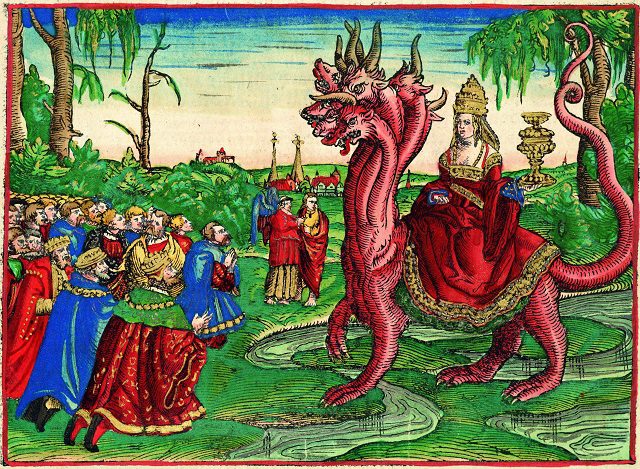
Photo credit: The Whore of Babylon (workshop of Lucas Cranach): colorized illustration from Martin Luther’s 1534 translation of the Bible [public domain / Wikimedia Commons]

***
Summary: The late Steve Hays was a Calvinist and anti-Catholic writer and apologist. This is one of my many critiques of Hays’ “Catholicism”: a 695-page self-published volume.
Previous Post
May 12, 2023
Reply to Hays' "Catholicism" #1
Next Post
May 15, 2023 Reply to Hays’ “Catholicism” #3
Recent Comments
"Special pleading, and not a serious response to my arguments . . ."
Is Venerating Men & Angels Worship? ..."
""no man needs to teach us."Didn't you just teach us?"
Is Venerating Men & Angels Worship? ..."
""Catholics say they are the only church that can lead people into heaven."In fact, we ..."
Is Venerating Men & Angels Worship? ..."
"And lastly, I belong to no denomination and am free to serve God as He ..."
Is Venerating Men & Angels Worship? ..."
Browse Our Archives
Select a Category & Last Things About Me Anti-Catholicism Atheism & Agnosticism Baptism and Sacramentalism Bible and Tradition Blessed Virgin Mary Books by Dave Armstrong C. S. Lewis Calvinism & General Protestantism Catholic Apologetics Catholic Apologists Catholic conversion Catholic converts Christmas Church (Ecclesiology) Church History Conversion and Converts Development of Doctrine Eastern Orthodoxy Ecumenism & Christian Unity Eucharist & Liturgy Fathers of the Church French Translations G. K. Chesterton Hell Hell & Satan Hell & Satan & Last Things Heresies & Comparative Religion Holistic Health Inquisition & Crusades & Scandals James White Jews & Judaism & Old Testament John Calvin John Henry Newman Liberal / Modernist Theology Life Issues Literary Resume Lutheranism Mariology Martin Luther Music Orthodoxy Papacy & Infallibility Personal Page Philosophy & Science Political & Ethical & Moral Issues Protestant Persecution & Intolerance Protestantism Purgatory Purgatory & Penance Romantic & Imaginative Theology Saints & Purgatory & Penance Salvation Salvation & Justification Satan & Last Things Sexuality and Gender Issues Spanish Translations Traditionalism vs. Radical Catholic Reactionaries Traducciones al español / tradução para português Trinitarianism & Christology Uncategorized Videos
Select a Month October 2026 September 2026 August 2026 July 2026 June 2026 May 2026 April 2026 March 2026 February 2026 January 2026 December 2025 November 2025 October 2025 September 2025 August 2025 July 2025 June 2025 May 2025 April 2025 March 2025 February 2025 January 2025 December 2024 November 2024 October 2024 September 2024 August 2024 July 2024 June 2024 May 2024 April 2024 March 2024 February 2024 January 2024 December 2023 November 2023 October 2023 September 2023 August 2023 July 2023 June 2023 May 2023 April 2023 March 2023 February 2023 January 2023 December 2022 November 2022 October 2022 September 2022 August 2022 July 2022 June 2022 May 2022 April 2022 March 2022 February 2022 January 2022 December 2021 November 2021 October 2021 September 2021 August 2021 July 2021 June 2021 May 2021 April 2021 March 2021 February 2021 January 2021 December 2020 November 2020 October 2020 September 2020 August 2020 July 2020 June 2020 May 2020 April 2020 March 2020 February 2020 January 2020 December 2019 November 2019 October 2019 September 2019 August 2019 July 2019 June 2019 May 2019 April 2019 March 2019 February 2019 January 2019 December 2018 November 2018 October 2018 September 2018 August 2018 July 2018 June 2018 May 2018 April 2018 March 2018 February 2018 January 2018 December 2017 November 2017 October 2017 September 2017 August 2017 July 2017 June 2017 May 2017 April 2017 March 2017 February 2017 January 2017 December 2016 November 2016 October 2016 September 2016 August 2016 July 2016 June 2016 May 2016 April 2016 March 2016 February 2016 January 2016 December 2015 November 2015 October 2015 September 2015 August 2015 July 2015 June 2015 May 2015 April 2015 March 2015 February 2015 January 2015 December 2014 November 2014 October 2014 September 2014 August 2014 July 2014 June 2014 April 2014 March 2014 February 2014 January 2014 December 2013 November 2013 October 2013 September 2013 August 2013 July 2013 June 2013 April 2013 March 2013 February 2013 January 2013 December 2012 November 2012 October 2012 September 2012 August 2012 July 2012 June 2012 May 2012 April 2012 March 2012 February 2012 January 2012 December 2011 November 2011 October 2011 September 2011 August 2011 July 2011 June 2011 April 2011 March 2011 February 2011 October 2010 September 2010 August 2010 July 2010 April 2010 March 2010 December 2009 October 2009 August 2009 July 2009 June 2009 May 2009 March 2009 February 2009 October 2008 September 2008 April 2008 March 2008 February 2008 January 2008 December 2007 November 2007 October 2007 May 2007 March 2007 February 2007 January 2007 November 2006 October 2006 September 2006 August 2006 July 2006 June 2006 May 2006 April 2006 March 2006 February 2006 October 2005 June 2005 April 2005 February 2005 July 2004 May 2004 April 2004
Follow Us!
TAKE THE
Religious Wisdom Quiz
What does the Bible say about greed?
Select your answer to see how you score.
It leads to ruin It is always wise It is best It helps you win
Books by This Author Books by Dave Armstrong
Related posts from Biblical Evidence for Catholicism

Three More Anti-Catholic Lies About Catholicism (#6-4)
Biblical Evidence for Catholicism

Top Ten Anti-Catholic Lies (#10-7)
Biblical Evidence for Catholicism

"Baptism" & Romans 10 (Engwer's Silly Word Games)
Biblical Evidence for Catholicism

Biblical Perspicuity: Absurd Anti-Catholic "Defense"
Biblical Evidence for Catholicism
TRENDING AT PATHEOS Catholic

Janie Learns the Way of the Cross: A...
Teaching children about Jesus' Passion can be challenging. Many parents and educators...

Looking For Good Catholic Writing - October 2026
He alone extends the heavens, and he walks upon the waves of...

In "Irreplaceable," our book on vocation and technology, Trevor Sutton and I...

I was strolling through the top floor of the brand new Parthenon...

What Does Gêvâh Mean For Kimberley Guifoyle &...
This week, a lot of the news is focused on Kimberly Guilfoyle....

INNER CIRCLE: Profound Mystery (Of Christ In All...
Ephesians 5:31-32 “For this reason, a man will leave his father and...
view all Catholic blogs
What Are Your Thoughts?leave a comment
Ad-Free & Subscriber Log-In Subscription Support
- About Us
- 2026 Calendar
- Videos
- Podcasts
- Library of World Religions
- Faith In Media Tracker
- Advertise With Us
- Write for Us
- Privacy Policy
- Terms of Service
- Do Not Sell My Data
- Contact Us
- Radiant Digital
- Manage Newsletter Subscriptions
- Unsubscribe From Notifications
- Sitemap
Copyright 2008-2026, Patheos. All rights reserved.
Subscription Support Ad-Free & Subscriber Log-In
Follow Patheos