
BuddhistCatholicContemplativeEvangelicalGeneral ChristianHinduJewishLatter-day SaintMuslimNew VisionsProgressive Christian
Beliefs
- Buddhist
- Catholic
- Contemplative
- Evangelical
- General Christian
- Hindu
- Jewish
- Latter-day Saint
- More Voices
- Muslim
- New Visions
- Pagan
- Progressive Christian
Topics
- Religion News
- Food and Religion
- Sports and Religion
- Religious Art
- Religious Music and Entertainment
- Religious Events
- History and Religion
- Style and Religion
- Politics and Religion
- Women in Religion
- Recreation Outdoors and Religion
- Business Finance and Religion
- Careers Workplace and Religion
- Education and Religion
- Family Parenting and Religion
- Health Fitness and Religion
- Home and Religion
- Relationships and Religion
- Technology and Religion
- Travel and Religion
Columnists
- Buddhist Columnists
- Business Finance and Religion Columnists
- Careers Workplace and Religion Columnists
- Catholic Columnists
- Contemplative Columnists
- Education and Religion Columnists
- Evangelists Columnists
- Family Parenting and Religion Columnists
- General Christian Columnists
- Health Fitness and Religion Columnists
- Hindu Columnists
- History and Religion Columnists
- Home and Religion Columnists
- Jewish Columnists
- More Voices Columnists
- Latter Day Columnists
- Muslim Columnists
- New Visions Columnists
- Nonreligious Columnists
- Pagan Columnists
- Politics and Religion Columnists
- Progressive Columnists
- Recreation Outdoors and Religion Columnists
- Relationships and Religion Columnists
- Religion News Columnists
- Religious Art Columnists
- Religious Events Columnists
- Religious Music and Entertainment Columnists
- Sports and Religion Columnists
- Style and Religion Columnists
- Technology and Religion Columnists
- Travel and Religion Columnists
- Women in Religion Columnists
Resource Library
- 2026 Calendar
- Library of World Religions
- The 100 Most Holy Places on Earth
- Patheos Answers
- Podcasts
- Videos
- Faith Leaders Database
- Anglican Episcopalian
- Bahai
- Baptist
- Buddhism
- Christianity
- Confucianism
- Eastern Orthodoxy
- Hinduism
- Holiness and Pentecostal
- ISKCON
- Islam
- Judaism
- Lutheran
- Methodist
- The Church of Jesus Christ of Latter-day Saints
- New Age
- Paganism
- Presbytarian and Reformed
- Protestantism
- Religion Behind the Scenes
- Roman Catholic
- Scientology
- Shia Islam
- Sikhism
- Sufism
- Sunni Islam
- Taoism
- Zen
- See all religions
Research Tools
 Ad-Free & Subscriber Log-In Subscription Support
Follow Patheos 

- Trending:
- Advent
- |
- Forgiveness
- |
- Thanksgiving
- |
- Election
- |
- Seasonal Holidays
- |
- Marriage

-
About
-
Catholic Apologetics
-
Church History
-
Great Apologists
-
Christian Worldview
-
Protestantism & Misc.
- Home
- Catholic
- History and Religion
- Reply to Hays’ “Catholicism” #19
Reply to Hays’ “Catholicism” #19
Last updated on: May 30, 2023 at 10:17 am by Dave Armstrong
Reply to Hays’ “Catholicism” #19 2023-05-30T10:17:05-04:00 Dave Armstrong
Patheos Explore the world's faith through different perspectives on religion and spirituality! Patheos has the views of the prevalent religions and spiritualities of the world.
Catholic Conversion; Why Infallibility?; Limbo; Catholicism & Exegesis; Salvation(?) by Faith Alone?; St. Cardinal Newman & Pope St. Pius X
The late Steve Hays (1959-2020) was a Calvinist (and anti-Catholic) apologist, who was very active on his blog, called Triablogue (now continued by Jason Engwer). His 695-page self-published book, Catholicism — a collection of articles from his site — has graciously been made available for free. On 9 September 2006, Hays was quite — almost extraordinarily — charitable towards me. He wrote then:
I don’t think I’ve ever accused him of being a traitor or apostate or infidel. . . . I have nothing to say, one way or the other, regarding his state of grace. But his sincerity is unquestionable. I also don’t dislike him. . . . I don’t think there’s anything malicious about Armstrong—unlike some people who come to mind. In addition, I don’t think I’ve ever said he was unintelligent. For the record, it’s obvious that Armstrong has a quick, nimble mind.
Two-and-a-half years later, starting in April 2009 and up through December 2011 (in the following quotations) his opinion radically changed, and he claimed that I have “an evil character,” am “actually evil,” “ego-maniac, narcissist,” “idolater,” “self-idolater,” “hack who pretends to be a professional apologist,” given to “chicanery,” one who doesn’t “do any real research,” “a stalwart enemy of the faith . . . no better than [the atheists] Richard Dawkins or Christopher Hitchens,” with an intent to “destroy faith in God’s word,” “schizophrenic,” “emotionally unhinged,” one who “doesn’t trust in the merit of Christ alone for salvation,” “has no peace of mind,” “a bipolar solipsist,” “split-personality,” and a “bad” man. He wasn’t one to mince words! See more gory details.
I feel no need whatsoever to reciprocate these silly and sinful insults. I just wanted the record to be known. I’ve always maintained that Hays was a very intelligent man, but habitually a sophist in methodology; sincere and well-meaning, but tragically and systematically wrong and misguided regarding Catholicism. That’s what I’m addressing, not the state of his heart and soul (let alone his eternal destiny). It’s a theological discussion. This is one of many planned critiques of his book (see my reasons why I decided to do this). Rather than list them all here, interested readers are directed to the “Steve Hays” section of my Anti-Catholicism web page, where they will all be listed. My Bible citations are from the RSV. Steve’s words will be in blue.
*****
[Chapter 5: Convert Syndrome]
The gingerbread house-part 1
So many Catholic conversion stories have a cerebral emphasis. [p. 247]
Yes, because Catholicism is a thinking mans’ religion: the opposite of the small sub-group of Protestant fundamentalism, which is anti-intellectual. In many cases, it was a matter of learning things one had never been taught, and reading from a perspective other than Protestant. That process is “cerebral.” In my case, it was learning a lot about Church history and development of doctrine that I had never been taught. Historical facts are not “touchy-feely / warm fuzzy” experiential. One has to learn it and think about it. But there are lots of different types of conversion stories.
The appeal of Catholicism is like the gingerbread house in Hansel & Gretel. It presents a startling contrast between what’s on the outside and what’s on the inside. There’s the yummy exterior, which is the bait–but once inside, there’s the cannibalistic witch. [p. 247]
Sure, if one converts based on mere ideals and outward appearances, and relying on human beings to never let one down, then they will be in for a big disappointment. Catholicism is blessed “on the ground” with massive ignorance and nominalism and hypocrisy just as Protestantism is. It’s the “dumb man’s” approach to think that everything will be perfect. The wise convert understands the biblical teaching that the Church has flawed people in it, but that God is at work to guide His Church on the level of doctrines and dogmas and moral teaching.
They convert because they believe the doctrines to be true, as opposed to thinking that all Catholics will be perfect saints. Nothing comes close to the Catholic Church in these regards. We alone have preserved the full moral teaching of the Bible and the apostles. Everyone else has compromised and caved, to one degree or another (on abortion and divorce and cohabitation and contraception and so-called “gay marriage”, and now, an increasing euthanasia and even infanticide in the most liberal states). This is a major reason why I am a Catholic. I got tired of Church groups that compromised on serious moral issues.
They convert to Catholicism before they experience Catholic parish life. Like the gingerbread house, this sets up a dichotomy between Catholicism on paper and the church on the ground. [p. 247]
One simply looks around for a good, orthodox, pious parish where the people actually believe and practice Catholicism. It’s not difficult: at least not in urban areas. Occasionally, it may be difficult to find a good parish close by. Avoid the theological liberal garbage like the plague . . .
By comparison, there’s nothing ironic about reading yourself into evangelicalism or Calvinism because, initially, the primary question is whether it’s true. [p. 248]
That’s not different from a standard, serious conversion to Catholicism by someone who was already a solid Protestant. I’m answering as I read, and I already wrote above: “They convert because they believe the doctrines to be true, . . .”
[S]ome converts already had a background in liturgical churches (Lutheran, Anglican, Episcopalian). It comes as no surprise when they convert to Catholicism since their religious background predisposed them in that direction. [p. 248]
I was as unliturgical and low-church as one could be. It wasn’t about going where I felt comfortable, but following truth where I thought it led, regardless of “touchy-feely / oh-so-familiar” feelings.
On a related note, several converts had a background that was irreligious or nominally religious or nominally Protestant. Once again, it comes as no surprise that their background makes them susceptible to Catholicism inasmuch as they never had a strong, intellectually well-informed evangelical standard of comparison. [p. 248]
In my case, the churches I attended were intellectually sound (the pastor who married us had a doctorate in education), with a love of apologetics, such as from C. S. Lewis and Francis Schaeffer and Walter Martin, and the notion that Jesus was Lord of all of life. I did street witnessing at the Ann Arbor Art Fair (University of Michigan) for ten years, all through the 80s. One can’t succeed in doing that at all — without making a total fool of oneself — if one is anti-intellectual. It’s one of the hotbeds of radical secularism and left-wing politics in the country: and my parish now is located there.
But Hays still tried to lie about my background, as if it were anti-intellectual (“he had a rather brief and superficial experience with Evangelicalism [13 years!]—reading popularizers and attending emotive, anti-intellectual churches. . . . a shallow brand of Evangelicalism”: 9-9-06).
Bishop James White tried to pull the same schtick in December 2004, and described me as “one who has given very little evidence, in fact, of having done a lot of serious reading in better non-Catholic literature to begin with” (see the books I had actually read as a Protestant). I had been a Protestant apologist, for heaven’s sake, and did anti-cult research (still posted on my blog) and outreach in the early 80s. I did a radio show, teaching about Jehovah’s Witnesses on the big evangelical station in Detroit in 1989. That’s “thinking” stuff. People like Hays simply can’t believe that anyone at all intelligent or well-read or knowledgeable in Christianity could possibly become a Catholic. So we see him perpetually rationalizing away the reasons for such conversions. But he failed. E for effort and also for performance . . .
I use myself as an example because I know my own conversion story very well. But my overall point is that, if he can twist and distort my story that much, surely he did so with many others, too. My conversion to Catholicism was built upon the many true elements of Protestantism, that had taught me so much, and for which I am very grateful.
The gingerbread house-part 3
What’s so great about infallibility, anyway? You don’t have to be infallible to be right. We hold many fallible but true beliefs. [p. 253]
What’s great about it is that it allows for certainty that one is believing in truth. The Bible (especially Paul) is very big on truth. The word “truth” appears 103 times in the NT in RSV. “Assured[ly]” appears three times, “may know” sixteen times, “confident[ly]” six times, “knowledge” 48 times, “wise” 36 times, and “wisdom” 51 times. Infallibility is the same sort of thing. Jesus said that the Holy Spirit would “guide” us “into all the truth” (Jn 16:13), and Paul taught that the Church was “the pillar and bulwark of the truth” (1 Tim 3:15). The apostles and elders at the Jerusalem council said that their decision “seemed good to the Holy Spirit” (Acts 15:28). For a more linguistically equivalent assertion of infallibility, we see a passage like this one:
2 Corinthians 13:5-6 Examine yourselves, to see whether you are holding to your faith. Test yourselves. Do you not realize that Jesus Christ is in you? — unless indeed you fail to meet the test! [6] I hope you will find out that we have not failed.
God likes His followers being certain, assured, confident, knowledgeable, wise, and adhering to infallible doctrinal proclamations, such as are present in Catholicism. He doesn’t like the (sought after, gloried in!) uncertainty, doctrinal chaos and indifferentism, and theological relativism that is so pervasive in Protestantism.
The gingerbread house-part 4
“The Church” didn’t compile the Bible. [p. 258]
Yeah, we know. It ratified or sanctioned or “authorized” it by her authority, so that the issue would henceforth be settled. More of that dreaded infallibility and certainty . . .
The gingerbread house-part 6
The church can be indefectible even though denominations are defectible, because the church is instantiated in different denominations at different times and places. When they outlive their usefulness, the church is then instantiated in newer denominations. [p. 261]
And where is this novel notion found in the Bible? Sectarianism and division are everywhere and always condemned in the NT.
[Chapter 6: Development of Doctrine]
No hard feelings, right?
For centuries, grieving parents were told that unbaptized babies went to Limbo rather than heaven. While that’s better than hell, it also means the parents will be permanently separated from their deceased children. Even if the parents are ultimately saved, they occupy a different place than their children. [p. 266]
Rather, Rome came down firmly on both sides of the issue at different times. [p. 268]
Limbo was never established doctrine. See:
Has Limbo Been Relegated to Limbo?: It Never Was Definitive Teaching [12-28-07]
Jay Dyer: Intellectual Limbo Re Catholic Belief in Limbo (with Dr. Robert Fastiggi) [7-24-20]
Cardinal Müller on Catholicism and Protestantism
Cardinal Müller represents the conservative, intellectual wing of the hierarchy. [p. 269]
In other words, he is simply an orthodox Catholic. It’s nice to see Hays finally acknowledge that there is a human being who is not a flaming liberal dissident (in his mind) as part of the “hierarchy.” But any of us orthodox apologists are just deluded dopes supposedly out of touch with the “actual” Catholic Church. Hays disagreed with Cardinal Müller’s statement: “The visible Church is the concretization of the Word of God’s incarnate presence in Jesus Christ” by replying, “It is in Catholic ecclesiology, but not in NT ecclesiology.” Oh yes it is. I dealt with this in reply #18:
1 Corinthians 12:27 Now you are the body of Christ and individually members of it.
Acts 8:3; 9:1, 4-5 But Saul was ravaging the church, and entering house after house, he dragged off men and women and committed them to prison. . . . Saul, still breathing threats and murder against the disciples of the Lord. . . . And he fell to the ground and heard a voice saying to him, “Saul, Saul, why do you persecute me?” And he said, “Who are you, Lord?” And he said, “I am Jesus, whom you are persecuting”;
Rome claims the ability to bypass transparent, responsible methods of exegesis and substitutes the sheer ecclesiastical authority to posit the meaning. [p. 274]
No she doesn’t. There are only seven to nine Bible passages that the Catholic Church has definitively and finally interpreted See: The Freedom of the Catholic Biblical Exegete / Interpreter + Bible Passages that the Church has Definitively Interpreted [9-14-03]. Surely, any Calvinist has at least that many passages that they think prove their beloved TULIP false doctrine, and which in their minds could have no other possible interpretation.
For example, all Calvinists seem to think that Romans 9 is an unanswerable, unquestionable confirmation of their novel doctrines on double predestination (I saw this “confidence” exhibited just last week online). It’s not, as I showed: Romans 9: Plausible Non-Calvinist Interpretation [4-22-10]. But my main present point is that it’s not only Catholics who say “you can’t interpret verses a, b, c, other than as x” (in the Catholic case, for only 7-9 passages) Protestants do it, too. So why wrangle about things that are a wash?
The classic Protestant position isn’t salvation by faith alone but justification by faith alone and salvation by grace alone. [p. 278]
John Calvin’s pretty “classic” and he wrote about one of Protestantism’s favorite passages (Ephesians 2:8-9):
For by grace are ye saved. This is an inference from the former statements. Having treated of election and of effectual calling, he arrives at this general conclusion, that they had obtained salvation by faith alone. First, he asserts, that the salvation of the Ephesians was entirely the work, the gracious work of God. But then they had obtained this grace by faith. On one side, we must look at God; and, on the other, at man. God declares, that he owes us nothing; so that salvation is not a reward or recompense, but unmixed grace. The next question is, in what way do men receive that salvation which is offered to them by the hand of God? The answer is, by faith; . . .
When, on the part of man, the act of receiving salvation is made to consist in faith alone, all other means, on which men are accustomed to rely, are discarded. (Commentary on Ephesians 2:8–10; my italics)
St. John Cardinal Newman
Set your “lie meters.” They will be going crazy, for sure . . .
Newman resembles Luther inasmuch as both developed one-man belief-systems to resolve their personal religious quest. [p. 280]
This is sheer nonsense: ignorant as it can be. Newman was in complete accord with the tradition of Catholicism, and even his thesis on development that Hays relentlessly lies about and mischaracterizes, was directly derived from St. Vincent of Lerins in the 5th century. Luther, on the other hand, was a revolutionary, who had already rejected at least fifty Catholic beliefs and traditions and practices by 1520, before he was excommunicated.
The theory of development was necessitated by the increasing strain between the appeal to tradition and innovations in Catholic theology. Innovations that lacked a documentable pedigree in primitive tradition. [p. 280]
This is garbage, too, and I have refuted it again and again. See, in particular, my editing of replies to the virulently anti-Catholic and anti-Newman Anglican anti-Catholic George Salmon, and my own replies to Salmon’s anti-Newman damnable lies.
The theory of development solved one problem by creating another problem. It severed Catholic theology from any traditional moorings. Catholic theology is now adrift. It has no fixed center or boundaries. Catholic theology is now the theology of whoever the current pope happens to be. Like a chameleon, Catholic theology changes colors to match the shade of the current pope. [p. 280]
In Hays’ vain and highly fanciful imagination, development of doctrine is supposedly equivalent to evolution of dogmas. He seems constitutionally unable to comprehend how dead wrong this is. The former is fully accepted by the Catholic Church and involves no essential change. The latter involves essential change into something different and is condemned by the Church. Now, if indeed, Newman’s development was so supposedly radical and novel, how is it that the pope most known for being traditional and anti-modernist, Pope St. Pius X, was such a big advocate of it?
It so happens that an Irish bishop defended Newman from the false charges that he was a modernist and a liberal, and that his theory of development was no different than modernist “evolution of dogma” which Pope St. Pius X had condemned (and that he was condemned by his encyclical Pascendi). The document’s title is: Cardinal Newman and the Encyclical Pascendi Dominici Gregis, and it was written by Edward Thomas O’Dwyer, Bishop of Limerick (1908). Here is an excerpt:
(3) With regard to the theory of the development of Christian Doctrine, two questions entirely distinct from one another have to be considered in relation to Newman: (a) is his theory admissible according to the principles of Catholic Theology, and (b) is it covered, or touched in any wise, by the condemnations of the recent Encyclical.
The first of these questions I leave on one side now, venturing merely to express, with all submission, my personal opinion, little as it is worth, that in its broad outlines it is thoroughly sound and orthodox, and most serviceable for the interpretation of the facts of the history of dogma.
As to the second, I cannot see how there can be room for doubt. Newman’s whole doctrine was not only different from that of the Modernists, but so contrary to it in essence and fundamental principle, that I cannot conceive how, by any implication, it could be involved in their condemnation. Nothing less than an explicit statement by the supreme authority of the Holy See would convince me to the contrary. I see no common ground in both systems. The word development is the only thing which they hold in common. They do not mean the same thing by Christianity, by dogma, by religion, by Church. They do not start from the same first principles, and consequently they are as separate as the poles.
Pope St. Pius X himself – in the same year: 1908 (on 10 March) – wrote a letter to Bishop O’Dwyer, thoroughly approving of his pamphlet. Here are some excerpts:
We hereby inform you that your essay, in which you show that the writings of Cardinal Newman, far from being in disagreement with Our Encyclical Letter Pascendi, are very much in harmony with it, . . . Moreover, as far as that matter is concerned, his way of thinking has been expressed in very different ways, both in the spoken word and in his published writings, and the author himself, on his admission into the Catholic Church, forwarded all his writings to the authority of the same Church so that any corrections might be made, if judged appropriate. Regarding the large number of books of great importance and influence which he wrote as a Catholic, it is hardly necessary to exonerate them from any connection with this present heresy. . . . what the Modernists do is to falsely and deceitfully take those words out of the whole context of what he meant to say and twist them to suit their own meaning. We therefore congratulate you for having, through your knowledge of all his writings, brilliantly vindicated the memory of this eminently upright and wise man from injustice: . . . Would that they should follow Newman the author faithfully by studying his books without, to be sure, being addicted to their own prejudices, and let them not with wicked cunning conjure anything up from them or declare that their own opinions are confirmed in them; but instead let them understand his pure and whole principles, his lessons and inspiration which they contain. They will learn many excellent things from such a great teacher: in the first place, to regard the Magisterium of the Church as sacred, to defend the doctrine handed down inviolately by the Fathers and, what is of highest importance to the safeguarding of Catholic truth, to follow and obey the Successor of St. Peter with the greatest faith. [link]
When I dropped this bombshell on David T. King: without question the loudest-mouthed, most arrogant and obnoxious, rude anti-Catholic I’ve ever met, he never again tried to reply to me (and it has remained that way for almost twenty years now). For more details, see: Was Cardinal Newman a Modernist?: Pope St. Pius X vs. Anti-Catholic Polemicist David T. King (Development, not Evolution of Doctrine) [1-20-04].
Hays has created a wholly fictional, imaginary landscape whereby Pope St. Pius X supposedly opposed Newman’s development of doctrine and regarded him as a modernist. That couldn’t be any more opposed to the truth than it is, as I just documented. If Hays had read this paper of mine in 2004, he could have never argued anything this stupid and removed from reality. David T. King sure learned to cease spouting his ignorant nonsense about Cardinal Newman. “Once bitten, twice shy” . . .
Rome’s clouded crystal ball
A Catholic might object that I’m burning a straw man. Sure, Catholic doctrine changes. No one disputes that. Some changes represent a development of doctrine. In other cases, the tradition wasn’t infallible to begin with. I’m aware of those caveats. [p. 286]
Good. A ray of hope and some desperately needed nuance . . .
***
Practical Matters: Perhaps some of my 4,300+ free online articles (the most comprehensive “one-stop” Catholic apologetics site) or fifty-one books have helped you (by God’s grace) to decide to become Catholic or to return to the Church, or better understand some doctrines and why we believe them.
Or you may believe my work is worthy to support for the purpose of apologetics and evangelism in general. If so, please seriously consider a much-needed financial contribution. I’m always in need of more funds: especially monthly support. “The laborer is worthy of his wages” (1 Tim 5:18, NKJV). 1 December 2021 was my 20th anniversary as a full-time Catholic apologist, and February 2022 marked the 25th anniversary of my blog.
PayPal donations are the easiest: just send to my email address: [email protected]. You’ll see the term “Catholic Used Book Service”, which is my old side-business. To learn about the different methods of contributing, including 100% tax deduction, etc., see my page: About Catholic Apologist Dave Armstrong / Donation Information. Thanks a million from the bottom of my heart!
***
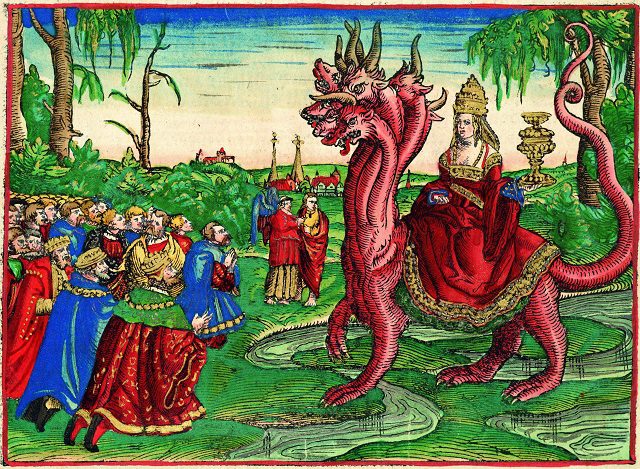
Photo credit: The Whore of Babylon (workshop of Lucas Cranach): colorized illustration from Martin Luther’s 1534 translation of the Bible [public domain / Wikimedia Commons]

***
Summary: The late Steve Hays was a Calvinist and anti-Catholic writer and apologist. This is one of my many critiques of Hays’ “Catholicism”: a 695-page self-published volume.
Previous Post
May 28, 2023
Reply to Hays’ “Catholicism” #18
Next Post
May 30, 2023 Reply to Hays’ “Catholicism” #20
Recent Comments
"Special pleading, and not a serious response to my arguments . . ."
Is Venerating Men & Angels Worship? ..."
""no man needs to teach us."Didn't you just teach us?"
Is Venerating Men & Angels Worship? ..."
""Catholics say they are the only church that can lead people into heaven."In fact, we ..."
Is Venerating Men & Angels Worship? ..."
"And lastly, I belong to no denomination and am free to serve God as He ..."
Is Venerating Men & Angels Worship? ..."
Browse Our Archives
Select a Category & Last Things About Me Anti-Catholicism Atheism & Agnosticism Baptism and Sacramentalism Bible and Tradition Blessed Virgin Mary Books by Dave Armstrong C. S. Lewis Calvinism & General Protestantism Catholic Apologetics Catholic Apologists Catholic conversion Catholic converts Christmas Church (Ecclesiology) Church History Conversion and Converts Development of Doctrine Eastern Orthodoxy Ecumenism & Christian Unity Eucharist & Liturgy Fathers of the Church French Translations G. K. Chesterton Hell Hell & Satan Hell & Satan & Last Things Heresies & Comparative Religion Holistic Health Inquisition & Crusades & Scandals James White Jews & Judaism & Old Testament John Calvin John Henry Newman Liberal / Modernist Theology Life Issues Literary Resume Lutheranism Mariology Martin Luther Music Orthodoxy Papacy & Infallibility Personal Page Philosophy & Science Political & Ethical & Moral Issues Protestant Persecution & Intolerance Protestantism Purgatory Purgatory & Penance Romantic & Imaginative Theology Saints & Purgatory & Penance Salvation Salvation & Justification Satan & Last Things Sexuality and Gender Issues Spanish Translations Traditionalism vs. Radical Catholic Reactionaries Traducciones al español / tradução para português Trinitarianism & Christology Uncategorized Videos
Select a Month November 2026 October 2026 September 2026 August 2026 July 2026 June 2026 May 2026 April 2026 March 2026 February 2026 January 2026 December 2025 November 2025 October 2025 September 2025 August 2025 July 2025 June 2025 May 2025 April 2025 March 2025 February 2025 January 2025 December 2024 November 2024 October 2024 September 2024 August 2024 July 2024 June 2024 May 2024 April 2024 March 2024 February 2024 January 2024 December 2023 November 2023 October 2023 September 2023 August 2023 July 2023 June 2023 May 2023 April 2023 March 2023 February 2023 January 2023 December 2022 November 2022 October 2022 September 2022 August 2022 July 2022 June 2022 May 2022 April 2022 March 2022 February 2022 January 2022 December 2021 November 2021 October 2021 September 2021 August 2021 July 2021 June 2021 May 2021 April 2021 March 2021 February 2021 January 2021 December 2020 November 2020 October 2020 September 2020 August 2020 July 2020 June 2020 May 2020 April 2020 March 2020 February 2020 January 2020 December 2019 November 2019 October 2019 September 2019 August 2019 July 2019 June 2019 May 2019 April 2019 March 2019 February 2019 January 2019 December 2018 November 2018 October 2018 September 2018 August 2018 July 2018 June 2018 May 2018 April 2018 March 2018 February 2018 January 2018 December 2017 November 2017 October 2017 September 2017 August 2017 July 2017 June 2017 May 2017 April 2017 March 2017 February 2017 January 2017 December 2016 November 2016 October 2016 September 2016 August 2016 July 2016 June 2016 May 2016 April 2016 March 2016 February 2016 January 2016 December 2015 November 2015 October 2015 September 2015 August 2015 July 2015 June 2015 May 2015 April 2015 March 2015 February 2015 January 2015 December 2014 November 2014 October 2014 September 2014 August 2014 July 2014 June 2014 April 2014 March 2014 February 2014 January 2014 December 2013 November 2013 October 2013 September 2013 August 2013 July 2013 June 2013 April 2013 March 2013 February 2013 January 2013 December 2012 November 2012 October 2012 September 2012 August 2012 July 2012 June 2012 May 2012 April 2012 March 2012 February 2012 January 2012 December 2011 November 2011 October 2011 September 2011 August 2011 July 2011 June 2011 April 2011 March 2011 February 2011 October 2010 September 2010 August 2010 July 2010 April 2010 March 2010 December 2009 October 2009 August 2009 July 2009 June 2009 May 2009 March 2009 February 2009 October 2008 September 2008 April 2008 March 2008 February 2008 January 2008 December 2007 November 2007 October 2007 May 2007 March 2007 February 2007 January 2007 November 2006 October 2006 September 2006 August 2006 July 2006 June 2006 May 2006 April 2006 March 2006 February 2006 October 2005 June 2005 April 2005 February 2005 July 2004 May 2004 April 2004
Follow Us!
TAKE THE
Religious Wisdom Quiz
In Revelation, what do the souls under the altar cry out for?
Select your answer to see how you score.
Justice and vengeance for their blood The return of Christ Mercy for their persecutors Peace on earth
Books by This Author Books by Dave Armstrong
Related posts from Biblical Evidence for Catholicism
Top Three Anti-Catholic Lies About Catholicism
Biblical Evidence for Catholicism
Three More Anti-Catholic Lies About Catholicism (#6-4)
Biblical Evidence for Catholicism
Top Ten Anti-Catholic Lies (#10-7)
Biblical Evidence for Catholicism
"Baptism" & Romans 10 (Engwer's Silly Word Games)
Biblical Evidence for Catholicism
TRENDING AT PATHEOS Catholic

The Darkening of the Sun, Moon, and Stars
The darkening of the sun and moon and the falling of stars...

Gratitude as the Parent of All Virtues
Giving thanks stems from gratitude. Cicero said that gratitude is the parent...

Make Thanksgiving Bring Family Closer
Written by Dr. David K. Ewen from Eternal Truth Bible College Start...

Ghosts, Spirits, and Wizards in Post-Puritan New England
As it is Thanksgiving, I have a seasonal post concerned with New...

Here are two Thanksgiving columns that I originally wrote for the...

Book III, Chapter 3: Christ "Classic" (Matt. 9:9-34)
Book III, Chapter 3: Christ "Classic" (Matt. 9:9-34) In honor of tomorrow's...
view all Catholic blogs
What Are Your Thoughts?leave a comment
Ad-Free & Subscriber Log-In Subscription Support
- About Us
- 2026 Calendar
- Videos
- Podcasts
- Library of World Religions
- Faith In Media Tracker
- Advertise With Us
- Write for Us
- Privacy Policy
- Terms of Service
- Do Not Sell My Data
- Contact Us
- Radiant Digital
- Manage Newsletter Subscriptions
- Unsubscribe From Notifications
- Sitemap
Copyright 2008-2026, Patheos, part of the Radiant Digital network of media brands. All rights reserved.
Subscription Support Ad-Free & Subscriber Log-In
Follow Patheos