
BuddhistCatholicContemplativeEvangelicalGeneral ChristianHinduJewishLatter-day SaintMuslimNew VisionsProgressive Christian
Beliefs
- Buddhist
- Catholic
- Contemplative
- Evangelical
- General Christian
- Hindu
- Jewish
- Latter-day Saint
- More Voices
- Muslim
- New Visions
- Pagan
- Progressive Christian
Topics
- Religion News
- Food and Religion
- Sports and Religion
- Religious Art
- Religious Music and Entertainment
- Religious Events
- History and Religion
- Style and Religion
- Politics and Religion
- Women in Religion
- Recreation Outdoors and Religion
- Business Finance and Religion
- Careers Workplace and Religion
- Education and Religion
- Family Parenting and Religion
- Health Fitness and Religion
- Home and Religion
- Relationships and Religion
- Technology and Religion
- Travel and Religion
Columnists
- Buddhist Columnists
- Business Finance and Religion Columnists
- Careers Workplace and Religion Columnists
- Catholic Columnists
- Contemplative Columnists
- Education and Religion Columnists
- Evangelists Columnists
- Family Parenting and Religion Columnists
- General Christian Columnists
- Health Fitness and Religion Columnists
- Hindu Columnists
- History and Religion Columnists
- Home and Religion Columnists
- Jewish Columnists
- More Voices Columnists
- Latter Day Columnists
- Muslim Columnists
- New Visions Columnists
- Nonreligious Columnists
- Pagan Columnists
- Politics and Religion Columnists
- Progressive Columnists
- Recreation Outdoors and Religion Columnists
- Relationships and Religion Columnists
- Religion News Columnists
- Religious Art Columnists
- Religious Events Columnists
- Religious Music and Entertainment Columnists
- Sports and Religion Columnists
- Style and Religion Columnists
- Technology and Religion Columnists
- Travel and Religion Columnists
- Women in Religion Columnists
Resource Library
- 2026 Calendar
- Library of World Religions
- The 100 Most Holy Places on Earth
- Patheos Answers
- Podcasts
- Videos
- Faith Leaders Database
- Anglican Episcopalian
- Bahai
- Baptist
- Buddhism
- Christianity
- Confucianism
- Eastern Orthodoxy
- Hinduism
- Holiness and Pentecostal
- ISKCON
- Islam
- Judaism
- Lutheran
- Methodist
- The Church of Jesus Christ of Latter-day Saints
- New Age
- Paganism
- Presbytarian and Reformed
- Protestantism
- Religion Behind the Scenes
- Roman Catholic
- Scientology
- Shia Islam
- Sikhism
- Sufism
- Sunni Islam
- Taoism
- Zen
- See all religions
Research Tools
 Ad-Free & Subscriber Log-In Subscription Support
Ad-Free & Subscriber Log-In Subscription Support
Follow Patheos 

- Trending:
- Forgiveness
- |
- Marriage
- |
- Consciousness
- |
- Death Penalty
- |
- Election
- |
- Halloween

-
About
-
Catholic Apologetics
-
Church History
-
Great Apologists
-
Christian Worldview
-
Protestantism & Misc.
- Home
- Catholic
- History and Religion
- Reply to Hays’ “Catholicism” #14
Reply to Hays’ “Catholicism” #14
Last updated on: June 6, 2026 at 12:48 am by Dave Armstrong
Reply to Hays’ “Catholicism” #14 2026-06-06T00:48:22-04:00 Dave Armstrong
Patheos Explore the world's faith through different perspectives on religion and spirituality! Patheos has the views of the prevalent religions and spiritualities of the world.
Canonicity; God’s Guidance; Ancient Contraception; Relics; Intercession of Saints
The late Steve Hays (1959-2020) was a Calvinist (and anti-Catholic) apologist, who was very active on his blog, called Triablogue (now continued by Jason Engwer). His 695-page self-published book, Catholicism — a collection of articles from his site — has graciously been made available for free. On 9 September 2006, Hays was quite — almost extraordinarily — charitable towards me. He wrote then:
I don’t think I’ve ever accused him of being a traitor or apostate or infidel. . . . I have nothing to say, one way or the other, regarding his state of grace. But his sincerity is unquestionable. I also don’t dislike him. . . . I don’t think there’s anything malicious about Armstrong—unlike some people who come to mind. In addition, I don’t think I’ve ever said he was unintelligent. For the record, it’s obvious that Armstrong has a quick, nimble mind.
Two-and-a-half years later, starting in April 2009 and up through December 2011 (in the following quotations) his opinion radically changed, and he claimed that I have “an evil character,” am “actually evil,” “ego-maniac, narcissist,” “idolater,” “self-idolater,” “hack who pretends to be a professional apologist,” given to “chicanery,” one who doesn’t “do any real research,” “a stalwart enemy of the faith . . . no better than [the atheists] Richard Dawkins or Christopher Hitchens,” with an intent to “destroy faith in God’s word,” “schizophrenic,” “emotionally unhinged,” one who “doesn’t trust in the merit of Christ alone for salvation,” “has no peace of mind,” “a bipolar solipsist,” “split-personality,” and a “bad” man. He wasn’t one to mince words! See more gory details.
I feel no need whatsoever to reciprocate these silly and sinful insults. I just wanted the record to be known. I’ve always maintained that Hays was a very intelligent man, but habitually a sophist in methodology; sincere and well-meaning, but tragically and systematically wrong and misguided regarding Catholicism. That’s what I’m addressing, not the state of his heart and soul (let alone his eternal destiny). It’s a theological discussion. This is one of many planned critiques of his book (see my reasons why I decided to do this). Rather than list them all here, interested readers are directed to the “Steve Hays” section of my Anti-Catholicism web page, where they will all be listed. My Bible citations are from the RSV. Steve’s words will be in blue.
*****
[Chapter 3: Competing Paradigms]
Why I’m still Protestant
Let’s begin with an admission. As a Protestant, it would be nice to have more theological clarity and certainty on some issues. [p. 106]
Yes it would. And if that is the case, then maybe, just maybe, and perhaps God intended for Christians to have more certainty on those topics? And to not have to wonder about so many things because of competing, contradictory denominational claims? For my part, I think the Bible plainly teaches that God intended a profound doctrinal and institutional unity. I lay out the case in my articles critiquing denominationalism (linked in #13).
[D]oes anyone seriously think that Tobit or Bel and the Dragon is the equal of Lamentations, Ecclesiastes, or Song of Songs? [p. 107]
More or less the entire early Church (minus a few dissenters like Jerome) thought they were part of the Deuterocanon.
The problem with asking “who decides” [the canon] is that it only pushes the same question back a step: Who decides “who decides”? You decide who decides! A convert to Catholicism decided to make the Magisterium the decider. So the convert is the ultimate decider. [p. 107]
This is the old “infallible regress” argument that I have already dealt with (I won’t keep repeating myself in these critiques). But here’s a few more articles I didn’t link to before:
The Protestant “Non-Quest” for Certainty [3-15-06; abridged and links added on 7-12-20]
Glorying in Uncertainty in Modern Protestantism (Dialogue with a Calvinist) [11-11-09]
Radically Unbiblical Protestant “Quest for Uncertainty” [2-12-14]
It’s a myth in the first place. Jesus decided to make Peter the head (“rock”) of His one “church.” That means central authority, and hierarchical authority (because the other disciples represented the authority of bishops, lesser than the popes, but working together with them). And the system perpetuates itself by apostolic succession (first seen in the disciples choosing Matthias to replace Judas). The individual Catholic isn’t arbitrarily deciding on anything. He or she simply bows to what was demonstrably true from the beginning of the Church, instituted by our Lord Jesus, and described in inspired Scripture in Matthew 16. The Jerusalem Council also demonstrates how this authority was intended to work. It was the early councils and popes — not atomistic individuals taking polls — that decided the extent of the biblical canon.
A charismatic expects that God will give us certainty, clarity, and evidence whenever we need it or ask for it. God will answer all our prayers. He will perform miracles upon request. He will give us a sign. So the charismatic goes the Catholic one better. [p. 108]
That is an uninformed charismatic; on the fringes. I attended charismatic churches as a Protestant and now as a Catholic I am a member of a charismatic parish. I critiqued charismatic excesses and errors as a Protestant early as 40 years ago, when I started doing serious apologetics. And I utilized research from other charismatics who were fighting distortions of the mainstream charismatic body of thought. Once again, it’s the notorious Hays “broad brush”: claiming to be an expert on things he knows little about.
[Chapter 4: Catholic Apologetics]
Why be Catholic?
1. I’m not going to rehash 1 Tim 3:15. I’ve discussed that here: [link] [p. 113]
Yeah, I’ve discussed it many times, too:
1 Timothy 3:15: Sola Scriptura or Visible Church Authority? [10-2-07]
1 Timothy 3:15 = Church Infallibility (vs. Steve Hays) [5-14-20]
I Timothy 3:15 vs. Sola Scriptura & Jason Engwer [10-4-21]
1 Timothy 3:15 = Infallible Church (vs. Lucas Banzoli) [6-3-22]
Turretin, 1 Timothy 3:15, Infallibility, & Eisegesis [8-24-22]
Church = Foundation of the Truth (1 Tim 3:15) (vs. L. Banzoli) [2-9-23]
And I’ll guarantee that Hays didn’t address several parts of my argument.
Regarding the Johannine verses [14:26; 16:13]:
i) The promise is made to the Eleven, not to “the Church”.
A Catholic might counter that the promise extends to the successors of the Eleven. If the papacy/Roman episcopate is an extension of the Apostolate, then the promise extends to the papacy/Roman episcope.
ii) Problem is, there’s nothing in these verses, or John’s Gospel generally, or 1-3 John, to warrant that extension. [p. 113]
John 15:16 You did not choose me, but I chose you and appointed you that you should go and bear fruit and that your fruit should abide; so that whatever you ask the Father in my name, he may give it to you.
John 20:21 . . . As the Father has sent me, even so I send you. [the next two verses have Jesus granting them the Holy Spirit and the power to absolve sins]
To my knowledge, early Christian opposition to contraception was inseparable from opposition to abortion because, before modern medical science, it was impossible in principle or practice to separate the two. So that’s obsolete. [p. 114]
To the contrary, the ancients were well aware of the distinction between the two (though many — like Luther and Calvin centuries later — regarded both as “murder”):
There was no lack of birth control in the ancient world. I don’t think that there is any type of contraception known today that was not known in the ancient world: pharmacological, barrier (both chemical and mechanical), coitus interruptus, sodomy, sterilization, etc. For a brief introduction to the subject by the foremost historian of the subject, see John M. Riddle, et al., “Ever Since Eve . . .: Birth Control in the Ancient World”, Archaeology, March/April 1994, pp. 29-35. We really do underestimate the ingenuity of our ancestors. While in the past these were far from always effective or reliable, people kept trying. See John M. Riddle: Contraception and Abortion from the Ancient World to the Renaissance (1992), and Eve’s Herbs: A History of Contraception and Abortion in the West (1997).
For centuries, historians paid no attention to ancient accounts that claimed certain plants provided an effective means of birth control. . . . Modern laboratory analysis of various plants [including silphium, asafoetida, seeds of Queen Anne’s lace, pennyroyal, willow, date palm, pomegranate, inter al.], however, gives us reason to believe that the classical potions were effective, and that women in antiquity had more control over their reproductive lives than previously thought. (Riddle, op. cit., p. 30)
There is a consensus in the Catholic Church. The Orthodox churches not in communion with Rome are outside of this consensus:
The propositions constituting a condemnation of contraception are, it will be seen, recurrent. Since the first clear mention of contraception by a Christian theologian, when a harsh third-century moralist accused a pope of encouraging it, the articulated judgment has been the same. In the world of the late Empire known to St. Jerome and St. Augustine, in the Ostrogothic Arles of Bishop Caesarius and the Suevian Braga of Bishop Martin, in the Paris of St. Albert and St. Thomas, in the Renaissance Rome of Sixtus V and the Renaissance Milan of St. Charles Borromeo, in the Naples of St. Alphonsus Liguori and Liege of Charles Billuart, in the Philadelphia of Bishop Kenrick, and in the Bombay of Cardinal Gracias, the teachers of the Church have taught without hestitation or variation that certain acts preventing procreation are gravely sinful. No Catholic theologian has ever taught, ‘Contraception is a good act.’ The teaching on contraception is clear and apparently fixed forever. (John T. Noonan, Jr., Contraception: A History of Its Treatment by the Catholic Theologians and Canonists [1965], p. 6)
The use of contraception was condemned by church fathers. (Contraception: Early Church Teaching, by William Klimon; see much more in this article)
I think the NT does allow for divorce (for desertion and infidelity). [p. 114]
It does not:
Biblical Evidence for the Prohibition of Divorce [2004]
Nor did the early Church allow it along with remarriage:
Divorce: Early Church Teaching [Oct. 1998]
The counsel of Trent, part 2
[Hays tackles prooftexts for relics (2 Kgs 13:21; Acts 5:15; 19:11-12)]
God can assign a supernatural effect to a natural object. If you tampered with sacred furniture in the tabernacle, there were catastrophic consequences. That, however, creates no presumption that natural objects produce supernatural effects. To the contrary, that’s very rare. [p. 118]
They would only do that if God intervened and wanted them to. And according to the Bible, He certainly does. 2 Kings 13:21 describes a dead man being raised by mere contact with the prophet Elisha’s bones. Acts 5:15 strongly implies that Peter’s shadow could heal people. And Acts 19:11-12 teaches that “handkerchiefs or aprons” that touched Paul’s body healed the sick and caused demons to depart the possessed. If all of these are not proofs of the truthfulness of the Catholic belief in relics, I don’t know what is. Hays can’t defeat them with one of his irrelevant, sophistical faux-distinctions.
None of [these] prooftexts involve a divine command or apostolic command. In the passages in Acts, people take the initiative. They take it upon themselves to do this. [p. 118]
The command aspect is perfectly irrelevant. The fact remains that these inanimate objects connected to holy men and saints and apostles caused miracles to occur. If God didn’t want such an outcome, then the miracles would have been condemned as sorcery or what-not in the passage (or would have never occurred in the first place). But they are not. There is not the slightest hint that these events are unsavory or impermissible. In the Old Testament we see a physical item very similar to a relic, and it’s by God’s command: the bronze serpent:
Numbers 21:8-9 And the LORD said to Moses, “Make a fiery serpent, and set it on a pole; and every one who is bitten, when he sees it, shall live.” [9] So Moses made a bronze serpent, and set it on a pole; and if a serpent bit any man, he would look at the bronze serpent and live.
So, command or no, God heals through objects. Here’s another example where oil is an instrument of healing:
James 5:14-15 Is any among you sick? Let him call for the elders of the church, and let them pray over him, anointing him with oil in the name of the Lord; [15] and the prayer of faith will save the sick man, and the Lord will raise him up; and if he has committed sins, he will be forgiven.
Their attitude reflects folk theology. Superstitious belief in sympathetic magic. That things that come in contact with a wonder-worker store magic energy. [p. 118]
Exactly as I anticipated, Hays pulls out the silly “sorcery” card. Again, if these things were examples of that, then the text itself (and/or the apostles) would have condemned it, just as Simon’s desire for what he thought was mere magic powers (by purchasing them!) was roundly condemned (Acts 8:9-24). So Hays’ desperate attempt to evade the obvious falls flat. Readers, decide who has the better case from Scripture!
Problem is, these prooftexts are a double-edged sword. How often are ailing people healed when they make a pilgrimage to a Catholic reliquary? When was the last time a dead person was revived by contact with the relic of a Catholic saint? How often are people healed when the pope’s shadow falls on their sickbed? Why doesn’t the pope empty the Gemelli of patients by paying a visit every so often to cast his healing shadow on the patients? [pp. 118-119]
This is the old David Hume-like trick or sophistry that “reasons” as follows: “if a supernatural event is very rare, we ought not to believe that it can ever happen, or ever be in God’s will.” Rarity doesn’t disprove the possibility and actuality of miracles. Frequency is another topic altogether.
[H]e [Trent Horn] justifies the intercession of the saints by asserting the possibility that the saints are aware of what’s happening to us. But there are basic problems with that appeal:
i) It’s possible that an anonymous benefactor will bail me out if I go into debt. Indeed, anonymous benefactors actually exist. Would it therefore be prudent for me to go into debt, in the expectation that an anonymous benefactor will cover my expenses? It’s possible that if I forego cancer therapy, my cancer will undergo spontaneous remission. Indeed, that happens every so often. Would it therefore be prudent for me to forego cancer therapy in the expectation that my cancer will undergo spontaneous remission?
The fact that we can’t eliminate a possibility isn’t justification to count on that possibility being a reality or probability. That’s dangerous make-believe and wishful thinking. [p. 119]
I think Trent made a much weaker argument than he could have in this instance. It’s not just a guess. We know they are aware of earthly events, and we do from inspired revelation: Hebrews 12:1. Here is what I wrote about that passage in my 2004 book, The Catholic Verses: 95 Bible Passages That Confound Protestants (pp. 141-142):
Hebrews 12:1: “Therefore, since we are surrounded by so great a cloud of witnesses, let us also lay aside every weight, and sin which clings so closely, and let us run with perseverance the race that is set before us,”
Catholics believe that the saints in heaven are aware of happenings on the earth. They are not isolated and removed from earthly realities, but intimately involved in them, as Hebrews 12:1 strongly suggests. Witnesses is the Greek word martus, from which is derived the English word martyr. The reputable Protestant Greek scholars Marvin Vincent and A. T. Robertson comment on this verse as follows:
[T]he idea of spectators is implied, and is really the principal idea. The writer’s picture is that of an arena in which the Christians whom he addresses are contending in a race, while the vast host of the heroes of faith . . . watches the contest from the encircling tiers of the arena, compassing and overhanging it like a cloud, filled with lively interest and sympathy, and lending heavenly aid (Vincent, Word Studies in the New Testament, IV, 536).
“Cloud of witnesses” (nephos marturon) . . . The metaphor refers to the great amphitheatre with the arena for the runners and the tiers upon tiers of seats rising up like a cloud. The martures here are not mere spectators (theatai), but testifiers (witnesses) who testify from their own experience (11:2, 4-5, 33, 39) to God’s fulfilling promises as shown in chapter 11 (Robertson, Word Pictures in the New Testament, V, 432).
This completely defeats Hays’ reply because his premise is wrong (so was Trent’s, for that matter).
While it’s possible for God to reveal my situation to a “saint”, there are built-in limitations to what a saint can know. To be a creature is to be finite. Even an omnipotent God is restricted by the medium if he works through a natural medium. That’s a self-imposed limitation. God can often circumvent a natural medium. But if God is working through human beings, then there are things that an omnipotent being can’t do via that medium. [p. 119]
I’ve already addressed how God can cause saints to be out of time when they are in heaven; no problem at all. Even in the natural world, people can be in different time-frames if one travels at the speed of light for a while (Einstein’s theory of relativity). 1 John 1:3 states that “we are God’s children now; it does not yet appear what we shall be, but we know that when he appears we shall be like him . . .” “Like” God? One way we could be more like Him is for God to give us the ability to be aware of the earth after we die, due in large part to being outside of time, as He is.
There’s no reason to think the Virgin Mary can simultaneously process millions of prayers in hundreds of foreign languages. That’s inhumane. [p. 119]
Yeah? How so? God can make us learn different languages or understand languages we don’t know. He did that with the gift of tongues in the book of Acts.
Invoking divine omnipotence doesn’t solve the problem, since there’s an upper limit on what it means to be human. [p. 119]
Being outside of time is within the range of possibilities for humans. It doesn’t involve us being omniscient or omnipotent; just outside of time!
Assuming the departed can intercede for us, [p. 119]
That’s not even much of an assumption. If they have a “lively interest and sympathy” in us, and lend “heavenly aid”: as Presbyterian linguist Marvin Vincent has stated, then that directly ties into the possibility of praying for us.
the obvious candidate wouldn’t be a Christian who lived and died long before we were born, but a dead relative who knows who we are. [p. 119]
That doesn’t follow if the saints in heaven are much increased in knowledge as well as charity. Hays thinks in purely human terms, but we’re talking about heaven, and how saints will be transformed there:
1 Corinthians 2:9, 11 But, as it is written, “What no eye has seen, nor ear heard, nor the heart of man conceived, what God has prepared for those who love him,” . . . [11] . . . So also no one comprehends the thoughts of God except the Spirit of God.
By contrast, the efficacy of evangelical intercessory prayer isn’t based on the merit of the prayer partners. The only merit is the merit of Christ. [p. 120]
That’s not biblical teaching. The most obvious example of merit affecting prayer is James 5:16-18:
. . . The prayer of a righteous man has great power in its effects. [17] Eli’jah was a man of like nature with ourselves and he prayed fervently that it might not rain, and for three years and six months it did not rain on the earth. [18] Then he prayed again and the heaven gave rain, and the earth brought forth its fruit.
But there is much, much more than that. I compiled as much as I could find in these papers of mine: Bible on Praying Straight to God (vs. Lucas Banzoli) [9-21-22] and Why the Bible Says the Prayers of Holy People Are More Powerful [National Catholic Register, 3-19-19].
***
Practical Matters: Perhaps some of my 4,200+ free online articles (the most comprehensive “one-stop” Catholic apologetics site) or fifty-one books have helped you (by God’s grace) to decide to become Catholic or to return to the Church, or better understand some doctrines and why we believe them.
Or you may believe my work is worthy to support for the purpose of apologetics and evangelism in general. If so, please seriously consider a much-needed financial contribution. I’m always in need of more funds: especially monthly support. “The laborer is worthy of his wages” (1 Tim 5:18, NKJV). 1 December 2021 was my 20th anniversary as a full-time Catholic apologist, and February 2022 marked the 25th anniversary of my blog.
PayPal donations are the easiest: just send to my email address: [email protected]. You’ll see the term “Catholic Used Book Service”, which is my old side-business. To learn about the different methods of contributing, including 100% tax deduction, etc., see my page: About Catholic Apologist Dave Armstrong / Donation Information. Thanks a million from the bottom of my heart!
***
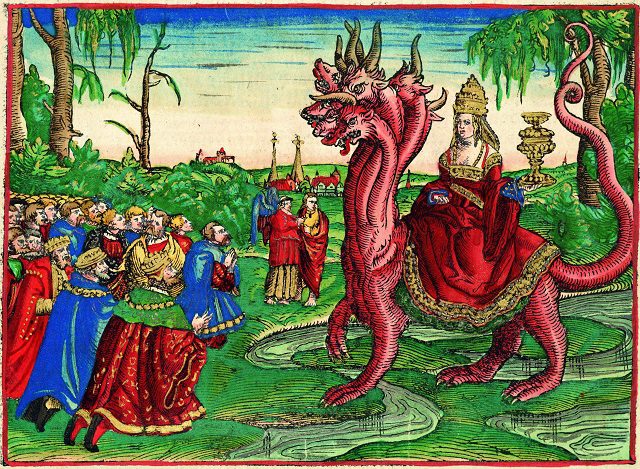
Photo credit: The Whore of Babylon (workshop of Lucas Cranach): colorized illustration from Martin Luther’s 1534 translation of the Bible [public domain / Wikimedia Commons]

***
Summary: The late Steve Hays was a Calvinist and anti-Catholic writer and apologist. This is one of my many critiques of Hays’ “Catholicism”: a 695-page self-published volume.
Previous Post
May 23, 2023
Reply to Hays’ “Catholicism” #13
Next Post
May 25, 2023 Reply to Hays’ “Catholicism” #15
Recent Comments
"Special pleading, and not a serious response to my arguments . . ."
Is Venerating Men & Angels Worship? ..."
""no man needs to teach us."Didn't you just teach us?"
Is Venerating Men & Angels Worship? ..."
""Catholics say they are the only church that can lead people into heaven."In fact, we ..."
Is Venerating Men & Angels Worship? ..."
"And lastly, I belong to no denomination and am free to serve God as He ..."
Is Venerating Men & Angels Worship? ..."
Browse Our Archives
Select a Category & Last Things About Me Anti-Catholicism Atheism & Agnosticism Baptism and Sacramentalism Bible and Tradition Blessed Virgin Mary Books by Dave Armstrong C. S. Lewis Calvinism & General Protestantism Catholic Apologetics Catholic Apologists Catholic conversion Catholic converts Christmas Church (Ecclesiology) Church History Conversion and Converts Development of Doctrine Eastern Orthodoxy Ecumenism & Christian Unity Eucharist & Liturgy Fathers of the Church French Translations G. K. Chesterton Hell Hell & Satan Hell & Satan & Last Things Heresies & Comparative Religion Holistic Health Inquisition & Crusades & Scandals James White Jews & Judaism & Old Testament John Calvin John Henry Newman Liberal / Modernist Theology Life Issues Literary Resume Lutheranism Mariology Martin Luther Music Orthodoxy Papacy & Infallibility Personal Page Philosophy & Science Political & Ethical & Moral Issues Protestant Persecution & Intolerance Protestantism Purgatory Purgatory & Penance Romantic & Imaginative Theology Saints & Purgatory & Penance Salvation Salvation & Justification Satan & Last Things Sexuality and Gender Issues Spanish Translations Traditionalism vs. Radical Catholic Reactionaries Traducciones al español / tradução para português Trinitarianism & Christology Uncategorized Videos
Select a Month October 2026 September 2026 August 2026 July 2026 June 2026 May 2026 April 2026 March 2026 February 2026 January 2026 December 2025 November 2025 October 2025 September 2025 August 2025 July 2025 June 2025 May 2025 April 2025 March 2025 February 2025 January 2025 December 2024 November 2024 October 2024 September 2024 August 2024 July 2024 June 2024 May 2024 April 2024 March 2024 February 2024 January 2024 December 2023 November 2023 October 2023 September 2023 August 2023 July 2023 June 2023 May 2023 April 2023 March 2023 February 2023 January 2023 December 2022 November 2022 October 2022 September 2022 August 2022 July 2022 June 2022 May 2022 April 2022 March 2022 February 2022 January 2022 December 2021 November 2021 October 2021 September 2021 August 2021 July 2021 June 2021 May 2021 April 2021 March 2021 February 2021 January 2021 December 2020 November 2020 October 2020 September 2020 August 2020 July 2020 June 2020 May 2020 April 2020 March 2020 February 2020 January 2020 December 2019 November 2019 October 2019 September 2019 August 2019 July 2019 June 2019 May 2019 April 2019 March 2019 February 2019 January 2019 December 2018 November 2018 October 2018 September 2018 August 2018 July 2018 June 2018 May 2018 April 2018 March 2018 February 2018 January 2018 December 2017 November 2017 October 2017 September 2017 August 2017 July 2017 June 2017 May 2017 April 2017 March 2017 February 2017 January 2017 December 2016 November 2016 October 2016 September 2016 August 2016 July 2016 June 2016 May 2016 April 2016 March 2016 February 2016 January 2016 December 2015 November 2015 October 2015 September 2015 August 2015 July 2015 June 2015 May 2015 April 2015 March 2015 February 2015 January 2015 December 2014 November 2014 October 2014 September 2014 August 2014 July 2014 June 2014 April 2014 March 2014 February 2014 January 2014 December 2013 November 2013 October 2013 September 2013 August 2013 July 2013 June 2013 April 2013 March 2013 February 2013 January 2013 December 2012 November 2012 October 2012 September 2012 August 2012 July 2012 June 2012 May 2012 April 2012 March 2012 February 2012 January 2012 December 2011 November 2011 October 2011 September 2011 August 2011 July 2011 June 2011 April 2011 March 2011 February 2011 October 2010 September 2010 August 2010 July 2010 April 2010 March 2010 December 2009 October 2009 August 2009 July 2009 June 2009 May 2009 March 2009 February 2009 October 2008 September 2008 April 2008 March 2008 February 2008 January 2008 December 2007 November 2007 October 2007 May 2007 March 2007 February 2007 January 2007 November 2006 October 2006 September 2006 August 2006 July 2006 June 2006 May 2006 April 2006 March 2006 February 2006 October 2005 June 2005 April 2005 February 2005 July 2004 May 2004 April 2004
Follow Us!
TAKE THE
Religious Wisdom Quiz
I made a rash vow that cost me my only child after a military victory. Who am I?
Select your answer to see how you score.
Jephthah Samson Gideon Barak
Books by This Author Books by Dave Armstrong
Related posts from Biblical Evidence for Catholicism

Three More Anti-Catholic Lies About Catholicism (#6-4)
Biblical Evidence for Catholicism

Top Ten Anti-Catholic Lies (#10-7)
Biblical Evidence for Catholicism

"Baptism" & Romans 10 (Engwer's Silly Word Games)
Biblical Evidence for Catholicism

Biblical Perspicuity: Absurd Anti-Catholic "Defense"
Biblical Evidence for Catholicism
TRENDING AT PATHEOS Catholic

The Sermon on the Mount, Part I: Matthew...
The Sermon on the Mount, Part I (Matthew 4:12-5:12) St. Matthew moves...

What's up from Crossway: Reviewing some of their latest A few weeks...

Janie Learns the Way of the Cross: A...
Teaching children about Jesus' Passion can be challenging. Many parents and educators...

Looking For Good Catholic Writing - October 2026
He alone extends the heavens, and he walks upon the waves of...

In "Irreplaceable," our book on vocation and technology, Trevor Sutton and I...

I was strolling through the top floor of the brand new Parthenon...
view all Catholic blogs
What Are Your Thoughts?leave a comment
Ad-Free & Subscriber Log-In Subscription Support
- About Us
- 2026 Calendar
- Videos
- Podcasts
- Library of World Religions
- Faith In Media Tracker
- Advertise With Us
- Write for Us
- Privacy Policy
- Terms of Service
- Do Not Sell My Data
- Contact Us
- Radiant Digital
- Manage Newsletter Subscriptions
- Unsubscribe From Notifications
- Sitemap
Copyright 2008-2026, Patheos. All rights reserved.
Subscription Support Ad-Free & Subscriber Log-In
Follow Patheos