
BuddhistCatholicContemplativeEvangelicalGeneral ChristianHinduJewishLatter-day SaintMuslimNew VisionsProgressive Christian
Beliefs
- Buddhist
- Catholic
- Contemplative
- Evangelical
- General Christian
- Hindu
- Jewish
- Latter-day Saint
- More Voices
- Muslim
- New Visions
- Pagan
- Progressive Christian
Topics
- Religion News
- Food and Religion
- Sports and Religion
- Religious Art
- Religious Music and Entertainment
- Religious Events
- History and Religion
- Style and Religion
- Politics and Religion
- Women in Religion
- Recreation Outdoors and Religion
- Business Finance and Religion
- Careers Workplace and Religion
- Education and Religion
- Family Parenting and Religion
- Health Fitness and Religion
- Home and Religion
- Relationships and Religion
- Technology and Religion
- Travel and Religion
Columnists
- Buddhist Columnists
- Business Finance and Religion Columnists
- Careers Workplace and Religion Columnists
- Catholic Columnists
- Contemplative Columnists
- Education and Religion Columnists
- Evangelists Columnists
- Family Parenting and Religion Columnists
- General Christian Columnists
- Health Fitness and Religion Columnists
- Hindu Columnists
- History and Religion Columnists
- Home and Religion Columnists
- Jewish Columnists
- More Voices Columnists
- Latter Day Columnists
- Muslim Columnists
- New Visions Columnists
- Nonreligious Columnists
- Pagan Columnists
- Politics and Religion Columnists
- Progressive Columnists
- Recreation Outdoors and Religion Columnists
- Relationships and Religion Columnists
- Religion News Columnists
- Religious Art Columnists
- Religious Events Columnists
- Religious Music and Entertainment Columnists
- Sports and Religion Columnists
- Style and Religion Columnists
- Technology and Religion Columnists
- Travel and Religion Columnists
- Women in Religion Columnists
Resource Library
- 2026 Calendar
- Library of World Religions
- The 100 Most Holy Places on Earth
- Patheos Answers
- Podcasts
- Videos
- Faith Leaders Database
- Anglican Episcopalian
- Bahai
- Baptist
- Buddhism
- Christianity
- Confucianism
- Eastern Orthodoxy
- Hinduism
- Holiness and Pentecostal
- ISKCON
- Islam
- Judaism
- Lutheran
- Methodist
- The Church of Jesus Christ of Latter-day Saints
- New Age
- Paganism
- Presbytarian and Reformed
- Protestantism
- Religion Behind the Scenes
- Roman Catholic
- Scientology
- Shia Islam
- Sikhism
- Sufism
- Sunni Islam
- Taoism
- Zen
- See all religions
Research Tools
 Ad-Free & Subscriber Log-In Subscription Support
Follow Patheos 

- Trending:
- Advent
- |
- Forgiveness
- |
- Thanksgiving
- |
- Election
- |
- Seasonal Holidays
- |
- Marriage

-
About
-
Catholic Apologetics
-
Church History
-
Great Apologists
-
Christian Worldview
-
Protestantism & Misc.
- Home
- Catholic
- History and Religion
- Reply to Hays’ “Catholicism” #12
Reply to Hays’ “Catholicism” #12
Last updated on: May 26, 2023 at 7:20 pm by Dave Armstrong
Reply to Hays’ “Catholicism” #12 2023-05-26T19:20:24-04:00 Dave Armstrong
Patheos Explore the world's faith through different perspectives on religion and spirituality! Patheos has the views of the prevalent religions and spiritualities of the world.
Church, Seven Sacraments, Papacy, Saints, Priesthood, & Mariology in the Gospels
The late Steve Hays (1959-2020) was a Calvinist (and anti-Catholic) apologist, who was very active on his blog, called Triablogue (now continued by Jason Engwer). His 695-page self-published book, Catholicism — a collection of articles from his site — has graciously been made available for free. On 9 September 2006, Hays was quite — almost extraordinarily — charitable towards me. He wrote then:
I don’t think I’ve ever accused him of being a traitor or apostate or infidel. . . . I have nothing to say, one way or the other, regarding his state of grace. But his sincerity is unquestionable. I also don’t dislike him. . . . I don’t think there’s anything malicious about Armstrong—unlike some people who come to mind. In addition, I don’t think I’ve ever said he was unintelligent. For the record, it’s obvious that Armstrong has a quick, nimble mind.
Two-and-a-half years later, starting in April 2009 and up through December 2011 (in the following quotations) his opinion radically changed, and he claimed that I have “an evil character,” am “actually evil,” “ego-maniac, narcissist,” “idolater,” “self-idolater,” “hack who pretends to be a professional apologist,” given to “chicanery,” one who doesn’t “do any real research,” “a stalwart enemy of the faith . . . no better than [the atheists] Richard Dawkins or Christopher Hitchens,” with an intent to “destroy faith in God’s word,” “schizophrenic,” “emotionally unhinged,” one who “doesn’t trust in the merit of Christ alone for salvation,” “has no peace of mind,” “a bipolar solipsist,” “split-personality,” and a “bad” man. He wasn’t one to mince words! See more gory details.
I feel no need whatsoever to reciprocate these silly and sinful insults. I just wanted the record to be known. I’ve always maintained that Hays was a very intelligent man, but habitually a sophist in methodology; sincere and well-meaning, but tragically and systematically wrong and misguided regarding Catholicism. That’s what I’m addressing, not the state of his heart and soul (let alone his eternal destiny). It’s a theological discussion. This is one of many planned critiques of his book (see my reasons why I decided to do this). Rather than list them all here, interested readers are directed to the “Steve Hays” section of my Anti-Catholicism web page, where they will all be listed. My Bible citations are from the RSV. Steve’s words will be in blue.
*****
[Chapter 3: Competing Paradigms]
Where was your church before the Reformation?
Where do we find the Roman Catholic church in the Gospels? Where do we find “the church” in the Gospel of Mark? Mark’s Gospel never mentions “the church”. Where do we find “the church” in the Gospel of Luke? Luke’s Gospel never mentions “the church”. Where do we find “the church” in the Gospel of John? John’s Gospel never mentions “the church”. The only Gospel that even mentions “the church” is Matthew’s Gospel. And it mentions “the church” just two times. That’s it! [p. 99]
Where do we find sola Scriptura or denominationalism or “faith alone” in the Gospels? Where do we find sola Scriptura or denominationalism or “faith alone” in the Gospel of Mark? Mark’s Gospel never mentions them. Where do we find sola Scriptura or denominationalism or “faith alone” in the Gospel of Luke? Luke’s Gospel never mentions them. Where do we find sola Scriptura or denominationalism or “faith alone” in the Gospel of John? John’s Gospel never mentions them. I did this parody to highlight the fact that if we want to argue “biblical absence,” Protestantism can offer plenty of that, and it’s rarely addressed within its ranks.
Now let’s address whether “church” is almost entirely absent in the Gospels. I deny this and assert that it is indeed present in the phrase “kingdom of God [or heaven]”. McClintock and Strong Biblical Cyclopedia (“Kingdom of God”) stated:
As external, it is either embodied in the visible Church of Christ, and in so far is present and progressive (Mt 6:10; Mt 12:28; Mt 13:24,31,33,41,47; Mt 16:19,28; Mr 4:30; Mr 11:10; Lu 13:18,20; Ac 19:8; Heb 12:28), or it is to be perfected in the coming of the Messiah to judgment and his subsequent spiritual reign in bliss and glory, in which view it is future (Mt 13:43; Mt 26:29; Mr 14:25; Lu 22:29-30; 2Pe 1:11; Re 12:10). . . . But these different aspects are not always distinguished, the expression often embracing both the internal and external sense, and referring both to its commencement in this world and its completion in the world to come (Mt 5:3,10,20; Mt 7:21; Mt 11:11; Mt 13:11,52; Mt 18:3-4; Col 1:13; 1Th 2:12).
“Kingdom of heaven” in RSV appears 32 times in the Gospel of Matthew. “Kingdom of God” appears four times in Matthew, fourteen times in Mark, 32 times in Luke, and twice in John. So if we add all these together and add the two uses of “church” in Matthew, we have 86 appearances altogether. Taking away the ones that refer to Christ’s kingdom after the Second Coming, there are still quite a bit. Hays’ attempt to argue for a non-Church framework in the Gospels abysmally fails.
In fairness, a concept can be present where the word is absent. In the Gospels there’s a notion of Christian community. But you can’t find the Roman Catholic church anywhere in the Gospels. [p. 99]
Matthew 16:17-19 And Jesus answered him, “Blessed are you, Simon Bar-Jona! For flesh and blood has not revealed this to you, but my Father who is in heaven. [18] And I tell you, you are Peter, and on this rock I will build my church, and the powers of death shall not prevail against it. [19] I will give you the keys of the kingdom of heaven, and whatever you bind on earth shall be bound in heaven, and whatever you loose on earth shall be loosed in heaven.”
This is a “Church” built upon St. Peter as its first leader. Does that sound familiar as any particular Christian communion?
All four Gospels have accounts of the Last Supper, but there’s nothing about a priest officiating at the Eucharist. [p. 99]
Jesus presided over it, and He is the new high priest (Heb 2:17; 3:1; 4:14-15; 5:5, 10; 6:20; 7:26; 8:1, 3; 9:11) and prototype of Catholic priests.
And only one Gospel has a clear reference to Christian baptism. [p. 99]
Hays no doubt refers to Matthew 28:19: “Go therefore and make disciples of all nations, baptizing them in the name of the Father and of the Son and of the Holy Spirit”. He neglects Mark 16:16: “He who believes and is baptized will be saved; but he who does not believe will be condemned.” If he wants to play the game that 16:9-20 is a late addition, read one of many defenses of these verses as Scripture, and a second excellent one. Hays also overlooks John 3:22: “After this Jesus and his disciples went into the land of Judea; there he remained with them and baptized.” And John 4:1-2: “. . . Jesus was making and baptizing more disciples than John [2] (although Jesus himself did not baptize, but only his disciples),”.
Why couldn’t he look these things up? As it is, he now just looks foolish and silly. Nothing is easier than searching the Bible, with today’s marvelous searching technology.
Where are the seven sacraments in the Gospels? Nowhere. [p. 99]
First of all, there is no rule (certainly not in the Bible or the Gospels) that everything in Christianity must be present in the Gospels in the first pace. They are only part of the New Testament. But there is plenty of sacramental indication in the Gospels. We just saw the evidence for baptism. The Eucharist is explicitly laid out in the Last Supper accounts and in John 6, where Jesus dramatically states: “unless you eat the flesh of the Son of man and drink his blood, you have no life in you; he who eats my flesh and drinks my blood has eternal life” (6:53-54), “He who eats my flesh and drinks my blood abides in me, and I in him” (6:56), “he who eats this bread will live for ever” (6:58).
Absolution (reconciliation / confession) is found in John 20:23: “If you forgive the sins of any, they are forgiven; if you retain the sins of any, they are retained” (cf. Mt 16:19; 18:18). The sacrament of marriage is arguably found in Jesus saying: “Have you not read that he who made them from the beginning made them male and female, and said, `For this reason a man shall leave his father and mother and be joined to his wife, and the two shall become one flesh’? So they are no longer two but one flesh. What therefore God has joined together, let not man put asunder.” (Mt 19:4-6).
Ordination is present in “”He who receives you receives me” (Mt 10:40), ” As the Father has sent me, even so I send you” (Jn 20:21) and other similar passages. Extreme Unction / last rites / anointing is implied in all the many healing passages, especially those where death is imminent or has already occurred. Confirmation is found in “Receive the Holy Spirit” (Jn 20:22) and “the Counselor . . . whom I shall send to you from the Father, even the Spirit of truth” (Jn 15:26), and “When the Spirit of truth comes, he will guide you into all the truth” (Jn 16:13).
Where’s the cult of the saints in the Gospels? Nowhere. [p. 99]
It’s implied in Jesus teaching about how the rich man prayed to Abraham in Hades (Luke 16), in Jesus talking to the dead and praying for them when He raised people from the dead, in Moses and Elijah appearing with Jesus and talking to Him during His transfiguration, and in the dead coming out of their tombs and walking around Jerusalem after the crucifixion (Mt 27). Protestant theology is vague in terms of incorporating these extraordinary events into an overall consistent framework. Often, Protestants will simply ignore it as if it doesn’t exist, just as Hays did here!
Where’s the Roman Catholic priesthood in the Gospels? Nowhere. [p. 99]
In Jesus’ commission to His disciples (in addition to granting them the power of absolution, as I already addressed above):
Matthew 10:1, 7-8 And he called to him his twelve disciples and gave them authority over unclean spirits, to cast them out, and to heal every disease and every infirmity. . . . [7] And preach as you go, saying, ‘The kingdom of heaven is at hand.’ [8] Heal the sick, raise the dead, cleanse lepers, cast out demons. You received without paying, give without pay.
Matthew 28:19-20 Go therefore and make disciples of all nations, baptizing them in the name of the Father and of the Son and of the Holy Spirit, [20] teaching them to observe all that I have commanded you; . . .
Who, for example, casts out demons today? For the most part, it’s Catholic priests performing exorcisms.
Where’s the papacy in the Gospels? Nowhere. [p. 99]
Nonsense. It’s clearly in the portrayed leadership of Peter among the disciples (Petrine primacy), and in Jesus building His Church upon him (I already cited above). Here is much more:
Matthew 16:19b . . . whatever you bind on earth shall be bound in heaven, and whatever you loose on earth shall be loosed in heaven.
“Binding” and “loosing” were rabbinical terms, meaning to “forbid” and “permit” with reference to the interpretation of the law, and secondarily to “condemn” or “acquit.” Thus, St. Peter was given the authority to determine the rules for doctrine and practice. Bishops also these powers (Mt 18:17-18; Jn 20:23), but Peter was the only apostle who received them singularly, by name (making him preeminent). Peter was regarded by Jesus as the chief shepherd after Himself (Jn 10:11; 21:15-17): over the universal Church. Jesus told him to “feed my lambs” and “tend my sheep” and “feed my sheep.”
Jesus uniquely prayed for Peter, that his “faith may not fail”, and exhorted him to “strengthen” his “brethren” (Lk 22:32), and informed him that he had received divine knowledge by a special revelation (Mt 16:17). Jesus uniquely associated Himself and Peter in the miracle of the tribute-money (Mt 17:24-27), and taught from Peter’s boat. A miraculous catch of fish followed (Lk 5:1-11).
Peter’s name occurs first in all lists of apostles (Mt 10:2; Mk 3:16; Lk 6:14). Matthew even called him the “first” (10:2). He is almost without exception named first whenever he appears with anyone else. He alone among the apostles received a new name, Rock (Jn 1:42; Mt 16:18). The two disciples on the road to Emmaus (Lk 24:34) distinguished the Lord’s post-Resurrection appearances to Peter from those to other apostles.
Peter is often spoken of as distinct among apostles (Mk 1:36; Lk 9:28, 32), and his name is always the first listed of the “inner circle” of the disciples (Peter, James and John – Mt 17:1; 26:37, 40; Mk 5:37; 14:37). He’s mentioned more often than all the other disciples put together: 191 times (162 as Peter or Simon Peter, 23 as Simon, and 6 as Cephas). John is next (48). In the entire NT, his name is mentioned even more than Paul’s.
Peter first confessed Christ’s divinity (Mt 16:16), first set out for, and entered the empty tomb (Lk 24:12; Jn 20:6), and led the apostles in fishing (Jn 21:2-3, 11). He was often the central figure in dramatic gospel scenes such as Jesus’ walking on the water (Mt 14:28-32; Lk 5:1 ff., Mk 10:28; Mt 17:24 ff.). He alone cast himself into the sea to come to Jesus (Jn 21:7). He was often the spokesman for the apostles (Mk 8:29; Mt 18:21; Lk 9:5; 12:41; Jn 6:67 ff.). There is much more in the entire NT.
Where’s the Immaculate Conception in the Gospels (or anywhere in the NT)? Nowhere. [p. 99]
The essence of the Immaculate Conception (a sinless Mary) is found in Luke 1:28 and the word kecharitomene (“full of grace”), once scrutinized in depth, especially in light of what Paul teaches about grace, as I have written about. There are also other biblical analogies that can be brought to bear, including (in the Gospels), the similar sanctity of John the Baptist:
Luke 1:15 for he will be great before the Lord, and he shall drink no wine nor strong drink, and he will be filled with the Holy Spirit, even from his mother’s womb.
Where’s the Assumption of Mary in the NT? Nowhere. [p. 99]
It’s implied in many biblical analogies of persons going to heaven in an extraordinary way, in Revelation 12, and it follows deductively from her Immaculate Conception. Bodily death and decay are the result of sin and the fall of man (Genesis 3:16-19; Psalm 16:10). An absence of actual and original sin would allow for instant bodily resurrection. It’s as if Mary goes back to before the fall (for this reason the Church fathers call her the “New Eve”). Jesus’ resurrection makes possible universal resurrection and redemption of our bodies as well as souls (1 Corinthians 15:13-16). Mary’s assumption is the “first fruits,” sign, and type of the general resurrection of all (created) mankind; she exemplifies the age in which death and sin are conquered once and for all.
Now, a Catholic apologist might object that it’s anachronistic to expect a blueprint of the church in the Gospels. But is that an unreasonable expectation? [p. 100]
It’s unreasonable to find a fully developed “blueprint” but all the essentials are there, as I have just shown. Hays kept claiming that all of this was “nowhere” in the Gospels and NT. He was dead wrong.
Catholic apologists tell us that the Roman Catholic church was directly founded by Jesus Christ. [p. 100]
Yes, because it’s laid out clear as day in Matthew 16.
Catholic apologists tell us that Jesus instituted the seven sacraments. So it’s a reasonable expectation that when we compare the Roman Catholic church to the Gospels, we find something in the Gospels recognizably corresponding to the Roman Catholic church. [p. 100]
Yes it is, which is why I took the time to answer these questions. If Steve Hays were alive he would then have the responsibility to counter my answers. But he wouldn’t have done so. Nor will anti-Catholics today do so (they almost certainly will not). That’s fine with me. If the Catholic apologetic from Scripture goes out unopposed from my blog (over 4,200 articles), and my 51 books, then that’s terrific. People will receive undiluted, undistorted theological and spiritual truth. I keep producing Scripture, and the leading anti-Catholics (all of whom used to respond at least cursorily to my arguments) deliberately ignore it (pretend that I don’t exist). Let them. No skin off of my back. I keep persuading people, by the grace of God, and if this happens with no opposition taking place, so be it!
A Catholic apologist might counter that Jesus indirectly founded the Roman Catholic church by establishing the initial conditions, then leaving the rest to theological development. Suppose we grant that for the sake of argument. If so, why can’t we claim the Protestant Reformation as an intended theological development? [p. 100]
We can insofar as it continues apostolic, patristic, Catholic tradition. We cannot where it departs and introduces novelties not before taught by the universal Church (which it massively did; for example, Luther alone departed in at least fifty ways by 1520, even before his excommunication).
***
Practical Matters: Perhaps some of my 4,200+ free online articles (the most comprehensive “one-stop” Catholic apologetics site) or fifty-one books have helped you (by God’s grace) to decide to become Catholic or to return to the Church, or better understand some doctrines and why we believe them.
Or you may believe my work is worthy to support for the purpose of apologetics and evangelism in general. If so, please seriously consider a much-needed financial contribution. I’m always in need of more funds: especially monthly support. “The laborer is worthy of his wages” (1 Tim 5:18, NKJV). 1 December 2021 was my 20th anniversary as a full-time Catholic apologist, and February 2022 marked the 25th anniversary of my blog.
PayPal donations are the easiest: just send to my email address: [email protected]. You’ll see the term “Catholic Used Book Service”, which is my old side-business. To learn about the different methods of contributing, including 100% tax deduction, etc., see my page: About Catholic Apologist Dave Armstrong / Donation Information. Thanks a million from the bottom of my heart!
***
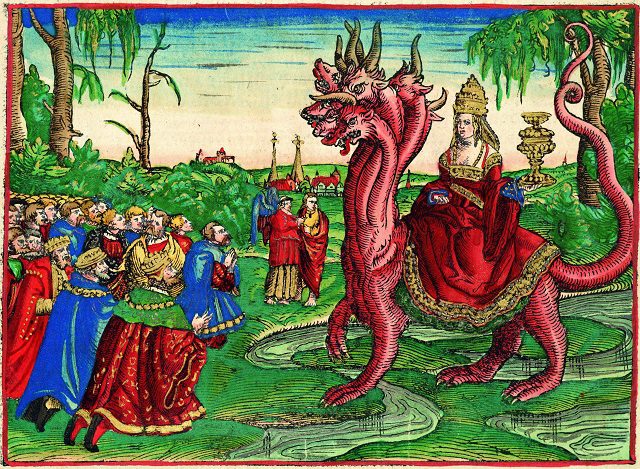
Photo credit: The Whore of Babylon (workshop of Lucas Cranach): colorized illustration from Martin Luther’s 1534 translation of the Bible [public domain / Wikimedia Commons]

***
Summary: The late Steve Hays was a Calvinist and anti-Catholic writer and apologist. This is one of my many critiques of Hays’ “Catholicism”: a 695-page self-published volume.
Previous Post
May 22, 2023
Reply to Hays’ “Catholicism” #11
Next Post
May 23, 2023 Reply to Hays’ “Catholicism” #13
Recent Comments
"Special pleading, and not a serious response to my arguments . . ."
Is Venerating Men & Angels Worship? ..."
""no man needs to teach us."Didn't you just teach us?"
Is Venerating Men & Angels Worship? ..."
""Catholics say they are the only church that can lead people into heaven."In fact, we ..."
Is Venerating Men & Angels Worship? ..."
"And lastly, I belong to no denomination and am free to serve God as He ..."
Is Venerating Men & Angels Worship? ..."
Browse Our Archives
Select a Category & Last Things About Me Anti-Catholicism Atheism & Agnosticism Baptism and Sacramentalism Bible and Tradition Blessed Virgin Mary Books by Dave Armstrong C. S. Lewis Calvinism & General Protestantism Catholic Apologetics Catholic Apologists Catholic conversion Catholic converts Christmas Church (Ecclesiology) Church History Conversion and Converts Development of Doctrine Eastern Orthodoxy Ecumenism & Christian Unity Eucharist & Liturgy Fathers of the Church French Translations G. K. Chesterton Hell Hell & Satan Hell & Satan & Last Things Heresies & Comparative Religion Holistic Health Inquisition & Crusades & Scandals James White Jews & Judaism & Old Testament John Calvin John Henry Newman Liberal / Modernist Theology Life Issues Literary Resume Lutheranism Mariology Martin Luther Music Orthodoxy Papacy & Infallibility Personal Page Philosophy & Science Political & Ethical & Moral Issues Protestant Persecution & Intolerance Protestantism Purgatory Purgatory & Penance Romantic & Imaginative Theology Saints & Purgatory & Penance Salvation Salvation & Justification Satan & Last Things Sexuality and Gender Issues Spanish Translations Traditionalism vs. Radical Catholic Reactionaries Traducciones al español / tradução para português Trinitarianism & Christology Uncategorized Videos
Select a Month November 2026 October 2026 September 2026 August 2026 July 2026 June 2026 May 2026 April 2026 March 2026 February 2026 January 2026 December 2025 November 2025 October 2025 September 2025 August 2025 July 2025 June 2025 May 2025 April 2025 March 2025 February 2025 January 2025 December 2024 November 2024 October 2024 September 2024 August 2024 July 2024 June 2024 May 2024 April 2024 March 2024 February 2024 January 2024 December 2023 November 2023 October 2023 September 2023 August 2023 July 2023 June 2023 May 2023 April 2023 March 2023 February 2023 January 2023 December 2022 November 2022 October 2022 September 2022 August 2022 July 2022 June 2022 May 2022 April 2022 March 2022 February 2022 January 2022 December 2021 November 2021 October 2021 September 2021 August 2021 July 2021 June 2021 May 2021 April 2021 March 2021 February 2021 January 2021 December 2020 November 2020 October 2020 September 2020 August 2020 July 2020 June 2020 May 2020 April 2020 March 2020 February 2020 January 2020 December 2019 November 2019 October 2019 September 2019 August 2019 July 2019 June 2019 May 2019 April 2019 March 2019 February 2019 January 2019 December 2018 November 2018 October 2018 September 2018 August 2018 July 2018 June 2018 May 2018 April 2018 March 2018 February 2018 January 2018 December 2017 November 2017 October 2017 September 2017 August 2017 July 2017 June 2017 May 2017 April 2017 March 2017 February 2017 January 2017 December 2016 November 2016 October 2016 September 2016 August 2016 July 2016 June 2016 May 2016 April 2016 March 2016 February 2016 January 2016 December 2015 November 2015 October 2015 September 2015 August 2015 July 2015 June 2015 May 2015 April 2015 March 2015 February 2015 January 2015 December 2014 November 2014 October 2014 September 2014 August 2014 July 2014 June 2014 April 2014 March 2014 February 2014 January 2014 December 2013 November 2013 October 2013 September 2013 August 2013 July 2013 June 2013 April 2013 March 2013 February 2013 January 2013 December 2012 November 2012 October 2012 September 2012 August 2012 July 2012 June 2012 May 2012 April 2012 March 2012 February 2012 January 2012 December 2011 November 2011 October 2011 September 2011 August 2011 July 2011 June 2011 April 2011 March 2011 February 2011 October 2010 September 2010 August 2010 July 2010 April 2010 March 2010 December 2009 October 2009 August 2009 July 2009 June 2009 May 2009 March 2009 February 2009 October 2008 September 2008 April 2008 March 2008 February 2008 January 2008 December 2007 November 2007 October 2007 May 2007 March 2007 February 2007 January 2007 November 2006 October 2006 September 2006 August 2006 July 2006 June 2006 May 2006 April 2006 March 2006 February 2006 October 2005 June 2005 April 2005 February 2005 July 2004 May 2004 April 2004
Follow Us!
TAKE THE
Religious Wisdom Quiz
Who said, "To the pure, all things are pure"?
Select your answer to see how you score.
James Peter John Paul
Books by This Author Books by Dave Armstrong
Related posts from Biblical Evidence for Catholicism
Top Three Anti-Catholic Lies About Catholicism
Biblical Evidence for Catholicism
Three More Anti-Catholic Lies About Catholicism (#6-4)
Biblical Evidence for Catholicism
Top Ten Anti-Catholic Lies (#10-7)
Biblical Evidence for Catholicism
"Baptism" & Romans 10 (Engwer's Silly Word Games)
Biblical Evidence for Catholicism
TRENDING AT PATHEOS Catholic

For many years, Catholicism has been caught up in division over the...

'Statements of Faith' never get shorter
Nothing demonstrates a conservative commitment to faith and faithfulness like a "statement...

Michele's Reviews - Future Grace by John Piper
In God's Place, at God's Pace, by Future Grace Impatience is...

Bama Gramma's Blackout Christmas: the Power of Light...
Another Christmas Skit: I have an alter ego: Bama Gramma. She shows...

Thanksgiving as a Way of Life: A Christian...
Each year, Thanksgiving brings families and friends together to share meals, stories,...

Two Women Doctors Who Went Against the Current
Women physicians who transformed healthcare for "Indians" “I shall have an advantage...
view all Catholic blogs
What Are Your Thoughts?leave a comment
Ad-Free & Subscriber Log-In Subscription Support
- About Us
- 2026 Calendar
- Videos
- Podcasts
- Library of World Religions
- Faith In Media Tracker
- Advertise With Us
- Write for Us
- Privacy Policy
- Terms of Service
- Do Not Sell My Data
- Contact Us
- Radiant Digital
- Manage Newsletter Subscriptions
- Unsubscribe From Notifications
- Sitemap
Copyright 2008-2026, Patheos, part of the Radiant Digital network of media brands. All rights reserved.
Subscription Support Ad-Free & Subscriber Log-In
Follow Patheos