
BuddhistCatholicContemplativeEvangelicalGeneral ChristianHinduJewishLatter-day SaintMuslimNew VisionsProgressive Christian
Beliefs
- Buddhist
- Catholic
- Contemplative
- Evangelical
- General Christian
- Hindu
- Jewish
- Latter-day Saint
- More Voices
- Muslim
- New Visions
- Pagan
- Progressive Christian
Topics
- Religion News
- Food and Religion
- Sports and Religion
- Religious Art
- Religious Music and Entertainment
- Religious Events
- History and Religion
- Style and Religion
- Politics and Religion
- Women in Religion
- Recreation Outdoors and Religion
- Business Finance and Religion
- Careers Workplace and Religion
- Education and Religion
- Family Parenting and Religion
- Health Fitness and Religion
- Home and Religion
- Relationships and Religion
- Technology and Religion
- Travel and Religion
Columnists
- Buddhist Columnists
- Business Finance and Religion Columnists
- Careers Workplace and Religion Columnists
- Catholic Columnists
- Contemplative Columnists
- Education and Religion Columnists
- Evangelists Columnists
- Family Parenting and Religion Columnists
- General Christian Columnists
- Health Fitness and Religion Columnists
- Hindu Columnists
- History and Religion Columnists
- Home and Religion Columnists
- Jewish Columnists
- More Voices Columnists
- Latter Day Columnists
- Muslim Columnists
- New Visions Columnists
- Nonreligious Columnists
- Pagan Columnists
- Politics and Religion Columnists
- Progressive Columnists
- Recreation Outdoors and Religion Columnists
- Relationships and Religion Columnists
- Religion News Columnists
- Religious Art Columnists
- Religious Events Columnists
- Religious Music and Entertainment Columnists
- Sports and Religion Columnists
- Style and Religion Columnists
- Technology and Religion Columnists
- Travel and Religion Columnists
- Women in Religion Columnists
Resource Library
- 2026 Calendar
- Library of World Religions
- The 100 Most Holy Places on Earth
- Patheos Answers
- Podcasts
- Videos
- Faith Leaders Database
- Anglican Episcopalian
- Bahai
- Baptist
- Buddhism
- Christianity
- Confucianism
- Eastern Orthodoxy
- Hinduism
- Holiness and Pentecostal
- ISKCON
- Islam
- Judaism
- Lutheran
- Methodist
- The Church of Jesus Christ of Latter-day Saints
- New Age
- Paganism
- Presbytarian and Reformed
- Protestantism
- Religion Behind the Scenes
- Roman Catholic
- Scientology
- Shia Islam
- Sikhism
- Sufism
- Sunni Islam
- Taoism
- Zen
- See all religions
Research Tools
 Ad-Free & Subscriber Log-In Subscription Support
Ad-Free & Subscriber Log-In Subscription Support
Follow Patheos 

- Trending:
- Forgiveness
- |
- Marriage
- |
- Consciousness
- |
- Death Penalty
- |
- Election
- |
- Halloween

-
About
-
Catholic Apologetics
-
Church History
-
Great Apologists
-
Christian Worldview
-
Protestantism & Misc.
- Home
- Catholic
- History and Religion
- Solomon’s Temple and its Archaeological Analogies
Solomon’s Temple and its Archaeological Analogies
Last updated on: April 25, 2023 at 1:31 pm by Dave Armstrong
Solomon’s Temple and its Archaeological Analogies 2023-04-25T13:31:57-04:00 Dave Armstrong
Patheos Explore the world's faith through different perspectives on religion and spirituality! Patheos has the views of the prevalent religions and spiritualities of the world.
Also, Parallels to Solomon’s Palace
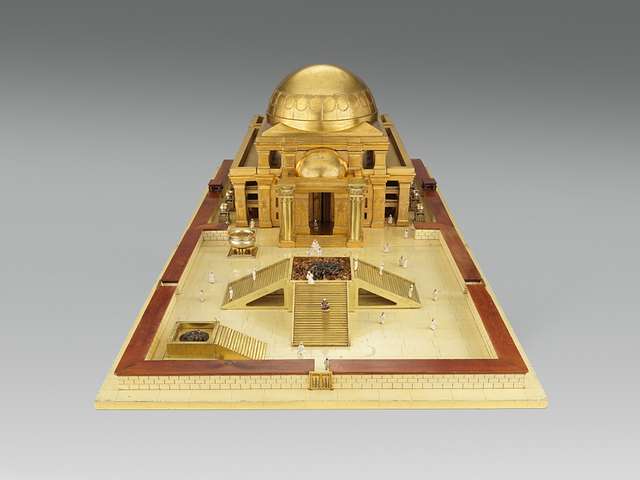
1 Kings 6:2-6 (RSV) The house which King Solomon built for the LORD was sixty cubits long, twenty cubits wide, and thirty cubits high. The vestibule in front of the nave of the house was twenty cubits long, equal to the width of the house, and ten cubits deep in front of the house. And he made for the house windows with recessed frames. He also built a structure against the wall of the house, running round the walls of the house, both the nave and the inner sanctuary; and he made side chambers all around. The lowest story was five cubits broad, the middle one was six cubits broad, and the third was seven cubits broad; for around the outside of the house he made offsets on the wall in order that the supporting beams should not be inserted into the walls of the house.
1 Kings 6:18-23 The cedar within the house was carved in the form of gourds and open flowers; all was cedar, no stone was seen. The inner sanctuary he prepared in the innermost part of the house, to set there the ark of the covenant of the LORD. The inner sanctuary was twenty cubits long, twenty cubits wide, and twenty cubits high; and he overlaid it with pure gold. He also made an altar of cedar. And Solomon overlaid the inside of the house with pure gold, and he drew chains of gold across, in front of the inner sanctuary, and overlaid it with gold. And he overlaid the whole house with gold, until all the house was finished. Also the whole altar that belonged to the inner sanctuary he overlaid with gold. In the inner sanctuary he made two cherubim of olivewood, each ten cubits high.
I again am utilizing the terrific, tour de force book on the Old Testament and archaeology by Egyptologist and archaeologist Kenneth A. Kitchen, for the particular argument herein. (1) He describes the temple of Solomon, based on biblical descriptions:
Behind the portico the temple had a main hall or vestibule and an inner sanctuary. . . . The interior (walls, floor) was then surfaced with gold overlay ([1 Kings 6] vv. 9, 15-22, 30) .. . the wall paneling bore engraved decoration (cherubs, palm trees, open flowers, gourds; vv. 18, 29). Within the inner sanctuary were placed two winged cherubs, wooden and also gilded (vv. 23-28). Around the temple was an inner courtyard of dressed stone-work having a course of cedar beams at every third course (v. 36). . . .
How far does such a structure and its embellishment correspond to known ancient reality or arise from mere fantasy? (2)
There is no trace of this temple, but this is rather easily explained, so contends Kitchen, by the fact that Jerusalem was thoroughly destroyed by the Babylonians in 586 B.C., a second temple built on the same spot later in the same century, massive redevelopment of the entire temple mount and a third temple built in King Herod’s time (first century B.C.), and the even more complete Roman destruction of Jerusalem in 70 A. D.
This being the case, in order to back up the claims of the Bible about the first temple (for those who question it on inadequate grounds), we can only compare them to temple and otherwise sacred design and architecture from the ancient world, elsewhere. Fortunately, there are many such temples in the ancient Near East from the fourth millennium all the way down to the times of the Greeks and Romans. Therefore, why not in Jerusalem in the tenth century B.C.?
Temple D at north Syrian Ebla (ca. 1800) . . . is tripartite: open portico (no columns), anteroom, hall with raised sanctuary niche. (3) At Habuba Kabira, on the west end of the Euphrates, probable remains of such a tripartite temple (portico, no columns, anteroom, long sanctuary hall) . . . date to the early second millennium. At Mari on the east Syrian Euphrates, the twentieth- to eighteenth-century rebuild of the temple of Dagan . . . is seemingly tripartite, with portico (no columns), hall, and then twin sanctuaries. At Alakh (4), by the north bend of the Orontes, the stratum VII temple (ca. eighteenth century . . .) has an enclosed portico (no columns), broad hall, and larger niched sanctuary. (5)
Similar structures were located at Tell Munbaqa (ancient Ekalte) from the fifteenth century, at Hazor in Canaan (thirteenth century), at Ain Dara (about forty miles from Aleppo), built from 1300-1000, embellished during 1000-900: the latter being the same century as Solomon’s temple, and a third building phase, c. 900-740. It’s the closest architecturally to Solomon’s temple. (6)
We have many parallels to the “side chambers” (1 Kings 6:5) or storerooms, in the Egyptian pyramid temples of Sahure and Pepi II in the third millennium, and Sesostris I in the early second millennium. In Sahure, we can observe two-level storerooms, quite similar to Solomon’s three-level structures. Tuthmosis [or Thutmose] III built two-level storerooms in the temple of Amun at Karnak in the fifteenth century. We find similar structures at Hattusas, the Hittite capital, in the thirteenth century. (7)
I Kings 6:36 He built the inner court with three courses of hewn stone and one course of cedar beams.
Kitchen notes similar building practices:
The system of building walls with stone base-courses, topped by timber beams (at times with cross-framing) and then by higher courses in brick or stone, was endemic to the eastern Mediterranean world during the second and first millennia in particular, in the Aegean, and in Anatolia, Syria, and Palestine. Its purpose was to give strength and flexibility against earthquake shocks. (8)
He cites examples of this from the late second millennium, in the Hittite citadel at Hattusas (Boghazkoi) and at Kultepe, and in Syria, at Ugarit.
1 Kings 6:15-16 He lined the walls of the house on the inside with boards of cedar; from the floor of the house to the rafters of the ceiling, he covered them on the inside with wood; and he covered the floor of the house with boards of cypress. He built twenty cubits of the rear of the house with boards of cedar from the floor to the rafters, and he built this within as an inner sanctuary, as the most holy place.
Kitchen provides parallels of wood-paneling of this sort:
It first occurs at Abydos and Saqqara in the great tombs of Egypt’s Archaic Period (ca. 3000-2700). (9) Then in . . . Ebla (ca. 2500), we find . . . fine relief scenes engraved on wooden paneling . . . (10) Then in late-second-millennium Hattusas . . . In the early first millennium, . . . Carchemish and Zinjirli showed analogous evidence . . . In ninth-century Assyria, areas of a major palace could be defined by the type of wood used in the rooms . . . Finally, in the eighth-century palace at Tell Tayinat in north Syria, wooden wall-facing backed by brick was found . . . (11)
Kitchen goes on to note use of gold-plating in Egyptian tombs (c. 3000), and
. . . in the later second millennium, . . . sheet gold and electrum (gold/silver alloy) on temple walls, columns, obelisks, doorways, etc., and silver on floors . . . Nor were the kings of Assyria and Babylon any less generous . . . Esarhaddon and Nabonidus alike “sheathed the walls with gold as if plaster” . . . Nebuchadrezzar II. . . claims . . . “In Esagila . . . the awe-inspiring sanctuary . . . of Marduk . . . I clad in shining gold.” . . . Solomon leafing his temple walls and floor with gold is — in this context — merely what kings then customarily did. (12)
Even the size of Solomon’s temple is entirely typical:
In terms of size and scale, Solomon’s temple at 90/105 feet by 30 feet (plus side rooms) stands within a long-established range of size for temples of its type during the third to first millennia. . . . And, as Solomon’s temple adjoined his palace in Jerusalem’s acropolis, so several of out other examples do likewise. . . . Therefore Solomon’s works here are not fantasy but belong within a widespread and solid framework of actual, long-lived ancient practice. (13)
As for a few of the features of temple of Solomon, the (nonfunctional) bronze columns (1 Kings 7:15-22) can be observed in other Near Eastern temples, such as at Hazor in the late thirteenth century. (14)
The bronze “sea” or tank (1 Kings 7:23-26) copied a similar structure in the tabernacle (Exod. 30:17-21; 38:8). These were common throughout the ancient Near East during all periods; for example, in the late second millennium in Egypt and thirteenth-century Ugarit in north Syria. The ten bronze wheeled stands next to the sea are similar to items found in twelfth/eleventh-century Cyprus and at Ekron. Philistia in the eleventh century. (15)
Even Solomon’s palace (1 Kings 7:1-12) has many parallels: particularly its “House of the Forest of Lebanon” (7:2) and “Hall of Pillars” (7:6), in Pharaoh Akhenaten’s palace in the fourteenth century, among the Hittite “Great Kings” a century later, the ninth-century Phoenician temple at Kition, and an Urartian royal citadel at Altintepe (northeast Anatoli) in he eight/seventh centuries. (16)
The hall of the palace was adorned with gold shields (1 Kings 10:16-17). Some critics have claimed that this is fantasy as well. But it has its parallels in the temple of the god Haldi at Musasir in 714 B. C. and Sargon II’s palace at Khorsabad in the same period. Decorated bronze shields have been found at Nimrud in Assyria, Carchemish in north Syria, and Urartian Toprak Kale in eastern present-day Turkey. Greek tradition refers to gold shields in the temple of Zeus at Olympia. (17)
1 Kings 10:18 The king also made a great ivory throne, and overlaid it with the finest gold.
We find analogies even in this instance. In the fourteenth century Amarna letters, Pharaoh Amenophis III sends to Kadashman-Enlil I of Babylon an ebony bed and ten chairs overlaid with ivory and gold, with several similar footstools. Thus, Kitchen asks rhetorically: “If Solomon is fantasy, what shall we say of Amenophis III?” (18) The tomb of Tutankhamun yielded all these items as well, fabulously gold-plated. Gold tables, vessels, and jewelry were found in the burial places of ninth-eighth century Assyrian queens and in the burial chamber of Psusennes I of Egypt (1040/1039-992-991), which was in the time of King David’s reign. (19)
FOOTNOTES
1) Kenneth A. Kitchen, On the Reliability of the Old Testament (Grand Rapids, Michigan: Wm. B. Eerdmans Publishing Co., 2003).
2) Kitchen, 122.
3) See: P. Matthiae, Ebla, an Empire Rediscovered (London: Hodder & Stoughton, 1977), 131-132 and fig. 30 (and in unnumbered plates at the end).
4) See Sir C. L. Woolley, Alalakh (London: Society of Antiquaries, 1955), fig. 35.
5) Kitchen, 123.
6) Ibid.
7) See Kitchen, 123-124.
8) See H. C. Thomson, Palestine Exploration Quarterly 92 (1960), 57-63.
9) See W. B. Emery, Archaic Egypt (Harmondsworth: Pelican Books, 1961), 190 and fig. 11 (wooden flooring, 187 and pl. 21).
10) Matthiae, 75 and unnumbered 17th to 20th photo pages.
11) Kitchen, 125.
12) Kitchen, 125-126.
13) Kitchen, 126.
14) Ibid.
15) Kitchen, 126-127.
16) Kitchen, 128-129.
17) Kitchen, 129.
18) Kitchen, 131.
10) Ibid.
***
See Related Articles
Acacia, Ark of the Covenant, & Biblical Accuracy [8-24-21]
Archaeology & Solomon’s Temple-Period Ivory [1-28-23]
King Solomon’s “Mines” & Archaeological Evidence [3-24-23]
Solomon’s “Impossible” (?) Wealth & Archaeology [4-25-23]
***
Practical Matters: Perhaps some of my 4,200+ free online articles (the most comprehensive “one-stop” Catholic apologetics site) or fifty-one books have helped you (by God’s grace) to decide to become Catholic or to return to the Church, or better understand some doctrines and why we believe them.
Or you may believe my work is worthy to support for the purpose of apologetics and evangelism in general. If so, please seriously consider a much-needed financial contribution. I’m always in need of more funds: especially monthly support. “The laborer is worthy of his wages” (1 Tim 5:18, NKJV). 1 December 2021 was my 20th anniversary as a full-time Catholic apologist, and February 2022 marked the 25th anniversary of my blog.
PayPal donations are the easiest: just send to my email address: [email protected]. You’ll see the term “Catholic Used Book Service”, which is my old side-business. To learn about the different methods of contributing, including 100% tax deduction, etc., see my page: About Catholic Apologist Dave Armstrong / Donation Information. Thanks a million from the bottom of my heart!
***
Photo credit: model of Solomon’s temple, Metropolitan Museum of Art (London), 1883 [public domain / Picryl]
***
Summary: Archaeologists have discovered all sorts of architectural parallels to particular features of Solomon’s temple, down to almost the smallest detail. I summarize them.
Jews & Judaism & Old Testament
Previous Post

April 25, 2023
Solomon's "Impossible" (?) Wealth & Archaeology
Next Post
April 27, 2023 The Queen of Sheba, Solomon, & Archaeology
Recent Comments
"Special pleading, and not a serious response to my arguments . . ."
Is Venerating Men & Angels Worship? ..."
""no man needs to teach us."Didn't you just teach us?"
Is Venerating Men & Angels Worship? ..."
""Catholics say they are the only church that can lead people into heaven."In fact, we ..."
Is Venerating Men & Angels Worship? ..."
"And lastly, I belong to no denomination and am free to serve God as He ..."
Is Venerating Men & Angels Worship? ..."
Browse Our Archives
Select a Category & Last Things About Me Anti-Catholicism Atheism & Agnosticism Baptism and Sacramentalism Bible and Tradition Blessed Virgin Mary Books by Dave Armstrong C. S. Lewis Calvinism & General Protestantism Catholic Apologetics Catholic Apologists Catholic conversion Catholic converts Christmas Church (Ecclesiology) Church History Conversion and Converts Development of Doctrine Eastern Orthodoxy Ecumenism & Christian Unity Eucharist & Liturgy Fathers of the Church French Translations G. K. Chesterton Hell Hell & Satan Hell & Satan & Last Things Heresies & Comparative Religion Holistic Health Inquisition & Crusades & Scandals James White Jews & Judaism & Old Testament John Calvin John Henry Newman Liberal / Modernist Theology Life Issues Literary Resume Lutheranism Mariology Martin Luther Music Orthodoxy Papacy & Infallibility Personal Page Philosophy & Science Political & Ethical & Moral Issues Protestant Persecution & Intolerance Protestantism Purgatory Purgatory & Penance Romantic & Imaginative Theology Saints & Purgatory & Penance Salvation Salvation & Justification Satan & Last Things Sexuality and Gender Issues Spanish Translations Traditionalism vs. Radical Catholic Reactionaries Traducciones al español / tradução para português Trinitarianism & Christology Uncategorized Videos
Select a Month October 2026 September 2026 August 2026 July 2026 June 2026 May 2026 April 2026 March 2026 February 2026 January 2026 December 2025 November 2025 October 2025 September 2025 August 2025 July 2025 June 2025 May 2025 April 2025 March 2025 February 2025 January 2025 December 2024 November 2024 October 2024 September 2024 August 2024 July 2024 June 2024 May 2024 April 2024 March 2024 February 2024 January 2024 December 2023 November 2023 October 2023 September 2023 August 2023 July 2023 June 2023 May 2023 April 2023 March 2023 February 2023 January 2023 December 2022 November 2022 October 2022 September 2022 August 2022 July 2022 June 2022 May 2022 April 2022 March 2022 February 2022 January 2022 December 2021 November 2021 October 2021 September 2021 August 2021 July 2021 June 2021 May 2021 April 2021 March 2021 February 2021 January 2021 December 2020 November 2020 October 2020 September 2020 August 2020 July 2020 June 2020 May 2020 April 2020 March 2020 February 2020 January 2020 December 2019 November 2019 October 2019 September 2019 August 2019 July 2019 June 2019 May 2019 April 2019 March 2019 February 2019 January 2019 December 2018 November 2018 October 2018 September 2018 August 2018 July 2018 June 2018 May 2018 April 2018 March 2018 February 2018 January 2018 December 2017 November 2017 October 2017 September 2017 August 2017 July 2017 June 2017 May 2017 April 2017 March 2017 February 2017 January 2017 December 2016 November 2016 October 2016 September 2016 August 2016 July 2016 June 2016 May 2016 April 2016 March 2016 February 2016 January 2016 December 2015 November 2015 October 2015 September 2015 August 2015 July 2015 June 2015 May 2015 April 2015 March 2015 February 2015 January 2015 December 2014 November 2014 October 2014 September 2014 August 2014 July 2014 June 2014 April 2014 March 2014 February 2014 January 2014 December 2013 November 2013 October 2013 September 2013 August 2013 July 2013 June 2013 April 2013 March 2013 February 2013 January 2013 December 2012 November 2012 October 2012 September 2012 August 2012 July 2012 June 2012 May 2012 April 2012 March 2012 February 2012 January 2012 December 2011 November 2011 October 2011 September 2011 August 2011 July 2011 June 2011 April 2011 March 2011 February 2011 October 2010 September 2010 August 2010 July 2010 April 2010 March 2010 December 2009 October 2009 August 2009 July 2009 June 2009 May 2009 March 2009 February 2009 October 2008 September 2008 April 2008 March 2008 February 2008 January 2008 December 2007 November 2007 October 2007 May 2007 March 2007 February 2007 January 2007 November 2006 October 2006 September 2006 August 2006 July 2006 June 2006 May 2006 April 2006 March 2006 February 2006 October 2005 June 2005 April 2005 February 2005 July 2004 May 2004 April 2004
Follow Us!
TAKE THE
Religious Wisdom Quiz
Which book has the famous phrase, "For everything there is a season"?
Select your answer to see how you score.
Proverbs Psalms Ecclesiastes Lamentations
Books by This Author Books by Dave Armstrong
Related posts from Biblical Evidence for Catholicism

God's Presence, the Ark, the Eucharist, & Death
Biblical Evidence for Catholicism
Garden of Eden’s Location Verified by Science
Biblical Evidence for Catholicism
Unregenerate Good Works in the Old Testament
Biblical Evidence for Catholicism
Perfectly Keeping the Law: Top Ten Bible Proofs
Biblical Evidence for Catholicism
TRENDING AT PATHEOS Catholic

Nearly every morning, I make the drive to Detroit with my high-school-age...

The Real AI Story Is Adoption Without Trust
Artificial intelligence has crossed a political threshold. It is no longer a...

A new article, written by Jeff Lindsay and Gale L. Pooley,...

Swimfan: Forgotten Aughts Pleasures
This is a recovery effort. In 2002, My Big Fat Greek Wedding...

Top Three Anti-Catholic Lies About Catholicism
This is my initial transcript for the video, "THE 3 WORST...

Pope Leo Celebrates Mass for Nurses & Docs...
I don't have any idea how he did it, but Pope Leo...
view all Catholic blogs
What Are Your Thoughts?leave a comment
Ad-Free & Subscriber Log-In Subscription Support
- About Us
- 2026 Calendar
- Videos
- Podcasts
- Library of World Religions
- Faith In Media Tracker
- Advertise With Us
- Write for Us
- Privacy Policy
- Terms of Service
- Do Not Sell My Data
- Contact Us
- Radiant Digital
- Manage Newsletter Subscriptions
- Unsubscribe From Notifications
- Sitemap
Copyright 2008-2026, Patheos. All rights reserved.
Subscription Support Ad-Free & Subscriber Log-In
Follow Patheos