
BuddhistCatholicContemplativeEvangelicalGeneral ChristianHinduJewishLatter-day SaintMuslimNew VisionsProgressive Christian
Beliefs
- Buddhist
- Catholic
- Contemplative
- Evangelical
- General Christian
- Hindu
- Jewish
- Latter-day Saint
- More Voices
- Muslim
- New Visions
- Pagan
- Progressive Christian
Topics
- Religion News
- Food and Religion
- Sports and Religion
- Religious Art
- Religious Music and Entertainment
- Religious Events
- History and Religion
- Style and Religion
- Politics and Religion
- Women in Religion
- Recreation Outdoors and Religion
- Business Finance and Religion
- Careers Workplace and Religion
- Education and Religion
- Family Parenting and Religion
- Health Fitness and Religion
- Home and Religion
- Relationships and Religion
- Technology and Religion
- Travel and Religion
Columnists
- Buddhist Columnists
- Business Finance and Religion Columnists
- Careers Workplace and Religion Columnists
- Catholic Columnists
- Contemplative Columnists
- Education and Religion Columnists
- Evangelists Columnists
- Family Parenting and Religion Columnists
- General Christian Columnists
- Health Fitness and Religion Columnists
- Hindu Columnists
- History and Religion Columnists
- Home and Religion Columnists
- Jewish Columnists
- More Voices Columnists
- Latter Day Columnists
- Muslim Columnists
- New Visions Columnists
- Nonreligious Columnists
- Pagan Columnists
- Politics and Religion Columnists
- Progressive Columnists
- Recreation Outdoors and Religion Columnists
- Relationships and Religion Columnists
- Religion News Columnists
- Religious Art Columnists
- Religious Events Columnists
- Religious Music and Entertainment Columnists
- Sports and Religion Columnists
- Style and Religion Columnists
- Technology and Religion Columnists
- Travel and Religion Columnists
- Women in Religion Columnists
Resource Library
- 2026 Calendar
- Library of World Religions
- The 100 Most Holy Places on Earth
- Patheos Answers
- Podcasts
- Videos
- Faith Leaders Database
- Anglican Episcopalian
- Bahai
- Baptist
- Buddhism
- Christianity
- Confucianism
- Eastern Orthodoxy
- Hinduism
- Holiness and Pentecostal
- ISKCON
- Islam
- Judaism
- Lutheran
- Methodist
- The Church of Jesus Christ of Latter-day Saints
- New Age
- Paganism
- Presbytarian and Reformed
- Protestantism
- Religion Behind the Scenes
- Roman Catholic
- Scientology
- Shia Islam
- Sikhism
- Sufism
- Sunni Islam
- Taoism
- Zen
- See all religions
Research Tools
 Ad-Free & Subscriber Log-In Subscription Support
Ad-Free & Subscriber Log-In Subscription Support
Follow Patheos 

- Trending:
- Forgiveness
- |
- Marriage
- |
- Consciousness
- |
- Death Penalty
- |
- Election
- |
- Halloween

-
About
-
Catholic Apologetics
-
Church History
-
Great Apologists
-
Christian Worldview
-
Protestantism & Misc.
- Home
- Catholic
- History and Religion
- Svendsen’s Dissertation on Mary: 2. “Brothers” of Jesus
Svendsen’s Dissertation on Mary: 2. “Brothers” of Jesus
Last updated on: June 6, 2026 at 12:01 am by Dave Armstrong
Svendsen’s Dissertation on Mary: 2. “Brothers” of Jesus 2026-06-06T00:01:44-04:00 Dave Armstrong
Patheos Explore the world's faith through different perspectives on religion and spirituality! Patheos has the views of the prevalent religions and spiritualities of the world.
Including a Handy, Nine-Point Summary of Solid Exegetical Arguments for the “Cousins” Theory of Jesus’ “Brothers”
Eric Svendsen is an anti-Catholic Protestant, who was, for a time, arguably the second most influential and active anti-Catholic polemicist online, after Bishop “Dr.” [???] James White. Then he suddenly vanished from the Internet in 2008. He had been indicating that he would do so as early as 2 November 2005, when he wrote on his blog that he was “packing it in” in large part because of “the incorrigible and vitriolic pooling of ignorance that comes from self-styled ‘apologists,’ each promoting his own version of a false gospel.”
He wrote on 27 April 2003 on his “discussion” forum: “RC apologists will do or say just about anything–true or not–to advance their cause. They engage in the strategy of deception regularly.”
Svendsen produced three anti-Catholic books with small publishers: Evangelical Answers: A Critique of Current Roman Catholic Apologists (Reformation Press, 1999), Who is My Mother? (Calvary Press: 2001), Upon This Slippery Rock (Calvary Press: 2002). This series of critiques is devoted to his doctoral dissertation from 2000: Who is My Mother?: The Role and Status of the Mother of Jesus in the New Testament and in Roman Catholicism. His words will be in blue.
*****
Svendsen cites orthodox Catholic John McHugh (a refreshing change there!), who defends Mary’s perpetual virginity in one specific manner:
McHugh, convinced by the NT evidence that these “brothers” of Jesus must be part of his immediate family (else they would not be in constant company with Jesus’ mother), contends that these “brothers” of Jesus are actually cousins who were adopted by Joseph and Mary. . . .
[S]ince Joseph was likely dead by this time we must ask the question, Why do we find the sons of Mary of Clopas (who was still alive at this time) still living with Mary the mother of Jesus instead of their own mother? There seems to be no good reason why Mary as a widow should somehow be more capable of supporting the sons of Clopas’ wife than Clopas’ wife herself. . . .
[T]hat Joseph and Mary would become the foster parents of so many sets of unrelated siblings (at least three sets, and perhaps even more if we are to account for the “sisters” of Jesus using the same explanation) strains credulity . . . (pp. 44-45)
I think a more plausible interpretation is to examine more closely the nature of Jewish families in Israel in the first century. The Hebrew “household” (if not virtually always) often would contain extended family members. It was not like our nuclear families of today. For example, in the book, Families in Ancient Israel (Leo G. Perdue, editor; Westminster John Knox Press, 1997) we find this description:
The familial roles of males in the household’s kinship structure included those of lineal descent and marriage — grandfather, father, son, and husband — and those lateral relationships — brother, uncle, nephew, and cousin. (pp. 179-180)
The Eerdmans Bible Dictionary (edited by Allen C. Myers, Grand Rapids, Michigan: Eerdmans, revised edition, 1975) makes the nature of the Israelite family very clear, by noting that it could include more than one nuclear family (thus, cousins would be residing together):
The basic social unit, comprised of persons related by kinship and sharing a common residence. The Israelite family was an extended family known as the “father’s house” or “household” (Heb. “bet-ab”), consisting of two or more nuclear families (i.e., a married couple and their children) or composite families (an individual with multiple spouses and their offspring) . . . other kin (including grandparents), servants, concubines, and sojourners might also be reckoned part of the household (cf. Gen. 46:5-7, 26). (“Family,” p. 376)
Moreover, on the next page, this reference work noted that clans also usually “occupied the same or adjacent towns.” Extended families stuck together. It was like a perpetual family reunion. This would account for first or second or third cousins (all referred to as “brothers” in Semitic or Near Eastern culture: then and now) “hanging around” in one place.
This overcomes Svendsen’s objection. He needs to better understand Hebrew families in this period and region, and not think in terms of the modern American and European nuclear family. Svendsen continues to “pile on” McHugh’s belief in Mary’s perpetual virginity, and plays the old “special pleading regarding one’s prior dispositions” card:
There seems to be no reason to adopt McHugh’s thesis other than to accommodate the gratuitous assumption that these “brothers” of Jesus cannot be biological brothers. . . . At the end of the day, McHugh’s reconstruction raises more questions than it answers, and in any case seems like a farfetched solution in explaining the identity of the brothers of Jesus. In the words of Meier: “One cannot avoid the impression that every escape hatch imaginable is being pried open because a highly unlikely position has been adopted a priori on other grounds” (1992:22).
Actually, McHugh’s and the orthodox Catholic position on this matter is based on rather solid biblical exegesis; serious, substantive, and formidable arguments:
1) In comparing Matthew 27:56, Mark 15:40, and John 19:25, we find that James and Joseph (mentioned in Matthew 13:55 with Simon and Jude as Jesus’ “brothers”) are the sons of Mary, wife of Clopas. This other Mary (Mt 27:61; 28:1) is called the Blessed Virgin Mary’s adelphe in John 19:25. Assuming that there are not two women named “Mary” in one family, this usage apparently means “cousin” or more distant relative. Matthew 13:55-56 and Mark 6:3 mention Simon, Jude and “sisters” along with James and Joseph, calling all adelphoi. The most plausible interpretation of all this related data is a use of adelphos as “cousins” (or possibly, step-brothers) rather than “siblings.” We know for sure, from the above information, that James and Joseph were not Jesus’ siblings. . . .
2) Jude is called the Lord’s “brother” in Matthew 13:55 and Mark 6:3. If this is the same Jude who wrote the epistle bearing that name (as many think), he calls himself “a servant of Jesus Christ and brother of James” (Jude 1:1). Now, suppose for a moment that he was Jesus’ blood brother. In that case, he refrains from referring to himself as the Lord’s own sibling (while we are told that such a phraseology occurs several times in the New Testament, referring to a sibling relationship) and chooses instead to identify himself as James‘ brother. This is far too strange and implausible to believe. Moreover, James also refrains from calling himself Jesus’ brother, in his epistle (James 1:1: “servant of God and of the Lord Jesus Christ”): even though St. Paul calls him “the Lord’s brother” (Gal 1:19).
3) Commenter Alex Lielbardis brought up this further argument:
Mark 6:4 And Jesus said to them, “A prophet is not without honor, except in his own country, and among his own kin [(συγγενής, ές / suggenes)], and in his own house.” (cf. Jn 7:5: “For even his brothers did not believe in him.”)
He added:
The plural Greek word used refers to kinsfolk, relatives, or fellow countrymen. This same word is used by Luke in his account of the Annunciation which in the singular form specifically means a cousin: “And behold, your kinswoman [συγγενίς / syngenis] Elizabeth in her old age has also conceived a son; and this is the sixth month with her who was called barren” (Luke 1:36). Thus, Jesus apparently replies with his cousins (relatives or kin) in mind, in response to what was said by those who were offended at him.
The context of this incident was His preaching in His hometown of Nazareth. Both Mark (6:3) and the parallel text in Matthew (13:55-56), in the immediate context mention four “brothers” of Jesus” and also, unnamed “sisters.” Jesus was catching flak from these relatives in His hometown. Both Matthew and Mark record Jesus as saying in response that a “prophet” is not honored “in his own house.”
4) Luke 2:41-51 describes Mary and Joseph taking Jesus to the temple at the age of twelve, for the required observance of Passover. Everyone agrees that He was the first child of Mary, so if there were up to five or more siblings, as some maintain (or even one), why is there no hint of them at all in this account? I recently wrote in-depth about this. If Jesus had brothers or sisters and He was the oldest, then He certainly would have had siblings at 12 years old, when His parents took Him to Jerusalem for the Passover (Luke 2:41-50) — particularly since Mary was estimated to have been around 16 at His birth, which would make her still only around 28 at this time. We’re to believe that it makes sense that she bore her first child at 16 and then had no more from 16-28, and then more than four after that? That’s not very plausible at all.
5) The Blessed Virgin Mary is committed to the care of the Apostle John by Jesus from the Cross (John 19:26-27). Jesus certainly wouldn’t have done this if He had brothers (all of whom would have been younger than He was).
6) Nowhere does the New Testament state that any of Jesus’ “brothers” (adelphoi) are the children of Jesus’ mother Mary, even when they are referenced together (cf. Mark 3:31 ff.; 6:3 ff.; John 2:12; Acts 1:14). So for example, in Mark 6:3 and Matthew 13:55. Jesus is called “the son of Mary” and “the carpenter’s son” and only He is referred to in this way. The others (four “brothers” named in each passage) are not. It happens again in the book of Acts:
Acts 1:14 All these with one accord devoted themselves to prayer, together with the women and Mary the mother of Jesus, and with his brothers
See how a distinction is made between Mary as the mother of Jesus and “his brothers,” who are not called Mary’s sons? Nor is she called their mother. These verses do not read in a “siblings” way. Svendsen writes: “We further read that Jesus has ‘brothers’ and ‘sisters’ (in texts that place them with his ‘mother’), from which we infer that these are biological siblings” (p. 58), but he doesn’t delve deep enough into the texts, to notice the important distinctions made, as I have above. It looks like he simply sees only what he wants to see.
7) In the New Testament, none of these “brothers” are ever called Joseph’s children, anywhere, either.
8) Much has been written about the use of adelphos in the NT. Its range of use is almost precisely like how it is used in the works of the first century Jewish historian Josephus (as we would expect, since he was a fellow Israelite and lived in the same period). In Antiquities, Book XVIII, ch. 4, sec. 6, Josephus refers to “Philip, Herod’s brother” (likely using adelphos there). In Wars of the Jews, Book II, ch. 6, sec. 1, he refers to “Archelaus’s brother Philip.” But we know that they were not siblings (sons of the same mother and father). In Wars of the Jews, Book II, ch. 7, sec. 4, Josephus mentions “Alexander, who was the brother of Archelaus, . . . This Alexander was the son of Herod the king . . .” Again, he likely uses adelphos, but is not referring to literal siblings, since we know that this Alexander’s mother was Mariamne. Wikipedia (“Philip the Tetrarch”) informs us that Philip was “son of Herod the Great and his fifth wife, Cleopatra of Jerusalem, . . . half-brother of Herod Antipas and Herod Archelaus.” The mother of the latter two men was Malthace.
Seemingly unaware of this evidence, Svendsen writes: “Indeed, even in the Greek literature contemporaneous to the NT there is no clear-cut example of adelphos or adelphe denoting a ‘cousin’ (Meier, 1992:20)” (p. 52). But as I just documented, Josephus refers to “Philip, Herod’s brother” and “Archelaus’s brother Philip” and “Alexander, who was the brother of Archelaus” even though they were not siblings in all three cases. Meier, and Svendsen who cites him, appear not to have searched Josephus as comprehensively as I have.
Now I shall compare Josephus’ use of terms for relatives (excluding the straightforward terms mother, father, son, daughter), over against that of the NT. Adelphos appears in the NT 346 times and syngeneís [“cousin”] only appears twelve times. Anepsios [“cousin”] appears once (Col 4:10). Here is the breakdown of NT terms for relatives (in the RSV):
brethren 191
brother(s) 159
sister 24
mother-in-law 5
daughter-in-law 3
father-in-law 1
cousin 1
uncle / aunt / nephew / niece 0
son-in-law 0
kin 1
Out of these 385 instances, 374 of them (or 97%) are either brother, brethren, or sister. The one appearance of cousin is 0.26% of the whole. Likewise, in Josephus (Antiquities and Wars of the Jews), out of 1024 terms for relative, 867 (85%) are brother, brethren, or sister. The thirteen appearances of cousin are 1.3% of the whole: remarkably similar usage to the NT, which also uses adelphos for non-siblings.
9) The same strikingly similar usage is found in the Septuagint (LXX): the Greek translation of the Old Testament. Adelphos appears 649 times (99%), syngeneís only appears five times (0.76%), and anepsios appears once (0.15%).
These are all solid, respectable, exegetical arguments (tying into contemporary or near contemporary Greek usage in other well-known sources), that can’t be dismissed as of no import. Critics have to grapple with them. In any case, the traditional, Catholic and Orthodox (as well as initial Protestant) view is not merely a matter of a “gratuitous assumption” and “a highly unlikely position” that “has been adopted a priori on other grounds”: as Svendsen and Meier rather condescendingly and disdainfully claim. They must do better than that. We’ll see if Svendsen truly grapples with these arguments. I’m only near the beginning of his long dissertation. I predict that he won’t.
It will be helpful to examine the usage of adelphos in the LXX and the NT to see if we can adduce support for this usage in the NT texts that speak of the brothers and sisters of Jesus. . . . not a few are references to other kinds of relationships. (p. 47)
Good! Bring it on! He continues, making observations that orthodox Catholics also make regarding adelphos:
Genesis 9:5 uses adelphos to denote “fellow man” (also 2 Kings 7:6). In Gen 14:14-16 Lot is called the “brother” of Abraham (see also 13:8), though we know from other texts (14:12; 12:5) that Lot is the son of Abraham’s biological brother. Here the meaning is simply “close relative.” The meaning “relative” is also found in Gen 24:27 where it refers to Abraham’s immediate relatives, in Gen 24:59 where it refers to Rebekah’s relationship to her mother and brother, and in Gen 29:12, 15 where it refers to the relationship between Jacob the nephew and Laban his uncle (cf. also Judg 9:18 for this sense). In each case, the relationship is a close one. (pp. 47-48)
The word adelphos is also used of fellow citizens (Gen 19:7) or ethnic countrymen (Exod 2:11, 4:18; Lev 19:17). It is sometimes used to denote a fellow “tribesman” (distinguished from countrymen as a whole; Num 8:26, 16:10, 18:2, 6;Judg 18:8, 14; 19:23), or of the relationship between tribes 0udg 1:3, 17; 5:14; 1 Chron 9:9). On a broader scale it is used to denote the relationship between distantly related ethnic groups that share a common ancestry (e.g., the brotherhood of lsrael and Edom [Num 20:14; Deut 23:7] or Israel and Esau [Deut 2:4, 8] based on common Semitic ancestry). It may also be used to denote “close friend” (as in the case of David and Jonathan, 2 Sam 1 :26), “associate” (1 Chron 6:44[29]), “companion” (Prov 7:4; 18:9, 19;Job 17:14; 30:29), or simply “friend” as a term of endearment (2 Sam 20:9, where Joab calls Amasa adelphos just before killing him; see also Jer 22:18; 1 Kings 9:13; 20:32-33; 2 Kings 9:2). Tob 5:14, 17 is ambiguous and could mean either “friend” or “relative.” In a few cases the meaning is more like “colleague” (as in 1 Kings 13:30, “fellow prophet”). . . . Instances of “cousins” proper may be found in a couple of texts, including Lev 10:4 (the cousins of Nadab and Abihu) and 1 Chron 23:22 (the cousins of Eleazar’s daughters). (p. 48)
On page 49 Svendsen notes that out of 368 NT usages of adelphos and its cognates, only 91 “carry the meaning ‘sibling’ (included here are the disputed passages that mention the brothers of Jesus).” Thus, less than one-fourth carry the meaning of “literal sibling” that Svendsen and most Protestants insist is the case for the “brothers” and “sisters” of Jesus. He observes that “Not surprisingly, the vast majority of instances (243) carry the meaning “spiritual sibling” (i.e., fellow Christian), and most of these (all but fifty-five) occur in the NT epistles.” All agree on those usages.
[T]here are no instances of adelphos in the NT that bear the meaning “relatives,” except of course where the reference is to biological siblings: “With ‘full brother’ and ‘half-brother’ we exhaust the literal meaning of adelphos found in the NT. … it never means stepbrother (the solution of Epiphanius), [or] cousin (the solution of Jerome” (Meier, 1992:20-21). (p. 51)
In similar vein, everywhere adelphos is used in contexts in which a “brother” is named it, too, always refers to a sibling. (pp. 52-53)
To the contrary, in effect (as argued in my point #3 above) the named “brothers” of Jesus in Mark 6:3 and its parallel text Matthew 13:55-56 are — by strong but not certain implication — called “cousins” (sungenis / “kin” in RSV) by Jesus Himself in Mark 6:4. Also, by inexorable deduction, two of these “brothers” are described as sons of “the other Mary” (see my argument in point #1 above). This being the case, when they are called “brothers” elsewhere, the meaning must be “first cousin” or more distant relative; it cannot possibly be “Jesus’ sibling.”
In any case, “the very reason why we know that … adelphos [in the LXX] can mean cousin, nephew, or some other relative is that the immediate context regularly makes the exact relation clear by some sort of periphrasis …. No such clarification is given in the NT texts concerning the brothers of Jesus” (Meier, 1992:17). (p. 52)
This is simply not true. “Brothers” of Jesus James and Joseph (Mt 13:55; Mk 6:3) are called sons of the “other Mary” (Mt 27:61; 28:1), or Mary Clopas (Jn 19:25), in Matthew 27:56 and Mark 15:40. Mary Clopas is called the Blessed Virgin Mary’s adelphe in John 19:25, meaning, I believe, Mary’s sister-in-law (wife of Clopas, Joseph’s brother), according to very early tradition, from Eusebius, citing the historian Hegesippus). This would make them Jesus’ first cousins; yet they are called “brothers” (adelphe). And Jude calls himself the brother of James rather than of Jesus (Jude 1:1; #2 above). That more or less proves whose sibling he really is.
Yet Svendsen can only react to this scriptural data with the following obtuse, “exegetically despairing” statement:
Indeed, Meier (1992:11) may very well be correct when he says that to use Mark 15:40-or any of the “women at the cross” parallels-to attempt to
explain the relationship between the various Marys and those designated the “brothers” of Jesus is to “explain the obscure by the still more obscure.” (p. 60)
What, pray tell, is so “obscure” about “Mary the mother of James and Joseph” (Mt 27:56) and “Mary the mother of James the younger and of Joses” (Mk 15:40)? The only remaining question to resolve is the exact identity of this Mary. I submit that it’s not that difficult when we compare all of the relevant passages (and the related early traditional evidence). She’s clearly not Mary the mother of Jesus, since she is called her adelphe. Assuming for a moment that she was, it would be absurd to describe her as the mother of these two men, but not Jesus’ mother. That stretches credulity beyond the breaking point. Yet some “Helvidians” have desperately sought to make that very case. I’ve debated them myself.
In fact, this is Svendsen’s preferred view, as he affirms on page 63, while admitting that “it is not without its weaknesses.” And he himself provides the reason that I consider fatal to this hypothesis: “why the gospel writers should suddenly change the designation of Jesus’ mother from ‘the mother of Jesus’ (and equivalents) to ‘the mother of James [and Joses]’ seems odd if not inexplicable. . . . perhaps it is John’s ‘Mary the wife of Clopas’ who is to be equated with Matthew and Mark’s “Mary mother of James and Joses” (p. 63).
[T]he existence of two sisters named Mary in the same household . . . plagues this view as well, and we may reject this view on the grounds
that it would be “highly improbable that two sisters should have borne the same name” (McHugh, 1975:232). (p. 62)
It’s no problem if we take the view that this Mary is Blessed Virgin Mary’s sister-in-law. John 19:25 indicates that by calling her “his mother’s sister, Mary the wife of Clopas.” “Sister” (adelphe) can possibly be a sister-in-law (no problem; husband’s brother’s wife in this case), and indeed we continue such a usage in English: when a particularly close sister-in-law or step sister, half-sister, etc., is simply called a “sister.” Sometimes close friends are said to be “like a sister.” Very early tradition backs it up, too.
In Eusebius’ Church History, he states: “Hegesippus [(c. 110 – c. 180)] records that Clopas was a brother of Joseph” (Book III, section 11, parts 1-2; translated by Arthur Cushman McGiffert. From Nicene and Post-Nicene Fathers, Second Series, Vol. 1. Edited by Philip Schaff and Henry Wace. [1890], pp. 123-124 in the version translated by G. A. Williamson, Baltimore: Penguin Books, 1965. Hegesippus also refers to “the Lord’s uncle, Clopas” (Book IV, section 22, part 4; ibid., p. 181). This overcomes the odd scenario of two Marys as siblings. Svendsen notes Hegesippus’ opinion on this matter on page 64.
***
Practical Matters: Perhaps some of my 4,000+ free online articles (the most comprehensive “one-stop” Catholic apologetics site) or fifty books have helped you (by God’s grace) to decide to become Catholic or to return to the Church, or better understand some doctrines and why we believe them.
Or you may believe my work is worthy to support for the purpose of apologetics and evangelism in general. If so, please seriously consider a much-needed financial contribution. I’m always in need of more funds: especially monthly support. “The laborer is worthy of his wages” (1 Tim 5:18, NKJV). 1 December 2021 was my 20th anniversary as a full-time Catholic apologist, and February 2022 marked the 25th anniversary of my blog.
PayPal donations are the easiest: just send to my email address: [email protected]. You’ll see the term “Catholic Used Book Service”, which is my old side-business. To learn about the different methods of contributing, including 100% tax deduction, etc., see my page: About Catholic Apologist Dave Armstrong / Donation Information. Thanks a million from the bottom of my heart!
***
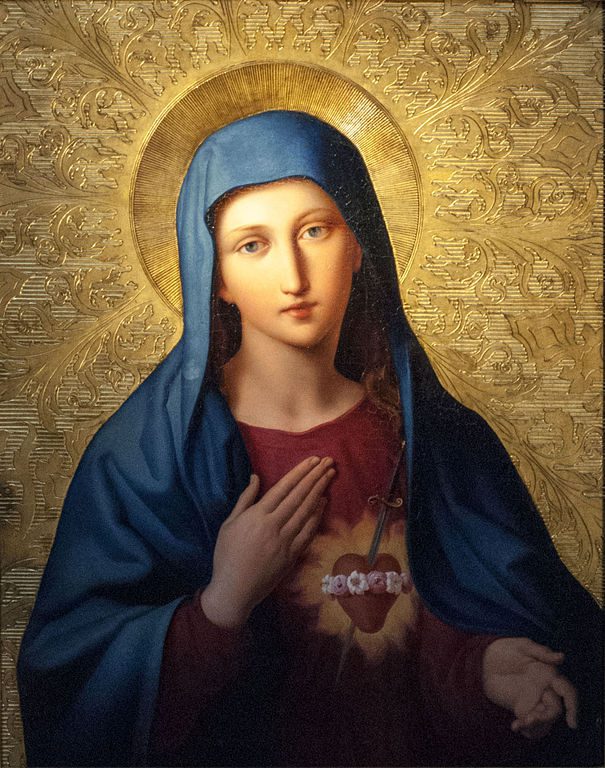
Photo credit: The Heart of Mary, by Leopold Kupelwieser (1796-1862). Photograph by Diana Ringo at Peterskirche, Vienna, Austria (9-22-13) [Wikimedia Commons / Creative Commons Attribution-Share Alike 4.0 International license]
***
Summary: I critique in great depth Protestant anti-Catholic apologist Eric Svendsen’s dissertation on the Blessed Virgin Mary, regarding the so-called “brothers” of Jesus.
Svendsen's Dissertation on Mary
Previous Post

February 2, 2023
Svendsen's Dissertation on Mary: 1. Preliminaries
Next Post

February 6, 2023 Archaeology Confirms Dates of Five Biblical Battles
Recent Comments
"And lastly, I belong to no denomination and am free to serve God as He ..."
Is Venerating Men & Angels Worship? ..."
"And obeisance doesn't mean "worship". It means "respect", "obey", or "submission". Very weird that you ..."
Is Venerating Men & Angels Worship? ..."
"Many of these scriptures you have noted have been taken out of context. With Daniel, ..."
Is Venerating Men & Angels Worship? ..."
""Protestants often point out that Jesus is now triumphant in heaven and object to Catholics ..."
Three More Anti-Catholic Lies About Catholicism ..."
Browse Our Archives
Select a Category & Last Things About Me Anti-Catholicism Atheism & Agnosticism Baptism and Sacramentalism Bible and Tradition Blessed Virgin Mary Books by Dave Armstrong C. S. Lewis Calvinism & General Protestantism Catholic Apologetics Catholic Apologists Catholic conversion Catholic converts Christmas Church (Ecclesiology) Church History Conversion and Converts Development of Doctrine Eastern Orthodoxy Ecumenism & Christian Unity Eucharist & Liturgy Fathers of the Church French Translations G. K. Chesterton Hell Hell & Satan Hell & Satan & Last Things Heresies & Comparative Religion Holistic Health Inquisition & Crusades & Scandals James White Jews & Judaism & Old Testament John Calvin John Henry Newman Liberal / Modernist Theology Life Issues Literary Resume Lutheranism Mariology Martin Luther Music Orthodoxy Papacy & Infallibility Personal Page Philosophy & Science Political & Ethical & Moral Issues Protestant Persecution & Intolerance Protestantism Purgatory Purgatory & Penance Romantic & Imaginative Theology Saints & Purgatory & Penance Salvation Salvation & Justification Satan & Last Things Sexuality and Gender Issues Spanish Translations Traditionalism vs. Radical Catholic Reactionaries Traducciones al español / tradução para português Trinitarianism & Christology Uncategorized Videos
Select a Month October 2026 September 2026 August 2026 July 2026 June 2026 May 2026 April 2026 March 2026 February 2026 January 2026 December 2025 November 2025 October 2025 September 2025 August 2025 July 2025 June 2025 May 2025 April 2025 March 2025 February 2025 January 2025 December 2024 November 2024 October 2024 September 2024 August 2024 July 2024 June 2024 May 2024 April 2024 March 2024 February 2024 January 2024 December 2023 November 2023 October 2023 September 2023 August 2023 July 2023 June 2023 May 2023 April 2023 March 2023 February 2023 January 2023 December 2022 November 2022 October 2022 September 2022 August 2022 July 2022 June 2022 May 2022 April 2022 March 2022 February 2022 January 2022 December 2021 November 2021 October 2021 September 2021 August 2021 July 2021 June 2021 May 2021 April 2021 March 2021 February 2021 January 2021 December 2020 November 2020 October 2020 September 2020 August 2020 July 2020 June 2020 May 2020 April 2020 March 2020 February 2020 January 2020 December 2019 November 2019 October 2019 September 2019 August 2019 July 2019 June 2019 May 2019 April 2019 March 2019 February 2019 January 2019 December 2018 November 2018 October 2018 September 2018 August 2018 July 2018 June 2018 May 2018 April 2018 March 2018 February 2018 January 2018 December 2017 November 2017 October 2017 September 2017 August 2017 July 2017 June 2017 May 2017 April 2017 March 2017 February 2017 January 2017 December 2016 November 2016 October 2016 September 2016 August 2016 July 2016 June 2016 May 2016 April 2016 March 2016 February 2016 January 2016 December 2015 November 2015 October 2015 September 2015 August 2015 July 2015 June 2015 May 2015 April 2015 March 2015 February 2015 January 2015 December 2014 November 2014 October 2014 September 2014 August 2014 July 2014 June 2014 April 2014 March 2014 February 2014 January 2014 December 2013 November 2013 October 2013 September 2013 August 2013 July 2013 June 2013 April 2013 March 2013 February 2013 January 2013 December 2012 November 2012 October 2012 September 2012 August 2012 July 2012 June 2012 May 2012 April 2012 March 2012 February 2012 January 2012 December 2011 November 2011 October 2011 September 2011 August 2011 July 2011 June 2011 April 2011 March 2011 February 2011 October 2010 September 2010 August 2010 July 2010 April 2010 March 2010 December 2009 October 2009 August 2009 July 2009 June 2009 May 2009 March 2009 February 2009 October 2008 September 2008 April 2008 March 2008 February 2008 January 2008 December 2007 November 2007 October 2007 May 2007 March 2007 February 2007 January 2007 November 2006 October 2006 September 2006 August 2006 July 2006 June 2006 May 2006 April 2006 March 2006 February 2006 October 2005 June 2005 April 2005 February 2005 July 2004 May 2004 April 2004
Follow Us!
TAKE THE
Religious Wisdom Quiz
Who prayed for rain after a long drought and sent his servant to look seven times?
Select your answer to see how you score.
Elijah Isaiah Samuel Hosea
Books by This Author Books by Dave Armstrong
Related posts from Biblical Evidence for Catholicism

Three More Anti-Catholic Lies About Catholicism (#6-4)
Biblical Evidence for Catholicism

Top Ten Anti-Catholic Lies (#10-7)
Biblical Evidence for Catholicism

Holy Ground: Why Mary Had NO Other Children...
Biblical Evidence for Catholicism
Protestant Confessions & "Ever-Virgin" Mary
Biblical Evidence for Catholicism
TRENDING AT PATHEOS Catholic

I was strolling through the top floor of the brand new Parthenon...

What Does Gêvâh Mean For Kimberley Guifoyle &...
This week, a lot of the news is focused on Kimberly Guilfoyle....

INNER CIRCLE: Profound Mystery (Of Christ In All...
Ephesians 5:31-32 “For this reason, a man will leave his father and...

Do Not Rejoice When Your Enemy Falls: The...
Turning an execution into a public spectacle is a disturbing expression of...

'The Chosen' S6 Trailer: The Passion Gets Very...
Not many watching 'The Chosen' worry about spoilers, but just because they...

The purpose-driven labor priest
A labor activist reads Rick Warren and it gets me wondering about...
view all Catholic blogs
What Are Your Thoughts?leave a comment
Ad-Free & Subscriber Log-In Subscription Support
- About Us
- 2026 Calendar
- Videos
- Podcasts
- Library of World Religions
- Faith In Media Tracker
- Advertise With Us
- Write for Us
- Privacy Policy
- Terms of Service
- Do Not Sell My Data
- Contact Us
- Radiant Digital
- Manage Newsletter Subscriptions
- Unsubscribe From Notifications
- Sitemap
Copyright 2008-2026, Patheos. All rights reserved.
Subscription Support Ad-Free & Subscriber Log-In
Follow Patheos