
BuddhistCatholicContemplativeEvangelicalGeneral ChristianHinduJewishLatter-day SaintMuslimNew VisionsProgressive Christian
Beliefs
- Buddhist
- Catholic
- Contemplative
- Evangelical
- General Christian
- Hindu
- Jewish
- Latter-day Saint
- More Voices
- Muslim
- New Visions
- Pagan
- Progressive Christian
Topics
- Religion News
- Food and Religion
- Sports and Religion
- Religious Art
- Religious Music and Entertainment
- Religious Events
- History and Religion
- Style and Religion
- Politics and Religion
- Women in Religion
- Recreation Outdoors and Religion
- Business Finance and Religion
- Careers Workplace and Religion
- Education and Religion
- Family Parenting and Religion
- Health Fitness and Religion
- Home and Religion
- Relationships and Religion
- Technology and Religion
- Travel and Religion
Columnists
- Buddhist Columnists
- Business Finance and Religion Columnists
- Careers Workplace and Religion Columnists
- Catholic Columnists
- Contemplative Columnists
- Education and Religion Columnists
- Evangelists Columnists
- Family Parenting and Religion Columnists
- General Christian Columnists
- Health Fitness and Religion Columnists
- Hindu Columnists
- History and Religion Columnists
- Home and Religion Columnists
- Jewish Columnists
- More Voices Columnists
- Latter Day Columnists
- Muslim Columnists
- New Visions Columnists
- Nonreligious Columnists
- Pagan Columnists
- Politics and Religion Columnists
- Progressive Columnists
- Recreation Outdoors and Religion Columnists
- Relationships and Religion Columnists
- Religion News Columnists
- Religious Art Columnists
- Religious Events Columnists
- Religious Music and Entertainment Columnists
- Sports and Religion Columnists
- Style and Religion Columnists
- Technology and Religion Columnists
- Travel and Religion Columnists
- Women in Religion Columnists
Resource Library
- 2026 Calendar
- Library of World Religions
- The 100 Most Holy Places on Earth
- Patheos Answers
- Podcasts
- Videos
- Faith Leaders Database
- Anglican Episcopalian
- Bahai
- Baptist
- Buddhism
- Christianity
- Confucianism
- Eastern Orthodoxy
- Hinduism
- Holiness and Pentecostal
- ISKCON
- Islam
- Judaism
- Lutheran
- Methodist
- The Church of Jesus Christ of Latter-day Saints
- New Age
- Paganism
- Presbytarian and Reformed
- Protestantism
- Religion Behind the Scenes
- Roman Catholic
- Scientology
- Shia Islam
- Sikhism
- Sufism
- Sunni Islam
- Taoism
- Zen
- See all religions
Research Tools
 Ad-Free & Subscriber Log-In Subscription Support
Follow Patheos 

- Trending:
- Advent
- |
- Forgiveness
- |
- Thanksgiving
- |
- Election
- |
- Seasonal Holidays
- |
- Marriage

-
About
-
Catholic Apologetics
-
Church History
-
Great Apologists
-
Christian Worldview
-
Protestantism & Misc.
- Home
- Catholic
- History and Religion
- Svendsen’s Dissertation on Mary: 1. Preliminaries
Svendsen’s Dissertation on Mary: 1. Preliminaries
Last updated on: June 6, 2026 at 12:47 am by Dave Armstrong
Svendsen’s Dissertation on Mary: 1. Preliminaries 2026-06-06T00:47:40-04:00 Dave Armstrong
Patheos Explore the world's faith through different perspectives on religion and spirituality! Patheos has the views of the prevalent religions and spiritualities of the world.
Including Explicit Biblical Indications or Analogies for Mary’s Universal Intercession and the Notion of “Fittingness”
Eric Svendsen is an anti-Catholic Protestant, who was, for a time, arguably the second most influential and active anti-Catholic polemicist online, after Bishop “Dr.” [???] James White. Then he suddenly vanished from the Internet in 2008. He had been indicating that he would do so as early as 2 November 2005, when he wrote on his blog that he was “packing it in” in large part because of “the incorrigible and vitriolic pooling of ignorance that comes from self-styled ‘apologists,’ each promoting his own version of a false gospel.” He wrote on 27 April 2003 on his “discussion” forum: “RC apologists will do or say just about anything–true or not–to advance their cause. They engage in the strategy of deception regularly.”
Svendsen produced three anti-Catholic books with small publishers: Evangelical Answers: A Critique of Current Roman Catholic Apologists (Reformation Press, 1999), Who is My Mother? (Calvary Press: 2001), Upon This Slippery Rock (Calvary Press: 2002). This series of critiques is devoted to his doctoral dissertation from 2000: Who is My Mother?: The Role and Status of the Mother of Jesus in the New Testament and in Roman Catholicism. His words will be in blue.
*****
In his “Background and Problem Statement” (p. vii) Svendsen stated that Catholics tend to “portray Mary as the most exalted of God’s creatures, something of a demigod between the rest of mankind and the Trinity . . .” I looked up “demigod” at Dictionary.com and it defines the term as:
1 a mythological being who is partly divine and partly human; an inferior deity.
2 a deified mortal.
Merriam-Webster defines the word similarly: “a mythological being with more power than a mortal but less than a god.”
Interestingly, both highlight the idea that a demigod is a “mythological being.” Is this what Svendsen wished to convey in his dissertation, as to how Catholics regard the Blessed Virgin Mary? A few pages later (p. ix) he refers to “a Roman Mariolatry that is guided by legend and myth rather than biblical data.”
It doesn’t seem very scholarly to me at all. The only “legend and myth” here is Svendsen’s absurd caricatures of actual, demonstrable Catholic teachings. As always, when these outrageous claims are made as to the supposed Catholic dogmatic teaching regarding Mary’s “status,” they are never backed up with documentation. Needless to say, no Catholic magisterial document ever asserts such an absurd thing. If that were the case, surely the anti-Catholics would be right on it. But instead they make the charge and never ever document it.
Svendsen elsewhere tried to rationalize this. On his discussion board on 17 January 2004, he described Catholics as “those who would raise Mary to the status of the Trinity . . .” Challenged by Reformed Protestant theologian Paul Owen to prove this absurd description, Eric retorted on 19 January 2004:
If what you mean by this is that you’ll find no official RC statement that says “we elevate Mary to the status of the Trinity,” then I’m happy to agree. Of course you’re not going to find anything as overt as that. What you’ll find instead is that Mary is [laundry list of Catholic titles for Mary given] . . . With titles like these, who in the world needs an explicit statement that Mary is on par with the Trinity?
In his “Problem Statement” (p. viii) he writes:
In spite of the progress that has been made since Vatican II, the tendency on the Roman Catholic side to read the Marian texts in far too favorable a light is still highly prevalent (Brown, 1982:378), resulting in a view of Mary that portrays her as Ever Virgin and highly exalted.
First, he implies that Vatican II changed the Catholic position as regards Mary. It did not. Never mind that the Church fathers with virtual unanimity believed that Mary was a perpetual virgin, and that all of the original founders of Protestantism did as well. I get a chuckle over his citing of the ubiquitous Fr. Raymond Brown.
It seems that he is as beloved among anti-Catholic Protestants as he is among atheists, who also absurdly fawn over him (which I have observed innumerable times in my hundreds of debates with them). Well-known online atheist Jonathan M. S. Pearce, just eight days before I wrote the words in this paragraph, described Fr. Brown as a “great Catholic exegete” and stated that “I can’t tell you how [much] I revere the work of Raymond Brown”.
Why is this? Why would an atheist love a Catholic priest and fawn all over him? Well, it’s obviously because he was a liberal dissident, who denied many Catholic doctrines; thus he is so often lavished with praise and approvingly cited as a sort of “useful idiot” for those opposing Catholicism (or Christianity in general, as it were). Jesus said: “Woe to you, when all men speak well of you, for so their fathers did to the false prophets” (Lk 6:26, RSV).
If we speak full Catholic truth, we’ll be hated by the enemies of the Church, just as Jesus was, and as He foretold that we would be also, as His followers (Mt 10:22; Mk 13:13; Lk 21:17); or at the very least not rapturously admired. When someone is so loved by anti-Catholics and atheists alike, beware. There is a reason for it. Accordingly, Fr. Brown is the very first person that Svendsen cites (two different works in his first and second references). He knows where to go to back up his falsehoods.
Svendsen cites Fr. John L. McKenzie, whom he calls a “moderate” Catholic scholar; but what he writes in the citation proves that he was a dissident, too, and anything but a “moderate”:
The Mary of Christian legend, art, poetry, hymnody, and even theology is a fictitious character …. Faith in the Mary of traditional Christian devotion is faith in something which is not true . . . (emphases in original)
Later, on page 42, Svendsen notes that both Fr. Brown and Fr. McKenzie denied Mary’s perpetual virginity, and adopted the “Helvidian” view of the “brothers” of Jesus being His biological siblings. Therefore, they can’t possibly be orthodox Catholics, having denied one of the Catholic dogmas that Catholics are not at liberty to deny. For Svendsen, in light of this, to deny that they are heterodox by Catholic magisterial standards is either outright dishonest or exceedingly ignorant (take your pick). In other words, they don’t speak for historic, orthodox Catholicism as it is self-understood and presented in the Catechism, the councils, papal encyclicals, etc.
On pages 7-8 Svendsen makes another ridiculous claim:
Roman Catholicism has in many ways attributed the unique role and activity of the Holy Spirit to Mary, in that she guides, inspires and acts as the link between the believer and Christ . . . prior to Vatican II Roman Catholic Theology manuals had no section on the Holy Spirit . . .
As an example, take A Manual of Catholic Theology, by Matthias Scheeben, Joseph Wilhelm, and Thomas B. Scannell (London: 1906; Vol. 1, including “God”: 508 pages). Searching an online PDF version, I found 447 instances of “Holy Ghost”, 102 occurrences of “the Spirit,” and four more of “Holy Spirit.” This is about 553 references (a few of “the spirit” references were to the “spirit of man” etc.), or an average of more than once per page over the entire work. It appears not to have a section only devoted solely to the Holy Spirit, but that’s because most of the analysis happens in sections devoted to the Holy Trinity. I highly suspect that it would be the same with similar Protestant works.
Not a single reference to the Blessed Virgin Mary appears in the entire work, by the way. Yet Svendsen would have his unfortunate readers to believe that she is a “demigod” in Catholic teaching, and almost elevated to the Trinity, and that she has usurped the role of the Holy Spirit in Catholic theology, and that “the period between Trent and Vatican II was concurrently a time of great development in Mariology and a time of depreciation in Pneumatology.” This is sheer nonsense, as shown in this manual from 1906, which mentions the Holy Spirit around 553 times and Mary not at all. That’s beyond odd if supposedly we are given to substituting Mary for the Holy Spirit. Svendsen is out to sea without a lifeboat on this score.
Shinnets traces numerous examples of this type of “mariolatry” from the period following the Reformation down to the present day; beliefs which include Mary’s ability to save even if God is bent on judgment, . . . (p. 16)
One would have to see examples of such alleged “mariolatry” in context, but I suspect that they are quite similar in essence to what we already find explicitly in the Bible: situations that clearly involve anthropomorphism with regard to God’s supposed changes of mind (He can’t and doesn’t do so: being both immutable and omniscient):
Genesis 18:22-32 So the men turned from there, and went toward Sodom; but Abraham still stood before the LORD. [23] Then Abraham drew near, and said, “Wilt thou indeed destroy the righteous with the wicked? [24] Suppose there are fifty righteous within the city; wilt thou then destroy the place and not spare it for the fifty righteous who are in it? [25] Far be it from thee to do such a thing, to slay the righteous with the wicked, so that the righteous fare as the wicked! Far be that from thee! Shall not the Judge of all the earth do right?” [26] And the LORD said, “If I find at Sodom fifty righteous in the city, I will spare the whole place for their sake.” [27] Abraham answered, “Behold, I have taken upon myself to speak to the Lord, I who am but dust and ashes. [28] Suppose five of the fifty righteous are lacking? Wilt thou destroy the whole city for lack of five?” And he said, “I will not destroy it if I find forty-five there.” [29] Again he spoke to him, and said, “Suppose forty are found there.” He answered, “For the sake of forty I will not do it.” [30] Then he said, “Oh let not the Lord be angry, and I will speak. Suppose thirty are found there.” He answered, “I will not do it, if I find thirty there.” [31] He said, “Behold, I have taken upon myself to speak to the Lord. Suppose twenty are found there.” He answered, “For the sake of twenty I will not destroy it.” [32] Then he said, “Oh let not the Lord be angry, and I will speak again but this once. Suppose ten are found there.” He answered, “For the sake of ten I will not destroy it.”
In that case, of course, Sodom was judged and destroyed, but Abraham’s prayers would have “saved” it if only ten righteous people could have been found there. In other words, this shows how God directly involves exceptionally righteous people into His plans. He didn’t tell Abraham: “who are you to wrangle with Me about what I should do or not do? I’m God!” He involved Abraham in the process.
Numbers 11:1-2 And the people complained in the hearing of the LORD about their misfortunes; and when the LORD heard it, his anger was kindled, and the fire of the LORD burned among them, and consumed some outlying parts of the camp. [2] Then the people cried to Moses; and Moses prayed to the LORD, and the fire abated.
What is this: “Mosiolatry“? After all, Moses was directly involved in “persuading” God to not judge His own people. How is that any essentially different from Mary doing the same thing? If it’s “mariolatry” when she does it, then it must be “idolatry” when Bible writers have no problem recording Abraham and Moses and Samuel and King Hezekiah doing the same thing. And so then Svendsen would have to go after God’s inspired, inerrant, infallible revelation. This was not an isolated incident with Moses. There are at least four more in the Bible:
Numbers 14:11-20 And the LORD said to Moses, “How long will this people despise me? And how long will they not believe in me, in spite of all the signs which I have wrought among them? [12] I will strike them with the pestilence and disinherit them, and I will make of you a nation greater and mightier than they.” [13] But Moses said to the LORD, “Then the Egyptians will hear of it, for thou didst bring up this people in thy might from among them, [14] and they will tell the inhabitants of this land. They have heard that thou, O LORD, art in the midst of this people; for thou, O LORD, art seen face to face, and thy cloud stands over them and thou goest before them, in a pillar of cloud by day and in a pillar of fire by night. [15] Now if thou dost kill this people as one man, then the nations who have heard thy fame will say, [16] `Because the LORD was not able to bring this people into the land which he swore to give to them, therefore he has slain them in the wilderness.’ [17] And now, I pray thee, let the power of the LORD be great as thou hast promised, saying, [18] `The LORD is slow to anger, and abounding in steadfast love, forgiving iniquity and transgression, but he will by no means clear the guilty, visiting the iniquity of fathers upon children, upon the third and upon the fourth generation.’ [19] Pardon the iniquity of this people, I pray thee, according to the greatness of thy steadfast love, and according as thou hast forgiven this people, from Egypt even until now.” [20] Then the LORD said, “I have pardoned, according to your word;
Numbers 21:6-8 Then the LORD sent fiery serpents among the people, and they bit the people, so that many people of Israel died. [7] And the people came to Moses, and said, “We have sinned, for we have spoken against the LORD and against you; pray to the LORD, that he take away the serpents from us.” So Moses prayed for the people. [8] And the LORD said to Moses, “Make a fiery serpent, and set it on a pole; and every one who is bitten, when he sees it, shall live.”
Deuteronomy 9:18-20 Then I lay prostrate before the LORD as before, forty days and forty nights; I neither ate bread nor drank water, because of all the sin which you had committed, in doing what was evil in the sight of the LORD, to provoke him to anger. [19] For I was afraid of the anger and hot displeasure which the LORD bore against you, so that he was ready to destroy you. But the LORD hearkened to me that time also. [20] And the LORD was so angry with Aaron that he was ready to destroy him; and I prayed for Aaron also at the same time.
Deuteronomy 10:10 I stayed on the mountain, as at the first time, forty days and forty nights, and the LORD hearkened to me that time also; the LORD was unwilling to destroy you.
The prophet Samuel does the same thing (1 Sam 12:18-19). So does King Hezekiah (2 Chr 30:18-20).
Jeremiah 15:1 Then the LORD said to me, “Though Moses and Samuel stood before me, yet my heart would not turn toward this people. Send them out of my sight, and let them go!” [in other words, this is an exception to the rule; normally great intercessors like Moses and Samuel would suffice to save whole peoples]
Therefore, there is absolutely nothing intrinsically wrong at all, let alone “mariolatrous” in the notion of God choosing to involve Mary in profound intercession for the human race: even if universally, according to His will. That looks exactly like 1) God’s boundless mercy, and 2) God’s desire to involve human beings in the process of reform, redemption, and salvation.
If Protestants object that Scripture doesn’t explicitly indicate this about Mary, we reply that 1) it does by analogy (see the above examples), and 2) who says that everything in Christianity must be explicitly indicated in the Bible, anyway (since the Bible itself never states such a thing)? The canon of the Bible isn’t in the Bible; nor is sola Scriptura. Yet Protestants presuppose the canon (minus just seven books out of 73), and build their entire unbiblical rule of faith (sola Scriptura) from it. The Bible never once lays out the Protestant standard definition of sola Scriptura. It’s not an explicit biblical doctrine (nor, I would argue, even an implicit doctrine).
Nor is universal and profound Marian intercession. But it’s thoroughly in harmony with what is in the Bible; whereas sola Scriptura is not (see my two books: 100 Biblical Arguments Against Sola Scriptura (2012) and Pillars of Sola Scriptura: Replies to Whitaker, Goode, & Biblical “Proofs” for “Bible Alone” (2012), and my massive web page: Bible, Tradition, Canon, & “Sola Scriptura”. Nor is sola Scriptura part of apostolic and patristic tradition, whereas the Catholic Marian doctrines are, though they developed relatively slowly.
St. Cardinal Newman (who so often brilliantly argued from analogy) noted that there was much more about purgatory in the Church fathers (which Protestants deny) than about original sin (which they accept). Development of doctrine (my favorite topic in theology) is a completely separate and complex factor. Here I am concentrating on Svendsen’s arguments from the Bible, or lack thereof. As usual, I provide far more relevant scriptural analysis than my Protestant dialogical opponent (in this case, Svendsen) does.
Post-Tridentine Catholic theology “went so far as to develop arguments from ‘fittingness,’ holding that it was impossible to say too much about Maty. In her regard, if God could have done it, God should have done it, and therefore God did it!” (McKenzie, 1983:7). This “fittingness” argument is usually traced to Duns Scotus. Excesses such as this lent credibility to the Protestant charge that Catholics “divinized” Mary in an idolatrous way. (pp. 16-17).
Eric Svendsen, who fancies himself an expert on Catholic Mariology, opines that Dun Scotus (c. 1265-1308) began this form of argument (probably referring to a piece regarding Mary’s Immaculate Conception). He doesn’t even get that right. Duns Scotus in his first paragraph of the aforementioned treatise, cites St. Anselm (c. 1033-1109): “It was fitting that the Virgin should be resplendent with a purity greater than which none under God can be conceived.” But he’s 1200 years off. It was actually the writers of the New Testament (drawing from deuterocanonical precedent) who thought in these terms:
Hebrews 2:10 For it was fitting that he, for whom and by whom all things exist, in bringing many sons to glory, should make the pioneer of their salvation perfect through suffering.
Hebrews 7:26 For it was fitting that we should have such a high priest, holy, blameless, unstained, separated from sinners, exalted above the heavens.
Matthew 3:15 But Jesus answered him, “Let it be so now; for thus it is fitting for us to fulfil all righteousness.” . . .
1 Corinthians 11:13 Judge for yourselves; is it proper for a woman to pray to God with her head uncovered?
Ephesians 5:3-4 But fornication and all impurity or covetousness must not even be named among you, as is fitting among saints. [4] Let there be no filthiness, nor silly talk, nor levity, which are not fitting; but instead let there be thanksgiving.
Colossians 3:18 Wives, be subject to your husbands, as is fitting in the Lord.
2 Thessalonians 1:3 We are bound to give thanks to God always for you, brethren, as is fitting, . . .
1 Timothy 2:6 who gave himself as a ransom for all, the testimony to which was borne at the proper time.
1 Timothy 6:15 and this will be made manifest at the proper time by the blessed and only Sovereign, the King of kings and Lord of lords,
Titus 1:3 and at the proper time manifested in his word through the preaching with which I have been entrusted by command of God our Savior;
So we see that supposedly exclusively Catholic “fittingness” is a frequent and explicit biblical teaching, whereas the canon of Scripture and sola Scriptura are not only not explicitly biblical, but also totally absent from Holy Scripture. Thus we again see — as we so often do — that Catholic thinking is much more thoroughly and comprehensively and deeply biblical than the Protestant worldview and “theological imagination.”
Hence, Blessed Pope Pius IX, in declaring the dogma of the Immaculate Conception of Mary in 1854 (Ineffabilis Deus), thought in these explicitly biblical terms:
And indeed it was wholly fitting that so wonderful a mother should be ever resplendent with the glory of most sublime holiness and so completely free from all taint of original sin that she would triumph utterly over the ancient serpent.
And hence they affirmed that the Blessed Virgin was, through grace, entirely free from every stain of sin, and from all corruption of body, soul and mind; that she was always united with God and joined to him by an eternal covenant; that she was never in darkness but always in light; and that, therefore, she was entirely a fit habitation for Christ, not because of the state of her body, but because of her original grace.
For it was certainly not fitting that this vessel of election should be wounded by the common injuries, since she, differing so much from the others, had only nature in common with them, not sin. In fact, it was quite fitting that, as the Only-Begotten has a Father in heaven, whom the Seraphim extol as thrice holy, so he should have a Mother on earth who would never be without the splendor of holiness.
After all, an angel declaring that the Blessed Virgin Mary was “full of grace” meant that she was without sin, as a straightforward deduction from the biblical data regarding grace and sin (as I have argued elsewhere). This is why it is indeed “fitting” that Mary was immaculately conceived, so that she could be freed — entirely by God’s grace, since she had no will or self-consciousness a moment after her conception –, from original as well as actual sin.
***
See the next installment of the series: Svendsen’s Dissertation on Mary: 2. “Brothers” of Jesus (Including a Handy, Nine-Point Summary of Solid Exegetical Arguments for the “Cousins” Theory of Jesus’ “Brothers”) [2-2-23]
***
Practical Matters: Perhaps some of my 4,000+ free online articles (the most comprehensive “one-stop” Catholic apologetics site) or fifty books have helped you (by God’s grace) to decide to become Catholic or to return to the Church, or better understand some doctrines and why we believe them.
Or you may believe my work is worthy to support for the purpose of apologetics and evangelism in general. If so, please seriously consider a much-needed financial contribution. I’m always in need of more funds: especially monthly support. “The laborer is worthy of his wages” (1 Tim 5:18, NKJV). 1 December 2021 was my 20th anniversary as a full-time Catholic apologist, and February 2022 marked the 25th anniversary of my blog.
PayPal donations are the easiest: just send to my email address: [email protected]. You’ll see the term “Catholic Used Book Service”, which is my old side-business. To learn about the different methods of contributing, including 100% tax deduction, etc., see my page: About Catholic Apologist Dave Armstrong / Donation Information. Thanks a million from the bottom of my heart!
***
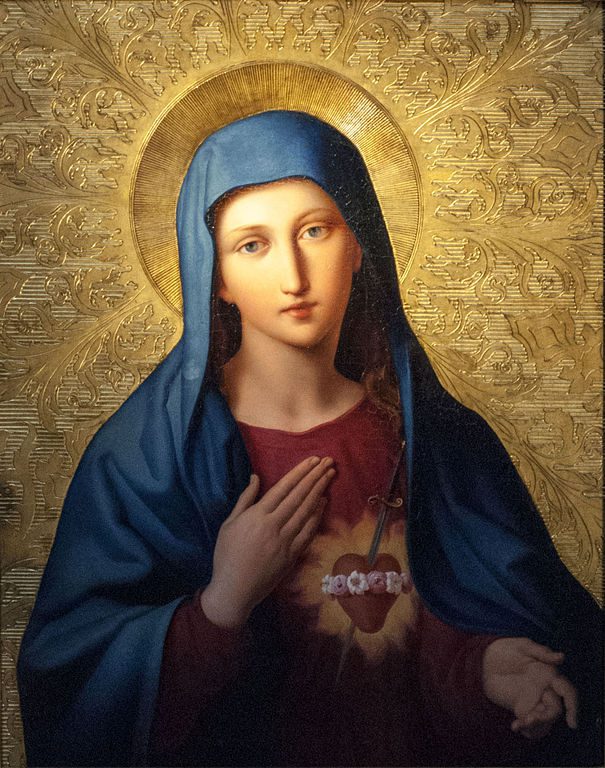
Photo credit: The Heart of Mary, by Leopold Kupelwieser (1796-1862). Photograph by Diana Ringo at Peterskirche, Vienna, Austria (9-22-13) [Wikimedia Commons / Creative Commons Attribution-Share Alike 4.0 International license]
***
Summary: I critique Protestant anti-Catholic apologist Eric Svendsen’s dissertation on the Blessed Virgin Mary, concentrating on his (rather pathetic) attempted biblical arguments.
Svendsen's Dissertation on Mary
Previous Post

January 31, 2023
Archaeology & a Proto-Hebrew Language in 1800 BC
Next Post
February 2, 2023 Svendsen’s Dissertation on Mary: 2. "Brothers" of Jesus
Recent Comments
"Special pleading, and not a serious response to my arguments . . ."
Is Venerating Men & Angels Worship? ..."
""no man needs to teach us."Didn't you just teach us?"
Is Venerating Men & Angels Worship? ..."
""Catholics say they are the only church that can lead people into heaven."In fact, we ..."
Is Venerating Men & Angels Worship? ..."
"And lastly, I belong to no denomination and am free to serve God as He ..."
Is Venerating Men & Angels Worship? ..."
Browse Our Archives
Select a Category & Last Things About Me Anti-Catholicism Atheism & Agnosticism Baptism and Sacramentalism Bible and Tradition Blessed Virgin Mary Books by Dave Armstrong C. S. Lewis Calvinism & General Protestantism Catholic Apologetics Catholic Apologists Catholic conversion Catholic converts Christmas Church (Ecclesiology) Church History Conversion and Converts Development of Doctrine Eastern Orthodoxy Ecumenism & Christian Unity Eucharist & Liturgy Fathers of the Church French Translations G. K. Chesterton Hell Hell & Satan Hell & Satan & Last Things Heresies & Comparative Religion Holistic Health Inquisition & Crusades & Scandals James White Jews & Judaism & Old Testament John Calvin John Henry Newman Liberal / Modernist Theology Life Issues Literary Resume Lutheranism Mariology Martin Luther Music Orthodoxy Papacy & Infallibility Personal Page Philosophy & Science Political & Ethical & Moral Issues Protestant Persecution & Intolerance Protestantism Purgatory Purgatory & Penance Romantic & Imaginative Theology Saints & Purgatory & Penance Salvation Salvation & Justification Satan & Last Things Sexuality and Gender Issues Spanish Translations Traditionalism vs. Radical Catholic Reactionaries Traducciones al español / tradução para português Trinitarianism & Christology Uncategorized Videos
Select a Month November 2026 October 2026 September 2026 August 2026 July 2026 June 2026 May 2026 April 2026 March 2026 February 2026 January 2026 December 2025 November 2025 October 2025 September 2025 August 2025 July 2025 June 2025 May 2025 April 2025 March 2025 February 2025 January 2025 December 2024 November 2024 October 2024 September 2024 August 2024 July 2024 June 2024 May 2024 April 2024 March 2024 February 2024 January 2024 December 2023 November 2023 October 2023 September 2023 August 2023 July 2023 June 2023 May 2023 April 2023 March 2023 February 2023 January 2023 December 2022 November 2022 October 2022 September 2022 August 2022 July 2022 June 2022 May 2022 April 2022 March 2022 February 2022 January 2022 December 2021 November 2021 October 2021 September 2021 August 2021 July 2021 June 2021 May 2021 April 2021 March 2021 February 2021 January 2021 December 2020 November 2020 October 2020 September 2020 August 2020 July 2020 June 2020 May 2020 April 2020 March 2020 February 2020 January 2020 December 2019 November 2019 October 2019 September 2019 August 2019 July 2019 June 2019 May 2019 April 2019 March 2019 February 2019 January 2019 December 2018 November 2018 October 2018 September 2018 August 2018 July 2018 June 2018 May 2018 April 2018 March 2018 February 2018 January 2018 December 2017 November 2017 October 2017 September 2017 August 2017 July 2017 June 2017 May 2017 April 2017 March 2017 February 2017 January 2017 December 2016 November 2016 October 2016 September 2016 August 2016 July 2016 June 2016 May 2016 April 2016 March 2016 February 2016 January 2016 December 2015 November 2015 October 2015 September 2015 August 2015 July 2015 June 2015 May 2015 April 2015 March 2015 February 2015 January 2015 December 2014 November 2014 October 2014 September 2014 August 2014 July 2014 June 2014 April 2014 March 2014 February 2014 January 2014 December 2013 November 2013 October 2013 September 2013 August 2013 July 2013 June 2013 April 2013 March 2013 February 2013 January 2013 December 2012 November 2012 October 2012 September 2012 August 2012 July 2012 June 2012 May 2012 April 2012 March 2012 February 2012 January 2012 December 2011 November 2011 October 2011 September 2011 August 2011 July 2011 June 2011 April 2011 March 2011 February 2011 October 2010 September 2010 August 2010 July 2010 April 2010 March 2010 December 2009 October 2009 August 2009 July 2009 June 2009 May 2009 March 2009 February 2009 October 2008 September 2008 April 2008 March 2008 February 2008 January 2008 December 2007 November 2007 October 2007 May 2007 March 2007 February 2007 January 2007 November 2006 October 2006 September 2006 August 2006 July 2006 June 2006 May 2006 April 2006 March 2006 February 2006 October 2005 June 2005 April 2005 February 2005 July 2004 May 2004 April 2004
Follow Us!
TAKE THE
Religious Wisdom Quiz
Which king was killed at the Battle of Megiddo?
Select your answer to see how you score.
Asa Jehoash Amaziah Josiah
Books by This Author Books by Dave Armstrong
Related posts from Biblical Evidence for Catholicism
Top Three Anti-Catholic Lies About Catholicism
Biblical Evidence for Catholicism
Three More Anti-Catholic Lies About Catholicism (#6-4)
Biblical Evidence for Catholicism
Top Ten Anti-Catholic Lies (#10-7)
Biblical Evidence for Catholicism
Holy Ground: Why Mary Had NO Other Children...
Biblical Evidence for Catholicism
TRENDING AT PATHEOS Catholic

Chapter 5, Sarah: The Quest for Safety in...
Open and Relational Theology & Social Psychology About this series: This series...

When Worry Gets You Nowhere, How Can Faith...
Sometimes, we think that by worrying, we can somehow predict the future....

The Wasp And I: Meditations on Repentance
How can we enter the power and joy of the repentant self...
Reflections on the Evangelical Theological Society
As I mentioned before, this year, for the first time since 2005,...

Demmed if it do and demmed if it...
"First Presidency Announces Salt Lake Temple Rededication Date" Apropos of that,...

Stop Making Thanksgiving Problematic And Just Give Thanks
“What if, today, we were grateful for everything?” –Charlie Brown I...
view all Catholic blogs
What Are Your Thoughts?leave a comment
Ad-Free & Subscriber Log-In Subscription Support
- About Us
- 2026 Calendar
- Videos
- Podcasts
- Library of World Religions
- Faith In Media Tracker
- Advertise With Us
- Write for Us
- Privacy Policy
- Terms of Service
- Do Not Sell My Data
- Contact Us
- Radiant Digital
- Manage Newsletter Subscriptions
- Unsubscribe From Notifications
- Sitemap
Copyright 2008-2026, Patheos, part of the Radiant Digital network of media brands. All rights reserved.
Subscription Support Ad-Free & Subscriber Log-In
Follow Patheos