
BuddhistCatholicContemplativeEvangelicalGeneral ChristianHinduJewishLatter-day SaintMuslimNew VisionsProgressive Christian
Beliefs
- Buddhist
- Catholic
- Contemplative
- Evangelical
- General Christian
- Hindu
- Jewish
- Latter-day Saint
- More Voices
- Muslim
- New Visions
- Pagan
- Progressive Christian
Topics
- Religion News
- Food and Religion
- Sports and Religion
- Religious Art
- Religious Music and Entertainment
- Religious Events
- History and Religion
- Style and Religion
- Politics and Religion
- Women in Religion
- Recreation Outdoors and Religion
- Business Finance and Religion
- Careers Workplace and Religion
- Education and Religion
- Family Parenting and Religion
- Health Fitness and Religion
- Home and Religion
- Relationships and Religion
- Technology and Religion
- Travel and Religion
Columnists
- Buddhist Columnists
- Business Finance and Religion Columnists
- Careers Workplace and Religion Columnists
- Catholic Columnists
- Contemplative Columnists
- Education and Religion Columnists
- Evangelists Columnists
- Family Parenting and Religion Columnists
- General Christian Columnists
- Health Fitness and Religion Columnists
- Hindu Columnists
- History and Religion Columnists
- Home and Religion Columnists
- Jewish Columnists
- More Voices Columnists
- Latter Day Columnists
- Muslim Columnists
- New Visions Columnists
- Nonreligious Columnists
- Pagan Columnists
- Politics and Religion Columnists
- Progressive Columnists
- Recreation Outdoors and Religion Columnists
- Relationships and Religion Columnists
- Religion News Columnists
- Religious Art Columnists
- Religious Events Columnists
- Religious Music and Entertainment Columnists
- Sports and Religion Columnists
- Style and Religion Columnists
- Technology and Religion Columnists
- Travel and Religion Columnists
- Women in Religion Columnists
Resource Library
- 2026 Calendar
- Library of World Religions
- The 100 Most Holy Places on Earth
- Patheos Answers
- Podcasts
- Videos
- Faith Leaders Database
- Anglican Episcopalian
- Bahai
- Baptist
- Buddhism
- Christianity
- Confucianism
- Eastern Orthodoxy
- Hinduism
- Holiness and Pentecostal
- ISKCON
- Islam
- Judaism
- Lutheran
- Methodist
- The Church of Jesus Christ of Latter-day Saints
- New Age
- Paganism
- Presbytarian and Reformed
- Protestantism
- Religion Behind the Scenes
- Roman Catholic
- Scientology
- Shia Islam
- Sikhism
- Sufism
- Sunni Islam
- Taoism
- Zen
- See all religions
Research Tools
 Ad-Free & Subscriber Log-In Subscription Support
Ad-Free & Subscriber Log-In Subscription Support
Follow Patheos 

- Trending:
- Forgiveness
- |
- Marriage
- |
- Consciousness
- |
- Death Penalty
- |
- Election
- |
- Halloween

-
About
-
Catholic Apologetics
-
Church History
-
Great Apologists
-
Christian Worldview
-
Protestantism & Misc.
- Home
- Catholic
- History and Religion
- Church = Foundation of the Truth (1 Tim 3:15) (vs. L. Banzoli)
Church = Foundation of the Truth (1 Tim 3:15) (vs. L. Banzoli)
Last updated on: June 6, 2026 at 12:47 am by Dave Armstrong
Church = Foundation of the Truth (1 Tim 3:15) (vs. L. Banzoli) 2026-06-06T00:47:40-04:00 Dave Armstrong
Patheos Explore the world's faith through different perspectives on religion and spirituality! Patheos has the views of the prevalent religions and spiritualities of the world.
Lucas Banzoli is a very active Brazilian anti-Catholic polemicist, who holds to basically a Seventh-Day Adventist theology, whereby there is no such thing as a soul that consciously exists outside of a body, and no hell (soul sleep and annihilationism). This leads him to a Christology which is deficient and heterodox in terms of Christ’s human nature after His death. He has a Master’s degree in theology, a degree and postgraduate work in history, a license in letters, and is a history teacher, author of 27 self-published books, as well as blogmaster (active on and off) for six blogs. He has many videos on YouTube.
This is my 58th refutation of Banzoli’s writings. For almost half a year (5-25-22 to 11-12-22) he didn’t write one single word in reply, because my articles were deemed to be “without exception poor, superficial and weak . . . only a severely cognitively impaired person would be inclined to take” them “seriously.” Despite this childish rationalizing, he found my refutations so “entertaining” that he bravely decided to “make a point of rebutting” them “one by one”; this effort being his “new favorite sport.”
He has now replied to me 15 times (the last one dated 2-9-23). I disposed of the main themes of his slanderous insults in several Facebook posts under his name on my Anti-Catholicism page. I plan (by God’s grace) to ignore the insults henceforth, and heartily thank him for these innumerable blessings and extra rewards in heaven (Matthew 5:11-12).
Google Translate is utilized to render Lucas’ Portugese into English. Occasionally I slightly modify clearly inadequate translations, so that his words will read more smoothly and meaningfully in English. His words will be in blue. Words from past replies of mine to him will be in green.
*****
This is my reply to a portion of Lucas Banzoli’s article, “1ª Timóteo 3:15 ensina que a Igreja Romana é infalível? Refutando o conceito de “Igreja” de Dave Armstrong” [Does 1 Timothy 3:15 teach that the Roman Church is infallible? Refuting Dave Armstrong’s Concept of the “Church”] (12-26-22), which purports to be a “reply” to my article, “1 Timothy 3:15 = Infallible Church (vs. Lucas Banzoli)” (6-3-22). As usual, Banzoli comprehends almost none of my argumentation, and so — true to form — he belittles what he is unable and/or unwilling to understand, throughout his pathetic screed.
I will concentrate on one aspect of this debate: the Church as the “foundation of the truth.” He didn’t respond at all to my best argument in this regard, which is why I will mostly repeat it here, but it’s well worth nailing down and reiterating this crucial point. Repetition (as long as rational argument is part and parcel of it) is a great teacher. I have added bolding below, for “foundation” as he uses the word; italics are his own throughout:
After distorting as many biblical texts as usual and machine-gunning passages out of context, Dave proceeds to distort the Greek as well. . . . neither of the two Greek words used in 1 Timothy 3:15 mean “foundation,” . . .
Even if “foundation” were one of the possible meanings of hedraióma, this would not imply that it was the meaning in 1st Timothy 3:15 . . .
[I]t would not make the slightest sense that Paul would say that the church (that is, Christians) are the “foundation” of the truth, . . .
To say that an institution like this is the very foundation of truth, . . . is a crime against humanity. . . .
[I]f the Church is not the “foundation” of the truth, as if the truth were dependent on the Church, what is it anyway? It is the “pillar” or “pillar” of truth, built upon the truth, not the truth in it. . . .
Dave . . . fails miserably to prove . . . that the text speaks of being the “foundation” of the truth, and not a “pillar” or support to it. . . . he completely reverses the meaning and purpose of the Pauline text, turning a plain and simple message about Christians being truth-keepers into a burlesque message about a Roman institution being infallible and above all. . . .
[E]xegesis is not done by joining disconnected verses at will. With that same logic, we could take any other text where the word “foundation” appears and relate it to 1st Timothy 3:15, which would obviously be stupid as well as begging the question (for wanting to inculcate this meaning into the text rather than to extract it from it). . . .
[T]he foundation itself can be none other than Jesus, who is the very “way, the truth and the life” (John 14:6), sharing no space with anyone else. . . .
1st Timothy 3:15 does not speak of “foundation” . . .
[B]oth Peter and James and John are called pillars (exactly what I argue based on 1 Timothy 3:15), not foundation (as Dave believes, removing Jesus from his post as sole foundation). As any child knows, and maybe even a baby, a pillar is not the foundation, but it is on the foundation (because the foundation is Christ, not themselves). . . .
Banzoli goes round and round, almost drowning in his own voluminous, ever-present verbal diarrhea. What he never did throughout his entire ridiculous rant, was address one of my central, and most effective arguments. How is it that we best determine what word (translation of a Hebrew or Greek word) is proper in any specific Bible passage? Well, a great and relatively easy way to do that is to consult the many hundreds of linguists and Bible scholars who take part in the translation process of new versions of the Bible. I made this argument, but he utterly ignored it (I don’t blame him; he operates with the mentality of “if you can’t overcome an argument, just pretend that it doesn’t exist!”).
47 scholars translated the famous King James Version (KJV, 1611). The RSV, the most well-known revision of the KJV, and the Bible that I use, was translated by 32 scholars in conjunction with representatives from fifty denominations. The New International Version (NIV) was produced by fifteen scholars. The New American Standard Bible (NASB) — the version I used when I first read the Bible — was produced by more than twenty linguists. Etc., etc.
These people know what they’re doing. They’re actually scholars, not merely amateur ranters and ravers and anti-Catholic polemicists like Banzoli, who can’t even manage to get a book published by an actual publisher outside of himself, and so is consigned to self-publishing only.
Lucas falsely claimed in his original paper on the topic (not this latest one) that “none of them [Bible translations] has the sense of ‘foundation’ (as some adulterated Catholic translations render it)”. I regret to inform him (but I’m happy to inform my readers) that this is a glaring falsehood, and it is proven not just by Catholic translations (in English), but by (overwhelmingly) non-Catholic Bibles, which translate hedraíōma as follows (Catholic Bibles in green) — including 24 of them that chose the rendering of foundation or foundation-stone:
foundation (NIV, NLT, Amplified, CSB, Holman, CEV, ISV, LSV, NAB, Young’s Literal, Berean Study, Lamsa, EHV, EXB, GW, Phillips, MEV, NOG, NTE, TLV, Goodspeed, Knox, Williams)
foundation-stone (Weymouth)
buttress (ESV, Mounce, Barclay)
ground (KJV, NKJV, ASV, Douay-Rheims, WEB, AKJV, ERV, Webster, Geneva, Bishop’s Bible, Coverdale, Tyndale, BRG, Good News, NMB, RGT)
bulwark (NET, NRSV, NCB, RSV, NEB, REB, Moffatt, Kleist & Lilly)
base (Darby, Smith’s Literal, Literal Emphasis, JUB)
[see web pages with most of these translations written out: one / two]
So much for Lucas’ groundless argument (no pun intended) . . .
All of this was utterly ignored in Banzoli’s purported “reply.” He had desperately written in his original article:
Therefore, the meaning of the text is not that the truth is subject or dependent on the Church, but the opposite. As the pillar is dependent on the foundation, the Church is dependent on the truth. The foundation (truth) comes first, and the pillar (Church) comes later. The Church, therefore, has the role of announcing this truth, not manipulating that truth, as if whatever the Church said was true for the sole reason that the Church said it.
The text says the exact opposite of what Lucas argues, as shown above (from actual scholars). Far from the Church being “dependent on the truth”, The Bible says it is the foundation or ground or base of the truth: exactly what we Catholics are saying. It doesn’t follow that the Bible is not that (either/or reasoning). But the Church is, along with or alongside the Bible: precisely as in the Catholic rule of faith. This doesn’t make the Church inspired; only infallible. And that is quite enough to destroy sola Scriptura as a supposed biblical principle and rule of faith.
The heart of the Catholic argument is not the word stulos, but the word hedraíōma, as shown. First Lucas defines it wrongly, and then ignores it as if it isn’t there. But the meaning is crystal-clear; couldn’t be more clear than it is!
. . . the Church, which is not a “foundation” of the truth, but a pillar, . . . The Bible is not really the pillar of truth, because it is much more than a pillar. It is not like a pillar (which depends on something), but the foundation, the truth itself.
The Church also is the foundation (or ground or base or bulwark) of “the truth”: as shown above. Lucas is foolishly denying what ought to be right in front of his face. I know it’s difficult to have one’s cherished (but false) belief crushed. But we all have to be strong enough to endure correction from the Bible. We can’t fight against it. That won’t do us any good at all.
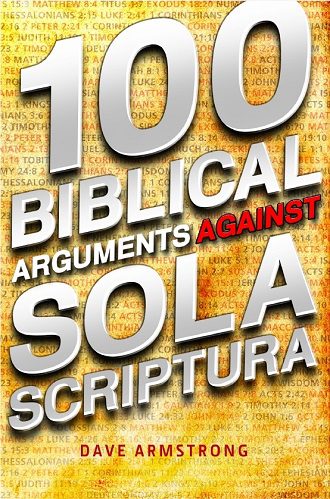
For those who haven’t yet read it, here is my most concise presentation of the “Catholic argument” from 1 Timothy 3:15, from my book, 100 Biblical Arguments Against Sola Scriptura (Catholic Answers Press, 2012, pp. 104-107, #82):
Pillars and foundations support things and prevent them from collapsing. To be a “bulwark” of the truth, means to be a “safety net” against truth turning into falsity. If the Church could err, it could not be what Scripture says it is. God’s truth would be the house built on a foundation of sand in Jesus’ parable. For this passage of Scripture to be true, the Church could not err — it must be infallible. A similar passage may cast further light on 1 Timothy 3:15:
Ephesians 2:19-21 . . . you are fellow citizens with the saints and members of the household of God, [20] built upon the foundation of the apostles and prophets, Christ Jesus himself being the cornerstone, [21] in whom the whole structure is joined together and grows into a holy temple in the Lord;
1 Timothy 3:15 defines “household of God” as “the church of the living God.” Therefore, we know that Ephesians 2:19-21 is also referring to the Church, even though that word is not present. Here the Church’s own “foundation” is “the apostles and prophets, Christ Jesus himself being the cornerstone.” The foundation of the Church itself is Jesus and apostles and prophets.
Prophets spoke “in the name of the Lord” (1 Chron 21:19; 2 Chron 33:18; Jer 26:9), and commonly introduced their utterances with “thus says the Lord” (Is 10:24; Jer 4:3; 26:4; Ezek 13:8; Amos 3:11-12; and many more). They spoke the “word of the Lord” (Is 1:10; 38:4; Jer 1:2; 13:3, 8; 14:1; Ezek 13:1-2; Hos 1:1; Joel 1:1; Jon 1:1; Mic 1:1, et cetera). These communications cannot contain any untruths insofar as they truly originate from God, with the prophet serving as a spokesman or intermediary of God (Jer 2:2; 26:8; Ezek 11:5; Zech 1:6; and many more). Likewise, apostles proclaimed truth unmixed with error (1 Cor 2:7-13; 1 Tim 2:7; 2 Tim 1:11-14; 2 Pet 1:12-21).
Does this foundation have any faults or cracks? Since Jesus is the cornerstone, he can hardly be a faulty foundation. Neither can the apostles or prophets err when teaching the inspired gospel message or proclaiming God’s word. In the way that apostles and prophets are infallible, so is the Church set up by our Lord Jesus Christ. We ourselves (all Christians) are incorporated into the Church (following the metaphor), on top of the foundation.
1 Peter 2:4-9 Come to him, to that living stone, rejected by men but in God’s sight chosen and precious; [5] and like living stones be yourselves built into a spiritual house, to be a holy priesthood, to offer spiritual sacrifices acceptable to God through Jesus Christ. [6] For it stands in scripture: “Behold, I am laying in Zion a stone, a cornerstone chosen and precious, and he who believes in him will not be put to shame.” [7] To you therefore who believe, he is precious, but for those who do not believe, “The very stone which the builders rejected has become the head of the corner,” [8] and “A stone that will make men stumble, a rock that will make them fall”; for they stumble because they disobey the word, as they were destined to do. [9] But you are a chosen race, a royal priesthood, a holy nation, God’s own people, that you may declare the wonderful deeds of him who called you out of darkness into his marvelous light. (cf. Isa 28:16)
Jesus is without fault or untruth, and he is the cornerstone of the Church. The Church is also more than once even identified with Jesus himself, by being called his “Body” (Acts 9:5 cf. with 22:4 and 26:11; 1 Cor 12:27; Eph 1:22-23; 4:12; 5:23, 30; Col 1:24). That the Church is so intimately connected with Jesus, who is infallible, is itself a strong argument that the Church is also infallible and without error.
Therefore, the Church is built on the foundation of Jesus (perfect in all knowledge), and the prophets and apostles (who spoke infallible truth, often recorded in inspired, infallible Scripture). Moreover, it is the very “Body of Christ.” It stands to reason that the Church herself is infallible, by the same token. In the Bible, nowhere is truth presented as anything less than pure truth, unmixed with error. That was certainly how Paul conceived his own “tradition” that he received and passed down.
Knowing what truth is, how can its own foundation or pillar be something less than total truth (since truth itself contains no falsehoods, untruths, lies, or errors)? It cannot. It is impossible. It is a straightforward matter of logic and plain observation. A stream cannot rise above its source. What is built upon a foundation cannot be greater than the foundation. If it were, the whole structure would collapse.
If an elephant stood on the shoulders of a man as its foundation, that foundation would collapse. The base of a skyscraper has to hold the weight above it. The foundations of a suspension bridge over a river have to be strong enough to support that bridge.
Therefore, we must conclude that if the Church is the foundation of truth, the Church must be infallible, since truth is infallible, and the foundation cannot be lesser than that which is built upon it. And since there is another infallible authority apart from Scripture, sola scriptura must be false.
***
Practical Matters: Perhaps some of my 4,000+ free online articles (the most comprehensive “one-stop” Catholic apologetics site) or fifty-one books have helped you (by God’s grace) to decide to become Catholic or to return to the Church, or better understand some doctrines and why we believe them.
Or you may believe my work is worthy to support for the purpose of apologetics and evangelism in general. If so, please seriously consider a much-needed financial contribution. I’m always in need of more funds: especially monthly support. “The laborer is worthy of his wages” (1 Tim 5:18, NKJV). 1 December 2021 was my 20th anniversary as a full-time Catholic apologist, and February 2022 marked the 25th anniversary of my blog.
PayPal donations are the easiest: just send to my email address: [email protected]. You’ll see the term “Catholic Used Book Service”, which is my old side-business. To learn about the different methods of contributing, including 100% tax deduction, etc., see my page: About Catholic Apologist Dave Armstrong / Donation Information. Thanks a million from the bottom of my heart!
***
Summary: 1 Timothy 3:15 proves that the Church = foundation of the truth, and is infallible and indefectible (also disproving sola Scriptura). Banzoli futilely ignores it.
***
Church = Foundation of the Truth
pillar and foundation of truth
Previous Post
February 8, 2023
Bible & the Intercession of Saints (vs. Lucas Banzoli)
Next Post
February 9, 2023 Mary and "Crazy" Jesus, Pt. II (vs. Lucas Banzoli)
Recent Comments
"And lastly, I belong to no denomination and am free to serve God as He ..."
Is Venerating Men & Angels Worship? ..."
"And obeisance doesn't mean "worship". It means "respect", "obey", or "submission". Very weird that you ..."
Is Venerating Men & Angels Worship? ..."
"Many of these scriptures you have noted have been taken out of context. With Daniel, ..."
Is Venerating Men & Angels Worship? ..."
""Protestants often point out that Jesus is now triumphant in heaven and object to Catholics ..."
Three More Anti-Catholic Lies About Catholicism ..."
Browse Our Archives
Select a Category & Last Things About Me Anti-Catholicism Atheism & Agnosticism Baptism and Sacramentalism Bible and Tradition Blessed Virgin Mary Books by Dave Armstrong C. S. Lewis Calvinism & General Protestantism Catholic Apologetics Catholic Apologists Catholic conversion Catholic converts Christmas Church (Ecclesiology) Church History Conversion and Converts Development of Doctrine Eastern Orthodoxy Ecumenism & Christian Unity Eucharist & Liturgy Fathers of the Church French Translations G. K. Chesterton Hell Hell & Satan Hell & Satan & Last Things Heresies & Comparative Religion Holistic Health Inquisition & Crusades & Scandals James White Jews & Judaism & Old Testament John Calvin John Henry Newman Liberal / Modernist Theology Life Issues Literary Resume Lutheranism Mariology Martin Luther Music Orthodoxy Papacy & Infallibility Personal Page Philosophy & Science Political & Ethical & Moral Issues Protestant Persecution & Intolerance Protestantism Purgatory Purgatory & Penance Romantic & Imaginative Theology Saints & Purgatory & Penance Salvation Salvation & Justification Satan & Last Things Sexuality and Gender Issues Spanish Translations Traditionalism vs. Radical Catholic Reactionaries Traducciones al español / tradução para português Trinitarianism & Christology Uncategorized Videos
Select a Month October 2026 September 2026 August 2026 July 2026 June 2026 May 2026 April 2026 March 2026 February 2026 January 2026 December 2025 November 2025 October 2025 September 2025 August 2025 July 2025 June 2025 May 2025 April 2025 March 2025 February 2025 January 2025 December 2024 November 2024 October 2024 September 2024 August 2024 July 2024 June 2024 May 2024 April 2024 March 2024 February 2024 January 2024 December 2023 November 2023 October 2023 September 2023 August 2023 July 2023 June 2023 May 2023 April 2023 March 2023 February 2023 January 2023 December 2022 November 2022 October 2022 September 2022 August 2022 July 2022 June 2022 May 2022 April 2022 March 2022 February 2022 January 2022 December 2021 November 2021 October 2021 September 2021 August 2021 July 2021 June 2021 May 2021 April 2021 March 2021 February 2021 January 2021 December 2020 November 2020 October 2020 September 2020 August 2020 July 2020 June 2020 May 2020 April 2020 March 2020 February 2020 January 2020 December 2019 November 2019 October 2019 September 2019 August 2019 July 2019 June 2019 May 2019 April 2019 March 2019 February 2019 January 2019 December 2018 November 2018 October 2018 September 2018 August 2018 July 2018 June 2018 May 2018 April 2018 March 2018 February 2018 January 2018 December 2017 November 2017 October 2017 September 2017 August 2017 July 2017 June 2017 May 2017 April 2017 March 2017 February 2017 January 2017 December 2016 November 2016 October 2016 September 2016 August 2016 July 2016 June 2016 May 2016 April 2016 March 2016 February 2016 January 2016 December 2015 November 2015 October 2015 September 2015 August 2015 July 2015 June 2015 May 2015 April 2015 March 2015 February 2015 January 2015 December 2014 November 2014 October 2014 September 2014 August 2014 July 2014 June 2014 April 2014 March 2014 February 2014 January 2014 December 2013 November 2013 October 2013 September 2013 August 2013 July 2013 June 2013 April 2013 March 2013 February 2013 January 2013 December 2012 November 2012 October 2012 September 2012 August 2012 July 2012 June 2012 May 2012 April 2012 March 2012 February 2012 January 2012 December 2011 November 2011 October 2011 September 2011 August 2011 July 2011 June 2011 April 2011 March 2011 February 2011 October 2010 September 2010 August 2010 July 2010 April 2010 March 2010 December 2009 October 2009 August 2009 July 2009 June 2009 May 2009 March 2009 February 2009 October 2008 September 2008 April 2008 March 2008 February 2008 January 2008 December 2007 November 2007 October 2007 May 2007 March 2007 February 2007 January 2007 November 2006 October 2006 September 2006 August 2006 July 2006 June 2006 May 2006 April 2006 March 2006 February 2006 October 2005 June 2005 April 2005 February 2005 July 2004 May 2004 April 2004
Follow Us!
TAKE THE
Religious Wisdom Quiz
How many disciples did Jesus have?
Select your answer to see how you score.
Thirty Seven One hundred Twelve
Books by This Author Books by Dave Armstrong
Related posts from Biblical Evidence for Catholicism

Three More Anti-Catholic Lies About Catholicism (#6-4)
Biblical Evidence for Catholicism

Top Ten Anti-Catholic Lies (#10-7)
Biblical Evidence for Catholicism

Was Peter "Any Old" Apostle? 10 Anti-Papal Arguments
Biblical Evidence for Catholicism

Jesus Founded the [Catholic] Church. If Not Him,...
Biblical Evidence for Catholicism
TRENDING AT PATHEOS Catholic

In "Irreplaceable," our book on vocation and technology, Trevor Sutton and I...

I was strolling through the top floor of the brand new Parthenon...

What Does Gêvâh Mean For Kimberley Guifoyle &...
This week, a lot of the news is focused on Kimberly Guilfoyle....

INNER CIRCLE: Profound Mystery (Of Christ In All...
Ephesians 5:31-32 “For this reason, a man will leave his father and...

Do Not Rejoice When Your Enemy Falls: The...
Turning an execution into a public spectacle is a disturbing expression of...

'The Chosen' S6 Trailer: The Passion Gets Very...
Not many watching 'The Chosen' worry about spoilers, but just because they...
view all Catholic blogs
What Are Your Thoughts?leave a comment
Ad-Free & Subscriber Log-In Subscription Support
- About Us
- 2026 Calendar
- Videos
- Podcasts
- Library of World Religions
- Faith In Media Tracker
- Advertise With Us
- Write for Us
- Privacy Policy
- Terms of Service
- Do Not Sell My Data
- Contact Us
- Radiant Digital
- Manage Newsletter Subscriptions
- Unsubscribe From Notifications
- Sitemap
Copyright 2008-2026, Patheos. All rights reserved.
Subscription Support Ad-Free & Subscriber Log-In
Follow Patheos