
BuddhistCatholicContemplativeEvangelicalGeneral ChristianHinduJewishLatter-day SaintMuslimNew VisionsProgressive Christian
Beliefs
- Buddhist
- Catholic
- Contemplative
- Evangelical
- General Christian
- Hindu
- Jewish
- Latter-day Saint
- More Voices
- Muslim
- New Visions
- Pagan
- Progressive Christian
Topics
- Religion News
- Food and Religion
- Sports and Religion
- Religious Art
- Religious Music and Entertainment
- Religious Events
- History and Religion
- Style and Religion
- Politics and Religion
- Women in Religion
- Recreation Outdoors and Religion
- Business Finance and Religion
- Careers Workplace and Religion
- Education and Religion
- Family Parenting and Religion
- Health Fitness and Religion
- Home and Religion
- Relationships and Religion
- Technology and Religion
- Travel and Religion
Columnists
- Buddhist Columnists
- Business Finance and Religion Columnists
- Careers Workplace and Religion Columnists
- Catholic Columnists
- Contemplative Columnists
- Education and Religion Columnists
- Evangelists Columnists
- Family Parenting and Religion Columnists
- General Christian Columnists
- Health Fitness and Religion Columnists
- Hindu Columnists
- History and Religion Columnists
- Home and Religion Columnists
- Jewish Columnists
- More Voices Columnists
- Latter Day Columnists
- Muslim Columnists
- New Visions Columnists
- Nonreligious Columnists
- Pagan Columnists
- Politics and Religion Columnists
- Progressive Columnists
- Recreation Outdoors and Religion Columnists
- Relationships and Religion Columnists
- Religion News Columnists
- Religious Art Columnists
- Religious Events Columnists
- Religious Music and Entertainment Columnists
- Sports and Religion Columnists
- Style and Religion Columnists
- Technology and Religion Columnists
- Travel and Religion Columnists
- Women in Religion Columnists
Resource Library
- 2026 Calendar
- Library of World Religions
- The 100 Most Holy Places on Earth
- Patheos Answers
- Podcasts
- Videos
- Faith Leaders Database
- Anglican Episcopalian
- Bahai
- Baptist
- Buddhism
- Christianity
- Confucianism
- Eastern Orthodoxy
- Hinduism
- Holiness and Pentecostal
- ISKCON
- Islam
- Judaism
- Lutheran
- Methodist
- The Church of Jesus Christ of Latter-day Saints
- New Age
- Paganism
- Presbytarian and Reformed
- Protestantism
- Religion Behind the Scenes
- Roman Catholic
- Scientology
- Shia Islam
- Sikhism
- Sufism
- Sunni Islam
- Taoism
- Zen
- See all religions
Research Tools
 Ad-Free & Subscriber Log-In Subscription Support
Ad-Free & Subscriber Log-In Subscription Support
Follow Patheos 

- Trending:
- Forgiveness
- |
- Marriage
- |
- Consciousness
- |
- Death Penalty
- |
- Election
- |
- Halloween

-
About
-
Catholic Apologetics
-
Church History
-
Great Apologists
-
Christian Worldview
-
Protestantism & Misc.
- Home
- Catholic
- History and Religion
- Biblical Catholic Confession & Absolution (vs. Lucas Banzoli)
Biblical Catholic Confession & Absolution (vs. Lucas Banzoli)
Last updated on: February 23, 2023 at 10:38 am by Dave Armstrong
Biblical Catholic Confession & Absolution (vs. Lucas Banzoli) 2023-02-23T10:38:24-04:00 Dave Armstrong
Patheos Explore the world's faith through different perspectives on religion and spirituality! Patheos has the views of the prevalent religions and spiritualities of the world.
+ The Church Fathers on Auricular Confession to a Priest
Lucas Banzoli is a very active Brazilian anti-Catholic polemicist, who holds to basically a Seventh-day Adventist theology, whereby there is no such thing as a soul that consciously exists outside of a body, and no hell (soul sleep and annihilationism). This leads him to a Christology which is deficient and heterodox in terms of Christ’s human nature after His death. He has a Master’s degree in theology, a degree and postgraduate work in history, a license in letters, and is a history teacher, author of 27 self-published books, as well as blogmaster for six blogs. He has many videos on YouTube.
This is my 64th refutation of Banzoli’s writings. From 25 May until 12 November 2022 he wrote not one single word in reply, claiming that my articles were “without exception poor, superficial and weak” and that “only a severely cognitively impaired person” would take them “seriously.” Nevertheless, he found them so “entertaining” that after almost six months of inaction he resolved to “make a point of rebutting” them “one by one”; this effort being his “new favorite sport.”
He has now replied to me 16 times (the last one dated 2-20-23). I disposed of the main themes of his numberless slanders in several Facebook posts under his name on my Anti-Catholicism page (where all my replies to him are listed). I shall try, by God’s grace, to ignore his innumerable insults henceforth, and heartily thank him for all these blessings and extra rewards in heaven (Matthew 5:11-12).
Google Translate is utilized to render Lucas’ Portugese into English. Occasionally I slightly modify clearly inadequate translations, so that his words will read more smoothly and meaningfully in English. I use the RSV for both my Bible citations and Banzoli’s. His words will be in blue.
*****
This is a reply to Lucas Banzoli’s article, “Os discípulos podiam perdoar pecados?” [Could the disciples forgive sins?] (9-18-15)
The Roman Church bases its teaching on ear confession upon John 20:22-23, which says:
John 20:22-23 And when he had said this, he breathed on them, and said to them, “Receive the Holy Spirit. [23] If you forgive the sins of any, they are forgiven; if you retain the sins of any, they are retained.”
On this basis, it declares that the Roman priests have the authority to withhold or forgive sins effectively, being means through which we must pass to obtain the forgiveness of our sins. Evangelicals, however, understand that we can confess our sins directly to God.
Catholics are free to confess any sins which are not subjectively mortal, or grave, directly to God, and in fact, there is a general absolution that covers such sins at every Mass. Here is that portion (Latin / western rites); the way it is usually done:
PENITENTIAL ACT
I confess to almighty God
and to you, my brothers and sisters,
that I have greatly sinned
in my thoughts and in my words,
in what I have done and in what I have
failed to do,
[And, striking their breast, they say]:
through my fault, through my fault,
through my most grievous fault;
therefore I ask blessed Mary ever-Virgin,
all the Angels and Saints,
and you, my brothers and sisters,
to pray for me to the Lord our God.Absolution of the Priest:
C: May almighty God have mercy on us
forgive us our sins, and bring us to everlasting life.P: Amen.
Thus, right in every Mass, Catholics are collectively asking God for forgiveness of sins. Thus it’s beyond silly and absurd to believe that Catholics don’t have this as part of their constant practice. But if one commits a subjectively mortal sin, then it’s required in Catholicism that they are contrite, confess it to a priest, who then offers formal sacramental absolution. In cases of venial sin, the Catholic is free to take it straight to God or to utilize the sacrament of reconciliation.
David . . . said:
Psalm 32:5 I acknowledged my sin to thee, and I did not hide my iniquity; I said, “I will confess my transgressions to the LORD”; then thou didst forgive the guilt of my sin.
Either David was lying, or sins can be confessed straight to God! Ezra, another great errant, likewise asserted:
Ezra 10:11 “Now then make confession to the LORD the God of your fathers, and do his will; separate yourselves from the peoples of the land and from the foreign wives.”
As usual, it’s not the stark “either/or” and false dichotomy scenario so sadly familiar in Protestant thought. David confessed in this instance directly to God, just as Catholics do at every Mass, and privately during prayer. But there was also formal forgiveness and atonement in ancient Israel and OT times, as I will soon prove, and which Banzoli should already be aware of, if he claims to know the Bible well.
Ezra was not a “great errant.” He was a priest (Ezra 7:11), and in this instance was praying to God as an intermediary for his people, not because of his own sin, but theirs (much like a Catholic priest offering absolution). Banzoli can’t even get this basic fact right because he obviously didn’t read the passage closely enough. The widespread sin was taking on wives of foreigners who served false gods (Ezra 9:1-2).
The rest of this chapter (9:3-17) and the beginning of the next (10: 1-6) shows Ezra in great distress, praying for his people, which is a constant motif in the Old Testament: the holy men praying that God would forgive sinners and great collective among the people (which I have documented; see also a Facebook addendum with further examples). Again, this is much like going to a Catholic priest in confession who then acts as an agent of dispensing God’s forgiveness through formal absolution.
Ezra had offered the “evening sacrifice” during this time (9:5), which was the formal way to receive forgiveness of sins in the Mosaic OT system of law. Ezra 10:1 reports that “Ezra prayed and made confession”: again, not for himself but for his people, functioning just like a Catholic priest in the confessional does. We see Moses doing the same thing (Ex 32:30-32). Ezra was a priest offering sacrifice in the temple. This was how God forgave Jews in OT times. See, for example:
Leviticus 5:5-6 When a man is guilty in any of these, he shall confess the sin he has committed, [6] and he shall bring his guilt offering to the LORD for the sin which he has committed, a female from the flock, a lamb or a goat, for a sin offering; and the priest shall make atonement for him for his sin.
Leviticus 19:21-22 but he shall bring a guilt offering for himself to the LORD, to the door of the tent of meeting, a ram for a guilt offering. [22] And the priest shall make atonement for him with the ram of the guilt offering before the LORD for his sin which he has committed; and the sin which he has committed shall be forgiven him.
This is virtually Catholic absolution already: 3200 years ago. A search for “priest” and “atonement” appearing together in the OT yielded 28 matches in Leviticus and Numbers. King David, as a good Jew, took part in this. He was commanded to like everyone else was. So we see that he “he sacrificed an ox and a fatling” (2 Sam 6:13) and “offered burnt offerings and peace offerings before the LORD” (2 Sam 6:17). Thus, his confession directly to God was not all that was involved. He also had to participate in the OT sacrificial system of atonement for sins, which bears an uncanny resemblance to Catholic confession and absolution (minus the animal sacrifice).
There is not a single line or prescription in the Bible commanding the faithful to confess their secret sins to priests, as an absolute prerequisite for finding divine forgiveness. This would be really absurd if the forgiveness of sins (something indispensable for salvation) depended on the approval of a priest.
Banzoli hangs himself again (!!!) with a dumb universal negative statement that is easily proven to be false. I go through this every time I refute his anti-Catholic nonsense. Leviticus 5:5-6 and 19:21-22 show a remarkably similar process to the Catholic sacrament of reconciliation (contrition, followed by confession and absolution and assigned penance). The New Testament develops and continues this thought. With John the Baptist, people came “confessing their sins” (Mt 3:6; Mk 1:5) and being baptized, which entailed a “repentance for the forgiveness of sins” (Mk 1:4). The water of baptism took their sins away just as the sacrament of absolution wipes away Catholic confessed sins.
Jesus specifically set up such a system with his disciples, who were the type and foreshadowing of priests:
Matthew 16:19 “I will give you [Peter] the keys of the kingdom of heaven, and whatever you bind on earth shall be bound in heaven, and whatever you loose on earth shall be loosed in heaven.”
Matthew 18:18 Truly, I say to you, whatever you bind on earth shall be bound in heaven, and whatever you loose on earth shall be loosed in heaven. (cf. John 20:22-23 above)
Confession (possibly to men) is shown in the book of Acts:
Acts 19:18 Many also of those who were now believers came, confessing and divulging their practices. (cf. 1 Jn 1:8-9)
The “came” in this passage suggests that they confessed to Paul or possibly to him and/or to the public assembly. Otherwise, it seems to me that the text would have simply stated that they confessed, not that they “came” to where Paul was to do so.
In James, we have a more direct suggestion that priests were offering absolution along with prayers:
James 5:14-16 Is any among you sick? Let him call for the elders of the church, and let them pray over him, anointing him with oil in the name of the Lord; [15] and the prayer of faith will save the sick man, and the Lord will raise him up; and if he has committed sins, he will be forgiven. [16] Therefore confess your sins to one another, and pray for one another, that you may be healed. The prayer of a righteous man has great power in its effects.
We know for sure that here we have sick people specifically going to the “elders” (priests), who pray and anoint them. This is our sacrament of anointing or extreme unction (aka “last rites”). 5:15 strongly suggests these same prayers and rituals of the elders allow sins to “be forgiven”. And then the next verse mentions “confess your sins to one another”. I don’t see that this would exclude the elders. The whole passage presupposes that these elders are holy men, and that their prayers — which have “great power” — can heal and offer forgiveness. Doctrines develop, but just about everything we need to establish an explicitly biblical sanction of Catholic confession and absolution is already present in the above passages.
As is well known, auricular confession was absolutely unknown to the Fathers of the Church, and was only invented as a dogma at the Lateran Council, in 1215, during the pontificate of Pope Innocent III. The attempts by Catholic apologists to distort patristic statements in favor of auricular confession in the early centuries is . . . laughable . . .
Another universal negative! This guy’s pseudo-“arguments” are a running joke.
And there is still a seventh remission of sins through penance, although admittedly it is difficult and toilsome, when the sinner washes “his couch in tears” (Cf. Ps 6.7) and his “tears” become his “bread day and night,” (Cf. Ps 41.4) when he is not ashamed to make known his sin to the priest of the Lord and to seek a cure according to the one who says, “I said, ‘I will proclaim to the Lord my injustice against myself,’ and you forgave the impiety of my heart.”
What the Apostle James said is fulfilled in this: “But if anyone is sick, let that person call the presbyters of the Church, and they will place their hands on him, anointing him with oil in the name of the Lord. And the prayer of faith will save the sick person, and if he is in sins, they will be forgiven him.” (Jas 5.14-15) (Origen, Homilies on Leviticus, 2:4 [A.D. 248])
I entreat you, beloved brethren, that each one should confess his own sin, while he who has sinned is still in this world, while his confession may be received, while the satisfaction and remission made by the priests are pleasing to the Lord? (Cyprian, Treatise 3: On the Lapsed, 29 [A.D. 251], in ANF, IV: 445)
Just as a man is enlightened by the Holy Spirit when he is baptized by a priest, so he who confesses his sins with a repentant heart obtains their remission from the priest. (St. Athanasius, 295-373 AD, On the Gospel of Luke 19)
It is necessary to confess our sins to those to whom the dispensation of God’s mysteries [i.e. the Sacraments] is entrusted [i.e. priests]. Those doing penance of old are found to have done it before the saints. It is written in the Gospel that they confessed their sins to John the Baptist [Matt 3:6]; but in Acts they confessed to the Apostles, by whom also all were baptized [Acts 19:18]. (Basil the Great, Rule Briefly Treated, 288 [A.D. 374] )
For if any one will consider how great a thing it is for one, being a man, and compassed with flesh and blood, to be enabled to draw nigh to that blessed and pure nature, he will then clearly see what great honor the grace of the Spirit has vouchsafed to priests; since by their agency these rites are celebrated, and others nowise inferior to these both in respect of our dignity and our salvation. For they who inhabit the earth and make their abode there are entrusted with the administration of things which are in Heaven, and have received an authority which God has not given to angels or archangels. For it has not been said to them, ‘Whatsoever ye shall bind on earth shall be bound in Heaven, and whatsoever ye shall loose on earth shall be loosed in Heaven.’ They who rule on earth have indeed authority to bind, but only the body: whereas this binding lays hold of the soul and penetrates the heavens; and what priests do here below God ratifies above, and the Master confirms the sentence of his servants. For indeed what is it but all manner of heavenly authority which He has given them when He says, ‘Whose sins ye remit they are remitted, and whose sins ye retain they are retained?’ What authority could be greater than this? ‘The Father hath committed all judgment to the Son?’ But I see it all put into the hands of these men by the Son. (John Chrysostom, The Priesthood, 3:5 [A.D. 387], in NPNF1, IX: 47)
The office of the priest is a gift of the Holy Spirit, and His right it is specially to forgive and to retain sins. (Ambrose, Concerning Repentance, I, ch, 2, sec. 8 [A.D. 388], in NPNF2, X: 330)
Just as in the Old Testament the priest makes the leper clean or unclean, so in the New Testament the bishop and presbyter binds or looses not those who are innocent or guilty, but by reason of their office, when they have heard various kinds of sins, they know who is to be bound and who loosed. (Jerome, Commentary on Matthew, 3:16, 19 [A.D. 398], in JUR, II:202)
All mortal sins are to be submitted to the keys of the Church and all can be forgiven; but recourse to these keys is the only, the necessary, and the certain way to forgiveness. Unless those who are guilty of grievous sin have recourse to the power of the keys, they cannot hope for eternal salvation. Open your lips, then, and confess your sins to the priest. Confession alone is the true gate to Heaven. (Augustine, Christian Combat [A.D. 397] )
This is the medicine for sins, established by God and delivered to the priests of the Church, who make diligent use of it in healing the afflictions of men. You are aware of these things, as also of the fact that God, because He greatly cares for us, gave us penitence and showed us the medicine of repentance; and He established some men, those who are priests, as physicians of sins. If in this world we receive through them healing and forgiveness of sins, we shall be delivered from the judgment that is to come. It behooves us, therefore, to draw near to the priests in great confidence and to reveal to them our sins; and those priests, with all diligence, solicitude, and love, and in accord with the regulations mentioned above, will grant healing to sinners. [The priests] will not disclose the things that ought not be disclosed; rather, they will be silent about the things that have happened, as befits true and loving fathers [cf. 1 Thess 2:11; 1 Cor 4:15] who are bound to guard the shame of their children while striving to heal their bodies. (Theodore of Mopsuestia, c. 428 AD, Catechetical Homilies 16)
***
Practical Matters: Perhaps some of my 4,000+ free online articles (the most comprehensive “one-stop” Catholic apologetics site) or fifty-one books have helped you (by God’s grace) to decide to become Catholic or to return to the Church, or better understand some doctrines and why we believe them.
Or you may believe my work is worthy to support for the purpose of apologetics and evangelism in general. If so, please seriously consider a much-needed financial contribution. I’m always in need of more funds: especially monthly support. “The laborer is worthy of his wages” (1 Tim 5:18, NKJV). 1 December 2021 was my 20th anniversary as a full-time Catholic apologist, and February 2022 marked the 25th anniversary of my blog.
PayPal donations are the easiest: just send to my email address: [email protected]. You’ll see the term “Catholic Used Book Service”, which is my old side-business. To learn about the different methods of contributing, including 100% tax deduction, etc., see my page: About Catholic Apologist Dave Armstrong / Donation Information. Thanks a million from the bottom of my heart!
***
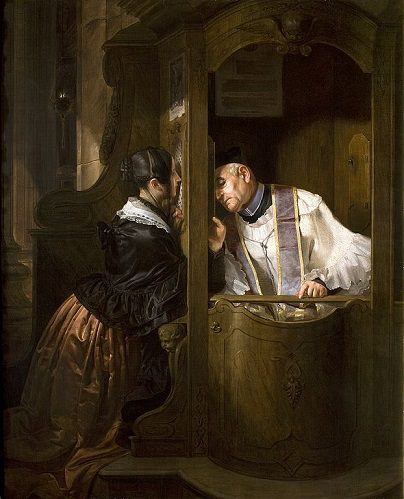
Photo credit: The Confession (1838), by Giuseppe Molteni (1800-1867) [Wikimedia Commons / Creative Commons Attribution-Share Alike 3.0 Unported license]

***
Summary: I go through the many biblical evidences in favor of confession & absolution, and reply to counter-arguments. I also provide significant patristic proofs for same.
Previous Post
February 22, 2023
Lucas Banzoli vs. Biblically Venerated "Catholic" Mary
Next Post

February 23, 2023 Asbury Revival & My Many Predictions of Revival Since 2000
Recent Comments
Browse Our Archives
Select a Category & Last Things About Me Anti-Catholicism Atheism & Agnosticism Baptism and Sacramentalism Bible and Tradition Blessed Virgin Mary Books by Dave Armstrong C. S. Lewis Calvinism & General Protestantism Catholic Apologetics Catholic Apologists Catholic conversion Catholic converts Christmas Church (Ecclesiology) Church History Conversion and Converts Development of Doctrine Eastern Orthodoxy Ecumenism & Christian Unity Eucharist & Liturgy Fathers of the Church French Translations G. K. Chesterton Hell Hell & Satan Hell & Satan & Last Things Heresies & Comparative Religion Holistic Health Inquisition & Crusades & Scandals James White Jews & Judaism & Old Testament John Calvin John Henry Newman Liberal / Modernist Theology Life Issues Literary Resume Lutheranism Mariology Martin Luther Music Orthodoxy Papacy & Infallibility Personal Page Philosophy & Science Political & Ethical & Moral Issues Protestant Persecution & Intolerance Protestantism Purgatory Purgatory & Penance Romantic & Imaginative Theology Saints & Purgatory & Penance Salvation Salvation & Justification Satan & Last Things Sexuality and Gender Issues Spanish Translations Traditionalism vs. Radical Catholic Reactionaries Traducciones al español / tradução para português Trinitarianism & Christology Uncategorized Videos
Select a Month October 2026 September 2026 August 2026 July 2026 June 2026 May 2026 April 2026 March 2026 February 2026 January 2026 December 2025 November 2025 October 2025 September 2025 August 2025 July 2025 June 2025 May 2025 April 2025 March 2025 February 2025 January 2025 December 2024 November 2024 October 2024 September 2024 August 2024 July 2024 June 2024 May 2024 April 2024 March 2024 February 2024 January 2024 December 2023 November 2023 October 2023 September 2023 August 2023 July 2023 June 2023 May 2023 April 2023 March 2023 February 2023 January 2023 December 2022 November 2022 October 2022 September 2022 August 2022 July 2022 June 2022 May 2022 April 2022 March 2022 February 2022 January 2022 December 2021 November 2021 October 2021 September 2021 August 2021 July 2021 June 2021 May 2021 April 2021 March 2021 February 2021 January 2021 December 2020 November 2020 October 2020 September 2020 August 2020 July 2020 June 2020 May 2020 April 2020 March 2020 February 2020 January 2020 December 2019 November 2019 October 2019 September 2019 August 2019 July 2019 June 2019 May 2019 April 2019 March 2019 February 2019 January 2019 December 2018 November 2018 October 2018 September 2018 August 2018 July 2018 June 2018 May 2018 April 2018 March 2018 February 2018 January 2018 December 2017 November 2017 October 2017 September 2017 August 2017 July 2017 June 2017 May 2017 April 2017 March 2017 February 2017 January 2017 December 2016 November 2016 October 2016 September 2016 August 2016 July 2016 June 2016 May 2016 April 2016 March 2016 February 2016 January 2016 December 2015 November 2015 October 2015 September 2015 August 2015 July 2015 June 2015 May 2015 April 2015 March 2015 February 2015 January 2015 December 2014 November 2014 October 2014 September 2014 August 2014 July 2014 June 2014 April 2014 March 2014 February 2014 January 2014 December 2013 November 2013 October 2013 September 2013 August 2013 July 2013 June 2013 April 2013 March 2013 February 2013 January 2013 December 2012 November 2012 October 2012 September 2012 August 2012 July 2012 June 2012 May 2012 April 2012 March 2012 February 2012 January 2012 December 2011 November 2011 October 2011 September 2011 August 2011 July 2011 June 2011 April 2011 March 2011 February 2011 October 2010 September 2010 August 2010 July 2010 April 2010 March 2010 December 2009 October 2009 August 2009 July 2009 June 2009 May 2009 March 2009 February 2009 October 2008 September 2008 April 2008 March 2008 February 2008 January 2008 December 2007 November 2007 October 2007 May 2007 March 2007 February 2007 January 2007 November 2006 October 2006 September 2006 August 2006 July 2006 June 2006 May 2006 April 2006 March 2006 February 2006 October 2005 June 2005 April 2005 February 2005 July 2004 May 2004 April 2004
Follow Us!
TAKE THE
Religious Wisdom Quiz
What does "Bartholomew" mean in Aramaic?
Select your answer to see how you score.
Servant of God The Lord is my Shepherd Fisher of Men Son of Talmai
Books by This Author Books by Dave Armstrong
Related posts from Biblical Evidence for Catholicism

Three More Anti-Catholic Lies About Catholicism (#6-4)
Biblical Evidence for Catholicism

Bible & Catholicism on Mortal Sin (vs. John...
Biblical Evidence for Catholicism

Top Ten Anti-Catholic Lies (#10-7)
Biblical Evidence for Catholicism

Does Catholic Intercession of Saints Require Omniscience?
Biblical Evidence for Catholicism
TRENDING AT PATHEOS Catholic

Pope Leo Celebrates Mass for Nurses & Docs...
I don't have any idea how he did it, but Pope Leo...

The Sermon on the Mount, Part I: Matthew...
The Sermon on the Mount, Part I (Matthew 4:12-5:12) St. Matthew moves...

What's up from Crossway: Reviewing some of their latest A few weeks...

Janie Learns the Way of the Cross: A...
Teaching children about Jesus' Passion can be challenging. Many parents and educators...

Looking For Good Catholic Writing - October 2026
He alone extends the heavens, and he walks upon the waves of...

In "Irreplaceable," our book on vocation and technology, Trevor Sutton and I...
view all Catholic blogs
What Are Your Thoughts?leave a comment
Ad-Free & Subscriber Log-In Subscription Support
- About Us
- 2026 Calendar
- Videos
- Podcasts
- Library of World Religions
- Faith In Media Tracker
- Advertise With Us
- Write for Us
- Privacy Policy
- Terms of Service
- Do Not Sell My Data
- Contact Us
- Radiant Digital
- Manage Newsletter Subscriptions
- Unsubscribe From Notifications
- Sitemap
Copyright 2008-2026, Patheos. All rights reserved.
Subscription Support Ad-Free & Subscriber Log-In
Follow Patheos