
BuddhistCatholicContemplativeEvangelicalGeneral ChristianHinduJewishLatter-day SaintMuslimNew VisionsProgressive Christian
Beliefs
- Buddhist
- Catholic
- Contemplative
- Evangelical
- General Christian
- Hindu
- Jewish
- Latter-day Saint
- More Voices
- Muslim
- New Visions
- Pagan
- Progressive Christian
Topics
- Religion News
- Food and Religion
- Sports and Religion
- Religious Art
- Religious Music and Entertainment
- Religious Events
- History and Religion
- Style and Religion
- Politics and Religion
- Women in Religion
- Recreation Outdoors and Religion
- Business Finance and Religion
- Careers Workplace and Religion
- Education and Religion
- Family Parenting and Religion
- Health Fitness and Religion
- Home and Religion
- Relationships and Religion
- Technology and Religion
- Travel and Religion
Columnists
- Buddhist Columnists
- Business Finance and Religion Columnists
- Careers Workplace and Religion Columnists
- Catholic Columnists
- Contemplative Columnists
- Education and Religion Columnists
- Evangelists Columnists
- Family Parenting and Religion Columnists
- General Christian Columnists
- Health Fitness and Religion Columnists
- Hindu Columnists
- History and Religion Columnists
- Home and Religion Columnists
- Jewish Columnists
- More Voices Columnists
- Latter Day Columnists
- Muslim Columnists
- New Visions Columnists
- Nonreligious Columnists
- Pagan Columnists
- Politics and Religion Columnists
- Progressive Columnists
- Recreation Outdoors and Religion Columnists
- Relationships and Religion Columnists
- Religion News Columnists
- Religious Art Columnists
- Religious Events Columnists
- Religious Music and Entertainment Columnists
- Sports and Religion Columnists
- Style and Religion Columnists
- Technology and Religion Columnists
- Travel and Religion Columnists
- Women in Religion Columnists
Resource Library
- 2026 Calendar
- Library of World Religions
- The 100 Most Holy Places on Earth
- Patheos Answers
- Podcasts
- Videos
- Faith Leaders Database
- Anglican Episcopalian
- Bahai
- Baptist
- Buddhism
- Christianity
- Confucianism
- Eastern Orthodoxy
- Hinduism
- Holiness and Pentecostal
- ISKCON
- Islam
- Judaism
- Lutheran
- Methodist
- The Church of Jesus Christ of Latter-day Saints
- New Age
- Paganism
- Presbytarian and Reformed
- Protestantism
- Religion Behind the Scenes
- Roman Catholic
- Scientology
- Shia Islam
- Sikhism
- Sufism
- Sunni Islam
- Taoism
- Zen
- See all religions
Research Tools
 Ad-Free & Subscriber Log-In Subscription Support
Ad-Free & Subscriber Log-In Subscription Support
Follow Patheos 

- Trending:
- Forgiveness
- |
- Marriage
- |
- Consciousness
- |
- Death Penalty
- |
- Election
- |
- Halloween

-
About
-
Catholic Apologetics
-
Church History
-
Great Apologists
-
Christian Worldview
-
Protestantism & Misc.
- Home
- Catholic
- History and Religion
- Polycarp vs. “Faith Alone” (vs. Jason Engwer)
Polycarp vs. “Faith Alone” (vs. Jason Engwer)
Last updated on: January 27, 2023 at 2:55 pm by Dave Armstrong
Polycarp vs. “Faith Alone” (vs. Jason Engwer) 2023-01-27T14:55:10-04:00 Dave Armstrong
Patheos Explore the world's faith through different perspectives on religion and spirituality! Patheos has the views of the prevalent religions and spiritualities of the world.
St. Polycarp (69-155) was the bishop of Smyrna, and was a disciple of St. John, according to St. Irenaeus (c. 130-c. 202) and Tertullian (c. 155-c. 220). Protestant apologist Jason Engwer, the main blogger at Triablogue, recently wrote the article, “Baptism and Justification in Polycarp” (1-26-23). This is my response to it. His words will be in blue, Polycarp’s in green.
*****
Polycarp’s Letter To The Philippians [link] occasionally discusses soteriological issues, but not in a lot of depth. For example:
‘In whom, though now ye see Him not, ye believe, and believing, rejoice with joy unspeakable and full of glory;’ [1 Pet 1:8] into which joy many desire to enter, knowing that ‘by grace ye are saved, not of works,’ [Eph 2:8-9] but by the will of God through Jesus Christ….If we please Him in this present world, we shall receive also the future world, according as He has promised to us that He will raise us again from the dead, and that if we live worthily of Him, ‘we shall also reign together with Him,’ provided only we believe. ([Chapters] 1, 5)
The focus is on faith, but he requires works in some sense as well, probably in the sense of works being the fruit of justifying faith. Just before what I quoted in section 1 of the letter, Polycarp refers to how “the strong root of your faith, spoken of in days [Phil 1:5] long gone by, endureth even until now, and bringeth forth fruit to our Lord Jesus Christ”. He had noted that justification is “not of works”. He connects that comment in section 1 of the letter to 1 Peter 1:8, which refers to believing in Jesus. . . .
Near the end of Polycarp’s letter, he refers again to those who “shall believe in our Lord Jesus Christ” (12). . . . The most natural reading of the references to faith is that they’re meant in an unqualified sense, . . . [i.e., faith alone].
Baptism isn’t mentioned in the letter, so we can’t know for sure what St. Polycarp thought about that. Jason seems to think that this omission is significant. I do not. It’s simply one fairly short letter, so not “everything” will be mentioned in it. He didn’t mention the Eucharist or bishops in it, either, and we know that the entire early Church celebrated the Eucharist, and that he himself was a bishop.
But let’s examine whether he believed in faith alone: one of the two “pillars” of the Protestant so-called “Reformation.” Jason concedes that St. Polycarp “requires works in some sense”, but then opines that it’s “probably in the sense of works being the fruit of justifying faith”. This is the classic Protestant understanding of works: taught by both Luther and Calvin. It removes from good works any hint of merit or causal relation to to salvation (even if understood as always in conjunction with works and soaked with and enabled by grace).
Works are simply done in gratitude to God for the salvation already granted through faith alone. They have no direct relationship to salvation (even though I have found fifty Bible passages that teach that they definitely do have a very close relationship). Sanctification is formally separated from justification and salvation in Protestant thought. Good works are promoted, but in the final analysis, they aren’t required for salvation. This is the meaning of faith alone.
The Catholic view, on the other hand, is that a person is justified by grace alone through faith, with the necessary addition (after initial justification) of meritorious good works: without which faith is dead. We do not believe in salvation by works alone. That is the heresy of Pelagianism or Semi-Pelagianism (which we are often falsely accused of believing by those who haven’t studied Catholic soteriology).
The Wikipedia article on Polycarp takes a view similar to Jason’s, as to the Church father’s soteriology:
Polycarp’s soteriology is not clear; he does cite Ephesians 2:8 to say salvation is by grace rather than works, though later exhorts his readers to do good works. It is not clear from the text how he views works in relation to salvation as his comments are too little to make a clear conclusion. He could have believed that works are mere results of saving grace or that they are necessary to keep salvation and that they have meritorious value, thus we cannot know if he was a monergist or a synergist.
I shall argue that we have enough information in this letter from St. Polycarp, to determine that he held to a Catholic soteriology, not a “proto-Protestant” one.
St. Polycarp, in asserting that salvation is “not of works” (citing Ephesians 2) is simply condemning salvation by works or by self-generated works, apart from grace (i.e., Pelagianism). No one disagrees with that, so it’s not at issue. It’s not the same thing as an assertion of “faith alone.” Many Protestants fail to comprehend the fine but crucial logical distinctions in play.
Jason implies that St. Peter teaches faith alone. He doesn’t. In the same First Epistle, he directly ties works and merit to salvation:
1 Peter 4:17-19 (RSV) For the time has come for judgment to begin with the household of God; and if it begins with us, what will be the end of those who do not obey the gospel of God? [18] And “If the righteous man is scarcely saved, where will the impious and sinner appear?” [19] Therefore let those who suffer according to God’s will do right and entrust their souls to a faithful Creator.
He also teaches baptismal regeneration, or justification, stating that baptism “saves” us (1 Pet 3:21).
Already in his second chapter, St. Polycarp makes it very clear that he believes in the Catholic view of justification by grace alone through faith, with the necessary addition of meritorious good works: without which faith is dead, and salvation unattainable:
But He who raised Him up from the dead will raise us up also, if we do His will, and walk in His commandments, and love what He loved, keeping ourselves from all unrighteousness, covetousness, love of money, evil speaking, false witness; not rendering evil for evil, or railing for railing, or blow for blow, or cursing for cursing, but being mindful of what the Lord said in His teaching: Judge not, that you be not judged; forgive, and it shall be forgiven unto you; be merciful, that you may obtain mercy; with what measure you measure, it shall be measured to you again; and once more, “Blessed are the poor, and those that are persecuted for righteousness’ sake, for theirs is the kingdom of God.” [ch. 2; added verse numbers removed, but he cites five passages in this section; my italics and bolding]
This is extraordinary! Note the bolded “if.” Our resurrection (which means salvation, since only the saved will be resurrected to glory) is conditional upon doing various works. God will “raise us up” if we “do His will” (a work, especially indicated by the “do”), if we “walk in His commandments” (several works), and if we avoid nine different sins: the avoidance of which amounts to meritorious action and behavior. That’s at least eleven things that are necessary in order for us to be saved and resurrected, followed by five more things that are opportunities for meritorious actions leading (in faith and grace) to salvation.
If St. Polycarp in fact thought like a Protestant (in this regard of salvation), this section would have been much shorter. He would have written something like, “But He who raised Him up from the dead will raise us up also, if we believe in Him in faith alone.” All of the rest would have been relegated to a good and praiseworthy, yet optional sanctification: not related to salvation at all. But Polycarp makes our resurrection conditional upon doing all these good works and behaving the right (Christlike) way. It’s very Catholic and exceedingly unlike Protestantism.
All of this (!), and yet Jason thinks St. Polycarp believes in faith alone and not in merit and the Catholic conception of sanctification and good works (and the Wikipedia article thinks his soteriology isn’t “clear”)? I don’t see how, even giving Jason some slack for his Protestant bias (we all have bias and predispositions one way or another).
If we please Him in this present world, we shall receive also the future world, according as He has promised to us that He will raise us again from the dead, and that if we live worthily of Him, we shall also reign together with Him, [2 Tim 2:12] provided only we believe. (ch. 5; my bolding and italics)
This is again the Catholic doctrine of merit and good works as necessary in salvation, in conjunction with faith. Faith isn’t alone. This is the furthest thing imaginable from faith alone. It reminds me of this similar passage: “and if children, then heirs, heirs of God and fellow heirs with Christ, provided we suffer with him in order that we may also be glorified with him” (Rom 8:17).
neither fornicators, nor effeminate, nor abusers of themselves with mankind, shall inherit the kingdom of God, [1 Cor 6:9-10] (ch. 5)
He cites St. Paul in agreement. Paul is expressing merit in the opposite manner: those who habitually commit various sins and don’t cease, won’t be saved, as opposed to writing, “those who don’t have faith alone won’t inherit the kingdom of God.”
When you can do good, defer it not, because alms delivers from death. [Tobit 4:10, 12:9] (ch. 10)
Once again, he espouses Catholic meritorious action, leading to salvation, with two deuterocanonical references thrown in as an extra bonus and a Three Stooges-like poke in the Protestant “eye.” Alms (and doing “good” in general) aren’t just nice and touchy-feely, warm fuzzy actions, done in gratitude to God for an existing, salvation that can’t be lost. No!; they can actually “deliver” one from eternal damnation.
St. Polycarp clearly would have flunked out of any evangelical Protestant or Calvinist seminary (but not before mercilessly tormenting his Protestant professors first, with innumerable “Catholic verses” from the Bible . . .).
***
Practical Matters: Perhaps some of my 4,000+ free online articles (the most comprehensive “one-stop” Catholic apologetics site) or fifty books have helped you (by God’s grace) to decide to become Catholic or to return to the Church, or better understand some doctrines and why we believe them.
Or you may believe my work is worthy to support for the purpose of apologetics and evangelism in general. If so, please seriously consider a much-needed financial contribution. I’m always in need of more funds: especially monthly support. “The laborer is worthy of his wages” (1 Tim 5:18, NKJV). 1 December 2021 was my 20th anniversary as a full-time Catholic apologist, and February 2022 marked the 25th anniversary of my blog.
PayPal donations are the easiest: just send to my email address: [email protected]. You’ll see the term “Catholic Used Book Service”, which is my old side-business. To learn about the different methods of contributing, including 100% tax deduction, etc., see my page: About Catholic Apologist Dave Armstrong / Donation Information. Thanks a million from the bottom of my heart!
***
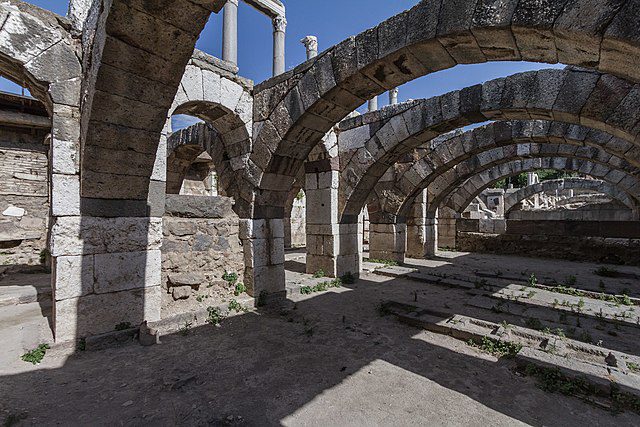
Photo credit: Arches from ancient Smyrna in western Turkey [Izmir Agora Archs / Benh LIEU SONG from Torcy, France / Creative Commons Attribution-Share Alike 2.0 Generic license]
***
Summary: St. Polycarp (69-155), disciple of the apostle John, did not believe in faith alone: the Protestant view of salvation, but rather, salvation by faith + meritorious works.
Church fathers & justification
Previous Post
January 26, 2023
Archaeology & Judges-Era Lead & Tin Trade
Next Post
January 28, 2023 Archaeology & Solomon's Temple-Period Ivory
Recent Comments
"And lastly, I belong to no denomination and am free to serve God as He ..."
Is Venerating Men & Angels Worship? ..."
"And obeisance doesn't mean "worship". It means "respect", "obey", or "submission". Very weird that you ..."
Is Venerating Men & Angels Worship? ..."
"Many of these scriptures you have noted have been taken out of context. With Daniel, ..."
Is Venerating Men & Angels Worship? ..."
""Protestants often point out that Jesus is now triumphant in heaven and object to Catholics ..."
Three More Anti-Catholic Lies About Catholicism ..."
Browse Our Archives
Select a Category & Last Things About Me Anti-Catholicism Atheism & Agnosticism Baptism and Sacramentalism Bible and Tradition Blessed Virgin Mary Books by Dave Armstrong C. S. Lewis Calvinism & General Protestantism Catholic Apologetics Catholic Apologists Catholic conversion Catholic converts Christmas Church (Ecclesiology) Church History Conversion and Converts Development of Doctrine Eastern Orthodoxy Ecumenism & Christian Unity Eucharist & Liturgy Fathers of the Church French Translations G. K. Chesterton Hell Hell & Satan Hell & Satan & Last Things Heresies & Comparative Religion Holistic Health Inquisition & Crusades & Scandals James White Jews & Judaism & Old Testament John Calvin John Henry Newman Liberal / Modernist Theology Life Issues Literary Resume Lutheranism Mariology Martin Luther Music Orthodoxy Papacy & Infallibility Personal Page Philosophy & Science Political & Ethical & Moral Issues Protestant Persecution & Intolerance Protestantism Purgatory Purgatory & Penance Romantic & Imaginative Theology Saints & Purgatory & Penance Salvation Salvation & Justification Satan & Last Things Sexuality and Gender Issues Spanish Translations Traditionalism vs. Radical Catholic Reactionaries Traducciones al español / tradução para português Trinitarianism & Christology Uncategorized Videos
Select a Month October 2026 September 2026 August 2026 July 2026 June 2026 May 2026 April 2026 March 2026 February 2026 January 2026 December 2025 November 2025 October 2025 September 2025 August 2025 July 2025 June 2025 May 2025 April 2025 March 2025 February 2025 January 2025 December 2024 November 2024 October 2024 September 2024 August 2024 July 2024 June 2024 May 2024 April 2024 March 2024 February 2024 January 2024 December 2023 November 2023 October 2023 September 2023 August 2023 July 2023 June 2023 May 2023 April 2023 March 2023 February 2023 January 2023 December 2022 November 2022 October 2022 September 2022 August 2022 July 2022 June 2022 May 2022 April 2022 March 2022 February 2022 January 2022 December 2021 November 2021 October 2021 September 2021 August 2021 July 2021 June 2021 May 2021 April 2021 March 2021 February 2021 January 2021 December 2020 November 2020 October 2020 September 2020 August 2020 July 2020 June 2020 May 2020 April 2020 March 2020 February 2020 January 2020 December 2019 November 2019 October 2019 September 2019 August 2019 July 2019 June 2019 May 2019 April 2019 March 2019 February 2019 January 2019 December 2018 November 2018 October 2018 September 2018 August 2018 July 2018 June 2018 May 2018 April 2018 March 2018 February 2018 January 2018 December 2017 November 2017 October 2017 September 2017 August 2017 July 2017 June 2017 May 2017 April 2017 March 2017 February 2017 January 2017 December 2016 November 2016 October 2016 September 2016 August 2016 July 2016 June 2016 May 2016 April 2016 March 2016 February 2016 January 2016 December 2015 November 2015 October 2015 September 2015 August 2015 July 2015 June 2015 May 2015 April 2015 March 2015 February 2015 January 2015 December 2014 November 2014 October 2014 September 2014 August 2014 July 2014 June 2014 April 2014 March 2014 February 2014 January 2014 December 2013 November 2013 October 2013 September 2013 August 2013 July 2013 June 2013 April 2013 March 2013 February 2013 January 2013 December 2012 November 2012 October 2012 September 2012 August 2012 July 2012 June 2012 May 2012 April 2012 March 2012 February 2012 January 2012 December 2011 November 2011 October 2011 September 2011 August 2011 July 2011 June 2011 April 2011 March 2011 February 2011 October 2010 September 2010 August 2010 July 2010 April 2010 March 2010 December 2009 October 2009 August 2009 July 2009 June 2009 May 2009 March 2009 February 2009 October 2008 September 2008 April 2008 March 2008 February 2008 January 2008 December 2007 November 2007 October 2007 May 2007 March 2007 February 2007 January 2007 November 2006 October 2006 September 2006 August 2006 July 2006 June 2006 May 2006 April 2006 March 2006 February 2006 October 2005 June 2005 April 2005 February 2005 July 2004 May 2004 April 2004
Follow Us!
TAKE THE
Religious Wisdom Quiz
Who asked Jesus, "What is truth?"
Select your answer to see how you score.
Caiaphas Pilate Nicodemus Herod
Books by This Author Books by Dave Armstrong
Related posts from Biblical Evidence for Catholicism

Three More Anti-Catholic Lies About Catholicism (#6-4)
Biblical Evidence for Catholicism

Top Ten Anti-Catholic Lies (#10-7)
Biblical Evidence for Catholicism

"Faith Alone" Dialogue with a Calvinist
Biblical Evidence for Catholicism

Exegesis of 75 NT Faith [Alone?] & Works...
Biblical Evidence for Catholicism
TRENDING AT PATHEOS Catholic

I was strolling through the top floor of the brand new Parthenon...

What Does Gêvâh Mean For Kimberley Guifoyle &...
This week, a lot of the news is focused on Kimberly Guilfoyle....

INNER CIRCLE: Profound Mystery (Of Christ In All...
Ephesians 5:31-32 “For this reason, a man will leave his father and...

Do Not Rejoice When Your Enemy Falls: The...
Turning an execution into a public spectacle is a disturbing expression of...

'The Chosen' S6 Trailer: The Passion Gets Very...
Not many watching 'The Chosen' worry about spoilers, but just because they...

The purpose-driven labor priest
A labor activist reads Rick Warren and it gets me wondering about...
view all Catholic blogs
What Are Your Thoughts?leave a comment
Ad-Free & Subscriber Log-In Subscription Support
- About Us
- 2026 Calendar
- Videos
- Podcasts
- Library of World Religions
- Faith In Media Tracker
- Advertise With Us
- Write for Us
- Privacy Policy
- Terms of Service
- Do Not Sell My Data
- Contact Us
- Radiant Digital
- Manage Newsletter Subscriptions
- Unsubscribe From Notifications
- Sitemap
Copyright 2008-2026, Patheos. All rights reserved.
Subscription Support Ad-Free & Subscriber Log-In
Follow Patheos