
BuddhistCatholicContemplativeEvangelicalGeneral ChristianHinduJewishLatter-day SaintMuslimNew VisionsProgressive Christian
Beliefs
- Buddhist
- Catholic
- Contemplative
- Evangelical
- General Christian
- Hindu
- Jewish
- Latter-day Saint
- More Voices
- Muslim
- New Visions
- Pagan
- Progressive Christian
Topics
- Religion News
- Food and Religion
- Sports and Religion
- Religious Art
- Religious Music and Entertainment
- Religious Events
- History and Religion
- Style and Religion
- Politics and Religion
- Women in Religion
- Recreation Outdoors and Religion
- Business Finance and Religion
- Careers Workplace and Religion
- Education and Religion
- Family Parenting and Religion
- Health Fitness and Religion
- Home and Religion
- Relationships and Religion
- Technology and Religion
- Travel and Religion
Columnists
- Buddhist Columnists
- Business Finance and Religion Columnists
- Careers Workplace and Religion Columnists
- Catholic Columnists
- Contemplative Columnists
- Education and Religion Columnists
- Evangelists Columnists
- Family Parenting and Religion Columnists
- General Christian Columnists
- Health Fitness and Religion Columnists
- Hindu Columnists
- History and Religion Columnists
- Home and Religion Columnists
- Jewish Columnists
- More Voices Columnists
- Latter Day Columnists
- Muslim Columnists
- New Visions Columnists
- Nonreligious Columnists
- Pagan Columnists
- Politics and Religion Columnists
- Progressive Columnists
- Recreation Outdoors and Religion Columnists
- Relationships and Religion Columnists
- Religion News Columnists
- Religious Art Columnists
- Religious Events Columnists
- Religious Music and Entertainment Columnists
- Sports and Religion Columnists
- Style and Religion Columnists
- Technology and Religion Columnists
- Travel and Religion Columnists
- Women in Religion Columnists
Resource Library
- 2026 Calendar
- Library of World Religions
- The 100 Most Holy Places on Earth
- Patheos Answers
- Podcasts
- Videos
- Faith Leaders Database
- Anglican Episcopalian
- Bahai
- Baptist
- Buddhism
- Christianity
- Confucianism
- Eastern Orthodoxy
- Hinduism
- Holiness and Pentecostal
- ISKCON
- Islam
- Judaism
- Lutheran
- Methodist
- The Church of Jesus Christ of Latter-day Saints
- New Age
- Paganism
- Presbytarian and Reformed
- Protestantism
- Religion Behind the Scenes
- Roman Catholic
- Scientology
- Shia Islam
- Sikhism
- Sufism
- Sunni Islam
- Taoism
- Zen
- See all religions
Research Tools
 Ad-Free & Subscriber Log-In Subscription Support
Ad-Free & Subscriber Log-In Subscription Support
Follow Patheos 

- Trending:
- Forgiveness
- |
- Marriage
- |
- Consciousness
- |
- Death Penalty
- |
- Election
- |
- Halloween

-
About
-
Catholic Apologetics
-
Church History
-
Great Apologists
-
Christian Worldview
-
Protestantism & Misc.
- Home
- Catholic
- History and Religion
- Dialogue w a Protestant on Mary’s Perpetual Virginity
Dialogue w a Protestant on Mary’s Perpetual Virginity
Last updated on: January 5, 2023 at 7:54 pm by Dave Armstrong
Dialogue w a Protestant on Mary’s Perpetual Virginity 2023-01-05T19:54:33-04:00 Dave Armstrong
Patheos Explore the world's faith through different perspectives on religion and spirituality! Patheos has the views of the prevalent religions and spiritualities of the world.
“Iceman2525” is some sort of Protestant. His Disqus profile offers no further information about him. This exchange took place underneath my article, “Jesus’ ‘Brothers’: Anti-Catholic Lies from a Tiny Lutheran Sect (ELS).” His words will be in blue. I have made some slight editorial corrections or additions in his text.
*****
[Regarding] your first argument of Luke [2:]41-51, I don’t think it should be expected that siblings would be mentioned. Jesus’s siblings would have been young and hardly responsible for their brother Jesus. Mary and Joseph would have that responsibility of finding Jesus. If I found a lost child I would likely tell them that their parents have been looking for them. Even if the child had siblings I wouldn’t feel the need to mention them because his parents are his caregivers.
Also, if you are going to take the position that when Jesus’s brothers are mentioned they refer to his cousins, then that seemingly contradicts the earliest Catholic tradition of Jesus’s brothers being from a prior marriage of Joseph. If Catholics trust tradition then seems like that would be the one to stick with.
As for the adelphos argument, have you made a count of the occurrences in the NT where adelphos means actual brother/sibling versus cousin usage? My point is that if adelphos is used for sibling say 98% of the time, then the usage for cousin would be a rare one. Relying on an uncommon usage of a word doesn’t give much confidence for that argument. We already know NT writers use words for cousin. I am a Protestant but I’m just respectfully offering my insight. Thank you.
Thanks for your reply. So you think Mary bore no children between Jesus’ birth and about age 28, and then proceeded to have four or more? You think that’s likely? [these questions were never replied to]
Whether you talked to siblings of a lost and found child is irrelevant. What’s relevant is what Mary said, which confirms (in a probabilistic fashion) that Jesus was an only child.
There are two early traditions: the theory you mention (held by Orthodox and eastern Catholics) and St. Jerome’s cousins theory (held mostly by Catholics). In cases like that I look to Scripture to see which theory it seems to favor, and in my opinion, it favors the cousin theory.
I have looked into relative numbers of terms. Adelphos is used for a broad range of relational terms. And that’s because it is reflecting Hebrew / Aramaic, which didn’t have a term for cousin. Sungenis and anepsios (“cousin” in Greek) appear 12 times and once (Col 4:10), respectively, in the NT. Adephos and its cognates appear 346 times. So between the three terms, adelphos, etc. is used 96% of the time.
Recently I wrote about Josephus’ use of adelphos and it mirrored almost exactly the NT pattern. So does LXX [the Septuagint], which has adelphos 649 times, anepsios once, and sungenis five times. So that’s a 99% usage of adelphos and its cognates for relatives.
Thank you.
If the popular tradition before Jerome was that Jesus’s brothers were from Joseph’s prior marriage, then I find it odd for Catholics to support any other theory/tradition that would come later from Jerome.
I know you said you looked at Scripture to see which tradition looks more favorable but still this raises a question. If Catholics put so much trust in tradition, how can one choose an alternative theory over the earlier most dominant tradition that the brothers were from Joseph’s previous marriage? If you can’t have confidence in early tradition in this case, then how can you have complete confidence in other accepted traditions? If early church fathers can be wrong here then they can be wrong in anything else even if the tradition is widely believed. Either these were Joseph’s sons from a previous marriage or the brothers were actually cousins. At least one tradition is wrong.
As for “adelphos” I must not have been clear enough of what I was meaning. I’m asking how many times in the NT does adelphos mean cousin compared to how many times adelphos is used to mean an actual brother as a sibling. My point is that if adelphos is used to refer to an actual brother a few hundred times or whatever compared to only a handful of times adelphos is used to refer to a cousin then I don’t see that as a strong argument for your side. Depending on an uncommon word usage to fit your belied just stretches it a bit. Especially when the NT writers used other words for cousin such as sungenis.
Plus it shouldn’t matter if Hebrew/Aramaic didn’t have a word for cousin because the NT writers wrote in Greek and I’ve read evidence that many Jewish people spoke Greek or as a second language. So the NT writers had capability to differentiate words for brother and cousin.
You’re not understanding. The Greek in the NT still reflects Hebrew culture and the then-current language of Aramaic. It didn’t even have a word for cousin, and so the word for “brother” (ach: Strong’s Hebrew word #251), would be used for a wide range of relatives and even countrymen. Jesus Himself did this, using adelphos. The NT reflects Hebrew culture in that way, and so does the Greek LXX and someone like Josephus.
I don’t have time to go through all the usages and determine when “cousin” or any other non-sibling was meant, but it surely must be a lot of times.
Tradition develops, and there can be a variety of sub-traditions or non-essential traditions, especially early on. The essence of the doctrine of Mary’s perpetual virginity is that she had no other children, and that even Jesus’ birth was supernatural (virgin during delivery, or “in partu” virginity; in biological terms that we understand today: an unbroken hymen). Both hypotheses (step-brothers or cousins) hold to Mary’s perpetual virginity. As long as that is upheld (which is the tradition passed down), different ways of working it out are no problem. It’s permissible diversity. The ones who really departed from the Grand Tradition on this were Protestants, 150-200 years after the Protestant Revolt, as a result of theological liberalism: which always breaks down traditions and internal orthodoxy wherever it is found.
Perhaps for a future article you could research how many times in NT adelphos refers to a relative and compare that to it’s more common usage meaning sibling. I think that would help put it all into perspective.
I don’t agree that the Greek in the NT entirely mirrors the Aramaic language, as you say. To some extent, sure, but as I said some of the NT writers used Greek words for relative so they obviously knew how to differentiate between brother and relative. For example Luke said he used firsthand accounts and [seeing] that Greek language was known and even used by the Jews at that time, I would think Luke’s careful [investigations] would clarify if these were Jesus’ siblings or relatives, for an accurate account. I can’t prove that, but [it] makes more sense to me.
You say it’s no problem if there [are] differing theories (step-siblings or cousins) because they both support Mary’s perpetual virginity. But I think this raises an issue.
Since Mary’s perpetual virginity is a dogma, then I assume examples of tradition were used to support this essential belief. And in that support I would imagine that the issue of Jesus’ brothers, as Scripture mentions, would be necessary to be explained away. I haven’t read the official complete dogma though as I’m having a hard time finding it for some reason.
Now if you have two competing theories to explain away Jesus brothers and both are based on tradition, then at least one of the two has to be wrong. I suppose theoretically there could be some combo of the two but [that’s] unlikely. If either of the widely held traditions is wrong, then how can other traditions used to support Marian dogmas be confidently trusted?
If the widely held idea that Jesus’ brothers were actually step brothers came from a gnostic source, then it’s also very plausible [that] the idea of Mary’s perpetual virginity came from the same gnostic source. I realize that you believe the magisterium and Pope are Holy Spirit-guided to declare the truth from traditions, but of course I don’t agree [with] that. I see how even the New Testament speaks of how quickly false doctrines quickly develop, and that’s one reason I don’t [think it’s] wise to put so much faith in tradition.
You raise what you believe to be an internal inconsistency in the Catholic position. It isn’t. The dogma we are required to believe in is the perpetual virginity of Mary. As I already noted, both the “step-brothers” and “cousins” theories are perfectly consistent with that. Explanations for a dogma are different from the dogma itself, and can be held, just as different exegetical opinions are held on Bible passages, or as there are different theories of predestination within Catholicism that are allowed to be held by Catholics, as long as one believes that the elect were predestined by God.
You can rail against Catholic doctrines all you like, but I’m not moved by that unless and until you grapple with my many biblical arguments supporting perpetual virginity (that were handily summarized in the article above). Feel free to do so. Many more such are listed on my Blessed Virgin Mary web page. If you think your position is so superior to ours, then certainly you can easily refute my arguments. I look forward to it! But simply stating your position or opposition to another one is not an argument. I have appealed to Scripture (as I almost always do in arguments with Protestants, because that is their preferred ground, and what we hold in common); so I challenge you: show where my arguments went wrong.
Here’s another argument I made elsewhere:
Luke was a Greek Gentile. Paul, though Jewish, was raised in the very cosmopolitan, culturally Greek town of Tarsus. But even so, both still clearly used adelphos many times with the meaning of non-sibling:
Luke 10:29 [RSV] But he, desiring to justify himself, said to Jesus, “And who is my neighbor?”
Acts 3:17 “And now, brethren, I know that you acted in ignorance, as did also your rulers.”
Acts 7:23, 25-26 “When he was forty years old, it came into his heart to visit his brethren, the sons of Israel.. . . [25] He supposed that his brethren understood that God was giving them deliverance by his hand, but they did not understand. [26] And on the following day he appeared to them as they were quarreling and would have reconciled them, saying, `Men, you are brethren, why do you wrong each other?’”
Romans 1:13 I want you to know, brethren, . . .
Romans 9:3 For I could wish that I myself were accursed and cut off from Christ for the sake of my brethren, my kinsmen by race.
1 Thessalonians 1:4 For we know, brethren beloved by God, that he has chosen you;
And here’s yet another argument from Paul’s use of language, from a different article of mine:
Paul’s letters were written in Greek, because they were written to Greek-speaking people. Therefore, he chose [very few times] to use a Greek word for cousin (whereas Aramaic didn’t have such a word). . . .
Paul could also choose to use adelphos . . . because it was understood in Greek to have a wide variety of meanings. Even today we (in English, at any rate) often use “brother” in the broader sense: “Band of brothers”, “Brother Jed will preach the sermon today”, “Brother” and “Sister” for monks and nuns (and non-literal “Father” for priests), “am I my brother’s keeper?”, Ringo Starr (an only child) calling the Beatles his “brothers” etc. Therefore, this use in and of itself doesn’t prove that he was referring to siblings of Jesus. It’s not funny or silly; it’s how language works. . . .
Lucas [Banzoli] denied that the Greek word suggenes or sungenis had a “broader meaning” than cousin. He’s wrong about that. Sungenis (Greek for “cousin”) and its cognate sungenia appear in the New Testament fifteen times (sungenia: Lk 1:61; Acts 7:3, 14; sungenis: Mk 6:4; Lk 1:36, 58; 2:44; 14:12; 21:16; Jn 18:26; Acts 10:24; Rom 9:3; 16:7, 11, 21). But they are usually translated kinsmen, kinsfolk, or kindred in KJV: that is, in a sense wider than cousin: often referring to the entire nation of Hebrews. Thus, the eminent Protestant linguist W. E. Vine, in his Expository Dictionary of New Testament Words, lists sungenis not only under “Cousin” but also under “Kin, Kinsfolk, Kinsman, Kinswoman.”
In all but two of these occurrences, the authors were either Luke or Paul. Luke was a Greek Gentile. Paul, though Jewish, was raised in the very cosmopolitan, culturally Greek town of Tarsus. But even so, both still clearly used adelphos many times with the meaning of non-sibling (Lk 10:29; Acts 3:17; 7:23-26; Rom 1:7, 13; 9:3; 1 Thess 1:4). They understood what all these words meant, yet they continued to use adelphos even in those instances that had a non-sibling application.
Strikingly, it looks like every time St. Paul uses adelphos (unless I missed one or two), he means it as something other than blood brother or sibling. He uses the word or related cognates no less than 138 times in this way. Yet we often hear about Galatians 1:19: “James the Lord’s brother.” 137 other times, Paul means non-sibling, yet amazingly enough, here he must mean sibling, because (so we are told) he uses the word adelphos? That doesn’t make any sense.
“Cousin” appears four times in the entire OT in the RSV (three of those in Jeremiah, another in Leviticus). But “brother[s]” appears 390 times, “brethren” 154 times and “sister[s]” 110 times. So by a 654-4 ratio, we have those terms (which at first glance sound like siblings) used over against “cousin.” Obviously, many times they were used for non-sibling relatives.
The New Testament (which came out of the same culture, and was Jewish-written save for Luke) totally reflects this. It has “brother[s]” 159 times, “brethren” 191, and “sister[s]” 24 times, while “cousin” appears exactly once (Col 4:10). So that’s a 374-1 ratio (even more lopsided than the OT), and for the entire Bible (minus the Deuterocanon), the numbers are 1028-5, or “cousin” used instead of “brother” or “sister” once in every 206 times a relative is mentioned.
***
See Part II: Dialogue w a Protestant on Mary’s Perpetual Virginity (II): Biblical Proof That Three Named “Brethren” of Jesus Are Non-Siblings + Harmonious 2nd Century Evidence Regarding the Fourth (Simon) [1-3-23]
***
Practical Matters: Perhaps some of my 4,000+ free online articles (the most comprehensive “one-stop” Catholic apologetics site) or fifty books have helped you (by God’s grace) to decide to become Catholic or to return to the Church, or better understand some doctrines and why we believe them.
Or you may believe my work is worthy to support for the purpose of apologetics and evangelism in general. If so, please seriously consider a much-needed financial contribution. I’m always in need of more funds: especially monthly support. “The laborer is worthy of his wages” (1 Tim 5:18, NKJV). 1 December 2021 was my 20th anniversary as a full-time Catholic apologist, and February 2022 marked the 25th anniversary of my blog.
PayPal donations are the easiest: just send to my email address: [email protected]. You’ll see the term “Catholic Used Book Service”, which is my old side-business. To learn about the different methods of contributing, including 100% tax deduction, etc., see my page: About Catholic Apologist Dave Armstrong / Donation Information. Thanks a million from the bottom of my heart!
***
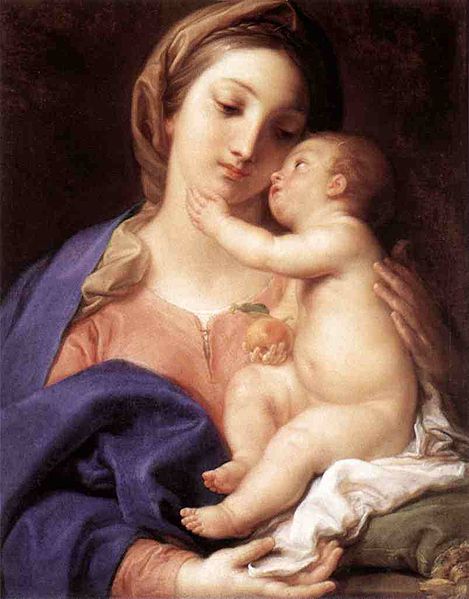
Photo credit: Madonna and Child (c. 1743), by Pompeo Batoni (1708-1787) [public domain / Wikimedia Commons]
***
Summary: A Protestant makes several arguments against Mary’s perpetual virginity, & I provide thorough Catholic responses, including analyses of two Greek words for “cousin.”


Next Post

January 3, 2023 Dialogue w a Protestant on Mary’s Perpetual Virginity (II)
Recent Comments
"Special pleading, and not a serious response to my arguments . . ."
Is Venerating Men & Angels Worship? ..."
""no man needs to teach us."Didn't you just teach us?"
Is Venerating Men & Angels Worship? ..."
""Catholics say they are the only church that can lead people into heaven."In fact, we ..."
Is Venerating Men & Angels Worship? ..."
"And lastly, I belong to no denomination and am free to serve God as He ..."
Is Venerating Men & Angels Worship? ..."
Browse Our Archives
Select a Category & Last Things About Me Anti-Catholicism Atheism & Agnosticism Baptism and Sacramentalism Bible and Tradition Blessed Virgin Mary Books by Dave Armstrong C. S. Lewis Calvinism & General Protestantism Catholic Apologetics Catholic Apologists Catholic conversion Catholic converts Christmas Church (Ecclesiology) Church History Conversion and Converts Development of Doctrine Eastern Orthodoxy Ecumenism & Christian Unity Eucharist & Liturgy Fathers of the Church French Translations G. K. Chesterton Hell Hell & Satan Hell & Satan & Last Things Heresies & Comparative Religion Holistic Health Inquisition & Crusades & Scandals James White Jews & Judaism & Old Testament John Calvin John Henry Newman Liberal / Modernist Theology Life Issues Literary Resume Lutheranism Mariology Martin Luther Music Orthodoxy Papacy & Infallibility Personal Page Philosophy & Science Political & Ethical & Moral Issues Protestant Persecution & Intolerance Protestantism Purgatory Purgatory & Penance Romantic & Imaginative Theology Saints & Purgatory & Penance Salvation Salvation & Justification Satan & Last Things Sexuality and Gender Issues Spanish Translations Traditionalism vs. Radical Catholic Reactionaries Traducciones al español / tradução para português Trinitarianism & Christology Uncategorized Videos
Select a Month October 2026 September 2026 August 2026 July 2026 June 2026 May 2026 April 2026 March 2026 February 2026 January 2026 December 2025 November 2025 October 2025 September 2025 August 2025 July 2025 June 2025 May 2025 April 2025 March 2025 February 2025 January 2025 December 2024 November 2024 October 2024 September 2024 August 2024 July 2024 June 2024 May 2024 April 2024 March 2024 February 2024 January 2024 December 2023 November 2023 October 2023 September 2023 August 2023 July 2023 June 2023 May 2023 April 2023 March 2023 February 2023 January 2023 December 2022 November 2022 October 2022 September 2022 August 2022 July 2022 June 2022 May 2022 April 2022 March 2022 February 2022 January 2022 December 2021 November 2021 October 2021 September 2021 August 2021 July 2021 June 2021 May 2021 April 2021 March 2021 February 2021 January 2021 December 2020 November 2020 October 2020 September 2020 August 2020 July 2020 June 2020 May 2020 April 2020 March 2020 February 2020 January 2020 December 2019 November 2019 October 2019 September 2019 August 2019 July 2019 June 2019 May 2019 April 2019 March 2019 February 2019 January 2019 December 2018 November 2018 October 2018 September 2018 August 2018 July 2018 June 2018 May 2018 April 2018 March 2018 February 2018 January 2018 December 2017 November 2017 October 2017 September 2017 August 2017 July 2017 June 2017 May 2017 April 2017 March 2017 February 2017 January 2017 December 2016 November 2016 October 2016 September 2016 August 2016 July 2016 June 2016 May 2016 April 2016 March 2016 February 2016 January 2016 December 2015 November 2015 October 2015 September 2015 August 2015 July 2015 June 2015 May 2015 April 2015 March 2015 February 2015 January 2015 December 2014 November 2014 October 2014 September 2014 August 2014 July 2014 June 2014 April 2014 March 2014 February 2014 January 2014 December 2013 November 2013 October 2013 September 2013 August 2013 July 2013 June 2013 April 2013 March 2013 February 2013 January 2013 December 2012 November 2012 October 2012 September 2012 August 2012 July 2012 June 2012 May 2012 April 2012 March 2012 February 2012 January 2012 December 2011 November 2011 October 2011 September 2011 August 2011 July 2011 June 2011 April 2011 March 2011 February 2011 October 2010 September 2010 August 2010 July 2010 April 2010 March 2010 December 2009 October 2009 August 2009 July 2009 June 2009 May 2009 March 2009 February 2009 October 2008 September 2008 April 2008 March 2008 February 2008 January 2008 December 2007 November 2007 October 2007 May 2007 March 2007 February 2007 January 2007 November 2006 October 2006 September 2006 August 2006 July 2006 June 2006 May 2006 April 2006 March 2006 February 2006 October 2005 June 2005 April 2005 February 2005 July 2004 May 2004 April 2004
Follow Us!
TAKE THE
Religious Wisdom Quiz
Who prayed in a den of lions?
Select your answer to see how you score.
Elijah Noah Daniel David
Books by This Author Books by Dave Armstrong
Related posts from Biblical Evidence for Catholicism

Holy Ground: Why Mary Had NO Other Children...
Biblical Evidence for Catholicism
Protestant Confessions & "Ever-Virgin" Mary
Biblical Evidence for Catholicism

Mary Wife of Clopas (Jn 19:25): Mary's Sister-in-Law?
Biblical Evidence for Catholicism

Jesus Had Four Brothers? The Bible Sez No!
Biblical Evidence for Catholicism
TRENDING AT PATHEOS Catholic

Swimfan: Forgotten Aughts Pleasures
This is a recovery effort. In 2002, My Big Fat Greek Wedding...

Top Three Anti-Catholic Lies About Catholicism
This is my initial transcript for the video, "THE 3 WORST...

Pope Leo Celebrates Mass for Nurses & Docs...
I don't have any idea how he did it, but Pope Leo...

The Sermon on the Mount, Part I: Matthew...
The Sermon on the Mount, Part I (Matthew 4:12-5:12) St. Matthew moves...

What's up from Crossway: Reviewing some of their latest A few weeks...

Janie Learns the Way of the Cross: A...
Teaching children about Jesus' Passion can be challenging. Many parents and educators...
view all Catholic blogs
What Are Your Thoughts?leave a comment
Ad-Free & Subscriber Log-In Subscription Support
- About Us
- 2026 Calendar
- Videos
- Podcasts
- Library of World Religions
- Faith In Media Tracker
- Advertise With Us
- Write for Us
- Privacy Policy
- Terms of Service
- Do Not Sell My Data
- Contact Us
- Radiant Digital
- Manage Newsletter Subscriptions
- Unsubscribe From Notifications
- Sitemap
Copyright 2008-2026, Patheos. All rights reserved.
Subscription Support Ad-Free & Subscriber Log-In
Follow Patheos