
BuddhistCatholicContemplativeEvangelicalGeneral ChristianHinduJewishLatter-day SaintMuslimNew VisionsProgressive Christian
Beliefs
- Buddhist
- Catholic
- Contemplative
- Evangelical
- General Christian
- Hindu
- Jewish
- Latter-day Saint
- More Voices
- Muslim
- New Visions
- Pagan
- Progressive Christian
Topics
- Religion News
- Food and Religion
- Sports and Religion
- Religious Art
- Religious Music and Entertainment
- Religious Events
- History and Religion
- Style and Religion
- Politics and Religion
- Women in Religion
- Recreation Outdoors and Religion
- Business Finance and Religion
- Careers Workplace and Religion
- Education and Religion
- Family Parenting and Religion
- Health Fitness and Religion
- Home and Religion
- Relationships and Religion
- Technology and Religion
- Travel and Religion
Columnists
- Buddhist Columnists
- Business Finance and Religion Columnists
- Careers Workplace and Religion Columnists
- Catholic Columnists
- Contemplative Columnists
- Education and Religion Columnists
- Evangelists Columnists
- Family Parenting and Religion Columnists
- General Christian Columnists
- Health Fitness and Religion Columnists
- Hindu Columnists
- History and Religion Columnists
- Home and Religion Columnists
- Jewish Columnists
- More Voices Columnists
- Latter Day Columnists
- Muslim Columnists
- New Visions Columnists
- Nonreligious Columnists
- Pagan Columnists
- Politics and Religion Columnists
- Progressive Columnists
- Recreation Outdoors and Religion Columnists
- Relationships and Religion Columnists
- Religion News Columnists
- Religious Art Columnists
- Religious Events Columnists
- Religious Music and Entertainment Columnists
- Sports and Religion Columnists
- Style and Religion Columnists
- Technology and Religion Columnists
- Travel and Religion Columnists
- Women in Religion Columnists
Resource Library
- 2026 Calendar
- Library of World Religions
- The 100 Most Holy Places on Earth
- Patheos Answers
- Podcasts
- Videos
- Faith Leaders Database
- Anglican Episcopalian
- Bahai
- Baptist
- Buddhism
- Christianity
- Confucianism
- Eastern Orthodoxy
- Hinduism
- Holiness and Pentecostal
- ISKCON
- Islam
- Judaism
- Lutheran
- Methodist
- The Church of Jesus Christ of Latter-day Saints
- New Age
- Paganism
- Presbytarian and Reformed
- Protestantism
- Religion Behind the Scenes
- Roman Catholic
- Scientology
- Shia Islam
- Sikhism
- Sufism
- Sunni Islam
- Taoism
- Zen
- See all religions
Research Tools
 Ad-Free & Subscriber Log-In Subscription Support
Ad-Free & Subscriber Log-In Subscription Support
Follow Patheos 

- Trending:
- Forgiveness
- |
- Marriage
- |
- Consciousness
- |
- Death Penalty
- |
- Election
- |
- Halloween

-
About
-
Catholic Apologetics
-
Church History
-
Great Apologists
-
Christian Worldview
-
Protestantism & Misc.
- Home
- Catholic
- History and Religion
- Defense of Immortal, Conscious Souls (vs. Lucas Banzoli): #7
Defense of Immortal, Conscious Souls (vs. Lucas Banzoli): #7
Last updated on: February 21, 2023 at 4:20 pm by Dave Armstrong
Defense of Immortal, Conscious Souls (vs. Lucas Banzoli): #7 2023-02-21T16:20:03-04:00 Dave Armstrong
Patheos Explore the world's faith through different perspectives on religion and spirituality! Patheos has the views of the prevalent religions and spiritualities of the world.
7. Banzoli Decides (At Last!) to Reply to My Second Post (#5) About Souls Under the Altar in Heaven
Lucas Banzoli is a very active Brazilian anti-Catholic polemicist, who holds to basically a Seventh-Day Adventist theology, whereby there is no such thing as a soul that consciously exists outside of a body, and no hell (soul sleep and annihilationism). This leads him to a Christology which is deficient and heterodox in terms of Christ’s human nature after His death. He has a Master’s degree in theology, a degree and postgraduate work in history, a license in letters, and is a history teacher, author of 25 books, as well as blogmaster (but now inactive) for six blogs. He’s active on YouTube.
This is my 41st refutation of Banzoli’s writings. Since 5-25-22 he hadn’t written one word in reply, until he responded on 11-12-22 to Part 5 of my series on souls. Why? Because my articles are “without exception poor, superficial and weak” and my “objective” was “not to refute anything, but to exhaust [my] opponent.” Indeed, my writings are so bad that “only a severely cognitively impaired person would be inclined to take” them “seriously.” He didn’t “waste time reading” 37 of my 40 replies (three articles are his proof of the worthlessness of all of my 4,000+ articles and 51 books). He also denied that I had a “job” and claimed that I didn’t “work.” I disposed of these and other slanderous insults on my Facebook page on 11-13-22. But Banzoli thought that replying to me was so “entertaining” that he’ll “make a point of rebutting” my articles “one by one.”
My current effort is a major multi-part response to Banzoli’s 1900-page self-published book, The Legend of the Immortality of the Soul [A Lenda da Imortalidade da Alma], published on 1 August 2022. He claims to have “cover[ed] in depth all the immortalist arguments” and to have “present[ed] all the biblical proofs of the death of the soul . . .” and he confidently asserted: “the immortality of the soul is at the root of almost all destructive deception and false religion.” He himself admits on page 18 of his Introduction that what he is opposing is held by “nearly all the Christians in the world.” A sincere unbiblical error (and I assume his sincerity) is no less dangerous than a deliberate lie, and we apologists will be “judged with greater strictness” for any false teachings that we spread (Jas 3:1).
I use RSV for the Bible passages (including ones that Banzoli cites) unless otherwise indicated. Google Translate is utilized to render Lucas’ Portugese into English. Occasionally I slightly modify clearly inadequate translations, so that his words will read more smoothly and meaningfully in English. His words will be in blue.
*****
See the other installments:
#1 Preliminaries [11-1-22]
*
#2 Genesis 2:7 and the Hebrew / Biblical Idiom of Synecdoche [11-4-22]
*
#3 Hebrew, Nephesh [Soul]: Massive Figurative Biblical Use [11-7-22]
*
#4 Revelation 6:9: “Souls” in Heaven / 16 Biblical Proofs for Conscious Souls After Death [11-9-22]
*
#5 Revelation 6:9: “Souls” in Heaven Redux [11-11-22]
*
#6 Conspiracy Theories About Bibles and the Many Meanings of “Soul” in Holy Scripture [11-12-22]
*
*
#8 Banzoli’s Soul Sleep Leads Him to Believe That the Soul of Jesus Christ “Died” — Didn’t Exist — Between His Death and Resurrection, and That He was Unconscious in His Human Nature During That Time [11-14-22]
*
#9 Matthew 10:28: Did Jesus Teach That a Soul Could be Annihilated? [11-18-22]
*
*
*
*
#13 Dead Biblical Heroes Return to Earth!: Samuel & Saul / Moses & Elijah at Jesus’ Transfiguration [12-1-22]
*
*
#15 Hebrews 12:23: “the spirits of just men made perfect” [12-3-22]
*
#16 Sheol (Hades): Merely the “Grave” or “Underground” or the Conscious Abode of Dead Souls? [12-5-22]
*
#17 Ecclesiastes 9:5: “The Dead Know Nothing” / Psalm 146:4: “His Thoughts Perish,” Etc. [12-6-22]
*
See also the related articles:
Seven Replies Re Interceding Saints (vs. Lucas Banzoli) [5-25-22]
Answer to Banzoli’s “Challenge” Re Intercession of Saints [9-20-22]
Bible on Praying Straight to God (vs. Lucas Banzoli) [9-21-22]
Reply to Banzoli’s “Analyzing the ‘evidence’ of saints’ intercession” [9-22-22]
*****
Banzoli made point-by-point reply to Part 5 of my series, subtitled Revelation 6:9: “Souls” in Heaven Redux. Note that Banzoli only responded to my second post about the souls under the altar in Revelation 6 (“Redux” in the title was a dead giveaway that this was the case). Installment #4 was my initial and far lengthier treatment of the question. This is important to mention because he claimed that my methodology was “selecting at his discretion 5% of my text and then not being able to refute even that 5%.”
So it’s fairly comical that he seems to be unaware that what he finally got up the courage to interact with was my second treatment in my overall series. Perhaps he’ll get to the other one, too, now that he is all of a sudden newly emboldened to interact with serious critics of his work. Is there a new “confidence pill” out now that I haven’t heard about? That would be a godsend for the anti-Catholics! They could take it every day at breakfast.
Secondly, as to my method in this series in particular, I explained that in Part 1:
Soul sleep and annihilationist arguments are based on the same basic errors simply repeated again and again. One such error, for example, is often the basis of the “exegesis” (really, eisegesis) of many passages interpreted wrongly and vastly misconstrued based on the false premise.
To put it bluntly, those who hold to this line of reasoning don’t understand biblical language in its nuanced complexity. That’s 90% of the problem. Once these sorts of “wrong paths” are understood and adequately explained, the conclusions of the soul sleep advocate and their falsely alleged prooftexts fall like a house of cards or a bunch of dominoes. . . .
All it takes is a few of those [false premises] to build an entire heretical superstructure, . . .
I reiterated this approach in Part 6:
He goes on to provide several similar examples, but they are all based on the same presuppositional falsehood that nephesh = person literally, exclusively, and all the time, rather than having a meaning of an immaterial soul of a person (as often occurs in the Bible) or in terms of synecdoche (a person being called a soul). It doesn’t matter how many examples he can come up with if they all involve the same demonstrably false premise.
For this reason, a book as absurdly long as Banzoli’s (1900 pages!) mustn’t be thought to be unanswerable and profoundly compelling merely due to length and hundreds of “examples.” They simply multiply the same lie and falsehood over and over and prove nothing. That being the case, I’ll deal with a few of his supposed proofs (like the two above), but need not deal with all of them, because they’re all refuted by virtue of the fact that the same falsehood [at the presuppositional level] is present in each one. Once that falsehood is decisively refuted, all the examples built upon it go down with it.
Does this mean that in fact the “souls under the altar” mentioned by John were in heaven? Let’s see: first, Dave assumes that if John was in heaven, then everything he saw happened in heaven.
I don’t “assume” that, nor did I ever assert it in my reply. Rather, I made a specific, five-part, exclusively biblical argument for the “souls under the altar” in Revelation 6 being in heaven, with my conclusion being: “It makes no sense at all to ignore all of this contextual evidence and arbitrarily place this event on earth” [italics and bolding added presently]. I also made several arguments in one or both of my articles on this topic — though perhaps it was in another one — regarding things happening on earth, in history (to counter his arguments for almost universal symbolism in Revelation).
But that is just as stupid as it would be for someone to claim that because a prophet is on earth he could not see a vision of heaven (as is often the case in the Old and New Testaments).
It can’t be “stupid” because I never claimed it.
Just as prophets such as Isaiah and Ezekiel saw heavenly visions while on earth, there is nothing to stop John from seeing visions of things happening on earth while in heaven.
Of course. I agree!
It seems that in Dave’s mind, if someone is in a place, his vision must be limited to that place.
I also stated that from the standpoint of the visions presented in Revelation, John’s “vantage point” was in heaven: and (I grant and realize now) that would hold true whether he was literally there or was allowed to see things by God as if he were there. In either case, it’s his vantage point in the visions. But Banzoli brought up Revelation 4:1-2. I’m glad he did! 4:1 partially reads: “Come up hither, and I will show you what must take place . . .”
If the vision was solely one that John had while still on the earth, why is it preceded by an invitation to “come up hither”? What does that mean? Where did he go? Well, it seems to me that it makes perfect sense to think that he actually went to heaven before he died, just as Paul did, as he describes the amazing event in 2 Corinthians 12:1-4, 7, since Revelation 4:2 states: “lo, a throne stood in heaven, with one seated on the throne!” He went “up hither” to heaven and saw that.
We have good reason to believe this based on the same exact summoning words elsewhere in the book of Revelation, regarding the “two witnesses”:
Revelation 11:12 Then they heard a loud voice from heaven saying to them, “Come up hither!” And in the sight of their foes they went up to heaven in a cloud.
Therefore, if John said he heard a “voice” which was “like a trumpet” (i.e., loud), saying “come up hither” and then a verse later he is describing God’s “throne” which is “in heaven” then it stands to reason, from the cross-reference of 11:12, that he is actually in heaven, just as the two witnesses were, when the same phrase having to do with going somewhere, beckoned by an angel, was used. These are the only two times this phrase is used in the entire Bible (in RSV).
If Dave really believes that everything John saw is from heaven just because “he was in heaven”, it will be difficult to explain the dragon chasing the pregnant woman in the desert (Rev 12:13), unless there is a heavenly Sahara that only Dave discovered. John also saw creatures in the sea speaking and praising God (Rev 5:13), which makes us wonder if this was referring to a heavenly aquarium that Dave found there, as well as a beast that comes out of the earth to torment the inhabitants of the sea. earth (Rev. 13:11-14), which leads us to wonder what this accursed beast was doing there, when he should have been in heaven just because “John was in heaven.” This is Armstrong’s level of argumentation, and from here on it only gets worse.
As I already stated, I never asserted that everything John saw happened in heaven. I made five specific biblical arguments from context and cross-referencing for the souls under the altar being in heaven, which is (or so I thought) the topic at hand. Banzoli can fly away on these wild and irrelevant flights of fancy if he wishes, but they have nothing to do with the topic or what I believe. Then he quixotically finishes by denigrating my supposed “level of argumentation,” when in fact I never argued such a thing and it’s yet another straw man.
In addition, it is necessary to highlight some things here, which go unnoticed by Dave’s eyes or are purposely ignored. First, that the “heaven” which John saw in his vision is not the real heaven, but a heaven full of symbolism presented to him figuratively. For example, no one really believes that Jesus is in heaven in the form of a bloody lamb (Rev 5:6, 7:14, 12:11), and not in human form. Or imagine a Catholic believer who dies now and whose soul goes to heaven and encounters a Christ who has a sharp, two-edged sword in his mouth (Rev 2:16, 12), which he uses to kill people ( Rev 19:21, 2:16), plus seven stars that fit inside a single hand (Rev 1:16), eyes on fire (Rev 2:18) and a “tattoo” on the thigh (Rev 19:16) . He’ll probably get scared and run away.
Yes, there is a lot of symbolism in Revelation. Everyone believes that. We differ on the finer points. In the argument at hand, the question is whether it is historical and actual, or merely symbolic. I gave my reasons for why I believe the former. I dealt with the question of these souls being the souls of actual persons with a history, at some length in Part 4, that Banzoli hasn’t yet answered. I need not cite that here. If he wishes to go tackle those arguments, too, he’s free to do so. Hopefully, he’ll wrestle with my actual arguments, rather than straw man caricatures of what he mistakenly thinks my arguments are. Hope springs eternal. I’m certainly not impressed by his debating abilities so far.
What Dave doesn’t seem to understand is that even the heaven John saw or “was in” is not the real heaven, but a symbolic heaven, something quite typical of spiritual visions.
I gave several arguments for why I believe that the souls under the altar really were in heaven, and that they were real people, with a prior history on earth (as indicated by their prayer). I still await his replies to them.
He cites my words: “St. John, too, was given a “revelation” (Rev 1:1: this is where the name of this book comes from).”
The fact that it is a revelation does not mean that it necessarily refers to revelations of things that are in heaven, it just means that God revealed to John something that was hidden, hidden from human eyes.
I agree. My statement was a comparison of Paul’s “revelations” (2 Cor 12:1, 7) and John’s “revelation” (Rev 1:1). We know that Paul actually visited heaven, because he told us so (2 Cor 12:2-3). Maybe John did the same (and it seems to me that he did). That was what was in my mind, in making the comparison.
To think that the term “revelation” by itself implies that it refers to heavenly things is utterly ridiculous, bordering on the surreal.
I agree. It would be nice if just once in a while, Banzoli responds to my actual arguments. Revelation means “reveal.” Duh!
anyone with a modicum of intellectual honesty who has ever read the Apocalypse in their lifetime is able to easily notice how the vast majority of the events there narrated do not refer to things that happen in heaven, but to events that take place in the land.
Yep. That’s why I wrote in Part 4:
Revelation, though largely a symbolic book of visions (as virtually all agree) also contains actual historical events, which belong to the Last Days and/or (there are differing views on this) other periods of judgment. . . . The second [seal] had to do with war; the third with economic difficulties. The sixth seal had to do with an “earthquake” (6:12) and other natural catastrophes.
Regarding the fourth seal, “Death” was “given power over a fourth of the earth, to kill with sword and with famine and with pestilence and by wild beasts of the earth” (Rev 6:8). This appears to be a reference to real and widespread judgment (including persecution) during the Last Days, or alternately, perhaps, to a great persecution at some other time in history; historical events. In either case, it’s not mere symbolism. . . .
The larger point is that the book of Revelation is not divorced from actual history. It’s devoted — one might say — to the culmination of history.
To quote a set of texts that speak of what happens in heaven as if it implied anything in relation to Revelation 6:9 is simply intellectual dishonesty, if not one of the grossest non sequiturs I have ever seen.
This is a mere insult, rather than an argument, and as such deserves no reply.
He cited my four arguments from passages in Revelation that there was an altar in heaven and then stated:
Note that one of these quoted texts (Revelation 11:1) is precisely the text used by many preterist Catholics to support preterism, who argue that the text refers to the earthly altar that existed in the temple of Jerusalem, which “would prove ” that John wrote before 70 AD (when in fact it only proves that the temple will be rebuilt, as I have already shown in several other articles and videos). Note that Dave, in his eagerness to rush out and look for the greatest amount of apocalyptic texts that mention the word “altar”, forgot this small detail and overlooked this gaffe that simply refutes his own argument!
It’s true that I did make a mistake by neglecting to look at the context in Revelation 11:1. It was indeed about the temple on earth (a rebuilt one). So, my bad, and thanks to Banzoli for pointing this out. I will remove it from my three proofs. But the other three are in heaven (context and language prove this) and their force isn’t undone (let alone supposedly refuted) by my wrongly including a fourth passage.
It would be up to Armstrong to prove that the altar of Revelation 6:9 can only refer to the heavenly altar, which he is absolutely unable to do, as nowhere in the text or context does it even remotely state or suggest it.
I do that by cross-referencing; making an argument for plausibility. These are the five arguments I provided, which he ignored, after claiming that he would “make a point of rebutting point by point everything” I wrote in this article. Wrong! Revelation 8:3 and 9:13 are relatively close to 6:9, and they refer, respectively, to “the golden altar before the throne” and “the golden altar before God”. That’s in heaven. Revelation 14:18 also refers to this altar in heaven, since “the temple in heaven” (which contained the “altar”) was mentioned in the previous verse. Those are the three cross-referenced arguments left, now that I concede that I made a mistake in including 11:1 (it happens; but I have no problem retracting mistakes when I realize I made them).
That’s why he has to fantasize that the only altar in Revelation is the heavenly one, to fool foolish readers of the kind who follow him and who probably don’t even have a Bible (or at least one that isn’t mildewed).
These particular references to an “altar” refer to the one in heaven, before the throne of God. My larger multi-faceted argument was that this suggests that the same one was referred to in 6:9. Revelation 7:15, which I provided as a similar verse, since it referred to” before the throne of God, . . . within his temple” is only 23 verses after 6:9; and the original New Testament had neither chapters nor verses. That’s pretty close, and it suggests that the altar in heaven is also being referred to in 6:9.
Note, dear reader (at least regular readers of mine), that he even hurls a potshot at you: “to fool foolish readers of the kind who follow him and who probably don’t even have a Bible.” A very charitable and unassuming guy, isn’t ol’ Lucas?
Next he “interacted” [choke] with the seven passages I provided for the temple in heaven, which included the altar there.
This here is just a repetition of the same previous “argument”, which maintains that the only altar that exists in the book is in heaven, . . .
It builds upon the previous argument, by adding another element. I never said that Revelation never referred to an earthly altar; I merely mistook one passage that referred to that, for the altar in heaven.
Again, what Armstrong should do is prove that the altar of Revelation 6:9 can only be the heavenly one, which he is unable to do, which is why he resorts to more compilations of randomly quoted texts that prove nothing of what he says . . . [it’s] the heights of amateurism.
Serious exegesis looks to other similar passages, when the exact meaning of one particular passage is unclear. There is nothing controversial or “amateurish” about that. It’s standard exegesis and systematic theology: “explain the less clear passage by similar ones that are more clear.” Banzoli doesn’t even consider my arguments by analogy and cross-referencing. He caricatures them, and then dismisses them as of no relevance. This won’t do, and he only makes himself look silly and petty, with his continuing gratuitous insults.
I freely grant that it’s possible that Revelation 6:9 refers to an altar on earth. In my own opinion, for the many reasons I have provided, I believe it is more plausible and more sensible to interpret it as the altar in heaven. Banzoli, on the other hand, seems to take a dogmatic attitude that it can only be an altar on earth; couldn’t possibly be one in heaven.
Otherwise, he wouldn’t mock my belief that it’s in heaven. It would simply be an honest opinion held by someone else (a person who submits several biblical reasons for why he believes as he does), that he honestly disagrees with. But he’s so deep into his error about souls that he feels compelled to mock anyone else who dares disagree with him, and (moreover) offers any reasons and biblical arguments that go against his heretical belief.
He cites me:
Fourthly, it’s clearly not true that all the seals in Revelation take place solely on earth, as Banzoli asserts above. The chapter starts (6:1) with John hearing the “four living creatures”: who are — so it is stated six times — in heaven by God’s throne (see Rev 4:6; 5:6, 8; 7:11; 14:3; 19:4).
Then he proceeds with his usual condescending mockery:
I have just spoken of amateurism, and here he takes pains to reinforce the point: to prove that John only saw the things of heaven,
I wasn’t arguing that. Again, I was arguing that there are several contextual clues about where the “souls under the altar” were. John saw lots of things: in heaven and on earth (in the future). My very statement above that he cited presupposed that the events of the seals were in heaven and earth.
he cites in his favor the four living creatures(!), which any interpreter with the least degree of seriousness or who wants to take themselves seriously knows that this is symbolism, not literal beings literally found in the sky.
This is the only time I mentioned the “four living creatures” in this article. I took no position as to what exactly they were; I only stated that the Bible, six times, describes them as “in heaven by God’s throne.” That’s all I was concerned with. 6:1 again mentioned them, which meant that the location of what he saw (whether he was on earth, in a vision, or actually in heaven) was heaven. Pulpit Commentary (under Revelation 4:6) notes that there are at least 13 different interpretations of them that commentators have taken. Reasonable, equally honest people can have different opinions. I tend to favor the “angels” interpretation, per the reasoning and opinion (I think) of this commentary:
The question of the precise meaning and interpretation of the vision of “the living beings” is a difficult one, and much has been written concerning it. The vision is evidently connected with the appearances described in Isaiah 6 and Ezekiel 1 and 10, and which are called in Isaiah “seraphim,” in Ezekiel “cherubim.”
Here are those passages (all visions of heaven; presumably not the prophets “in” heaven, but who knows?):
Isaiah 6:1-3 In the year that King Uzzi’ah died I saw the Lord sitting upon a throne, high and lifted up; and his train filled the temple. [2] Above him stood the seraphim; each had six wings: with two he covered his face, and with two he covered his feet, and with two he flew. [3] And one called to another and said: “Holy, holy, holy is the LORD of hosts; the whole earth is full of his glory.”
Ezekiel 1:1, 4-15 [Ezekiel’s “wheel”] In the thirtieth year, in the fourth month, on the fifth day of the month, as I was among the exiles by the river Chebar, the heavens were opened, and I saw visions of God. . . . [4] As I looked, behold, a stormy wind came out of the north, and a great cloud, with brightness round about it, and fire flashing forth continually, and in the midst of the fire, as it were gleaming bronze. [5] And from the midst of it came the likeness of four living creatures. And this was their appearance: they had the form of men, [6] but each had four faces, and each of them had four wings. [7] Their legs were straight, and the soles of their feet were like the sole of a calf’s foot; and they sparkled like burnished bronze. [8] Under their wings on their four sides they had human hands. And the four had their faces and their wings thus: [9] their wings touched one another; they went every one straight forward, without turning as they went. [10] As for the likeness of their faces, each had the face of a man in front; the four had the face of a lion on the right side, the four had the face of an ox on the left side, and the four had the face of an eagle at the back. [11] Such were their faces. And their wings were spread out above; each creature had two wings, each of which touched the wing of another, while two covered their bodies. [12] And each went straight forward; wherever the spirit would go, they went, without turning as they went. [13] In the midst of the living creatures there was something that looked like burning coals of fire, like torches moving to and fro among the living creatures; and the fire was bright, and out of the fire went forth lightning. [14] And the living creatures darted to and fro, like a flash of lightning. [15] Now as I looked at the living creatures, I saw a wheel upon the earth beside the living creatures, one for each of the four of them.
Ezekiel 10:14-15, 17, 20 And every one had four faces: the first face was the face of the cherub, and the second face was the face of a man, and the third the face of a lion, and the fourth the face of an eagle. [15] And the cherubim mounted up. These were the living creatures that I saw by the river Chebar. . . . [17] . . . the spirit of the living creatures was in them. . . . [20] These were the living creatures that I saw underneath the God of Israel by the river Chebar; and I knew that they were cherubim. (“cherub” or “cherabim” are mentioned 20 times in this chapter)
Compare with the very similar passage in Revelation:
Revelation 4:6-8 . . . And round the throne, on each side of the throne, are four living creatures, full of eyes in front and behind: [7] the first living creature like a lion, the second living creature like an ox, the third living creature with the face of a man, and the fourth living creature like a flying eagle. [8] And the four living creatures, each of them with six wings, are full of eyes all round and within, and day and night they never cease to sing, “Holy, holy, holy, is the Lord God Almighty, who was and is and is to come!”
So on this basis, it’s appears quite reasonable to me to hold the view that angels (cherubim and seraphim) are in mind. Pulpit Commentary continues:
We are led, therefore, to inquire what mental ideas were pictured to the Jews under the symbolical forms of cherubim and seraphim. . . . Now, in Old Testament passages the cherubim and seraphim are always pictured as the attendants of God, and the workers of his purposes and judgments . . . Thus cherubim with the flaming sword are placed at the entrance of the garden of Eden (Genesis 3:24); Jehovah rode upon a cherub, and did fly (2 Samuel 22:11; Psalm 18:10); he communes with his people from between the cherubim (Exodus 25:22); he is the Shepherd of Israel, who dwells between the cherubim (Psalm 80:1); the temple in Ezekiel 41:18 is adorned with cherubim, as being the dwelling-place of God; they are the attendants of the glory of God in Ezekiel 1:22-28; and the seraphim fill an analogous position (Isaiah 6:2). We may therefore infer that the appearance of the “living beings” implied the presence of some order of beings in attendance upon God, the workers of his will, and the manifestation of his glory. Again, the term used (ζῶα) and the characteristics of the appearance naturally and almost irresistibly lead us to interpret the form as one symbolical of life. The human face, the ox as the representative of domestic, and the lion of wild animals, and the eagle among birds, appear to be typical of the four most conspicuous orders of animal life. The ceaseless movements described in ver. 8 portray the same idea. The four living beings draw attention to the woes heaped upon created life (Revelation 6:8). The eyes denote never-resting activity. We may therefore believe that the living beings are symbolical of all creation fulfilling its proper office – waiting upon God, fulfilling his will, and setting forth his glory.
Whatever they are, they are portrayed as being in close proximity to God, which in heaven would be by His throne. “Living creatures” are referred to as making proclamations in Revelation 6:1, 3, 5, 7. Then we have the passage of the souls under the altar in 6:9. Once again, it seems most plausible to infer that they are in heaven, too, near God (since this altar is right before His throne), just like the four living creatures.
The Church Fathers used to interpret it as an allusion to the four gospels, and it amazes me that a Catholic like Dave doesn’t know this or dare to confront them (and then say that the Church Fathers were good Roman Catholics like him!).
More unserious silliness that deserves no reply (I have already given my in-depth reply). I just want my readers to observe the childish mentality that we are dealing with here.
It takes a surreal imagination to maintain that there are really four living creatures covered with eyes in front and behind and with animal-like appearance around the throne (Rev 4:6-8), which coincidentally are only mentioned in symbolic visions and never appear in other places in the Bible,
Yes, visions of heaven; precisely like (in my scenario), Revelation 6.
although for someone who believes in ghostly souls screaming for revenge in the middle of the sky (while coalescing under a literal altar) this is understandable.
Note the derisive mockery again . . . and as I argued in Part 4, Banzoli’s mockery extends to Holy Scripture itself, and what it was clearly teaching in Revelation 6. He was literally blaspheming (mocking both God’s inspired revelation and the martyrs — martyrs! — described in Revelation 6:9-11), and comes close to doing it again here.
In fact, all these texts prove is that the heaven John saw is really a figurative heaven, not the real heaven, and that much of what he saw there is not literally there (which would include the “souls under the altar”). ”, if the altar really was a heavenly altar). That is, Dave has once again managed to make an argument that destroys his own argument. Congrats!
He hasn’t proven that absolutely everything in Revelation or these passages under review is only symbolic and figurative, and has no relation whatever to a literal reality. For example, are we to believe that God has no literal throne, too? Or that all angels described are figurative? Or that the Second Coming of Jesus also described in Revelation is only symbolic: not an actual historic occurrence in the future? That heaven itself is not a real place, or the final destiny of the saved and the elect? He denies the reality of hell: also plainly asserted in Revelation. So why not deny heaven, too?
After regurgitating similar talking points yet again, he states that my “mentality is equivalent to that of a 6-year-old child reading a Marvel comic book.”
Banzoli then goes after a counter-argument I made about personification, having to do with the murdered Abel: “The voice of your brother’s blood is crying to me from the ground” (Gen 4:10): which he compares to the souls in Revelation 6 crying out (selfishly, ungratefully, and impiously, according to him). He spent seven pages in his book raving about that. It was one of the most hyper-ludicrous displays I’ve ever seen, made by a theologian, pastor, priest, or apologist. But he did it. Then he exclaims:
It is really puzzling how Armstrong invents exegetical criteria taken only and only from inside his own head, and not from any hermeneutics book or a dictionary.
As I stated, personification is a well-known idiom, and in my opinion (as argued), Revelation 6:9-11 simply doesn’t qualify as an instance of that.
he ignores that in the Apocalypse [16:7] it is the altar itself that speaks, rather than just someone on the altar. This I already showed in my book in one of the many parts that Dave completely ignored.
In context, it’s quite obvious that it’s a poetic, non-literal alternate for saying, “an angel at the altar said . . .” We see this obvious fact in two passages, separated by just one in-between:
Revelation 16:5 And I heard the angel of water say, “Just art thou in these thy judgments, thou who art and wast, O Holy One.
Revelation 16:7 And I heard the altar cry, “Yea, Lord God the Almighty, true and just are thy judgments!”
Revelation 19:1-2 also states that “a great multitude in heaven” was “crying, “. . . his judgments are true and just”; so it’s expressed differently one time. So what!? Idiom is extremely common in the Bible, and in language today. For example, we hear the phrase (in English anyway), “a ruling from the bench”: meaning, a ruling by the judge who sits at the bench (since a literal bench can make no ruling at all). I ignored that argument of his because it was so dense, and so obvious in context why it was wrong, that I didn’t think it was worthy of any further consideration. But since he brought it up again, now I have, and everyone can see how silly his argument is.
The Greek of Revelation 16:7 reads only kai akouo tou thusiasterion lego (“and I heard the altar say…”).
Yep. That’s not at issue; what is, is whether it is to be interpreted literally or not. Most sensible human beings know that inanimate altars don’t literally talk. Therefore, it was an idiomatic expression, noting someone talking who was near the altar (who ostensibly actually said what was recorded, since angels and others praise God in heaven quite a bit). Sometimes we may say, for example, “the clock tells me it’s time to go.” Does anyone take that literally? No. But when it comes to the Bible, all kinds of boorish silliness is applied, and all of a sudden folks can’t figure out idiom and figurative language when they see it. Or they make everything symbolic in the whole book because they see some legitimate examples of it. Hence, Banzoli spews out: “the whole language of Revelation is fundamentally symbolic.”
Dave basically lied about everything he wrote in the article, . . . [and] interprets the Bible as a 6-year-old child reading a Marvel comic . . .
. . . immortalists have no counterarguments, . . .
This is its own refutation. He also claims that I spend “all day writing rubbish instead of getting a job.”
***
Practical Matters: Perhaps some of my 4,000+ free online articles (the most comprehensive “one-stop” Catholic apologetics site) or fifty books have helped you (by God’s grace) to decide to become Catholic or to return to the Church, or better understand some doctrines and why we believe them.
Or you may believe my work is worthy to support for the purpose of apologetics and evangelism in general. If so, please seriously consider a much-needed financial contribution. I’m always in need of more funds: especially monthly support. “The laborer is worthy of his wages” (1 Tim 5:18, NKJV). 1 December 2021 was my 20th anniversary as a full-time Catholic apologist, and February 2022 marked the 25th anniversary of my blog.
PayPal donations are the easiest: just send to my email address: [email protected]. You’ll see the term “Catholic Used Book Service”, which is my old side-business. To learn about the different methods of contributing, including 100% tax deduction, etc., see my page: About Catholic Apologist Dave Armstrong / Donation Information. Thanks a million from the bottom of my heart!
***
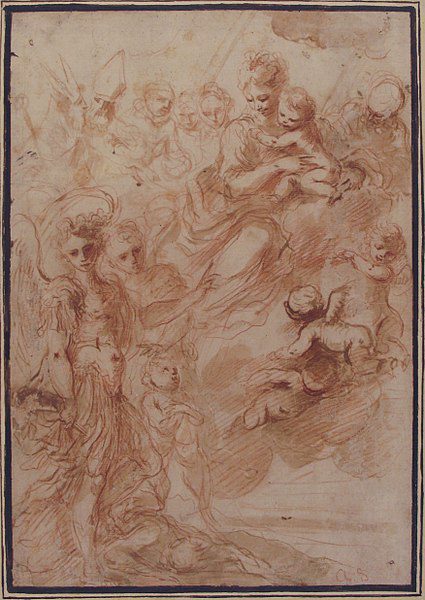
Photo credit: Saint Michael the Archangel and Another Figure Recommending a Soul to the Virgin and Child in Heaven, by Bartolomeo Biscaino (1629-1657) [public domain / Wikimedia Commons]

***
Summary: Part 7 of many responses to Lucas Banzoli’s 1900-page book, The Legend of the Immortality of the Soul: published on 1 August 2022. I defend historic Christianity.
A Lenda da Imortalidade da Alma
The Legend of the Immortality of the Soul
Previous Post
November 12, 2022
Defense of Immortal, Conscious Souls (vs. Lucas Banzoli): #6
Next Post
November 14, 2022 Defense of Immortal, Conscious Souls (vs. Lucas Banzoli): #8
Browse Our Archives
Select a Category & Last Things About Me Anti-Catholicism Atheism & Agnosticism Baptism and Sacramentalism Bible and Tradition Blessed Virgin Mary Books by Dave Armstrong C. S. Lewis Calvinism & General Protestantism Catholic Apologetics Catholic Apologists Catholic conversion Catholic converts Christmas Church (Ecclesiology) Church History Conversion and Converts Development of Doctrine Eastern Orthodoxy Ecumenism & Christian Unity Eucharist & Liturgy Fathers of the Church French Translations G. K. Chesterton Hell Hell & Satan Hell & Satan & Last Things Heresies & Comparative Religion Holistic Health Inquisition & Crusades & Scandals James White Jews & Judaism & Old Testament John Calvin John Henry Newman Liberal / Modernist Theology Life Issues Literary Resume Lutheranism Mariology Martin Luther Music Orthodoxy Papacy & Infallibility Personal Page Philosophy & Science Political & Ethical & Moral Issues Protestant Persecution & Intolerance Protestantism Purgatory Purgatory & Penance Romantic & Imaginative Theology Saints & Purgatory & Penance Salvation Salvation & Justification Satan & Last Things Sexuality and Gender Issues Spanish Translations Traditionalism vs. Radical Catholic Reactionaries Traducciones al español / tradução para português Trinitarianism & Christology Uncategorized Videos
Select a Month October 2026 September 2026 August 2026 July 2026 June 2026 May 2026 April 2026 March 2026 February 2026 January 2026 December 2025 November 2025 October 2025 September 2025 August 2025 July 2025 June 2025 May 2025 April 2025 March 2025 February 2025 January 2025 December 2024 November 2024 October 2024 September 2024 August 2024 July 2024 June 2024 May 2024 April 2024 March 2024 February 2024 January 2024 December 2023 November 2023 October 2023 September 2023 August 2023 July 2023 June 2023 May 2023 April 2023 March 2023 February 2023 January 2023 December 2022 November 2022 October 2022 September 2022 August 2022 July 2022 June 2022 May 2022 April 2022 March 2022 February 2022 January 2022 December 2021 November 2021 October 2021 September 2021 August 2021 July 2021 June 2021 May 2021 April 2021 March 2021 February 2021 January 2021 December 2020 November 2020 October 2020 September 2020 August 2020 July 2020 June 2020 May 2020 April 2020 March 2020 February 2020 January 2020 December 2019 November 2019 October 2019 September 2019 August 2019 July 2019 June 2019 May 2019 April 2019 March 2019 February 2019 January 2019 December 2018 November 2018 October 2018 September 2018 August 2018 July 2018 June 2018 May 2018 April 2018 March 2018 February 2018 January 2018 December 2017 November 2017 October 2017 September 2017 August 2017 July 2017 June 2017 May 2017 April 2017 March 2017 February 2017 January 2017 December 2016 November 2016 October 2016 September 2016 August 2016 July 2016 June 2016 May 2016 April 2016 March 2016 February 2016 January 2016 December 2015 November 2015 October 2015 September 2015 August 2015 July 2015 June 2015 May 2015 April 2015 March 2015 February 2015 January 2015 December 2014 November 2014 October 2014 September 2014 August 2014 July 2014 June 2014 April 2014 March 2014 February 2014 January 2014 December 2013 November 2013 October 2013 September 2013 August 2013 July 2013 June 2013 April 2013 March 2013 February 2013 January 2013 December 2012 November 2012 October 2012 September 2012 August 2012 July 2012 June 2012 May 2012 April 2012 March 2012 February 2012 January 2012 December 2011 November 2011 October 2011 September 2011 August 2011 July 2011 June 2011 April 2011 March 2011 February 2011 October 2010 September 2010 August 2010 July 2010 April 2010 March 2010 December 2009 October 2009 August 2009 July 2009 June 2009 May 2009 March 2009 February 2009 October 2008 September 2008 April 2008 March 2008 February 2008 January 2008 December 2007 November 2007 October 2007 May 2007 March 2007 February 2007 January 2007 November 2006 October 2006 September 2006 August 2006 July 2006 June 2006 May 2006 April 2006 March 2006 February 2006 October 2005 June 2005 April 2005 February 2005 July 2004 May 2004 April 2004
Follow Us!
TAKE THE
Religious Wisdom Quiz
Who was stoned to death for preaching about Jesus?
Select your answer to see how you score.
Peter Paul Stephen James
Books by This Author Books by Dave Armstrong
Related posts from Biblical Evidence for Catholicism

Three More Anti-Catholic Lies About Catholicism (#6-4)
Biblical Evidence for Catholicism

Top Ten Anti-Catholic Lies (#10-7)
Biblical Evidence for Catholicism

No Hell? Dialogue on Conditional Immortality, Pt. 3
Biblical Evidence for Catholicism
No Hell? Dialogue on Conditional Immortality, Pt. 2
Biblical Evidence for Catholicism
TRENDING AT PATHEOS Catholic

Janie Learns the Way of the Cross: A...
Teaching children about Jesus' Passion can be challenging. Many parents and educators...

Looking For Good Catholic Writing - October 2026
He alone extends the heavens, and he walks upon the waves of...

In "Irreplaceable," our book on vocation and technology, Trevor Sutton and I...

I was strolling through the top floor of the brand new Parthenon...

What Does Gêvâh Mean For Kimberley Guifoyle &...
This week, a lot of the news is focused on Kimberly Guilfoyle....

INNER CIRCLE: Profound Mystery (Of Christ In All...
Ephesians 5:31-32 “For this reason, a man will leave his father and...
view all Catholic blogs
Ad-Free & Subscriber Log-In Subscription Support
- About Us
- 2026 Calendar
- Videos
- Podcasts
- Library of World Religions
- Faith In Media Tracker
- Advertise With Us
- Write for Us
- Privacy Policy
- Terms of Service
- Do Not Sell My Data
- Contact Us
- Radiant Digital
- Manage Newsletter Subscriptions
- Unsubscribe From Notifications
- Sitemap
Copyright 2008-2026, Patheos. All rights reserved.
Subscription Support Ad-Free & Subscriber Log-In
Follow Patheos