
BuddhistCatholicContemplativeEvangelicalGeneral ChristianHinduJewishLatter-day SaintMuslimNew VisionsProgressive Christian
Beliefs
- Buddhist
- Catholic
- Contemplative
- Evangelical
- General Christian
- Hindu
- Jewish
- Latter-day Saint
- More Voices
- Muslim
- New Visions
- Pagan
- Progressive Christian
Topics
- Religion News
- Food and Religion
- Sports and Religion
- Religious Art
- Religious Music and Entertainment
- Religious Events
- History and Religion
- Style and Religion
- Politics and Religion
- Women in Religion
- Recreation Outdoors and Religion
- Business Finance and Religion
- Careers Workplace and Religion
- Education and Religion
- Family Parenting and Religion
- Health Fitness and Religion
- Home and Religion
- Relationships and Religion
- Technology and Religion
- Travel and Religion
Columnists
- Buddhist Columnists
- Business Finance and Religion Columnists
- Careers Workplace and Religion Columnists
- Catholic Columnists
- Contemplative Columnists
- Education and Religion Columnists
- Evangelists Columnists
- Family Parenting and Religion Columnists
- General Christian Columnists
- Health Fitness and Religion Columnists
- Hindu Columnists
- History and Religion Columnists
- Home and Religion Columnists
- Jewish Columnists
- More Voices Columnists
- Latter Day Columnists
- Muslim Columnists
- New Visions Columnists
- Nonreligious Columnists
- Pagan Columnists
- Politics and Religion Columnists
- Progressive Columnists
- Recreation Outdoors and Religion Columnists
- Relationships and Religion Columnists
- Religion News Columnists
- Religious Art Columnists
- Religious Events Columnists
- Religious Music and Entertainment Columnists
- Sports and Religion Columnists
- Style and Religion Columnists
- Technology and Religion Columnists
- Travel and Religion Columnists
- Women in Religion Columnists
Resource Library
- 2026 Calendar
- Library of World Religions
- The 100 Most Holy Places on Earth
- Patheos Answers
- Podcasts
- Videos
- Faith Leaders Database
- Anglican Episcopalian
- Bahai
- Baptist
- Buddhism
- Christianity
- Confucianism
- Eastern Orthodoxy
- Hinduism
- Holiness and Pentecostal
- ISKCON
- Islam
- Judaism
- Lutheran
- Methodist
- The Church of Jesus Christ of Latter-day Saints
- New Age
- Paganism
- Presbytarian and Reformed
- Protestantism
- Religion Behind the Scenes
- Roman Catholic
- Scientology
- Shia Islam
- Sikhism
- Sufism
- Sunni Islam
- Taoism
- Zen
- See all religions
Research Tools
 Ad-Free & Subscriber Log-In Subscription Support
Ad-Free & Subscriber Log-In Subscription Support
Follow Patheos 

- Trending:
- Forgiveness
- |
- Marriage
- |
- Consciousness
- |
- Death Penalty
- |
- Election
- |
- Halloween

-
About
-
Catholic Apologetics
-
Church History
-
Great Apologists
-
Christian Worldview
-
Protestantism & Misc.
- Home
- Catholic
- History and Religion
- Is Sola Scriptura Self-Refuting? (vs. Bruno Lima)
Is Sola Scriptura Self-Refuting? (vs. Bruno Lima)
Last updated on: June 6, 2026 at 12:47 am by Dave Armstrong
Is Sola Scriptura Self-Refuting? (vs. Bruno Lima) 2026-06-06T00:47:19-04:00 Dave Armstrong
Patheos Explore the world's faith through different perspectives on religion and spirituality! Patheos has the views of the prevalent religions and spiritualities of the world.
[book and purchase information]
Bruno Lima is a Brazilian Calvinist (and anti-Catholic) writer and apologist.
*****
I am responding to his article, “A Sola Scriptura é Auto-Refutável?” [Is Sola Scriptura Self-Refuting?] (11-3-17). His words will be in blue.
I have already dealt with the arguments most often used by papists against Sola Scriptura (here).
I’m the same on the opposite side. I’ve written three books about it (one / two / three), have an extremely extensive web page about the topic and larger authority issues, and have written and debated more about this than any other apologetics subject, among my 4,000+ online articles and fifty books. So this looks like it will be a good and substantive discussion. I hope Bruno actually defends his articles. I have recently critiqued Brazilian apologist Lucas Banzoli 34 times, and he never did so: not one word. I respect people who have the courage of their convictions.
Today I want to address a specific objection. Catholics claim that Sola Scriptura refutes itself as Scripture itself does not teach the idea.
Indeed, that is exactly the case, as I will demonstrate yet again, as I have many times through the years.
Generally, Protestants respond by attacking the premise and pointing to texts where Scripture teaches its own material and formal sufficiency.
That’s true, too, as a generality; and then Catholic apologists systematically show that all these supposed “proofs” miserably fail in their intended purpose.
I believe the Reformed principle is taught in Scripture implicitly. By this I mean that there is no text that says “Scripture is the only infallible rule of faith,” but there are a number of texts that put together imply the Reformed principle.
I look forward to seeing which passages Bruno thinks do this. This is the latest fad in defending the notion that sola Scriptura is taught in Scripture: that it is, but only indirectly and by deduction. I vehemently deny that, too. It’s fascinating how Protestant apologists are now often applying this new approach to their serious problem in this regard: flat-out admitting that no single text teaches sola Scriptura (true so far). But then they go on to claim (as Bruno will) that it doesn’t matter, anyway. I think, with all due respect, that this is desperation and special pleading.
I was shocked recently to see Lutheran pastor and apologist Jordan Cooper using this same “forfeit argument”. He stated in his video, “A Defense of Sola Scriptura“ (3-12-19):
I think the question that we have is: do we have to find a particular Scripture that says Scripture is the only authority? And I just don’t think we have to. We don’t. There’s nothing in — you can’t find — in any of Paul’s letters, for example, . . . “by the way, Scripture is the only authority and traditions are not an authority and there is no magisterium that is given some kind of infallible authority to pass on infallible teachings.” It seems like a lot of Roman Catholic apologists think that for Protestants to defend their position, that they have to find a text that says that.” [1:39-2:14]
How pathetic (if I do say so) that Protestant apologists have been so roundly defeated in this particular argument, that they readily concede that no Bible verse teaches it; after having spent some 480 years arguing that a host of Bible verses supposedly did so (with 2 Timothy 3:16 always leading the way!). One can certainly see ironic humor in this state of affairs.
This is the case for several other biblical teachings – the Trinity is an example. There is no text that says “Father, Son and Holy Spirit form a Trinity”. However, if we put together all that Scripture says about the three Persons, the implication is the teaching of the Trinity.
Bad choice of analogy. Literally forty years ago, when I first started writing serious apologetics (as an evangelical Protestant), I compiled the hundreds of biblical passages that — considered together — do definitely demonstrate the truth of trinitarianism. I’m still proud of that research and it has stood the test of time. There is, however, no similar set of passages that allegedly add up to the truth of sola Scriptura. It’s a fantasy; a pipe-dream.
I know; I’ve debated the topic with many of the leading defenders of the false doctrine in our time and have also critiqued the best historical defenders (Whitaker and Goode: highly recommended by James White, Luther, Calvin). The arguments fail without exception. It’s remarkable to observe such a bad and substanceless scriptural case being made for one of the two “pillars” of the Protestant Revolt, and the very basis of their unbiblically narrow rule of faith.
I would like to answer the objection on its own terms. Even though Sola Scriptura was not implicitly in Scripture, the Roman objection is false. Still, it wouldn’t be self-refuting. Let’s see:
(1) Scripture is the only infallible rule of faith;
(2) Only Scripture can say that Scripture is the only infallible rule of faith.
I agree that #2 is an obviously false statement. But it’s framing the issue in a wrong fashion. I would state #2 as follows, as part of my overall argument: “Only inspired Scripture can say infallibly, and as inspired revelation, that Scripture is the only infallible rule of faith.” And that is the basis of Protestantism’s internal difficulty in holding this unbiblical doctrine. Because of my proposition #2, their reasoning entails vicious self-contradiction, with no solution possible from within their own wildly incoherent and inconsistent reasoning. This will all be unpacked and laid out as we proceed.
Note that (1) is the definition of Sola Scriptura
I agree. It’s crucial to agree on definitions in any debate.
and (2) would be the way we could identify the article of faith.
That’s right. But the real issue is the authoritativeness (or rather, lack thereof) of such a statement, and whether it is proper to make it binding or not (from within the Protestant paradigm and rule of faith) if it’s not in the Bible itself. I say that attempting to do so results in insuperable logical difficulties: impossible to resolve. Anyone can state anything, and/or believe anything they want. But why do they believe it? On what epistemological grounds is their alleged “certainty” or (to express it another way) strong adherence based?
It turns out that (2) is not a necessary implication of (1).
I agree again, if we are talking strict logic. But the Christian faith is not mere logic and philosophy. We claim (all of us, in one way or another) to have certainty, based on God’s revelation to man. Simply having someone say, “Scripture is the only infallible rule of faith!” on no ultimate basis derived from Scripture, raises all sorts of problems for Protestantism that can’t be resolved, and which make a mockery of their centuries-old polemic against Catholic conceptions of sacred and apostolic tradition. It does that because it entails a “double epistemological standard”, whereby Catholics have to prove our views from Scripture (and we assuredly can do so, far more than they think) but the Protestant — strangely enough — gives himself a pass from doing so. It’s endless irony that this is how it is in these discussions.
It is entirely possible that there are no other rules even though Scripture does not say so.
I shall argue that there are indeed other rules (though always in harmony with Scripture) precisely because Scripture does say so: which in and of itself refutes sola Scriptura in one elegant step.
Roman apologists confuse the content of the rule with our knowledge of the rule.
We confuse nothing. Protestants have insufficient and inadequate knowledge to assert what they do about the rule of faith. They base everything else on Scripture, but then inexplicably make an exception for this: even when it’s about the nature of scriptural authority. Or if they do have such “knowledge”, it’s based on precisely the notion of “extrabiblical tradition” that they have bashed us for 500 years for believing. Truth is stranger than fiction again!
The content of the rule is infallible, but the epistemological basis on which we identify the rule need not necessarily be infallible.
Then why do they believe it in the first place?: is the question. In the end, in my opinion, it comes down to a reason of mere polemics and the reactionary impulse: “it’s not Catholic, so we believe it, even though we have no biblical or any other good reason to do so.” That’s how it began, when Martin Luther was backed into a corner in a debate in Leipzig in 1519, and adopted sola Scriptura as his “can’t do anything else” default position, and it’s been every bit as arbitrary and baseless and unbiblical ever since.
Now, there would be some ways in which the Catholic objection would be valid. If Protestants claimed that Scripture is the only source of truth (a straw man often used in debates), it would be self-refuting.
That’s right. And it’s true that this is a straw man too often used by Catholics uninformed about Protestant teachings. But I am not in that number. I properly understand it and also understand how it is logically and biblically inconsistent and incoherent.
Or if Scripture itself laid down other infallible rules. Despite attempts to use texts such as Matthew 16:18, Scripture does not point to infallible rules other than itself.
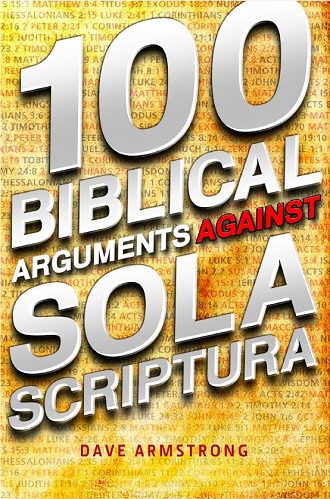
I’m glad to see that Bruno has already forfeited this debate. For indeed there are at least two scriptural arguments showing that the Church, too, is infallible (1 Timothy 3:15 and the Jerusalem Council of Acts 15). Here is my most concise presentation of the argument from 1 Timothy 3:15, from my book, 100 Biblical Arguments Against Sola Scriptura (Catholic Answers: 2012, pp. 104-107, #82):
1 Timothy 3:15 [RSV] if I am delayed, you may know how one ought to behave in the household of God, which is the church of the living God, the pillar and bulwark of the truth.
Pillars and foundations support things and prevent them from collapsing. To be a “bulwark” of the truth, means to be a “safety net” against truth turning into falsity. If the Church could err, it could not be what Scripture says it is. God’s truth would be the house built on a foundation of sand in Jesus’ parable. For this passage of Scripture to be true, the Church could not err — it must be infallible. A similar passage may cast further light on 1 Timothy 3:15:
Ephesians 2:19-21 . . . you are fellow citizens with the saints and members of the household of God, [20] built upon the foundation of the apostles and prophets, Christ Jesus himself being the cornerstone, [21] in whom the whole structure is joined together and grows into a holy temple in the Lord;
1 Timothy 3:15 defines “household of God” as “the church of the living God.” Therefore, we know that Ephesians 2:19-21 is also referring to the Church, even though that word is not present. Here the Church’s own “foundation” is “the apostles and prophets, Christ Jesus himself being the cornerstone.” The foundation of the Church itself is Jesus and apostles and prophets.
Prophets spoke “in the name of the Lord” (1 Chron 21:19; 2 Chron 33:18; Jer 26:9), and commonly introduced their utterances with “thus says the Lord” (Is 10:24; Jer 4:3; 26:4; Ezek 13:8; Amos 3:11-12; and many more). They spoke the “word of the Lord” (Is 1:10; 38:4; Jer 1:2; 13:3, 8; 14:1; Ezek 13:1-2; Hos 1:1; Joel 1:1; Jon 1:1; Mic 1:1, et cetera). These communications cannot contain any untruths insofar as they truly originate from God, with the prophet serving as a spokesman or intermediary of God (Jer 2:2; 26:8; Ezek 11:5; Zech 1:6; and many more). Likewise, apostles proclaimed truth unmixed with error (1 Cor 2:7-13; 1 Tim 2:7; 2 Tim 1:11-14; 2 Pet 1:12-21).
Does this foundation have any faults or cracks? Since Jesus is the cornerstone, he can hardly be a faulty foundation. Neither can the apostles or prophets err when teaching the inspired gospel message or proclaiming God’s word. In the way that apostles and prophets are infallible, so is the Church set up by our Lord Jesus Christ. We ourselves (all Christians) are incorporated into the Church (following the metaphor), on top of the foundation.
1 Peter 2:4-9 Come to him, to that living stone, rejected by men but in God’s sight chosen and precious; [5] and like living stones be yourselves built into a spiritual house, to be a holy priesthood, to offer spiritual sacrifices acceptable to God through Jesus Christ. [6] For it stands in scripture: “Behold, I am laying in Zion a stone, a cornerstone chosen and precious, and he who believes in him will not be put to shame.” [7] To you therefore who believe, he is precious, but for those who do not believe, “The very stone which the builders rejected has become the head of the corner,” [8] and “A stone that will make men stumble, a rock that will make them fall”; for they stumble because they disobey the word, as they were destined to do. [9] But you are a chosen race, a royal priesthood, a holy nation, God’s own people, that you may declare the wonderful deeds of him who called you out of darkness into his marvelous light. (cf. Isa 28:16)
Jesus is without fault or untruth, and he is the cornerstone of the Church. The Church is also more than once even identified with Jesus himself, by being called his “Body” (Acts 9:5 cf. with 22:4 and 26:11; 1 Cor 12:27; Eph 1:22-23; 4:12; 5:23, 30; Col 1:24). That the Church is so intimately connected with Jesus, who is infallible, is itself a strong argument that the Church is also infallible and without error.
Therefore, the Church is built on the foundation of Jesus (perfect in all knowledge), and the prophets and apostles (who spoke infallible truth, often recorded in inspired, infallible Scripture). Moreover, it is the very “Body of Christ.” It stands to reason that the Church herself is infallible, by the same token. In the Bible, nowhere is truth presented as anything less than pure truth, unmixed with error. That was certainly how Paul conceived his own “tradition” that he received and passed down.
Knowing what truth is, how can its own foundation or pillar be something less than total truth (since truth itself contains no falsehoods, untruths, lies, or errors)? It cannot. It is impossible. It is a straightforward matter of logic and plain observation. A stream cannot rise above its source. What is built upon a foundation cannot be greater than the foundation. If it were, the whole structure would collapse.
If an elephant stood on the shoulders of a man as its foundation, that foundation would collapse. The base of a skyscraper has to hold the weight above it. The foundations of a suspension bridge over a river have to be strong enough to support that bridge.
Therefore, we must conclude that if the Church is the foundation of truth, the Church must be infallible, since truth is infallible, and the foundation cannot be lesser than that which is built upon it. And since there is another infallible authority apart from Scripture, sola scriptura must be false.
Here’s the second argument:
The Jerusalem Council (recorded in the Bible) demonstrated the sublime authority of the Church to make binding, infallible decrees (something sola Scriptura expressly denies can or should be the case). It claimed to be speaking in conjunction with the Holy Spirit (“it has seemed good to the Holy Spirit and to us”: Acts 15:28) and its decree was delivered as such by the Apostle Paul in several cities (“As they went on their way through the cities, they delivered to them for observance the decisions which had been reached by the apostles and elders who were at Jerusalem”: Acts 16:4). [see many more papers on this by searching “Jerusalem” on my Church web page]
These two arguments alone already annihilate sola Scriptura, but there are many other arguments against it. I happen to think that these two are the best and most unanswerable ones (and so I look forward to Bruno’s attempted answer!). Very few Protestants have ever tried to knock down these two arguments: at least as I have argued and expressed them. I can only report what my own almost universal experience has been. There’s a reason for that (as James White would say).
The Roman apologist could still say “if all that is necessary to believe in order to be saved is in Scripture, then the Reformed principle must be contained in Scripture.” Once again, it is a straw man caricature of Protestant teaching. Protestants do not claim that you need to believe that Scripture is the only infallible rule to be saved, but that you need to believe the gospel that Scripture presents unadulterated.
Agreed. That’s not an argument I use, because it is a very weak one and largely a straw man.
Therefore, there is no contradiction.
Not in that particular respect, but there are several other self-contradictions, as I have been demonstrating.
We cannot fail to mention the burden of proof. If indeed there is any other infallible rule of faith besides Scripture, it behooves its proponent to evidence it.
I was happy to provide two above. How does Bruno reply to them? How is sola Scriptura salvaged in light of those two things?
If no other infallible rules are laid down, the Protestant is rationally justified in appealing to Scripture alone as unquestioned authority.
I agree. But they have been laid down from the Bible itself.
The Catholic objection is often put another way, “Sola Scriptura is self-refuting because it does not contain the canon.”
That’s a decent argument, too, but forms no part of my present *much more compelling) argument; therefore, I need not address it at the moment.
First of all, I should mention that Catholics despise the canon’s internal and intertextual evidence.
That’s an unfair and inaccurate generalization.
Scripture itself provides the criteria by which the canon can be established.
Usually, but not always:
Are All Bible Books Self-Evidently Inspired? [6-19-06]
Are All the Biblical Books Self-Evidently Canonical? [6-22-06]
The Catholic objection to the canon strikes me as hypocritical too, since supposing that there were in Scripture a book which gave us the list of the canon, papists would go on to say “how do you know that the book which lists the canon is a part of Scripture?”
That’s sheer nonsense. What we would say is that such a list in a book would decisively resolve this issue in and of itself, provided that we have good reason to believe that the book it appeared in is itself canonical and inspired. We would determine the latter by seeing what the Church Church fathers taught about it. Since we (unlike Protestants) believe in the infallibility of authentic apostolic tradition (not all claimed tradition), this is not a difficulty for us, or an inconsistency. There’s no “hypocrisy” here at all. There is epistemological and biblical consistency.
It’s precisely because there is no such list in the Bible, that infallible Catholic Church authority was needed to resolve the issue. Protestants end up accepting that, as an embarrassing exception to their usual methodology (minus seven biblical books that they rejected, following a minority position in the Church fathers), because (just as with the arbitrary sola Scriptura) they have no other recourse. It’s a desperate default position.
This is because the aim of Catholic apologetics is to demote the authority of Scripture in order to elevate the authority of its own Church.
We’ve never done such a thing. This is simply ad hominem smearing. I’ve knocked down dozens of anti-Catholic attempts to try to establish as historical fact some fictional, imaginary animus of the Catholic Church against the Bible. Perhaps Bruno wants to make an attempt (but after we discuss this!)? I’ll be happy to refute that, too.
[I]in the same way that someone might ask “how do you know what is or is not the word of God?”, we asked “how do you know your Church is infallible”. To answer this question, the Catholic will have to either appeal to circular reasoning (the church is infallible because it says it is) or to a fallible private judgment to determine whether his church is infallible. At the end of the day, we all depend on our fallible judgment to know the truth.
This is nonsense. Christianity doesn’t reduce to secular philosophical epistemology. We all have faith, remember? And that faith must derive from God’s grace. In other words, in the final analysis it’s a spiritual, religious thing, not a philosophical thing. We can defend many parts of our beliefs from philosophy and secular learning (I have no problem with that: I often do it as an apologist, and my upcoming book about biblical archaeology — that any Protestant should agree with — does it). But we have to exercise faith, too. Protestants do and Catholics do. It’s religious and theological belief.
The informed, educated Catholic doesn’t say that the Church is infallible merely because it says so. That would be stupid and prove nothing, of course. We say it’s infallible because the Bible asserts it, in 1 Timothy 3:15 and Acts 15. We believe the Bible on many other grounds (including archaeology, which my latest book addresses). We believe it because our Lord Jesus (Who proved He was God by performing miracles and rising from the dead and returning) said that the Holy Spirit would guide us into all truth, and told Peter He would build His Church upon his leadership as first pope, and that “the gates of Hades shall not prevail against it” (Matthew 16).
St. Paul also mentions quite a bit, the notion of “truth” and a set of teachings (he uses many synonymous terms) that are regarded as dogma and unassailable. And he railed against those who would deny this, and go against the “tradition” that he himself passed on to his followers: urging folks to avoid those who cause division. I wrote an entire book of biblical arguments related to this very topic of infallibility (Biblical Proofs for an Infallible Church and Papacy: March 2012).
Why do we believe the Catholic Church is the same Church talked about in the Bible and in early Church history? That’s an historical matter, and we have all kinds of arguments demonstrating historical continuity and apostolic succession (that Protestants glaringly lack for themselves). That’s why we believe it: still in and with faith, by grace, but with ample objective reasons to do so: that can withstand skeptical scrutiny (I do it for a living).
But in any event, it’s not merely “fallible private judgment” (nice try there). Of course it may be for many inadequately taught particular Catholics, just as there are also millions of undereducated Protestants (I know: I was in that group, too, for 32 years). But we can never go by that. We have to examine what “official teachings” assert, not “Joe Blow Catholic / Protestant” in some bar at midnight, spouting off about theology, says, or some loudmouthed ignorant fool on the Internet, falsely claiming to represent something.
Infallible epistemological certainty is something that God did not want to give us.
He wanted to give us an infallible certitude of faith: not the theologically relativistic, ecclesiologically chaotic state of affairs that we have in Protestant denominationalism: a concept never found in the New Testament anywhere: let alone sanctioned as a supposed norm.
Think for a moment. Why an infallible magisterium that needs to be accessed or interpreted by fallible judgments?
It’s not. The premise is wrong. It’s infallibly interpreted in specific highly specified circumstances by ecumenical councils in conjunction with popes, or by popes themselves. That’s how our system works. Bruno seems to have us confused with Protestantism, where the individual is king, and so a a result it has multiple hundreds of competing denominations, where all sorts of errors are necessarily present (by the law of contradiction).
That’s not from God. Any falsehood is from the devil. God would never countenance a system that necessarily contains that much falsehood. That’s why denominationalism is yet another central Protestant belief or reality that is utterly absent from the Bible, just like sola Scriptura and sola fide and several other false doctrines. But thank heavens, we do agree on many things, too, which is cause for rejoicing.
If that were God’s purpose, he would do something better. He would make all Christians infallible.
There is no need to do that. We have more than enough infallible human authority, and inspired Scripture, to guide us to the truth in all these matters.
The whole body of Christ in unison and clear would hold the same opinions and hold the same truths.
That will never happen in fact because of the sinfulness and lack of knowledge of human beings as a whole. But we can have an infallible, inspired Bible and infallible Church and tradition to guide the way. We don’t have to rely on our own miserable, flimsy, fallible selves as the ultimate rule and standard of faith (thank God!). The Bible never teaches that we do: yet Protestantism does: yet another unbiblical tradition of men.
*
Now, in closing I will note how fascinating it is that Bruno started out with the assertion: “I believe the Reformed principle is taught in Scripture implicitly. . . . there are a number of texts that put together imply the Reformed principle.” But yet, oddly enough, he managed to never produce these supposed Scriptures that “put together” allegedly add up to the principle of sola Scriptura. He just “forgot” about that and hoped that the reader would, too (ah! the thorny and frustrating problems of incoherent theology). What a shock and surprise! But I’m being sarcastic. This is often the methodology of Protestants “defending” sola Scriptura. It’s an ethereal, shadowy thing. The ever-evasive or plain imaginary “prooftexts” are given lip service and then ignored as if they have no importance (or existence). In fact, producing these alleged texts is absolutely crucial to their case.
It’s like the old tale about “the emperor is naked.” Everyone is scared to tell him that he is. Well, the nakedness in the present discussion is the lack of any compelling biblical evidence for sola Scriptura (and I ain’t scared to point it out!). That being the case, Protestants seem to be engaged in a sort of voluntary mass self-deception or self-delusion: by pretending that the proof is there “somewhere” in the Bible, but never producing it (or them). It’s terribly inadequate, woefully insufficient theology, exegesis, debate, and thinking, period. But it’s not going to end anytime soon. In the meantime, we can only expose the farcical, self-contradictory, and unbiblical nature of the belief so that less people are fooled and harmed by it.
See my related papers, which get into other aspects of this issue that I didn’t address here:
Sola Scriptura is Self-Defeating and False if Not in the Bible (vs. Kevin Johnson) [5-4-04]
Sola Scriptura: Self-Refuting? (vs. Steve Hays) [12-14-21]
Protestantism: Is it Logically Self-Defeating? [9-15-03]
***
Practical Matters: Perhaps some of my 4,000+ free online articles (the most comprehensive “one-stop” Catholic apologetics site) or fifty books have helped you (by God’s grace) to decide to become Catholic or to return to the Church, or better understand some doctrines and why we believe them.
Or you may believe my work is worthy to support for the purpose of apologetics and evangelism in general. If so, please seriously consider a much-needed financial contribution. I’m always in need of more funds: especially monthly support. “The laborer is worthy of his wages” (1 Tim 5:18, NKJV). 1 December 2021 was my 20th anniversary as a full-time Catholic apologist, and February 2022 marked the 25th anniversary of my blog.
PayPal donations are the easiest: just send to my email address: [email protected]. You’ll see the term “Catholic Used Book Service”, which is my old side-business. To learn about the different methods of contributing, including 100% tax deduction, etc., see my page: About Catholic Apologist Dave Armstrong / Donation Information. Thanks a million from the bottom of my heart!
***
Summary: Brazilian Protestant apologist Bruno Lima makes various arguments for sola Scriptura being biblical. I shoot down every one and offer plausible biblical alternatives.
Previous Post

September 26, 2022
NT Baptism of Whole "Households" (vs. Lucas Banzoli)
Next Post
October 13, 2022 Defense of Vatican II vs. Oliveira Leonardo's Attacks
Browse Our Archives
Select a Category & Last Things About Me Anti-Catholicism Atheism & Agnosticism Baptism and Sacramentalism Bible and Tradition Blessed Virgin Mary Books by Dave Armstrong C. S. Lewis Calvinism & General Protestantism Catholic Apologetics Catholic Apologists Catholic conversion Catholic converts Christmas Church (Ecclesiology) Church History Conversion and Converts Development of Doctrine Eastern Orthodoxy Ecumenism & Christian Unity Eucharist & Liturgy Fathers of the Church French Translations G. K. Chesterton Hell Hell & Satan Hell & Satan & Last Things Heresies & Comparative Religion Holistic Health Inquisition & Crusades & Scandals James White Jews & Judaism & Old Testament John Calvin John Henry Newman Liberal / Modernist Theology Life Issues Literary Resume Lutheranism Mariology Martin Luther Music Orthodoxy Papacy & Infallibility Personal Page Philosophy & Science Political & Ethical & Moral Issues Protestant Persecution & Intolerance Protestantism Purgatory Purgatory & Penance Romantic & Imaginative Theology Saints & Purgatory & Penance Salvation Salvation & Justification Satan & Last Things Sexuality and Gender Issues Spanish Translations Traditionalism vs. Radical Catholic Reactionaries Traducciones al español / tradução para português Trinitarianism & Christology Uncategorized Videos
Select a Month October 2026 September 2026 August 2026 July 2026 June 2026 May 2026 April 2026 March 2026 February 2026 January 2026 December 2025 November 2025 October 2025 September 2025 August 2025 July 2025 June 2025 May 2025 April 2025 March 2025 February 2025 January 2025 December 2024 November 2024 October 2024 September 2024 August 2024 July 2024 June 2024 May 2024 April 2024 March 2024 February 2024 January 2024 December 2023 November 2023 October 2023 September 2023 August 2023 July 2023 June 2023 May 2023 April 2023 March 2023 February 2023 January 2023 December 2022 November 2022 October 2022 September 2022 August 2022 July 2022 June 2022 May 2022 April 2022 March 2022 February 2022 January 2022 December 2021 November 2021 October 2021 September 2021 August 2021 July 2021 June 2021 May 2021 April 2021 March 2021 February 2021 January 2021 December 2020 November 2020 October 2020 September 2020 August 2020 July 2020 June 2020 May 2020 April 2020 March 2020 February 2020 January 2020 December 2019 November 2019 October 2019 September 2019 August 2019 July 2019 June 2019 May 2019 April 2019 March 2019 February 2019 January 2019 December 2018 November 2018 October 2018 September 2018 August 2018 July 2018 June 2018 May 2018 April 2018 March 2018 February 2018 January 2018 December 2017 November 2017 October 2017 September 2017 August 2017 July 2017 June 2017 May 2017 April 2017 March 2017 February 2017 January 2017 December 2016 November 2016 October 2016 September 2016 August 2016 July 2016 June 2016 May 2016 April 2016 March 2016 February 2016 January 2016 December 2015 November 2015 October 2015 September 2015 August 2015 July 2015 June 2015 May 2015 April 2015 March 2015 February 2015 January 2015 December 2014 November 2014 October 2014 September 2014 August 2014 July 2014 June 2014 April 2014 March 2014 February 2014 January 2014 December 2013 November 2013 October 2013 September 2013 August 2013 July 2013 June 2013 April 2013 March 2013 February 2013 January 2013 December 2012 November 2012 October 2012 September 2012 August 2012 July 2012 June 2012 May 2012 April 2012 March 2012 February 2012 January 2012 December 2011 November 2011 October 2011 September 2011 August 2011 July 2011 June 2011 April 2011 March 2011 February 2011 October 2010 September 2010 August 2010 July 2010 April 2010 March 2010 December 2009 October 2009 August 2009 July 2009 June 2009 May 2009 March 2009 February 2009 October 2008 September 2008 April 2008 March 2008 February 2008 January 2008 December 2007 November 2007 October 2007 May 2007 March 2007 February 2007 January 2007 November 2006 October 2006 September 2006 August 2006 July 2006 June 2006 May 2006 April 2006 March 2006 February 2006 October 2005 June 2005 April 2005 February 2005 July 2004 May 2004 April 2004
Follow Us!
TAKE THE
Religious Wisdom Quiz
Who was Jacob's first wife?
Select your answer to see how you score.
Rachel Dinah Leah Rebekah
Books by This Author Books by Dave Armstrong
Related posts from Biblical Evidence for Catholicism

Three More Anti-Catholic Lies About Catholicism (#6-4)
Biblical Evidence for Catholicism

Top Ten Anti-Catholic Lies (#10-7)
Biblical Evidence for Catholicism

A Few "Worst" & "Best" Arguments vs. Protestantism
Biblical Evidence for Catholicism

"Baptism" & Romans 10 (Engwer's Silly Word Games)
Biblical Evidence for Catholicism
TRENDING AT PATHEOS Catholic

The Sermon on the Mount, Part I: Matthew...
The Sermon on the Mount, Part I (Matthew 4:12-5:12) St. Matthew moves...

What's up from Crossway: Reviewing some of their latest A few weeks...

Janie Learns the Way of the Cross: A...
Teaching children about Jesus' Passion can be challenging. Many parents and educators...

Looking For Good Catholic Writing - October 2026
He alone extends the heavens, and he walks upon the waves of...

In "Irreplaceable," our book on vocation and technology, Trevor Sutton and I...

I was strolling through the top floor of the brand new Parthenon...
view all Catholic blogs
Ad-Free & Subscriber Log-In Subscription Support
- About Us
- 2026 Calendar
- Videos
- Podcasts
- Library of World Religions
- Faith In Media Tracker
- Advertise With Us
- Write for Us
- Privacy Policy
- Terms of Service
- Do Not Sell My Data
- Contact Us
- Radiant Digital
- Manage Newsletter Subscriptions
- Unsubscribe From Notifications
- Sitemap
Copyright 2008-2026, Patheos. All rights reserved.
Subscription Support Ad-Free & Subscriber Log-In
Follow Patheos