
BuddhistCatholicContemplativeEvangelicalGeneral ChristianHinduJewishLatter-day SaintMuslimNew VisionsProgressive Christian
Beliefs
- Buddhist
- Catholic
- Contemplative
- Evangelical
- General Christian
- Hindu
- Jewish
- Latter-day Saint
- More Voices
- Muslim
- New Visions
- Pagan
- Progressive Christian
Topics
- Religion News
- Food and Religion
- Sports and Religion
- Religious Art
- Religious Music and Entertainment
- Religious Events
- History and Religion
- Style and Religion
- Politics and Religion
- Women in Religion
- Recreation Outdoors and Religion
- Business Finance and Religion
- Careers Workplace and Religion
- Education and Religion
- Family Parenting and Religion
- Health Fitness and Religion
- Home and Religion
- Relationships and Religion
- Technology and Religion
- Travel and Religion
Columnists
- Buddhist Columnists
- Business Finance and Religion Columnists
- Careers Workplace and Religion Columnists
- Catholic Columnists
- Contemplative Columnists
- Education and Religion Columnists
- Evangelists Columnists
- Family Parenting and Religion Columnists
- General Christian Columnists
- Health Fitness and Religion Columnists
- Hindu Columnists
- History and Religion Columnists
- Home and Religion Columnists
- Jewish Columnists
- More Voices Columnists
- Latter Day Columnists
- Muslim Columnists
- New Visions Columnists
- Nonreligious Columnists
- Pagan Columnists
- Politics and Religion Columnists
- Progressive Columnists
- Recreation Outdoors and Religion Columnists
- Relationships and Religion Columnists
- Religion News Columnists
- Religious Art Columnists
- Religious Events Columnists
- Religious Music and Entertainment Columnists
- Sports and Religion Columnists
- Style and Religion Columnists
- Technology and Religion Columnists
- Travel and Religion Columnists
- Women in Religion Columnists
Resource Library
- 2026 Calendar
- Library of World Religions
- The 100 Most Holy Places on Earth
- Patheos Answers
- Podcasts
- Videos
- Faith Leaders Database
- Anglican Episcopalian
- Bahai
- Baptist
- Buddhism
- Christianity
- Confucianism
- Eastern Orthodoxy
- Hinduism
- Holiness and Pentecostal
- ISKCON
- Islam
- Judaism
- Lutheran
- Methodist
- The Church of Jesus Christ of Latter-day Saints
- New Age
- Paganism
- Presbytarian and Reformed
- Protestantism
- Religion Behind the Scenes
- Roman Catholic
- Scientology
- Shia Islam
- Sikhism
- Sufism
- Sunni Islam
- Taoism
- Zen
- See all religions
Research Tools
 Ad-Free & Subscriber Log-In Subscription Support
Ad-Free & Subscriber Log-In Subscription Support
Follow Patheos 

- Trending:
- Forgiveness
- |
- Marriage
- |
- Consciousness
- |
- Death Penalty
- |
- Election
- |
- Halloween

-
About
-
Catholic Apologetics
-
Church History
-
Great Apologists
-
Christian Worldview
-
Protestantism & Misc.
- Home
- Catholic
- History and Religion
- Why Doesn’t Scripture Call Jesus an “Only Child”?
Why Doesn’t Scripture Call Jesus an “Only Child”?
Last updated on: June 6, 2026 at 12:01 am by Dave Armstrong
Why Doesn’t Scripture Call Jesus an “Only Child”? 2026-06-06T00:01:00-04:00 Dave Armstrong
Patheos Explore the world's faith through different perspectives on religion and spirituality! Patheos has the views of the prevalent religions and spiritualities of the world.
vs. Lucas Banzoli
Lucas Banzoli is a very active Brazilian anti-Catholic polemicist, who holds to basically a Seventh-Day Adventist theology, whereby there is no such thing as a soul that consciously exists outside of a body, and no hell (soul sleep and annihilationism). This leads him to a Christology which is deficient and heterodox in terms of Christ’s human nature after His death. He has a Master’s degree in theology, a degree and postgraduate work in history, a license in letters, and is a history teacher, author of 25 books, as well as blogmaster (but now inactive) for six blogs. He’s active on YouTube.
The words of Lucas Banzoli will be in blue. I use RSV for the Bible passages unless otherwise indicated.
This is my 18th refutation of articles written by Lucas Banzoli. As of yet, I haven’t received a single word in reply to any of them (or if Banzoli has replied to anything, anywhere, he certainly hasn’t informed me of it). Readers may decide for themselves why that is the case.
*****
I’m replying to a portion of Lucas’ article, “E não a conheceu até que…” [“And knew her not until…” ] (8-16-12).
The fact that Matthew also adds that Mary gave birth to her “firstborn” (v. 25) also indicates that she had other children. Otherwise, he would simply have written that Jesus was his “only son”, as the Bible often states in other cases, where in fact there were no other brothers in the family. . ., as in the case of the widow of Nain, whose “only son” (Lk. 7:12) had died, and of the man who wanted to cast out the devil from his son, because he was his “only son” (Lk. 9:38).
Why is it not written in these cases that they were her firstborn sons? Because they were his only children. When someone was the first of other children of the same mother, it is common for the Bible to call “firstborn”; however, when he is not only the first but also the only one, the word often used is “only child”, . . .
This is a decent argument, and deserves a reply. I would note, however, that the phrase “only son” (applying to persons other than Jesus) occurs in the New Testament (in the RSV) only twice (Lk 7:12; Heb 11:17), while “only child” appears exactly once (Lk 9:38). This is why Lucas mentioned the two instances in Luke, because they are two out of only three total. For whatever reason, the New Testament uses these terms very rarely.
But I still grant that the argument carries some force, which is why I am writing about it. If Lucas asks me why it is that Jesus is never called an “only son”: a thing that would put this whole controversy to rest (which would have been a good thing!), I reply, “I have no idea.” We can’t figure everything out in the Bible or understand why some things are written and others are not written, which would clarify and put a lot of historic controversies to rest.
Yet our inability to fully understand is to be expected when we are talking about an inspired revelation that comes from an infinitely intelligent, omniscient God. So I don’t know, and I don’t have the slightest embarrassment or shame in admitting that. There are lots of things we don’t know about God, theology, and the Bible.
That said, the Catholic can still “turn the tables” on the Protestant and demonstrate by several solid analogies that this difficulty (of something not explicitly and clearly stated in the Bible that presumably or seemingly ought to be if a thing is true) is not unique to us. Protestants have several major ones of their own, along the same lines. If this factor is a “problem” for Catholics, so it also is for Protestants (and I say, in several far more problematic and more internally inconsistent ways).
The two “pillars” of the so-called Protestant “Reformation” are sola Scriptura (the Bible only as the only infallible rule of faith) and sola fide (justification by faith alone). Yet neither thing is explicitly spelled out in the Bible; not even close. Here is how three prominent modern-day Protestant apologists define sola Scriptura:
What Protestants mean by sola scriptura is that the Bible alone is the infallible written authority for faith and morals. (Evangelical Protestant Norman Geisler: Roman Catholics and Evangelicals: Agreements and Differences, Grand Rapids, Michigan: Baker Books, 1995, 178; co-author, Ralph E. Mackenzie)
The doctrine of sola scriptura, simply stated, is that the Scriptures alone are sufficient to function as the regula fidei, the infallible rule of faith for the Church. (Reformed Baptist James R. White: The Roman Catholic Controversy, Minneapolis: Bethany House Publishers, 1996, 59)
Scripture . . . is the only inspired and inherently infallible norm, and therefore Scripture is the only final authoritative norm. (Reformed Protestant Keith A. Mathison: The Shape of Sola Scriptura, Moscow, Idaho: Canon Press, 2001, 260)
See also various “classical” Protestant definitions: all consistent with the above. Such a thing is never remotely stated in the Bible. It doesn’t exist, period. I’ve written three books about the topic and I have sought for such a verse and asked every Protestant I debate with to come up with one. It’s not there. Even a prominent (and worthy and able) Protestant apologist like the Lutheran pastor Jordan Cooper recently freely conceded this point:
I think the question that we have is: do we have to find a particular Scripture that says Scripture is the only authority? And I just don’t think we have to. We don’t. There’s nothing in — you can’t find — in any of Paul’s letters, for example, . . . “by the way, Scripture is the only authority and traditions are not an authority and there is no magisterium that is given some kind of infallible authority to pass on infallible teachings.” It seems like a lot of Roman Catholic apologists think that for Protestants to defend their position, that they have to find a text that says that.” I think, more so, what we have to do is just speak about the unique authority of Scripture and the unique nature of Scripture, and just to say that Scripture does present itself as God-breathed. 2 Timothy 3:16 is kind of the famous text that says this . . . [1:39-2:35, in the video, “A Defense of Sola Scriptura“ (3-12-19)]
Does sola Scriptura have to be spelled out in the Bible in order for the view to be self-consistent and valid? Of course it does! I’ve laid out that rather straightforward and solid argument elsewhere. I recently expressed it in a nutshell, in a Facebook reply to another Protestant YouTube Apologist, Collin Brooks (modified slightly):
It’s my contention that sola Scriptura, by its very nature, must be able to be defended from Holy Scripture, or else it is viciously self-defeating, and a mere arbitrary tradition of men: as such, not worthy of allegiance, and of no compelling authority.
Protestants have, nevertheless, made it their formal rule of faith, without the grounding in Scripture that it must have in order to consistently be granted such an imposing epistemological status.
In my opinion, this must be done before the discussion can sensibly continue. Why do Protestants hold to sola Scriptura in the first place? It becomes an example of “the emperor is naked.” Protestants refuse to grapple with the shocking realization that it has no scriptural basis.
Whether or not any given Catholic can defend his own critiques of sola Scriptura and assertions of the infallibility of Church and Tradition or not (I think I can, if I do say so), it remains the burden of Protestantism and Protestant theologians and apologists to demonstrate how and why sola Scriptura is a biblically required doctrine, over against the constant Catholic apostolic tradition that directly contradicts it. And Catholics must press this point, because it’s so absolutely fundamental and necessary for Protestants to adequately explain their rule of faith in a non-self-contradictory manner.
I set forth the argument in much more depth in my article, Sola Scriptura: Self-Refuting? (vs. Steve Hays) [12-14-21]. But this seems not to give Protestants any pause at all. They are absolutely determined to hold on to this invented tradition of men (which suddenly appeared almost fifteen centuries after Christ), despite the fact that the Bible nowhere teaches it. They seem to be blissfully unaware of how viciously self-refuting and epistemologically ludicrous such a scenario is. This is a far greater difficulty for their view than the Bible never stating “Jesus was Mary’s only son” is for the belief in Mary’s perpetual virginity (because we have many other biblical arguments, whereas Protestants have none for the actual definition and concept of sola Scriptura).
*
The second Protestant pillar is sola fide. It, too, is not taught in the Bible, and in fact is expressly denied in at least two passages:
James 2:24 (RSV) You see that a man is justified by works and not by faith alone.
James 2:26 For as the body apart from the spirit is dead, so faith apart from works is dead.
In a nutshell, as James 2:26 makes the most clear: faith, in order to be genuine, authentic faith, must have the aspect of works inherently connected with it; part and parcel of it; two sides of the same coin. Thus, good works become a crucial part of the process of salvation: not in and of or by themselves (which is the heresy of works-salvation or Pelagianism) but as inevitably a part of faith, by definition. That is the biblical and Catholic view.
*
But Protestants, despite not being able to identify any undeniable biblical teaching of faith alone, nevertheless irrationally and unbiblically insist that works have nothing whatsoever to do with salvation, and put them in a separate, non-salvific box of “sanctification.” For the Catholic, sanctification is organically part of justification. This, too, is a much greater difficulty for their view than the Bible never stating “Jesus was Mary’s only son” is for ours.
*
As a third argument, the Bible never lists the books of its own canon. Whether a book is canonical or not, cannot be determined by utilizing the Bible as the only infallible norm of faith. It is necessarily and inevitably dependent upon historic Catholic Church authority, which decreed which books were in the Bible in the late 4th century. This is an insuperable problem for Protestant authority and its rule of faith. It amounts to what the late Presbyterian theologian R. C. Sproul candidly described as a “fallible collection of infallible books.” But do Protestants as a whole care about this huge internal contradiction? No! They go on about their merry way, assuming that the canon is determined, and hardly ever considering how it was . . .
*
A fourth analogy is denominationalism, which is never taught in the Bible and is expressly contradicted whenever the New Testament refers to “the Church” or “the truth” or “the tradition” and whenever it condemns divisiveness and sectarianism (as it often does). As one aspect of this atrocious denominationalism, Protestants come up with the special pleading of supposed “primary and secondary doctrines”: with the first set required and the second up for grabs (thus allowing countless theological contradictions to exist; even encouraged!). But that, too, is nowhere found in the Bible. So we have an unbiblical tradition of men utilized for the sake of rationalizing the initial unbiblical tradition of men: and this from the folks who supposedly “always go by the Bible alone”: whereas we Catholics — so they never tire of telling us — supposedly look down on the Bible and Bible proofs.
*
A fifth thing I would bring up as an example of a theological doctrine only implicitly outlined in the Bible, is the divinity of the Holy Spirit. The Bible doesn’t state outright: “the Holy Spirit is God” or “the Holy Spirit is the third Person of the Holy Trinity” (“the word “trinity” never appears, either). I went through the argument forty years ago in my massive study of biblical trinitarianism: one of my first major apologetics projects. Probably the best argument for this is the following deductive one:
Acts 5:3-4 But Peter said, “Anani’as, why has Satan filled your heart to lie to the Holy Spirit and to keep back part of the proceeds of the land? [4] . . . You have not lied to men but to God.”
This works by the following logic:
Ananias lied to the Holy Spirit.
The same act of Ananias is also described as his having “lied to God.”
Therefore, the Holy Spirit is God.
That may not be readily apparent, and I think most people would miss it, if it wasn’t spelled out to them. I never thought of it myself until I first saw this explained.
So, as in all these cases, we have to ask, in our turning the tables analogical argument:
- If sola Scriptura is true, why doesn’t the Bible simply state something akin to the classic Protestant definition? And, lacking that, why do Protestants accept it as Gospel Truth anyway and make their entire theology dependent on a thing never asserted in the Bible?
- If sola fide is true, why doesn’t the Bible state something akin to the classic Protestant definition? And, lacking that, why do Protestants accept it as Gospel Truth anyway and make their entire soteriology dependent on a thing never stated in the Bible, and a thing the Bible condemns at least twice (James 2:24, 26)?
- Why didn’t the Bible make it easy for all Christians and state which books are included in it? Instead, the Church had to go through a 400-year process to reach consensus, only to have Protestants decide to throw out (demote) seven Old Testament books 11oo years later, and we have been wrangling about which books are in the Bible ever since. All God had to do to prevent all that was provide a list that was itself inspired and infallible. But He chose not to. Why?
- Why didn’t God state through His inspired revelation: the Bible, that denominations are fine and dandy and part His will for Christianity: with His blessing!? He chose not to. We say it is because the notion is against His will, since it’s condemned over and over in Scripture. Yet Protestants think they’re perfectly acceptable in the final analysis, since they have no way to prevent their proliferation, and so they simply don’t care that denominations are utterly absent from the Bible. Well, some do, but they’re helpless to do anything about it.
- Why didn’t God make the divinity of the Holy Spirit clear in the Bible, or much more clear than He did?
Lots of things for our esteemed separated brethren to think about!
*
***
Practical Matters: Perhaps some of my 4,000+ free online articles (the most comprehensive “one-stop” Catholic apologetics site) or fifty books have helped you (by God’s grace) to decide to become Catholic or to return to the Church, or better understand some doctrines and why we believe them.
Or you may believe my work is worthy to support for the purpose of apologetics and evangelism in general. If so, please seriously consider a much-needed financial contribution. I’m always in need of more funds: especially monthly support. “The laborer is worthy of his wages” (1 Tim 5:18, NKJV). 1 December 2021 was my 20th anniversary as a full-time Catholic apologist, and February 2022 marked the 25th anniversary of my blog.
PayPal donations are the easiest: just send to my email address: [email protected]. You’ll see the term “Catholic Used Book Service”, which is my old side-business. To learn about the different methods of contributing, including 100% tax deduction, etc., see my page: About Catholic Apologist Dave Armstrong / Donation Information. Thanks a million from the bottom of my heart!
***
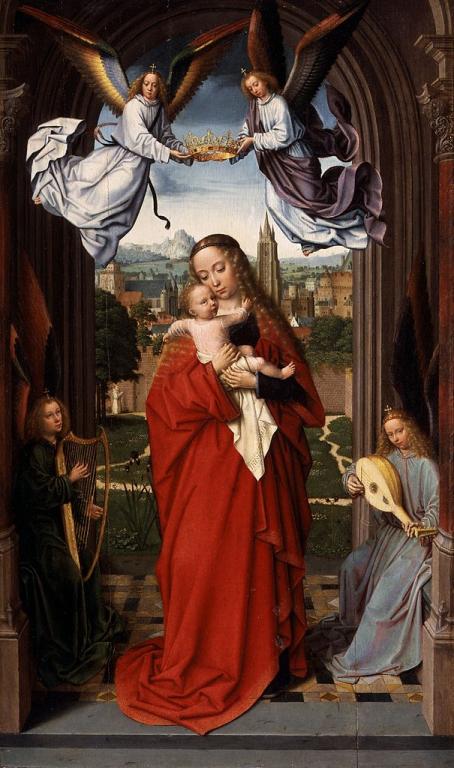
Photo credit: Virgin and Child with Four Angels, by Gerard David (c. 1450/1460-1523) [public domain / Wikimedia Commons]

***
Summary: Why doesn’t Scripture call Jesus an “only child”? Good question! I don’t know why. But I do know that there are at least five similar “problem areas” for Protestants, too.
Why Doesn't Scripture Call Jesus an "Only Child"?
Previous Post
September 5, 2022
Virgin Mary "Until"? (Matthew 1:25) (vs. Lucas Banzoli)
Next Post
September 7, 2022 James: "Brother" of Jesus: Josephus vs. the Bible & Hegesippus
Browse Our Archives
Select a Category & Last Things About Me Anti-Catholicism Atheism & Agnosticism Baptism and Sacramentalism Bible and Tradition Blessed Virgin Mary Books by Dave Armstrong C. S. Lewis Calvinism & General Protestantism Catholic Apologetics Catholic Apologists Catholic conversion Catholic converts Christmas Church (Ecclesiology) Church History Conversion and Converts Development of Doctrine Eastern Orthodoxy Ecumenism & Christian Unity Eucharist & Liturgy Fathers of the Church French Translations G. K. Chesterton Hell Hell & Satan Hell & Satan & Last Things Heresies & Comparative Religion Holistic Health Inquisition & Crusades & Scandals James White Jews & Judaism & Old Testament John Calvin John Henry Newman Liberal / Modernist Theology Life Issues Literary Resume Lutheranism Mariology Martin Luther Music Orthodoxy Papacy & Infallibility Personal Page Philosophy & Science Political & Ethical & Moral Issues Protestant Persecution & Intolerance Protestantism Purgatory Purgatory & Penance Romantic & Imaginative Theology Saints & Purgatory & Penance Salvation Salvation & Justification Satan & Last Things Sexuality and Gender Issues Spanish Translations Traditionalism vs. Radical Catholic Reactionaries Traducciones al español / tradução para português Trinitarianism & Christology Uncategorized Videos
Select a Month October 2026 September 2026 August 2026 July 2026 June 2026 May 2026 April 2026 March 2026 February 2026 January 2026 December 2025 November 2025 October 2025 September 2025 August 2025 July 2025 June 2025 May 2025 April 2025 March 2025 February 2025 January 2025 December 2024 November 2024 October 2024 September 2024 August 2024 July 2024 June 2024 May 2024 April 2024 March 2024 February 2024 January 2024 December 2023 November 2023 October 2023 September 2023 August 2023 July 2023 June 2023 May 2023 April 2023 March 2023 February 2023 January 2023 December 2022 November 2022 October 2022 September 2022 August 2022 July 2022 June 2022 May 2022 April 2022 March 2022 February 2022 January 2022 December 2021 November 2021 October 2021 September 2021 August 2021 July 2021 June 2021 May 2021 April 2021 March 2021 February 2021 January 2021 December 2020 November 2020 October 2020 September 2020 August 2020 July 2020 June 2020 May 2020 April 2020 March 2020 February 2020 January 2020 December 2019 November 2019 October 2019 September 2019 August 2019 July 2019 June 2019 May 2019 April 2019 March 2019 February 2019 January 2019 December 2018 November 2018 October 2018 September 2018 August 2018 July 2018 June 2018 May 2018 April 2018 March 2018 February 2018 January 2018 December 2017 November 2017 October 2017 September 2017 August 2017 July 2017 June 2017 May 2017 April 2017 March 2017 February 2017 January 2017 December 2016 November 2016 October 2016 September 2016 August 2016 July 2016 June 2016 May 2016 April 2016 March 2016 February 2016 January 2016 December 2015 November 2015 October 2015 September 2015 August 2015 July 2015 June 2015 May 2015 April 2015 March 2015 February 2015 January 2015 December 2014 November 2014 October 2014 September 2014 August 2014 July 2014 June 2014 April 2014 March 2014 February 2014 January 2014 December 2013 November 2013 October 2013 September 2013 August 2013 July 2013 June 2013 April 2013 March 2013 February 2013 January 2013 December 2012 November 2012 October 2012 September 2012 August 2012 July 2012 June 2012 May 2012 April 2012 March 2012 February 2012 January 2012 December 2011 November 2011 October 2011 September 2011 August 2011 July 2011 June 2011 April 2011 March 2011 February 2011 October 2010 September 2010 August 2010 July 2010 April 2010 March 2010 December 2009 October 2009 August 2009 July 2009 June 2009 May 2009 March 2009 February 2009 October 2008 September 2008 April 2008 March 2008 February 2008 January 2008 December 2007 November 2007 October 2007 May 2007 March 2007 February 2007 January 2007 November 2006 October 2006 September 2006 August 2006 July 2006 June 2006 May 2006 April 2006 March 2006 February 2006 October 2005 June 2005 April 2005 February 2005 July 2004 May 2004 April 2004
Follow Us!
TAKE THE
Religious Wisdom Quiz
What was Paul’s profession before becoming an apostle?
Select your answer to see how you score.
Tentmaker Tax Collector Fisherman Carpenter
Books by This Author Books by Dave Armstrong
Related posts from Biblical Evidence for Catholicism

Three More Anti-Catholic Lies About Catholicism (#6-4)
Biblical Evidence for Catholicism

Top Ten Anti-Catholic Lies (#10-7)
Biblical Evidence for Catholicism

Was Peter "Any Old" Apostle? 10 Anti-Papal Arguments
Biblical Evidence for Catholicism

Holy Ground: Why Mary Had NO Other Children...
Biblical Evidence for Catholicism
TRENDING AT PATHEOS Catholic

I was strolling through the top floor of the brand new Parthenon...

What Does Gêvâh Mean For Kimberley Guifoyle &...
This week, a lot of the news is focused on Kimberly Guilfoyle....

INNER CIRCLE: Profound Mystery (Of Christ In All...
Ephesians 5:31-32 “For this reason, a man will leave his father and...

Do Not Rejoice When Your Enemy Falls: The...
Turning an execution into a public spectacle is a disturbing expression of...

'The Chosen' S6 Trailer: The Passion Gets Very...
Not many watching 'The Chosen' worry about spoilers, but just because they...

The purpose-driven labor priest
A labor activist reads Rick Warren and it gets me wondering about...
view all Catholic blogs
Ad-Free & Subscriber Log-In Subscription Support
- About Us
- 2026 Calendar
- Videos
- Podcasts
- Library of World Religions
- Faith In Media Tracker
- Advertise With Us
- Write for Us
- Privacy Policy
- Terms of Service
- Do Not Sell My Data
- Contact Us
- Radiant Digital
- Manage Newsletter Subscriptions
- Unsubscribe From Notifications
- Sitemap
Copyright 2008-2026, Patheos. All rights reserved.
Subscription Support Ad-Free & Subscriber Log-In
Follow Patheos