
BuddhistCatholicContemplativeEvangelicalGeneral ChristianHinduJewishLatter-day SaintMuslimNew VisionsProgressive Christian
Beliefs
- Buddhist
- Catholic
- Contemplative
- Evangelical
- General Christian
- Hindu
- Jewish
- Latter-day Saint
- More Voices
- Muslim
- New Visions
- Pagan
- Progressive Christian
Topics
- Religion News
- Food and Religion
- Sports and Religion
- Religious Art
- Religious Music and Entertainment
- Religious Events
- History and Religion
- Style and Religion
- Politics and Religion
- Women in Religion
- Recreation Outdoors and Religion
- Business Finance and Religion
- Careers Workplace and Religion
- Education and Religion
- Family Parenting and Religion
- Health Fitness and Religion
- Home and Religion
- Relationships and Religion
- Technology and Religion
- Travel and Religion
Columnists
- Buddhist Columnists
- Business Finance and Religion Columnists
- Careers Workplace and Religion Columnists
- Catholic Columnists
- Contemplative Columnists
- Education and Religion Columnists
- Evangelists Columnists
- Family Parenting and Religion Columnists
- General Christian Columnists
- Health Fitness and Religion Columnists
- Hindu Columnists
- History and Religion Columnists
- Home and Religion Columnists
- Jewish Columnists
- More Voices Columnists
- Latter Day Columnists
- Muslim Columnists
- New Visions Columnists
- Nonreligious Columnists
- Pagan Columnists
- Politics and Religion Columnists
- Progressive Columnists
- Recreation Outdoors and Religion Columnists
- Relationships and Religion Columnists
- Religion News Columnists
- Religious Art Columnists
- Religious Events Columnists
- Religious Music and Entertainment Columnists
- Sports and Religion Columnists
- Style and Religion Columnists
- Technology and Religion Columnists
- Travel and Religion Columnists
- Women in Religion Columnists
Resource Library
- 2026 Calendar
- Library of World Religions
- The 100 Most Holy Places on Earth
- Patheos Answers
- Podcasts
- Videos
- Faith Leaders Database
- Anglican Episcopalian
- Bahai
- Baptist
- Buddhism
- Christianity
- Confucianism
- Eastern Orthodoxy
- Hinduism
- Holiness and Pentecostal
- ISKCON
- Islam
- Judaism
- Lutheran
- Methodist
- The Church of Jesus Christ of Latter-day Saints
- New Age
- Paganism
- Presbytarian and Reformed
- Protestantism
- Religion Behind the Scenes
- Roman Catholic
- Scientology
- Shia Islam
- Sikhism
- Sufism
- Sunni Islam
- Taoism
- Zen
- See all religions
Research Tools
 Ad-Free & Subscriber Log-In Subscription Support
Ad-Free & Subscriber Log-In Subscription Support
Follow Patheos 

- Trending:
- Forgiveness
- |
- Marriage
- |
- Consciousness
- |
- Death Penalty
- |
- Election
- |
- Halloween

-
About
-
Catholic Apologetics
-
Church History
-
Great Apologists
-
Christian Worldview
-
Protestantism & Misc.
- Home
- Catholic
- History and Religion
- St. Ignatius & Eucharistic Real Presence (vs. Lucas Banzoli)
St. Ignatius & Eucharistic Real Presence (vs. Lucas Banzoli)
Last updated on: February 21, 2023 at 3:57 pm by Dave Armstrong
St. Ignatius & Eucharistic Real Presence (vs. Lucas Banzoli) 2023-02-21T15:57:30-04:00 Dave Armstrong
Patheos Explore the world's faith through different perspectives on religion and spirituality! Patheos has the views of the prevalent religions and spiritualities of the world.
Lucas Banzoli is a very active Brazilian anti-Catholic polemicist, who holds to basically a Seventh-Day Adventist theology, whereby there is no such thing as a soul that consciously exists outside of a body, and no hell (soul sleep and annihilationism). This leads him to a Christology which is deficient and heterodox in terms of Christ’s human nature after His death. He has a Master’s degree in theology, a degree and postgraduate work in history, a license in letters, and is a history teacher, author of 25 books, as well as blogmaster (but now inactive) for six blogs. He’s active on YouTube.
This is my 23rd refutation of articles written by Lucas Banzoli. As of yet, I haven’t received a single word in reply to any of them (or if Banzoli has replied to anything, anywhere, he certainly hasn’t informed me of it). Readers may decide for themselves why that is the case. His words will be in blue. I use RSV for the Bible passages unless otherwise indicated.
*****
I’m replying to a portion of Lucas’ article, “Os Pais da Igreja e a transubstanciação – Parte 1” [The Church Fathers and Transubstantiation (Part 1)] (8-22-12). Citations of St. Ignatius of Antioch (in Lucas’ text and my own) are from the standard Schaff collection of the Church fathers, unless otherwise indicated.
It is common to see Catholics citing Ignatius, Justin, Augustine and others in favor of “transubstantiation”. But what they said was only what Christ himself said: that the bread was his body and the wine was his blood, just as He said He was the true vine, the door, the way, the light, etc. Nothing in the statements indicates or implies any sign of literalism or materialism.
The Church Fathers sometimes repeated the same truths that Christ taught, but likewise did not believe that the statements were literal, but rather, that they were symbolic and figurative statements. To quote Ignatius [of Antioch], for example, to “prove” transubstantiation because he said that the bread is the body of Christ is as illogical as to believe that faith, the gospel, and himself are the flesh of Christ(!), for he said:
I flee to the Gospel as to the flesh of Jesus, and to the apostles as to the presbytery of the Church. (To the Philippians [should be Philadelphians], 5:1)
Wherefore, clothing yourselves with meekness, be renewed in faith, that is the flesh of the Lord, and in love, that is the blood of Jesus Christ. (Ignatius to the Trallians, 8:1)
Ignatius affirms that the gospel is the “flesh of Jesus” and faith is the “flesh of the Lord”. These are evident proofs of symbolism, of metaphor. If we were to grant his words literally, we would have to assume that he himself was the “bread of Christ,” for he said:
Allow me to become food for the wild beasts, through whose instrumentality it will be granted me to attain to God. I am the wheat of God, and let me be ground by the teeth of the wild beasts, that I may be found the pure bread of Christ. (Ignatius to the Romans, 4:1)
The fact that Ignatius said that he would be presented as “the clean bread of Christ” does not mean that he would literally “transubstantiate” himself into the form of bread. All language was merely symbolic.
These three utterances are symbolic (I agree). The question then becomes: is this the only sense in which St. Ignatius uses eucharistic language or talks about the Holy Eucharist? And of course it’s not, as I will prove. The two things aren’t mutually exclusive. In his epistle to the Philadelphians, in the chapter before the one Lucas cites (4), he also writes (seemingly literally):
Take heed, then, to have but one Eucharist. For there is one flesh of our Lord Jesus Christ, and one cup to [show forth] the unity of His blood; one altar; as there is one bishop, . . .
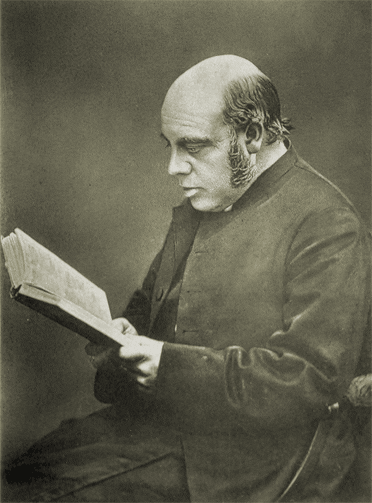
The great Anglican scholar J. B. Lightfoot (pictured at the top) translates this passage as: “Therefore take care to keep the eucharistic feast only; for Christ’s flesh is one and His blood is one . . . so that all may be one by partaking of His own blood” (The Apostolic Fathers: Clement, Ignatius, and Polycarp, five volumes, 1890; reprinted by Baker Book House [Grand Rapids, Michigan, 1981]; I cite Part Two, Volume 2, pp. 257-258)
Therefore, Catholic attempts to interpret certain statements of the Church Fathers literally when they said that the bread was the body and the wine the blood of Christ fail, since very similar statements were clearly symbolic, and they were metaphors, without necessarily requiring any allusion to literalism.
We must, therefore, be very careful with what Catholic websites and blogs have to pass us on from patristic statements that apparently resemble Catholic belief, but which actually apply perfectly to symbolism and figurative expression, as the Church Fathers id not have in mind the Catholic cannibalistic thesis of the transubstantiation of the elements in the Supper. . . .
Lucas’ problem, which is extremely common in Protestant treatments of the Church fathers (as I know, from 25 years of online debates with them), is to select only certain statements from the fathers that appear to support (but don’t actually support) their view, while ignoring other equally relevant ones that do not support their late-arriving Protestant position.
Thus, he presents the three examples above where Ignatius writes symbolically (and I agree that he does), while ignoring his literal eucharistic statements, and also scholars‘ opinions of his eucharistic theology. I provide both, so that readers will have the full picture, not a “half-truth” and propagandistic presentation.
St. Ignatius expresses eucharistic realism in no uncertain terms here:
They abstain from the Eucharist and from prayer, because they confess not the Eucharist to be the flesh of our Saviour Jesus Christ, which suffered for our sins, and which the Father, of His goodness, raised up again. (To the Smyrnaeans, ch. 7 [or, 6 in some sources])
I desire the drink of God, namely His blood, which is incorruptible love and eternal life. (Ignatius to the Romans, 7:3)
Lucas cuts off the beginning of Ignatius’ thought, so that it appears less “realistic” than it would otherwise have seemed. Here’s the whole thing:
I have no delight in corruptible food, nor in the pleasures of this life. I desire the bread of God, the heavenly bread, the bread of life, which is the flesh of Jesus Christ, the Son of God, who became afterwards of the seed of David and Abraham; and I desire the drink of God, namely His blood, which is incorruptible love and eternal life.
Renowned Anglican patristics scholar J. N. D. Kelly writes about this passage and the one in the letter to the Smyrnaeans, above:
The bread is the flesh of Jesus, the cup His blood. Clearly he intends this realism to be taken strictly, for he makes it the basis of his argument against the Docetists’ denial of the reality of Christ’s body. (Early Christian Doctrines, HarperSanFrancisco, revised edition of 1978, p. 197; he refers to: “he . . . blasphemes my Lord, not confessing that He was [truly] possessed of a body”: Smyrnaeans, ch. 5 in Schaff; Kelly says it is in ch. 6)
Again, St. Ignatius teaches the substantial Real Presence of Jesus in the Eucharist:
. . . breaking one and the same bread, which is the medicine of immortality, and the antidote to prevent us from dying, but [which causes] that we should live for ever in Jesus Christ. (To the Ephesians, ch. 20, 2)
Kelly comments:
Because the eucharist brings Christians into union with their Lord, it is the great bond between them, and since it mediates communion with Christ, it is a medicine which procures immortality, . . . an antidote against death which enables us to live in the Lord forever. (Ibid., 197-198)
Eminent Protestant Church historian Philip Schaff summed up Ignatius’ eucharistic theology:
Ignatius speaks of this sacrament in two passages, only by way of allusion, but in very strong, mystical terms, calling it the flesh of our crucified and risen Lord Jesus Christ, and the consecrated bread a medicine of immortality and an antidote of spiritual death. This view, closely connected with his high-churchly tendency in general, no doubt involves belief in the real presence, and ascribes to the holy Supper an effect on spirit and body at once, with reference to the future resurrection, but is still somewhat obscure, and rather an expression of elevated feeling than a logical definition. (History of the Christian Church, § 69. The Doctrine of the Eucharist; my italics)
“Real presence” is not mere symbolism. St. Ignatius — in the first century, not long after the death of Christ — clearly had a Catholic view: one entirely consistent with transubstantiation, although the full development of that doctrine came a little while later, as we should expect and see in the case of all Christian doctrines.
Jaroslav Pelikan, writing at the time as a Lutheran, concurred in his scholarly opinion concerning St. Ignatius’ eucharistic theology. Citing Smyrnaeans, ch. 7 [or, 6], he stated:
In some early Christian writers that presupposition [“special presence” in the previous sentence] was expressed in strikingly realistic language. Ignatius . . . assert[ed] the reality of Christ’s presence in the Eucharist against docetists, who regarded his flesh as a phantasm both in the incarnation and in the Eucharist . . .
The theologians [in the 1st and 2nd centuries] did not have adequate concepts within which to formulate a doctrine of the real presence that evidently was already believed by the church even though it was not yet taught by explicit instruction or confessed by creeds.
As Irenaeus’ reference to the Eucharist as “not common bread” indicates, however, this doctrine of the real presence believed by the church and affirmed in its liturgy was closely tied to the idea of the Eucharist as a sacrifice. (The Christian Tradition: A History of the Development of Doctrine: Vol. 1 of 5: The Emergence of the Catholic Tradition (100-600), Chicago: University of Chicago Press, 1971, p. 168)
Ignatius of Antioch (35-107) . . . stated:
Nothing that is visible is good. Indeed, our God Jesus Christ, being now with his Father, becomes even more manifest. (To the Trallians, 3:3) [Google translation of Lucas’ Portugese original: “Nada do que é visível é bom. De fato, nosso Deus Jesus Cristo, estando agora com o seu Pai, torna-se manifesto ainda mais” (Inácio aos Tralianos, 3:3) ]
Lucas has the incorrect citation here. It’s actually Letter to the Romans, ch. 3, 3:
Nothing visible is eternal. For the things which are seen are temporal, but the things which are not seen are eternal. For our God, Jesus Christ, now that He is with the Father, is all the more revealed [in His glory].
Ignatius certainly would not have said that “nothing that is visible is good” if he believed that Jesus physically changes himself into a piece of bread at the Supper. If that were so, Ignatius would be saying that Jesus himself is not good! The fact is that he believed that Jesus is “now with his Father,” and not physically on earth.
Schaff translates the phrase as “Nothing visible is eternal” but Lightfoot has “Nothing visible is of any worth” (Ibid., p. 202). If Ignatius had intended this as a universal, literal statement, it would have been expressing flat-out docetic or gnostic heresy: as if matter is evil. Ignatius opposed the Docetists, as was noted above by two patristic scholars. In fact, it couldn’t have been an absolute statement because Ignatius goes on to say that “Jesus Christ, now that He is with the Father, is all the more revealed.” He‘s certainly eternal.
St. Ignatius seems to have had in mind 2 Corinthians 4:18: “because we look not to the things that are seen but to the things that are unseen; for the things that are seen are transient, but the things that are unseen are eternal.” Schaff inserted the passage in italics. If in fact this were the case, “eternal” is the better translation because it parallels this Scripture. “Nothing visible is eternal” corresponds to “the things that are seen are transient.” They’re not bad per se; they’re simply not eternal. They pass away. But not all of them pass away, because Jesus is still seen in heaven.
So Lucas’ argument here about Ignatius: Romans 3, 3 is absurd, proves too much, and is therefore its own refutation. St. Ignatius had a Catholic view of the Eucharist, not a low-church Protestant symbolic view. All the reputable scholars and Church historians agree with this opinion: which is likely why Lucas cited none. Out of sight, out of mind . . .
***
Practical Matters: Perhaps some of my 4,000+ free online articles (the most comprehensive “one-stop” Catholic apologetics site) or fifty books have helped you (by God’s grace) to decide to become Catholic or to return to the Church, or better understand some doctrines and why we believe them.
Or you may believe my work is worthy to support for the purpose of apologetics and evangelism in general. If so, please seriously consider a much-needed financial contribution. I’m always in need of more funds: especially monthly support. “The laborer is worthy of his wages” (1 Tim 5:18, NKJV). 1 December 2021 was my 20th anniversary as a full-time Catholic apologist, and February 2022 marked the 25th anniversary of my blog.
PayPal donations are the easiest: just send to my email address: [email protected]. You’ll see the term “Catholic Used Book Service”, which is my old side-business. To learn about the different methods of contributing, including 100% tax deduction, etc., see my page: About Catholic Apologist Dave Armstrong / Donation Information. Thanks a million from the bottom of my heart!
***
Photo credit: Joseph Barber Lightfoot (1828-1889): Anglican biblical scholar, translator of the early Church fathers and Bishop of Durham. He was a key advocate of the authenticity of the epistles of St. Ignatius of Antioch [public domain / Wikimedia Commons]
***
Summary: Brazilian Protestant apologist Lucas Banzoli wrote about Ignatius & eucharistic real presence, and claimed that he held a purely symbolic view. He was dead wrong.
development of eucharistic doctrine
Fathers & eucharistic sacrifice
Ignatius & Eucharistic Real Presence
patristic eucharistic theology
Previous Post

September 11, 2022
Lucas Banzoli's Mindless Denigration of an Imagined "Mary"


Browse Our Archives
Select a Category & Last Things About Me Anti-Catholicism Atheism & Agnosticism Baptism and Sacramentalism Bible and Tradition Blessed Virgin Mary Books by Dave Armstrong C. S. Lewis Calvinism & General Protestantism Catholic Apologetics Catholic Apologists Catholic conversion Catholic converts Christmas Church (Ecclesiology) Church History Conversion and Converts Development of Doctrine Eastern Orthodoxy Ecumenism & Christian Unity Eucharist & Liturgy Fathers of the Church French Translations G. K. Chesterton Hell Hell & Satan Hell & Satan & Last Things Heresies & Comparative Religion Holistic Health Inquisition & Crusades & Scandals James White Jews & Judaism & Old Testament John Calvin John Henry Newman Liberal / Modernist Theology Life Issues Literary Resume Lutheranism Mariology Martin Luther Music Orthodoxy Papacy & Infallibility Personal Page Philosophy & Science Political & Ethical & Moral Issues Protestant Persecution & Intolerance Protestantism Purgatory Purgatory & Penance Romantic & Imaginative Theology Saints & Purgatory & Penance Salvation Salvation & Justification Satan & Last Things Sexuality and Gender Issues Spanish Translations Traditionalism vs. Radical Catholic Reactionaries Traducciones al español / tradução para português Trinitarianism & Christology Uncategorized Videos
Select a Month October 2026 September 2026 August 2026 July 2026 June 2026 May 2026 April 2026 March 2026 February 2026 January 2026 December 2025 November 2025 October 2025 September 2025 August 2025 July 2025 June 2025 May 2025 April 2025 March 2025 February 2025 January 2025 December 2024 November 2024 October 2024 September 2024 August 2024 July 2024 June 2024 May 2024 April 2024 March 2024 February 2024 January 2024 December 2023 November 2023 October 2023 September 2023 August 2023 July 2023 June 2023 May 2023 April 2023 March 2023 February 2023 January 2023 December 2022 November 2022 October 2022 September 2022 August 2022 July 2022 June 2022 May 2022 April 2022 March 2022 February 2022 January 2022 December 2021 November 2021 October 2021 September 2021 August 2021 July 2021 June 2021 May 2021 April 2021 March 2021 February 2021 January 2021 December 2020 November 2020 October 2020 September 2020 August 2020 July 2020 June 2020 May 2020 April 2020 March 2020 February 2020 January 2020 December 2019 November 2019 October 2019 September 2019 August 2019 July 2019 June 2019 May 2019 April 2019 March 2019 February 2019 January 2019 December 2018 November 2018 October 2018 September 2018 August 2018 July 2018 June 2018 May 2018 April 2018 March 2018 February 2018 January 2018 December 2017 November 2017 October 2017 September 2017 August 2017 July 2017 June 2017 May 2017 April 2017 March 2017 February 2017 January 2017 December 2016 November 2016 October 2016 September 2016 August 2016 July 2016 June 2016 May 2016 April 2016 March 2016 February 2016 January 2016 December 2015 November 2015 October 2015 September 2015 August 2015 July 2015 June 2015 May 2015 April 2015 March 2015 February 2015 January 2015 December 2014 November 2014 October 2014 September 2014 August 2014 July 2014 June 2014 April 2014 March 2014 February 2014 January 2014 December 2013 November 2013 October 2013 September 2013 August 2013 July 2013 June 2013 April 2013 March 2013 February 2013 January 2013 December 2012 November 2012 October 2012 September 2012 August 2012 July 2012 June 2012 May 2012 April 2012 March 2012 February 2012 January 2012 December 2011 November 2011 October 2011 September 2011 August 2011 July 2011 June 2011 April 2011 March 2011 February 2011 October 2010 September 2010 August 2010 July 2010 April 2010 March 2010 December 2009 October 2009 August 2009 July 2009 June 2009 May 2009 March 2009 February 2009 October 2008 September 2008 April 2008 March 2008 February 2008 January 2008 December 2007 November 2007 October 2007 May 2007 March 2007 February 2007 January 2007 November 2006 October 2006 September 2006 August 2006 July 2006 June 2006 May 2006 April 2006 March 2006 February 2006 October 2005 June 2005 April 2005 February 2005 July 2004 May 2004 April 2004
Follow Us!
TAKE THE
Religious Wisdom Quiz
Which book of the Bible records Paul’s shipwreck?
Select your answer to see how you score.
2 Timothy Romans 1 Corinthians Acts
Books by This Author Books by Dave Armstrong
Related posts from Biblical Evidence for Catholicism

Three More Anti-Catholic Lies About Catholicism (#6-4)
Biblical Evidence for Catholicism

Top Ten Anti-Catholic Lies (#10-7)
Biblical Evidence for Catholicism

Was Peter "Any Old" Apostle? 10 Anti-Papal Arguments
Biblical Evidence for Catholicism

17 Church Fathers on Purgatory (Esp. 1 Cor...
Biblical Evidence for Catholicism
TRENDING AT PATHEOS Catholic

In "Irreplaceable," our book on vocation and technology, Trevor Sutton and I...

I was strolling through the top floor of the brand new Parthenon...

What Does Gêvâh Mean For Kimberley Guifoyle &...
This week, a lot of the news is focused on Kimberly Guilfoyle....

INNER CIRCLE: Profound Mystery (Of Christ In All...
Ephesians 5:31-32 “For this reason, a man will leave his father and...

Do Not Rejoice When Your Enemy Falls: The...
Turning an execution into a public spectacle is a disturbing expression of...

'The Chosen' S6 Trailer: The Passion Gets Very...
Not many watching 'The Chosen' worry about spoilers, but just because they...
view all Catholic blogs
Ad-Free & Subscriber Log-In Subscription Support
- About Us
- 2026 Calendar
- Videos
- Podcasts
- Library of World Religions
- Faith In Media Tracker
- Advertise With Us
- Write for Us
- Privacy Policy
- Terms of Service
- Do Not Sell My Data
- Contact Us
- Radiant Digital
- Manage Newsletter Subscriptions
- Unsubscribe From Notifications
- Sitemap
Copyright 2008-2026, Patheos. All rights reserved.
Subscription Support Ad-Free & Subscriber Log-In
Follow Patheos