
BuddhistCatholicContemplativeEvangelicalGeneral ChristianHinduJewishLatter-day SaintMuslimNew VisionsProgressive Christian
Beliefs
- Buddhist
- Catholic
- Contemplative
- Evangelical
- General Christian
- Hindu
- Jewish
- Latter-day Saint
- More Voices
- Muslim
- New Visions
- Pagan
- Progressive Christian
Topics
- Religion News
- Food and Religion
- Sports and Religion
- Religious Art
- Religious Music and Entertainment
- Religious Events
- History and Religion
- Style and Religion
- Politics and Religion
- Women in Religion
- Recreation Outdoors and Religion
- Business Finance and Religion
- Careers Workplace and Religion
- Education and Religion
- Family Parenting and Religion
- Health Fitness and Religion
- Home and Religion
- Relationships and Religion
- Technology and Religion
- Travel and Religion
Columnists
- Buddhist Columnists
- Business Finance and Religion Columnists
- Careers Workplace and Religion Columnists
- Catholic Columnists
- Contemplative Columnists
- Education and Religion Columnists
- Evangelists Columnists
- Family Parenting and Religion Columnists
- General Christian Columnists
- Health Fitness and Religion Columnists
- Hindu Columnists
- History and Religion Columnists
- Home and Religion Columnists
- Jewish Columnists
- More Voices Columnists
- Latter Day Columnists
- Muslim Columnists
- New Visions Columnists
- Nonreligious Columnists
- Pagan Columnists
- Politics and Religion Columnists
- Progressive Columnists
- Recreation Outdoors and Religion Columnists
- Relationships and Religion Columnists
- Religion News Columnists
- Religious Art Columnists
- Religious Events Columnists
- Religious Music and Entertainment Columnists
- Sports and Religion Columnists
- Style and Religion Columnists
- Technology and Religion Columnists
- Travel and Religion Columnists
- Women in Religion Columnists
Resource Library
- 2026 Calendar
- Library of World Religions
- The 100 Most Holy Places on Earth
- Patheos Answers
- Podcasts
- Videos
- Faith Leaders Database
- Anglican Episcopalian
- Bahai
- Baptist
- Buddhism
- Christianity
- Confucianism
- Eastern Orthodoxy
- Hinduism
- Holiness and Pentecostal
- ISKCON
- Islam
- Judaism
- Lutheran
- Methodist
- The Church of Jesus Christ of Latter-day Saints
- New Age
- Paganism
- Presbytarian and Reformed
- Protestantism
- Religion Behind the Scenes
- Roman Catholic
- Scientology
- Shia Islam
- Sikhism
- Sufism
- Sunni Islam
- Taoism
- Zen
- See all religions
Research Tools
 Ad-Free & Subscriber Log-In Subscription Support
Ad-Free & Subscriber Log-In Subscription Support
Follow Patheos 

- Trending:
- Forgiveness
- |
- Marriage
- |
- Consciousness
- |
- Death Penalty
- |
- Election
- |
- Halloween

-
About
-
Catholic Apologetics
-
Church History
-
Great Apologists
-
Christian Worldview
-
Protestantism & Misc.
- Home
- Catholic
- History and Religion
- Turretin, 1 Timothy 3:15, Infallibility, & Eisegesis
Turretin, 1 Timothy 3:15, Infallibility, & Eisegesis
Last updated on: June 6, 2026 at 12:47 am by Dave Armstrong
Turretin, 1 Timothy 3:15, Infallibility, & Eisegesis 2026-06-06T00:47:19-04:00 Dave Armstrong
Patheos Explore the world's faith through different perspectives on religion and spirituality! Patheos has the views of the prevalent religions and spiritualities of the world.
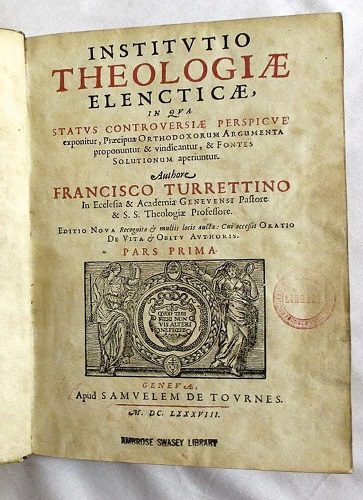
François Turretin (1623-1687) was a Genevan-Italian Reformed scholastic theologian, earnest defender of the Calvinistic orthodoxy represented by the Synod of Dort, and one of the authors of the Helvetic Consensus (1675). His Institutes of Elenctic Theology (three parts, Geneva, 1679–1685) used the scholastic method. It was a popular textbook; notably at Princeton Theological Seminary, until it was replaced by Charles Hodge‘s Systematic Theology in the late 19th century. Turretin also greatly influenced the Puritans.
*****
I am replying to a portion of a piece from Turretin simply entitled “The Scriptures”: from the website, A Puritan’s Mind. No further information was provided as to what work it is drawn from, but a search revealed that it is from Institutes of Elenctic Theology. His words will be in blue.
1 Timothy 3:15 (RSV) if I am delayed, you may know how one ought to behave in the household of God, which is the church of the living God, the pillar and bulwark of the truth.
The church is called “pillar and bulwark of truth” (I Tim. 3:15), not because it keeps truth from falling and provides authority for it, since truth is rather the foundation of the church, upon which it is built (Eph. 2:20), . . .
This is just silly, and plainly illegitimate exegesis (actually, a classic specimen of eisegesis). One doesn’t explain the phrase “the church [is] the pillar and bulwark of truth” by saying that truth is its own pillar. Indeed, both things might be (and this case, are) true, in the paradoxical Hebraic “both/and” mindset. But the first proposition is not explained by the other. It’s simply changing the subject, or in logic, what’s known as the Ignoratio elenchi fallacy; more popularly known as a “red herring.”
Ephesians 2:19-22 So then you are no longer strangers and sojourners, but you are fellow citizens with the saints and members of the household of God, [20] built upon the foundation of the apostles and prophets, Christ Jesus himself being the cornerstone, [21] in whom the whole structure is joined together and grows into a holy temple in the Lord; [22] in whom you also are built into it for a dwelling place of God in the Spirit.
This citation he gives (I’ve provided a fuller context) doesn’t specifically assert that the Church was built upon “truth” (that word never appears in it). What it does add to the discussion, however, merely supports the Catholic position, and not Turretin’s. I wrote about Ephesians 2:19-22 in my book, 100 Biblical Arguments Against Sola Scriptura (2012, pp. 105-106, #82):
1 Timothy 3:15 defines “household of God” as “the church of the living God.” Therefore, we know that Ephesians 2:19-21 is also referring to the Church, even though that word is not present. Here the Church’s own “foundation” is “the apostles and prophets, Christ Jesus himself being the cornerstone.” The foundation of the Church itself is Jesus and apostles and prophets.
Prophets spoke “in the name of the Lord” (1 Chron 21:19; 2 Chron 33:18; Jer 26:9), and commonly introduced their utterances with “thus says the Lord” (Is 10:24; Jer 4:3; 26:4; Ezek 13:8; Amos 3:11-12; and many more). They spoke the “word of the Lord” (Is 1:10; 38:4; Jer 1:2; 13:3, 8; 14:1; Ezek 13:1-2; Hos 1:1; Joel 1:1; Jon 1:1; Mic 1:1, et cetera). These communications cannot contain any untruths insofar as they truly originate from God, with the prophet serving as a spokesman or intermediary of God (Jer 2:2; 26:8; Ezek 11:5; Zech 1:6; and many more). Likewise, apostles proclaimed truth unmixed with error (1 Cor 2:7-13; 1 Tim 2:7; 2 Tim 1:11-14; 2 Pet 1:12-21).
Does this foundation have any faults or cracks? Since Jesus is the cornerstone, he can hardly be a faulty foundation. Neither can the apostles or prophets err when teaching the inspired gospel message or proclaiming God’s word. In the way that apostles and prophets are infallible, so is the Church set up by our Lord Jesus Christ. We ourselves (all Christians) are incorporated into the Church (following the metaphor), on top of the foundation.
but because [the Scripture] offers itself and shows itself to the sight of all in the church as on a bulletin board. So “pillar” is used not in its architectural meaning, as pillars “‘ are placed to hold up a building, but in its forensic and political meaning, as the edicts of the princes and the decrees and laws of the magistrate used to ‘be posted on pillars in front of the curias and praetoriums, and the doors of [secular] basilicas, so that they might become known by everybody, as Pliny and Josephus report (Historia Naturalis 6.28 [(32) 152]; Antiquities 1.4 [book 1.69 – 71]). So the church is the pillar of truth both in the matter of its proclamation, for it is obliged to proclaim the laws of God, and the heavenly truth is posted on her so that it may be known by all, [my added italics]
In an effort to escape the plain and evident meaning of the text, he goes back to Roman examples, drawing from Pliny and Josephus. This is valid, provided there is a clearly indicated link to a particular biblical text. I submit that this is not the case here, and that this is more desperate eisegesis. Turretin somehow (in his mind) can transform the notion of the Church being a “pillar and bulwark of the truth”: literally holding it up and supporting it, to the idea that it is merely a post where decrees and laws (analogous to theological doctrines) were posted in ancient Rome (sort of like Luther’s door of the Wittenberg church, where he posted his 95 feces, er, Theses). Nothing whatsoever in the biblical text (that I can see) suggests this.
Many classic Protestant commentaries provide interpretations that are quite similar to Catholic ones, if not identical:
[T]he same Church is painted as a massive pillar, holding up and displaying before men and angels the truth—the saving truth of the gospel. In the first picture, the thought of a great company gathered together for God to dwell among is prominent: in the second, the thought of the great redemption-truth alone comes to the front, and the Church of God is no longer viewed as a company of separate individuals, but as one massive foundation-pillar, supporting and displaying the glories of redemption.
This peculiar aspect of the Church, ”the support and pillar of the truth,” was dwelt upon probably by the Apostle as “defining—with indirect allusion to nascent and developing heresies—the true note, office, and vocation of the Church. . . . Were there no Church, there would be no witness, no guardian of archives, no basis, nothing whereon acknowledged truth could rest” (Ellicott). (Ellicott’s Commentary for English Readers)
[T]the truth of God – that revealed truth which he had given to save the world – was entrusted to the church; that it was designed to preserve it pure, to defend it, and to transmit it to future times; and that, therefore, every one to whom the administration of the affairs of the church was entrusted, should engage in this duty with a deep conviction of his responsibility. On the construction of the passage, Bloomfield Rosenmuller, and Clarke, may be consulted. The word “pillar” means a column, such as that by which a building is supported, and then any firm prop or support; Galatians 2:9; Revelation 3:12. If it refers to the church here, it means that that is the support of the truth, as a pillar is of a building. It sustains it amidst the war of elements, the natural tendency to fall, and the assaults which may be made on it, and preserves it when it would otherwise tumble into ruin.
Thus it is with the church. It is entrusted with the business of maintaining the truth, of defending it from the assaults of error, and of transmitting it to future times. The truth is, in fact, upheld in the world by the church. The people of the world feel no interest in defending it, and it is to the church of Christ that it is owing that it is preserved and transmitted from age to age. The word rendered “ground” – ἑδραίωμα hedraiōma – means, properly, a basis, or foundation. The figure here is evidently taken from architecture, as the use of the word pillar is. The proper meaning of the one expression would be, that truth is supported by the church. as an edifice is by a pillar; of the other, that the truth rests “on” the church, as a house does on its foundation. It is that which makes it fixed, stable, permanent; that on which it securely stands amidst storms and tempests; that which renders it firm when systems of error are swept away as a house that is built on the sand; compare notes on Matthew 7:24-27.
The meaning then is, that the stability of the truth on earth is dependent on the church. It is owing to the fact that the church is itself founded on a rock, that the gates of hell cannot prevail against it, that no storms of persecution can overthrow it, that the truth is preserved from age to age. Other systems of religion are swept away; other opinions change; other forms of doctrine vanish; but the knowledge of the great system of redemption is preserved on earth unshaken, because the church is preserved, and because its foundations cannot be moved. This does not refer, I suppose, to creeds and confessions, or to the decisions of synods and councils; but to the living spirit of truth and piety “in” the church itself. As certainly as the church continues to live, so certain it will be that the truth of God will be perpetuated among people. (Barnes’ Notes on the Bible)
The Church is “the pillar of the truth,” as the continued existence (historically) of the truth rests on it; for it supports and preserves the word of truth. He who is of the truth belongs by the very fact to the Church. Christ is the alone ground of the truth in the highest sense (1Co 3:11). The apostles are foundations in a secondary sense (Eph 2:20; Re 21:14). The Church rests on the truth as it is in Christ; not the truth on the Church. But the truth as it is in itself is to be distinguished from the truth as it is acknowledged in the world. In the former sense it needs no pillar, but supports itself; in the latter sense, it needs the Church as its pillar, that is, its supporter and preserver [Baumgarten]. The importance of Timothy’s commission is set forth by reminding him of the excellence of “the house” in which he serves; and this in opposition to the coming heresies which Paul presciently forewarns him of immediately after (1Ti 4:1). The Church is to be the stay of the truth and its conserver for the world, and God’s instrument for securing its continuance on earth, in opposition to those heresies (Mt 16:18; 28:20). The apostle does not recognize a Church which has not the truth, or has it only in part. (Jamieson-Fausset-Brown Bible Commentary)
It is therefore better to understand this clause as descriptive of the Church of God. The Church is the pillar of the truth. It supports it; holds it together – binds together its different parts. And it is the ground of the truth. By it the truth is made fast, firm, and fixed. The ground (ἑδραίωμα). This word only occurs here at all; ἑδραῖος, common both in the New Testament, the LXX., and in classical Greek, means “fixed,” “firm,” or” fast.” In the A.V. of 1 Corinthians 7:37 and 1 Cor 15:58, “steadfast;” Colossians 1:23 (where it is coupled with τεθεμελιωμένα), “settled.” Thence ἑδραιόω in late Greek, “to make firm or fast,” and ἑδραίμα, the “establishment” or “grounding” of the truth; that in and by which the truth is placed on a sure and fixed basis. (Pulpit Commentary)
The idea is that the church is the pillar, and, as such, the prop or support of the truth. It is quite beside the mark to press the architectural metaphor into detail. . . . The church is the pillar of the truth, and the function of the pillar is to support. (Vincent’s Word Studies)
[T]he pillar and the basement both belong to the house. . . . The way in which the congregation of the faithful is the pillar and basement of the truth is . . . that it is the element in which and medium by which the truth is conserved and upheld. (Greek Testament Critical Exegetical Commentary – Alford)
While our Lord was on earth He said, “I am the truth.” He is so still; and His Word is the truth. The church is here to maintain this truth on earth, to contend earnestly for the faith delivered unto the saints. She is the witness for Christ on earth, Christ who is hidden now with God. Therefore the true Church is the pillar of the truth, in proclaiming it. Woe! to the men who meddle with the truth of God, and by their wicked criticism try to undermine the support of the pillar and the house of God. God shall destroy them for their evil work (1Corinthians 3:17). When the Church leaves the earth, then the truth will be abandoned, and complete apostasy has come. As long as the true Church (though it only may be a feeble remnant) the pillar and support of the truth, is on the earth, the complete apostasy cannot come (2Thessalonians 2:1-17). From all this we learn that the presence of the living God and the maintenance of the truth are the foremost characteristics of the house of God. (Gaebelein’s Annotated Bible)
The meaning couldn’t be clearer or more perspicuous than it is. In relation to the truth, the Church — according to the above Protestant commentaries (direct quotes) — is the massive foundation-pillar, guardian, preserver, defender, transmitter, prop, support, upholder, foundation, God’s instrument for securing its continuance, and preventer of apostasy.
All that remains is the notion of infallibility and indefectibility of the Church. I wrote further in my sola Scriptura book, making the case:
Pillars and foundations support things and prevent them from collapsing. To be a “bulwark” of the truth, means to be a “safety net” against truth turning into falsity. If the Church could err, it could not be what Scripture says it is. God’s truth would be the house built on a foundation of sand in Jesus’ parable. For this passage of Scripture to be true, the Church could not err — it must be infallible. . . .
Jesus is without fault or untruth, and he is the cornerstone of the Church [1 Pet 2:4-9]. The Church is also more than once even identified with Jesus himself, by being called his “Body” (Acts 9:5 cf. with 22:4 and 26:11; 1 Cor 12:27; Eph 1:22-23; 4:12; 5:23, 30; Col 1:24). That the Church is so intimately connected with Jesus, who is infallible, is itself a strong argument that the Church is also infallible and without error.
Therefore, the Church is built on the foundation of Jesus (perfect in all knowledge), and the prophets and apostles (who spoke infallible truth, often recorded in inspired, infallible Scripture). Moreover, it is the very “Body of Christ.” It stands to reason that the Church herself is infallible, by the same token. In the Bible, nowhere is truth presented as anything less than pure truth, unmixed with error. That was certainly how Paul conceived his own “tradition” that he received and passed down.
Knowing what truth is, how can its own foundation or pillar be something less than total truth (since truth itself contains no falsehoods, untruths, lies, or errors)? It cannot. It is impossible. It is a straightforward matter of logic and plain observation. A stream cannot rise above its source. What is built upon a foundation cannot be greater than the foundation. If it were, the whole structure would collapse.
If an elephant stood on the shoulders of a man as its foundation, that foundation would collapse. The base of a skyscraper has to hold the weight above it. The foundations of a suspension bridge over a river have to be strong enough to support that bridge.
Therefore, we must conclude that if the Church is the foundation of truth, the Church must be infallible, since truth is infallible, and the foundation cannot be lesser than that which is built upon it. And since there is another infallible authority apart from Scripture, sola scriptura must be false.
[and pillar] also in the sense of guardian, who not only proclaims the Scripture but also vindicates and protects it, and so it is called not only “pillar,” but also “bulwark” (I Tim. 3:15), a support (firmamentum) by which known truth is vindicated and preserved, whole and safe against all corruptions, but not a foundation (qemelion; fundamentum), which gives truth itself its hypostasis and the basis on which it stands. [my added italics]
Now Turretin seems to be talking our language. He says that the Church is the guardian, vindicator, preserver, and protector of the truth. Yes it is! And to do that she must needs be infallible and indefectible. He denies that the Church is a foundation of the truth, but that’s silly, since the text plainly asserts that she is. Nothing good comes from doubting or flat-out rejecting plain and evident teachings of Holy Scripture.
Turretin then vainly attempts to argue that the Church is not infallible because some martyrs, bishops, and Church fathers were called “pillars.” That’s neither here nor there, since it has nothing to do with the text at hand, and as such, is simply the Ignoratio elenchi fallacy again.
Whatever is here attributed to the church is attributed to the local church of Ephesus (I Tim. 1:3) to which the Roman Catholics do not attribute the privilege of infallibility, and it refers to the collective church of believers, in which Timothy ought to be included, . . .
That is not at all evident from the text. St. Paul referred to both the Church at large and the local church. This was an instance of the former, similar to his other usages in that respect:
Acts 20:28 . . . the church of God which he obtained with the blood of his own Son.
1 Corinthians 10:32 Give no offense to Jews or to Greeks or to the church of God,
1 Corinthians 11:22 . . . do you despise the church of God . . .? . . .
1 Corinthians 12:14 For the body does not consist of one member but of many. (“the body”: 12:12, 15-16, 18-19, 22-25)
1 Corinthians 12:27 Now you are the body of Christ and individually members of it.
1 Corinthians 12:28 And God has appointed in the church first apostles, second prophets, . . .
1 Corinthians 15:9 . . . I persecuted the church of God.
Galatians 1:13 . . . I persecuted the church of God . . .
Ephesians 1:22 and he has put all things under his feet and has made him the head over all things for the church,
Ephesians 3:10 . . . the church . . . (the same in 3:21; 5:23-25, 27, 29, 32; Phil 3:6)
Ephesians 4:12 to equip the saints for the work of ministry, for building up the body of Christ,
Ephesians 5:23 . . . Christ is the head of the church, his body, and is himself its Savior.
Ephesians 5:30 because we are members of his body.
Colossians 1:18 He is the head of the body, the church; . . .
Colossians 1:24 . . . his body, that is ,the church,
When he is referring only to a local congregation or assembly, on the other hand, he makes that clear:
Romans 16:1 . . . the church at Cen’chre-ae,
Romans 16:4 . . . all the churches of the Gentiles . . .
Romans 16:5 greet also the church in their house. . . .
Romans 16:6 . . . All the churches of Christ greet you.
1 Corinthians 1:2 To the church of God which is at Corinth, . . .
1 Corinthians 7:17 . . . This is my rule in all the churches.
1 Corinthians 11:16 . . . the churches of God.
1 Corinthians 14:33 . . . all the churches of the saints,
1 Corinthians 14:34 . . . the churches. . . .
1 Corinthians 16:1 . . . the churches of Galatia . . .
1 Corinthians 16:19 . . . the church in their house . . .
2 Corinthians 1:1 . . . the church of God which is at Corinth . . .
2 Corinthians 8:1 . . . the churches of Macedo’nia,
2 Corinthians 8:18 . . . the churches . . . (the same in 8:19, 23-24; 11:28; 12:13)
Galatians 1:2 . . . the churches of Galatia:
Galatians 1:22 . . . the churches of Christ in Judea;
Colossians 4:15 . . . the church in her house.
Colossians 4:16 . . . the church of the La-odice’ans . . .
1 Thessalonians 1:1 . . . the church of the Thessalo’nians . . .
1 Thessalonians 2:14 . . . the churches of God in Christ Jesus which are in Judea . . .
2 Thessalonians 1:1 . . . the church of the Thessalo’nians . . .
2 Thessalonians 1:4 . . . the churches of God . . .
Philemon 1:2 . . . the church in your house:
There were a few other equally silly arguments that Turretin made, but they’re worth no further effort. He already stands refuted.
***
Practical Matters: Perhaps some of my 4,000+ free online articles (the most comprehensive “one-stop” Catholic apologetics site) or fifty books have helped you (by God’s grace) to decide to become Catholic or to return to the Church, or better understand some doctrines and why we believe them.
Or you may believe my work is worthy to support for the purpose of apologetics and evangelism in general. If so, please seriously consider a much-needed financial contribution. I’m always in need of more funds: especially monthly support. “The laborer is worthy of his wages” (1 Tim 5:18, NKJV). 1 December 2021 was my 20th anniversary as a full-time Catholic apologist, and February 2022 marked the 25th anniversary of my blog.
PayPal donations are the easiest: just send to my email address: [email protected]. You’ll see the term “Catholic Used Book Service”, which is my old side-business. To learn about the different methods of contributing, including 100% tax deduction, etc., see my page: About Catholic Apologist Dave Armstrong / Donation Information. Thanks a million from the bottom of my heart!
***
Photo credit: from the Brill page, “Francis Turretin (1623–87) and the Reformed Tradition”: chapter 6, publication history.
***
Summary: 17th century Reformed theologian François Turretin made terrible exegetical arguments in order to deny that 1 Timothy 3:15 teaches the infallibility of the Church.
pillar and foundation of truth
Previous Post

August 19, 2022
C.S. Lewis vs. the Bible & Newman Re "Religion"
Next Post
August 24, 2022 Turretin Lied About the Catholic View of Scripture
Browse Our Archives
Select a Category & Last Things About Me Anti-Catholicism Atheism & Agnosticism Baptism and Sacramentalism Bible and Tradition Blessed Virgin Mary Books by Dave Armstrong C. S. Lewis Calvinism & General Protestantism Catholic Apologetics Catholic Apologists Catholic conversion Catholic converts Christmas Church (Ecclesiology) Church History Conversion and Converts Development of Doctrine Eastern Orthodoxy Ecumenism & Christian Unity Eucharist & Liturgy Fathers of the Church French Translations G. K. Chesterton Hell Hell & Satan Hell & Satan & Last Things Heresies & Comparative Religion Holistic Health Inquisition & Crusades & Scandals James White Jews & Judaism & Old Testament John Calvin John Henry Newman Liberal / Modernist Theology Life Issues Literary Resume Lutheranism Mariology Martin Luther Music Orthodoxy Papacy & Infallibility Personal Page Philosophy & Science Political & Ethical & Moral Issues Protestant Persecution & Intolerance Protestantism Purgatory Purgatory & Penance Romantic & Imaginative Theology Saints & Purgatory & Penance Salvation Salvation & Justification Satan & Last Things Sexuality and Gender Issues Spanish Translations Traditionalism vs. Radical Catholic Reactionaries Traducciones al español / tradução para português Trinitarianism & Christology Uncategorized Videos
Select a Month October 2026 September 2026 August 2026 July 2026 June 2026 May 2026 April 2026 March 2026 February 2026 January 2026 December 2025 November 2025 October 2025 September 2025 August 2025 July 2025 June 2025 May 2025 April 2025 March 2025 February 2025 January 2025 December 2024 November 2024 October 2024 September 2024 August 2024 July 2024 June 2024 May 2024 April 2024 March 2024 February 2024 January 2024 December 2023 November 2023 October 2023 September 2023 August 2023 July 2023 June 2023 May 2023 April 2023 March 2023 February 2023 January 2023 December 2022 November 2022 October 2022 September 2022 August 2022 July 2022 June 2022 May 2022 April 2022 March 2022 February 2022 January 2022 December 2021 November 2021 October 2021 September 2021 August 2021 July 2021 June 2021 May 2021 April 2021 March 2021 February 2021 January 2021 December 2020 November 2020 October 2020 September 2020 August 2020 July 2020 June 2020 May 2020 April 2020 March 2020 February 2020 January 2020 December 2019 November 2019 October 2019 September 2019 August 2019 July 2019 June 2019 May 2019 April 2019 March 2019 February 2019 January 2019 December 2018 November 2018 October 2018 September 2018 August 2018 July 2018 June 2018 May 2018 April 2018 March 2018 February 2018 January 2018 December 2017 November 2017 October 2017 September 2017 August 2017 July 2017 June 2017 May 2017 April 2017 March 2017 February 2017 January 2017 December 2016 November 2016 October 2016 September 2016 August 2016 July 2016 June 2016 May 2016 April 2016 March 2016 February 2016 January 2016 December 2015 November 2015 October 2015 September 2015 August 2015 July 2015 June 2015 May 2015 April 2015 March 2015 February 2015 January 2015 December 2014 November 2014 October 2014 September 2014 August 2014 July 2014 June 2014 April 2014 March 2014 February 2014 January 2014 December 2013 November 2013 October 2013 September 2013 August 2013 July 2013 June 2013 April 2013 March 2013 February 2013 January 2013 December 2012 November 2012 October 2012 September 2012 August 2012 July 2012 June 2012 May 2012 April 2012 March 2012 February 2012 January 2012 December 2011 November 2011 October 2011 September 2011 August 2011 July 2011 June 2011 April 2011 March 2011 February 2011 October 2010 September 2010 August 2010 July 2010 April 2010 March 2010 December 2009 October 2009 August 2009 July 2009 June 2009 May 2009 March 2009 February 2009 October 2008 September 2008 April 2008 March 2008 February 2008 January 2008 December 2007 November 2007 October 2007 May 2007 March 2007 February 2007 January 2007 November 2006 October 2006 September 2006 August 2006 July 2006 June 2006 May 2006 April 2006 March 2006 February 2006 October 2005 June 2005 April 2005 February 2005 July 2004 May 2004 April 2004
Follow Us!
TAKE THE
Religious Wisdom Quiz
Who asked Jesus, "What is truth?"
Select your answer to see how you score.
Caiaphas Pilate Nicodemus Herod
Books by This Author Books by Dave Armstrong
Related posts from Biblical Evidence for Catholicism

Jesus Founded the [Catholic] Church. If Not Him,...
Biblical Evidence for Catholicism

Jerusalem Council vs. James White & Sola Scriptura
Biblical Evidence for Catholicism

Biblical Perspicuity: Absurd Anti-Catholic "Defense"
Biblical Evidence for Catholicism

50 Biblical Disproofs of "Evident Clearness" of the...
Biblical Evidence for Catholicism
TRENDING AT PATHEOS Catholic

I was strolling through the top floor of the brand new Parthenon...

What Does Gêvâh Mean For Kimberley Guifoyle &...
This week, a lot of the news is focused on Kimberly Guilfoyle....

INNER CIRCLE: Profound Mystery (Of Christ In All...
Ephesians 5:31-32 “For this reason, a man will leave his father and...

Do Not Rejoice When Your Enemy Falls: The...
Turning an execution into a public spectacle is a disturbing expression of...

'The Chosen' S6 Trailer: The Passion Gets Very...
Not many watching 'The Chosen' worry about spoilers, but just because they...

The purpose-driven labor priest
A labor activist reads Rick Warren and it gets me wondering about...
view all Catholic blogs
Ad-Free & Subscriber Log-In Subscription Support
- About Us
- 2026 Calendar
- Videos
- Podcasts
- Library of World Religions
- Faith In Media Tracker
- Advertise With Us
- Write for Us
- Privacy Policy
- Terms of Service
- Do Not Sell My Data
- Contact Us
- Radiant Digital
- Manage Newsletter Subscriptions
- Unsubscribe From Notifications
- Sitemap
Copyright 2008-2026, Patheos. All rights reserved.
Subscription Support Ad-Free & Subscriber Log-In
Follow Patheos