
BuddhistCatholicContemplativeEvangelicalGeneral ChristianHinduJewishLatter-day SaintMuslimNew VisionsProgressive Christian
Beliefs
- Buddhist
- Catholic
- Contemplative
- Evangelical
- General Christian
- Hindu
- Jewish
- Latter-day Saint
- More Voices
- Muslim
- New Visions
- Pagan
- Progressive Christian
Topics
- Religion News
- Food and Religion
- Sports and Religion
- Religious Art
- Religious Music and Entertainment
- Religious Events
- History and Religion
- Style and Religion
- Politics and Religion
- Women in Religion
- Recreation Outdoors and Religion
- Business Finance and Religion
- Careers Workplace and Religion
- Education and Religion
- Family Parenting and Religion
- Health Fitness and Religion
- Home and Religion
- Relationships and Religion
- Technology and Religion
- Travel and Religion
Columnists
- Buddhist Columnists
- Business Finance and Religion Columnists
- Careers Workplace and Religion Columnists
- Catholic Columnists
- Contemplative Columnists
- Education and Religion Columnists
- Evangelists Columnists
- Family Parenting and Religion Columnists
- General Christian Columnists
- Health Fitness and Religion Columnists
- Hindu Columnists
- History and Religion Columnists
- Home and Religion Columnists
- Jewish Columnists
- More Voices Columnists
- Latter Day Columnists
- Muslim Columnists
- New Visions Columnists
- Nonreligious Columnists
- Pagan Columnists
- Politics and Religion Columnists
- Progressive Columnists
- Recreation Outdoors and Religion Columnists
- Relationships and Religion Columnists
- Religion News Columnists
- Religious Art Columnists
- Religious Events Columnists
- Religious Music and Entertainment Columnists
- Sports and Religion Columnists
- Style and Religion Columnists
- Technology and Religion Columnists
- Travel and Religion Columnists
- Women in Religion Columnists
Resource Library
- 2026 Calendar
- Library of World Religions
- The 100 Most Holy Places on Earth
- Patheos Answers
- Podcasts
- Videos
- Faith Leaders Database
- Anglican Episcopalian
- Bahai
- Baptist
- Buddhism
- Christianity
- Confucianism
- Eastern Orthodoxy
- Hinduism
- Holiness and Pentecostal
- ISKCON
- Islam
- Judaism
- Lutheran
- Methodist
- The Church of Jesus Christ of Latter-day Saints
- New Age
- Paganism
- Presbytarian and Reformed
- Protestantism
- Religion Behind the Scenes
- Roman Catholic
- Scientology
- Shia Islam
- Sikhism
- Sufism
- Sunni Islam
- Taoism
- Zen
- See all religions
Research Tools
 Ad-Free & Subscriber Log-In Subscription Support
Ad-Free & Subscriber Log-In Subscription Support
Follow Patheos 

- Trending:
- Forgiveness
- |
- Marriage
- |
- Consciousness
- |
- Death Penalty
- |
- Election
- |
- Halloween

-
About
-
Catholic Apologetics
-
Church History
-
Great Apologists
-
Christian Worldview
-
Protestantism & Misc.
- Home
- Catholic
- History and Religion
- St. Thomas More: Noble Heroism Amidst Treachery & Madness
St. Thomas More: Noble Heroism Amidst Treachery & Madness
Last updated on: June 6, 2026 at 12:46 am by Dave Armstrong
St. Thomas More: Noble Heroism Amidst Treachery & Madness 2026-06-06T00:46:58-04:00 Dave Armstrong
Patheos Explore the world's faith through different perspectives on religion and spirituality! Patheos has the views of the prevalent religions and spiritualities of the world.
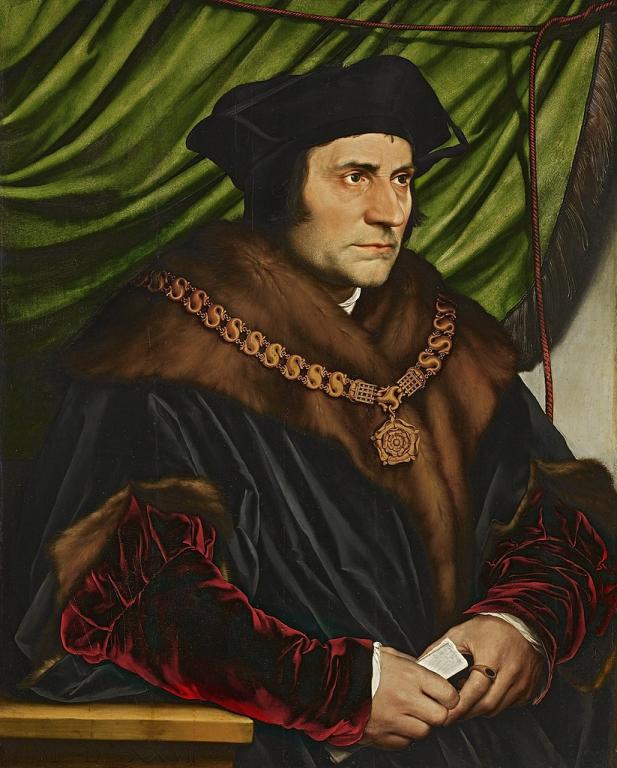
[originally written / edited in 1991]
The most famous English martyr in the 16th century was St. Thomas More (1478-1535), the universally admired humanist, lawyer, Lord Chancellor, and scholar probably second only to Erasmus; he had written the famous Utopia. This remarkable man was immortalized in our own time by the movie A Man For All Seasons (1966). It is well worthwhile to stop and take a look at this great hero, filled with the highest integrity:
More was a delightful person, one of the simplest and most human saints in the calendar. There was nothing stiff or severe or morose about him. He radiated the joyous tranquility and spiritual goodness of a man who, having once resolutely opted for heaven, is able to offer the world below a never-ending peace of mind . . . At the same time he was the perfect type of humanist, his mind and soul packed with noble thoughts; a man well abreast of all the discoveries or his age, and passionately interested in new ideas. His love of knowledge and the arts took him to the lengths of turning his own house into a miniature Platonic Academy . . . This is the saint we love so well, and whom we long to resemble . . .
His religion corresponded with his noble character. He was tolerant towards his fellow men, completely free from dogmatism, but resolute in his principles. Christian humanism . . . had no more accomplished representative than More . . .
At the beginning More, like Erasmus, had viewed the great stir and commotion at Wittenberg with a certain amount of amused delight. But it was not very long before the utterances of Luther shocked and disgusted him; in 1529 he had condemned them in his spirited little masterpiece, Dialogue On Heresies; then, in his Supplication Of Souls, he pointed out the falsehood of the Lutheran view of monastic vows and indulgences. He had sustained a lively argument against the Protestant propaganda of Tyndale, in which he had shown that the alleged return to primitive doctrine was a false enticement to the unwary, and that Tradition was simply the adaptation to changing kinds of society of one single, fundamental message.
A man of this stamp was obviously not made to participate in the king’s game and accept the wholly personal reasons which had led Henry VIII to disobey the laws of the Church. (Henri Daniel-Rops, The Protestant Reformation, vol. 2, tr. Audrey Butler, Garden City, New York: Doubleday Image, 1961, 246-248)
He inherited, and stepped naturally into, the greatest honours and legal position. He abandoned them all and died for the Faith . . . More was . . . eminent throughout Europe for his scholarship, a great international figure . . .
He had the temptations which beset the intellectual man, the sensitive scholar, the successful worldly figure. To these temptations he was in danger of yielding, and had partly yielded. He triumphed over them, and that in a fashion quite peculiar to himself. That is why he is so glorious, and that is why he is so great an example . . . He acted in complete isolation, and he laid down his life for one small strict point of Catholic doctrine only; and, what is more, a point of doctrine on which he himself had long doubted . . . He was not supported by any sympathy for himself even among his nearest. He was not supported by the nature of his own mind, which had been hesitant and, even in essential matters, changeable. He gave himself up as a victim in spite of all those things which would made 999 men out of a thousand deceive themselves that they might be doing right in yielding. This is the heroic and almost unique quality in More.
To begin with let it clearly be understood that St. Thomas More was a reformer . . . The whole of Christendom was moved also by a spirit which caused the younger men especially, and more especially the more intelligent and emotional of the younger men, to denounce the corruptions of the time, the errors of legend, the exaggeration of certain practices and the doubtfulness or demonstrable falsity of many shrines and relics.
Sir Thomas More was just of the kind who would . . . have drifted from step to step, beginning with indignation against abuses, and ending with the full heretical position into which nearly all such men later fell.
He was indignant against the social order of his time as well as against the abuses of the Church. What is more, his indignation inspired him to wit, and to very high literary efforts; and men who discover such talents in themselves while they are still young nearly always fall into the temptation of becoming increasingly revolutionary as time proceeds . . . More should, therefore, according to the order of nature, have become ultimately a violent opponent not only of the social order but of that Divine unity in the Church for which he laid down his life. All his character seemed to point that way . . .
He was absolutely alone . . . nothing promised in the future . . . nothing in the traditions of his habits and life, to nerve him for what he did. And yet he did it.
In order to understand how extraordinary the case is, and what a marvelous example it is of resolution and vision combined, let us appreciate exactly what it was that More defended at the cost of his life.
He died for the principle, that ultimately, in spiritual matters, the Pope was the Head of Christendom – a principle which all Christendom was debating, and had been debating for more than a hundred years . . . Yet it was for that very point, which he had himself doubted, that he consented to die . . . He had what is called “Heroic Faith.” (Hilaire Belloc, Characters of the Reformation, Garden City, New York: Doubleday Image, 1958, 62-67, 69)
When ordered to swear to the Act of Succession, he tried to evade the issue; but the king’s soldiers came to arrest him, and on 17th April 1534 he was sent to the Tower. For fourteen months he remained in prison . . . On 1st July 1535 he was condemned to death in Westminster Hall where he had so often dispensed justice in the past . . . Thomas More rose to his feet, very calm, and told this court of flunkeys and time-servers why he was going to his death:
I will now in discharge of my conscience speak my mind plainly and freely touching my indictment and your Statute withal. And forasmuch as this indictment is grounded upon an Act of Parliament directly repugnant to the laws of God and His holy Church, the supreme government of which . . . may no temporal prince presume by any law to take upon him, as rightfully belonging to the See of Rome, a spiritual preeminence by the mouth of Our Saviour Himself . . . only to St. Peter and his successors bishops of the same See . . .
Very and pure necessity . . . enforces me to speak so much. Wherein I call and appeal to God, whose only sight pierces into the very depth of man’s heart, to be my witness . . . the Church is one and indivisible, and you have no authority to make a law which infringes Christian unity.
Only the executioner could reply to words like these. The last word was his . . . This judicial murder provoked the strongest reactions throughout Europe . . . All protests were of no avail against an autocrat like Henry. He confined himself to telling other rulers that he had merely punished traitors, and had fourteen Anabaptists burned at the stake to demonstrate his own religious zeal . . . Stapleton relates how Henry was brought the news of More’s execution . . . He sprang to his feet, quite pale, overcome by an absurd remorse. Looking blackly at Anne Boleyn, he shouted: “You are responsible!” The blood of this new John the Baptist was soon to spill over the Tudor Herodias. A year later, to the very day, she too would mount the scaffold steps. (Daniel-Rops, ibid., 248-250)
On July 6th, More was led to the scaffold. He retained his dignity and humor to the end:
He said to an attendant, “I pray you . . . see me safe up, and for my coming down let me shift for myself.” The executioner asked his forgiveness; More embraced him . . . More begged the spectators to pray for him, and to “bear witness that he . . . suffered death in and for the faith of the Holy Catholic Church.” He then asked them to pray for the King . . . and he protested that he died being the King’s good servant, but God’s first. He repeated the 51st Psalm. Then he laid his head upon the block, carefully arranging his long gray beard that it should take no harm: “pity that should be cut,” he said, “that has not committed treason.” His head was affixed to London Bridge . . .
A wave of terror passed through an England that now realized the resolute mercilessness of the King, and a shudder of horror ran through Europe. Erasmus felt that he himself had died, for “we had but one soul between us”; he said that he had now no further wish to live, and a year later he too was dead. (Will Durant, The Reformation, New York: Simon & Schuster, 1957, 558)
Jonathan Swift (1667-1745), a priest in the Church of England and famous satirical author of Gulliver’s Travels (1726), thought More the man “of the greatest virtue this kingdom ever produced.” (Durant, ibid., 558)
On the 400th anniversary of their execution the Church of Rome enrolled Thomas More and John Fisher among her saints. (Durant, ibid., 558)
***
I include excerpts from St. Thomas More’s writings in my book, Classic Catholic Biblical Apologetics: 1525-1925 (Feb. 2012, 246 pages)
***
Practical Matters: Perhaps some of my 4,000+ free online articles (the most comprehensive “one-stop” Catholic apologetics site) or fifty books have helped you (by God’s grace) to decide to become Catholic or to return to the Church, or better understand some doctrines and why we believe them.
Or you may believe my work is worthy to support for the purpose of apologetics and evangelism in general. If so, please seriously consider a much-needed financial contribution. I’m always in need of more funds: especially monthly support. “The laborer is worthy of his wages” (1 Tim 5:18, NKJV). 1 December 2021 was my 20th anniversary as a full-time Catholic apologist, and February 2022 marked the 25th anniversary of my blog.
PayPal donations are the easiest: just send to my email address: [email protected]. You’ll see the term “Catholic Used Book Service”, which is my old side-business. To learn about the different methods of contributing, including 100% tax deduction, etc., see my page: About Catholic Apologist Dave Armstrong / Donation Information. Thanks a million from the bottom of my heart!
*
***
*
Photo credit: Sir Thomas More, by Hans Holbein the Younger (1497 or 1498-1543) [public domain / Wikipedia]

*
***
*
Summary: Brief remembrance of the heroic sanctity of the Catholic martyr St. Thomas More: beheaded by butcher King Henry VIII of England, for opposing his divorce as sinful.
*
Catholic
Religious Events
History and Religion
Education and Religion
Protestant Persecution & Intolerance
Previous Post
August 3, 2022
Biblical Defense of Images and Icons (vs. Matt Hedges)
Next Post
August 5, 2022 Semi-Pelagianism & Catholicism (vs. Francisco Tourinho)
Browse Our Archives
Select a Category & Last Things About Me Anti-Catholicism Atheism & Agnosticism Baptism and Sacramentalism Bible and Tradition Blessed Virgin Mary Books by Dave Armstrong C. S. Lewis Calvinism & General Protestantism Catholic Apologetics Catholic Apologists Catholic conversion Catholic converts Christmas Church (Ecclesiology) Church History Conversion and Converts Development of Doctrine Eastern Orthodoxy Ecumenism & Christian Unity Eucharist & Liturgy Fathers of the Church French Translations G. K. Chesterton Hell Hell & Satan Hell & Satan & Last Things Heresies & Comparative Religion Holistic Health Inquisition & Crusades & Scandals James White Jews & Judaism & Old Testament John Calvin John Henry Newman Liberal / Modernist Theology Life Issues Literary Resume Lutheranism Mariology Martin Luther Music Orthodoxy Papacy & Infallibility Personal Page Philosophy & Science Political & Ethical & Moral Issues Protestant Persecution & Intolerance Protestantism Purgatory Purgatory & Penance Romantic & Imaginative Theology Saints & Purgatory & Penance Salvation Salvation & Justification Satan & Last Things Sexuality and Gender Issues Spanish Translations Traditionalism vs. Radical Catholic Reactionaries Traducciones al español / tradução para português Trinitarianism & Christology Uncategorized Videos
Select a Month October 2026 September 2026 August 2026 July 2026 June 2026 May 2026 April 2026 March 2026 February 2026 January 2026 December 2025 November 2025 October 2025 September 2025 August 2025 July 2025 June 2025 May 2025 April 2025 March 2025 February 2025 January 2025 December 2024 November 2024 October 2024 September 2024 August 2024 July 2024 June 2024 May 2024 April 2024 March 2024 February 2024 January 2024 December 2023 November 2023 October 2023 September 2023 August 2023 July 2023 June 2023 May 2023 April 2023 March 2023 February 2023 January 2023 December 2022 November 2022 October 2022 September 2022 August 2022 July 2022 June 2022 May 2022 April 2022 March 2022 February 2022 January 2022 December 2021 November 2021 October 2021 September 2021 August 2021 July 2021 June 2021 May 2021 April 2021 March 2021 February 2021 January 2021 December 2020 November 2020 October 2020 September 2020 August 2020 July 2020 June 2020 May 2020 April 2020 March 2020 February 2020 January 2020 December 2019 November 2019 October 2019 September 2019 August 2019 July 2019 June 2019 May 2019 April 2019 March 2019 February 2019 January 2019 December 2018 November 2018 October 2018 September 2018 August 2018 July 2018 June 2018 May 2018 April 2018 March 2018 February 2018 January 2018 December 2017 November 2017 October 2017 September 2017 August 2017 July 2017 June 2017 May 2017 April 2017 March 2017 February 2017 January 2017 December 2016 November 2016 October 2016 September 2016 August 2016 July 2016 June 2016 May 2016 April 2016 March 2016 February 2016 January 2016 December 2015 November 2015 October 2015 September 2015 August 2015 July 2015 June 2015 May 2015 April 2015 March 2015 February 2015 January 2015 December 2014 November 2014 October 2014 September 2014 August 2014 July 2014 June 2014 April 2014 March 2014 February 2014 January 2014 December 2013 November 2013 October 2013 September 2013 August 2013 July 2013 June 2013 April 2013 March 2013 February 2013 January 2013 December 2012 November 2012 October 2012 September 2012 August 2012 July 2012 June 2012 May 2012 April 2012 March 2012 February 2012 January 2012 December 2011 November 2011 October 2011 September 2011 August 2011 July 2011 June 2011 April 2011 March 2011 February 2011 October 2010 September 2010 August 2010 July 2010 April 2010 March 2010 December 2009 October 2009 August 2009 July 2009 June 2009 May 2009 March 2009 February 2009 October 2008 September 2008 April 2008 March 2008 February 2008 January 2008 December 2007 November 2007 October 2007 May 2007 March 2007 February 2007 January 2007 November 2006 October 2006 September 2006 August 2006 July 2006 June 2006 May 2006 April 2006 March 2006 February 2006 October 2005 June 2005 April 2005 February 2005 July 2004 May 2004 April 2004
Follow Us!
TAKE THE
Religious Wisdom Quiz
Why were the plagues significant against Egyptian beliefs?
Select your answer to see how you score.
They were meant to test Pharaoh’s patience Each plague targeted an Egyptian god Pharaoh had offended the Hebrew people They were random acts of nature
Books by This Author Books by Dave Armstrong
Related posts from Biblical Evidence for Catholicism
Gavin Ortlund, Hus's Burning, & Double Standards
Biblical Evidence for Catholicism
Early Protestant Leaders Damning Each Other: 40 Examples
Biblical Evidence for Catholicism
Biblical Teaching on Divorce, Remarriage, & Annulments
Biblical Evidence for Catholicism

Luther Favored Death for Heresy (Transcript)
Biblical Evidence for Catholicism
TRENDING AT PATHEOS Catholic

I was strolling through the top floor of the brand new Parthenon...

What Does Gêvâh Mean For Kimberley Guifoyle &...
This week, a lot of the news is focused on Kimberly Guilfoyle....

INNER CIRCLE: Profound Mystery (Of Christ In All...
Ephesians 5:31-32 “For this reason, a man will leave his father and...

Do Not Rejoice When Your Enemy Falls: The...
Turning an execution into a public spectacle is a disturbing expression of...

'The Chosen' S6 Trailer: The Passion Gets Very...
Not many watching 'The Chosen' worry about spoilers, but just because they...

The purpose-driven labor priest
A labor activist reads Rick Warren and it gets me wondering about...
view all Catholic blogs
Ad-Free & Subscriber Log-In Subscription Support
- About Us
- 2026 Calendar
- Videos
- Podcasts
- Library of World Religions
- Faith In Media Tracker
- Advertise With Us
- Write for Us
- Privacy Policy
- Terms of Service
- Do Not Sell My Data
- Contact Us
- Radiant Digital
- Manage Newsletter Subscriptions
- Unsubscribe From Notifications
- Sitemap
Copyright 2008-2026, Patheos. All rights reserved.
Subscription Support Ad-Free & Subscriber Log-In
Follow Patheos