
BuddhistCatholicContemplativeEvangelicalGeneral ChristianHinduJewishLatter-day SaintMuslimNew VisionsProgressive Christian
Beliefs
- Buddhist
- Catholic
- Contemplative
- Evangelical
- General Christian
- Hindu
- Jewish
- Latter-day Saint
- More Voices
- Muslim
- New Visions
- Pagan
- Progressive Christian
Topics
- Religion News
- Food and Religion
- Sports and Religion
- Religious Art
- Religious Music and Entertainment
- Religious Events
- History and Religion
- Style and Religion
- Politics and Religion
- Women in Religion
- Recreation Outdoors and Religion
- Business Finance and Religion
- Careers Workplace and Religion
- Education and Religion
- Family Parenting and Religion
- Health Fitness and Religion
- Home and Religion
- Relationships and Religion
- Technology and Religion
- Travel and Religion
Columnists
- Buddhist Columnists
- Business Finance and Religion Columnists
- Careers Workplace and Religion Columnists
- Catholic Columnists
- Contemplative Columnists
- Education and Religion Columnists
- Evangelists Columnists
- Family Parenting and Religion Columnists
- General Christian Columnists
- Health Fitness and Religion Columnists
- Hindu Columnists
- History and Religion Columnists
- Home and Religion Columnists
- Jewish Columnists
- More Voices Columnists
- Latter Day Columnists
- Muslim Columnists
- New Visions Columnists
- Nonreligious Columnists
- Pagan Columnists
- Politics and Religion Columnists
- Progressive Columnists
- Recreation Outdoors and Religion Columnists
- Relationships and Religion Columnists
- Religion News Columnists
- Religious Art Columnists
- Religious Events Columnists
- Religious Music and Entertainment Columnists
- Sports and Religion Columnists
- Style and Religion Columnists
- Technology and Religion Columnists
- Travel and Religion Columnists
- Women in Religion Columnists
Resource Library
- 2026 Calendar
- Library of World Religions
- The 100 Most Holy Places on Earth
- Patheos Answers
- Podcasts
- Videos
- Faith Leaders Database
- Anglican Episcopalian
- Bahai
- Baptist
- Buddhism
- Christianity
- Confucianism
- Eastern Orthodoxy
- Hinduism
- Holiness and Pentecostal
- ISKCON
- Islam
- Judaism
- Lutheran
- Methodist
- The Church of Jesus Christ of Latter-day Saints
- New Age
- Paganism
- Presbytarian and Reformed
- Protestantism
- Religion Behind the Scenes
- Roman Catholic
- Scientology
- Shia Islam
- Sikhism
- Sufism
- Sunni Islam
- Taoism
- Zen
- See all religions
Research Tools
 Ad-Free & Subscriber Log-In Subscription Support
Ad-Free & Subscriber Log-In Subscription Support
Follow Patheos 

- Trending:
- Forgiveness
- |
- Marriage
- |
- Consciousness
- |
- Death Penalty
- |
- Election
- |
- Halloween

-
About
-
Catholic Apologetics
-
Church History
-
Great Apologists
-
Christian Worldview
-
Protestantism & Misc.
- Home
- Catholic
- History and Religion
- “Reformed Biblicism”: Reply to James White
“Reformed Biblicism”: Reply to James White
Last updated on: June 6, 2026 at 12:47 am by Dave Armstrong
“Reformed Biblicism”: Reply to James White 2026-06-06T00:47:19-04:00 Dave Armstrong
Patheos Explore the world's faith through different perspectives on religion and spirituality! Patheos has the views of the prevalent religions and spiritualities of the world.
This is a point-by-point response to Bishop “Dr.” [???] James White’s article, “Reformed Biblicism” (7-6-22). His words will be in blue.
*****
While going over Calvin’s rebuttal of Sadoleto’s letter from 1539, I read a paragraph where Calvin held Sadoleto’s argument to a biblical standard. Calvin was a scholar of the early church.
I wish he had cited which part. I don’t feel like going through the whole book that I have, to find it.
He cites from patristic sources regularly. He read widely in what was available to him in his day.
Yes, and he regularly distorts what they taught and pretends that they were more [proto-] “Protestant” than Catholic.
And yet he gave us an example of what it means to know history, to know what those before us have said, and yet to hold their views up to Scripture as the final test of truth.
That is, of course, according to Calvin, as the final arbiter (in effect, a “super-pope”) of the particulars of this scriptural truth: over against the entire prior tradition and teaching of the Church fathers en masse if needs be. Yet he is blind to the fact of how supremely arrogant and erroneous in outlook this is.
I referred to his stand as “Reformed Biblicism,” and proclaimed myself a Reformed Biblicist, seeking to be faithful to that important concept.
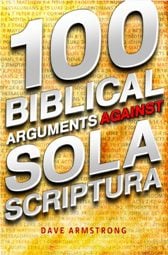
I refer to it as standard sola Scriptura Protestantism, with all of the manifest glaring and anti-biblical holes entailed (see, for example, my book, 100 Biblical Arguments Against Sola Scriptura).
I do not believe Calvin was the first, nor do I pretend that everyone in the past in whom I would see a commitment to a proper, Scripturally defined and historically knowledgeable biblicism, has practiced their craft with complete consistency.
Like, of course, Bishop White (in his chronological snobbery) claims to do . . .
But I believe a very strong and balanced case can be made for Calvin’s stand in 1539, and the one we must take today as well.
For starters, Calvin thought that the Bible taught sacramental infant baptism. Bishop White is equally convinced that it teaches purely symbolic, non-sacramental adult “believer’s” baptism. Which one is right? More importantly and to the present point: how do we determine who is right? According to the vast consensus of the fathers, John Calvin is more correct, though insofar as he also denied baptismal regeneration, he also departed from the patristic view. Calvin himself consented to the drowning of Anabaptists as seditious heretics. So he quite possibly would have consented to drown Bishop White, whereas I, as a Catholic, would merely be banished from his territory.
Already, then, we see that this “Bible as the final arbiter sans an infallible Church and Tradition” position breaks down as soon as two Protestants disagree. As Jews say about themselves, so it is with Protestants. If you get two of them together, they will have three different opinions on any given doctrine.
Please allow me to very briefly outline the position.
It starts with the highest view of Scripture. The Bible is theopneustos. Nothing else is. Therefore, it is utterly unique.
It is unique, as an inspired, “God-breathed”, infallible revelation. No one disagrees with that.
It is unique in its origin, in its nature, in its effects, in its purpose, and in its consistency.
Yes, but none of that logically or biblically requires sola Scriptura: the view that the Bible is the only infallible norm and authority, and formally sufficient in and of itself to function as the rule of faith.
It is intended to be a sufficient guide to Christ’s body, the Church.
It itself never teaches that. It’s simply man-made, late-arriving, arbitrary Protestant traditions of men.
It is intended to be seen as God’s very speech, and it has authority for all men, no matter their spiritual state.
That’s true, but again, not germane to the debate over the truthfulness of sola Scriptura.
The Bible then teaches us that Christ has established His Church, His body, and that the Word is intended to be central to the teaching and proclamation that defines that body.
The Bible also teaches that the Church is infallible: at the council of Jerusalem (Acts 15) and in 1 Timothy 3:15. Already, then, the Bible alone has refuted the false doctrine of sola Scriptura.
Since we have Christ’s promise to build His church, we can expect the continued ministry of the Holy Spirit amongst His people, preserving and protecting them down through history.
Absolutely. And this is most perfectly accomplished in the Holy Spirit’s unique guidance of the Church that Jesus Christ established with Peter as its first leader: the historic Catholic Church, headed by the popes (successors of Peter) in Rome.
We do not have to re-invent the wheel with each generation. We can learn much from those who came before us.
Exactly! Yet Protestants continue to do exactly that. It’s sad, foolish, and so unnecessary. As G. K. Chesterton noted: “tradition is the democracy of the dead.” It’s an acknowledgment that folks who lived before our own time learned and gained spiritual and theological insights, too.
However, we learn both positively and negatively. Their words do not become equal with Scripture, nor the lens through which we are to read Scripture, either.
The first thing is true; the second is partially false. True apostolic tradition is indeed an interpretive guide to Scripture. The accumulated exegetical and hermeneutical wisdom of almost 2,000 years of Christian history is very rich, and many things have been long since determined. It’s our task to tie into that tradition and align our views with it.
We learn from their successes as well as their failures. We see that they often had great insights, but at the same time, were blinded by their conflicts and prejudices.
And that’s true of us today, too. There is such a thing as received, true, apostolic tradition, which has determined what is orthodox and what isn’t. Like Bishop White said, we have no need to invent the wheel in each new generation. We already know from our received past heritage what is true and untrue in most theological matters. This received tradition is precisely what can cut through our ignorance and prejudices and quite fallible and imperfect predispositions.
We recognize that the tendency in the past has been for the church to become her own authority,
It’s not her “own” authority; it’s established by Jesus Christ and scriptural sanction and instruction.
erecting unbiblical structures of authority that limit the corrective work of the Word and Spirit in her midst.
Yes, like the grotesque, tragi-comic spectacle of denominationalism, which nowhere appears in Holy Scripture, and “super-popes” like Calvin and Luther who ridiculously pretend to know more than all the wise figures in the history of the Church before them. They sit there and judge them all, and make their own views in effect “dogma” for their followers.
Often tradition has been elevated to a position of having equal authority with Scripture, being seen as a necessary possession without which Scripture actually becomes a dangerous thing.
Since Scripture grants it this position, there is nothing wrong with it. To the contrary, it is biblically required. Apostolic tradition and the Bible are always in harmony with each other. They do not and cannot contradict. It’s individualistic, sectarian interpretations of Scripture, disconnected from past Christian history that are truly the dangerous things.
We can read the interpretations of those who have gone before us and learn much, while at the same time recognizing fundamental problems. For example, the rise of monasticism led to traditions developing that impacted the interpretation of Scripture literally for centuries. We are under no compulsion to embrace traditional readings that were simply repeated over and over again when it is clear that they were originally based in misunderstandings.
We agree. The many novel errors of Protestantism are one of these misunderstandings that we need to scrutinize and examine (as I am presently doing).
Creeds and confessions are important monuments in the history of the gospel’s progress in the world. But we must remember that the majority of these come from a small portion of that expansion, primarily from Europe and Asia Minor. Hence, they are focused upon the theological questions prevalent there, and use the language of those cultures. We often forget that there is a whole, big world with many more languages and cultures out there.
Indeed.
Creeds and confessions are secondary documents; indeed, we might say creeds are secondary and confessions tertiary, as they are often derived from creedal statements. Creeds are few, and ancient, confessions are many, and often more modern.
Protestants give them a degree of authority, and lip service is given to them, but in the final analysis, the individual is completely free to determine for himself what is true and false in theology: just as Calvin and Luther, Zwingli, Henry VIII, Bullinger, Bucer, Menno Simons, and the Anabaptists did.
Both are dependent for their authority upon their fidelity to that which is ontologically superior to them; that is, their authority is derivative from Scripture for they are, by their nature, human, and fallible. They are not theopneustos.
Yes, and because of that, the question becomes: “who is it that determines what is true and false — and binding upon believers — in these creeds and confessions?” It’s simply the same problem as with authoritative scriptural interpretation: merely one step removed. In the end, interpretation is necessary, or else we have more divisions and likely more denominations. And this interpretation can always in theory come down to each individual Protestant, as “his own pope.”
No Protestant can deny that, because this was the very founding principle or presupposition or premise upon which Luther and Calvin operated, and began the whole thing (Protestantism, based on “private judgment”). This is what is always ignored in analyses like White’s present one. It’s the elephant in the room or the naked emperor, as it were. He doesn’t mention it, so I have to bring up the perfectly obvious dilemma and contradiction at the heart of the Protestant rule of faith.
This observation should not be novel or surprising to any Protestant. In what might be seen as the older equivalent of the Declaration of Independence, Luther said in his concluding statement before the Emperor at the Diet of Worms:
Since your most serene majesty and your highnesses require of me a simple, clear, and direct answer, I will give one, and it is this: I cannot submit my faith either to the pope or to the council, because it is clear that they have fallen into error and even into inconsistency with themselves. If, then, I am not convinced by proof from Holy Scripture, or by cogent reasons, if I am not satisfied by the very text I have cited, and if my judgment is not in this way brought into subjection to God’s word, I neither can nor will retract anything; for it cannot be either safe or honest for a Christian to speak against his conscience. Here I stand. I cannot do otherwise. God help me. Amen.
Yes he did (though the last section is not certain). This perfectly proves what I have been contending above. Luther “knows” more than the entire history of the Church preceding him. It doesn’t follow that he did in fact reject all of previous tradition. He maintained much of it. But theoretically or abstractly, he was always at liberty to reject yet more of the existing tradition. Why and how? Well, like he said, because he thinks “pope . . . [and] council have fallen into error and even into inconsistency.”
Luther (or any Protestant individual) determine where these errors have occurred. But the obvious error shot through all this is that Luther assumed he was right and infallible (and by extension all Protestants have that prerogative). Who checks his arbitrarily self-proclaimed “authority” (or any Protestant’s “authority”) with Scripture? Well, as it turned out, Zwingli, Calvin, and the Anabaptists all disagreed with him on a host of issues, as did even his successor, Philip Melanchthon, who soon departed from the view of the Holy Eucharist that confession Lutheranism held.
Bottom line: in this mentality: historic councils and popes could be in error, but apparently Luther and Calvin cannot: even though they and the myriad Protestant sects after them contradict each other all over the place. In a sense, I am actually acting like a good Protestant, in correcting White and standard Protestant sola Scriptura with both Scripture and tradition / history.
Popes and councils have erred and have even contradicted each other.
We deny this insofar as is concerned their decrees that are infallible (not all parts of councils or papal decrees are). Both possess the gift of infallibility: granted by God.
Was Luther wrong?
Partially.
No, he was assuredly right.
Partially. We Catholics determine where he was right and wrong, based on Scripture, Church teaching, and apostolic tradition.
And how do we know when their statements and teachings are contradictory to the truth? Luther answers: subjection to God’s word.
And then of course, Protestants disagree in literally thousands of ways, in interpreting this revelation of Scripture that all agree is inspired and infallible.
There is surely nothing new about such a stance for those who are Reformed.
Today Reformed biblicism is being mocked and derided through the use of straw-man misrepresentation, and that by believing, confessional men. Let’s lay to rest the straw-men so actual progress can be made between men of good faith who will honestly seek to represent the issues with integrity.
Sure; and let’s also (for once) grapple with Protestantism’s and sola Scriptura‘s serious internal problems as noted above.
It is said we are pretending the Bible fell down out of heaven three days ago, i.e., we reject the reality that there are generations of interpreters who have come before us. FALSE. Ancient writings and modern commentaries can all be helpful and should be consulted when dealing with the Biblical text, not because they hold some traditional authority, or together form some Great Tradition (the amount of contradiction and inconsistency precludes such banal representations), but because we recognize that the Spirit of God has been active from the beginning, and hence, we can be benefitted by such study and reference. But, just as the Spirit’s work does not make us infallible, we can see errors in those who have gone before us.
Exactly! In Protestantism, the individual determines where those errors occur (with massive internal disagreement). In Catholicism, bound by very strict rules of procedure, the Church does, in strict accordance with received apostolic tradition.
We can see that traditions have become popular in the past that have corrupted understandings for literally centuries, as noted earlier (views of women, for example, or especially views related to papal texts and papal authority, for another).
And including the myriad of false teachings necessarily present in various forms of Protestantism (since the presence of contradictions means that at least one of the parties must necessarily be wrong).
The Second Nicene Council gives a glorious example of pure and utter error determining the outcome of the council’s decrees.
Bishop White is referring to its espousal of religious images. Of course it was right, because that is the biblical position, as I have shown in many articles.
Next, we are told that to be a biblicist is to believe it is just you and your Bible under a tree, each person a tabula rasa, starting from scratch each and every day. FALSE.
No; TRUE. In theory, any and every Protestant can (and too often does) do exactly that, just as Luther and Calvin and all of the other “reformers” did. They took it upon themselves to determine true and false doctrine.
There is nothing in being a Reformed biblicist that requires one to ignore everything the Spirit has provided to us in the form of past generations, commentaries, multiple translations, community interaction, etc.
That’s right. It’s not required, but it’s always theoretically possible to do, given the founding principles of Protestantism. It has to be that way, because in the end, either an official “church” or an individual has to figure out who and what in the past was in error. There are only so many choices.
None of these things, however, can be elevated to a point of equality with, or interpretative control over, Scripture.
Nor can the atomistic individual like Bishop White do so.
We are told to be a Reformed biblicist is to reject creeds and confessions. Every man become his own Pope! FALSE.
TRUE in an ultimate or logically reductive sense; as explained over and over above.
It is to reject the elevation of creeds and confessions to the level of Scripture, yes. It is to agree wholeheartedly with the sentiment of the LBCF at 1:10:
The supreme judge, by which all controversies of religion are to be determined, and all decrees of councils, opinions of ancient writers, doctrines of men, and private spirits, are to be examined, and in whose sentence we are to rest, can be no other but the Holy Scripture delivered by the Spirit, into which Scripture so delivered, our faith is finally resolved.
Of course. We agree! But the question becomes: who decrees for all what this Scripture truly teaches on any given topic?
That means creeds and confessions are to be subject to the Scripture.
As determined by one or a number of like-minded Protestants . . . to which we reply: why are they considered authoritative? On what basis?
But, we are told that this means we get to change our doctrine at our every whim, at the drop of a hat! FALSE. Such does not follow at all. Recognition of the inferior nature of creeds and confessions to Scripture does not require us to believe that those who have gone before were naive or ignorant and hence missed the most central realities of the Christian faith, leaving it all up to us today to fix it all! This is an absurd charge. At the same time, to be a Reformed biblicist is to insist that the content of the Christian faith has been “once for all delivered to the saints” so that, in the words of the LBCF in 1:7, “All things in Scripture are not alike plain in themselves, nor alike clear unto all; yet those things which are necessary to be known, believed and observed for salvation, are so clearly propounded and opened in some place of Scripture or other, that not only the learned, but the unlearned, in a due use of ordinary means, may attain to a sufficient understanding of them.” So, a Reformed biblicist can recognize development of theological language over time, in, say, how the questions related to Christology developed after the Council of Nicea up and through that of Chalcedon, without investing in those councils, or the interpretations of the key writers, East and West, a parallel authority to Scripture. Even the greatest of the writers of the past must be held to the standard of Scriptural consistency and, when they went beyond those bounds, the Reformed biblicist does not find any compulsion in following them in their speculations.
Exactly! Truth is determined by one or a number of like-minded Protestants . . . to which we reply: why are they considered authoritative? On what basis?
Hence, the Reformed biblicist is simply allowing Scripture to be God-breathed, the Spirit to be accomplishing His purposes in the Church, those of the past to speak and testify to the truth (and to their own errors and traditions), and the useful and beneficial gifts of God in commentaries, textual resources, etc., to bless us in the present. Always the biblicist believes:
The authority of the Holy Scripture, for which it ought to be believed, dependeth not upon the testimony of any man or church, but wholly upon God (who is truth itself), the author thereof; therefore it is to be received because it is the Word of God (LBCF 1:4).
Unfortunately, God doesn’t always provide the full and entire and particular interpretation of Holy Scripture. Human beings must do that. The disagreement on the rule of faith between Catholics and Protestants is alive and well. I have done my best to outline some of the important issues that Protestants have to resolve and the thorny internal difficulties in their system.
***
Practical Matters: Perhaps some of my 4,000+ free online articles (the most comprehensive “one-stop” Catholic apologetics site) or fifty books have helped you (by God’s grace) to decide to become Catholic or to return to the Church, or better understand some doctrines and why we believe them.
Or you may believe my work is worthy to support for the purpose of apologetics and evangelism in general. If so, please seriously consider a much-needed financial contribution. I’m always in need of more funds: especially monthly support. “The laborer is worthy of his wages” (1 Tim 5:18, NKJV). 1 December 2021 was my 20th anniversary as a full-time Catholic apologist, and February 2022 marked the 25th anniversary of my blog.
PayPal donations are the easiest: just send to my email address: [email protected]. You’ll see the term “Catholic Used Book Service”, which is my old side-business. To learn about the different methods of contributing, including 100% tax deduction, etc., see my page: About Catholic Apologist Dave Armstrong / Donation Information. Thanks a million from the bottom of my heart!
***
Summary: James White explains “Reformed biblicism” (sola Scriptura dressed up in a new term). I note the insuperable internal logical and biblical problems with sola Scriptura.
Church fathers & sola Scriptura
Previous Post
August 15, 2022
Odd James White View Re Matthew 16:19 & the "Keys"
Next Post
August 19, 2022 Anti-Catholics: Sincere & Ignorant or Malicious?
Browse Our Archives
Select a Category & Last Things About Me Anti-Catholicism Atheism & Agnosticism Baptism and Sacramentalism Bible and Tradition Blessed Virgin Mary Books by Dave Armstrong C. S. Lewis Calvinism & General Protestantism Catholic Apologetics Catholic Apologists Catholic conversion Catholic converts Christmas Church (Ecclesiology) Church History Conversion and Converts Development of Doctrine Eastern Orthodoxy Ecumenism & Christian Unity Eucharist & Liturgy Fathers of the Church French Translations G. K. Chesterton Hell Hell & Satan Hell & Satan & Last Things Heresies & Comparative Religion Holistic Health Inquisition & Crusades & Scandals James White Jews & Judaism & Old Testament John Calvin John Henry Newman Liberal / Modernist Theology Life Issues Literary Resume Lutheranism Mariology Martin Luther Music Orthodoxy Papacy & Infallibility Personal Page Philosophy & Science Political & Ethical & Moral Issues Protestant Persecution & Intolerance Protestantism Purgatory Purgatory & Penance Romantic & Imaginative Theology Saints & Purgatory & Penance Salvation Salvation & Justification Satan & Last Things Sexuality and Gender Issues Spanish Translations Traditionalism vs. Radical Catholic Reactionaries Traducciones al español / tradução para português Trinitarianism & Christology Uncategorized Videos
Select a Month October 2026 September 2026 August 2026 July 2026 June 2026 May 2026 April 2026 March 2026 February 2026 January 2026 December 2025 November 2025 October 2025 September 2025 August 2025 July 2025 June 2025 May 2025 April 2025 March 2025 February 2025 January 2025 December 2024 November 2024 October 2024 September 2024 August 2024 July 2024 June 2024 May 2024 April 2024 March 2024 February 2024 January 2024 December 2023 November 2023 October 2023 September 2023 August 2023 July 2023 June 2023 May 2023 April 2023 March 2023 February 2023 January 2023 December 2022 November 2022 October 2022 September 2022 August 2022 July 2022 June 2022 May 2022 April 2022 March 2022 February 2022 January 2022 December 2021 November 2021 October 2021 September 2021 August 2021 July 2021 June 2021 May 2021 April 2021 March 2021 February 2021 January 2021 December 2020 November 2020 October 2020 September 2020 August 2020 July 2020 June 2020 May 2020 April 2020 March 2020 February 2020 January 2020 December 2019 November 2019 October 2019 September 2019 August 2019 July 2019 June 2019 May 2019 April 2019 March 2019 February 2019 January 2019 December 2018 November 2018 October 2018 September 2018 August 2018 July 2018 June 2018 May 2018 April 2018 March 2018 February 2018 January 2018 December 2017 November 2017 October 2017 September 2017 August 2017 July 2017 June 2017 May 2017 April 2017 March 2017 February 2017 January 2017 December 2016 November 2016 October 2016 September 2016 August 2016 July 2016 June 2016 May 2016 April 2016 March 2016 February 2016 January 2016 December 2015 November 2015 October 2015 September 2015 August 2015 July 2015 June 2015 May 2015 April 2015 March 2015 February 2015 January 2015 December 2014 November 2014 October 2014 September 2014 August 2014 July 2014 June 2014 April 2014 March 2014 February 2014 January 2014 December 2013 November 2013 October 2013 September 2013 August 2013 July 2013 June 2013 April 2013 March 2013 February 2013 January 2013 December 2012 November 2012 October 2012 September 2012 August 2012 July 2012 June 2012 May 2012 April 2012 March 2012 February 2012 January 2012 December 2011 November 2011 October 2011 September 2011 August 2011 July 2011 June 2011 April 2011 March 2011 February 2011 October 2010 September 2010 August 2010 July 2010 April 2010 March 2010 December 2009 October 2009 August 2009 July 2009 June 2009 May 2009 March 2009 February 2009 October 2008 September 2008 April 2008 March 2008 February 2008 January 2008 December 2007 November 2007 October 2007 May 2007 March 2007 February 2007 January 2007 November 2006 October 2006 September 2006 August 2006 July 2006 June 2006 May 2006 April 2006 March 2006 February 2006 October 2005 June 2005 April 2005 February 2005 July 2004 May 2004 April 2004
Follow Us!
TAKE THE
Religious Wisdom Quiz
Who asked Jesus, "What is truth?"
Select your answer to see how you score.
Caiaphas Pilate Nicodemus Herod
Books by This Author Books by Dave Armstrong
Related posts from Biblical Evidence for Catholicism

A Few "Worst" & "Best" Arguments vs. Protestantism
Biblical Evidence for Catholicism

Deuterocanon & Javier Perdomo's Straw Men
Biblical Evidence for Catholicism

St. Athanasius & the Deuterocanon (vs. Javier Perdomo)
Biblical Evidence for Catholicism

Jerusalem Council vs. James White & Sola Scriptura
Biblical Evidence for Catholicism
TRENDING AT PATHEOS Catholic

I was strolling through the top floor of the brand new Parthenon...

What Does Gêvâh Mean For Kimberley Guifoyle &...
This week, a lot of the news is focused on Kimberly Guilfoyle....

INNER CIRCLE: Profound Mystery (Of Christ In All...
Ephesians 5:31-32 “For this reason, a man will leave his father and...

Do Not Rejoice When Your Enemy Falls: The...
Turning an execution into a public spectacle is a disturbing expression of...

'The Chosen' S6 Trailer: The Passion Gets Very...
Not many watching 'The Chosen' worry about spoilers, but just because they...

The purpose-driven labor priest
A labor activist reads Rick Warren and it gets me wondering about...
view all Catholic blogs
Ad-Free & Subscriber Log-In Subscription Support
- About Us
- 2026 Calendar
- Videos
- Podcasts
- Library of World Religions
- Faith In Media Tracker
- Advertise With Us
- Write for Us
- Privacy Policy
- Terms of Service
- Do Not Sell My Data
- Contact Us
- Radiant Digital
- Manage Newsletter Subscriptions
- Unsubscribe From Notifications
- Sitemap
Copyright 2008-2026, Patheos. All rights reserved.
Subscription Support Ad-Free & Subscriber Log-In
Follow Patheos