
BuddhistCatholicContemplativeEvangelicalGeneral ChristianHinduJewishLatter-day SaintMuslimNew VisionsProgressive Christian
Beliefs
- Buddhist
- Catholic
- Contemplative
- Evangelical
- General Christian
- Hindu
- Jewish
- Latter-day Saint
- More Voices
- Muslim
- New Visions
- Pagan
- Progressive Christian
Topics
- Religion News
- Food and Religion
- Sports and Religion
- Religious Art
- Religious Music and Entertainment
- Religious Events
- History and Religion
- Style and Religion
- Politics and Religion
- Women in Religion
- Recreation Outdoors and Religion
- Business Finance and Religion
- Careers Workplace and Religion
- Education and Religion
- Family Parenting and Religion
- Health Fitness and Religion
- Home and Religion
- Relationships and Religion
- Technology and Religion
- Travel and Religion
Columnists
- Buddhist Columnists
- Business Finance and Religion Columnists
- Careers Workplace and Religion Columnists
- Catholic Columnists
- Contemplative Columnists
- Education and Religion Columnists
- Evangelists Columnists
- Family Parenting and Religion Columnists
- General Christian Columnists
- Health Fitness and Religion Columnists
- Hindu Columnists
- History and Religion Columnists
- Home and Religion Columnists
- Jewish Columnists
- More Voices Columnists
- Latter Day Columnists
- Muslim Columnists
- New Visions Columnists
- Nonreligious Columnists
- Pagan Columnists
- Politics and Religion Columnists
- Progressive Columnists
- Recreation Outdoors and Religion Columnists
- Relationships and Religion Columnists
- Religion News Columnists
- Religious Art Columnists
- Religious Events Columnists
- Religious Music and Entertainment Columnists
- Sports and Religion Columnists
- Style and Religion Columnists
- Technology and Religion Columnists
- Travel and Religion Columnists
- Women in Religion Columnists
Resource Library
- 2026 Calendar
- Library of World Religions
- The 100 Most Holy Places on Earth
- Patheos Answers
- Podcasts
- Videos
- Faith Leaders Database
- Anglican Episcopalian
- Bahai
- Baptist
- Buddhism
- Christianity
- Confucianism
- Eastern Orthodoxy
- Hinduism
- Holiness and Pentecostal
- ISKCON
- Islam
- Judaism
- Lutheran
- Methodist
- The Church of Jesus Christ of Latter-day Saints
- New Age
- Paganism
- Presbytarian and Reformed
- Protestantism
- Religion Behind the Scenes
- Roman Catholic
- Scientology
- Shia Islam
- Sikhism
- Sufism
- Sunni Islam
- Taoism
- Zen
- See all religions
Research Tools
 Ad-Free & Subscriber Log-In Subscription Support
Ad-Free & Subscriber Log-In Subscription Support
Follow Patheos 

- Trending:
- Forgiveness
- |
- Marriage
- |
- Consciousness
- |
- Death Penalty
- |
- Election
- |
- Halloween

-
About
-
Catholic Apologetics
-
Church History
-
Great Apologists
-
Christian Worldview
-
Protestantism & Misc.
- Home
- Catholic
- History and Religion
- Odd James White View Re Matthew 16:19 & the “Keys”
Odd James White View Re Matthew 16:19 & the “Keys”
Last updated on: August 15, 2022 at 9:49 am by Dave Armstrong
Odd James White View Re Matthew 16:19 & the “Keys” 2022-08-15T09:49:06-04:00 Dave Armstrong
Patheos Explore the world's faith through different perspectives on religion and spirituality! Patheos has the views of the prevalent religions and spiritualities of the world.
I was looking over some of the more recent (and increasingly rare) writings of Bishop “Dr.” [???] James White (as opposed to his webcast). I found one with the title, “Do You Really Believe and Practice Sola Scriptura?” (4-30-22). In it, he stated:
But here is the test: when you encounter a key text that could, in fact, impact your currently favored theological position (especially if that position is the subject of controversy), do you alter your hermeneutical method so as to come to the needed interpretation?
When dealing with Roman Catholics, for example, and you are looking at Matthew 16:19, and you point out to the RC that δώσω is future, not present, tense, (“I will give” not “I am giving”) do they respond by appealing to an external authority rather than actually dealing with the text itself? Many of us have experienced this in doing apologetic evangelism with many groups.
The Greek word δώσω (dōsō) is one of many forms of the Greek word δίδωμι (didómi / “to give”): Strong’s word #1325. It appears 23 times in the NT in this form. See also the passage in side-by-side Greek and English. Here is the verse in RSV:
Matthew 16:19 I will give you the keys of the kingdom of heaven, and whatever you bind on earth shall be bound in heaven, and whatever you loose on earth shall be loosed in heaven.
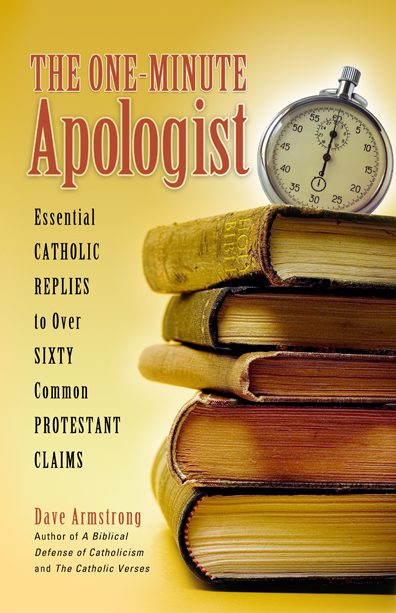
I wasn’t exactly sure what Bishop White was insinuating by pointing out the tense involved with regard to Jesus giving Peter the “keys” so I searched his site a bit for clarification, and lo and behold, when he explained it further it was in a post directed towards me. The post in question is “Dave Armstrong: The One Minute Apologist“ (6-13-07). He wrote there:
The One Minute Apologist illustrates the same problem I have documented in the majority of the rest of Rome’s apologists: they do not have any desire to interact with the strongest criticisms of their position, but, for some reason, are more than content to repeat the same worn out arguments that have been offered, and refuted, over and over again in the past. And when they represent the “objections,” they do not present the best, the strongest, but the most mundane, the least compelling, as normative for “the other side.”
For example, Armstrong does not even seem to be aware of fundamental and fatal objections to his favorite arguments. He repeatedly asserts that Jesus gave the keys to Peter alone. On page 34 we read, “Peter alone is given the ‘keys of the kingdom of heaven’–a symbol of stewardship and supervisory capacity over the house of God, or the Church.” A footnote is attached pointing us to Matthew 16:19: “I will give you the keys of the kingdom of heaven; and whatever you bind on earth shall have been bound in heaven, and whatever you loose on earth shall have been loosed in heaven.” But there does not seem to be any recognition on his part of what I brought out over a decade ago in The Roman Catholic Controversy:
This statement is followed by the promise to, at some time in the future, give the keys of the kingdom of heaven to Peter, so that what he binds on earth will be bound in heaven, and whatever he looses on earth will be loosed in heaven. I emphasize this is a promise, for the verb is future in tense.[1] Yet, when we see this authority given in Matthew 18:18, it is given not to Peter alone, or even primarily, but to all the apostles, and that using the exact same language,[2] regarding binding and loosing. If someone wishes to say that Peter receives the keys in distinction from the other apostles, as their superior, they are also forced to admit that the giving of these keys is never recorded for us anywhere in Scripture, a strange thing indeed for something supposedly so fundamental to the constitution of the Church. . . .
So I took the time to scan Armstrong’s materials to see if he had addressed this issue elsewhere. I checked his The Catholic Verses and found that the discussion of the Papacy (55-61) is almost identical to what is found in this new book, but there is no recognition, or discussion, of the fact that you cannot cite Matthew 16:19 as indicative of Peter alone receiving the keys, and that despite the fact that my book is cited in the bibliography. . . . I would ask Armstrong: where in Scripture do we see the giving of the keys to Peter alone, as he claims? We all know this is the Roman claim. Outside of the self-serving interpretations of the bishops of Rome, upon what basis are we to accept this claim? And if Armstrong wishes to be taken seriously as an apologist, why does he not write in such a way as to indicate a growing, deepening knowledge of the critics of the position he espouses?
Of course, I answered White’s arguments (as I usually did) the very next day: Reply to James White on the Papacy and Soteriology: His So-Called “Review” of My Book, The One-Minute Apologist [6-14-07]. Here is a key portion:
The first (rather obvious) response to this is what [my longtime friend] Paul Hoffer wrote on my blog:
[A]t Matt. 16:19, Jesus says to Peter that He “will” give Peter the keys of the kingdom. Is he trying to say that Jesus is not a person that keeps His word because the Scriptures don’t record the actual conveyance of keys later? If one reduces Mr. White’s argument to its logical conclusion, it would suggest that Jesus is not “the Man of His Word (pun intended).
I added:
Yes, I thought this was rather bizarre and striking also. What does it matter what tense the statement was? Obviously Peter was singled out for an extraordinary position and we can assume from common sense that Jesus intended for this to be during his earthly lifetime.
So who cares whether it was a reference to the future? The fact remains that only Peter was promised the “keys of the kingdom.” What God says will happen inevitably does happen. Another fallacy of White is to assume that “binding and loosing” represents the sum total of the responsibilities and prerogatives of the “keyholder.” This is untrue. It involves much more than that.
Along the lines of what Paul Hoffer pointed out, White stated in his book: “the giving of these keys is never recorded for us anywhere in Scripture, a strange thing indeed for something supposedly so fundamental to the constitution of the Church.” This is exceedingly curious. Where does White get this notion that such a passage has to be included in Scripture? Jesus has promised the keys to Peter, and He is true to His word. What He declares, will inevitably, inexorably happen. Thus, there is no need for a further passage proving that Jesus did what He promised.
I’d like to presently address White’s objection / argument from a few more angles. First of all, he claimed that Catholics habitually merely appeal to authority rather than engage in exegesis. As readers can observe, I am not doing that now, nor did I in my former reply. I engaged (and engage) in exegesis, and cited (and now cite) many Protestant scholars, who are themselves exegeting the text: thus removing myself from the charge that I cite only Catholic scholars; rather, I cite those who can’t be accused of having a Catholic bias (always a smart approach to take in these Catholic-Protestant debates).
Secondly, he stated: “Rome’s apologists . . . do not have any desire to interact with the strongest criticisms of their position, but, for some reason, are more than content to repeat the same worn out arguments that have been offered, and refuted, over and over again in the past.” I didn’t do that at the time; nor do I do so now. I have directly interacted with his arguments. It’s White himself who habitually ignores opposing arguments. He ignored my post of 6-14-07, and he has ignored every critique (and there are many) that I have made of his work, since 2009 or 2010. I wrote in that reply:
Previously, I wished to press home a point of not responding to White’s critique unless and until he was willing, for a change, to have a bona fide discussion about it. But since he has made it clear (I’m so surprised that I almost fainted) that he will not (“Armstrong . . . is beyond dialogue or discussion”), my gripe about rudimentary discussion method (understood by the overwhelming majority of sentient adults, let alone “thinkers”) has been decisively illustrated. Congratulations to Mr. White for again showing his true stripes, as he invariably does.
I think it is also important, though, to highlight the ongoing double standard whereby James White (so he has proven by his actions — or inactions — 150 times), has no responsibility or “apologetic [intellectual] duty” to defend his own arguments and papers against critique. None of his adoring fan club seems to be willing to publicly urge him to do this. Ah, but for some strange reason, he and his sycophants assume that everyone whom he critiques, does have this burden, on pain of being mocked and accused of cowardice if they don’t comply with the double standard demand.
Therefore, I will make my reply, in order to highlight the profound difference in method between myself and Bishop White. It never was (contrary to the anti-Catholic nattering nabobs) an issue of ability on my part. Of course I can respond. I routinely defend my points of view. White routinely fails to defend his own, unless he is dealing with folks who are exceptionally ignorant (such as Dave Hunt’s pathetic critiques of Calvinism, which are as bad — if that can be imagined — as his critiques of Catholicism).
In a word, White is always demanding of others what he rarely does himself. We have to defend our articles (and I certainly do); he has no such intellectual burden, for some reason, and seems utterly unaware of his own blatant double standard.
White’s argument (that I have seen made by many Protestant exegetes and apologists) is that receiving the keys of the kingdom is identical to binding and loosing. Hence, when Jesus also gives the latter power to the disciples as a whole in Matthew 18:18, White concludes that they have all received the keys of the kingdom like Peter has. But this doesn’t follow at all. The Greek in Matthew 16:19 has a semi-colon after what is rendered in the RSV as: “I will give you the keys of the kingdom of heaven.” In other words, it’s a strong break or pause in the text. Then it has the word “and” (καὶ/ kai), and then Jesus talks about Peter receiving the power to bind and loose.
This means that it is two different things, rather than the second clause of the verse being the definition or complete description of the first. It’s still notable that Peter is given this power singularly and by name, whereas the disciples receive it only as a collective. Everything in the Bible means something. Details are not insignificant. In other words. It’s exactly like the pope and bishops in the Catholic Church. All priests and bishops can forgive sins and grant absolution in the sacrament of reconciliation (confession). So can the pope.
Neither White nor anyone need take my word alone for that. Many eminent Protestant scholars agree. In a recent paper I again summarized how these Protestant scholars interpreted the meaning of the “keys of the kingdom” and noted the fact that Peter alone received them from Jesus. The exact references can be found in that paper. Here I will simply cite the scholarly statements, as briefly as I can, to get the point across:
W. F. Albright and C. S. Mann, concurring with the insights of Roland de Vaux thought that Peter’s receiving the keys made him “the vizier, the master of the house, the chamberlain.” That’s one person, Peter, who was the leader: not an oligarchy of all the disciples leading the Church. One vizier, one master, one chamberlain . . .
Craig S. Keener thought that the keys made Peter “the steward, who regulates” the “administration” of the “house”, and who has “legislative authority in the church.” Note again that the descriptions are of one person: the “steward”; not twelve “stewards.”
M. Eugene Boring stated that “Jesus . . . here gives his primary disciple the authority to teach in his name” [my emphasis] and that Peter was as a result the “chief teacher of the church.” Again, note that the keys and the extraordinary authority that they represent apply to Peter only.
George Buttrick thinks that the keys made Peter “the chief steward in the royal household”: who had “plenary authority.”
S. T. Lachs thought that Peter, possessor of the keys, and he alone, was therefore “over the Church.”
R. T. France thought that the keys made Peter “the steward” who regulated “the affairs of the household” and had “a daunting degree of authority.” Peter . . . “regulates” [the house’s] administration”. Once again, when he is exegeting what it meant to receive “the keys of the kingdom of heaven” he assumes that this refers to Peter alone, and not all the disciples. And like all the others cited here, he is a Protestant, who doesn’t “have” to interpret the passage in a “papal” or “Catholic” way. He simply interprets it according to his understanding of the cultural / legal background from Isaiah 22. And that makes it a very strong argument: derived from all non-Catholic scholars.
J. Jeremias thought that the keys gave Peter “full authority.”
F. F. Bruce (one of the greatest evangelical Bible scholars; he’s cited as an authoritative scholar ten times on White’s blog), stated: “in the new community which Jesus was about to build, Peter would be, so to speak, chief steward.” No mention of the other disciples.
Oscar Cullman thinks this meant that Peter was the “administrator of the house.”
New Bible Dictionary interprets Peter’s having the keys as “administrative authority (Is 22:22) with regard to the requirements of the household of faith” and the “curator . . . guardian . . . manager, . . . superintendent” of the Church.
T.W. Manson made the extraordinary declaration (especially for a Protestant): “The authority of Peter is an authority to declare what is right and wrong for the Christian community. His decisions will be confirmed by God.”
Eerdmans Bible Dictionary states: “[T]he keys here represent authority in the Church.”
Some things are so obvious they can be missed. Bishop White claims that the keys were given to all the disciples. The one relevant text simply doesn’t assert that. In context, Jesus is undeniably addressing Peter alone: “Blessed are you, Simon Bar-Jona!” (Mt 16:17). Then He says: “And I tell you, you are Peter, and on this rock I will build my church . . .” (Mt 16:18). Then, still addressing Peter alone, He says, “I will give you the keys of the kingdom of heaven . . . ” (Mt 16:19). After four verses of exclusive attention to Peter, the narrative states: “Then he strictly charged the disciples to tell no one that he was the Christ” (Mt 16:20) and “From that time Jesus began to show his disciples . . .” (Mt 16:21).
Now, if the keys were intended to be given to all the disciples, it seems to me that the text would surely have noted that and made it undeniable too. I think Jesus would have said something like, “I will give all of you the keys of the kingdom of heaven” or “I will give you and your fellow disciples the keys of the kingdom of heaven”. But it says no such thing. Only Peter receives them. Jesus uses the phrase (in RSV) “I will give you . . .” only two other times. Both times he was addressing a crowd: “Come to me, all who labor and are heavy laden, and I will give you rest” (Mt 11:28); “I will give you a mouth and wisdom, which none of your adversaries will be able to withstand or contradict” (Lk 21:15). Peter is the only individual recipient of something Jesus gives, accompanied by the phrase, “I will give you.”
If we search the phrase “I have given you” in RSV, we find that it occurs twice (Jesus saying it both times). One is directed towards the seventy disciples (Lk 10:1, 17): “Behold, I have given you authority to tread upon serpents and scorpions, and over all the power of the enemy; and nothing shall hurt you” (Lk 10:19). The other is to the twelve disciples: to wash each other’s feet as He had done to them: “For I have given you an example, that you also should do as I have done to you” (Jn 13:15). Likewise, the similar phrase, “To you it has been given” is directed by Jesus to the twelve disciples (Mt 13:10; Lk 8:9): “To you it has been given to know the secrets of the kingdom of heaven” (Mt 13:11; cf. Lk 8:10). Once again, we see that these sorts of phrases are either applied to the disciples or larger crowds, or (once) to Peter alone, when he received the keys of the kingdom.
It’s the same dynamic with Jesus and prayer. Either the Bible says that He went off and prayed (often on a mountain: Mt 14:23; Mk 6:46; Lk 6:12; 9:28), without further detail, or prayed for His disciples (and also all His followers): that they would be united (John 17:9, 21: “I am praying for . . . those whom thou hast given me . . . that they may all be one; even as thou, Father, art in me, and I in thee”). As far as I have been able to determine, there is only one time where the Bible records Him praying for one person by name:
Luke 22:31-32 “Simon, Simon [i.e., Peter], behold, Satan demanded to have you, that he might sift you like wheat, [32] but I have prayed for you that your faith may not fail; and when you have turned again, strengthen your brethren.”
I came along in 2007 and made the statement in my book, The One-Minute Apologist: “Peter alone is given the ‘keys of the kingdom of heaven’–a symbol of stewardship and supervisory capacity over the house of God, or the Church” (p. 34). As I proved above, such a statement (expressed rather mildly compared to what we have just seen) is massively supported by exemplary Protestant biblical / exegetical scholarship. I didn’t have to cite the Catholic Church or popes or Catholic scholars to contend for this viewpoint: only Protestants and Holy Scripture.
But White complains about the argument in my book: “there is no recognition, or discussion, of the fact that you cannot cite Matthew 16:19 as indicative of Peter alone receiving the keys.” Really? All the scholars above beg to differ with him.
“I would ask Armstrong: where in Scripture do we see the giving of the keys to Peter alone, as he claims?”
Matthew 16:19.
“We all know this is the Roman claim. Outside of the self-serving interpretations of the bishops of Rome, upon what basis are we to accept this claim?”
From the eminent Protestant scholars above, for starters, who have no motive or bias whatsoever that would cause them to tend to interpret in a way that is harmonious with traditional Catholic interpretations of the passage and of St. Peter himself.
Bishop “Dr.” [???] White is the one who is oblivious to critiques of his positions. He ignored my answer to this argument of his 15 years ago, and so he shoots out the same argument again now, and he will ignore my current answer, just as he has ignored any and all critiques of his arguments from yours truly for 12 years or more. He parrots his position from his earlier argument, and shows no awareness whatever of the sorts of academic considerations and exegetical trends in conservative Protestant Bible scholarship that I again point out in this article.
He never learns. He is exactly what he falsely claims Catholic apologists en masse are: oblivious to the best and most substantive objections to his positions.
***
Practical Matters: Perhaps some of my 4,000+ free online articles (the most comprehensive “one-stop” Catholic apologetics site) or fifty books have helped you (by God’s grace) to decide to become Catholic or to return to the Church, or better understand some doctrines and why we believe them.
Or you may believe my work is worthy to support for the purpose of apologetics and evangelism in general. If so, please seriously consider a much-needed financial contribution. I’m always in need of more funds: especially monthly support. “The laborer is worthy of his wages” (1 Tim 5:18, NKJV). 1 December 2021 was my 20th anniversary as a full-time Catholic apologist, and February 2022 marked the 25th anniversary of my blog.
PayPal donations are the easiest: just send to my email address: [email protected]. You’ll see the term “Catholic Used Book Service”, which is my old side-business. To learn about the different methods of contributing, including 100% tax deduction, etc., see my page: About Catholic Apologist Dave Armstrong / Donation Information. Thanks a million from the bottom of my heart!
***
Summary: Bishop James White makes a weird claim about the “keys of the kingdom” (Mt 16:19). I thoroughly refute it with Greek study aids and many eminent Protestant scholars.
Previous Post
August 13, 2022
"It's Greek to Me": Illuminating Exchange w Eric Svendsen
Next Post
August 17, 2022 "Reformed Biblicism": Reply to James White
Browse Our Archives
Select a Category & Last Things About Me Anti-Catholicism Atheism & Agnosticism Baptism and Sacramentalism Bible and Tradition Blessed Virgin Mary Books by Dave Armstrong C. S. Lewis Calvinism & General Protestantism Catholic Apologetics Catholic Apologists Catholic conversion Catholic converts Christmas Church (Ecclesiology) Church History Conversion and Converts Development of Doctrine Eastern Orthodoxy Ecumenism & Christian Unity Eucharist & Liturgy Fathers of the Church French Translations G. K. Chesterton Hell Hell & Satan Hell & Satan & Last Things Heresies & Comparative Religion Holistic Health Inquisition & Crusades & Scandals James White Jews & Judaism & Old Testament John Calvin John Henry Newman Liberal / Modernist Theology Life Issues Literary Resume Lutheranism Mariology Martin Luther Music Orthodoxy Papacy & Infallibility Personal Page Philosophy & Science Political & Ethical & Moral Issues Protestant Persecution & Intolerance Protestantism Purgatory Purgatory & Penance Romantic & Imaginative Theology Saints & Purgatory & Penance Salvation Salvation & Justification Satan & Last Things Sexuality and Gender Issues Spanish Translations Traditionalism vs. Radical Catholic Reactionaries Traducciones al español / tradução para português Trinitarianism & Christology Uncategorized Videos
Select a Month October 2026 September 2026 August 2026 July 2026 June 2026 May 2026 April 2026 March 2026 February 2026 January 2026 December 2025 November 2025 October 2025 September 2025 August 2025 July 2025 June 2025 May 2025 April 2025 March 2025 February 2025 January 2025 December 2024 November 2024 October 2024 September 2024 August 2024 July 2024 June 2024 May 2024 April 2024 March 2024 February 2024 January 2024 December 2023 November 2023 October 2023 September 2023 August 2023 July 2023 June 2023 May 2023 April 2023 March 2023 February 2023 January 2023 December 2022 November 2022 October 2022 September 2022 August 2022 July 2022 June 2022 May 2022 April 2022 March 2022 February 2022 January 2022 December 2021 November 2021 October 2021 September 2021 August 2021 July 2021 June 2021 May 2021 April 2021 March 2021 February 2021 January 2021 December 2020 November 2020 October 2020 September 2020 August 2020 July 2020 June 2020 May 2020 April 2020 March 2020 February 2020 January 2020 December 2019 November 2019 October 2019 September 2019 August 2019 July 2019 June 2019 May 2019 April 2019 March 2019 February 2019 January 2019 December 2018 November 2018 October 2018 September 2018 August 2018 July 2018 June 2018 May 2018 April 2018 March 2018 February 2018 January 2018 December 2017 November 2017 October 2017 September 2017 August 2017 July 2017 June 2017 May 2017 April 2017 March 2017 February 2017 January 2017 December 2016 November 2016 October 2016 September 2016 August 2016 July 2016 June 2016 May 2016 April 2016 March 2016 February 2016 January 2016 December 2015 November 2015 October 2015 September 2015 August 2015 July 2015 June 2015 May 2015 April 2015 March 2015 February 2015 January 2015 December 2014 November 2014 October 2014 September 2014 August 2014 July 2014 June 2014 April 2014 March 2014 February 2014 January 2014 December 2013 November 2013 October 2013 September 2013 August 2013 July 2013 June 2013 April 2013 March 2013 February 2013 January 2013 December 2012 November 2012 October 2012 September 2012 August 2012 July 2012 June 2012 May 2012 April 2012 March 2012 February 2012 January 2012 December 2011 November 2011 October 2011 September 2011 August 2011 July 2011 June 2011 April 2011 March 2011 February 2011 October 2010 September 2010 August 2010 July 2010 April 2010 March 2010 December 2009 October 2009 August 2009 July 2009 June 2009 May 2009 March 2009 February 2009 October 2008 September 2008 April 2008 March 2008 February 2008 January 2008 December 2007 November 2007 October 2007 May 2007 March 2007 February 2007 January 2007 November 2006 October 2006 September 2006 August 2006 July 2006 June 2006 May 2006 April 2006 March 2006 February 2006 October 2005 June 2005 April 2005 February 2005 July 2004 May 2004 April 2004
Follow Us!
TAKE THE
Religious Wisdom Quiz
Who asked Jesus, "What is truth?"
Select your answer to see how you score.
Caiaphas Pilate Nicodemus Herod
Books by This Author Books by Dave Armstrong
Related posts from Biblical Evidence for Catholicism

Was Peter "Any Old" Apostle? 10 Anti-Papal Arguments
Biblical Evidence for Catholicism

Jerusalem Council vs. James White & Sola Scriptura
Biblical Evidence for Catholicism

11 Protestant Objections to Papal Authority Debunked
Biblical Evidence for Catholicism

Matthew 16 & the Papacy (vs. Patrick O'Brien)
Biblical Evidence for Catholicism
TRENDING AT PATHEOS Catholic

I was strolling through the top floor of the brand new Parthenon...

What Does Gêvâh Mean For Kimberley Guifoyle &...
This week, a lot of the news is focused on Kimberly Guilfoyle....

INNER CIRCLE: Profound Mystery (Of Christ In All...
Ephesians 5:31-32 “For this reason, a man will leave his father and...

Do Not Rejoice When Your Enemy Falls: The...
Turning an execution into a public spectacle is a disturbing expression of...

'The Chosen' S6 Trailer: The Passion Gets Very...
Not many watching 'The Chosen' worry about spoilers, but just because they...

The purpose-driven labor priest
A labor activist reads Rick Warren and it gets me wondering about...
view all Catholic blogs
Ad-Free & Subscriber Log-In Subscription Support
- About Us
- 2026 Calendar
- Videos
- Podcasts
- Library of World Religions
- Faith In Media Tracker
- Advertise With Us
- Write for Us
- Privacy Policy
- Terms of Service
- Do Not Sell My Data
- Contact Us
- Radiant Digital
- Manage Newsletter Subscriptions
- Unsubscribe From Notifications
- Sitemap
Copyright 2008-2026, Patheos. All rights reserved.
Subscription Support Ad-Free & Subscriber Log-In
Follow Patheos