
BuddhistCatholicContemplativeEvangelicalGeneral ChristianHinduJewishLatter-day SaintMuslimNew VisionsProgressive Christian
Beliefs
- Buddhist
- Catholic
- Contemplative
- Evangelical
- General Christian
- Hindu
- Jewish
- Latter-day Saint
- More Voices
- Muslim
- New Visions
- Pagan
- Progressive Christian
Topics
- Religion News
- Food and Religion
- Sports and Religion
- Religious Art
- Religious Music and Entertainment
- Religious Events
- History and Religion
- Style and Religion
- Politics and Religion
- Women in Religion
- Recreation Outdoors and Religion
- Business Finance and Religion
- Careers Workplace and Religion
- Education and Religion
- Family Parenting and Religion
- Health Fitness and Religion
- Home and Religion
- Relationships and Religion
- Technology and Religion
- Travel and Religion
Columnists
- Buddhist Columnists
- Business Finance and Religion Columnists
- Careers Workplace and Religion Columnists
- Catholic Columnists
- Contemplative Columnists
- Education and Religion Columnists
- Evangelists Columnists
- Family Parenting and Religion Columnists
- General Christian Columnists
- Health Fitness and Religion Columnists
- Hindu Columnists
- History and Religion Columnists
- Home and Religion Columnists
- Jewish Columnists
- More Voices Columnists
- Latter Day Columnists
- Muslim Columnists
- New Visions Columnists
- Nonreligious Columnists
- Pagan Columnists
- Politics and Religion Columnists
- Progressive Columnists
- Recreation Outdoors and Religion Columnists
- Relationships and Religion Columnists
- Religion News Columnists
- Religious Art Columnists
- Religious Events Columnists
- Religious Music and Entertainment Columnists
- Sports and Religion Columnists
- Style and Religion Columnists
- Technology and Religion Columnists
- Travel and Religion Columnists
- Women in Religion Columnists
Resource Library
- 2026 Calendar
- Library of World Religions
- The 100 Most Holy Places on Earth
- Patheos Answers
- Podcasts
- Videos
- Faith Leaders Database
- Anglican Episcopalian
- Bahai
- Baptist
- Buddhism
- Christianity
- Confucianism
- Eastern Orthodoxy
- Hinduism
- Holiness and Pentecostal
- ISKCON
- Islam
- Judaism
- Lutheran
- Methodist
- The Church of Jesus Christ of Latter-day Saints
- New Age
- Paganism
- Presbytarian and Reformed
- Protestantism
- Religion Behind the Scenes
- Roman Catholic
- Scientology
- Shia Islam
- Sikhism
- Sufism
- Sunni Islam
- Taoism
- Zen
- See all religions
Research Tools
 Ad-Free & Subscriber Log-In Subscription Support
Ad-Free & Subscriber Log-In Subscription Support
Follow Patheos 

- Trending:
- Forgiveness
- |
- Marriage
- |
- Consciousness
- |
- Death Penalty
- |
- Election
- |
- Halloween

-
About
-
Catholic Apologetics
-
Church History
-
Great Apologists
-
Christian Worldview
-
Protestantism & Misc.
- Home
- Catholic
- History and Religion
- Thoughts: James White & Cameron Bertuzzi & Catholicism
Thoughts: James White & Cameron Bertuzzi & Catholicism
Last updated on: June 6, 2026 at 12:46 am by Dave Armstrong
Thoughts: James White & Cameron Bertuzzi & Catholicism 2026-06-06T00:46:37-04:00 Dave Armstrong
Patheos Explore the world's faith through different perspectives on religion and spirituality! Patheos has the views of the prevalent religions and spiritualities of the world.
Primarily Concerning the Papacy
Cameron Bertuzzi is a professional photographer and founder of Capturing Christianity, a ministry aimed at exposing the intellectual side of Christian belief. It began as a result of his brother becoming an atheist. He is a writer, speaker, and uses his ministry to host discussions and interviews on Christian Apologetics. His very popular YouTube channel with the same name has 127,000 subscribers. He wrote about his purpose:
I want to awaken American evangelicals to the fact that Christianity is among the most intellectually defensible world views out there. But also, it doesn’t take a degree in Astrophysics or Theology to engage in intelligent discussion. I am convinced that anyone with an open mind and willing heart, including a photographer like myself, can learn to engage in discussion and give a reasoned defense of the hope that is within them (1 Peter 3:15). . . .
My passion is to empower the Christian church with reasons for the truth of Christianity. I want to answer objections and help break down tough material into bite size pieces.
***
This is a reply to Cameron’s discussion with Reformed Baptist apologist (and virulent anti-Catholic) James White, entitled, “Cameron Bertuzzi & James White Discuss Catholicism” (5-10-22). At the time of this writing, a week later, it already has garnered 1,908 comments in the combox. James White’s words will be in blue; Cameron’s in green.
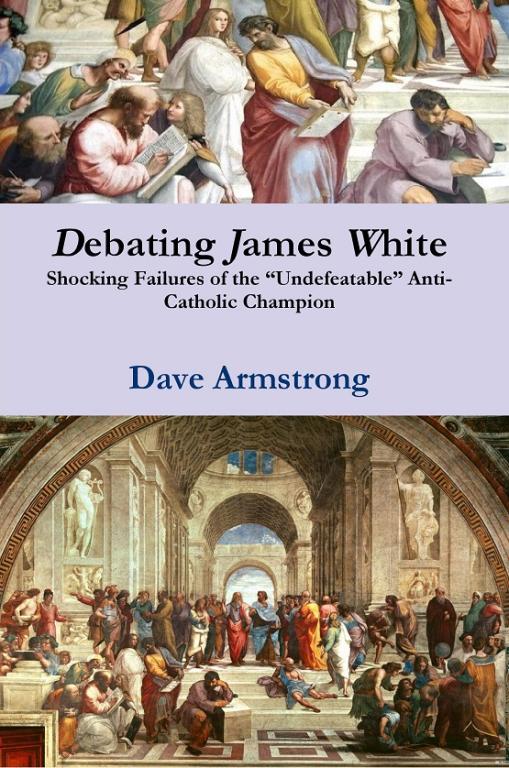
I’ve dealt with James White’s arguments against Catholicism for 27 years; my first encounter being a lengthy debate by regular mail in March-May 1995 (he departed from that exchange, leaving my final 36-page reply completely unanswered). My blog includes an extensive web page about him, and I’ve written the book, Debating James White: Shocking Failures of the “Undefeatable” Anti-Catholic Champion (Nov. 2013, 395 pages).
White stated that charismatics don’t have much of a sense of Church history. This is too often true (though it could be said in a very general way of Protestants as a group), but this is an excessive broad-brushing of an entire group. I attended Assemblies of God and non-denominational charismatic groups in the 1980s and I had no such animus against Church history. In fact, my love of it that I obtained while in those circles led me to Catholicism in 1990. White said that “fundamentalists” trace their history back to Billy Graham. Actually, many fundamentalists despise Billy Graham as a flaming liberal. Graham was in the forefront of post-World War II evangelicalism, which was a reaction against the ahistoricism and anti-intellectualism of fundamentalism.
White — soon after in the video — admits that he didn’t know much Church history, even as the son of a Baptist pastor, until he went to seminary. So this actually proves my point about widespread Protestant ignorance of Church history; and he basically refuted his own point, by his own example. He states about learning Church history in seminary: “Most Protestants have no earthly idea, where in the world they’re coming from, and hence, are not Protestants of conviction.” [8:23-31] Thanks for proving my point, James! And I hasten to add that this is absolutely true of most Catholics as well. White does apologetics to rectify this ignorance; so do I.
Cameron mentioned that he knew nothing about St. Augustine during his charismatic background. I proved in 2003 that according to James White’s antipathy to sacramentalism and his own voluminous words, Augustine and even Martin Luther couldn’t possibly be considered Christians. So if we are to talk about Christian ahistoricism, White is actually a poster boy for that view.
Interestingly, White said that he got started in apologetics by interacting with Mormons in 1982. I got my start by studying and interacting with Jehovah’s Witnesses in 1981 (the result of all that research is on my blog today). And that was by working with a charismatic person (from the Assemblies of God) who had begun a “cult ministry” (much like James White’s initial apologetics foray).
White almost chides Cameron for being ignorant as to John 6 and eucharistic theology (referring to Cameron’s chat with Matt Fradd on that topic). Readers might be interested in my response to White as regards the Holy Eucharist: Vs. James White #5: Real Eucharistic Presence or Symbolism? [9-20-19]
Though I don’t care for the slightly condescending way in which White criticizes Cameron for being unprepared to tackle Catholics in his shows, he does make a quite valid overall point. One must be prepared and properly educated in order to undertake such discussions and debates. I had been doing Christian apologetics for sixteen years and Catholic apologetics for six before I ever had a website: begun in 1997.
I had had published articles in Catholic magazines since 1993, my conversion story in the bestselling book, Surprised by Truth (1994), and had completed my first book, A Biblical Defense of Catholicism, with a Foreword by Servant of God Fr. John A. Hardon, SJ, a major figure in Catholic catechetics, and adviser to Pope St. Paul VI and St. Mother Teresa of Calcutta. I studied with him for a few years, and he expressly endorsed my book. I, too, have been accused many times by anti-Catholic polemicists, of being a “self-appointed” apologist, etc., but it is not the case at all, as I have just shown.
White mentions the usefulness of reading “classic Protestant works, such as Goode, Whitaker, Salmon . . .” [14:38-14:47].
It’s funny that he cited those particular authors. Goode and Whitaker were Anglicans who defended sola Scriptura. I wrote an entire book refuting their claims: Pillars of Sola Scriptura: Replies to Whitaker, Goode, & Biblical “Proofs” for “Bible Alone” (July 2012, 310 pages). Neither White nor any other anti-Catholic apologist / polemicist ever interacted with that. White will complain that Catholics are unfamiliar with the best Protestant historic apologists, yet ignore it when one of us makes a book-length response.
As for George Salmon, I had read his book, The Infallibility of the Church, when I was considering becoming a Catholic. I thought it was great, until I encountered St. John Henry Cardinal Newman, who demolished arguments like Salmon’s in his famous 1845 work, Essay on the Development of Christian Doctrine. Salmon has also been thoroughly (and directly) rebutted by B.C. (Basil Christopher) Butler, in a book-length treatment in 1954, which is available online. Before that, a series of articles in the Irish Ecclesiastical Record in 1901 (over 50 pages and available online) also took Salmon’s book apart.
So I agree with White: read the best historic Protestant arguments. But don’t stop there! Read the best Catholic responses you can find, too. If you are really interested in the full truth and hearing both sides of an argument before you make up your mind, read both sides and then decide. Anyone can make an ostensibly “good case” if they don’t interact with opposing views. I have provided (above) opposing treatments of the anti-Catholic sources that James White considers the best. Most are free, online, and my book can be purchased as an e-book for as little as $2.99 (I do do this for a living, as a professional apologist, after all, and have to pay my bills).
White also mentions Lutheran Martin Chemnitz as a classic source. I have dealt with errors in his arguments against the Council of Trent and Catholicism many times. I think Chemnitz is a fellow Christian. But White, because of his bizarre antipathy to all sacraments, cannot consistently do so. And the same would apply to Whitaker and Goode and Salmon (all Anglicans). So White appeals to all these men as the best historic defenders of Protestant Christianity, while his own views would classify them as not being Christians at all. Pretty weird, huh? He wants to have his cake and eat it, too.
Cameron mentions that he has heard replies to Catholic arguments from Gavin Ortlund, a Baptist pastor who also runs a YouTube channel. I have made several replies to his videos as well.
White starts going after the infallible papacy. I’ve written about all these topics he brings up. I’ll just refer readers to my extensive web page about the Papacy, and particularly, my article, 50 New Testament Proofs for Petrine Primacy & the Papacy [1994]. The entire chapter about the papacy from my first book is also available online.
White objects to Catholics anathematizing other views. He’s a Calvinist. I guess he is unfamiliar with (or chooses to ignore, as “bad PR”) the similar language in the Synod of Dort in 1618-1619, which placed Arminian Protestants outside of the fold. If one reads the canons of this synod, they repeatedly state what they believe is “orthodox” teaching and then summarily reject anything that contradicts it. How this is one whit different from Trent or Vatican I or Vatican II, perhaps James White can explain. But he never does. All Christians believe certain things, and in doing so, preclude other opinions that contradict what they believe. To act as if only Catholics do this is silly and historically naive and ignorant.
As a result of the Synod of Dort, non-Calvinist Christians (Arminians) were ordered to desist from the ministry, categorized as “disturbers of the public peace” and forced to leave the Netherlands. Johan van Oldenbarnevelt, one of the Arminian “Remonstrants”, was accused of “general perturbation in the state of the nation, both in Church and State” (treason), and was beheaded on 13 May 1619: just four days after the final meeting of the Synod. The jurist Hugo Grotius was given a life sentence in prison. These sorts of tactics followed the old template of the Lutheran and Reformed / Calvinist persecution of Anabaptists to the death. It was nothing new in Protestantism, which had a sordid record of intolerance and persecution from the beginning.
White seems to make out that no one can disagree with the pope about anything. Of course this is nonsense. He ought to be generally followed, but technically, one is free to disagree with any non-infallible utterance that any pope makes (which are actually quite a bit of the entirety of papal statements). In practice, this works out as little different than what White would believe about John Calvin. He will accept most of what he writes, but maybe disagree with some of it, too. But Protestants have their creeds and confessions just as Catholics do.
I just don’t think that the papacy entails Catholicism. [22:18-23]
This is an odd line of reasoning. But at least Cameron is not utterly hostile to the notion and possibility of a papacy.
Cameron says that the three elements of the papacy are “succession, infallibility, and supremacy” [23:21-25]. He says that if those elements are present, so is the papacy, but not necessarily Catholicism.
I think that if the papacy is true, then we do have some really good reason to think that Catholicism would be true. [23:43-51]
You realize that once you become a Roman Catholic, you don’t get to define these things; Rome does, right? . . . The dogmatic writings of the Church define what the papacy is . . . [24:06-23]
Again, Calvinists operate under the same sort of dogmatic authority, in only a slightly lesser degree, as we saw in the canons of Dort. Protestants, and particularly Calvinists, have many confessions that they are bound by. So, in effect, they don’t get to decide what they believe, either. They “sign onto” a Reformed / Calvinist affiliation and outlook and in so doing, are not at liberty to question the historic creeds that established dogmas such as the Calvinist “TULIP”: having to do with predestination. They either accept them or they aren’t considered good Calvinists (or good Christians).
No one [i.e., Catholics] wants to talk about [Pope] Francis. [26:53-56]
Really? Funny, then, that I myself have written 215 defenses of his orthodoxy, and have collected similar efforts in 289 additional articles. White implied that Jimmy Akin is reluctant to do so. This is untrue. My collection of 289 articles contains no less than fifty from Jimmy Akin. So just between Akin and myself (both full-time Catholic apologists), one can choose from 265 articles defending Pope Francis from bum raps and false accusations.
White is absolutely right that Catholics, by definition, are bound to accept as true, infallible dogmatic declarations of popes or ecumenical councils in conjunction with popes, or what the Catechism teaches, as a “sure norm.” One can’t pick and choose what they like and don’t like. That’s not how it works. If someone wants to pick and choose and select a denomination of their liking, that best fits in with their existing beliefs, then that is pure Protestantism, not Catholicism. Protestantism institutionalized theological relativism and ecclesiological, sectarian chaos.
White mentions a 2007 article and webcast of his, “Top Ten Questions for Romanist Converts” (link). I thoroughly answered these questions in my article, James White’s Top Ten Questions for “Romanist” Converts Answered [9-4-07]. As usual, he completely ignored that, as he does all of my refutations of his claims. He used to make limited answers, but has never engaged in a sustained, serious, substantive dialogue, since our first encounter in 1995. He basically takes shots and engages in ad hominem insults.
There was no monarchical episcopate in Rome until about 140 AD. [34:31-37]
We have incomplete data about a lot of things for that early period. For example, if we consider the canon of the New Testament, in the period up to 140, the Book of Acts was scarcely known or quoted. Quotations from the apostle Paul were rarely introduced as scriptural. The books of Hebrews, James, 1 and 2 Peter, 1, 2, and 3 John, Jude, and Revelation were not considered to be part of the canon, and most of these books weren’t accepted by consensus as biblical until the end of the 4th century. In the period of 160-250, the Shepherd of Hermas was considered part of the New Testament by Irenaeus, Tertullian, Origen, and Clement of Alexandria. Even in the early 5th century, 1 Clement and 2 Clement were included in the biblical manuscript: Codex Alexandrinus.
Is this information just my own “amateur” opinion, or gathered from Catholic apologists or official Catholic Church sources? No. It all came from solid Protestant scholarly reference works:
J. D. Douglas, editor, New Bible Dictionary, Grand Rapids, Michigan: Eerdmans, 1962 edition, 194-198.
F. L. Cross and E. A. Livingstone, editors, The Oxford Dictionary of the Christian Church, Oxford: Oxford Univ. Press, 2nd edition, 1983, 232, 300, 309-10, 626, 641, 724, 1049, 1069.
Norman L. Geisler & William E. Nix, From God to Us: How We Got Our Bible, Chicago: Moody Press, 1974, 109-12, 117-125.
If there was all this uncertainty about the Bible itself, why is it considered an issue that the papacy was nowhere near fully developed in 140 AD? It’s a non-issue. What we do definitely have are plenty of biblical indications of the papacy in how Peter is presented. We also have an infallible Church, as clearly seen in the Jerusalem Council (that I’ve written about many times), and in 1 Timothy 3:15, which is plain as day. And we have Clement of Rome acting very much like a “monarchical bishop” in writing to the Corinthians before 100 AD. Thus, White’s casual claim is not at all a “gotcha” polemical knockout punch, as he thinks.
White condemns “cheap debating tricks.” How comically ironic. I did an analysis of a whole range of such “tricks” and sophistry that he employed in our short live chat about Mariology in December 2000 in his own chat room (which — no surprise — he also departed early).
White fails to understand that exceptions among the Church fathers is not a disproof of the Catholic system, since no Church father is considered infallible in all that he teaches; nor is a Church father part of the magisterium, unless he was a bishop voting in an ecumenical council in agreement with the pope.
So Cyprian disagreeing with some aspects of the papacy (as White brought up) does not mean that Catholics are “requir[ed]” to “remove Cyprian from the Catholic Church” [36:09-18], anymore than we supposedly have to remove Augustine because some of his erroneous views on predestination of the damned, or St. Thomas Aquinas, because he was wrong on Mary’s Immaculate Conception. White is ignorant of the Catholic system when he makes such absurd claims. What he also fails to understand is Catholic language regarding the “unanimous consent” of Church fathers. That term (in Latin) did not mean “absolutely everyone, with no exceptions.” It meant “substantial consensus or majority.” See a further treatment of that question.
White claims that “the papal authority is saying . . . he is infallible in all of his teachings.” [43:01-11]
This is wrong on two counts. It wasn’t “papal authority” unilaterally proclaiming this dogma. It was an ecumenical council (Vatican I in 1870). The pope agreed with it, but he didn’t make the declaration himself, as White falsely claimed. Secondly, the dogmatic de fide declaration in 1870 (Pastor aeternus) didn’t state the pope was always infallible. It stated that he was in particular circumstances:
[W]e teach and define as a divinely revealed dogma that when the Roman Pontiff speaks EX CATHEDRA, that is, when, in the exercise of his office as shepherd and teacher of all Christians, in virtue of his supreme apostolic authority, he defines a doctrine concerning faith or morals to be held by the whole Church, he possesses, by the divine assistance promised to him in blessed Peter, that infallibility which the divine Redeemer willed his Church to enjoy in defining doctrine concerning faith or morals. Therefore, such definitions of the Roman Pontiff are of themselves, and not by the consent of the Church, irreformable. (end portion)
Cameron seemed to know that White was making an exaggerated, inaccurate claim, and asked “does it actually say that in Vatican I?” White then started reading from Pastor aeternus. He read a bunch of stuff from that and Vatican II but never noted the limitations of papal infallibility. Therefore, it’s an inaccurate presentation. White was either deliberately lying or ignorant. I choose in charity to believe the latter. But he was demonstrably wrong, in any event.
White indulges in the obligatory bashing of Popes Honorious and Liberius. There is another side to those stories and “problems” too. See:
Dialogue on (Supposedly Fallible) Pope Honorius [1997]
Honorius: Disproof of Papal Infallibility? [2007]
The Supposed Fall of Honorius and His Condemnation (J. H. R., American Catholic Quarterly Review, vol. 7, 1882, pp. 162-168)
*
The Condemnation of Pope Honorius (Dom John Chapman, O.S.B., London: Catholic Truth Society, 1907)
*
Pope Honorius I (Catholic Encyclopedia [Dom John Chapman])
*
The Alleged Fall of Pope Liberius (P. J. Harrold, American Catholic Quarterly Review, vol. 8, 1883, 529-549)
*
Pope Liberius (Catholic Encyclopedia [Dom John Chapman])
*
Pope Vigilius is another “whipping boy” of anti-papal rhetoric, See:
*
Pope Vigilius (Catholic Encyclopedia)
*
The Sixth Nicene Canon and the Papacy (James F. Loughlin, American Catholic Quarterly Review, vol. 5, 1880, 220-239)
*
White brings up the 6th Nicene Canon in the video. I’ve also responded to White twice with regard to the Council of Nicaea:
*
Pope Silvester and the Council of Nicaea [August 1997]
*
*
White makes the point that the live debates he was doing in the 1990s required a lot of preparation. I make the further point that written debate is far more in-depth than oral debate.
*
White said that he prepared for “six months” to debate atheist Bart Ehrman. That is impressive, and good for him!
*
White brings up Cardinal Newman. I’m familiar with his rhetoric here as well, and wrote about it in 2011 (including analysis of George Salmon): John Henry Newman on Papal Infallibility Prior to 1870 (Classic Anti-Catholic Lies: George Salmon, James White, David T. King et al) [8-11-11].
*
White urges Cameron to watch his debate with Fr. Peter Stravinskas on purgatory. I refuted White on this issue, but of course he always ignores me: Purgatory: Refutation of James White (1 Corinthians 3:10-15) [3-3-07].
*
White brings up soteriological issues near the end (regarding salvation and justification). I have responded to him eleven times regarding these matters (see the “Soteriology / Salvation . . .” section of my James White web page for those). But as for Catholics and the assurance of salvation, one must understand the notion of “moral assurance of salvation”. I contend that Protestants in fact have no more assurance of final salvation than Catholics do. They claim that they do. But a claim is not the same as an actuality. I’ve replied to White specifically in this regard: Vs. James White #4: Eternal Security of Believers? [9-19-19]
*
White asks if Cameron was familiar with Luther’s “dunghill” analogy to imputed justification. The problem is that it seems that Luther never wrote a thing. If White can verify this in the sources, I’d love to see it. But as I said, he always ignores me. Maybe someone else reading this can send me the reference. I wrote about this fascinating topic twice:
*
Luther’s “Snow-Covered Dunghill” (Myth?) [10-5-05]
*
Calvinist Origin of Luther’s (?) “Snow-Covered Dunghill”? [5-14-19]
*
***
Practical Matters: Perhaps some of my 4,000+ free online articles (the most comprehensive “one-stop” Catholic apologetics site) or fifty books have helped you (by God’s grace) to decide to become Catholic or to return to the Church, or better understand some doctrines and why we believe them.
Or you may believe my work is worthy to support for the purpose of apologetics and evangelism in general. If so, please seriously consider a much-needed financial contribution. I’m always in need of more funds: especially monthly support. “The laborer is worthy of his wages” (1 Tim 5:18, NKJV). 1 December 2021 was my 20th anniversary as a full-time Catholic apologist, and February 2022 marked the 25th anniversary of my blog.
PayPal donations are the easiest: just send to my email address: [email protected]. You’ll see the term “Catholic Used Book Service”, which is my old side-business. To learn about the different methods of contributing, including 100% tax deduction, etc., see my page: About Catholic Apologist Dave Armstrong / Donation Information. Thanks a million from the bottom of my heart!
***
Summary: Baptist anti-Catholic apologist James White and YouTube channel host Cameron Bertuzzi have a discussion about “Cameron Bertuzzi & Catholicism”. I reply.
Cameron Bertuzzi & Catholicism
Previous Post
May 15, 2022
Reply to Gavin Ortlund on Praying to the Saints
Next Post

May 19, 2022 Reply to Baptist Gavin Ortlund's Critique of Icons
Browse Our Archives
Select a Category & Last Things About Me Anti-Catholicism Atheism & Agnosticism Baptism and Sacramentalism Bible and Tradition Blessed Virgin Mary Books by Dave Armstrong C. S. Lewis Calvinism & General Protestantism Catholic Apologetics Catholic Apologists Catholic conversion Catholic converts Christmas Church (Ecclesiology) Church History Conversion and Converts Development of Doctrine Eastern Orthodoxy Ecumenism & Christian Unity Eucharist & Liturgy Fathers of the Church French Translations G. K. Chesterton Hell Hell & Satan Hell & Satan & Last Things Heresies & Comparative Religion Holistic Health Inquisition & Crusades & Scandals James White Jews & Judaism & Old Testament John Calvin John Henry Newman Liberal / Modernist Theology Life Issues Literary Resume Lutheranism Mariology Martin Luther Music Orthodoxy Papacy & Infallibility Personal Page Philosophy & Science Political & Ethical & Moral Issues Protestant Persecution & Intolerance Protestantism Purgatory Purgatory & Penance Romantic & Imaginative Theology Saints & Purgatory & Penance Salvation Salvation & Justification Satan & Last Things Sexuality and Gender Issues Spanish Translations Traditionalism vs. Radical Catholic Reactionaries Traducciones al español / tradução para português Trinitarianism & Christology Uncategorized Videos
Select a Month October 2026 September 2026 August 2026 July 2026 June 2026 May 2026 April 2026 March 2026 February 2026 January 2026 December 2025 November 2025 October 2025 September 2025 August 2025 July 2025 June 2025 May 2025 April 2025 March 2025 February 2025 January 2025 December 2024 November 2024 October 2024 September 2024 August 2024 July 2024 June 2024 May 2024 April 2024 March 2024 February 2024 January 2024 December 2023 November 2023 October 2023 September 2023 August 2023 July 2023 June 2023 May 2023 April 2023 March 2023 February 2023 January 2023 December 2022 November 2022 October 2022 September 2022 August 2022 July 2022 June 2022 May 2022 April 2022 March 2022 February 2022 January 2022 December 2021 November 2021 October 2021 September 2021 August 2021 July 2021 June 2021 May 2021 April 2021 March 2021 February 2021 January 2021 December 2020 November 2020 October 2020 September 2020 August 2020 July 2020 June 2020 May 2020 April 2020 March 2020 February 2020 January 2020 December 2019 November 2019 October 2019 September 2019 August 2019 July 2019 June 2019 May 2019 April 2019 March 2019 February 2019 January 2019 December 2018 November 2018 October 2018 September 2018 August 2018 July 2018 June 2018 May 2018 April 2018 March 2018 February 2018 January 2018 December 2017 November 2017 October 2017 September 2017 August 2017 July 2017 June 2017 May 2017 April 2017 March 2017 February 2017 January 2017 December 2016 November 2016 October 2016 September 2016 August 2016 July 2016 June 2016 May 2016 April 2016 March 2016 February 2016 January 2016 December 2015 November 2015 October 2015 September 2015 August 2015 July 2015 June 2015 May 2015 April 2015 March 2015 February 2015 January 2015 December 2014 November 2014 October 2014 September 2014 August 2014 July 2014 June 2014 April 2014 March 2014 February 2014 January 2014 December 2013 November 2013 October 2013 September 2013 August 2013 July 2013 June 2013 April 2013 March 2013 February 2013 January 2013 December 2012 November 2012 October 2012 September 2012 August 2012 July 2012 June 2012 May 2012 April 2012 March 2012 February 2012 January 2012 December 2011 November 2011 October 2011 September 2011 August 2011 July 2011 June 2011 April 2011 March 2011 February 2011 October 2010 September 2010 August 2010 July 2010 April 2010 March 2010 December 2009 October 2009 August 2009 July 2009 June 2009 May 2009 March 2009 February 2009 October 2008 September 2008 April 2008 March 2008 February 2008 January 2008 December 2007 November 2007 October 2007 May 2007 March 2007 February 2007 January 2007 November 2006 October 2006 September 2006 August 2006 July 2006 June 2006 May 2006 April 2006 March 2006 February 2006 October 2005 June 2005 April 2005 February 2005 July 2004 May 2004 April 2004
Follow Us!
TAKE THE
Religious Wisdom Quiz
Who fell out of a window and was restored to life by Paul?
Select your answer to see how you score.
Silas Barnabas Eutychus Timothy
Books by This Author Books by Dave Armstrong
Related posts from Biblical Evidence for Catholicism

Was Peter "Any Old" Apostle? 10 Anti-Papal Arguments
Biblical Evidence for Catholicism

A Few "Worst" & "Best" Arguments vs. Protestantism
Biblical Evidence for Catholicism

Jerusalem Council vs. James White & Sola Scriptura
Biblical Evidence for Catholicism

11 Protestant Objections to Papal Authority Debunked
Biblical Evidence for Catholicism
TRENDING AT PATHEOS Catholic

In "Irreplaceable," our book on vocation and technology, Trevor Sutton and I...

I was strolling through the top floor of the brand new Parthenon...

What Does Gêvâh Mean For Kimberley Guifoyle &...
This week, a lot of the news is focused on Kimberly Guilfoyle....

INNER CIRCLE: Profound Mystery (Of Christ In All...
Ephesians 5:31-32 “For this reason, a man will leave his father and...

Do Not Rejoice When Your Enemy Falls: The...
Turning an execution into a public spectacle is a disturbing expression of...

'The Chosen' S6 Trailer: The Passion Gets Very...
Not many watching 'The Chosen' worry about spoilers, but just because they...
view all Catholic blogs
Ad-Free & Subscriber Log-In Subscription Support
- About Us
- 2026 Calendar
- Videos
- Podcasts
- Library of World Religions
- Faith In Media Tracker
- Advertise With Us
- Write for Us
- Privacy Policy
- Terms of Service
- Do Not Sell My Data
- Contact Us
- Radiant Digital
- Manage Newsletter Subscriptions
- Unsubscribe From Notifications
- Sitemap
Copyright 2008-2026, Patheos. All rights reserved.
Subscription Support Ad-Free & Subscriber Log-In
Follow Patheos