
BuddhistCatholicContemplativeEvangelicalGeneral ChristianHinduJewishLatter-day SaintMuslimNew VisionsProgressive Christian
Beliefs
- Buddhist
- Catholic
- Contemplative
- Evangelical
- General Christian
- Hindu
- Jewish
- Latter-day Saint
- More Voices
- Muslim
- New Visions
- Pagan
- Progressive Christian
Topics
- Religion News
- Food and Religion
- Sports and Religion
- Religious Art
- Religious Music and Entertainment
- Religious Events
- History and Religion
- Style and Religion
- Politics and Religion
- Women in Religion
- Recreation Outdoors and Religion
- Business Finance and Religion
- Careers Workplace and Religion
- Education and Religion
- Family Parenting and Religion
- Health Fitness and Religion
- Home and Religion
- Relationships and Religion
- Technology and Religion
- Travel and Religion
Columnists
- Buddhist Columnists
- Business Finance and Religion Columnists
- Careers Workplace and Religion Columnists
- Catholic Columnists
- Contemplative Columnists
- Education and Religion Columnists
- Evangelists Columnists
- Family Parenting and Religion Columnists
- General Christian Columnists
- Health Fitness and Religion Columnists
- Hindu Columnists
- History and Religion Columnists
- Home and Religion Columnists
- Jewish Columnists
- More Voices Columnists
- Latter Day Columnists
- Muslim Columnists
- New Visions Columnists
- Nonreligious Columnists
- Pagan Columnists
- Politics and Religion Columnists
- Progressive Columnists
- Recreation Outdoors and Religion Columnists
- Relationships and Religion Columnists
- Religion News Columnists
- Religious Art Columnists
- Religious Events Columnists
- Religious Music and Entertainment Columnists
- Sports and Religion Columnists
- Style and Religion Columnists
- Technology and Religion Columnists
- Travel and Religion Columnists
- Women in Religion Columnists
Resource Library
- 2026 Calendar
- Library of World Religions
- The 100 Most Holy Places on Earth
- Patheos Answers
- Podcasts
- Videos
- Faith Leaders Database
- Anglican Episcopalian
- Bahai
- Baptist
- Buddhism
- Christianity
- Confucianism
- Eastern Orthodoxy
- Hinduism
- Holiness and Pentecostal
- ISKCON
- Islam
- Judaism
- Lutheran
- Methodist
- The Church of Jesus Christ of Latter-day Saints
- New Age
- Paganism
- Presbytarian and Reformed
- Protestantism
- Religion Behind the Scenes
- Roman Catholic
- Scientology
- Shia Islam
- Sikhism
- Sufism
- Sunni Islam
- Taoism
- Zen
- See all religions
Research Tools
 Ad-Free & Subscriber Log-In Subscription Support
Ad-Free & Subscriber Log-In Subscription Support
Follow Patheos 

- Trending:
- Forgiveness
- |
- Marriage
- |
- Consciousness
- |
- Death Penalty
- |
- Election
- |
- Halloween

-
About
-
Catholic Apologetics
-
Church History
-
Great Apologists
-
Christian Worldview
-
Protestantism & Misc.
- Home
- Catholic
- History and Religion
- Reply #2 to Gavin Ortlund on Purgatory
Reply #2 to Gavin Ortlund on Purgatory
Last updated on: May 14, 2022 at 9:16 pm by Dave Armstrong
Reply #2 to Gavin Ortlund on Purgatory 2022-05-14T21:16:13-04:00 Dave Armstrong
Patheos Explore the world's faith through different perspectives on religion and spirituality! Patheos has the views of the prevalent religions and spiritualities of the world.
Gavin Ortlund is an author, speaker, and apologist for the Christian faith, who serves as the senior pastor of First Baptist Church of Ojai in Ojai, California. Gavin has a Ph.D. from Fuller Theological Seminary in historical theology, and an M.Div from Covenant Theological Seminary. He is the author of seven books as well as numerous academic and popular articles. For a list of publications, see his CV. He runs the YouTube channel Truth Unites, which seeks to provide an “irenic” voice on theology, apologetics, and the Christian life.
I greatly admire and appreciate Gavin’s ecumenical methodology, and viewpoint. It’s extremely refreshing to hear in this hyper-polarized age. He is an exemplary Christian role model of this open-minded, charitable approach. We all learn and “win” when good, constructive dialogue takes place. It’s never a “loss” to arrive at more truth or to recognize one’s own error.
*****
I just completed an intensive 8800-page reply to a video of Gavin’s on this topic two days ago. But alas, he was curious about my reaction to his “Response to Trent Horn on Purgatory” (12-29-21). I like to fulfill folks’ request, as I am able, so here we go. I eagerly look forward to Gavin’s extensive replies to my critiques, too. At the moment he is too busy, which is fine. But some day he’ll have more available time on his hands . . . His words will be in blue.
I don’t like repeating myself (there are tons of topics to cover in apologetics, and we must make the best use of our time), so I will respond only to arguments in this video that I haven’t essentially already replied to last time.
Gavin mentions the “core essence” of purgatory. Yes, we Catholic apologists (including Trent Horn) often focus on that, especially regarding the earlier Church fathers because this is how it is with virtually all doctrines. They develop and become much more fully understood as time goes on. So there is nothing odd or unusual about boiling down the essence of the doctrine to a few ideas. It can be as simple as five words: “purging of sin after death.” Things, for example, like whether the purgatorial “fire” is literal or not, or whether purgatory is a place or condition, are not essential elements. And for that reason, Catholics are allowed to hold different views on those matters.
Gavin wants to make the essence of purgatory larger than what most Catholics would conceive it to be:
The suffering of purgatory is punitive and expiatory . . . and it affects the extinguishing of guilt. [10:55-11:06]
I’d say that this is part and parcel of “purging” or “cleansing” or “purifying.” It’s simply sanctification after death, and as such , is clearly part of the essence of purgatory. It’s “soteriological” insofar as it is sanctifying. But since it was Protestantism that basically removed sanctification from salvation (or from justification, as we would consider it), then a Protestant can hardly argue (from their own perspective) that purgatory has anything directly to do with salvation It neither causes nor prevents anyone’s salvation. As Gavin noted at the beginning of his previous video: all who are in purgatory are saved and will eventually be in heaven.
The activities of living Christians help those in purgatory. [11:16-22]
Prayer or penance for someone in purgatory is not (technically) of the essence of purgatory. It’s a function of charity (intercession and works on behalf of others). It is always associated with purgatory, but I don’t see how it is of the essence of it, anymore than, say, the prayers of Christians for the suffering people of Ukraine, or for those who are about to be martyred are the essence of suffering or martyrdom.
He mentions “fire” as a third element. Much of this is semantics. Typically of Protestants, Gavin wants to see a full-blown, nearly fully developed purgatory in the fathers before he is willing to call it purgatory. Short of that, he thinks we should say less developed expressions are “anticipatory” or suchlike. There is a sense in which that is true, too. But in the end, we’re talking about the same thing. Is “I and the father are one” a full-blown trinitarian expression? No. But I would call it an aspect of trinitarianism, or simply trinitarian (even though the Holy Spirit isn’t mentioned), and I suspect that Gavin would, too. But this is part of the reason that he doesn’t see purgatory as widely in the earlier fathers as we do, because of definitional controversies, and (I would also say) either a minimizing of development of doctrine or some sort of misunderstanding as to what it is.
Gavin expressed similarly in a comment to me underneath his last video: “A lot of the issues come down to how we define purgatory, and how much wiggle room is allowed in ‘development.’ ” Exactly right. I have tried to explain where I am coming from and where I think most Catholic theologians and apologists would also be coming from.
He again complains that Catholics are reducing purgatory to post-mortem cleansing. One reason we do it, I suppose, is because virtually no Protestants (save for an occasional anomalous Wesley C. S. Lewis) even go that far in agreement with us. This “bare minimum” is already anathema and heretical (therefore, a harmful idea) to virtually all Protestants, who think that all such sanctification occurs in this life and that God zaps the saved in a millisecond, making them fit for heaven.
In other words, if an early Church father refers to merely cleansing after death, without other details, he is already speaking in a very unProtestant way, and is already revealed to be far more Catholic in his worldview in this respect than some form of “proto-Protestant.”
I dealt with the issue of east-west division on purgatory at length last time. We think there are reasons for Eastern Christianity’s and later, Eastern Orthodoxy’s departure from our view, and that they are insufficient and unsatisfactory. But I do agree with Gavin that east-west differences concerning purgatory sometimes (if not most of the time) do involve essential matters. I stated that last time, too. I would probably disagree a bit with Trent Horn’s take on this particular issue.
Gavin cites the Greek Orthodox Archdiocese of America, claiming that both purgatory and indulgences are “unwitnessed in the Bible or in the Ancient Church.” This is untrue, I have shown last time (and more so in links provided) how purgatory is massively indicated in the Bible, and that even Protestant historians like Schaff (directly contradicting Gavon’s view of how widespread it was) confirm that it was the leading tendency in the Church fathers up to the 5th century, too. I make a straightforward biblical case for indulgences, as well: a doctrine that is misunderstood by virtually every non-Catholic, and have written about the “History and Myths” regarding it, and also about a favorite Protestant whipping-boy, Johann Tetzel, the notorious preacher of indulgences.
He brings up the development of trinitarianism. There certainly were “wildly alternative ideas[s]” [16:45-16:50]. As I showed last time, in the east there was massive, scandalous, tragic recurring belief in Arianism, Monophysitism, and Monothelitism: all very serious Christological heresies. That was not merely “a little variation or error in the details.” [16:42-16:45] And so if that could occur in relation to trinitarian doctrine, so, too, could it occur (and it did occur) with erroneous views of purgatory or outright rejection of it.
He brings up Hippolytus again. I conceded last time that he “seems unaware of purgatory.” Individual patristic exceptions are not a problem for the Catholic system and outlook. He didn’t recall whether Trent Horn dealt with Hippolytus. I did and do. I agreed and continue to agree with with Gavin’s opinion: at least based on what he presented, without doing an exhaustive survey.
He asks why there is so little attestation of purgatory early on. Good question! I think the reason would be something analogous to what Cardinal Newman stated about the seeming late arrival of the papacy in patristic understanding:
As to this doctrine the question is this, whether there was not from the first a certain element at work, or in existence, divinely sanctioned, which, for certain reasons, did not at once show itself upon the surface of ecclesiastical affairs, and of which events in the fourth century are the development; and whether the evidence of its existence and operation, which does occur in the earlier centuries, be it much or little, is not just such as ought to occur upon such an hypothesis.
For instance, it is true, St. Ignatius is silent in his Epistles on the subject of the Pope’s authority; but if in fact that authority could not be in active operation then, such silence is not so difficult to account for as the silence of Seneca or Plutarch about Christianity itself, or of Lucian about the Roman people. St. Ignatius directed his doctrine according to the need. While Apostles were on earth, there was the display neither of Bishop nor Pope; their power had no prominence, as being exercised by Apostles. In course of time, first the power of the Bishop displayed itself, and then the power of the Pope. . . .
St. Peter’s prerogative would remain a mere letter, till the complication of ecclesiastical matters became the cause of ascertaining it. While Christians were “of one heart and soul,” it would be suspended; love dispenses with laws . . .
When the Church, then, was thrown upon her own resources, first local disturbances gave exercise to Bishops, and next ecumenical disturbances gave exercise to Popes; and whether communion with the Pope was necessary for Catholicity would not and could not be debated till a suspension of that communion had actually occurred. It is not a greater difficulty that St. Ignatius does not write to the Asian Greeks about Popes, than that St. Paul does not write to the Corinthians about Bishops. And it is a less difficulty that the Papal supremacy was not formally acknowledged in the second century, than that there was no formal acknowledgment on the part of the Church of the doctrine of the Holy Trinity till the fourth. No doctrine is defined till it is violated . . .
Moreover, an international bond and a common authority could not be consolidated, were it ever so certainly provided, while persecutions lasted. If the Imperial Power checked the development of Councils, it availed also for keeping back the power of the Papacy. The Creed, the Canon, in like manner, both remained undefined. The Creed, the Canon, the Papacy, Ecumenical Councils, all began to form, as soon as the Empire relaxed its tyrannous oppression of the Church. And as it was natural that her monarchical power should display itself when the Empire became Christian, so was it natural also that further developments of that power should take place when that Empire fell. Moreover, when the power of the Holy See began to exert itself, disturbance and collision would be the necessary consequence . . . as St. Paul had to plead, nay, to strive for his apostolic authority, and enjoined St. Timothy, as Bishop of Ephesus, to let no man despise him: so Popes too have not therefore been ambitious because they did not establish their authority without a struggle. It was natural that Polycrates should oppose St. Victor; and natural too that St. Cyprian should both extol the See of St. Peter, yet resist it when he thought it went beyond its province . . . (Essay on the Development of Christian Doctrine, 1878 edition, Univ. of Notre Dame Press, 1989, pp. 148-155; Part 1, Chapter 4, Section 3)
I discussed Tertullian last time, and also Cyprian at some length. No doubt my answers were not identical to Trent Horn’s, so they require a response at some point. I’m defending my arguments, not Trent Horn’s, where they differ from mine. He brings up the Syriac father Aphrahat. Trent Horn noted that he believed in soul sleep, which is heretical. I did, too, last time. He was simply wrong, and even John Calvin rejected soul sleep (though Luther didn’t). If Ephraem also didn’t express belief in purgatory, then I’ll accept Gavin’s word for that, having little desire at this point to delve deeply into his works, too.
Patristic eulogies were brought up. Last time, I stated: “I agree that there is such a thing as praying for the dead without presupposing purgatory.”
He mentions a bunch of fathers praying for the dead in different ways. Granted. I’d say they are all closer to Catholicism because they’re praying for the dead: a thing that is anathema to most Protestants. The doctrine develops over time and more consensus is reached.
He cites Gregory Nazianzus (Orations 39:19). To me, this is referring to purging of Christians after death, because of the portion of the Bible that Gregory alludes to: 1 Corinthians 3:12-19. The whole passage is about Christians, some of whom “will be saved, but only as through fire” (1 Cor 3:15). So it seems to me that he is referring to purgative suffering of the saved, which is what purgatory is about. So maybe he believes in purgatory after all, huh?
But Gavin cites him seemingly saying that to die is to immediately have pleasure in God’s presence. I would say that St. Paul says the same. But he also has a passage like 1 Corinthians 3. Gavin argued before that this referred only to Christian workers. In my previous reply I showed at length why I don’t believe this is the case.
He brings up St. John Chrysostom. I dealt with him at some length last time, too.
He says that he can agree with various points Trent made without damaging his own thesis. That’s exactly how I feel about mine! I think it survives all of Gavin’s points. He denies a universality of the view in the fathers. So do I. I believe in a “near consensus”: as Cardinal Newman put it, or a consensus seemingly more towards the later Catholic view than not (as Schaff say). I sincerely don’t think anything Gavin has brought up has overthrown that.
***
Practical Matters: Perhaps some of my 4,000+ free online articles (the most comprehensive “one-stop” Catholic apologetics site) or fifty books have helped you (by God’s grace) to decide to become Catholic or to return to the Church, or better understand some doctrines and why we believe them.
Or you may believe my work is worthy to support for the purpose of apologetics and evangelism in general. If so, please seriously consider a much-needed financial contribution. I’m always in need of more funds: especially monthly support. “The laborer is worthy of his wages” (1 Tim 5:18, NKJV). 1 December 2021 was my 20th anniversary as a full-time Catholic apologist, and February 2022 marked the 25th anniversary of my blog.
PayPal donations are the easiest: just send to my email address: [email protected]. You’ll see the term “Catholic Used Book Service”, which is my old side-business. To learn about the different methods of contributing, including 100% tax deduction, etc., see my page: About Catholic Apologist Dave Armstrong / Donation Information. Thanks a million from the bottom of my heart!
***
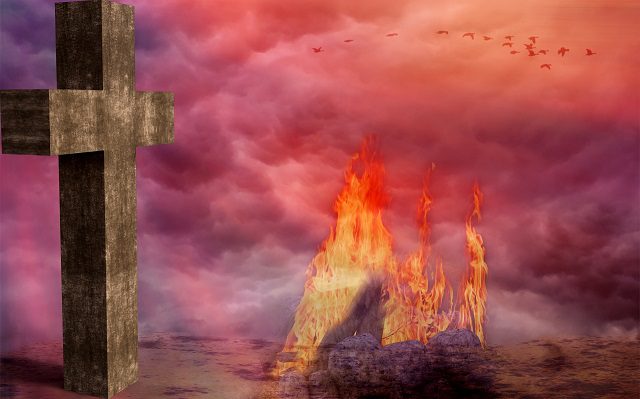
Photo credit: kai Stachowiak, “Purgatory” [PublicDomainPictures.Net]
***
Summary: 2nd reply to Baptist pastor Gavin Ortlund on purgatory. There wasn’t much new here, compared to my previous reply, but perhaps some things were clarified.
Previous Post
May 12, 2022
Reply to Gavin Ortlund's "Relics: A Protestant Critique"
Next Post
May 15, 2022 Reply to Gavin Ortlund on Praying to the Saints
Browse Our Archives
Select a Category & Last Things About Me Anti-Catholicism Atheism & Agnosticism Baptism and Sacramentalism Bible and Tradition Blessed Virgin Mary Books by Dave Armstrong C. S. Lewis Calvinism & General Protestantism Catholic Apologetics Catholic Apologists Catholic conversion Catholic converts Christmas Church (Ecclesiology) Church History Conversion and Converts Development of Doctrine Eastern Orthodoxy Ecumenism & Christian Unity Eucharist & Liturgy Fathers of the Church French Translations G. K. Chesterton Hell Hell & Satan Hell & Satan & Last Things Heresies & Comparative Religion Holistic Health Inquisition & Crusades & Scandals James White Jews & Judaism & Old Testament John Calvin John Henry Newman Liberal / Modernist Theology Life Issues Literary Resume Lutheranism Mariology Martin Luther Music Orthodoxy Papacy & Infallibility Personal Page Philosophy & Science Political & Ethical & Moral Issues Protestant Persecution & Intolerance Protestantism Purgatory Purgatory & Penance Romantic & Imaginative Theology Saints & Purgatory & Penance Salvation Salvation & Justification Satan & Last Things Sexuality and Gender Issues Spanish Translations Traditionalism vs. Radical Catholic Reactionaries Traducciones al español / tradução para português Trinitarianism & Christology Uncategorized Videos
Select a Month October 2026 September 2026 August 2026 July 2026 June 2026 May 2026 April 2026 March 2026 February 2026 January 2026 December 2025 November 2025 October 2025 September 2025 August 2025 July 2025 June 2025 May 2025 April 2025 March 2025 February 2025 January 2025 December 2024 November 2024 October 2024 September 2024 August 2024 July 2024 June 2024 May 2024 April 2024 March 2024 February 2024 January 2024 December 2023 November 2023 October 2023 September 2023 August 2023 July 2023 June 2023 May 2023 April 2023 March 2023 February 2023 January 2023 December 2022 November 2022 October 2022 September 2022 August 2022 July 2022 June 2022 May 2022 April 2022 March 2022 February 2022 January 2022 December 2021 November 2021 October 2021 September 2021 August 2021 July 2021 June 2021 May 2021 April 2021 March 2021 February 2021 January 2021 December 2020 November 2020 October 2020 September 2020 August 2020 July 2020 June 2020 May 2020 April 2020 March 2020 February 2020 January 2020 December 2019 November 2019 October 2019 September 2019 August 2019 July 2019 June 2019 May 2019 April 2019 March 2019 February 2019 January 2019 December 2018 November 2018 October 2018 September 2018 August 2018 July 2018 June 2018 May 2018 April 2018 March 2018 February 2018 January 2018 December 2017 November 2017 October 2017 September 2017 August 2017 July 2017 June 2017 May 2017 April 2017 March 2017 February 2017 January 2017 December 2016 November 2016 October 2016 September 2016 August 2016 July 2016 June 2016 May 2016 April 2016 March 2016 February 2016 January 2016 December 2015 November 2015 October 2015 September 2015 August 2015 July 2015 June 2015 May 2015 April 2015 March 2015 February 2015 January 2015 December 2014 November 2014 October 2014 September 2014 August 2014 July 2014 June 2014 April 2014 March 2014 February 2014 January 2014 December 2013 November 2013 October 2013 September 2013 August 2013 July 2013 June 2013 April 2013 March 2013 February 2013 January 2013 December 2012 November 2012 October 2012 September 2012 August 2012 July 2012 June 2012 May 2012 April 2012 March 2012 February 2012 January 2012 December 2011 November 2011 October 2011 September 2011 August 2011 July 2011 June 2011 April 2011 March 2011 February 2011 October 2010 September 2010 August 2010 July 2010 April 2010 March 2010 December 2009 October 2009 August 2009 July 2009 June 2009 May 2009 March 2009 February 2009 October 2008 September 2008 April 2008 March 2008 February 2008 January 2008 December 2007 November 2007 October 2007 May 2007 March 2007 February 2007 January 2007 November 2006 October 2006 September 2006 August 2006 July 2006 June 2006 May 2006 April 2006 March 2006 February 2006 October 2005 June 2005 April 2005 February 2005 July 2004 May 2004 April 2004
Follow Us!
TAKE THE
Religious Wisdom Quiz
Which book of the Bible contains the most direct prophecies about the Messiah?
Select your answer to see how you score.
Micah Isaiah Zechariah Psalms
Books by This Author Books by Dave Armstrong
Related posts from Biblical Evidence for Catholicism

Bible & Catholicism on Mortal Sin (vs. John...
Biblical Evidence for Catholicism

Does Catholic Intercession of Saints Require Omniscience?
Biblical Evidence for Catholicism

Eternal Hell: Biblical? 25 Verses Say So
Biblical Evidence for Catholicism

Capabilities of Heavenly Saints: Protestant Commentaries
Biblical Evidence for Catholicism
TRENDING AT PATHEOS Catholic

The Sermon on the Mount, Part I: Matthew...
The Sermon on the Mount, Part I (Matthew 4:12-5:12) St. Matthew moves...

What's up from Crossway: Reviewing some of their latest A few weeks...

Janie Learns the Way of the Cross: A...
Teaching children about Jesus' Passion can be challenging. Many parents and educators...

Looking For Good Catholic Writing - October 2026
He alone extends the heavens, and he walks upon the waves of...

In "Irreplaceable," our book on vocation and technology, Trevor Sutton and I...

I was strolling through the top floor of the brand new Parthenon...
view all Catholic blogs
Ad-Free & Subscriber Log-In Subscription Support
- About Us
- 2026 Calendar
- Videos
- Podcasts
- Library of World Religions
- Faith In Media Tracker
- Advertise With Us
- Write for Us
- Privacy Policy
- Terms of Service
- Do Not Sell My Data
- Contact Us
- Radiant Digital
- Manage Newsletter Subscriptions
- Unsubscribe From Notifications
- Sitemap
Copyright 2008-2026, Patheos. All rights reserved.
Subscription Support Ad-Free & Subscriber Log-In
Follow Patheos