
BuddhistCatholicContemplativeEvangelicalGeneral ChristianHinduJewishLatter-day SaintMuslimNew VisionsProgressive Christian
Beliefs
- Buddhist
- Catholic
- Contemplative
- Evangelical
- General Christian
- Hindu
- Jewish
- Latter-day Saint
- More Voices
- Muslim
- New Visions
- Pagan
- Progressive Christian
Topics
- Religion News
- Food and Religion
- Sports and Religion
- Religious Art
- Religious Music and Entertainment
- Religious Events
- History and Religion
- Style and Religion
- Politics and Religion
- Women in Religion
- Recreation Outdoors and Religion
- Business Finance and Religion
- Careers Workplace and Religion
- Education and Religion
- Family Parenting and Religion
- Health Fitness and Religion
- Home and Religion
- Relationships and Religion
- Technology and Religion
- Travel and Religion
Columnists
- Buddhist Columnists
- Business Finance and Religion Columnists
- Careers Workplace and Religion Columnists
- Catholic Columnists
- Contemplative Columnists
- Education and Religion Columnists
- Evangelists Columnists
- Family Parenting and Religion Columnists
- General Christian Columnists
- Health Fitness and Religion Columnists
- Hindu Columnists
- History and Religion Columnists
- Home and Religion Columnists
- Jewish Columnists
- More Voices Columnists
- Latter Day Columnists
- Muslim Columnists
- New Visions Columnists
- Nonreligious Columnists
- Pagan Columnists
- Politics and Religion Columnists
- Progressive Columnists
- Recreation Outdoors and Religion Columnists
- Relationships and Religion Columnists
- Religion News Columnists
- Religious Art Columnists
- Religious Events Columnists
- Religious Music and Entertainment Columnists
- Sports and Religion Columnists
- Style and Religion Columnists
- Technology and Religion Columnists
- Travel and Religion Columnists
- Women in Religion Columnists
Resource Library
- 2026 Calendar
- Library of World Religions
- The 100 Most Holy Places on Earth
- Patheos Answers
- Podcasts
- Videos
- Faith Leaders Database
- Anglican Episcopalian
- Bahai
- Baptist
- Buddhism
- Christianity
- Confucianism
- Eastern Orthodoxy
- Hinduism
- Holiness and Pentecostal
- ISKCON
- Islam
- Judaism
- Lutheran
- Methodist
- The Church of Jesus Christ of Latter-day Saints
- New Age
- Paganism
- Presbytarian and Reformed
- Protestantism
- Religion Behind the Scenes
- Roman Catholic
- Scientology
- Shia Islam
- Sikhism
- Sufism
- Sunni Islam
- Taoism
- Zen
- See all religions
Research Tools
 Ad-Free & Subscriber Log-In Subscription Support
Ad-Free & Subscriber Log-In Subscription Support
Follow Patheos 

- Trending:
- Forgiveness
- |
- Marriage
- |
- Consciousness
- |
- Death Penalty
- |
- Election
- |
- Halloween

-
About
-
Catholic Apologetics
-
Church History
-
Great Apologists
-
Christian Worldview
-
Protestantism & Misc.
- Home
- Catholic
- History and Religion
- Reply to Jordan Cooper’s Rejection of the Papacy
Reply to Jordan Cooper’s Rejection of the Papacy
Last updated on: April 25, 2022 at 2:36 pm by Dave Armstrong
Reply to Jordan Cooper’s Rejection of the Papacy 2022-04-25T14:36:17-04:00 Dave Armstrong
Patheos Explore the world's faith through different perspectives on religion and spirituality! Patheos has the views of the prevalent religions and spiritualities of the world.
Rev. Dr. Jordan B. Cooper is a Lutheran pastor, adjunct professor of Systematic Theology, Executive Director of the popular Just & Sinner YouTube channel, and the President of the American Lutheran Theological Seminary (which holds to a doctrinally traditional Lutheranism, similar to the Lutheran Church – Missouri Synod). He has authored several books, as well as theological articles in a variety of publications.
*****
I will be responding to the first “papacy portion” of Jordan’s YouTube video, “Five Reasons I Am Not Roman Catholic” (1-27-19). When I cite his words directly, they will be in blue, and citations and descriptions of his arguments will be accompanied by the time in the video as well.
1) The Papacy. . . . The claims regarding the papacy I simply don’t see as historically verifiable, and I also do not see them exegetically. I don’t see them as being taught in Scripture. . . . Matthew 16 is the one that’s often pointed to. . . . Even if you are to argue that Peter is indeed the Rock, . . . that still does not prove that there is any truth to the claims about the successors of St. Peter. [1:08-2:32]
See my papers, for the general Catholic “Petrine” or “papal” argument from Scripture:
50 New Testament Proofs for Petrine Primacy & the Papacy [1994]
Primacy of St. Peter Verified by Protestant Scholars [1994]
Can Christ & Peter Both be “Rocks”? [4-21-22]
See also: “Protestant Scholars on Matthew 16:16-19” (Nicholas Hardesty) [9-4-06]
As to papal succession, most Christians agree that St. Peter was the leader of the early Church and the disciples: whether they believe he was a “pope” or not. It stands to reason, then, that there would continue to be a leader, just as there was a first President when the laws of the United States were established at the Constitutional Convention in 1787.
Why have one President and then cease to have one thereafter and let the executive branch of government exist without a leader? Everyone understands that there is then a succession of Presidents and that it doesn’t end with the first one and the prototype.
So why do people think so differently when it comes to Christianity, which is in need of a governing body and person at the top of the chain of authority, just as any effective organization whatever has? Catholics are, therefore, applying common sense: if this is how Jesus set up the government of His Church in the beginning, then it ought to continue in like fashion, in perpetuity.
If indeed an office of the pope was truly intended to be set up by Jesus, why in the world would anyone think it was solely for the lifetime of Peter and then it would vanish? The Church supposedly had a supervisor for ten, twenty years, but then never did again? That makes no sense. What would be the point?
When other offices are referred to in the Bible (excepting the apostles and perhaps prophets: but there is a biblical argument that bishops are the successors of the apostles), they were clearly regarded as permanent and ongoing (deacons, elders, pastors / priests / bishops). By analogy, then, it follows that this office is perpetual, just as the others are. It also makes sense to have a chief bishop.
Moreover, the very nature of the concept of office is that it is larger than one mere person who occupies it: even the first and most extraordinary one who does. It’s quite obvious that Jesus’ commissioning of Peter was the creation of a new office or position: having to do with the governance of the Church and jurisdiction and power.
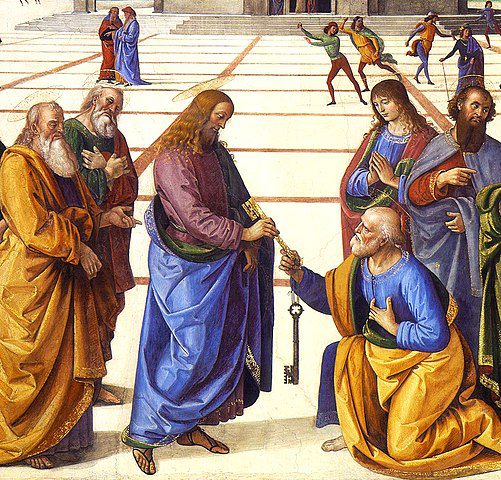
Moreover, the consensus of Bible scholars today (including Protestants) is that the notion of “keys of the kingdom of heaven” given to Peter by Jesus (Mt 16:19) hearkens back to the Old Testament:
Isaiah 22:22-24 (RSV) And I will place on his shoulder the key of the house of David; he shall open, and none shall shut; and he shall shut, and none shall open. [23] And I will fasten him like a peg in a sure place, and he will become a throne of honor to his father’s house. [24] And they will hang on him the whole weight of his father’s house, the offspring and issue, every small vessel, from the cups to all the flagons. (cf. 36:3, 22)
This was a supervisory office. The great Protestant Bible scholar, F. F. Bruce observed:
The keys of a royal or noble establishment were entrusted to the chief steward or majordomo; . . . About 700 B.C. an oracle from God announced that this authority in the royal palace in Jerusalem was to be conferred on a man called Eliakim . . . (Isa. 22:22). So in the new community which Jesus was about to build, Peter would be, so to speak, chief steward. (The Hard Sayings of Jesus, Downers Grove, Illinois: InterVarsity Press, 1983, 143-144)
If the direct analogy understood in the commission refers to an office itself inherently possessing succession, as a matter of historical fact (according to Old Testament scholars and ancient Near East historians), then it follows that the papacy also has succession as one of its inherent characteristics. This is purely logical and based on facts concerning the office that is the basis of the analogy. In that sense it is even explicit in Scripture.
Jordan then talked about how there are bishops in the NT and Church history, and that this is good. At that point, I ask again: why have leaders in local churches, but not one leader of the whole Church? Why have a leader of the disciples, but not a leader of the bishops, who were the successors of the disciples / apostles? I would say that in fact we observe Peter acting as such a leader of the Church throughout the first half of the book of Acts and in the Jerusalem Council (Acts 15).
We see him writing very much as a pope would write in his First Epistle, which was written from Rome in general homiletic, or “hortatory” fashion (though not to all Christian inhabitants of the known world, which is not required for my point to stand) as (according to Guthrie and The Eerdmans Bible Dictionary) a “circular letter” (much like a papal encyclical is today). In fact, if we look up encyclical in the dictionary, we find that it comes from the Latin encyclicus and the Greek enkyklios, meaning, literally, “in a circle, general, common, for general circulation.” The word encyclopedia is derived from the same root. Renowned Protestant Bible scholar J. B. Lightfoot comments on this passage as follows:
St. Peter, giving directions to the elders, claims a place among them. The title ‘fellow-presbyter,’ which he applies to himself, would doubtless recall to the memory of his readers the occasions when he himself had presided with the elders and guided their deliberations. (St. Paul’s Epistle to the Philippians, Lynn, Massachusett: Hendrickson Pub., 1982, 198; emphasis added)
Furthermore, we have St. Clement of Rome decidedly acting like a pope before 100 AD in his letter to the Corinthians:
Pope St. Clement of Rome & Papal Authority [7-28-21]
Is First Clement Non-Papal? (vs. Jason Engwer) [4-19-22]
Jordan argues that early Church documents don’t refer to a pope. For example, St. Ignatius of Antioch doesn’t seem to be aware of a pope. But he ignores the strong evidence of 1 Clement, which is very early as well. St. John Henry Cardinal Newman offers a cogent explanation as to why the papacy is rather subdued and manifest relatively less in the earlier centuries of the Church (and specifically a reason for Ignatius’ silence on the matter):
Let us see how, on the principles which I have been laying down and defending, the evidence lies for the Pope’s supremacy.
As to this doctrine the question is this, whether there was not from the first a certain element at work, or in existence, divinely sanctioned, which, for certain reasons, did not at once show itself upon the surface of ecclesiastical affairs, and of which events in the fourth century are the development; and whether the evidence of its existence and operation, which does occur in the earlier centuries, be it much or little, is not just such as ought to occur upon such an hypothesis.
For instance, it is true, St. Ignatius is silent in his Epistles on the subject of the Pope’s authority; but if in fact that authority could not be in active operation then, such silence is not so difficult to account for as the silence of Seneca or Plutarch about Christianity itself, or of Lucian about the Roman people. St. Ignatius directed his doctrine according to the need. While Apostles were on earth, there was the display neither of Bishop nor Pope; their power had no prominence, as being exercised by Apostles. In course of time, first the power of the Bishop displayed itself, and then the power of the Pope. . . .
St. Peter’s prerogative would remain a mere letter, till the complication of ecclesiastical matters became the cause of ascertaining it. While Christians were “of one heart and soul,” it would be suspended; love dispenses with laws . . .
When the Church, then, was thrown upon her own resources, first local disturbances gave exercise to Bishops, and next ecumenical disturbances gave exercise to Popes; and whether communion with the Pope was necessary for Catholicity would not and could not be debated till a suspension of that communion had actually occurred. It is not a greater difficulty that St. Ignatius does not write to the Asian Greeks about Popes, than that St. Paul does not write to the Corinthians about Bishops. And it is a less difficulty that the Papal supremacy was not formally acknowledged in the second century, than that there was no formal acknowledgment on the part of the Church of the doctrine of the Holy Trinity till the fourth. No doctrine is defined till it is violated . . .
Moreover, an international bond and a common authority could not be consolidated, were it ever so certainly provided, while persecutions lasted. If the Imperial Power checked the development of Councils, it availed also for keeping back the power of the Papacy. The Creed, the Canon, in like manner, both remained undefined. The Creed, the Canon, the Papacy, Ecumenical Councils, all began to form, as soon as the Empire relaxed its tyrannous oppression of the Church. And as it was natural that her monarchical power should display itself when the Empire became Christian, so was it natural also that further developments of that power should take place when that Empire fell. Moreover, when the power of the Holy See began to exert itself, disturbance and collision would be the necessary consequence . . . as St. Paul had to plead, nay, to strive for his apostolic authority, and enjoined St. Timothy, as Bishop of Ephesus, to let no man despise him: so Popes too have not therefore been ambitious because they did not establish their authority without a struggle. It was natural that Polycrates should oppose St. Victor; and natural too that St. Cyprian should both extol the See of St. Peter, yet resist it when he thought it went beyond its province . . .
On the whole, supposing the power to be divinely bestowed, yet in the first instance more or less dormant, a history could not be traced out more probable, more suitable to that hypothesis, than the actual course of the controversy which took place age after age upon the Papal supremacy.
It will be said that all this is a theory. Certainly it is: it is a theory to account for facts as they lie in the history, to account for so much being told us about the Papal authority in early times, and not more; a theory to reconcile what is and what is not recorded about it; and, which is the principal point, a theory to connect the words and acts of the Ante-nicene Church with that antecedent probability of a monarchical principle in the Divine Scheme, and that actual exemplification of it in the fourth century, which forms their presumptive interpretation. All depends on the strength of that presumption. Supposing there be otherwise good reason for saying that the Papal Supremacy is part of Christianity, there is nothing in the early history of the Church to contradict it . . .
Moreover, all this must be viewed in the light of the general probability, so much insisted on above, that doctrine cannot but develop as time proceeds and need arises, and that its developments are parts of the Divine system, and that therefore it is lawful, or rather necessary, to interpret the words and deeds of the earlier Church by the determinate teaching of the later. (Essay on the Development of Christian Doctrine, 1878 edition, Univ. of Notre Dame Press, 1989, pp. 148-155; Part 1, Chapter 4, Section 3)
And of course Catholics would ask Lutherans: there is no patristic evidence for sola Scriptura, sola fide (justification by faith alone), consubstantiation, or any number of other Lutheran doctrines that appeared suddenly in the 16th century (indeed, even by the time of the Diet of Worm in 1521). That doesn’t, however, make you stop believing in those doctrines? Why? Why the difference of principle with regard to the papacy, where there is actually more early evidence than for your Lutheran distinctives?
*
When you look at the earlier ecumenical councils, like the council of Nicaea [325], the bishop of Rome has no clear role there, not a strong one. It’s clear that the other bishops aren’t looking to Rome as the ultimate source of authority or truth. [4:28-4:43]
*
I debated this with Reformed anti-Catholic apologist James White way back in August 1997:
Pope Silvester and the Council of Nicaea (vs. James White)
See also the related: “Papal Authority at the Earliest Councils” (Fr. Brian Harrison, Catholic Answers, 1-1-91)
*
You see this going back to the book of Acts: the council of Jerusalem; it’s James who is really heading up that particular council, not Peter. [4:42-4:52]
*
I dealt with this question in my article, Did Peter or James Preside at the Jerusalem Council? (And Was it the Prototype of Ecumenical Councils or Merely a Local Synod?) [5-21-21]. Here’s the key portion:
From Acts 15, we learn that “after there was much debate, Peter rose” to address the assembly (15:7). The Bible records his speech, which goes on for five verses. Then it reports that “all the assembly kept silence” (15:12). Paul and Barnabas speak next, not making authoritative pronouncements, but confirming Peter’s exposition, speaking about “signs and wonders God had done through them among the Gentiles” (15:12). Then when James speaks, he refers right back to what “Simeon [Peter] has related” (15:14). To me, this suggests that Peter’s talk was central and definitive. James speaking last could easily be explained by the fact that he was the bishop of Jerusalem and therefore the “host.”
St. Peter indeed had already received a relevant revelation, related to the council. God gave him a vision of the cleanness of all foods (contrary to the Jewish Law: see Acts 10:9-16). St. Peter is already learning about the relaxation of Jewish dietary laws, and is eating with uncircumcised men, and is ready to proclaim the gospel widely to the Gentiles (Acts 10 and 11).
This was the secondary decision of the Jerusalem Council, and Peter referred to his experiences with the Gentiles at the council (Acts 15:7-11). The council then decided — with regard to food –, to prohibit only that which “has been sacrificed to idols and from blood and from what is strangled” (15:29).
He notes that the Church fathers, by and large, do not interpret Matthew 16 in a papal manner, but this is not at all fatal to the Catholic claims (or even any sort of difficulty), per my reasoning in a recent reply to a Reformed Protestant: James Swan, St. Augustine & “This Rock” [4-19-22].
*
***
*
Practical Matters: Perhaps some of my 4,000+ free online articles (the most comprehensive “one-stop” Catholic apologetics site) or fifty books have helped you (by God’s grace) to decide to become Catholic or to return to the Church, or better understand some doctrines and why we believe them.
Or you may believe my work is worthy to support for the purpose of apologetics and evangelism in general. If so, please seriously consider a much-needed financial contribution. I’m always in need of more funds: especially monthly support. “The laborer is worthy of his wages” (1 Tim 5:18, NKJV). 1 December 2021 was my 20th anniversary as a full-time Catholic apologist, and February 2022 marked the 25th anniversary of my blog.
PayPal donations are the easiest: just send to my email address: [email protected]. You’ll see the term “Catholic Used Book Service”, which is my old side-business. To learn about the different methods of contributing, including 100% tax deduction, etc., see my page: About Catholic Apologist Dave Armstrong / Donation Information. Thanks a million from the bottom of my heart!
***
Photo credit: Christ Handing the Keys to St. Peter (1481-1482), by Pietro Perugino (1448-1523) [public domain / Wikimedia Commons]

*
***
Summary: Response to Jordan Cooper’s rejection of the papacy, in his video, “Five Reasons I Am Not Roman Catholic”: showing his reasons to be weak & able to be refuted.
Jordan Cooper's Rejection of the Papacy
Lutheran rejection of the papacy
Previous Post
April 25, 2022
Is Sola Scriptura Biblical? (vs. Jordan B. Cooper)
Next Post
April 27, 2022 Reply to Jordan Cooper: Invocation of Saints
Browse Our Archives
Select a Category & Last Things About Me Anti-Catholicism Atheism & Agnosticism Baptism and Sacramentalism Bible and Tradition Blessed Virgin Mary Books by Dave Armstrong C. S. Lewis Calvinism & General Protestantism Catholic Apologetics Catholic Apologists Catholic conversion Catholic converts Christmas Church (Ecclesiology) Church History Conversion and Converts Development of Doctrine Eastern Orthodoxy Ecumenism & Christian Unity Eucharist & Liturgy Fathers of the Church French Translations G. K. Chesterton Hell Hell & Satan Hell & Satan & Last Things Heresies & Comparative Religion Holistic Health Inquisition & Crusades & Scandals James White Jews & Judaism & Old Testament John Calvin John Henry Newman Liberal / Modernist Theology Life Issues Literary Resume Lutheranism Mariology Martin Luther Music Orthodoxy Papacy & Infallibility Personal Page Philosophy & Science Political & Ethical & Moral Issues Protestant Persecution & Intolerance Protestantism Purgatory Purgatory & Penance Romantic & Imaginative Theology Saints & Purgatory & Penance Salvation Salvation & Justification Satan & Last Things Sexuality and Gender Issues Spanish Translations Traditionalism vs. Radical Catholic Reactionaries Traducciones al español / tradução para português Trinitarianism & Christology Uncategorized Videos
Select a Month October 2026 September 2026 August 2026 July 2026 June 2026 May 2026 April 2026 March 2026 February 2026 January 2026 December 2025 November 2025 October 2025 September 2025 August 2025 July 2025 June 2025 May 2025 April 2025 March 2025 February 2025 January 2025 December 2024 November 2024 October 2024 September 2024 August 2024 July 2024 June 2024 May 2024 April 2024 March 2024 February 2024 January 2024 December 2023 November 2023 October 2023 September 2023 August 2023 July 2023 June 2023 May 2023 April 2023 March 2023 February 2023 January 2023 December 2022 November 2022 October 2022 September 2022 August 2022 July 2022 June 2022 May 2022 April 2022 March 2022 February 2022 January 2022 December 2021 November 2021 October 2021 September 2021 August 2021 July 2021 June 2021 May 2021 April 2021 March 2021 February 2021 January 2021 December 2020 November 2020 October 2020 September 2020 August 2020 July 2020 June 2020 May 2020 April 2020 March 2020 February 2020 January 2020 December 2019 November 2019 October 2019 September 2019 August 2019 July 2019 June 2019 May 2019 April 2019 March 2019 February 2019 January 2019 December 2018 November 2018 October 2018 September 2018 August 2018 July 2018 June 2018 May 2018 April 2018 March 2018 February 2018 January 2018 December 2017 November 2017 October 2017 September 2017 August 2017 July 2017 June 2017 May 2017 April 2017 March 2017 February 2017 January 2017 December 2016 November 2016 October 2016 September 2016 August 2016 July 2016 June 2016 May 2016 April 2016 March 2016 February 2016 January 2016 December 2015 November 2015 October 2015 September 2015 August 2015 July 2015 June 2015 May 2015 April 2015 March 2015 February 2015 January 2015 December 2014 November 2014 October 2014 September 2014 August 2014 July 2014 June 2014 April 2014 March 2014 February 2014 January 2014 December 2013 November 2013 October 2013 September 2013 August 2013 July 2013 June 2013 April 2013 March 2013 February 2013 January 2013 December 2012 November 2012 October 2012 September 2012 August 2012 July 2012 June 2012 May 2012 April 2012 March 2012 February 2012 January 2012 December 2011 November 2011 October 2011 September 2011 August 2011 July 2011 June 2011 April 2011 March 2011 February 2011 October 2010 September 2010 August 2010 July 2010 April 2010 March 2010 December 2009 October 2009 August 2009 July 2009 June 2009 May 2009 March 2009 February 2009 October 2008 September 2008 April 2008 March 2008 February 2008 January 2008 December 2007 November 2007 October 2007 May 2007 March 2007 February 2007 January 2007 November 2006 October 2006 September 2006 August 2006 July 2006 June 2006 May 2006 April 2006 March 2006 February 2006 October 2005 June 2005 April 2005 February 2005 July 2004 May 2004 April 2004
Follow Us!
TAKE THE
Religious Wisdom Quiz
Who asked Jesus, "What is truth?"
Select your answer to see how you score.
Caiaphas Pilate Nicodemus Herod
Books by This Author Books by Dave Armstrong
Related posts from Biblical Evidence for Catholicism

Was Peter "Any Old" Apostle? 10 Anti-Papal Arguments
Biblical Evidence for Catholicism

Jesus Founded the [Catholic] Church. If Not Him,...
Biblical Evidence for Catholicism

11 Protestant Objections to Papal Authority Debunked
Biblical Evidence for Catholicism

Matthew 16 & the Papacy (vs. Patrick O'Brien)
Biblical Evidence for Catholicism
TRENDING AT PATHEOS Catholic

I was strolling through the top floor of the brand new Parthenon...

What Does Gêvâh Mean For Kimberley Guifoyle &...
This week, a lot of the news is focused on Kimberly Guilfoyle....

INNER CIRCLE: Profound Mystery (Of Christ In All...
Ephesians 5:31-32 “For this reason, a man will leave his father and...

Do Not Rejoice When Your Enemy Falls: The...
Turning an execution into a public spectacle is a disturbing expression of...

'The Chosen' S6 Trailer: The Passion Gets Very...
Not many watching 'The Chosen' worry about spoilers, but just because they...

The purpose-driven labor priest
A labor activist reads Rick Warren and it gets me wondering about...
view all Catholic blogs
Ad-Free & Subscriber Log-In Subscription Support
- About Us
- 2026 Calendar
- Videos
- Podcasts
- Library of World Religions
- Faith In Media Tracker
- Advertise With Us
- Write for Us
- Privacy Policy
- Terms of Service
- Do Not Sell My Data
- Contact Us
- Radiant Digital
- Manage Newsletter Subscriptions
- Unsubscribe From Notifications
- Sitemap
Copyright 2008-2026, Patheos. All rights reserved.
Subscription Support Ad-Free & Subscriber Log-In
Follow Patheos