
BuddhistCatholicContemplativeEvangelicalGeneral ChristianHinduJewishLatter-day SaintMuslimNew VisionsProgressive Christian
Beliefs
- Buddhist
- Catholic
- Contemplative
- Evangelical
- General Christian
- Hindu
- Jewish
- Latter-day Saint
- More Voices
- Muslim
- New Visions
- Pagan
- Progressive Christian
Topics
- Religion News
- Food and Religion
- Sports and Religion
- Religious Art
- Religious Music and Entertainment
- Religious Events
- History and Religion
- Style and Religion
- Politics and Religion
- Women in Religion
- Recreation Outdoors and Religion
- Business Finance and Religion
- Careers Workplace and Religion
- Education and Religion
- Family Parenting and Religion
- Health Fitness and Religion
- Home and Religion
- Relationships and Religion
- Technology and Religion
- Travel and Religion
Columnists
- Buddhist Columnists
- Business Finance and Religion Columnists
- Careers Workplace and Religion Columnists
- Catholic Columnists
- Contemplative Columnists
- Education and Religion Columnists
- Evangelists Columnists
- Family Parenting and Religion Columnists
- General Christian Columnists
- Health Fitness and Religion Columnists
- Hindu Columnists
- History and Religion Columnists
- Home and Religion Columnists
- Jewish Columnists
- More Voices Columnists
- Latter Day Columnists
- Muslim Columnists
- New Visions Columnists
- Nonreligious Columnists
- Pagan Columnists
- Politics and Religion Columnists
- Progressive Columnists
- Recreation Outdoors and Religion Columnists
- Relationships and Religion Columnists
- Religion News Columnists
- Religious Art Columnists
- Religious Events Columnists
- Religious Music and Entertainment Columnists
- Sports and Religion Columnists
- Style and Religion Columnists
- Technology and Religion Columnists
- Travel and Religion Columnists
- Women in Religion Columnists
Resource Library
- 2026 Calendar
- Library of World Religions
- The 100 Most Holy Places on Earth
- Patheos Answers
- Podcasts
- Videos
- Faith Leaders Database
- Anglican Episcopalian
- Bahai
- Baptist
- Buddhism
- Christianity
- Confucianism
- Eastern Orthodoxy
- Hinduism
- Holiness and Pentecostal
- ISKCON
- Islam
- Judaism
- Lutheran
- Methodist
- The Church of Jesus Christ of Latter-day Saints
- New Age
- Paganism
- Presbytarian and Reformed
- Protestantism
- Religion Behind the Scenes
- Roman Catholic
- Scientology
- Shia Islam
- Sikhism
- Sufism
- Sunni Islam
- Taoism
- Zen
- See all religions
Research Tools
 Ad-Free & Subscriber Log-In Subscription Support
Ad-Free & Subscriber Log-In Subscription Support
Follow Patheos 

- Trending:
- Forgiveness
- |
- Marriage
- |
- Consciousness
- |
- Death Penalty
- |
- Election
- |
- Halloween

-
About
-
Catholic Apologetics
-
Church History
-
Great Apologists
-
Christian Worldview
-
Protestantism & Misc.
- Home
- Catholic
- History and Religion
- Reply to Jordan Cooper: Invocation of Saints
Reply to Jordan Cooper: Invocation of Saints
Last updated on: April 27, 2022 at 10:23 am by Dave Armstrong
Reply to Jordan Cooper: Invocation of Saints 2022-04-27T10:23:50-04:00 Dave Armstrong
Patheos Explore the world's faith through different perspectives on religion and spirituality! Patheos has the views of the prevalent religions and spiritualities of the world.
Rev. Dr. Jordan B. Cooper is a Lutheran pastor, adjunct professor of Systematic Theology, Executive Director of the popular Just & Sinner YouTube channel, and the President of the American Lutheran Theological Seminary (which holds to a doctrinally traditional Lutheranism, similar to the Lutheran Church – Missouri Synod). He has authored several books, as well as theological articles in a variety of publications.
*****
I will be responding to the “saints portion” of Jordan’s YouTube video, “Five Reasons I Am Not Roman Catholic” (1-27-19). When I cite his words directly, they will be in blue, and citations and descriptions of his arguments will be accompanied by the time in the video as well.
Certainly I believe in the communion of saints. I believe there are figures of exemplary faith that we should honor and look up to in Church history, and all of those things are very much important. But . . . there are a number of significant problems [in the Catholic view of the saints]. . . . In official Roman Catholic theology, . . . there are very specific ideas of what it means, for example, to pray to the saints; that prayer to the saints is not a worship of the saints, but one is simply speaking to the saints as part of the communion of saints. They are closer to God and they speak to God on our behalf and we are looking at them in the way that we would ask people on earth to pray for us. . . . But if you look at the practical reality of how that works itself out, in terms of personal piety, it does become an act, I think, of worship. Scripturally, there simply is no category for prayer that is not worship. Prayer is always addressed to God. Prayer is very much connected to worship. And so this divide that you have between prayer to the saints that is not worship and prayer to God that is an aspect of worship, is simply one that I do not see scripturally. And I think if you just look at the fruits historically, of the idea of prayers to the saints, what it leads to is really superstition and idolatry. That becomes very clear. [5:48-7:34]
He then acknowledges that various aspects of communion of saints were present in the early Church, but essentially dismisses it by saying that “it’s not that prominent” [7:46-7:48].
In the Bible, prayer is not always addressed to God, and it’s not always worship. I would even argue that when addressed to God, most of the time prayer is not worship; it’s making requests of Him, for ourselves or others. When we “work together with” God (a common biblical theme, especially in Paul), that’s not worship, either, technically speaking, though it is communion with God. Jesus Himself provides an example of prayer to Abraham:
Luke 16:24 (RSV) And he called out, ‘Father Abraham, have mercy upon me, and send Laz’arus to dip the end of his finger in water and cool my tongue; for I am in anguish in this flame.’
This is the Abraham of the Bible: long dead by that time, being asked to do something by a “rich man” (16:19, 22), traditionally known as Dives (which is simply a Latin word for “rich man”). His answer was, in effect, “no” (16:25-26). Thus failing in that request, he prays to him again for something else:
Luke 16:27-28 And he said, ‘Then I beg you, father [KJV: “I pray thee therefore, father”], to send him to my father’s house, [28] for I have five brothers, so that he may warn them, lest they also come into this place of torment.’
His request is again declined (16:29). So, like any good self-respecting Jew (Moses even “negotiated” with God), he argues with Abraham (16:30). But Abraham states again that his request is futile (16:31).
This shows (in a fascinating way) that not only can dead saints hear our requests, they also have some measure of power to carry them out on their own. Abraham is asked to “send” a dead man to appear to Dives’ brothers, in order for them to avoid damnation (yet another [potential] instance of dead men — like the prophet Samuel to Saul — communicating to those on the earth). Abraham doesn’t deny that he is able to potentially send Lazarus to do such a thing; he only denies that it would work, or that it is necessary (by the logic of “if they don’t respond to greater factor x, nor will they to lesser factor y”).
Therefore, it is assumed in the story that Abraham could have possibly done so on his own. And this is all told, remember, by our Lord Jesus. It is disputed whether it is a parable or not (several textual factors suggest that it is not; e.g., parables do not use proper names), but even if it is, it nevertheless cannot contain things that are untrue, lest Jesus be guilty of leading people into heresy by means of false illustrations or analogies within His common teaching tool: the parable.
Whether Dives was dead or not is also irrelevant to the argument at hand, since standard Protestant theology holds that no one can make such a request to anyone but God (and Dr. Cooper reiterates this as pertains to Lutheranism). He’s asking Abraham to send Lazarus to him, and then to his brothers, to prevent them from going to hell. That is very much, prayer: asking for supernatural aid from those who have left the earthly life and attained sainthood and perfection, with God.
Quibbling about whether it was a parable (an argument that fails, anyway, as shown) or whether the requester was dead does not allow Protestants to escape the internal difficulties for them, as mentioned.
Abraham is functioning as a mini-mediator. He is being asked to accomplish certain things. An intercessory request was made of him, not God. In fact, God is never mentioned in the entire story. Why did Jesus teach in this fashion? Why did He teach that Dives was asking Abraham to do things that Protestant theology would hold that only God can do? And why is the whole story about him asking Abraham for requests, rather than going directly to God and asking Him: which is required by Lutheran and general Protestant theology?
Folks, this story just ain’t how it’s supposed to be, from a Lutheran / general Protestant perspective. All the emphases are wrong, and there are serous theological errors, committed by Jesus Himself (i.e., from their perspective). That should be enough to raise the red flags for any serious Christian who believes in biblical inspiration and the deity of Christ (both of which dictate that no such error can possibly exist).
I yield to the Bible over men’s traditions any day. We mustn’t allow our theology to contradict the inspired, infallible Bible.
A similar dynamic is in the story of King Saul seeking to speak to the prophet Samuel. Catholics agree that seeking him through a medium and occultic techniques is wrong. But the real Samuel does indeed appear. It’s not a “demon impersonating him” as some claim [for the rebuttal of that, see, e.g., New Bible Commentary, p. 301; Wycliffe Bible Commentary, p. 292. This was also the view of the ancient rabbis, St. Justin Martyr, Origen, and St. Augustine, among others], because Samuel gives an authentic prophecy (that is proven to be such the next day). Demons don’t tell the truth like that. Saul is praying to Samuel insofar as he seeks answers from him:
1 Samuel 28:15 . . . Saul answered, “I am in great distress; for the Philistines are warring against me, and God has turned away from me and answers me no more, either by prophets or by dreams; therefore I have summoned you to tell me what I shall do.”
Now note that Samuel doesn’t tell him — make a Lutheran point — that it is utterly impermissible for Saul to inquire of him (i.e., pray to him) in this way. He says something different:
1 Samuel 28:16 . . . “Why then do you ask me, since the LORD has turned from you and become your enemy?”
In other words, he’s saying, “why do you think I can help you, since God Himself has already turned from you?!” But he doesn’t say what he should say, if Protestant theology is true: “Why do you ask of me a petitionary request and pray to me? Don’t you know that prayer is only to be directed to God, and never to deceased men or angels?” That would be the RLV, or Revised Lutheran Version of the Bible [sarcasm]. But I use the RSV.
Then having said that, Samuel actually in effect answers Saul’s prayer, but in a way that Saul doesn’t want to hear: he accurately predicts his death in battle the next day (1 Sam 28:17-19).
There is also a scriptural argument to be made regarding prayer to / invocation of / intercession of angels:
Men talk to angels in Holy Scripture [many examples].
What’s the difference if they are in heaven or on earth when this happens?
Angels are extremely intelligent and can deduce our thoughts and follow our actions, and they intensely care about us and are able to help us.
Therefore we can ask angels to pray, and we can also pray to them and make petitionary requests (which they can carry out as representatives of God, on His behalf).
This is not only theoretically possible and theologically permissible; there are actual examples of it in the Bible (and they’re not presented as even improper, let alone blasphemous, idolatrous, or sinful). The petitionary or intercessory requests are in blue below. The angels’ responses to prayer are in green.
Genesis 19:15, 18-21 When morning dawned, the angels urged Lot, saying, “Arise, take your wife and your two daughters who are here, lest you be consumed in the punishment of the city.”. . . And Lot said to them, “Oh, no, my lords; behold, your servant has found favor in your sight, and you have shown me great kindness in saving my life; but I cannot flee to the hills, lest the disaster overtake me, and I die. Behold, yonder city is near enough to flee to, and it is a little one. Let me escape there — is it not a little one? — and my life will be saved!” He said to him, “Behold, I grant you this favor also, that I will not overthrow the city of which you have spoken.
Keil and Delitzsch Biblical Commentary on the Old Testament wrote about this passage:
[T]here is nothing to indicate that Jehovah suddenly joined the angels. The only supposition that remains, therefore, is that Lot recognised in the two angels a manifestation of God, and so addressed them (Genesis 19:18) as Adonai (my Lord), and that the angel who spoke addressed him as the messenger of Jehovah in the name of God, without its following from this, that Jehovah was present in the two angels. [the angels distinguish themselves from God in Genesis 19:13 above]
Jamieson-Fausset-Brown Bible Commentary states: “His request was granted him, the prayer of faith availed . . .”
Lot petitioned an angel (Gen 19:20) and his request was granted (Gen 19:21). How is this any different from a prayer? Therefore, it is prayer to someone other than God by a man on earth, and the fact that it was granted and that the angel did not tell him, “you must petition / pray to God only!” proves that it was perfectly proper to do so.
Genesis 32:24-29 And Jacob was left alone; and a man wrestled with him until the breaking of the day. When the man saw that he did not prevail against Jacob, he touched the hollow of his thigh; and Jacob’s thigh was put out of joint as he wrestled with him. Then he said, “Let me go, for the day is breaking.” But Jacob said, “I will not let you go, unless you bless me.” And he said to him, “What is your name?” And he said, “Jacob.” Then he said, “Your name shall no more be called Jacob, but Israel, for you have striven with God and with men, and have prevailed.” Then Jacob asked him, “Tell me, I pray, your name.” But he said, “Why is it that you ask my name?” And there he blessed him.
Genesis 48:14-16 And Israel stretched out his right hand and laid it upon the head of E’phraim, who was the younger, and his left hand upon the head of Manas’seh, crossing his hands, for Manas’seh was the first-born. And he blessed Joseph, and said, “The God before whom my fathers Abraham and Isaac walked, the God who has led me all my life long to this day, the angel who has redeemed me from all evil, bless the lads; and in them let my name be perpetuated, and the name of my fathers Abraham and Isaac; and let them grow into a multitude in the midst of the earth.”
Note: the “angel of the LORD” is, in the Bible, on several occasions, but not always (see Ex 23:20-22; 33:14; 2 Sam 24:16; Zech 1:12), equated in context with God Himself. Keep in mind, then, that in those instances it may be God Who is being addressed, not a created angel, which is a different scenario than what my present argument is addressing (when the angel is separate of God but His direct representative).
Matthew 27:46-50 And about the ninth hour Jesus cried with a loud voice, “Eli, Eli, la’ma sabach-tha’ni?” that is, “My God, my God, why hast thou forsaken me?” [47] And some of the bystanders hearing it said, “This man is calling Eli’jah.” [48] And one of them at once ran and took a sponge, filled it with vinegar, and put it on a reed, and gave it to him to drink. [49] But the others said, “Wait, let us see whether Eli’jah will come to save him.” [50] And Jesus cried again with a loud voice and yielded up his spirit. (cf. Mk 15:34-36)
The “bystanders” are presented as allies of Jesus, since one of them gave Him a drink, in the next verse (Matthew 27:48). The next verse (27:49) again shows that this was common belief at the time: “But the others said, ‘Wait, let us see whether Eli’jah will come to save him.’”
Thus, it was believed that one could pray to one such as Elijah (who had already appeared with Jesus at the transfiguration), and that he had power to come and give aid; to “save” a person (in this case, Jesus from a horrible death). It’s not presented as if they are wrong, and in light of other related Scriptures it is more likely that they are correct in thinking that this was a permitted scenario.
Jesus, after all , had already referred to Elijah, saying that he was the prototype for John the Baptist (Mt 11:14; 17:10-13; cf. Lk 1:17 from the angel Gabriel), and it could also have been known that Elijah and Moses appeared with Jesus at the transfiguration (Mt 17:1-6), if these were His followers.
Jordan claimed about the Bible: “Prayer is always addressed to God.” I have just provided six passages from the Bible that refute this. If it’s a biblical practice and teaching, then Lutherans shouldn’t reject it and forbid it. And if individual Catholics fail to properly understand this, that is their fault, or that of their immediate teachers, but not a problem with thoroughly thought-through Catholic theology of the communion of saints or the biblical rationale for it.
All religions (and sub-groups in them) have many practitioners who don’t properly understand various teachings in their own faith. That’s not a disproof of the teachings and beliefs; it’s only a proof that human beings are (sadly) so often misinformed and undereducated; sometimes even willfully ignorant. As an apologist, a big part of my job and motivation is to see that this is not the case: that people know what they believe and why, and that their Christian belief should always be in harmony with the Bible. If it isn’t, then it has to be seriously re-examined and modified, as needs be.
***
Practical Matters: Perhaps some of my 4,000+ free online articles (the most comprehensive “one-stop” Catholic apologetics site) or fifty books have helped you (by God’s grace) to decide to become Catholic or to return to the Church, or better understand some doctrines and why we believe them.
Or you may believe my work is worthy to support for the purpose of apologetics and evangelism in general. If so, please seriously consider a much-needed financial contribution. I’m always in need of more funds: especially monthly support. “The laborer is worthy of his wages” (1 Tim 5:18, NKJV). 1 December 2021 was my 20th anniversary as a full-time Catholic apologist, and February 2022 marked the 25th anniversary of my blog.
PayPal donations are the easiest: just send to my email address: [email protected]. You’ll see the term “Catholic Used Book Service”, which is my old side-business. To learn about the different methods of contributing, including 100% tax deduction, etc., see my page: About Catholic Apologist Dave Armstrong / Donation Information. Thanks a million from the bottom of my heart!
***
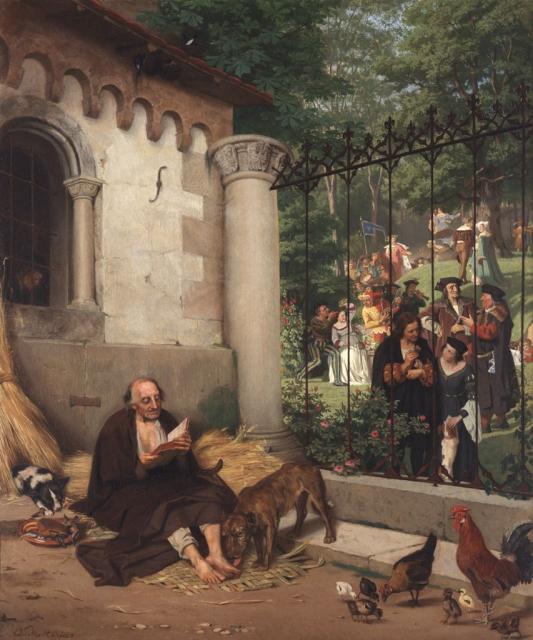
Photo credit: Lazarus and the Rich Man (1865), by Eduard von Gebhardt (1838-1925) [public domain / Wikimedia Commons]

***
Summary: Lutheran theologian Jordan Cooper rejects invocation of saints by saying, “Prayer is always addressed to God.” I refute this with six biblical counter-examples.
Lutheranism & the communion of saints
Previous Post

April 25, 2022
Reply to Jordan Cooper's Rejection of the Papacy
Next Post

April 27, 2022 Reply to Gavin Ortlund's "Sola Scriptura Defended"
Browse Our Archives
Select a Category & Last Things About Me Anti-Catholicism Atheism & Agnosticism Baptism and Sacramentalism Bible and Tradition Blessed Virgin Mary Books by Dave Armstrong C. S. Lewis Calvinism & General Protestantism Catholic Apologetics Catholic Apologists Catholic conversion Catholic converts Christmas Church (Ecclesiology) Church History Conversion and Converts Development of Doctrine Eastern Orthodoxy Ecumenism & Christian Unity Eucharist & Liturgy Fathers of the Church French Translations G. K. Chesterton Hell Hell & Satan Hell & Satan & Last Things Heresies & Comparative Religion Holistic Health Inquisition & Crusades & Scandals James White Jews & Judaism & Old Testament John Calvin John Henry Newman Liberal / Modernist Theology Life Issues Literary Resume Lutheranism Mariology Martin Luther Music Orthodoxy Papacy & Infallibility Personal Page Philosophy & Science Political & Ethical & Moral Issues Protestant Persecution & Intolerance Protestantism Purgatory Purgatory & Penance Romantic & Imaginative Theology Saints & Purgatory & Penance Salvation Salvation & Justification Satan & Last Things Sexuality and Gender Issues Spanish Translations Traditionalism vs. Radical Catholic Reactionaries Traducciones al español / tradução para português Trinitarianism & Christology Uncategorized Videos
Select a Month October 2026 September 2026 August 2026 July 2026 June 2026 May 2026 April 2026 March 2026 February 2026 January 2026 December 2025 November 2025 October 2025 September 2025 August 2025 July 2025 June 2025 May 2025 April 2025 March 2025 February 2025 January 2025 December 2024 November 2024 October 2024 September 2024 August 2024 July 2024 June 2024 May 2024 April 2024 March 2024 February 2024 January 2024 December 2023 November 2023 October 2023 September 2023 August 2023 July 2023 June 2023 May 2023 April 2023 March 2023 February 2023 January 2023 December 2022 November 2022 October 2022 September 2022 August 2022 July 2022 June 2022 May 2022 April 2022 March 2022 February 2022 January 2022 December 2021 November 2021 October 2021 September 2021 August 2021 July 2021 June 2021 May 2021 April 2021 March 2021 February 2021 January 2021 December 2020 November 2020 October 2020 September 2020 August 2020 July 2020 June 2020 May 2020 April 2020 March 2020 February 2020 January 2020 December 2019 November 2019 October 2019 September 2019 August 2019 July 2019 June 2019 May 2019 April 2019 March 2019 February 2019 January 2019 December 2018 November 2018 October 2018 September 2018 August 2018 July 2018 June 2018 May 2018 April 2018 March 2018 February 2018 January 2018 December 2017 November 2017 October 2017 September 2017 August 2017 July 2017 June 2017 May 2017 April 2017 March 2017 February 2017 January 2017 December 2016 November 2016 October 2016 September 2016 August 2016 July 2016 June 2016 May 2016 April 2016 March 2016 February 2016 January 2016 December 2015 November 2015 October 2015 September 2015 August 2015 July 2015 June 2015 May 2015 April 2015 March 2015 February 2015 January 2015 December 2014 November 2014 October 2014 September 2014 August 2014 July 2014 June 2014 April 2014 March 2014 February 2014 January 2014 December 2013 November 2013 October 2013 September 2013 August 2013 July 2013 June 2013 April 2013 March 2013 February 2013 January 2013 December 2012 November 2012 October 2012 September 2012 August 2012 July 2012 June 2012 May 2012 April 2012 March 2012 February 2012 January 2012 December 2011 November 2011 October 2011 September 2011 August 2011 July 2011 June 2011 April 2011 March 2011 February 2011 October 2010 September 2010 August 2010 July 2010 April 2010 March 2010 December 2009 October 2009 August 2009 July 2009 June 2009 May 2009 March 2009 February 2009 October 2008 September 2008 April 2008 March 2008 February 2008 January 2008 December 2007 November 2007 October 2007 May 2007 March 2007 February 2007 January 2007 November 2006 October 2006 September 2006 August 2006 July 2006 June 2006 May 2006 April 2006 March 2006 February 2006 October 2005 June 2005 April 2005 February 2005 July 2004 May 2004 April 2004
Follow Us!
TAKE THE
Religious Wisdom Quiz
What does "Pentateuch" mean?
Select your answer to see how you score.
Five Scrolls God's Law Sacred Teachings Holy Writings
Books by This Author Books by Dave Armstrong
Related posts from Biblical Evidence for Catholicism

Bible & Catholicism on Mortal Sin (vs. John...
Biblical Evidence for Catholicism

Does Catholic Intercession of Saints Require Omniscience?
Biblical Evidence for Catholicism

Capabilities of Heavenly Saints: Protestant Commentaries
Biblical Evidence for Catholicism

Revelation 5 & 8 (Intercession of Saints &...
Biblical Evidence for Catholicism
TRENDING AT PATHEOS Catholic

In "Irreplaceable," our book on vocation and technology, Trevor Sutton and I...

I was strolling through the top floor of the brand new Parthenon...

What Does Gêvâh Mean For Kimberley Guifoyle &...
This week, a lot of the news is focused on Kimberly Guilfoyle....

INNER CIRCLE: Profound Mystery (Of Christ In All...
Ephesians 5:31-32 “For this reason, a man will leave his father and...

Do Not Rejoice When Your Enemy Falls: The...
Turning an execution into a public spectacle is a disturbing expression of...

'The Chosen' S6 Trailer: The Passion Gets Very...
Not many watching 'The Chosen' worry about spoilers, but just because they...
view all Catholic blogs
Ad-Free & Subscriber Log-In Subscription Support
- About Us
- 2026 Calendar
- Videos
- Podcasts
- Library of World Religions
- Faith In Media Tracker
- Advertise With Us
- Write for Us
- Privacy Policy
- Terms of Service
- Do Not Sell My Data
- Contact Us
- Radiant Digital
- Manage Newsletter Subscriptions
- Unsubscribe From Notifications
- Sitemap
Copyright 2008-2026, Patheos. All rights reserved.
Subscription Support Ad-Free & Subscriber Log-In
Follow Patheos