
BuddhistCatholicContemplativeEvangelicalGeneral ChristianHinduJewishLatter-day SaintMuslimNew VisionsProgressive Christian
Beliefs
- Buddhist
- Catholic
- Contemplative
- Evangelical
- General Christian
- Hindu
- Jewish
- Latter-day Saint
- More Voices
- Muslim
- New Visions
- Pagan
- Progressive Christian
Topics
- Religion News
- Food and Religion
- Sports and Religion
- Religious Art
- Religious Music and Entertainment
- Religious Events
- History and Religion
- Style and Religion
- Politics and Religion
- Women in Religion
- Recreation Outdoors and Religion
- Business Finance and Religion
- Careers Workplace and Religion
- Education and Religion
- Family Parenting and Religion
- Health Fitness and Religion
- Home and Religion
- Relationships and Religion
- Technology and Religion
- Travel and Religion
Columnists
- Buddhist Columnists
- Business Finance and Religion Columnists
- Careers Workplace and Religion Columnists
- Catholic Columnists
- Contemplative Columnists
- Education and Religion Columnists
- Evangelists Columnists
- Family Parenting and Religion Columnists
- General Christian Columnists
- Health Fitness and Religion Columnists
- Hindu Columnists
- History and Religion Columnists
- Home and Religion Columnists
- Jewish Columnists
- More Voices Columnists
- Latter Day Columnists
- Muslim Columnists
- New Visions Columnists
- Nonreligious Columnists
- Pagan Columnists
- Politics and Religion Columnists
- Progressive Columnists
- Recreation Outdoors and Religion Columnists
- Relationships and Religion Columnists
- Religion News Columnists
- Religious Art Columnists
- Religious Events Columnists
- Religious Music and Entertainment Columnists
- Sports and Religion Columnists
- Style and Religion Columnists
- Technology and Religion Columnists
- Travel and Religion Columnists
- Women in Religion Columnists
Resource Library
- 2026 Calendar
- Library of World Religions
- The 100 Most Holy Places on Earth
- Patheos Answers
- Podcasts
- Videos
- Faith Leaders Database
- Anglican Episcopalian
- Bahai
- Baptist
- Buddhism
- Christianity
- Confucianism
- Eastern Orthodoxy
- Hinduism
- Holiness and Pentecostal
- ISKCON
- Islam
- Judaism
- Lutheran
- Methodist
- The Church of Jesus Christ of Latter-day Saints
- New Age
- Paganism
- Presbytarian and Reformed
- Protestantism
- Religion Behind the Scenes
- Roman Catholic
- Scientology
- Shia Islam
- Sikhism
- Sufism
- Sunni Islam
- Taoism
- Zen
- See all religions
Research Tools
 Ad-Free & Subscriber Log-In Subscription Support
Ad-Free & Subscriber Log-In Subscription Support
Follow Patheos 

- Trending:
- Forgiveness
- |
- Marriage
- |
- Consciousness
- |
- Death Penalty
- |
- Election
- |
- Halloween

-
About
-
Catholic Apologetics
-
Church History
-
Great Apologists
-
Christian Worldview
-
Protestantism & Misc.
- Home
- Catholic
- History and Religion
- Reply to Gavin Ortlund’s “Sola Scriptura Defended”
Reply to Gavin Ortlund’s “Sola Scriptura Defended”
Last updated on: June 6, 2026 at 12:46 am by Dave Armstrong
Reply to Gavin Ortlund’s “Sola Scriptura Defended” 2026-06-06T00:46:16-04:00 Dave Armstrong
Patheos Explore the world's faith through different perspectives on religion and spirituality! Patheos has the views of the prevalent religions and spiritualities of the world.
Gavin Ortlund is an author, speaker, and apologist for the Christian faith, who serves as the senior pastor of First Baptist Church of Ojai in Ojai, California. Gavin has a Ph.D. from Fuller Theological Seminary in historical theology, and an M.Div from Covenant Theological Seminary. He is the author of seven books as well as numerous academic and popular articles. For a list of publications, see his CV. He runs the YouTube channel Truth Unites, which seeks to provide an irenic voice on theology, apologetics, and the Christian life.
*****
I will be interacting with Gavin’s video, “Sola Scriptura DEFENDED” (12-15-20). His words will be in blue, and I will include times from the video, for reference purposes.
First of all, I’d like to express rapt admiration and appreciation for the words Gavin spoke in the first part of this video, in which he describes his “irenic” (or what I often describe as “ecumenical”) approach, methodology, and viewpoint. It’s extremely refreshing to hear in this age which is so hyper-polarized. The theological world (to our shame) has, of course, been divided and polarized for many centuries.
There is an increasing need for Christians to talk to each other — really talk and communicate — and to exercise charity and do our best to understand our Christian brothers and sisters and not to misrepresent what they believe. If we can’t do that, we have no hope of getting our message out to the unbelieving, suffering, dying, despairing world.
I find Gavin to be an exemplary role model of this approach, and it is worlds apart from the anti-Catholic-type Protestants I have mostly dealt with these past 26 years I have been very active online. Personally, as an apologist since 1981, Gavin’s words were a great exhortation to humility and to offset the pride that — sadly — too often cripples apologetics efforts. I am humbled and challenged by them, to do better in this regard.
Apologetics can very quickly become “oppositional” and shot-through with hostility or passive aggression. It need not be so. So, again, I am deeply grateful for these words from Gavin and he has already gained my respect as a Christian role model in terms of how we must conduct ourselves during discussions, where we disagree with each other.
That said, I will respectfully disagree with him on the present topic, and no doubt many in the future, if we continue to interact. But it is from the perspective of “brother to brother” within the Body of Christ, in order to better understand and to learn from each other, as well as providing challenges when we think a brother or sister in the faith is wrong on a particular issue (along with a willingness to be challenged).
We all learn and we all “win” when good, constructive dialogue takes place. That has always been my view, and it’s why I love dialogue so much and have engaged in many hundreds of them through the years. I’m not perfect, and have often fallen short of these high ideals, but they are my ideals and goals and what I strive to attain, by God’s grace.
***
In order to offset the danger of non-Protestant caricaturing of the Protestant position, Gavin offers a “nuanced” definition of the perspicuity (“clearness”) of Scripture from the Westminster Confession (1.7). He importantly notes the “key point” that “the perspicuity of Scripture has to do with getting saved; it’s about understanding the message of salvation from the Scripture. It has never been understood to say that the Bible is perspicuous in general, in some unqualified sense.” [6:o5-7:11]
I totally concur with this, and am happy to pass it on to my Catholic readers, so that they don’t caricature the Protestant view. I confess, on my part, that I have myself not always noted in my apologetics the subtlety and nuanced nature of the Protestant understanding of perspicuity. As Gavin noted earlier in the video, both sides too often caricature the other (I’ve seen it many times in my apologetics discussions, so I am personally quite aware of this, and sometimes I fall into it as well), and that does no one any good. It’s unethical, it bears false witness, and it doesn’t advance constructive, helpful dialogue.
Sola Scriptura has always been maintained as the view that the Bible is the only infallible rule for theology. . . . There’s a big difference in saying that the Bible is the only source for theology, and saying the Bible is the only infallible source for theology. But I hear this over and over again . . . If you [Catholics and Orthodox] hear nothing else in this entire video, hear this: don’t say that Protestants believe that the Bible is all you have or all you need; it’s just you and your Bible and that’s it. Thoughtful Protestants have always understood that tradition has an important place . . . all we’re saying is the Bible is the final court of appeal. . . . Calvin and Luther affirmed the early ecumenical creeds and councils. Thoughtful Protestants recognize that there is oral tradition mentioned in the Bible. . . . The Scripture is is the final court of appeal: the norming norm that norms all other norms but is not normed itself. [7:11-9:35, my own bolding, to highlight his central point]
This is my understanding of what sola Scriptura means as well, and has been my working definition in my Catholic critiques of it these past 31 years. The words “only infallible rule” are key, because it qualifies an overly broad understanding, or one that has been the caricature used by too many critics of sola Scriptura. I have even gotten into some discussions with fellow Catholic apologists about the supreme importance of getting the definition right, and not caricaturing it.
Here’s a second objection, and that’s that sola Scriptura was not known to Church history, and it was invented by the Reformers. [he provides a video example of a Catholic arguing this point]. . . . I want to suggest that things are much more complicated than that. Actually, what you have is a development in the Church’s understanding of Scripture and tradition, . . . It took a long time to get to a fully articulated two-source view of divine revelation, where you’ve got Scripture and sacred tradition as this sort of two-pronged view of revelation. [9:33-11:13]
It should be noted that the Second Vatican Council (1962-1965) disputes this “two-pronged” revelation in stating:
Hence there exists a close connection and communication between sacred tradition and Sacred Scripture. For both of them, flowing from the same divine wellspring, in a certain way merge into a unity and tend toward the same end. For Sacred Scripture is the word of God inasmuch as it is consigned to writing under the inspiration of the divine Spirit, while sacred tradition takes the word of God entrusted by Christ the Lord and the Holy Spirit to the Apostles, and hands it on to their successors in its full purity, so that led by the light of the Spirit of truth, they may in proclaiming it preserve this word of God faithfully, explain it, and make it more widely known. Consequently it is not from Sacred Scripture alone that the Church draws her certainty about everything which has been revealed. Therefore both sacred tradition and Sacred Scripture are to be accepted and venerated with the same sense of loyalty and reverence. (Dei Verbum, 9; my bolding)
Note that tradition is not referred to as inspired. Only Scripture is.
When you go back to the Church fathers, what you see is a mixed record. But if you want to check out some pretty fascinating quotes, pick up this book, The Church of Rome at the Bar of History, by William Webster, and just read the first Appendix . . . a series of quotes from the Church fathers . . . There is, among the Church fathers, even while they are appealing to oral tradition as well, an awareness and a conviction . . . that there is a deposit of authoritative revelation in the Holy Scripture that possesses a kind of unparalleled authority. [11:13-12:18]
Respectfully, I have not observed, myself, after much related study, a “mixed record” in the Church fathers on the matter of the rule of faith (or with regard to whether any of them held to sola Scriptura). In my experience, they do not express the principle of sola Scriptura, as defined by Gavin above. We must also note that in saying that Scripture is the only infallible authority, one is at the same time necessarily denying that tradition or the Church can be infallible (even under carefully laid-out conditions).
So when I went and studied what many Church fathers thought on this issue, I looked up what they said about the authority of the Church, sacred tradition, ecumenical councils, and apostolic succession. And lo and behold, in every case I have thus far studied, infallible or sublime authority was granted to one of these four things. That being the case, it proved that the Church father in question did not (by definition) subscribe to sola Scriptura as the rule of faith. To see my evidence for this in each case, go to my Fathers of the Church web page, to the section: “BIBLE / TRADITION / APOSTOLIC SUCCESSION / SOLA SCRIPTURA / PERSPICUITY / RULE OF FAITH.”
As for William Webster, I have interacted more than once with his contra-Catholic assertions, and with the three-volume series of the Church fathers and sola Scriptura, co-written with David T. King. Again, I was very unimpressed with his research and points of view. See my articles:
William Webster’s Misunderstanding of Development of Doctrine [2000]
*
William Webster vs. Tradition, Development, & Truth [4-10-03]
*
*
I informed Mr. Webster after my first critique of his work in 2000, and he said he would interact with it, but alas, he never has, these past 22 years.
*
Gavin cites passages from St. Basil the Great and St. Augustine. Both can be interpreted simply as recognitions of the supreme authority of Scripture as inspired revelation, and the need for all theology to be harmonious with Scripture. It doesn’t follow, however, that either Church father held to sola Scriptura. They did not, because they recognized non-Scriptural entities as also infallible authorities within the Christian rule of faith. I documented this — way back in 2003 — in Basil‘s and Augustine‘s cases, and showed how Webster and King were selectively citing Basil and citing him out of context, while (improperly and unhelpfully) ignoring what he said on these other issues.
*
Gavin continued to talk about the fathers’ view of Scripture without directly addressing the necessary corollary aspects of what they believed about the authority of the Church, sacred tradition, ecumenical councils, and apostolic succession. This is a common failing of Protestant “patristic apologetics” that I have observed again and again. If Gavin is drawing from William Webster (and he says he has only read one Appendix), assuredly, he is getting only one side of the story, because this is the consistent methodology of Webster and King: observed by myself and several other Catholic critics through the years. I think Gavin has shown that he is open to critiques, and hopefully, he will address this particular aspect — as a valid Catholic objection — in some sort of reply to this present article (especially since he has interacted with many other Catholic apologists; I simply concentrate on writing rather than videos).
*
I had a big written debate with Protestant apologist Jason Engwer at the large CARM forum in 2003 on the topic of the Church fathers and sola Scriptura (we’ve had many more interactions as well through the years), and he did precisely the same thing. I pointed this out over and over to no avail, and he departed before we even finished the debate.
*
That leads into the third objection, which is “Sola Scriptura is not in the Bible”. I hear this one all the time [provides a video example] . . . [It’s] a very common claim, and it’s certainly true that we don’t find any verses in the Bible that say, “Thus follows the relation of Scripture and tradition . . .” But then again there’s a lot of things that we would say are entailed by the Bible but aren’t spelled out in that sort of explicit, self-conscious way. I’d also admit that verses like 2 Timothy 3:16, 2 Peter 1:20-21, and John 10:35 don’t in themselves get you to sola Scriptura, . . . but they don’t say that they’re the only thing that has that kind of authority . . . [directed to those who say sola Scriptura isn’t in the Bible]: would you interact with Matthew 15:1-9 more? [13:55-16:05]
*
I debated this passage and related ones having to do with the Pharisees and tradition at extreme length in 2003 and 2005, with Reformed Baptist apologist James White. Unfortunately, they are tainted with his virulent anti-Catholicism and personal attacks (and must be very tedious to read), but I did my best to plug away and offer my viewpoint, in-between all of that diversion:
*
“Moses’ Seat” & Jesus vs. Sola Scriptura [12-27-03]
*
Refutation of James White: Moses’ Seat, the Bible, and Tradition (Introduction: #1) (+Part II | Part III | Part IV | Part V | Part VI) [5-12-05]
*
He comments on Matthew 15 and noted that Scripture is set against the traditions of men. But the reply is that not all traditions are “of men” (i.e., opposed to God or sacred, divine tradition). Matthew 15 is setting Scripture up against these false traditions of men, not all tradition. I get into this aspect in my articles:
“Tradition” Isn’t a Dirty Word [late 90s; rev. 8-16-16]
*
Tradition is Not a Dirty Word — It’s a Great Gift [National Catholic Register, 4-24-17]
*
Dialogue on Tradition: Good or Bad, How Much?, Etc. [12-12-17]
*
Paul expressly points out that there are good and bad traditions:
Colossians 2:8 (RSV) See to it that no one makes a prey of you by philosophy and empty deceit, according to human tradition, according to the elemental spirits of the universe, and not according to Christ.
I would say that “tradition” is the unspoken meaning in the latter part of the passage. Paul refers to this positive tradition from Christ elsewhere:
1 Corinthians 11:2 I commend you because you remember me in everything and maintain the traditions even as I have delivered them to you.
2 Thessalonians 2:15 So then, brethren, stand firm and hold to the traditions which you were taught by us, either by word of mouth or by letter.
2 Timothy 1:13-14 Follow the pattern of the sound words which you have heard from me, in the faith and love which are in Christ Jesus; [14] guard the truth that has been entrusted to you by the Holy Spirit who dwells within us.
When all is said and done, I don’t see that sola Scriptura is taught in the Bible, and I think this is a huge internal logical conundrum for Protestants: especially in terms of formulating their rule of faith.
*
What Protestants have always said is that the Church didn’t give us the Bible; it recognized the Bible: and that is a meaningful distinction. [22:16-22:23]
*
I totally agree; so do (Gavin might be surprised to learn) Vatican I and Vatican II:
First Vatican Council (1870)
These the Church holds to be sacred and canonical; not because, having been carefully composed by mere human industry, they were afterward approved by her authority; not because they contain revelation, with no admixture of error; but because, having been written by the inspiration of the Holy Ghost, they have God for their author, and have been delivered as such to the Church herself. (Dogmatic Constitution on the Catholic Faith, chapter II; emphasis added)
Second Vatican Council (1962-1965)
The divinely-revealed realities which are contained and presented in the text of sacred Scripture, have been written down under the inspiration of the Holy Spirit. For Holy Mother Church relying on the faith of the apostolic age, accepts as sacred and canonical the books of the Old and New Testaments, whole and entire, with all their parts, on the grounds that they were written under the inspiration of the Holy Spirit (cf. Jn. 20:31; 2 Tim. 3:16; 2 Pet. 1:19-21; 3:15-16), they have God as their author, and have been handed on as such to the Church herself. (Dogmatic Constitution on Divine Revelation [Dei Verbum], Chapter III, 11; emphasis added)
I acknowledge that most Protestants don’t function with a very robust definition of sola Scriptura. Many function with what some people call solo Scriptura or nuda Scriptura: Scripture alone. . . . Protestants do value Church history insufficiently, and so if there is any blame for caricatures of sola Scriptura, a lot of it comes on us Protestants, because we don’t even understand what that doctrine means in many cases. [23:35-24:18]
This is true, and I appreciate Gavin humbly acknowledging it. It’s really a universal shortcoming: ignorance and theological undereducation abounds; insufficient learning or catechesis in all Christian traditions and communions. This is why good teaching and apologetics are so crucial. All Christians need to know not only what they believe, but why they believe it. Catholics, for our part — on the whole — , are woefully ignorant of the contents of Scripture, before we even get to doctrinal beliefs and the reasons why we believe what we do.
*
They are insufficiently catechized and abysmally ignorant of Scripture, and can therefore, learn quite a bit from Protestants on that score: who do value Scripture, as a rule, far more highly than Catholics do. I wrote about this in This Rock (the magazine of Catholic Answers) in 2004: ““Catholics Need to Read Their Bibles,” February 2004, 20-22. I wrote about it again for the National Catholic Register: “Why Are Catholics So Deficient in Bible-Reading?” [11-22-17]. So there are plenty of faults to go around.
*
The massive ignorance of the populace in all Christian communions is the reason why we can — in doing apologetics and debates — only compare the “books” of one view with the books (confessions, creeds, catechisms) of another. We can always find bad examples on all sides, but we can’t base any sort of argument on that. We have to know and consult the “official teachings” of any given group.
*
“A second acknowledgment I would make [is that] . . . the second century church didn’t look exactly like a Protestant church.” He goes on to note that in the early letters of Ignatius, episcopal government and a high view of the Eucharist are present. He admits: “that’s tough. That’s a fair challenge to me. . . . They do challenge me as a Baptist, and I’ll just admit it. . . . that’s a challenge to my perspective.” [24:18-25:50]
*
Again, kudos to Gavin for humbly making such a concession. In conclusion: for much more of why I think the lack of the teaching of sola Scriptura in the Bible is a big challenge for Protestants and very difficult to explain from their perspective, see my recent article, Is Sola Scriptura Biblical? (vs. Jordan B. Cooper) [4-25-22]. For further related reading, see my two books on the topic:
100 Biblical Arguments Against Sola Scriptura (Catholic Answers: 10 May 2012, 135p)
*
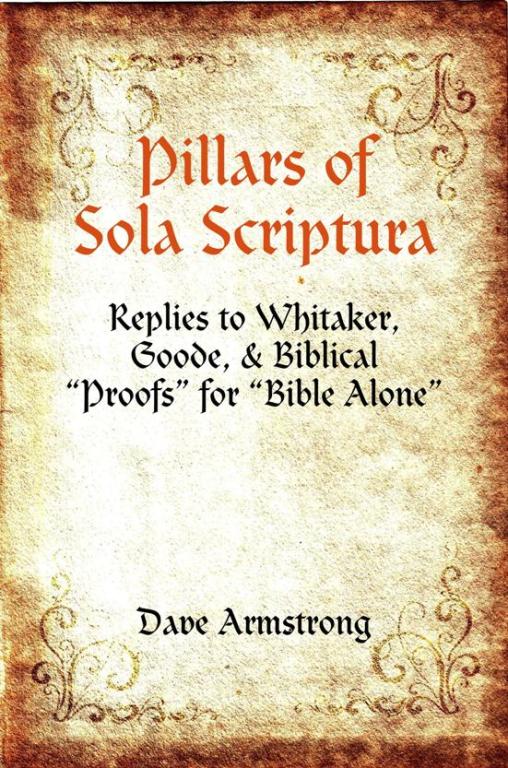
Pillars of Sola Scriptura: Replies to Whitaker, Goode, & Biblical “Proofs” for “Bible Alone” (July 2012, 310p)
*
I thank Gavin very much for a very stimulating, enjoyable, ecumenical, and educational dialogue. I hope he responds back, so that we can continue the dialogue. If he does it in a video, that’s fine. I operate in the “written mode” only, but am happy to view videos and respond, just as I have done here.
*
***
Practical Matters: Perhaps some of my 4,000+ free online articles (the most comprehensive “one-stop” Catholic apologetics site) or fifty books have helped you (by God’s grace) to decide to become Catholic or to return to the Church, or better understand some doctrines and why we believe them.
Or you may believe my work is worthy to support for the purpose of apologetics and evangelism in general. If so, please seriously consider a much-needed financial contribution. I’m always in need of more funds: especially monthly support. “The laborer is worthy of his wages” (1 Tim 5:18, NKJV). 1 December 2021 was my 20th anniversary as a full-time Catholic apologist, and February 2022 marked the 25th anniversary of my blog.
PayPal donations are the easiest: just send to my email address: [email protected]. You’ll see the term “Catholic Used Book Service”, which is my old side-business. To learn about the different methods of contributing, including 100% tax deduction, etc., see my page: About Catholic Apologist Dave Armstrong / Donation Information. Thanks a million from the bottom of my heart!
***
Summary: Baptist pastor Gavin Ortlund ably presents a Protestant perspective on sola Scriptura. I agreed in several ways but then explained why Catholics disagree in others.
Previous Post

April 27, 2022
Reply to Jordan Cooper: Invocation of Saints
Next Post
April 28, 2022 Augustine & Sola Scriptura (vs. Gavin Ortlund)
Browse Our Archives
Select a Category & Last Things About Me Anti-Catholicism Atheism & Agnosticism Baptism and Sacramentalism Bible and Tradition Blessed Virgin Mary Books by Dave Armstrong C. S. Lewis Calvinism & General Protestantism Catholic Apologetics Catholic Apologists Catholic conversion Catholic converts Christmas Church (Ecclesiology) Church History Conversion and Converts Development of Doctrine Eastern Orthodoxy Ecumenism & Christian Unity Eucharist & Liturgy Fathers of the Church French Translations G. K. Chesterton Hell Hell & Satan Hell & Satan & Last Things Heresies & Comparative Religion Holistic Health Inquisition & Crusades & Scandals James White Jews & Judaism & Old Testament John Calvin John Henry Newman Liberal / Modernist Theology Life Issues Literary Resume Lutheranism Mariology Martin Luther Music Orthodoxy Papacy & Infallibility Personal Page Philosophy & Science Political & Ethical & Moral Issues Protestant Persecution & Intolerance Protestantism Purgatory Purgatory & Penance Romantic & Imaginative Theology Saints & Purgatory & Penance Salvation Salvation & Justification Satan & Last Things Sexuality and Gender Issues Spanish Translations Traditionalism vs. Radical Catholic Reactionaries Traducciones al español / tradução para português Trinitarianism & Christology Uncategorized Videos
Select a Month October 2026 September 2026 August 2026 July 2026 June 2026 May 2026 April 2026 March 2026 February 2026 January 2026 December 2025 November 2025 October 2025 September 2025 August 2025 July 2025 June 2025 May 2025 April 2025 March 2025 February 2025 January 2025 December 2024 November 2024 October 2024 September 2024 August 2024 July 2024 June 2024 May 2024 April 2024 March 2024 February 2024 January 2024 December 2023 November 2023 October 2023 September 2023 August 2023 July 2023 June 2023 May 2023 April 2023 March 2023 February 2023 January 2023 December 2022 November 2022 October 2022 September 2022 August 2022 July 2022 June 2022 May 2022 April 2022 March 2022 February 2022 January 2022 December 2021 November 2021 October 2021 September 2021 August 2021 July 2021 June 2021 May 2021 April 2021 March 2021 February 2021 January 2021 December 2020 November 2020 October 2020 September 2020 August 2020 July 2020 June 2020 May 2020 April 2020 March 2020 February 2020 January 2020 December 2019 November 2019 October 2019 September 2019 August 2019 July 2019 June 2019 May 2019 April 2019 March 2019 February 2019 January 2019 December 2018 November 2018 October 2018 September 2018 August 2018 July 2018 June 2018 May 2018 April 2018 March 2018 February 2018 January 2018 December 2017 November 2017 October 2017 September 2017 August 2017 July 2017 June 2017 May 2017 April 2017 March 2017 February 2017 January 2017 December 2016 November 2016 October 2016 September 2016 August 2016 July 2016 June 2016 May 2016 April 2016 March 2016 February 2016 January 2016 December 2015 November 2015 October 2015 September 2015 August 2015 July 2015 June 2015 May 2015 April 2015 March 2015 February 2015 January 2015 December 2014 November 2014 October 2014 September 2014 August 2014 July 2014 June 2014 April 2014 March 2014 February 2014 January 2014 December 2013 November 2013 October 2013 September 2013 August 2013 July 2013 June 2013 April 2013 March 2013 February 2013 January 2013 December 2012 November 2012 October 2012 September 2012 August 2012 July 2012 June 2012 May 2012 April 2012 March 2012 February 2012 January 2012 December 2011 November 2011 October 2011 September 2011 August 2011 July 2011 June 2011 April 2011 March 2011 February 2011 October 2010 September 2010 August 2010 July 2010 April 2010 March 2010 December 2009 October 2009 August 2009 July 2009 June 2009 May 2009 March 2009 February 2009 October 2008 September 2008 April 2008 March 2008 February 2008 January 2008 December 2007 November 2007 October 2007 May 2007 March 2007 February 2007 January 2007 November 2006 October 2006 September 2006 August 2006 July 2006 June 2006 May 2006 April 2006 March 2006 February 2006 October 2005 June 2005 April 2005 February 2005 July 2004 May 2004 April 2004
Follow Us!
TAKE THE
Religious Wisdom Quiz
What is the main theme of the Parable of the Two Sons?
Select your answer to see how you score.
Obedience is proved by actions Honesty is best Repentance is easy Firstborns are favored
Books by This Author Books by Dave Armstrong
Related posts from Biblical Evidence for Catholicism

A Few "Worst" & "Best" Arguments vs. Protestantism
Biblical Evidence for Catholicism

Deuterocanon & Javier Perdomo's Straw Men
Biblical Evidence for Catholicism

St. Athanasius & the Deuterocanon (vs. Javier Perdomo)
Biblical Evidence for Catholicism

Jerusalem Council vs. James White & Sola Scriptura
Biblical Evidence for Catholicism
TRENDING AT PATHEOS Catholic

57th Dove Awards Honor Dolly Parton, Crown New...
On gospel music’s biggest night, the 57th annual GMA Dove Awards honored...

The First Eucharistic Controversy: Christ’s Real Presence
For Catholics, the Eucharist is the source and summit of the Christian...

What a Stop Sign Can Teach Us About...
How to Make a Decision When You Can't Hear God Main point:...

Archdiocese Hosts Military Marriage Retreat in Germany
RASTATT, Germany — The transient military lifestyle, with its frequent deployments and...

Nearly every morning, I make the drive to Detroit with my high-school-age...

The Real AI Story Is Adoption Without Trust
Artificial intelligence has crossed a political threshold. It is no longer a...
view all Catholic blogs
Ad-Free & Subscriber Log-In Subscription Support
- About Us
- 2026 Calendar
- Videos
- Podcasts
- Library of World Religions
- Faith In Media Tracker
- Advertise With Us
- Write for Us
- Privacy Policy
- Terms of Service
- Do Not Sell My Data
- Contact Us
- Radiant Digital
- Manage Newsletter Subscriptions
- Unsubscribe From Notifications
- Sitemap
Copyright 2008-2026, Patheos. All rights reserved.
Subscription Support Ad-Free & Subscriber Log-In
Follow Patheos