
BuddhistCatholicContemplativeEvangelicalGeneral ChristianHinduJewishLatter-day SaintMuslimNew VisionsProgressive Christian
Beliefs
- Buddhist
- Catholic
- Contemplative
- Evangelical
- General Christian
- Hindu
- Jewish
- Latter-day Saint
- More Voices
- Muslim
- New Visions
- Pagan
- Progressive Christian
Topics
- Religion News
- Food and Religion
- Sports and Religion
- Religious Art
- Religious Music and Entertainment
- Religious Events
- History and Religion
- Style and Religion
- Politics and Religion
- Women in Religion
- Recreation Outdoors and Religion
- Business Finance and Religion
- Careers Workplace and Religion
- Education and Religion
- Family Parenting and Religion
- Health Fitness and Religion
- Home and Religion
- Relationships and Religion
- Technology and Religion
- Travel and Religion
Columnists
- Buddhist Columnists
- Business Finance and Religion Columnists
- Careers Workplace and Religion Columnists
- Catholic Columnists
- Contemplative Columnists
- Education and Religion Columnists
- Evangelists Columnists
- Family Parenting and Religion Columnists
- General Christian Columnists
- Health Fitness and Religion Columnists
- Hindu Columnists
- History and Religion Columnists
- Home and Religion Columnists
- Jewish Columnists
- More Voices Columnists
- Latter Day Columnists
- Muslim Columnists
- New Visions Columnists
- Nonreligious Columnists
- Pagan Columnists
- Politics and Religion Columnists
- Progressive Columnists
- Recreation Outdoors and Religion Columnists
- Relationships and Religion Columnists
- Religion News Columnists
- Religious Art Columnists
- Religious Events Columnists
- Religious Music and Entertainment Columnists
- Sports and Religion Columnists
- Style and Religion Columnists
- Technology and Religion Columnists
- Travel and Religion Columnists
- Women in Religion Columnists
Resource Library
- 2026 Calendar
- Library of World Religions
- The 100 Most Holy Places on Earth
- Patheos Answers
- Podcasts
- Videos
- Faith Leaders Database
- Anglican Episcopalian
- Bahai
- Baptist
- Buddhism
- Christianity
- Confucianism
- Eastern Orthodoxy
- Hinduism
- Holiness and Pentecostal
- ISKCON
- Islam
- Judaism
- Lutheran
- Methodist
- The Church of Jesus Christ of Latter-day Saints
- New Age
- Paganism
- Presbytarian and Reformed
- Protestantism
- Religion Behind the Scenes
- Roman Catholic
- Scientology
- Shia Islam
- Sikhism
- Sufism
- Sunni Islam
- Taoism
- Zen
- See all religions
Research Tools
 Ad-Free & Subscriber Log-In Subscription Support
Ad-Free & Subscriber Log-In Subscription Support
Follow Patheos 

- Trending:
- Forgiveness
- |
- Marriage
- |
- Consciousness
- |
- Death Penalty
- |
- Election
- |
- Halloween

-
About
-
Catholic Apologetics
-
Church History
-
Great Apologists
-
Christian Worldview
-
Protestantism & Misc.
- Home
- Catholic
- History and Religion
- Pearce Pablum #71: Dragons in the Bible?
Pearce Pablum #71: Dragons in the Bible?
Last updated on: March 7, 2022 at 5:14 pm by Dave Armstrong
Pearce Pablum #71: Dragons in the Bible? 2022-03-07T17:14:53-04:00 Dave Armstrong
Patheos Explore the world's faith through different perspectives on religion and spirituality! Patheos has the views of the prevalent religions and spiritualities of the world.
Atheist anti-theist and “philosopher” Jonathan M. S. Pearce runs the blog, A Tippling Philosopher. He has encouraged me to visit his site and offer critiques, and wrote under a post dated 12-14-21: “I even need to thank the naysayers. Some of them have put up with a lot of robust pushback and still they come. Bravery or stupidity – it’s a fine line. But they are committed, and there is something to be said for taking that commitment into the lion’s den. Dave, you are welcome at my new place. Come challenge me. . . . thanks for your critiques of my pieces. Sorry I couldn’t get to more of them.” This echoes his words about me in a post dated 7-20-17, where he said, “well done . . . for coming here and suffering the slings and arrows of atheists’ wrath. . . . I commend him for getting involved and defending himself. Goodonya, mate.”
Under a post dated 1-27-22, he stated: “I do welcome disagreements because I don’t want [my blog] to [be] just an echo chamber. . . . [S]omeone like Armstrong does give me ammunition for some of my pieces!” Likewise, on 3-18-14 he proclaimed: “Dissenting views are utterly vital to being sure that you are warranted in your own beliefs and views.” And on 7-20-17: “I put my ideas and theories about the world out there for people to criticise. . . . I want to make damned sure that they are warranted. I can’t stand the idea that I could . . . believe something that is properly unwarranted. . . . What’s the point in self-delusion? . . . I put something out there, people attack it, and if it still stands, it’s pretty robust and I am happy to hold it. If not, I adapt and change my views accordingly.”
I’m delighted to oblige his wish to receive critiques and dissenting views! The rarity of his counter-replies, however, is an oddity and curiosity in light of this desire. He wrote, for example, on 11-22-19: “[I can’t be] someone who genuinely is not interested in finding out the truth about philosophy, God and everything. If I come up against any point that is even remotely problematic to my worldview, I feel the absolute necessity to bottom it out. I need to reconcile at least something; I have work to do. I cannot simply leave it as it is. . . . I would simply have to counter the arguments, or change my position.” Whatever; this hasn’t been my experience with him; only in short and infrequent spurts. I continue to offer them in any event, because they aren’t just for his sake.
Here’s what he thinks (by the way) of Jesus: “The Jesus as reported in the Gospels is so far removed from the real and historical figure of Jesus, overlaid with myth, story-telling, propaganda and evangelist agenda, that the end result is synonymous with myth. . . . I’d take mythicism over Christianity any day. And they call mythicists fringe as if the position is absurd? Now that’s crazy.” (8-2-14)
Jonathan’s words will be in blue.
*****
This is a reply to his article, Answers in Genesis and Dragons. Fact or Fiction? Er… fiction. (11-27-17).
Most of it is a lengthy citation of a fundamentalist piece, which appears to actually believe that dragons (i.e., dinosaurs) lived at the same time as man. That has nothing to do with what I write about or defend. I deal with serious, mainstream, intellectually cogent Christianity. Jonathan commented on it:
Probability-wise, it’s [the article he is critiquing] a shocker which depends on presupposing the truth of the Bible at any rate.
The Bible teaches no such thing, as I will shortly prove. The central issue here is what the Bible means by a “dragon.” There are reptiles today with the name dragon (e.g., bearded dragon, Chinese water dragon), but they are obviously not the fire-breathing mythical animals of folklore, fantasy, and fairy tale. It’s the same with the Bible.
New Bible Dictionary on “Behemoth” states that the word occurs nine times in the Old Testament, “and in all but one of these occurrences ‘beasts’, ‘animals’, or ‘cattle’ is apparently the intended meaning.” In Job 40:15, “the hippopotamus . . . seems to fit the description best.” The Catholic Encyclopedia (“Animals in the Bible”) agrees:
[G]enerally translated by “great beasts”; in its wider signification it includes all mammals living on earth, but in the stricter sense is applied to domesticated quadrupeds at large. However in Job 40:10, where it is left untranslated and considered as a proper name, it indicates a particular animal. The description of this animal has long puzzled the commentators. Many of them now admit that it represents the hippopotamus, so well known to the ancient Egyptians; it might possibly correspond as well to the rhinoceros.
No necessary interpretation of mythical animals here . . .
According to New Bible Dictionary, “Leviathan” in Psalms 104:26 is “generally thought to be the whale.” In Job 41:1-34, “most scholars” think it is a crocodile. In other instances, the use is clearly symbolic. Smith’s Bible Dictionary essentially concurs:
In the Hebrew Bible the word livyathan , which is, with the foregoing exception, always left untranslated in the Authorized Version, is found only in the following passages: ( Job 3:8 ; 41:1 ; Psalms 74:14 ; 104:26 ; Isaiah 27:1 ) In the margin of ( Job 3:8 ) and text of ( Job 41:1 ) the crocodile is most clearly the animal denoted by the Hebrew word. ( Psalms 74:14 ) also clearly points to this same saurian. The context of ( Psalms 104:26 ) seems to show that in this passage the name represents some animal of the whale tribe, which is common in the Mediterranean; but it is somewhat uncertain what animal is denoted in ( Isaiah 27:1 ) As the term leviathan is evidently used in no limited sense, it is not improbable that the “leviathan the piercing serpent,” or “leviathan the crooked serpent,” may denote some species of the great rock-snakes which are common in south and west Africa.
As for “dragons” in the Bible, Smith’s Bible Dictionary states:
The translators of the Authorized Version, apparently following the Vulgate, have rendered by the same word “dragon” the two Hebrew words tan and tannin, which appear to be quite distinct in meaning.
-
The former is used, always in the plural, in ( Job 30:29 ; Psalms 44:19 ; Isaiah 34:13 ; 43:20 ; Jeremiah 9:11 ) It is always applied to some creatures inhabiting the desert, and we should conclude from this that it refers rather to some wild beast than to a serpent. The Syriac renders it by a word which, according to Pococke, means a “jackal.”
-
The word tannin seems to refer to any great monster, whether of the land or the sea, being indeed more usually applied to some kind of serpent or reptile, but not exclusively restricted to that sense. ( Exodus 7:9 Exodus 7:10 Exodus 7:12 ; 32:33 ; Psalms 91:13 )
The Catholic Encyclopedia (“Animals in the Bible”) has an excellent treatment of “dragon”:
It stands indeed for several Hebrew names:
- (1) thán (Job 30:29; Isaiah 34:13; 35:7; 43:20; Jeremiah 9:11; 10:22; 14:6; 49:33; 51:37; Micah 1:8; Malachi 1:3), unquestionably meaning a denizen of desolate places, and generally identified with the jackal;
- (2) tánnîm, in a few passages with the sense of serpent [Deuteronomy 32:33; Psalm 90:13; Daniel 14:22-27), in others most likely signifying the crocodile [Psalm 73:13; Isaiah 51:9; Ezekiel 29:3], or even a sea-monster (Ezekiel 32:2), such as a whale, porpoise, or dugong, as rightly translated Lamentations 4:3, and as probably intended Psalm 148:7;
- (3) líweyãthãn (leviathan), meaning both the crocodile [Psalm 73:14] and sea-monster [Psalm 103:26];
- (4) çiyyim (Psalm 73:14; Jeremiah 1:39), which possibly means the hyena.
Other places, such as Esther 10:7; 11:6; Ecclesiasticus 25:23, can be neither traced back to a Hebrew original, nor identified with sufficient probability. . . . Of the fabulous dragon fancied by the ancients, represented as a monstrous winged serpent, with a crested head and enormous claws, and regarded as very powerful and ferocious, no mention whatever is to be found in the Bible. The word dragon, consequently, should really be blotted out of our Bibles, except perhaps Isaiah 14:29 and 30:6, where the draco fimbriatus is possibly spoken of.
The word itself doesn’t have to necessarily refer to a mythical creature, and scientists at the time of the King James Version in 1611 referred to large serpents as “dragons.” Wikipedia in its article on dragons provides the etymology:
The word dragon entered the English language in the early 13th century from Old French dragon, which in turn comes from Latin: draconem (nominative draco) meaning “huge serpent, dragon”, from Ancient Greek δράκων, drákōn (genitive δράκοντος, drákontos) “serpent, giant seafish”. The Greek and Latin term referred to any great serpent, not necessarily mythological.
“Flying serpents” are mentioned in Isaiah 14:29, and “fiery serpents” in Numbers 21:6-8. Wikipedia has an excellent article, “Fiery flying serpent” that lists all these passages and provides an altogether adequate and plausible explanation (see further source information there):
Ronald Millett and John Pratt identify the fiery serpent with the Israeli saw-scale viper or carpet viper (Echis coloratus) based on ten clues from the written sources: the serpents inhabit the Arava Valley, prefer rocky terrain, are deadly poisonous, extremely dangerous, especially painful “fiery” bite, reddish “fiery” color, lightning fast strike, leaping/”flying” strike, and death by internal bleeding. A Roman account dated 22 AD about the deserts of Arabia indicates the presence of the saw-scale viper, reporting that “there are snakes also of a dark red color, a span in length, which spring up as high as a man’s waist, and whose bite is incurable.” Other candidates include desert horned viper (and close relatives) and the desert black snake or black desert cobra.
Wikipedia, “Serpents in the Bible” / section: “Fiery serpents” provides more relevant information:
“Fiery serpent” (Hebrew: שָׂרָף, Modern: saraph, Tiberian: sä·räf’, “fiery”, “fiery serpent”, “seraph”, “seraphim”) occurs in the Torah to describe a species of vicious snakes whose poison burns upon contact. According to Wilhelm Gesenius, saraph corresponds to the Sanskrit Sarpa (Jawl aqra), serpent; sarpin, reptile (from the root srip, serpere). These “burning serpents” infested the great and terrible place of the desert wilderness (Num.21:4-9; Deut.8:15). The Hebrew word for “poisonous” literally means “fiery”, “flaming” or “burning”, as the burning sensation of a snake bite on human skin, a metaphor for the fiery anger of God (Numbers 11:1)
The ancient Greeks and Romans, on the other hand, believed in a huge number of mythical animals. For example, Pliny the Elder (AD 23–79), the Roman author, naturalist, and natural philosopher, wrote the 37-volume Naturalis Historia (Natural History), which became an editorial model for encyclopedias. Book 8, devoted to land animals, contained information about legendary creatures such as the Manticore, Basilisk, and Werewolf. He opined about the second:
It is produced in the province of Cyrene, being not more than twelve fingers in length. It has a white spot on the head, strongly resembling a sort of a diadem. When it hisses, all the other serpents fly from it: and it does not advance its body, like the others, by a succession of folds, but moves along upright and erect upon the middle. It destroys all shrubs, not only by its contact, but those even that it has breathed upon; it burns up all the grass, too, and breaks the stones, so tremendous is its noxious influence.
Pliny was the first to describe a mythical animal called the catoblepas “as a mid-sized creature, sluggish, with a heavy head and a face always turned to the ground. He thought its gaze, like that of the basilisk, was lethal, . . .” Herodotus, Ovid, and Virgil all wrote seriously about werewolves. Pliny “describes the [phoenix] as having a crest of feathers on its head” and Tacitus thought its color “made it stand out from all other birds.”
Jonathan Pearce and many atheists seem to assume that the Bible teaches similarly. It does not. The ancient Hebrews, being a far more sophisticated and advanced culture than the Greeks or Romans in this respect, did not believe in mythical animals, as has just been demonstrated. We see that yet another of the innumerable atheist bashings of the Bible is groundless.
For some curious reason, Jonathan never mentioned that the ancient Greeks and Romans believed in all these mythical animals (that doesn’t fit the “plan” of his polemics, you see). All he can do is quote fringe Christian fundamentalists and pretend that they accurately pass along biblical teachings and represent mainstream Christianity. Shame on him.
***
Practical Matters: Perhaps some of my 4,000+ free online articles (the most comprehensive “one-stop” Catholic apologetics site) or fifty books have helped you (by God’s grace) to decide to become Catholic or to return to the Church, or better understand some doctrines and why we believe them.
Or you may believe my work is worthy to support for the purpose of apologetics and evangelism in general. If so, please seriously consider a much-needed financial contribution. I’m always in need of more funds: especially monthly support. “The laborer is worthy of his wages” (1 Tim 5:18, NKJV). 1 December 2021 was my 20th anniversary as a full-time Catholic apologist, and February 2022 marked the 25th anniversary of my blog.
PayPal donations are the easiest: just send to my email address: [email protected]. You’ll see the term “Catholic Used Book Service”, which is my old side-business. To learn about the different methods of contributing, including 100% tax deduction, etc., see my page: About Catholic Apologist Dave Armstrong / Donation Information. Thanks a million from the bottom of my heart!
***
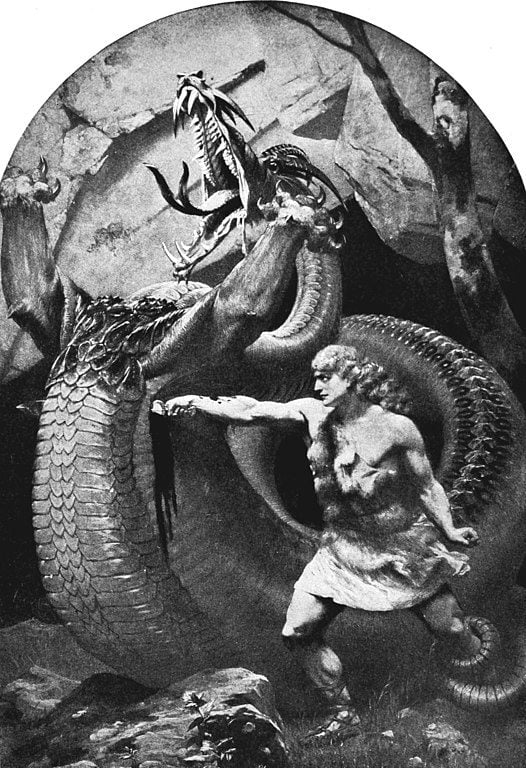
Photo credit: Richard Wagner’s opera Siegfried; Siegfried slays the dragon. From the painting by Delitz; The Victrola book of the opera : stories of one hundred and twenty operas with seven-hundred illustrations and descriptions of twelve-hundred Victor opera records [public domain / Wikimedia Commons]

***
Summary: Anti-theist atheist Jonathan MS Pearce sez that the Bible teaches the existence of (fire-breathing?) dragons who lived at the same time as man. Once again, he’s wrong.
alleged biblical contradictions
Previous Post
March 4, 2022
Pearce Pablum #70: Nativity Book Errors
Next Post

March 8, 2022 Pearce Pablum #72: Flood: 25 Criticisms & Non Sequiturs
Browse Our Archives
Select a Category & Last Things About Me Anti-Catholicism Atheism & Agnosticism Baptism and Sacramentalism Bible and Tradition Blessed Virgin Mary Books by Dave Armstrong C. S. Lewis Calvinism & General Protestantism Catholic Apologetics Catholic Apologists Catholic conversion Catholic converts Christmas Church (Ecclesiology) Church History Conversion and Converts Development of Doctrine Eastern Orthodoxy Ecumenism & Christian Unity Eucharist & Liturgy Fathers of the Church French Translations G. K. Chesterton Hell Hell & Satan Hell & Satan & Last Things Heresies & Comparative Religion Holistic Health Inquisition & Crusades & Scandals James White Jews & Judaism & Old Testament John Calvin John Henry Newman Liberal / Modernist Theology Life Issues Literary Resume Lutheranism Mariology Martin Luther Music Orthodoxy Papacy & Infallibility Personal Page Philosophy & Science Political & Ethical & Moral Issues Protestant Persecution & Intolerance Protestantism Purgatory Purgatory & Penance Romantic & Imaginative Theology Saints & Purgatory & Penance Salvation Salvation & Justification Satan & Last Things Sexuality and Gender Issues Spanish Translations Traditionalism vs. Radical Catholic Reactionaries Traducciones al español / tradução para português Trinitarianism & Christology Uncategorized Videos
Select a Month October 2026 September 2026 August 2026 July 2026 June 2026 May 2026 April 2026 March 2026 February 2026 January 2026 December 2025 November 2025 October 2025 September 2025 August 2025 July 2025 June 2025 May 2025 April 2025 March 2025 February 2025 January 2025 December 2024 November 2024 October 2024 September 2024 August 2024 July 2024 June 2024 May 2024 April 2024 March 2024 February 2024 January 2024 December 2023 November 2023 October 2023 September 2023 August 2023 July 2023 June 2023 May 2023 April 2023 March 2023 February 2023 January 2023 December 2022 November 2022 October 2022 September 2022 August 2022 July 2022 June 2022 May 2022 April 2022 March 2022 February 2022 January 2022 December 2021 November 2021 October 2021 September 2021 August 2021 July 2021 June 2021 May 2021 April 2021 March 2021 February 2021 January 2021 December 2020 November 2020 October 2020 September 2020 August 2020 July 2020 June 2020 May 2020 April 2020 March 2020 February 2020 January 2020 December 2019 November 2019 October 2019 September 2019 August 2019 July 2019 June 2019 May 2019 April 2019 March 2019 February 2019 January 2019 December 2018 November 2018 October 2018 September 2018 August 2018 July 2018 June 2018 May 2018 April 2018 March 2018 February 2018 January 2018 December 2017 November 2017 October 2017 September 2017 August 2017 July 2017 June 2017 May 2017 April 2017 March 2017 February 2017 January 2017 December 2016 November 2016 October 2016 September 2016 August 2016 July 2016 June 2016 May 2016 April 2016 March 2016 February 2016 January 2016 December 2015 November 2015 October 2015 September 2015 August 2015 July 2015 June 2015 May 2015 April 2015 March 2015 February 2015 January 2015 December 2014 November 2014 October 2014 September 2014 August 2014 July 2014 June 2014 April 2014 March 2014 February 2014 January 2014 December 2013 November 2013 October 2013 September 2013 August 2013 July 2013 June 2013 April 2013 March 2013 February 2013 January 2013 December 2012 November 2012 October 2012 September 2012 August 2012 July 2012 June 2012 May 2012 April 2012 March 2012 February 2012 January 2012 December 2011 November 2011 October 2011 September 2011 August 2011 July 2011 June 2011 April 2011 March 2011 February 2011 October 2010 September 2010 August 2010 July 2010 April 2010 March 2010 December 2009 October 2009 August 2009 July 2009 June 2009 May 2009 March 2009 February 2009 October 2008 September 2008 April 2008 March 2008 February 2008 January 2008 December 2007 November 2007 October 2007 May 2007 March 2007 February 2007 January 2007 November 2006 October 2006 September 2006 August 2006 July 2006 June 2006 May 2006 April 2006 March 2006 February 2006 October 2005 June 2005 April 2005 February 2005 July 2004 May 2004 April 2004
Follow Us!
TAKE THE
Religious Wisdom Quiz
Who asked Jesus, "What is truth?"
Select your answer to see how you score.
Caiaphas Pilate Nicodemus Herod
Books by This Author Books by Dave Armstrong
Related posts from Biblical Evidence for Catholicism

God, Modern Physics, & Dark Energy: An Analogy
Biblical Evidence for Catholicism

General Debate on Christianity with an Atheist
Biblical Evidence for Catholicism

Can Atheists Be Saved? Surprising Biblical Data
Biblical Evidence for Catholicism

Can Atheists Be Saved? YES! (Possibly Some ....
Biblical Evidence for Catholicism
TRENDING AT PATHEOS Catholic

I was strolling through the top floor of the brand new Parthenon...

What Does Gêvâh Mean For Kimberley Guifoyle &...
This week, a lot of the news is focused on Kimberly Guilfoyle....

INNER CIRCLE: Profound Mystery (Of Christ In All...
Ephesians 5:31-32 “For this reason, a man will leave his father and...

Do Not Rejoice When Your Enemy Falls: The...
Turning an execution into a public spectacle is a disturbing expression of...

'The Chosen' S6 Trailer: The Passion Gets Very...
Not many watching 'The Chosen' worry about spoilers, but just because they...

The purpose-driven labor priest
A labor activist reads Rick Warren and it gets me wondering about...
view all Catholic blogs
Ad-Free & Subscriber Log-In Subscription Support
- About Us
- 2026 Calendar
- Videos
- Podcasts
- Library of World Religions
- Faith In Media Tracker
- Advertise With Us
- Write for Us
- Privacy Policy
- Terms of Service
- Do Not Sell My Data
- Contact Us
- Radiant Digital
- Manage Newsletter Subscriptions
- Unsubscribe From Notifications
- Sitemap
Copyright 2008-2026, Patheos. All rights reserved.
Subscription Support Ad-Free & Subscriber Log-In
Follow Patheos