
BuddhistCatholicContemplativeEvangelicalGeneral ChristianHinduJewishLatter-day SaintMuslimNew VisionsProgressive Christian
Beliefs
- Buddhist
- Catholic
- Contemplative
- Evangelical
- General Christian
- Hindu
- Jewish
- Latter-day Saint
- More Voices
- Muslim
- New Visions
- Pagan
- Progressive Christian
Topics
- Religion News
- Food and Religion
- Sports and Religion
- Religious Art
- Religious Music and Entertainment
- Religious Events
- History and Religion
- Style and Religion
- Politics and Religion
- Women in Religion
- Recreation Outdoors and Religion
- Business Finance and Religion
- Careers Workplace and Religion
- Education and Religion
- Family Parenting and Religion
- Health Fitness and Religion
- Home and Religion
- Relationships and Religion
- Technology and Religion
- Travel and Religion
Columnists
- Buddhist Columnists
- Business Finance and Religion Columnists
- Careers Workplace and Religion Columnists
- Catholic Columnists
- Contemplative Columnists
- Education and Religion Columnists
- Evangelists Columnists
- Family Parenting and Religion Columnists
- General Christian Columnists
- Health Fitness and Religion Columnists
- Hindu Columnists
- History and Religion Columnists
- Home and Religion Columnists
- Jewish Columnists
- More Voices Columnists
- Latter Day Columnists
- Muslim Columnists
- New Visions Columnists
- Nonreligious Columnists
- Pagan Columnists
- Politics and Religion Columnists
- Progressive Columnists
- Recreation Outdoors and Religion Columnists
- Relationships and Religion Columnists
- Religion News Columnists
- Religious Art Columnists
- Religious Events Columnists
- Religious Music and Entertainment Columnists
- Sports and Religion Columnists
- Style and Religion Columnists
- Technology and Religion Columnists
- Travel and Religion Columnists
- Women in Religion Columnists
Resource Library
- 2026 Calendar
- Library of World Religions
- The 100 Most Holy Places on Earth
- Patheos Answers
- Podcasts
- Videos
- Faith Leaders Database
- Anglican Episcopalian
- Bahai
- Baptist
- Buddhism
- Christianity
- Confucianism
- Eastern Orthodoxy
- Hinduism
- Holiness and Pentecostal
- ISKCON
- Islam
- Judaism
- Lutheran
- Methodist
- The Church of Jesus Christ of Latter-day Saints
- New Age
- Paganism
- Presbytarian and Reformed
- Protestantism
- Religion Behind the Scenes
- Roman Catholic
- Scientology
- Shia Islam
- Sikhism
- Sufism
- Sunni Islam
- Taoism
- Zen
- See all religions
Research Tools
 Ad-Free & Subscriber Log-In Subscription Support
Ad-Free & Subscriber Log-In Subscription Support
Follow Patheos 

- Trending:
- Forgiveness
- |
- Marriage
- |
- Consciousness
- |
- Death Penalty
- |
- Election
- |
- Halloween

-
About
-
Catholic Apologetics
-
Church History
-
Great Apologists
-
Christian Worldview
-
Protestantism & Misc.
- Home
- Catholic
- History and Religion
- Pearce’s Potshots #65: Who First Visited Baby Jesus?
Pearce’s Potshots #65: Who First Visited Baby Jesus?
Last updated on: June 6, 2026 at 12:00 am by Dave Armstrong
Pearce’s Potshots #65: Who First Visited Baby Jesus? 2026-06-06T00:00:04-04:00 Dave Armstrong
Patheos Explore the world's faith through different perspectives on religion and spirituality! Patheos has the views of the prevalent religions and spiritualities of the world.
Atheist anti-theist and “philosopher” Jonathan M. S. Pearce runs the blog, A Tippling Philosopher. He has encouraged me to visit his site and offer critiques, and wrote under a post dated 12-14-21: “I even need to thank the naysayers. Some of them have put up with a lot of robust pushback and still they come. Bravery or stupidity – it’s a fine line. But they are committed, and there is something to be said for taking that commitment into the lion’s den. Dave, you are welcome at my new place. Come challenge me. . . . thanks for your critiques of my pieces. Sorry I couldn’t get to more of them.” This echoes his words about me in a post dated 7-20-17, where he said, “well done . . . for coming here and suffering the slings and arrows of atheists’ wrath. . . . I commend him for getting involved and defending himself. Goodonya, mate.”
Under a post dated 1-27-22, he stated: “I do welcome disagreements because I don’t want [my blog] to [be] just an echo chamber. . . . [S]omeone like Armstrong does give me ammunition for some of my pieces!” Likewise, on 3-18-14 he proclaimed: “Dissenting views are utterly vital to being sure that you are warranted in your own beliefs and views.” And on 7-20-17: “I put my ideas and theories about the world out there for people to criticise. . . . I want to make damned sure that they are warranted. I can’t stand the idea that I could . . . believe something that is properly unwarranted. . . . What’s the point in self-delusion? . . . I put something out there, people attack it, and if it still stands, it’s pretty robust and I am happy to hold it. If not, I adapt and change my views accordingly.”
I’m delighted to oblige his wish to receive critiques and dissenting views! The rarity of his counter-replies, however, is an oddity and curiosity in light of this desire. He wrote, for example, on 11-22-19: “[I can’t be] someone who genuinely is not interested in finding out the truth about philosophy, God and everything. If I come up against any point that is even remotely problematic to my worldview, I feel the absolute necessity to bottom it out. I need to reconcile at least something; I have work to do. I cannot simply leave it as it is. . . . I would simply have to counter the arguments, or change my position.” Whatever; this hasn’t been my experience with him; only in short and infrequent spurts. I continue to offer them in any event, because they aren’t just for his sake.
Here’s what he thinks (by the way) of Jesus: “The Jesus as reported in the Gospels is so far removed from the real and historical figure of Jesus, overlaid with myth, story-telling, propaganda and evangelist agenda, that the end result is synonymous with myth. . . . I’d take mythicism over Christianity any day. And they call mythicists fringe as if the position is absurd? Now that’s crazy.” (8-2-14)
Jonathan’s words will be in blue.
*****
This is a reply to a portion of Jonathan’s article, “The hoops the Christian has to jump through to believe the Nativity” (10-29-12):
In my book, The Nativity: A Critical Examination, I think I give ample evidence that allows one to conclude that the historicity of the nativity accounts is sorely and surely challenged. All of the aspects and claims, that is. There are problems, for sure, if one accepts that some claims are false but others are true. But the simple fact of the matter is that all of the claims are highly questionable.
Here are the hoops that a Christian must jump through. They are flaming hoops, and the Christian can do nothing to avoid being burnt, it seems. From my book:
In order for the Christian who believes that both accounts are factually true to uphold that faithful decree, the following steps must take place. The believer must: . . .
• Believe that there is (and provide it) a reasonable explanation as to why each Gospel provides different first witnesses (shepherds and magi) without any mention of the other witnesses.
This is an easy one, and it is remarkable to me that Jonathan has made such a basic error as regards the Gospel accounts. First of all, we find the usual sloppy logical thinking in atheist attacks on the Bible. Neither Matthew nor Luke claim that the shepherds or the wise men (magi) were the “first” to witness the baby Jesus. That’s an invention that Jonathan somehow came up with (who knows how?).
And this is a key factor in determining whether an alleged “contradiction” is present. Let me elaborate a bit if I may. If Matthew had said that the wise men were the “first” to visit baby Jesus and Luke said that the shepherds were the ‘first” to do so, then that would have been a true, clear contradiction. But of course neither account says any such thing.
This is so obvious that Jonathan himself even hosted Bible skeptic Bart Ehrman on his blog, making exactly the same point I just made, and contradicting his own:
Of course some of the differences are simply … differences, not “contradictions.” As an obvious example, the fact that Luke mentions the shepherds but not the magi (wise men) and that Matthew mentions the magi but not the shepherds is not a contradiction. If both groups visited the infant Jesus, then Luke mentioned one group and Matthew the other: no contradiction. (Ehrman on the Nativity, 10-29-13)
Somehow, Ehrman avoided the (what did Jonathan call it?) “flaming hoops” and he — inexplicably — managed to navigate this extraordinarily difficult logical conundrum without being “burnt.”
Right after Luke reports that Mary gave birth to Jesus (Lk 2:7), it’s reported that angels inform the shepherds of the birth of Jesus on that very night (Lk 2:8-14). Then the shepherds determined to go see baby Jesus, and indeed did so (Lk 2:15-16). We know that this was the night of Jesus’ birth, complete with his lying in the famous “manger” (Lk 2:7).
Nothing is said about their being the first visitors. They may have been, but we can’t know for sure from the text. They could have been the first or the fifth, or the only ones on that night. From the text we can’t determine those things. And there is no imaginary obligation for a text to mention any or all other visitors too. All we know for sure is that they visited shortly after He was born.
With the wise men (Mt 2:1-11), what Jonathan appears unaware of is that they didn’t visit on the night of Jesus’ birth. No doubt he would appeal to Matthew 2:1: “Now when Jesus was born in Bethlehem of Judea in the days of Herod the king, behold, wise men from the East came to Jerusalem, . . . ” (RSV). But this is one of the thousands of cases in the Bible where the intended meaning was not literal. Many Bible translations bring out more clearly the actual intent, that the incidents about to be recorded were some time after Jesus’ birth, not at the time of His birth:
CSB / CEB / EHV / ESV / ESVUK / HCSB / LEB / MEV / Mounce After Jesus was born in Bethlehem . . .
Darby / DNLT Now Jesus having been born in Bethlehem . . .
ERV Jesus was born in the town of Bethlehem in Judea during the time when Herod was king. After Jesus was born, some wise men from the east came to Jerusalem.
GW Jesus was born in Bethlehem in Judea when Herod was king. After Jesus’ birth wise men from the east arrived in Jerusalem.
GNT Jesus was born in the town of Bethlehem in Judea, during the time when Herod was king. Soon afterward, some men who studied the stars came from the East to Jerusalem
ICB . . . After Jesus was born, some wise men from the east came to Jerusalem.
ISV / NCB After Jesus had been born in Bethlehem . . .
Phillips Jesus was born in Bethlehem, in Judea, in the days when Herod was king of the province. Not long after his birth there arrived from the east a party of astrologers
MSG / NASB / NET / NIV / NKJV After Jesus was born in Bethlehem . . . [source]
Here’s a few more from my Bible collection:
Weymouth / Goodspeed Now after the birth of Jesus . . .
NEB / REB . . . After his birth . . .
NRSV . . . after Jesus was born . . .
Barclay When Jesus had been born . . .
Wuest Now, Jesus having been born . . .
When the magi stopped by, Jesus was a toddler. The word for child in Matthew 2:8-9 is paidion (Strong’s word #3813): defined as “a young child . . . properly, a child under training; the diminutive form of 3816 /país (“child”). . . . implies a younger child (perhaps seven years old or younger). Some scholars apply 3816 (país) to a son or daughter up to 20 years old.”
“Babe” on the other hand (Lk 2:12, 16 in RSV and KJV) is Strong’s word #1025, brephos: which means: “an unborn or a newborn child” and is used of children in the womb in Luke 1:41, 44. In Luke 2, it’s the day of Jesus’ birth (Lk 2:7, 11). So the use of “babe” (2:12, 16) and “child” (2:17) in English (RSV) obviously includes the meaning here of “newborn.” Commentators generally believe He was two years old or younger when the wise men visited, but in any event, not a newborn.
But Jonathan cites one Julian Haydon on his blog, making the same dumb mistake he made, including noting that “it is something I brought up in my last book” [on the Nativity]:
[T]he wise men knew to follow it [Star of Bethlehem] to find the baby Jesus, . . . Why didn’t the “miracle” of the star lead the wise men to baby Jesus in the first place . . .? (Slaughter of the innocents, 11-10-13, my italics)
Two years later, Jonathan was still trotting out this falsehood on his blog:
Herod is not likely to have troubled himself with the newborn . . . On pain of death, those Magi would have led him to the baby. . . . In fact, unless God only magically made the star visible to the Magi, the whole of Jerusalem could have gone to see the newborn Messiah; . . . (Response to Triablogue’s Jason Engwer on Nativity Accounts (Part 1), 12-20-14; my italics)
We know that this error is also present in his 2012 book, The Nativity: A Critical Examination because he cites part of it (p. 146) in a blog post dated 12-14-14:
[W]hy would catching a newborn and murdering this newborn, thereby forcing him to murder many other infants, be something that such an old king would bother to do? (my italics)
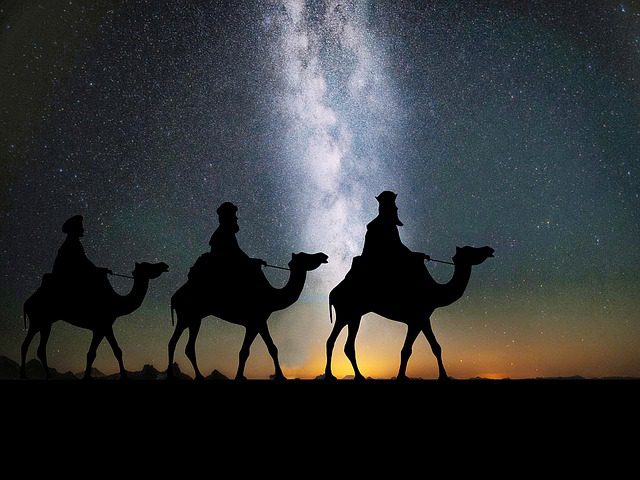
The magi visit a “house” (Mt 2:11), not a baby in a “manger” (Lk 2:7, 12, 16), in a place which was, in fact, very much a cave (I’ve been there). There are no angels (Lk 2:9-10, 13-15), shepherds (Lk 2:8, 15-18), or animals are in sight. The star of Bethlehem is a factor in Matthew’s account only. Luke never mentions it. The picture of the star of Bethlehem shining down on baby Jesus (surprisingly enough) is not biblical at all. Scholars believe that Jesus was possibly as old as two years old, based on Matthew 2:16 (RSV):
Then Herod, when he saw that he had been tricked by the wise men, was in a furious rage, and he sent and killed all the male children in Bethlehem and in all that region who were two years old or under, according to the time which he had ascertained from the wise men.
Herod felt “tricked” because they had departed the country by then (2:12-13). What he “ascertained from the wise men” was that Jesus was up to two years old. See also 2:7: “Herod summoned the wise men secretly and ascertained from them what time the star appeared”. I think they may have said He was a year old, and that Herod then ordered all children under two to be killed, to be sure He killed the Messiah, based on His estimated age given to him by the magi.
Since these are two completely separate events and visitations, Jonathan’s “difficulty” and alleged “contradiction” vanishes.
***
Practical Matters: Perhaps some of my 4,000+ free online articles (the most comprehensive “one-stop” Catholic apologetics site) or fifty books have helped you (by God’s grace) to decide to become Catholic or to return to the Church, or better understand some doctrines and why we believe them.
Or you may believe my work is worthy to support for the purpose of apologetics and evangelism in general. If so, please seriously consider a much-needed financial contribution. I’m always in need of more funds: especially monthly support. “The laborer is worthy of his wages” (1 Tim 5:18, NKJV). 1 December 2021 was my 20th anniversary as a full-time Catholic apologist, and February 2022 marked the 25th anniversary of my blog.
PayPal donations are the easiest: just send to my email address: [email protected]. You’ll see the term “Catholic Used Book Service”, which is my old side-business. To learn about the different methods of contributing, including 100% tax deduction, etc., see my page: About Catholic Apologist Dave Armstrong / Donation Information. Thanks a million from the bottom of my heart!
***
Photo credit: 27707 (1-20-16) [Pixabay / Pixabay License]
***
Summary: Atheist JMS Pearce claims that the NT contradictorily teaches that both the shepherds & wise men first visited baby Jesus. In fact, the latter visited 1-2 years later.
Previous Post
February 26, 2022
Quirinius & Luke's Census: Resources on the "Difficulty"
Next Post
February 28, 2022 Pearce's Potshots #66: Bethlehem Joseph / Census Issues
Browse Our Archives
Select a Category & Last Things About Me Anti-Catholicism Atheism & Agnosticism Baptism and Sacramentalism Bible and Tradition Blessed Virgin Mary Books by Dave Armstrong C. S. Lewis Calvinism & General Protestantism Catholic Apologetics Catholic Apologists Catholic conversion Catholic converts Christmas Church (Ecclesiology) Church History Conversion and Converts Development of Doctrine Eastern Orthodoxy Ecumenism & Christian Unity Eucharist & Liturgy Fathers of the Church French Translations G. K. Chesterton Hell Hell & Satan Hell & Satan & Last Things Heresies & Comparative Religion Holistic Health Inquisition & Crusades & Scandals James White Jews & Judaism & Old Testament John Calvin John Henry Newman Liberal / Modernist Theology Life Issues Literary Resume Lutheranism Mariology Martin Luther Music Orthodoxy Papacy & Infallibility Personal Page Philosophy & Science Political & Ethical & Moral Issues Protestant Persecution & Intolerance Protestantism Purgatory Purgatory & Penance Romantic & Imaginative Theology Saints & Purgatory & Penance Salvation Salvation & Justification Satan & Last Things Sexuality and Gender Issues Spanish Translations Traditionalism vs. Radical Catholic Reactionaries Traducciones al español / tradução para português Trinitarianism & Christology Uncategorized Videos
Select a Month October 2026 September 2026 August 2026 July 2026 June 2026 May 2026 April 2026 March 2026 February 2026 January 2026 December 2025 November 2025 October 2025 September 2025 August 2025 July 2025 June 2025 May 2025 April 2025 March 2025 February 2025 January 2025 December 2024 November 2024 October 2024 September 2024 August 2024 July 2024 June 2024 May 2024 April 2024 March 2024 February 2024 January 2024 December 2023 November 2023 October 2023 September 2023 August 2023 July 2023 June 2023 May 2023 April 2023 March 2023 February 2023 January 2023 December 2022 November 2022 October 2022 September 2022 August 2022 July 2022 June 2022 May 2022 April 2022 March 2022 February 2022 January 2022 December 2021 November 2021 October 2021 September 2021 August 2021 July 2021 June 2021 May 2021 April 2021 March 2021 February 2021 January 2021 December 2020 November 2020 October 2020 September 2020 August 2020 July 2020 June 2020 May 2020 April 2020 March 2020 February 2020 January 2020 December 2019 November 2019 October 2019 September 2019 August 2019 July 2019 June 2019 May 2019 April 2019 March 2019 February 2019 January 2019 December 2018 November 2018 October 2018 September 2018 August 2018 July 2018 June 2018 May 2018 April 2018 March 2018 February 2018 January 2018 December 2017 November 2017 October 2017 September 2017 August 2017 July 2017 June 2017 May 2017 April 2017 March 2017 February 2017 January 2017 December 2016 November 2016 October 2016 September 2016 August 2016 July 2016 June 2016 May 2016 April 2016 March 2016 February 2016 January 2016 December 2015 November 2015 October 2015 September 2015 August 2015 July 2015 June 2015 May 2015 April 2015 March 2015 February 2015 January 2015 December 2014 November 2014 October 2014 September 2014 August 2014 July 2014 June 2014 April 2014 March 2014 February 2014 January 2014 December 2013 November 2013 October 2013 September 2013 August 2013 July 2013 June 2013 April 2013 March 2013 February 2013 January 2013 December 2012 November 2012 October 2012 September 2012 August 2012 July 2012 June 2012 May 2012 April 2012 March 2012 February 2012 January 2012 December 2011 November 2011 October 2011 September 2011 August 2011 July 2011 June 2011 April 2011 March 2011 February 2011 October 2010 September 2010 August 2010 July 2010 April 2010 March 2010 December 2009 October 2009 August 2009 July 2009 June 2009 May 2009 March 2009 February 2009 October 2008 September 2008 April 2008 March 2008 February 2008 January 2008 December 2007 November 2007 October 2007 May 2007 March 2007 February 2007 January 2007 November 2006 October 2006 September 2006 August 2006 July 2006 June 2006 May 2006 April 2006 March 2006 February 2006 October 2005 June 2005 April 2005 February 2005 July 2004 May 2004 April 2004
Follow Us!
TAKE THE
Religious Wisdom Quiz
What city did David capture and make the capital of Israel?
Select your answer to see how you score.
Bethlehem Samaria Jerusalem Hebron
Books by This Author Books by Dave Armstrong
Related posts from Biblical Evidence for Catholicism

God, Modern Physics, & Dark Energy: An Analogy
Biblical Evidence for Catholicism
Jesus Proved He Was God in Six Ways...
Biblical Evidence for Catholicism

General Debate on Christianity with an Atheist
Biblical Evidence for Catholicism

Can Atheists Be Saved? Surprising Biblical Data
Biblical Evidence for Catholicism
TRENDING AT PATHEOS Catholic

I was strolling through the top floor of the brand new Parthenon...

What Does Gêvâh Mean For Kimberley Guifoyle &...
This week, a lot of the news is focused on Kimberly Guilfoyle....

INNER CIRCLE: Profound Mystery (Of Christ In All...
Ephesians 5:31-32 “For this reason, a man will leave his father and...

Do Not Rejoice When Your Enemy Falls: The...
Turning an execution into a public spectacle is a disturbing expression of...

'The Chosen' S6 Trailer: The Passion Gets Very...
Not many watching 'The Chosen' worry about spoilers, but just because they...

The purpose-driven labor priest
A labor activist reads Rick Warren and it gets me wondering about...
view all Catholic blogs
Ad-Free & Subscriber Log-In Subscription Support
- About Us
- 2026 Calendar
- Videos
- Podcasts
- Library of World Religions
- Faith In Media Tracker
- Advertise With Us
- Write for Us
- Privacy Policy
- Terms of Service
- Do Not Sell My Data
- Contact Us
- Radiant Digital
- Manage Newsletter Subscriptions
- Unsubscribe From Notifications
- Sitemap
Copyright 2008-2026, Patheos. All rights reserved.
Subscription Support Ad-Free & Subscriber Log-In
Follow Patheos