
BuddhistCatholicContemplativeEvangelicalGeneral ChristianHinduJewishLatter-day SaintMuslimNew VisionsProgressive Christian
Beliefs
- Buddhist
- Catholic
- Contemplative
- Evangelical
- General Christian
- Hindu
- Jewish
- Latter-day Saint
- More Voices
- Muslim
- New Visions
- Pagan
- Progressive Christian
Topics
- Religion News
- Food and Religion
- Sports and Religion
- Religious Art
- Religious Music and Entertainment
- Religious Events
- History and Religion
- Style and Religion
- Politics and Religion
- Women in Religion
- Recreation Outdoors and Religion
- Business Finance and Religion
- Careers Workplace and Religion
- Education and Religion
- Family Parenting and Religion
- Health Fitness and Religion
- Home and Religion
- Relationships and Religion
- Technology and Religion
- Travel and Religion
Columnists
- Buddhist Columnists
- Business Finance and Religion Columnists
- Careers Workplace and Religion Columnists
- Catholic Columnists
- Contemplative Columnists
- Education and Religion Columnists
- Evangelists Columnists
- Family Parenting and Religion Columnists
- General Christian Columnists
- Health Fitness and Religion Columnists
- Hindu Columnists
- History and Religion Columnists
- Home and Religion Columnists
- Jewish Columnists
- More Voices Columnists
- Latter Day Columnists
- Muslim Columnists
- New Visions Columnists
- Nonreligious Columnists
- Pagan Columnists
- Politics and Religion Columnists
- Progressive Columnists
- Recreation Outdoors and Religion Columnists
- Relationships and Religion Columnists
- Religion News Columnists
- Religious Art Columnists
- Religious Events Columnists
- Religious Music and Entertainment Columnists
- Sports and Religion Columnists
- Style and Religion Columnists
- Technology and Religion Columnists
- Travel and Religion Columnists
- Women in Religion Columnists
Resource Library
- 2026 Calendar
- Library of World Religions
- The 100 Most Holy Places on Earth
- Patheos Answers
- Podcasts
- Videos
- Faith Leaders Database
- Anglican Episcopalian
- Bahai
- Baptist
- Buddhism
- Christianity
- Confucianism
- Eastern Orthodoxy
- Hinduism
- Holiness and Pentecostal
- ISKCON
- Islam
- Judaism
- Lutheran
- Methodist
- The Church of Jesus Christ of Latter-day Saints
- New Age
- Paganism
- Presbytarian and Reformed
- Protestantism
- Religion Behind the Scenes
- Roman Catholic
- Scientology
- Shia Islam
- Sikhism
- Sufism
- Sunni Islam
- Taoism
- Zen
- See all religions
Research Tools
 Ad-Free & Subscriber Log-In Subscription Support
Ad-Free & Subscriber Log-In Subscription Support
Follow Patheos 

- Trending:
- Forgiveness
- |
- Marriage
- |
- Consciousness
- |
- Death Penalty
- |
- Election
- |
- Halloween

-
About
-
Catholic Apologetics
-
Church History
-
Great Apologists
-
Christian Worldview
-
Protestantism & Misc.
- Home
- Catholic
- History and Religion
- Pearce’s Potshots #60: Fairy-Tale Atheist Eisegesis (2)
Pearce’s Potshots #60: Fairy-Tale Atheist Eisegesis (2)
Last updated on: June 6, 2026 at 12:00 am by Dave Armstrong
Pearce’s Potshots #60: Fairy-Tale Atheist Eisegesis (2) 2026-06-06T00:00:04-04:00 Dave Armstrong
Patheos Explore the world's faith through different perspectives on religion and spirituality! Patheos has the views of the prevalent religions and spiritualities of the world.
Atheist anti-theist Jonathan M. S. Pearce is the main writer on the blog, A Tippling Philosopher. His “About” page from his former site states: “Pearce is a philosopher, author, blogger, public speaker and teacher from Hampshire in the UK. He specialises in philosophy of religion, but likes to turn his hand to science, psychology, politics and anything involved in investigating reality.”
He has encouraged me to visit his site and offer critiques. Before he departed his former site at Patheos, he wrote under a post dated 12-14-21: “I even need to thank the naysayers. Some of them have put up with a lot of robust pushback and still they come. Bravery or stupidity – it’s a fine line. But they are committed, and there is something to be said for taking that commitment into the lion’s den. Dave, you are welcome at my new place. Come challenge me. All the best to you and thanks for your critiques of my pieces. Sorry I couldn’t get to more of them.”
Again, at his new site (under a post dated 1-27-22), after a vicious attack by a commenter, calling for me and indeed all Christians to be banned, Jonathan offered an honorable and principled refusal: “I do welcome disagreements because I don’t want [my blog] to [be] just an echo chamber. As long as it is good faith . . . someone like Armstrong does give me ammunition for some of my pieces! As long as they aren’t trollish.”
His words below will be in blue.
*****
This is a reply to his post, Christian apologetics and defending Matthew’s guards (1-31-22), which in turn is a response to my articles, Pearce’s Potshots #57: Matthew & the Tomb Guards (1-28-22) and Pearce’s Potshots #58: Paul & Jesus’ “Empty” Tomb (1-29-22). See Part 1 of this larger reply for background.
First, I don’t make this up out of thin air. The general ahistoricity of Matthew’s guards pericope is accepted by all skeptical scholars and a good deal of believing ones—see Brown above. Here is the famous Christian scholar Dale C. Allison:
…and [the theory that] Matthew, “with vindicatory intent,” backdated the guard to an earlier time. The most extensive treatment of the subject is Kankaanniemi, Guards. He argues that the Christian story developed as a response to the early Jewish fiction that the disciples stole the body while Roman soldiers guarded the tomb. Although he has not convinced me that the guards derive from Jewish polemic as opposed to Christian apologetic, we concur that Matthew’s story is not history.
Dale C. Allison (2021), The Resurrection of Jesus, New York: Bloomsbury, p. 180.
Allison continues later to make exactly the same point as me concerning the guards not becoming Christians and believing—is he pulling it out of thin air? Is his claim a rabbit out of the hat?
Whatever the rationalization, it is wildly unlikely that either would have declared, “Jesus is Lord!” Annas and Herod would have been like the fictional guards in Matthew 28, who see everything yet fail to lay down their weapons and take up the new faith.
Ibid. p.331.
This is a problem today: a lot of Christian scholars: even the more “conservative” / orthodox ones, accept false skeptical premises. My friend, Dr. Lydia McGrew, philosopher and amateur theologian (traditional Anglican) has written a book about this, called, The Mirror or the Mask: Liberating the Gospels from Literary Devices (2020). Here is the Amazon blurb about it:
In recent years a number of evangelical scholars have claimed that the Gospel authors felt free to present events in one way even though they knew that the reality was different. Analytic philosopher Lydia McGrew brings her training in the evaluation of evidence to bear, investigates these theories about the evangelists’ literary standards in detail, and finds them wanting. At the same time she provides a nuanced, positive view of the Gospels that she dubs the reportage model. Clearing away misconceptions of this model, McGrew amasses objective evidence that the evangelists are honest, careful reporters who tell it like it is.
And here is the comment of a well-known Christian philosopher:
As Thomas Kuhn pointed out long ago, it is often someone from a different discipline who has the epistemic distance and objectivity to evaluate a widely accepted paradigm/methodology in another discipline, because practitioners in the latter tend to look at things the way they were trained and, thus, cannot see things accurately. Kuhn’s remarks are right on target when it comes to philosopher Lydia McGrew’s critique of widespread methodological practices in New Testament studies. While The Mirror or the Mask is very easy to read, it is also a massive piece of first-rate, rigorous scholarship that leaves no stone unturned. Replete with very careful distinctions, The Mirror or the Mask offers a precise analysis of the contemporary practice of employing “fictionalization” to exegete various Gospel texts. McGrew’s careful analysis finds such a practice wanting and dangerous and replaces this practice with an approach that treats the Gospels as honest historical reports based on eyewitness testimony. This book is a must read for all who are interested in the historical accuracy of our portraits of Jesus. I highly recommend it. (J.P. Moreland: Distinguished Professor of Philosophy, Talbot School of Theology)
This is what is going on with Dr. Allison above. One would have to see why he thinks this way; what evidence he adduces other than conspiracy theories, bolstered by the fact that an increasing number of scholars now believe them. Does he have anything substantial? Jonathan doesn’t present it, if so. But the text of Matthew has in its favor the hostile Jewish witnesses of the early centuries after Christianity arose, who themselves talked about the stolen body theory. That’s actual concrete historical evidence; quite different from Jonathan’s relentless mythmaking and legend creation with no historical basis. Wikipedia (“Stolen body hypothesis”) noted this:
A Jewish anti-Christian work dating from the 5th-century, the Toledoth Yeshu, contains the claim that the disciples planned to steal Jesus’s body from his tomb. In this account, the body had already been moved, and when the disciples arrived at the empty tomb they came to the incorrect conclusion that he had risen from the dead. Later, the corpse was sold to the Jewish leaders for thirty pieces of silver, who confirmed Jesus’s death; Jesus’s corpse was then dragged through the streets of Jerusalem. Another variant comes from a record of a 2nd-century debate between a Christian and a Jew, Justin Martyr‘s Dialogue with Trypho: “his disciples stole him by night from the tomb, where he was laid when unfastened from the cross, and now deceive men by asserting that he has risen from the dead and ascended to heaven.”
This makes Matthew’s story more plausible. Jonathan thinks conspiratorially about the Gospels. I look at them, not just with the faith of a Christian (belief in their inspiration), but in light of independent verification of their veracity. I think the scientific and intellectual approach is more respectable than sitting around coming up with 153 different conspiratorial scenarios. And of course, now these include (among many atheists) the increasingly fashionable Jesus mythicism, which I have always considered intellectual suicide; hence, I refuse to interact with it at all.
Jonathan then enlists John Dominic Crossan in favor of his “Matthew & the guards” skepticism. Wikipedia says about him: “His work is controversial, portraying the Second Coming as a late corruption of Jesus’ message and saying that Jesus’ divinity is metaphorical.” So much for him. Why would any Christian be impressed by a scholar who blasphemes Jesus as a creature and not God? He has no credibility in our eyes. But you atheists love him because he spouts anti-Christian things that you agree with.
N.T. Wright is mentioned by Jonathan:
The other story which spills over in Matthew’s gospel from the crucifixion narrative to the Easter account involves the chief priests getting together with the Pharisees to go to Pilate and request a guard on Jesus’ tomb. This is of considerable interest, not so much for its own sake (though that is interesting too) but for the sake of what it tells us about the story-telling motives of the early church.
The tale begins on the sabbath itself…
NT Wright (2003), The Resurrection of the Son of God,
But Wright does not agree with Jonathan’s take. He is brought to the table for a particular polemical purpose, as I will discuss below. The book is partially accessible at its Google Books page. On page 637, Wright recounts Matthew’s story in 27:62-66 and concludes that “there is nothing intrinsically implausible” in the description of “the apparently easy collaboration of the Pharisees and chief priests, and of the two together with Pilate.” Then he opines regarding the Jewish polemical use of “that deceiver” in 27:63 (“that impostor” in RSV): “it seems more likely that it goes back to some kind of well-rooted memory.”
He then cites Matthew 28:11-15, which continues this motif, concluding with “this story has been spread among the Jews to this day.” Wright’s opinion of this portion is that “There is nothing improbable in this narrative; indeed, it makes good sense all round.” Frustratingly, page 638 isn’t available on this site, but page 639 is. Here he summarizes “the Bultmannian scheme” of the passages and he concludes:
If any historian finds this sequence more probable than the one Matthew offers, I can only admire their ability to believe such remarkable things. But I suspect that if even Rudolf Bultmann were to find himself as a member of a jury he would be more prepared to believe a story like the one Matthew tells than a story like the five- or six-stage development of tradition that must be told if we are to declare that Matthew’s is impossible.
Jonathan cites Wright from page 638:
But, while the historian is always cautious about accepting obviously apologetic tales, there are further considerations which make it very unlikely that this one was actually invented from scratch within the Christian community. . . . For our present purposes, the main thing is not to argue that the story, in both its parts, is historically true in all respects, though as we have seen it is unlikely to have been invented as a late legend.
Jonathan takes a potshot against me as an apologist by contrasting me with “actual apologists” like Wright, who is “well aware of the skeptical and non-Christian accusations” and “takes them seriously” and “acknowledges the counter-argument.” I suppose he could say that he did that in some sense, in describing Bultmann’s theory at length. But then he remarks that he thinks that Bultmann wouldn’t even believe his own story over Matthew’s if he were on a jury. And he says of folks who would believe his take: “I can only admire their ability to believe such remarkable things.” So if that is taking Bultmann “seriously” it is certainly only in the very mildest sense (by merely citing it). Once he gives his own opinion, he virtually belittles it (scarcely different from my take on liberal scholars of his ilk).
So once again the cynical and (his self-description) “purposeful passive-aggressive” attempt to pit me against the great Christian scholar N. T. Wright with regard to the Matthew guard story, fails miserably. Wright basically believes Matthew’s account (at worst thinking it might have been embellished a bit) because he is an orthodox Anglican believer who actually believes the Bible and not an extreme skeptic, like most of those Jonathan cites. Therefore, his conclusion is diametrically opposed to folks like Crossan and Fr. Brown. Their biases (for or against the Bible) are manifest.
Conveniently, after citing reams of Bishop Wright’s words, he stops precisely before the paragraph above where Wright talks about what Bultmann would do on a jury. Nice touch there, Johnny. I believe in getting a scholar’s whole opinion out there, as much as we are able, within space limitations. One more paragraph would not have put Jonathan out. It’s silly and objectionable to quote Wright’s description of Bultmann’s view but to omit his negative and rather dismissive opinion of it. But I’m delighted that Jonathan brought up Wright, because he has bolstered my opinion a lot.
It is hilarious because Armstrong accuses me of lacking any historical evidence for why Matthew alone claims this and then provides absolutely no evidence himself for his own historical belief!
This is untrue.
- I have already noted in my many recent discussions on this matter that authors (even ancient ones) are generally given the benefit of the doubt and not regarded as deceivers, minus any compelling historical evidence of same. I’ve used Herodotus as an example: the great Greek historian who also includes supernatural elements in his accounts: like the Bible writers do.
- I also call to the defense of the Bible, archaeology (particularly with Luke). If it’s shown to be accurate again and again, we can trust it in details where we have no explicit evidence (or any at all).
- I also noted above that the presence of a verifiable post-Christian Jewish conspiracy theory of the “stolen body” makes it more plausible for Matthew to describe a situation where that very thing is discussed, and that this is an example of actual historical evidence for a claim (whereas Jonathan has offered none of that). He cites a bunch of almost all radically skeptical academic muckety-mucks, but never describes or cites their rationale for why they believe in this conspiracy theory; that is, some hard historical substantiation and not just raw, bald assertion and mention of others with like mind (which approaches the ad populum fallacy in some respects).
Perhaps his most substantial argument is the claim that there are 135 instances when the Synoptic Gospels make claims that are not seen in any other Gospel. He claims that this makes it “no big deal.”
Except many of the ones he mentions are again arguments against historicity!
Judas’ suicide? It’s included in Acts and there is a clear contradiction between the accounts.
No there isn’t, as I wrote about last May.
The magi and Herod chasing Jesus and family out of the country to live in political asylum for two years before returning out of Egypt to fulfill a Messianic prophecy in Matthew is a super example. Only super-committed Christians have the cognitive dissonance reduction to believe this rather insignificant “fact” of Jesus’ life would be omitted from, say, Luke, who flatly contradicts the claim in having Jesus’ family go to the Temple in Jerusalem straight away before then returning straight away afterwards to Nazareth. This never happened! This is Matthew ex eventu prophesying!
Nonsense. I’ve dealt with this whole supposed “gotcha!” polemic too:
What Armstrong fails to do here is to explore how the guards were posted there and how the Gospel writer knew about them and their arrangement. I briefly discussed the issue in the last post. Matthew would have had to have been privy to a private meeting between the chief priests and Pilate.
No he wouldn’t. It’s altogether possible that he heard a report from Nicodemus or Joseph of Arimathea, who were Pharisees (Mt 27:62) and members of the Sanhedrin, sympathetic to Christianity. They could very well have been present at the meeting with Pilate with the “chief priests” also.
Of course, he doesn’t mention his sources, or how actual words from secret non-Christian conversations were accurately relayed across such time and space.
I just provided one perfectly plausible theory. It’s speculation, but it’s plausible and based on some facts we know from the Bible (which is historically trustworthy).
This kind of stuff is too problematic for Armstrong.
Hardly.
My original piece stands. Armstrong has provided nothing to even remotely change my opinion on that. He should opt for substance over rhetoric because latter just starts a rhetorical whirlpool to the depths.
I’m happy as always to let readers decide who has built up a more compelling argument or “case.”
I’m still waiting for the substance.
Read this and Part 1 as well.
Just insulting me is an uninteresting game that we can, indeed, both play.
Once again, I have not insulted Jonathan personally. I have uttered many strong words, however, against his many flimsy, lousy arguments about this, and his futile, irrelevant (yet dogmatically expressed) bald opinions that entail by their very nature, mythmaking and legend-building efforts.
It’s just that it is a waste of time, no one wants to see it, and I don’t really want to play it anymore.
Jonathan played it this time, having already charged me in this overall discussion with “being willfully disingenuous” and “being really dishonest.” I have not accused him of these things: neither now nor ever. So if he is concerned about insulting debate opponents, I suggest that he look in the mirror and the beam in his own eye and not the speck in mine.
Meanwhile, though he lectures me about my nonexistent attacks on his person, he continues all the while (inexplicably) being perfectly content to allow commenters in his combox to insult me up and down in sweeping, prejudicial, and bigoted ways (with the repeated utter lie-myth-whopper that I supposedly ban everyone who simply disagrees with me, front and center). That’s all fine and dandy. I haven’t done this at all with him, yet somehow he has this mistaken notion in his head that I have. Go figure. I think it is oversensitivity: something we all fall into at times, as frail human beings.
I guess he has me confused with so many of his atheist buddies who routinely savage and insult Christians and offer little or no rational engagement on the issues between us.
***
Practical Matters: Perhaps some of my 3,900+ free online articles (the most comprehensive “one-stop” Catholic apologetics site) or fifty books have helped you (by God’s grace) to decide to become Catholic or to return to the Church, or better understand some doctrines and why we believe them.
Or you may believe my work is worthy to support for the purpose of apologetics and evangelism in general. If so, please seriously consider a much-needed financial contribution. I’m always in need of more funds: especially monthly support. “The laborer is worthy of his wages” (1 Tim 5:18, NKJV). 1 December 2021 was my 20th anniversary as a full-time Catholic apologist, and February 2022 marked the 25th anniversary of my blog.
PayPal donations are the easiest: just send to my email address: [email protected]. You’ll see the term “Catholic Used Book Service”, which is my old side-business. To learn about the different methods of contributing, including 100% tax deduction, etc., see my page: About Catholic Apologist Dave Armstrong / Donation Information. Thanks a million from the bottom of my heart!
***
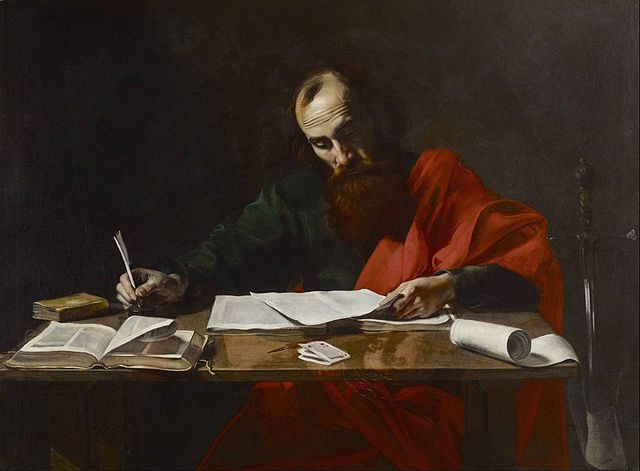
Photo credit: Saint Paul Writing His Epistles (c. 1620), attributed to Valentin de Boulogne (1591-1632) [public domain / Wikimedia Commons]

***
Summary: I critique atheist Jonathan MS Pearce’s relentless attack on the truthfulness of the Gospel texts & the honesty of the four Evangelists, i.e., fairy tale atheist eisegesis.
alleged Resurrection contradictions
Matthew & the Guards at the Tomb
Previous Post

January 31, 2022
Pearce's Potshots #59: Fairy-Tale Atheist Eisegesis (1)
Next Post

February 4, 2022 Evangelist Luke & Archaeology & History
Browse Our Archives
Select a Category & Last Things About Me Anti-Catholicism Atheism & Agnosticism Baptism and Sacramentalism Bible and Tradition Blessed Virgin Mary Books by Dave Armstrong C. S. Lewis Calvinism & General Protestantism Catholic Apologetics Catholic Apologists Catholic conversion Catholic converts Christmas Church (Ecclesiology) Church History Conversion and Converts Development of Doctrine Eastern Orthodoxy Ecumenism & Christian Unity Eucharist & Liturgy Fathers of the Church French Translations G. K. Chesterton Hell Hell & Satan Hell & Satan & Last Things Heresies & Comparative Religion Holistic Health Inquisition & Crusades & Scandals James White Jews & Judaism & Old Testament John Calvin John Henry Newman Liberal / Modernist Theology Life Issues Literary Resume Lutheranism Mariology Martin Luther Music Orthodoxy Papacy & Infallibility Personal Page Philosophy & Science Political & Ethical & Moral Issues Protestant Persecution & Intolerance Protestantism Purgatory Purgatory & Penance Romantic & Imaginative Theology Saints & Purgatory & Penance Salvation Salvation & Justification Satan & Last Things Sexuality and Gender Issues Spanish Translations Traditionalism vs. Radical Catholic Reactionaries Traducciones al español / tradução para português Trinitarianism & Christology Uncategorized Videos
Select a Month October 2026 September 2026 August 2026 July 2026 June 2026 May 2026 April 2026 March 2026 February 2026 January 2026 December 2025 November 2025 October 2025 September 2025 August 2025 July 2025 June 2025 May 2025 April 2025 March 2025 February 2025 January 2025 December 2024 November 2024 October 2024 September 2024 August 2024 July 2024 June 2024 May 2024 April 2024 March 2024 February 2024 January 2024 December 2023 November 2023 October 2023 September 2023 August 2023 July 2023 June 2023 May 2023 April 2023 March 2023 February 2023 January 2023 December 2022 November 2022 October 2022 September 2022 August 2022 July 2022 June 2022 May 2022 April 2022 March 2022 February 2022 January 2022 December 2021 November 2021 October 2021 September 2021 August 2021 July 2021 June 2021 May 2021 April 2021 March 2021 February 2021 January 2021 December 2020 November 2020 October 2020 September 2020 August 2020 July 2020 June 2020 May 2020 April 2020 March 2020 February 2020 January 2020 December 2019 November 2019 October 2019 September 2019 August 2019 July 2019 June 2019 May 2019 April 2019 March 2019 February 2019 January 2019 December 2018 November 2018 October 2018 September 2018 August 2018 July 2018 June 2018 May 2018 April 2018 March 2018 February 2018 January 2018 December 2017 November 2017 October 2017 September 2017 August 2017 July 2017 June 2017 May 2017 April 2017 March 2017 February 2017 January 2017 December 2016 November 2016 October 2016 September 2016 August 2016 July 2016 June 2016 May 2016 April 2016 March 2016 February 2016 January 2016 December 2015 November 2015 October 2015 September 2015 August 2015 July 2015 June 2015 May 2015 April 2015 March 2015 February 2015 January 2015 December 2014 November 2014 October 2014 September 2014 August 2014 July 2014 June 2014 April 2014 March 2014 February 2014 January 2014 December 2013 November 2013 October 2013 September 2013 August 2013 July 2013 June 2013 April 2013 March 2013 February 2013 January 2013 December 2012 November 2012 October 2012 September 2012 August 2012 July 2012 June 2012 May 2012 April 2012 March 2012 February 2012 January 2012 December 2011 November 2011 October 2011 September 2011 August 2011 July 2011 June 2011 April 2011 March 2011 February 2011 October 2010 September 2010 August 2010 July 2010 April 2010 March 2010 December 2009 October 2009 August 2009 July 2009 June 2009 May 2009 March 2009 February 2009 October 2008 September 2008 April 2008 March 2008 February 2008 January 2008 December 2007 November 2007 October 2007 May 2007 March 2007 February 2007 January 2007 November 2006 October 2006 September 2006 August 2006 July 2006 June 2006 May 2006 April 2006 March 2006 February 2006 October 2005 June 2005 April 2005 February 2005 July 2004 May 2004 April 2004
Follow Us!
TAKE THE
Religious Wisdom Quiz
What type of building was Jesus born in?
Select your answer to see how you score.
A cave A tent A castle A stable
Books by This Author Books by Dave Armstrong
Related posts from Biblical Evidence for Catholicism

God, Modern Physics, & Dark Energy: An Analogy
Biblical Evidence for Catholicism

General Debate on Christianity with an Atheist
Biblical Evidence for Catholicism

Can Atheists Be Saved? Surprising Biblical Data
Biblical Evidence for Catholicism
Can Atheists Be Saved? YES! (Possibly Some ....
Biblical Evidence for Catholicism
TRENDING AT PATHEOS Catholic

Janie Learns the Way of the Cross: A...
Teaching children about Jesus' Passion can be challenging. Many parents and educators...

Looking For Good Catholic Writing - October 2026
He alone extends the heavens, and he walks upon the waves of...

In "Irreplaceable," our book on vocation and technology, Trevor Sutton and I...

I was strolling through the top floor of the brand new Parthenon...

What Does Gêvâh Mean For Kimberley Guifoyle &...
This week, a lot of the news is focused on Kimberly Guilfoyle....

INNER CIRCLE: Profound Mystery (Of Christ In All...
Ephesians 5:31-32 “For this reason, a man will leave his father and...
view all Catholic blogs
Ad-Free & Subscriber Log-In Subscription Support
- About Us
- 2026 Calendar
- Videos
- Podcasts
- Library of World Religions
- Faith In Media Tracker
- Advertise With Us
- Write for Us
- Privacy Policy
- Terms of Service
- Do Not Sell My Data
- Contact Us
- Radiant Digital
- Manage Newsletter Subscriptions
- Unsubscribe From Notifications
- Sitemap
Copyright 2008-2026, Patheos. All rights reserved.
Subscription Support Ad-Free & Subscriber Log-In
Follow Patheos