
BuddhistCatholicContemplativeEvangelicalGeneral ChristianHinduJewishLatter-day SaintMuslimNew VisionsProgressive Christian
Beliefs
- Buddhist
- Catholic
- Contemplative
- Evangelical
- General Christian
- Hindu
- Jewish
- Latter-day Saint
- More Voices
- Muslim
- New Visions
- Pagan
- Progressive Christian
Topics
- Religion News
- Food and Religion
- Sports and Religion
- Religious Art
- Religious Music and Entertainment
- Religious Events
- History and Religion
- Style and Religion
- Politics and Religion
- Women in Religion
- Recreation Outdoors and Religion
- Business Finance and Religion
- Careers Workplace and Religion
- Education and Religion
- Family Parenting and Religion
- Health Fitness and Religion
- Home and Religion
- Relationships and Religion
- Technology and Religion
- Travel and Religion
Columnists
- Buddhist Columnists
- Business Finance and Religion Columnists
- Careers Workplace and Religion Columnists
- Catholic Columnists
- Contemplative Columnists
- Education and Religion Columnists
- Evangelists Columnists
- Family Parenting and Religion Columnists
- General Christian Columnists
- Health Fitness and Religion Columnists
- Hindu Columnists
- History and Religion Columnists
- Home and Religion Columnists
- Jewish Columnists
- More Voices Columnists
- Latter Day Columnists
- Muslim Columnists
- New Visions Columnists
- Nonreligious Columnists
- Pagan Columnists
- Politics and Religion Columnists
- Progressive Columnists
- Recreation Outdoors and Religion Columnists
- Relationships and Religion Columnists
- Religion News Columnists
- Religious Art Columnists
- Religious Events Columnists
- Religious Music and Entertainment Columnists
- Sports and Religion Columnists
- Style and Religion Columnists
- Technology and Religion Columnists
- Travel and Religion Columnists
- Women in Religion Columnists
Resource Library
- 2026 Calendar
- Library of World Religions
- The 100 Most Holy Places on Earth
- Patheos Answers
- Podcasts
- Videos
- Faith Leaders Database
- Anglican Episcopalian
- Bahai
- Baptist
- Buddhism
- Christianity
- Confucianism
- Eastern Orthodoxy
- Hinduism
- Holiness and Pentecostal
- ISKCON
- Islam
- Judaism
- Lutheran
- Methodist
- The Church of Jesus Christ of Latter-day Saints
- New Age
- Paganism
- Presbytarian and Reformed
- Protestantism
- Religion Behind the Scenes
- Roman Catholic
- Scientology
- Shia Islam
- Sikhism
- Sufism
- Sunni Islam
- Taoism
- Zen
- See all religions
Research Tools
 Ad-Free & Subscriber Log-In Subscription Support
Ad-Free & Subscriber Log-In Subscription Support
Follow Patheos 

- Trending:
- Forgiveness
- |
- Marriage
- |
- Consciousness
- |
- Death Penalty
- |
- Election
- |
- Halloween

-
About
-
Catholic Apologetics
-
Church History
-
Great Apologists
-
Christian Worldview
-
Protestantism & Misc.
- Home
- Catholic
- History and Religion
- Pearce’s Potshots #59: Fairy-Tale Atheist Eisegesis (1)
Pearce’s Potshots #59: Fairy-Tale Atheist Eisegesis (1)
Last updated on: June 6, 2026 at 12:00 am by Dave Armstrong
Pearce’s Potshots #59: Fairy-Tale Atheist Eisegesis (1) 2026-06-06T00:00:04-04:00 Dave Armstrong
Patheos Explore the world's faith through different perspectives on religion and spirituality! Patheos has the views of the prevalent religions and spiritualities of the world.
Atheist anti-theist Jonathan M. S. Pearce is the main writer on the blog, A Tippling Philosopher. His “About” page from his former site states: “Pearce is a philosopher, author, blogger, public speaker and teacher from Hampshire in the UK. He specialises in philosophy of religion, but likes to turn his hand to science, psychology, politics and anything involved in investigating reality.”
He has encouraged me to visit his site and offer critiques. Before he departed his former site at Patheos, he wrote under a post dated 12-14-21: “I even need to thank the naysayers. Some of them have put up with a lot of robust pushback and still they come. Bravery or stupidity – it’s a fine line. But they are committed, and there is something to be said for taking that commitment into the lion’s den. Dave, you are welcome at my new place. Come challenge me. All the best to you and thanks for your critiques of my pieces. Sorry I couldn’t get to more of them.”
Again, at his new site (under a post dated 1-27-22), after a vicious attack by a commenter, calling for me and indeed all Christians to be banned, Jonathan offered an honorable and principled refusal: “I do welcome disagreements because I don’t want [my blog] to [be] just an echo chamber. As long as it is good faith . . . someone like Armstrong does give me ammunition for some of my pieces! As long as they aren’t trollish.”
His words below will be in blue.
*****
This is a reply to his post, Christian apologetics and defending Matthew’s guards (1-31-22), which in turn is a response to my articles, Pearce’s Potshots #57: Matthew & the Tomb Guards (1-28-22) and Pearce’s Potshots #58: Paul & Jesus’ “Empty” Tomb (1-29-22).
There’s something meta going on
Oooh! More conspiracies underfoot?
when a Christian apologist takes aim at a biblical account of mine with some typical apologetics, claiming I am making stuff up out of whole cloth when I myself accused the Gospel writers (or apologists) of making stuff up out of whole cloth to defend themselves against Jewish accusations 2,000 years ago.
Or perhaps this is not meta, but hypocrisy, as you will see.
Yes it is not only hypocrisy, but high irony, that Jonathan does what he falsely accuses Matthew of doing, or — to put it more mildly — offers no proof or evidence whatsoever that Matthew was doing what he accuses him of doing.
This all concerns a small section of narrative—a pericope—that is only found in one Gospel (Matthew) and looks very much like the author made it up to serve a purpose.
Where is the hard historical evidence that he did this? And lacking same, why is the hostile claim made in the first place? Does Jonathan claim to be able to read the mind and discern the interior motivations of a Jewish writer from 1900+ years ago? If so, I hope he explains to all of us how that works. Simply stating something and assuming it is compelling is not an intellectual argument.
I’m sure many — like myself — are waiting with baited breath to see this revelation of how Jonathan can read minds and motives at a distance. But don’t hold your breath, folks, because you’ll be waitin’ a long, LONG time.
Christians don’t like such claims because, of course, it all has to be true!
Merely silly and useless comment. He believes very strongly what he does; so do I. My view “has” to be true as long as I believe there is sufficient epistemological reason and reason in general (of many sorts) to believe it to be true (along with a reason for religious faith itself). That’s how I’ve always lived my life and how I have approached disputes of fact and clashing beliefs: which is why I’ve changed my mind in many major ways throughout my life.
First let me again present the thesis I am proposing which is, just to confirm, constructed from the Gospel data and is drawing on a lot of pre-existent biblical criticism,
. . . which is itself almost always arbitrary and pulled out of thin air. This is a major point I make throughout.
and not pulled out of thin air, my posterior, or constructed from whole cloth:
Yeah, he gets it from theologically liberal or skeptical or atheist academics. Atheist arguments are almost always recycled and regurgitated and parroted from others. Very few of them are brand new. But these arguments from the big-name, fashionable academics among atheists must be substantiated on their own, not just accepted because they have an axe to grind that Jonathan also happily wants to grind along with them.
- Paul does not mention the empty tomb narrative at all in the passion sequence concerning Jesus’ death and resurrection. This is bizarre because we would have expected him to do so (perfect reasons for so doing to defend his arguments in 1 Corinthians, for example).
As I wrote at the end of my previous reply to Jonathan:
Paul is under no moral, logical, or “literary” obligation to replicate all that the Gospels have about the empty tomb. They already covered that. Paul did mostly systematic theology, not recounting of events.
Knocking him for that is yet more of the silly argument from silence. I say that Paul stated pretty much what he should have been expected to say, given his purpose in his writing. The epistles were written for theological instruction and exhortation, not to reiterate the facts of the life of Jesus that Christians were already well familiar with.
From this perspective, I don’t see why we should “expect” him to mention it. He referred to the “tomb” once, as I showed last time (Acts 13:29) and to Jesus’ “burial” three more times in his epistles. It’s much ado about nothing. He mentioned it. Because I dared to submit Acts 13:29 for Jonathan’s consideration, he immediately upped the rhetoric and polemics a thousand-fold and melted down in his combox:
Wow, you are being willfully disingenuous. Please show me where Paul mentions the empty tomb or any of the narrative the gospels include about the empty tomb. You are being really dishonest here and skating close to the mark.
Lacking any compelling reason to question to question the authenticity of Acts 13:29 and Luke’s record of what Paul preached in that instance, he immediately did what atheists almost always do when their particular claims are shown to be false: 1) make a huge fuss, and 2) arbitrarily and with no provided compelling reason, deny that Acts 13:29 is a truthful accurate record of Paul’s words. How do we know it’s not accurate? As I wrote in my second reply back to Jonathan:
Luke’s trustworthiness as an accurate reporter of all kinds of things in the book of Acts has been rather dramatically verified by archaeology, again and again. . . . This is the criterion for any other ancient historian: are the things they report independently verified or substantiated?
That’s objective, hard evidence: the opposite of what Jonathan is offering. One can quibble about how relatively strong each individual instance of this archaeological confirmation is, but it is evidence.
2. Mark, the first Gospel (written 40 years after the death of Jesus and some decades after Paul), mentions the empty tomb. But he adds an odd sequence at the end of his narrative that no other later Gospel writer adds. Indeed, they outright contradict the claim. He and his Gospel (later versions interpolate further details) with the women witnesses to the empty tomb leaving and specifically not telling anyone about the empty tomb and what they had seen. [five typos corrected]
3. This very much appears to act as an explanation as to why his audience has not heard about the empty tomb—because the women kept it a secret, of course! After all, we need to explain why he mentions this secret-keeping but all the other Gospels contradict this.
This is old ground that I have already covered. Word-search for the section “Jesus: Resurrection” in my Armstrong’s Refutations of Alleged Biblical “Contradictions” to find fifteen articles about all the alleged “difficulties” in the biblical accounts.
4. Matthew admits that Jews had been arguing that a better explanation of the empty tomb was that someone had stolen the body: “and this story was widely spread among the Jews and is to this day.” (Matthew 28:15)
Yes, it’s a perfectly plausible thing to believe actually happened. They didn’t believe in Jesus’ Resurrection and so they had to make up an alternate explanation for the empty tomb: precisely as atheists do today: including this very “stolen body” rationalization. We have Matthew’s report. Is it something that seems plausible or not? I think it clearly is. People hostile to one explanation of a purported event provide a contradictory one to explain the same thing. When folks didn’t like Jesus’ miracles, they tried to claim that they were done under the inspiration of the devil and not God (to which Jesus replied with his “a divided house cannot stand” discourse).
5. Matthew is the next Gospel after Mark, some 15+ years later, and is the only Gospel to include the narrative of their being guards at the door. This is odd, and is part of a slew of good evidence that it was made up by Matthew.
Saying there is “evidence” (hard, concrete, historical evidence) is not the same thing as demonstrating it. It remains the case that Jonathan has provided no such evidence that Matthew made up a whopper, save the conspiracy theories that emanate from his head and the heads of atheists whose ideas he parrots. The idea underlying this silliness seems to be, “if a nefarious plot to deceive readers is possible from the Evangelists, then it must be plausible or actual.” That doesn’t follow.
[An] eminent Catholic exegete admits that Matthew’s guards are “almost unintelligible” and that “there is neither internal nor external evidence to cause us to affirm historicity.” (The Death of the Messiah, Raymond Brown, 1994, p. 1311) [two typos corrected]
I’m delighted that Jonathan brought up Fr. Brown. I’ve been doing apologetics for 41 years: the last twenty as a full-time, published (11 books) Catholic apologist. I have observed a zillion times that the enemies of Christianity always bring up liberal or skeptical scholars who claim the name “Christian” in order to fight against various things in Christianity that they disbelieve. Atheists and cultists like Jehovah’s Witness, and Muslims, all use precisely this same technique. And I’ve debated them all.
But if a person cannot be said to accurately represent historical Christianity, then it is improper to cite them, and it should be noted that their views are heterodox, not orthodox, according to standard, historical Christian theological categories. Fr. Raymond Brown is one of these who is always brought up. He had some good things to say, like almost all scholars do. But he was a Catholic dissident, as I have documented:
Fr. Brown . . . cast doubt on the historical accuracy of numerous articles of the Catholic faith. These articles of faith, proclaimed by Popes and believed by the faithful over the centuries, include Jesus’ physical Resurrection; the Transfiguration; the fact that Jesus founded the one, true Catholic Church and instituted the priesthood and the episcopacy; the fact that 12 Apostles were missionaries and bishops; and the truth that Jesus was not “ignorant” on a number of matters.
Not least, though, was Fr. Brown’s exegesis concerning the infancy narratives of Saints Matthew and Luke that calls into question the virginal conception of Jesus and the accounts of our Lord’s birth and childhood.
In addition to Cardinal Shehan, such eminent peers of Fr. Brown as Msgr. George A. Kelly, Fr. William Most, Fr. Richard Gilsdorf, Fr. Rene Laurentin, and John J. Mulloy were highly critical of the Brown revisionism of the Catholic Church’s age-old theology of inspiration and inerrancy. (“Traditional Catholic Scholars Long Opposed Fr. Brown’s Theories,” Henry V. King, The Wanderer, 10 September 1998; reprinted at the Catholic Culture website)
This guy is supposed to represent historic Christianity? He does not! He’s skeptical of Matthew’s guards because he was skeptical even of all kinds of Catholic dogmas (things all Catholics are required to believe as a member of the faith). And I’m quite sure that if we examined Fr. Brown’s stated reason for doubting the veracity of the guards account, we would find nothing of any evidentiary value. It’ll be — so I confidently predict — like peeling an onion: no core. Just because he was famous and wrote a big 1000-page book that atheists like Jonathan are ecstatic about, doesn’t turn a non-argument (bald statements with no substantiation) into an actual argument.
Now Jonathan (with his oft-employed broad brush) will say that I am dismissing Christian scholarship per se, which is nonsense. I am dismissing those who masquerade as orthodox Catholics, but who are not at all: which is fundamentally intellectually dishonest. He himself does exactly the same thing from the opposite perspective. So, for example, Jonathan roundly mocks archaeologist and Egyptologist Kenneth A. Kitchen, who is a profound scholar, as if he were some uneducated troglodyte whose opinions are utterly worthless.
And why does he do that? Well, it’s because Kitchen is an archaeological “maximalist” who actually believes the Bible is trustworthy in matters of historical detail, and he is a practicing evangelical Protestant. That’s more than enough reason for Jonathan to immediately dismiss him out of hand. Here is an example of him sarcastically doing this:
He [yours truly!] then lists a bunch of Jewish and Christian conservatives, many from the 50s, 60s, and 70s, throwing in archaeologist Kenneth Kitchen for good measure. Always good to see an axiomatic biblical maximalist in there for fair and objective academia. (7-3-21)
Thus, if he is justified in dismissing a scholar like Kitchen because he actually believes in Christianity and the Bible, then by the same token I can dismiss the erroneous opinions of Fr. Brown: a man who was a Catholic priest, but who denied many Catholic dogmas. Goose and gander. Jonathan thinks Kitchen was intellectually dishonest and not a “true” archaeologist. I think Fr. Brown was intellectually dishonest and not a “true” Catholic (in the full sense of the words, including acceptance of dogmas). It doesn’t mean I would never cite him ever. In cases where he made a true observation, I certainly would.
Atheist philosopher Bertrand Russell, in his History of Western Philosophy (which I read many years ago) made a statement to the effect that a Christian (even someone like Thomas Aquinas) cannot truly do philosophy. Jonathan seems to think (with no basis) that an orthodox Christian cannot do theology, either. He or she must disbelieve several required tenets of their Christian faith in order to be a “true scholar.” This is epistemological madness.
Therefore, because I am an orthodox Catholic apologist, Jonathan must accuse me of “being willfully disingenuous . . . being really dishonest” when I defend the notion that Paul mentioned the empty tomb. He seems to be unable to classify me any other way. I actually believe that which I am defending, and so my opinions must be dismissed out of hand.
6. This looks like a counter-argument against the Jewish counter-arguments that the body was stolen. Matthew even phrases it like it is. Matthew appears to be privy to a private conversation between the guards and the Sanhedrin (Matthew 28):
I recently dealt with this issue of how the Evangelists could know “hidden / secret things.” In this case, one scenario that could explain it would be that a member of the Sanhedrin privy to such discussions later became a Christian and reported what was talked about. Nicodemus and Joseph of Arimathea were two such men. There could have been others. In fact, it could very well have been one of these two men who gave Matthew the information. Note that I am simply speculating on possibilities: not making foolish “certain” proclamations of what Matthew must have done, with no evidence.
7. This Christian polemic counter-counter-argument evidences that Mark invented (or communicated a developed narrative)
Yes, the oral traditions were present right from the time of Christ’s death and could be drawn from.
that did not exist in Paul’s time because otherwise Mark would have had to be dealing with the Jewish counter-arguments.
Of course it existed before Paul’s time . . .
But he didn’t because those arguments did not exist because no one in the wider community knew about the narrative before Mark’s Gospel.
Jonathan makes yet another universal negative statement — he never tires of these! — for which he has no hard evidence. Did you notice that he gave none? He simply spouts his fantasies as if they should be received with the utmost seriousness as unarguable profundities.
8. This is also supported by the fact that later Gospels did not include the women keeping secret since everyone did know about the empty tomb as a result of the late (compared to Paul and the events) communication of this part of the story. They had no need to explain the to their audiences why they had not heard of the empty tomb as Mark had to do.
See my defenses of the scriptural Resurrection accounts, under that category in my collection. Much ado about nothing. Groundless tin foil hat conspiracy theories . . .
9. The later Luke and John did not include the guards polemic. Christians equally need to explain this. I surmise that they saw it for what it was: an obviously ahistorical polemic.
I am not compelled to enter into a conspiratorial mindset. It’s a non-issue. The four Gospels have different emphases and different intended audiences. The Christian observes that if one of them mentioned something that was unique, so what? It’s in the New Testament somewhere, and that’s all that matters. There is no obligation for all four Gospels to be absolutely identical. What would be the point?! So all of them have unique things, because that’s what happens when four human beings take up writing about particular historical events.
I did not literally construct anything out of thin air. That is, er, literally impossible.
Did I even metaphorically do this?
No. I used data that is in the Gospels, and Matthew even admits to the Jews having a prevailing counter-argument. You cannot make things up out of thin air in proposing a coherent causal theory connecting actual data (Gospel claims). This is how all theories are constructed. Can we test it? Yes, for coherence. No, since we cannot go back in time. Data can disconfirm the theory (but doesn’t), if it could be found to do so. And this is the same case for the Christian thesis.
The hypothesis of Matthew simply making it up for polemical purposes has no supporting historical evidence. Period. Zero, zilch, zip, nada, nuthin’. The fact that Jonathan thinks it has explanatory value and should be believed because of the NT we have is not such evidence. One could “prove” [choke] virtually anything by the ridiculous criteria that Jonathan is employing.
Secondly, the fact that it is a hostile interpretation of Matthew’s motives has no connection whatsoever to what can be historically known. There is certainly nothing in the Bible about that. When Evangelist Luke explains his motivation for writing his Gospel (1:1-4) it seems perfectly respectable, honest, and above board. We have no good reason to suspect his stated motivations. Likewise, with the other three.
But of course, in the conspiratorialist mentality (which always has a quick answer for everything), that is just a ruse to fool the folks, you see . . .
This part is pretty egregious: apparently I “constructed (literally out of thin air) an entire elaborate story of deceit and intent to deliberately lie about the events surrounding Jesus’ death.”
Yes! This is his view: Matthew made up a story and pretended that it was fact when he knew it to be fiction; a fairy-tale. As I noted today in his combox: that is serious immorality according to Christian ethics. It violates one of the Ten Commandments (not bearing false witness) and is an objectively mortal (grave) sin in Catholic teaching, and a serious sin according to all Christians.
Now Jonathan is trying to make out that he didn’t do what he has stated repeatedly. If I call him on it, he is highly offended. It’s the first part of his recent article (1-27-22) on the Guards at the tomb and Matthew (my bolding):
I’ve written before on why the guards at the tomb of Jesus, included only in the Gospel of Matthew, are almost certainly invented by the author of that Gospel. . . .
Suffice to say that Matthew’s guards are a polemic created by the author to answer criticisms . . .
Mark made up the Empty Tomb claim. [i.e., this is the basis for the further conspiratorialist claim that Matthew made up the guards story]
Everyone loves a good fairy tale, but this is a bad fairy tale.
I am not sure if my claims are deceitful and if I am lying about the events, or whether I claim deceit and lying in the sources I am talking about.
The latter. I haven’t (and have never) accused Jonathan of being deliberately dishonest or disingenuous. He has accused me of that (see the citation above).
Either way, he needs to sort out his rhetoric and walk back the accusation or not mischaracterize or misinterpret my claims.
I don’t need to sort out or walk back anything. I have not misrepresented Jonathan. He thinks the Evangelists are (at least in some respects, not all) a pack of liars and that the ends justified the means for them. If they had to lie and deceive to get the story of Jesus Christ out, well, that’s just what they did! There’s not the slightest historical evidence for such an outrageous charge, but that won’t stop Jonathan from making it!
We’re back to the same old desperate Christian defenses that attack me rather than the substance of my arguments.
I have done no such thing. As always in my apologetics, I make a very vigorous “bulldog” argument against what I believe to be untrue and erroneous opinions. It’s ALL about the ideas, not persons. I think Jonathan is a nice guy who sincerely believes what he does, and that he is sincerely dead wrong on a zillion things, whenever he opines about the Bible and Christianity.
I have reiterated recently that I highly admire his allowing me to comment on his site. I have nothing whatever against him personally. I’m simply disagreeing with him. He’s said some nice things about me, too, but at times he becomes acerbic and makes it personal, and this is counter-productive in terms of good back-and-forth dialogue.
I think he may be too thin-skinned and oversensitive in this particular instance, causing him to “see” things in my critiques that simply aren’t there. He’s a human being. We’ve all done that at times.
Of course, it is worth noting that I didn’t pull the idea out of my posterior: the late Gospel invention of the empty tomb narrative has been around since Rudolf Bultmann proposed it in the early 20th century, and no doubt before.
Of course. See my comments about Fr. Raymond Brown above. All this does is send the process of how one manages to believe such conspiracy theories back to Bultmann, who has to explain where it came from; what actual evidence there is for it. As we see in the Wikipedia article on him, Bultmann was another radical skeptic:
[H]e argued for replacing supernatural biblical interpretations with temporal and existential categorizations . . . This approach led Bultmann to reject doctrines such as the pre-existence of Christ. [which is blasphemy and rank heresy according to Christianity because it denies the divinity of Christ and the Trinity] . . . Bultmann carried form criticism so far as to call the historical value of the gospels into serious question.
Why should I care what such a man thinks? He hasn’t even gotten to first base in Christianity, having rejected Jesus’ divinity. He has no credibility for any orthodox Christian on those grounds alone. So your pride in drawing from him gets a “ho hum” / “what else is new?” from me. Of course you will like a guy who has beliefs like that.
Armstrong continues in a way that makes me pretty angry:
First and foremost, arguments of this type are arguments from silence (the logical fallacy, argumentum ex silentio), and as anyone familiar with logic and/or philosophy, and/or debating strategies in general knows (and Jonathan calls himself “a philosopher”), they carry little or no force at all.
Considering he wants me to, I presume, exchange cordially and intellectually with him, he goes about this in a bizarre way. He is intellectually and existentially insulting me with passive-aggressive comments…
Really? I have no such passive-aggressiveness. I like Jonathan. I have nothing against him; tons of objections to his beliefs. Noting that someone used the notorious argument from silence is not attacking the person who did it. It’s pointing out a logical fallacy. He just doesn’t like having his views vigorously critiqued. Almost everyone is that way. He’s not alone, by any means. And many get angry when that happens, as he now admits he is. But there is not the slightest reason to be.
If anyone should be angry here, it would be me, seeing what Jonathan is saying, but I’m not, because I have a very even-tempered, easy-going personality and am well-used to people getting angry when their views are critiqued. His task is to prove that he has not used the fallacy of the argument from silence. It’s pretty clear that he has, in talking about various Gospel writers who didn’t mention things, and then poor old pitiful Matthew, who feels led to construct a lie as a result.
But he is also wrong. This is not an argument from silence, only a part of it is. The Paul claim is the only part that is, and it is valid, as I set out in an entire chapter on this in The Resurrection: A Critical Examination of the Easter Story. He can deal with that. This isn’t “pulled out of thin air” but he is certainly “skating on thin ice”.
I’m not referring to only Paul, but also the other Evangelists. He asserts their silence over and over in his previous related article (1-27-22):
Mark mentions nothing of the guards at the tomb because there is not yet a counter-argument. . . .
Yet Mark mentions nothing. There are no Jewish counter-claims, so Mark needs no counter-counter-claims. The lack of a pre-existing empty tomb narrative is the only thing that makes sense of the lack of guards in Mark, and their addition in Matthew. . . .
Luke and John don’t include them at all, which is a very good argument for their lack of authenticity. . . . Presumably, Luke and John omitted them because they saw it for what it was—an obvious polemic mechanism. . . .
So now Jonathan is objecting loudly to my characterization of his argument, while not even being aware of precisely what I am arguing.
He goes on to give three definitions of an argument from silence but does not in any way explain how the above entire claim is an argument from silence. Go figure.
Well, now I have! I thought it was so obvious that I didn’t need to spell it out.
Of course, as you will notice, mention of the tomb is in Luke/Acts, not Paul’s writing.
So what? It’s irrelevant. You claimed Paul never mentioned the empty tomb. Luke records a sermon where he in fact did do so.
And the rest, well, this is embarrassing stuff. This is taking the idea that he has died and been buried (well, yes…), and projecting his own ideas onto that. “Well, he was buried, so it must have been a tomb! And he left it, so it must have been empty! So Paul obviously mentions the empty tomb narrative!”
Nice try. This is so wearisome. I was projecting no ideas of my own. It was cross-referencing, which Bible students do all the time: interpreting one passage in light of another on the same topic and/or from the same person. So Paul states three times in the epistles that Jesus was “buried.” What should we think he meant by that? Buried in what? Well, Acts 13:29 fills that little information gap.
Now we know that Paul agreed that He was buried in a tomb, and so when he says “buried” in the epistles it’s reasonable to assume in light of this that he meant “buried in a tomb.” This is simple logic. Jonathan can fuss and protest and raise a big stink about it all he wants (much ado about nothing, and it would be at least entertaining and amusing if it weren’t so boorish), but it’s simple logic and common sense.
Yes: if a tomb is mentioned as the resting place of a dead person (Jesus, here), and then the narrative goes on to say that He was resurrected, then it follows inexorably that we have also an “empty tomb.” I didn’t invent logic. It is what it is. A=a.
Jonathan wasn’t talking in those instances (at least going by his words) the entire story of disciples seeing the empty tomb, entering it, etc., but whether Paul mentioned the tomb at all. Thus, he wrote on 1-31-21: “Paul has no mention of an empty tomb; Just Jesus was ‘buried’.” And on 11-10-21: “The phrase ‘he was buried’ is ambiguous, and does not necessarily imply an entombment.” Acts 13:29 resolves all this speculation.
Except no. Paul has a spiritual body resurrection that has no need for an empty tomb,
This is sheer nonsense, and I have refuted it several times:
Pearce’s Potshots #56: Paul & Jesus’ Resurrection [12-10-21]
Seidensticker Folly #26: Spiritual Bodies R Still Bodies! [10-9-18]
Seidensticker Folly #52: Spiritual Bodies R Physical [9-10-20]
and there is far, far greater likelihood that Jesus was dishonorably buried in a criminal’s necropolis. See my extensive chapter and writing in this in my Resurrection book.
I’ve dealt with this as well:
His claim that Jesus “was ‘buried’ (i.e., in a tomb, which is how they do it in Israel)” shows a real lack of knowledge of the subject matter. Criminals—especially ones accused of high treason and blasphemy—would never have been buried in a tomb, family or otherwise, at least until after a year of ritual purification in a criminal’s graveyard, or more likely in Jerusalem, necropolis. Such a place would have been the Graveyard for the Stoned and the Burned.
That’s simply not true (and there he goes with his irresponsible “never” statements again), as I showed in the above two papers (especially the second, which documents from actual relevant Roman law records regarding burials).
It is far more likely that Jesus was stoned, then hung upon a post, as this was literally the punishment for his crime. There are plenty of sources for all of this stuff if Armstrong wants to look:
- Josephus Antiquities of the Jews 4.8.6.
- Christian Byron R. McCane, in ‘“Where No One Had Yet Been Laid”: The Shame of Jesus’ Burial’.
- Mishnah Sanhedrin 6.5 and 6.6.
- Talmud Sanhedrin 47a (amongst also the Tosefta).
- Midrash Rabbah Numbers XXIII:13 (877).
- On stoning: Josephus Jewish Wares 4.202, 260; Leviticus 24:14; Acts 7; Mishnah Sanhedrin 6.4…
- …and so on.
Yet somehow, the massive majority of historians and Bible scholars (Jonathan loves to count up academic heads) — conservative and liberal alike — believe He was crucified. I concur with them (and the Bible got it right, as always). Jonathan is free to adopt an eccentric opinion (drawn largely from “hostile witnesses”) if he likes. But he can’t present it as a mainstream opinion. See, for example, the “Crucifixion” sections of the article, “Punishments in Ancient Rome” (Facts and Details).
Now why is it that all of a sudden, Jonathan won’t cite Fr. Raymond Brown when it comes to whether Jesus was crucified? It’s probably because he wrote a book entitled, A Crucified Christ in Holy Week (1986). So he’s a font of wisdom when he agrees with Jonathan’s opinion, but alas, “Needs to [like me!] do his research” when it comes to the question of how Jesus was murdered.
Armstrong needs to do his research because, and even though he is providing merely inference based on his own projection, his inferences are wholly incorrect. If he can’t be bothered to read up about it, there is this:
Yeah, been there, done that, in installments #49 and #52 answering Jonathan, which he appears unaware of, seeing that he has ignored almost all of my recent critiques. Occasionally, — often when he gets teed off (as presently) — he will attempt an answer. But his mostly ignoring my replies makes him say silly things about what I have done or supposedly not done.
Paul would surely have made reference to some aspect of the entire empty tomb narrative given he is arguing with the Corinthians about certain elements of the Resurrection.
I don’t see any compelling reason why he “surely” must do so. Again, it’s mere empty speculation. That’s all Jonathan has been giving us with this particular argument of his.
Instead, he uses Old Testament quotes to buttress his arguments, which is bizarre.
Why is it at all “bizarre”? It was standard New Testament practice to cite the Old Testament, because before the NT was compiled, that was what they meant (almost always in the NT; a few exceptions) by “Scripture”: accepted by all observant Jews and Christians as God’s infallible revelation. Part and parcel of the Gospel is that Jesus was the Jewish Messiah, Who fulfilled scores and scores of OT prophecies about the Messiah. It was regarded as evidence in support of His claims to be the Messiah and God in the flesh.
There is no reference to the women as first witnesses,
Yet another argument from silence . . .
nothing concerning Apostolic verification: “We know this, Corinthians, because X saw Y.”
This is untrue, as I have already shown:
1 Corinthians 15:5-7 (RSV) . . . he appeared to Cephas [Peter], then to the twelve. [6] Then he appeared to more than five hundred brethren at one time, most of whom are still alive, though some have fallen asleep. [7] Then he appeared to James, then to all the apostles.
***
Practical Matters: Perhaps some of my 3,900+ free online articles (the most comprehensive “one-stop” Catholic apologetics site) or fifty books have helped you (by God’s grace) to decide to become Catholic or to return to the Church, or better understand some doctrines and why we believe them.
Or you may believe my work is worthy to support for the purpose of apologetics and evangelism in general. If so, please seriously consider a much-needed financial contribution. I’m always in need of more funds: especially monthly support. “The laborer is worthy of his wages” (1 Tim 5:18, NKJV). 1 December 2021 was my 20th anniversary as a full-time Catholic apologist, and February 2022 marked the 25th anniversary of my blog.
PayPal donations are the easiest: just send to my email address: [email protected]. You’ll see the term “Catholic Used Book Service”, which is my old side-business. To learn about the different methods of contributing, including 100% tax deduction, etc., see my page: About Catholic Apologist Dave Armstrong / Donation Information. Thanks a million from the bottom of my heart!
***
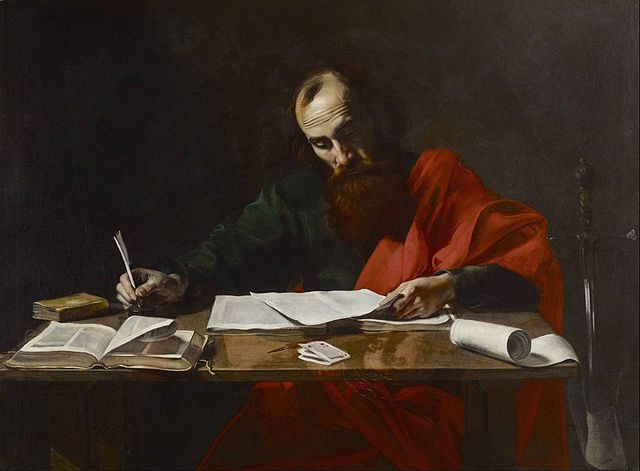
Photo credit: Saint Paul Writing His Epistles (c. 1620), attributed to Valentin de Boulogne (1591-1632) [public domain / Wikimedia Commons]

***
Summary: I critique atheist Jonathan MS Pearce’s relentless attack on the truthfulness of the Gospel texts & the honesty of the four Evangelists, i.e., fairy tale atheist eisegesis.
alleged Resurrection contradictions
Matthew & the Guards at the Tomb
Previous Post

January 30, 2022
Paul Knew the Gospels (vs. Richard Carrier)
Next Post

February 1, 2022 Pearce's Potshots #60: Fairy-Tale Atheist Eisegesis (2)
Browse Our Archives
Select a Category & Last Things About Me Anti-Catholicism Atheism & Agnosticism Baptism and Sacramentalism Bible and Tradition Blessed Virgin Mary Books by Dave Armstrong C. S. Lewis Calvinism & General Protestantism Catholic Apologetics Catholic Apologists Catholic conversion Catholic converts Christmas Church (Ecclesiology) Church History Conversion and Converts Development of Doctrine Eastern Orthodoxy Ecumenism & Christian Unity Eucharist & Liturgy Fathers of the Church French Translations G. K. Chesterton Hell Hell & Satan Hell & Satan & Last Things Heresies & Comparative Religion Holistic Health Inquisition & Crusades & Scandals James White Jews & Judaism & Old Testament John Calvin John Henry Newman Liberal / Modernist Theology Life Issues Literary Resume Lutheranism Mariology Martin Luther Music Orthodoxy Papacy & Infallibility Personal Page Philosophy & Science Political & Ethical & Moral Issues Protestant Persecution & Intolerance Protestantism Purgatory Purgatory & Penance Romantic & Imaginative Theology Saints & Purgatory & Penance Salvation Salvation & Justification Satan & Last Things Sexuality and Gender Issues Spanish Translations Traditionalism vs. Radical Catholic Reactionaries Traducciones al español / tradução para português Trinitarianism & Christology Uncategorized Videos
Select a Month October 2026 September 2026 August 2026 July 2026 June 2026 May 2026 April 2026 March 2026 February 2026 January 2026 December 2025 November 2025 October 2025 September 2025 August 2025 July 2025 June 2025 May 2025 April 2025 March 2025 February 2025 January 2025 December 2024 November 2024 October 2024 September 2024 August 2024 July 2024 June 2024 May 2024 April 2024 March 2024 February 2024 January 2024 December 2023 November 2023 October 2023 September 2023 August 2023 July 2023 June 2023 May 2023 April 2023 March 2023 February 2023 January 2023 December 2022 November 2022 October 2022 September 2022 August 2022 July 2022 June 2022 May 2022 April 2022 March 2022 February 2022 January 2022 December 2021 November 2021 October 2021 September 2021 August 2021 July 2021 June 2021 May 2021 April 2021 March 2021 February 2021 January 2021 December 2020 November 2020 October 2020 September 2020 August 2020 July 2020 June 2020 May 2020 April 2020 March 2020 February 2020 January 2020 December 2019 November 2019 October 2019 September 2019 August 2019 July 2019 June 2019 May 2019 April 2019 March 2019 February 2019 January 2019 December 2018 November 2018 October 2018 September 2018 August 2018 July 2018 June 2018 May 2018 April 2018 March 2018 February 2018 January 2018 December 2017 November 2017 October 2017 September 2017 August 2017 July 2017 June 2017 May 2017 April 2017 March 2017 February 2017 January 2017 December 2016 November 2016 October 2016 September 2016 August 2016 July 2016 June 2016 May 2016 April 2016 March 2016 February 2016 January 2016 December 2015 November 2015 October 2015 September 2015 August 2015 July 2015 June 2015 May 2015 April 2015 March 2015 February 2015 January 2015 December 2014 November 2014 October 2014 September 2014 August 2014 July 2014 June 2014 April 2014 March 2014 February 2014 January 2014 December 2013 November 2013 October 2013 September 2013 August 2013 July 2013 June 2013 April 2013 March 2013 February 2013 January 2013 December 2012 November 2012 October 2012 September 2012 August 2012 July 2012 June 2012 May 2012 April 2012 March 2012 February 2012 January 2012 December 2011 November 2011 October 2011 September 2011 August 2011 July 2011 June 2011 April 2011 March 2011 February 2011 October 2010 September 2010 August 2010 July 2010 April 2010 March 2010 December 2009 October 2009 August 2009 July 2009 June 2009 May 2009 March 2009 February 2009 October 2008 September 2008 April 2008 March 2008 February 2008 January 2008 December 2007 November 2007 October 2007 May 2007 March 2007 February 2007 January 2007 November 2006 October 2006 September 2006 August 2006 July 2006 June 2006 May 2006 April 2006 March 2006 February 2006 October 2005 June 2005 April 2005 February 2005 July 2004 May 2004 April 2004
Follow Us!
TAKE THE
Religious Wisdom Quiz
Which Old Testament book is entirely written as a dialogue between God and a prophet?
Select your answer to see how you score.
Zechariah Malachi Amos Habakkuk
Books by This Author Books by Dave Armstrong
Related posts from Biblical Evidence for Catholicism

God, Modern Physics, & Dark Energy: An Analogy
Biblical Evidence for Catholicism

General Debate on Christianity with an Atheist
Biblical Evidence for Catholicism

Can Atheists Be Saved? Surprising Biblical Data
Biblical Evidence for Catholicism
Can Atheists Be Saved? YES! (Possibly Some ....
Biblical Evidence for Catholicism
TRENDING AT PATHEOS Catholic

In "Irreplaceable," our book on vocation and technology, Trevor Sutton and I...

I was strolling through the top floor of the brand new Parthenon...

What Does Gêvâh Mean For Kimberley Guifoyle &...
This week, a lot of the news is focused on Kimberly Guilfoyle....

INNER CIRCLE: Profound Mystery (Of Christ In All...
Ephesians 5:31-32 “For this reason, a man will leave his father and...

Do Not Rejoice When Your Enemy Falls: The...
Turning an execution into a public spectacle is a disturbing expression of...

'The Chosen' S6 Trailer: The Passion Gets Very...
Not many watching 'The Chosen' worry about spoilers, but just because they...
view all Catholic blogs
Ad-Free & Subscriber Log-In Subscription Support
- About Us
- 2026 Calendar
- Videos
- Podcasts
- Library of World Religions
- Faith In Media Tracker
- Advertise With Us
- Write for Us
- Privacy Policy
- Terms of Service
- Do Not Sell My Data
- Contact Us
- Radiant Digital
- Manage Newsletter Subscriptions
- Unsubscribe From Notifications
- Sitemap
Copyright 2008-2026, Patheos. All rights reserved.
Subscription Support Ad-Free & Subscriber Log-In
Follow Patheos