
BuddhistCatholicContemplativeEvangelicalGeneral ChristianHinduJewishLatter-day SaintMuslimNew VisionsProgressive Christian
Beliefs
- Buddhist
- Catholic
- Contemplative
- Evangelical
- General Christian
- Hindu
- Jewish
- Latter-day Saint
- More Voices
- Muslim
- New Visions
- Pagan
- Progressive Christian
Topics
- Religion News
- Food and Religion
- Sports and Religion
- Religious Art
- Religious Music and Entertainment
- Religious Events
- History and Religion
- Style and Religion
- Politics and Religion
- Women in Religion
- Recreation Outdoors and Religion
- Business Finance and Religion
- Careers Workplace and Religion
- Education and Religion
- Family Parenting and Religion
- Health Fitness and Religion
- Home and Religion
- Relationships and Religion
- Technology and Religion
- Travel and Religion
Columnists
- Buddhist Columnists
- Business Finance and Religion Columnists
- Careers Workplace and Religion Columnists
- Catholic Columnists
- Contemplative Columnists
- Education and Religion Columnists
- Evangelists Columnists
- Family Parenting and Religion Columnists
- General Christian Columnists
- Health Fitness and Religion Columnists
- Hindu Columnists
- History and Religion Columnists
- Home and Religion Columnists
- Jewish Columnists
- More Voices Columnists
- Latter Day Columnists
- Muslim Columnists
- New Visions Columnists
- Nonreligious Columnists
- Pagan Columnists
- Politics and Religion Columnists
- Progressive Columnists
- Recreation Outdoors and Religion Columnists
- Relationships and Religion Columnists
- Religion News Columnists
- Religious Art Columnists
- Religious Events Columnists
- Religious Music and Entertainment Columnists
- Sports and Religion Columnists
- Style and Religion Columnists
- Technology and Religion Columnists
- Travel and Religion Columnists
- Women in Religion Columnists
Resource Library
- 2026 Calendar
- Library of World Religions
- The 100 Most Holy Places on Earth
- Patheos Answers
- Podcasts
- Videos
- Faith Leaders Database
- Anglican Episcopalian
- Bahai
- Baptist
- Buddhism
- Christianity
- Confucianism
- Eastern Orthodoxy
- Hinduism
- Holiness and Pentecostal
- ISKCON
- Islam
- Judaism
- Lutheran
- Methodist
- The Church of Jesus Christ of Latter-day Saints
- New Age
- Paganism
- Presbytarian and Reformed
- Protestantism
- Religion Behind the Scenes
- Roman Catholic
- Scientology
- Shia Islam
- Sikhism
- Sufism
- Sunni Islam
- Taoism
- Zen
- See all religions
Research Tools
 Ad-Free & Subscriber Log-In Subscription Support
Ad-Free & Subscriber Log-In Subscription Support
Follow Patheos 

- Trending:
- Forgiveness
- |
- Marriage
- |
- Consciousness
- |
- Death Penalty
- |
- Election
- |
- Halloween

-
About
-
Catholic Apologetics
-
Church History
-
Great Apologists
-
Christian Worldview
-
Protestantism & Misc.
- Home
- Catholic
- History and Religion
- Sola Scriptura: Self-Refuting? (vs. Steve Hays)
Sola Scriptura: Self-Refuting? (vs. Steve Hays)
Last updated on: June 6, 2026 at 12:45 am by Dave Armstrong
Sola Scriptura: Self-Refuting? (vs. Steve Hays) 2026-06-06T00:45:44-04:00 Dave Armstrong
Patheos Explore the world's faith through different perspectives on religion and spirituality! Patheos has the views of the prevalent religions and spiritualities of the world.
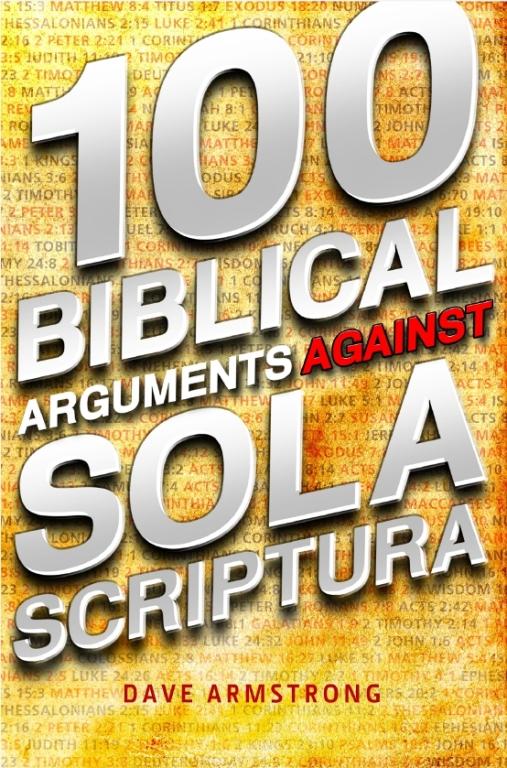
[book and purchase information]
This is a classic apologetics issue between Catholics and Orthodox on one side, and Protestants on the other, and one, I submit, that Protestants have not sufficiently answered, and, indeed, cannot answer. It’s a fatal objection to their position. Let me run through the logic of this devastating critique of sola Scriptura:
The question of sola Scriptura has to do with the rule of faith, which is the method by which Christians can know with certainty, or infallibly, what is true and what is not, in terms of Christian doctrine.
Sola Scriptura is the Protestant rule of faith. Its definition, taken from its most able defenders, is: “Scripture is the only infallible source and norm of Christian doctrine.” The consequence of this definition is that the Church and Sacred Tradition are not infallible, as they are in the Catholic “three-legged stool” rule of faith.
The whole point of a rule of faith is the attainment of infallible knowledge. Failing that, it logically reduces to a mere fallible “tradition of men”: in which case, no one is bound to it, since it has no divine guarantee of truthfulness.
Thus, in order to maintain the infallibility of the principle, it follows inevitably that the proofs for it must come from that same source: the Bible, which is alone infallible. They can be explicit or implicit or by deduction, but they must come from the Bible.
If sola Scriptura isn’t demonstrated from the Bible, it is self-refuting, because it would entail a non-infallible expression of a principle that is by its very nature, uniquely infallible. In other words, a tradition of men, not demonstrated from Scripture, is by nature, fallible.
Ergo: if sola Scriptura isn’t demonstrated from the Bible, it cannot possibly be the Christian rule of faith, and it is false altogether, as all viciously self-refuting propositions are.
Now having stated the Catholic argument that sola Scriptura is self-defeating, self-refuting, or logically viciously circular, let’s see how Steve Hays objected to this reasoning, in his article, “Is sola Scriptura self-refuting?” (1-15-10). His words will be in blue.
***
1. It’s become increasingly popular for Catholic apologists to counter sola Scriptura by claiming that sola Scriptura is self-refuting. For example, Francis Beckwith has been touting this objection at every available venue.
2. Their objection goes as follows:
Unless Scripture teaches sola Scriptura, then sola Scriptura is self-refuting.
3. Now, there are different ways of fielding this objection. For example, Scripture could implicitly teach sola Scriptura even if it didn’t explicitly teach sola Scriptura.
I have already granted that above, since it is potentially the case with all doctrines. For example, infant baptism — by far the most common Christian position now and throughout history — is technically implicitly biblical (though I would say the cumulative case is very strong).
4. However, I’d like to address the objection on its own grounds. The objection seems to be a special case of a more general argument:
A rule of faith is self-refuting unless the rule of faith is self-referential.
In other words, a rule of faith must include itself, and in order to do so it must designate itself as the rule of faith.
That’s not exactly the critique we are making. We’re saying that a rule of faith that purports to be infallible (in practical terms, “certain”), cannot be asserted via an intrinsically fallible (i.e., non-biblical) argument. It’s analogous to the very strong Catholic argument against the Protestant conception of the canon of the books of the Bible. As the late Presbyterian Bible scholar R. C. Sproul admitted, the Protestant canon is a “fallible collection of infallible books.”
That’s not good enough. The foundation of something cannot be weaker than that which it supposedly upholds. Here we have the logical impossibility of a non-biblical, fallible principle — literally, what the Bible calls a “tradition of men” — being applied as the overarching rule of faith with regard to its central aspect: the infallible, inspired Bible, God’s revelation to man.
5. Despite its facile, sales-worthy appeal, it isn’t clear to me that this is logically sound. I think its true that a rule of faith is self-inclusive. But it isn’t obvious to me that a rule of faith must also be self-referential.
For that’s not the rule of faith in itself. That isn’t built into the very nature or intrinsic definition of the rule.
It is in this instance, because if Scripture is the only infallible rule of faith and doctrine, then this notion must necessarily also be included in this Scripture, so as to avoid a logical “foundation of sand.” A strong chain with one weak link can still fail.
Rather, that’s a statement about the rule of faith. That’s a convenient way to identify the rule of faith.
But a statement about the rule of faith is not, itself, the rule of faith–although it’s possible for the rule of faith to make a statement about itself. A statement about the rule of faith can obviously come from the outside. It can also come from the within, but that isn’t inherent in what makes it a rule of faith, that I can see.
That’s neither here nor there. What we’re discussing is the stated Protestant rule of faith. Here are three statements of it, from leading Protestant apologists:
What Protestants mean by sola scriptura is that the Bible alone is the infallible written authority for faith and morals. (Evangelical Protestant apologist Norman Geisler: Roman Catholics and Evangelicals: Agreements and Differences, Grand Rapids, Michigan: Baker Books, 1995, 178; co-author, Ralph E. Mackenzie)
The doctrine of sola scriptura, simply stated, is that the Scriptures alone are sufficient to function as the regula fidei, the infallible rule of faith for the Church. (Reformed Baptist apologist James R. White: The Roman Catholic Controversy, Minneapolis: Bethany House Publishers, 1996, 59)
Scripture . . . is the only inspired and inherently infallible norm, and therefore Scripture is the only final authoritative norm. (Reformed Protestant Keith A. Mathison: The Shape of Sola Scriptura, Moscow, Idaho: Canon Press, 2001, 260)
For example, consider the need to standardize weights and measures. The BIPM issues the International System of Units. Yet it would be fallacious to say the units are self-refuting unless they refer back to the BIPM.
That’s not analogous to the topic at hand, and there is no inherent self-contradiction there.
Therefore, I think the objection is fallacious. But let’s assume, for the sake of argument, that it’s sound.
6. To reiterate the principle:
A rule of faith is self-refuting unless the rule of faith is self-referential.
That’s not the argument we make, as shown above.
Now, Catholics sometimes try to prooftext their rule of faith by appeal to certain Biblical or patristic statements.
7. However, there is also a popular, a priori argument for the Catholic rule of faith. Let’s take a classic statement of this argument:
Surely, then, if the revelations and lessons in Scripture are addressed to us personally and practically, the presence among us of a formal judge and standing expositor of its words, is imperative. It is antecedently unreasonable to suppose that a book so complex, so systematic, in parts so obscure, the outcome of so many minds, times, and places, should be given us from above without the safeguard of some authority; as if it could possibly, from the nature of the case, interpret itself. Its inspiration does but guarantee its truth, not its interpretation. How are private readers satisfactorily to distinguish what is didactic and what is historical, what is fact and what is vision, what is allegorical and what is literal, what is idiomatic and what is grammatical, what is enunciated formally and what occurs obiter, what is only of temporary and what is of lasting obligation? Such is our natural anticipation, and it is only too exactly justified in the events of the last three centuries, in the many countries where private judgment on the text of Scripture has prevailed. The gift of inspiration requires as its complement the gift of infallibility.
Where then is this gift lodged, which is so necessary for the due use of the written word of God? Thus we are introduced to the second dogma in respect to Holy Scripture taught by the Catholic religion. The first is that Scripture is inspired, the second that the Church is the infallible interpreter of that inspiration. [St. John Henry Cardinal Newman; source]
First of all, this isn’t the topic. The topic is not, “what is the Catholic rule of faith?” It’s (as in Steve’s own title), “Is sola Scriptura self-refuting?” He doesn’t resolve that conundrum one whit in switching the topic over to Catholic views. That’s what we call in logic a non sequitur. But those with poor arguments have utilized this pathetic method of switching the topic, for centuries. Cardinal Newman was not even (arguably) discussing the rule of faith. He was talking about perspicuity of Scripture, and authoritative interpretation of it.
Not only is that how Newman argues, but [Michael] Liccione, for one, also uses the same type of argument.
According to this form of the argument, you don’t really need to have the Catholic rule of faith asserted in Scripture or tradition. Rather, the Catholic rule of faith is treated like a necessary precondition or presupposition or self-evident truth-condition.
We should accept the Catholic rule of faith simply because the consequences of the Protestant alternative are unacceptable. So its status is axiomatic. A first principle.
Nonsense. As stated, this is an off-topic obfuscation, but briefly stated, the Catholic rule of faith is not circular and is grounded in Holy Scripture every step of the way.
8. Yet that invites a comparison. For if the Protestant rule of faith is self-refuting unless it is self-referential, then why isn’t the Catholic rule of faith self-refuting unless it is self-referential?
We contend that Scripture itself teaches that Church and Sacred Apostolic Tradition are also infallible, alongside Holy Scripture. It’s self-consistent because the whole thing can be deduced from inspired, infallible Scripture, whereas sola Scriptura cannot do so, since it fundamentally replies on a non-biblical principle which is then arbitrarily applied to the Bible.
Conversely, if the Catholic rule of faith can be treated as simply axiomatic, then why can’t the Protestant rule of faith be treated as simply axiomatic? If an a priori type of argument is sufficient for the Catholic rule of faith, then why can’t the same reasoning be applicable to the Protestant rule of faith?
I reject this claim about our rule of faith. It’s not “simply axiomatic.” It is explicitly grounded in Holy Scripture, which all parties accept as inspired revelation (on many other grounds, and in faith). Note what Steve has again done. He has not sought to overcome the extreme logical difficulty of his own position. Instead, he switches the topic over to Catholicism, falsely describes our view (a straw man), and then chides us by arguing, in effect, “why can’t we do the same thing you do?” Apart from the silly straw man, this isn’t any defense whatsoever of his own position. In fact, the adoption of these unworthy tactics of non sequitur and sophistical argumentation precisely prove that Steve isn’t confident in his own position, since he resolutely refuses to defend it.
And he acts that way because — I contend — he cannot do so. Not only him, but any Protestant, cannot defend sola Scriptura against this fatal charge. I think they know this down deep, which is why they always seek to switch the topic, in order to supposedly get off the “hot seat.” That doesn’t work with me (someone who has been doing Catholic apologetics for over thirty years: the last twenty professionally). I will expose it for what it is every time.
9. Is it just because the Protestant rule of faith contains the word “only,” whereas the Catholic rule of faith does not? But that’s a superficial, semantic difference–depending on how your verbally formulate the respective positions.
No it isn’t. It’s about the issues I raise above.
Yet Catholics also regard their rule of faith as the only true rule of faith, so there’s no material difference in terms of exclusivity.
From what I can tell, the Catholic objection is nothing more than a muddleheaded, verbal trick.
That’s absurd. But if it were true, then Steve ought to be able to decisively refute it. He hasn’t even tried to begin doing so. He hasn’t shown how sola Scriptura is not self-refuting. He hasn’t even made it to first base.
[now, a few comments from the combox]
Produce a definition of SS from a Reformed confession or representative Reformed theologian . . .
I did: Keith Mathison [Reformed Presbyterian] and Steve’s buddy James White [Reformed Baptist]. Both state definitions that can easily be squared with Reformed Confessions, if needs be. For example, the Belgic Confession:
7: The Sufficiency of the Holy Scriptures to Be the Only Rule of Faith
We believe that those Holy Scriptures fully contain the will of God, and that whatsoever man ought to believe unto salvation is sufficiently taught therein. For, since the whole manner of worship which God requires of us is written in them at large, it is unlawful for any one, though an apostle, to teach otherwise than we are now taught in the Holy Scriptures; nay, though it were an angel from heaven, as the apostle Paul saith. For, since it is forbidden to add unto or take away any thing from the Word of God, it doth thereby evidently appear that the doctrine thereof is most perfect and complete in all respects.
Neither do we consider of equal value any writing of men, however holy these men may have been, with those divine Scriptures, nor ought we to consider custom, or the great multitude, or antiquity, or succession of times and persons, or councils, decrees, or statutes, as of equal value with the truth of God, for the truth is above all; for all men are of themselves liars and more vain than vanity itself. Therefore we reject with all our hearts whatsoever doth not agree with this infallible rule, which the apostles have taught us, saying, Try the spirits whether they are of God. Likewise, if there come any unto you, and bring not this doctrine, receive him not into your house.
This is a long-winded but logically identical variation of the three brief definitions I have cited. Likewise, the Second Helvetic Confession:
But we hold that the interpretation of the Scripture to be orthodox and genuine which is gleaned from the Scriptures themselves . . .
Wherefore we do not despise the interpretations of the holy Greek and Latin fathers, nor reject their disputations and treatises concerning sacred matters as far as they agree with the Scriptures; but we modestly dissent from them when they are found to set down things differing from, or altogether contrary to, the Scriptures. . . .
Wherefore we do not permit ourselves, in controversies about religion or matters of faith, to urge our case with only the opinions of the fathers or decrees of councils; much less by received customs, or by the large number of those who share the same opinion, or by the prescription of a long time. Who Is The Judge? Therefore, we do not admit any other judge than God himself, who proclaims by the Holy Scriptures what is true, what is false, what is to be followed, or what to be avoided. . . .
Likewise we reject human traditions, even if they be adorned with high-sounding titles, as though they were divine and apostolical, delivered to the Church by the living voice of the apostles, and, as it were, through the hands of apostolical men to succeeding bishops which, when compared with the Scriptures, disagree with them; and by their disagreement show that they are not Apostolic at all. (Chapter Two)
And don’t forget the good ol’ Westminster Confession:
VI. The whole counsel of God, concerning all things necessary for his own glory, man’s salvation, faith, and life, is either expressly set down in Scripture, or by good and necessary consequence may be deduced from Scripture: unto which nothing at any time is to be added, whether by new revelations of the Spirit, or traditions of men. . . .
IX. The infallible rule of interpretation of Scripture is the Scripture itself; and therefore, when there is a question about the true and full sense of any Scripture (which is not manifold, but one), it must be searched and known by other places that speak more clearly.
X. The Supreme Judge, by which all controversies of religion are to be determined, and all decrees of councils, opinions of ancient writers, doctrines of men, and private spirits, are to be examined, and in whose sentence we are to rest, can be no other but the Holy Spirit speaking in the Scripture. (Chapter One)
Catholic arguments devastate all of these positions, which are consistent with each other, but all self-refuting.
If you think that sola scriptura is self-refuting by definition, then the first step is to arrive at an accurate definition. Whether or not what the thing defined is true is a separate and subsequent issue which you can’t even get to before you have a proper definition.
Exactly. That’s what I’ve done above, offering six self-definitions, all consistent with each other and all equally self-defeating.
***
*
Practical Matters: Perhaps some of my 3,900+ free online articles (the most comprehensive “one-stop” Catholic apologetics site) or fifty books have helped you (by God’s grace) to decide to become Catholic or to return to the Church, or better understand some doctrines and why we believe them.
*
Or you may believe my work is worthy to support for the purpose of apologetics and evangelism in general. If so, please seriously consider a much-needed financial contribution. I’m always in need of more funds: especially monthly support. “The laborer is worthy of his wages” (1 Tim 5:18, NKJV). 1 December 2021 was my 20th anniversary as a full-time Catholic apologist, and February 2022 marked the 25th anniversary of my blog.
*
PayPal donations are the easiest: just send to my email address: [email protected]. You’ll see the term “Catholic Used Book Service”, which is my old side-business. To learn about the different methods of contributing, including 100% tax deduction, etc., see my page: About Catholic Apologist Dave Armstrong / Donation Information. Thanks a million from the bottom of my heart!
*
***
*
Summary: Steve Hays introduces the topic of whether sola Scriptura is self-defeating, yet he never defends it from the charge. Instead, he engages in obfuscation & sophistry.
*
***
Previous Post
December 14, 2021
Steve Hays, Onan, Bible Commentary, & Contraception
Next Post
December 15, 2021 Sola Scriptura as Defined by Historic Protestantism
Browse Our Archives
Select a Category & Last Things About Me Anti-Catholicism Atheism & Agnosticism Baptism and Sacramentalism Bible and Tradition Blessed Virgin Mary Books by Dave Armstrong C. S. Lewis Calvinism & General Protestantism Catholic Apologetics Catholic Apologists Catholic conversion Catholic converts Christmas Church (Ecclesiology) Church History Conversion and Converts Development of Doctrine Eastern Orthodoxy Ecumenism & Christian Unity Eucharist & Liturgy Fathers of the Church French Translations G. K. Chesterton Hell Hell & Satan Hell & Satan & Last Things Heresies & Comparative Religion Holistic Health Inquisition & Crusades & Scandals James White Jews & Judaism & Old Testament John Calvin John Henry Newman Liberal / Modernist Theology Life Issues Literary Resume Lutheranism Mariology Martin Luther Music Orthodoxy Papacy & Infallibility Personal Page Philosophy & Science Political & Ethical & Moral Issues Protestant Persecution & Intolerance Protestantism Purgatory Purgatory & Penance Romantic & Imaginative Theology Saints & Purgatory & Penance Salvation Salvation & Justification Satan & Last Things Sexuality and Gender Issues Spanish Translations Traditionalism vs. Radical Catholic Reactionaries Traducciones al español / tradução para português Trinitarianism & Christology Uncategorized Videos
Select a Month October 2026 September 2026 August 2026 July 2026 June 2026 May 2026 April 2026 March 2026 February 2026 January 2026 December 2025 November 2025 October 2025 September 2025 August 2025 July 2025 June 2025 May 2025 April 2025 March 2025 February 2025 January 2025 December 2024 November 2024 October 2024 September 2024 August 2024 July 2024 June 2024 May 2024 April 2024 March 2024 February 2024 January 2024 December 2023 November 2023 October 2023 September 2023 August 2023 July 2023 June 2023 May 2023 April 2023 March 2023 February 2023 January 2023 December 2022 November 2022 October 2022 September 2022 August 2022 July 2022 June 2022 May 2022 April 2022 March 2022 February 2022 January 2022 December 2021 November 2021 October 2021 September 2021 August 2021 July 2021 June 2021 May 2021 April 2021 March 2021 February 2021 January 2021 December 2020 November 2020 October 2020 September 2020 August 2020 July 2020 June 2020 May 2020 April 2020 March 2020 February 2020 January 2020 December 2019 November 2019 October 2019 September 2019 August 2019 July 2019 June 2019 May 2019 April 2019 March 2019 February 2019 January 2019 December 2018 November 2018 October 2018 September 2018 August 2018 July 2018 June 2018 May 2018 April 2018 March 2018 February 2018 January 2018 December 2017 November 2017 October 2017 September 2017 August 2017 July 2017 June 2017 May 2017 April 2017 March 2017 February 2017 January 2017 December 2016 November 2016 October 2016 September 2016 August 2016 July 2016 June 2016 May 2016 April 2016 March 2016 February 2016 January 2016 December 2015 November 2015 October 2015 September 2015 August 2015 July 2015 June 2015 May 2015 April 2015 March 2015 February 2015 January 2015 December 2014 November 2014 October 2014 September 2014 August 2014 July 2014 June 2014 April 2014 March 2014 February 2014 January 2014 December 2013 November 2013 October 2013 September 2013 August 2013 July 2013 June 2013 April 2013 March 2013 February 2013 January 2013 December 2012 November 2012 October 2012 September 2012 August 2012 July 2012 June 2012 May 2012 April 2012 March 2012 February 2012 January 2012 December 2011 November 2011 October 2011 September 2011 August 2011 July 2011 June 2011 April 2011 March 2011 February 2011 October 2010 September 2010 August 2010 July 2010 April 2010 March 2010 December 2009 October 2009 August 2009 July 2009 June 2009 May 2009 March 2009 February 2009 October 2008 September 2008 April 2008 March 2008 February 2008 January 2008 December 2007 November 2007 October 2007 May 2007 March 2007 February 2007 January 2007 November 2006 October 2006 September 2006 August 2006 July 2006 June 2006 May 2006 April 2006 March 2006 February 2006 October 2005 June 2005 April 2005 February 2005 July 2004 May 2004 April 2004
Follow Us!
TAKE THE
Religious Wisdom Quiz
Who was the first woman?
Select your answer to see how you score.
Sarah Eve Mary Deborah
Books by This Author Books by Dave Armstrong
Related posts from Biblical Evidence for Catholicism

Three More Anti-Catholic Lies About Catholicism (#6-4)
Biblical Evidence for Catholicism

Top Ten Anti-Catholic Lies (#10-7)
Biblical Evidence for Catholicism

A Few "Worst" & "Best" Arguments vs. Protestantism
Biblical Evidence for Catholicism

"Baptism" & Romans 10 (Engwer's Silly Word Games)
Biblical Evidence for Catholicism
TRENDING AT PATHEOS Catholic

In "Irreplaceable," our book on vocation and technology, Trevor Sutton and I...

I was strolling through the top floor of the brand new Parthenon...

What Does Gêvâh Mean For Kimberley Guifoyle &...
This week, a lot of the news is focused on Kimberly Guilfoyle....

INNER CIRCLE: Profound Mystery (Of Christ In All...
Ephesians 5:31-32 “For this reason, a man will leave his father and...

Do Not Rejoice When Your Enemy Falls: The...
Turning an execution into a public spectacle is a disturbing expression of...

'The Chosen' S6 Trailer: The Passion Gets Very...
Not many watching 'The Chosen' worry about spoilers, but just because they...
view all Catholic blogs
Ad-Free & Subscriber Log-In Subscription Support
- About Us
- 2026 Calendar
- Videos
- Podcasts
- Library of World Religions
- Faith In Media Tracker
- Advertise With Us
- Write for Us
- Privacy Policy
- Terms of Service
- Do Not Sell My Data
- Contact Us
- Radiant Digital
- Manage Newsletter Subscriptions
- Unsubscribe From Notifications
- Sitemap
Copyright 2008-2026, Patheos. All rights reserved.
Subscription Support Ad-Free & Subscriber Log-In
Follow Patheos