
BuddhistCatholicContemplativeEvangelicalGeneral ChristianHinduJewishLatter-day SaintMuslimNew VisionsProgressive Christian
Beliefs
- Buddhist
- Catholic
- Contemplative
- Evangelical
- General Christian
- Hindu
- Jewish
- Latter-day Saint
- More Voices
- Muslim
- New Visions
- Pagan
- Progressive Christian
Topics
- Religion News
- Food and Religion
- Sports and Religion
- Religious Art
- Religious Music and Entertainment
- Religious Events
- History and Religion
- Style and Religion
- Politics and Religion
- Women in Religion
- Recreation Outdoors and Religion
- Business Finance and Religion
- Careers Workplace and Religion
- Education and Religion
- Family Parenting and Religion
- Health Fitness and Religion
- Home and Religion
- Relationships and Religion
- Technology and Religion
- Travel and Religion
Columnists
- Buddhist Columnists
- Business Finance and Religion Columnists
- Careers Workplace and Religion Columnists
- Catholic Columnists
- Contemplative Columnists
- Education and Religion Columnists
- Evangelists Columnists
- Family Parenting and Religion Columnists
- General Christian Columnists
- Health Fitness and Religion Columnists
- Hindu Columnists
- History and Religion Columnists
- Home and Religion Columnists
- Jewish Columnists
- More Voices Columnists
- Latter Day Columnists
- Muslim Columnists
- New Visions Columnists
- Nonreligious Columnists
- Pagan Columnists
- Politics and Religion Columnists
- Progressive Columnists
- Recreation Outdoors and Religion Columnists
- Relationships and Religion Columnists
- Religion News Columnists
- Religious Art Columnists
- Religious Events Columnists
- Religious Music and Entertainment Columnists
- Sports and Religion Columnists
- Style and Religion Columnists
- Technology and Religion Columnists
- Travel and Religion Columnists
- Women in Religion Columnists
Resource Library
- 2026 Calendar
- Library of World Religions
- The 100 Most Holy Places on Earth
- Patheos Answers
- Podcasts
- Videos
- Faith Leaders Database
- Anglican Episcopalian
- Bahai
- Baptist
- Buddhism
- Christianity
- Confucianism
- Eastern Orthodoxy
- Hinduism
- Holiness and Pentecostal
- ISKCON
- Islam
- Judaism
- Lutheran
- Methodist
- The Church of Jesus Christ of Latter-day Saints
- New Age
- Paganism
- Presbytarian and Reformed
- Protestantism
- Religion Behind the Scenes
- Roman Catholic
- Scientology
- Shia Islam
- Sikhism
- Sufism
- Sunni Islam
- Taoism
- Zen
- See all religions
Research Tools
 Ad-Free & Subscriber Log-In Subscription Support
Ad-Free & Subscriber Log-In Subscription Support
Follow Patheos 

- Trending:
- Forgiveness
- |
- Marriage
- |
- Consciousness
- |
- Death Penalty
- |
- Election
- |
- Halloween

-
About
-
Catholic Apologetics
-
Church History
-
Great Apologists
-
Christian Worldview
-
Protestantism & Misc.
- Home
- Catholic
- History and Religion
- Sola Scriptura as Defined by Historic Protestantism
Sola Scriptura as Defined by Historic Protestantism
Last updated on: June 6, 2026 at 12:46 am by Dave Armstrong
Sola Scriptura as Defined by Historic Protestantism 2026-06-06T00:46:00-04:00 Dave Armstrong
Patheos Explore the world's faith through different perspectives on religion and spirituality! Patheos has the views of the prevalent religions and spiritualities of the world.
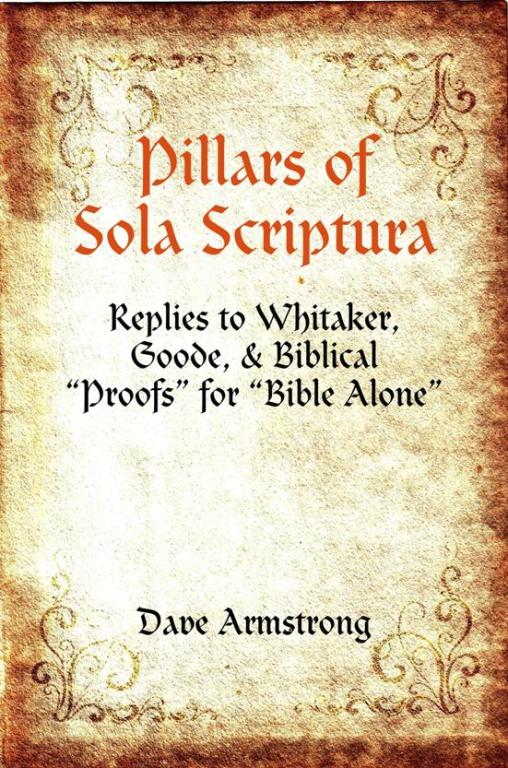
[book and purchase information]
Martin Luther (1483-1546)
This is my answer to those also who accuse me of rejecting all the holy teachers of the church. I do not reject them. But everyone, indeed, knows that at times they have erred, as men will; therefore, I am ready to trust them only when they give me evidence for their opinions from Scripture, which has never erred. This St. Paul bids me to do in I Thess. 5:21, where he says, “Test everything; hold fast what is good.” . . .
[N]ecessity forces us to run to the Bible with the writings of all teachers, and to obtain there a verdict and judgment upon them. Scripture alone is the true lord and master of all writings and doctrine on earth. If that is not granted, what is Scripture good for? The more we reject it, the more we become satisfied with men’s books and human teachers. (Defense and Explanation of All the Articles of Dr. Martin Luther Which Were Unjustly Condemned by the Roman Bull [March 1521], in Luther’s Works [LW], Vol. 32: Career of the Reformer II, ed. Jaroslav Jan Pelikan, Hilton C. Oswald, and Helmut T. Lehmann, vol. 32, Philadelphia: Fortress Press, 1999, 11–12 [see secondary source])
[W]e have an agreement that we are willing to fight each other, not by appealing to the authority of any doctor, but by that of Scripture alone. (On the Bondage of the Will, 1525, in LW, Vol. 33, 167 [see secondary source])
John Calvin (1509-1564)
First we affirm that we desire to follow Scripture alone as rule of faith and religion, without mixing with it any other thing which might be devised by the opinion of men apart from the Word of God, and without wishing to accept for our spiritual government any other doctrine than what is conveyed to us by the same Word without addition or diminution, according to the command of our Lord. (Instruction and Confession, 1537, in J. K. S. Reid, Calvin: Theological Treatises, Louisville, Kentucky; London: Westminster John Knox Press, 1954, 26 [see secondary source])
Here I implore the pious, I entreat that they might know the true rule of righteousness from Scripture alone, that they might judge religiously and seriously as Scripture itself judges it, . . . (Institutes of the Christian Religion, 10.68, edition of 1539; in Corpus Reformatorum [CR], 29.785 [see secondary source])
In regard to Traditions, I am aware that not unfrequent mention of them is made by ancient writers, though not with the intention of carrying our faith beyond the Scriptures, to which they always confine it. They only say that certain customs were received from the Apostles. Some of them appear to have that origin, but others are unworthy of it. These touch only upon a few points, and such as might be tolerated. But now we are called to believe, that whatever the Romanists are pleased to obtrude upon us, flowed by tradition from the Apostles; and so shameless are they, that without observing any distinction, they bring into this class things which crept in not long ago, during the darkness of ignorance. Therefore, though we grant that the Apostles of the Lord handed down to posterity some customs which they never committed to writing; still, first, this has nothing to do with the doctrine of faith, (as to it we cannot extract one iota from them,) but only with external rites subservient to decency or discipline; and secondly, it is still necessary for them to prove that everything to which they give the name is truly an apostolical tradition. . . . We especially repudiate their desire to make certainty of doctrine depend not less on what they call αγραφα, (unwritten,) than on the Scriptures. (Antidote to the Council of Trent, 1547, in Tracts Relating to the Reformation, vol. 3, trans. H. Beveridge, Edinburgh: Calvin Translation Society, 1851, 69 [see secondary source])
Belgic Confession (1561)
7: The Sufficiency of the Holy Scriptures to Be the Only Rule of Faith
We believe that those Holy Scriptures fully contain the will of God, and that whatsoever man ought to believe unto salvation is sufficiently taught therein. For, since the whole manner of worship which God requires of us is written in them at large, it is unlawful for any one, though an apostle, to teach otherwise than we are now taught in the Holy Scriptures; nay, though it were an angel from heaven, as the apostle Paul saith. For, since it is forbidden to add unto or take away any thing from the Word of God, it doth thereby evidently appear that the doctrine thereof is most perfect and complete in all respects.
Neither do we consider of equal value any writing of men, however holy these men may have been, with those divine Scriptures, nor ought we to consider custom, or the great multitude, or antiquity, or succession of times and persons, or councils, decrees, or statutes, as of equal value with the truth of God, for the truth is above all; for all men are of themselves liars and more vain than vanity itself. Therefore we reject with all our hearts whatsoever doth not agree with this infallible rule, which the apostles have taught us, saying, Try the spirits whether they are of God. Likewise, if there come any unto you, and bring not this doctrine, receive him not into your house. (source)
Second Helvetic Confession (1564)
But we hold that the interpretation of the Scripture to be orthodox and genuine which is gleaned from the Scriptures themselves . . .
Wherefore we do not despise the interpretations of the holy Greek and Latin fathers, nor reject their disputations and treatises concerning sacred matters as far as they agree with the Scriptures; but we modestly dissent from them when they are found to set down things differing from, or altogether contrary to, the Scriptures. . . .
Wherefore we do not permit ourselves, in controversies about religion or matters of faith, to urge our case with only the opinions of the fathers or decrees of councils; much less by received customs, or by the large number of those who share the same opinion, or by the prescription of a long time. Who Is The Judge? Therefore, we do not admit any other judge than God himself, who proclaims by the Holy Scriptures what is true, what is false, what is to be followed, or what to be avoided. . . .
Likewise we reject human traditions, even if they be adorned with high-sounding titles, as though they were divine and apostolical, delivered to the Church by the living voice of the apostles, and, as it were, through the hands of apostolical men to succeeding bishops which, when compared with the Scriptures, disagree with them; and by their disagreement show that they are not Apostolic at all. (Chapter Two) [source]
Thirty-Nine Articles (Anglicanism, 1571)
Of the sufficiency of the Holy Scripture for Salvation
Holy Scripture containeth all things necessary to salvation: so that whatsoever is not read therein, nor may be proved thereby, is not to be required of any man, that it should be believed as an article of the faith, or be thought requisite or necessary to salvation. (Article VI)
Lutheran Confession[s] (1577)
We believe, teach, and confess that the sole rule and standard according to which all dogmas together with [all] teachers should be estimated and judged are the prophetic and apostolic Scriptures of the Old and of the New Testament alone, as it is written Ps. 119:105: Thy Word is a lamp unto my feet and a light unto my path. And St. Paul: Though an angel from heaven preach any other gospel unto you, let him be accursed, Gal. 1:8. (The Formula of Concord: Epitome, 1 [written in 1577 by a number of Lutheran theologians, including Jakob Andreä (1528–90), Martin Chemnitz (1522–86), and Andreas Musculus (1514–81)] )
William Whitaker (1548-1595), Calvinist Anglican, Disputation on Holy Scripture: Against the Papists, Especially Bellarmine and Stapleton (1588)
We do not, therefore, as the papists falsely say of us, refuse the testimony of the church, but embrace it. But we deny that we believe the scriptures solely on account of this commendation of them by the church. For we say that there is a more certain and illustrious testimony, whereby we are persuaded of the sacred character of these books, that is to say, the internal testimony of the Holy Spirit, without which the commendation of the church would have with us no weight or moment. The papists, therefore, are unjust to us, when they affirm that we reject and make no account of the authority of the church. For we gladly receive the testimony of the church, and admit its authority; but we affirm that there is a far different, more certain, true, and august testimony than that of the church. The sum of our opinion is, that the scripture . . . hath all its authority and credit from itself; is to be acknowledged, is to be received, not only because the church hath so determined and commanded, but because it comes from God; and that we certainly know that it comes from God, not by the church, but by the Holy Ghost. (pp. 279-280) [primary source]
Westminster Confession (1646)
VI. The whole counsel of God, concerning all things necessary for his own glory, man’s salvation, faith, and life, is either expressly set down in Scripture, or by good and necessary consequence may be deduced from Scripture: unto which nothing at any time is to be added, whether by new revelations of the Spirit, or traditions of men. . . .
IX. The infallible rule of interpretation of Scripture is the Scripture itself; and therefore, when there is a question about the true and full sense of any Scripture (which is not manifold, but one), it must be searched and known by other places that speak more clearly.
X. The Supreme Judge, by which all controversies of religion are to be determined, and all decrees of councils, opinions of ancient writers, doctrines of men, and private spirits, are to be examined, and in whose sentence we are to rest, can be no other but the Holy Spirit speaking in the Scripture. (Chapter One) [source]
William Goode (1801-1868), evangelical Anglican, The Divine Rule of Faith and Practice (2nd ed., three volumes, 1853)
[T]here is nothing of which we have sufficient evidence that it is Divine or inspired testimony but the Holy Scripture; and consequently that the Holy Scripture is our sole and exclusive Divine Rule of faith and practice. (Vol. 1, p. 21)
Let us observe the arguments and objections derived from Scripture itself on this point. . . . Now, here I admit at once, that there is no passage of the New Testament precisely stating, that the Christian Rule of faith is limited to the Scriptures of the Old and New Testament; . . . (Vol. 1, p. 70; italics added)
But though we have not, and were not likely to have, such an announcement in Scripture, we have there what may answer as well, the determination of a parallel case, viz., that of the Jews at the time of our Lord’s incarnation. We learn clearly from Scripture, that the Canon of the Old Testament was to them at that time (the divine voice being no longer heard among them) the sole Rule of faith; and that the traditions of the Fathers, notwithstanding their pretended divine origin, were not worthy of being considered the Word of God. . . . That the Scriptures of the Old Testament were to the Jews of that period the sole authoritative Rule of faith, we have, I conceive, very sufficient testimony in Scripture. (Vol. 1, p. 71)
[T]here is no direct testimony in the Old Testament to its perfection as the sole infallible Rule of faith to the Jews in the time of our Lord, . . . (Vol. 1, p. 73; italics added) [primary sources: Vol. 1 / Vol. 2]
Modern Day Reiterations (1995-2001)
What Protestants mean by sola scriptura is that the Bible alone is the infallible written authority for faith and morals. (Evangelical Protestant apologist Norman Geisler: Roman Catholics and Evangelicals: Agreements and Differences, Grand Rapids, Michigan: Baker Books, 1995, 178; co-author, Ralph E. Mackenzie)
The doctrine of sola scriptura, simply stated, is that the Scriptures alone are sufficient to function as the regula fidei, the infallible rule of faith for the Church. (Reformed Baptist apologist James R. White: The Roman Catholic Controversy, Minneapolis: Bethany House Publishers, 1996, 59)
Scripture . . . is the only inspired and inherently infallible norm, and therefore Scripture is the only final authoritative norm. (Reformed Protestant Keith A. Mathison: The Shape of Sola Scriptura, Moscow, Idaho: Canon Press, 2001, 260)
Related Reading
My Bible, Tradition, Canon, & Sola Scriptura web page
Papal Infallibility Doctrine: History (Including Luther’s Dissent at the Leipzig Disputation in 1519) (Related also to the particular circumstances of the origins of sola Scriptura) [10-8-07]
100 Biblical Arguments Against Sola Scriptura [Book: May 2012]
Pillars of Sola Scriptura: Replies to Whitaker, Goode, & Biblical ‘Proofs’ for ‘Bible Alone’ [Book: 9-2-12]
The Bible Tells Me So: A Catholic Apologist Challenges Protestants with Scripture [Book: Jan. 2019]
***
Practical Matters: Perhaps some of my 3,900+ free online articles (the most comprehensive “one-stop” Catholic apologetics site) or fifty books have helped you (by God’s grace) to decide to become Catholic or to return to the Church, or better understand some doctrines and why we believe them.
*
Or you may believe my work is worthy to support for the purpose of apologetics and evangelism in general. If so, please seriously consider a much-needed financial contribution. I’m always in need of more funds: especially monthly support. “The laborer is worthy of his wages” (1 Tim 5:18, NKJV). 1 December 2021 was my 20th anniversary as a full-time Catholic apologist, and February 2022 marked the 25th anniversary of my blog.
*
PayPal donations are the easiest: just send to my email address: [email protected]. You’ll see the term “Catholic Used Book Service”, which is my old side-business. To learn about the different methods of contributing, including 100% tax deduction, etc., see my page: About Catholic Apologist Dave Armstrong / Donation Information. Thanks a million from the bottom of my heart!
***
Summary: I offer twelve sources: authoritative Protestant definitions of sola Scriptura: the notion that the Bible is the sole infallible norm and source of Christian doctrine and faith.
***
Protestantism & sola Scriptura
Previous Post
December 14, 2021
Sola Scriptura: Self-Refuting? (vs. Steve Hays)
Next Post
December 17, 2021 King David and Archaeology
Browse Our Archives
Select a Category & Last Things About Me Anti-Catholicism Atheism & Agnosticism Baptism and Sacramentalism Bible and Tradition Blessed Virgin Mary Books by Dave Armstrong C. S. Lewis Calvinism & General Protestantism Catholic Apologetics Catholic Apologists Catholic conversion Catholic converts Christmas Church (Ecclesiology) Church History Conversion and Converts Development of Doctrine Eastern Orthodoxy Ecumenism & Christian Unity Eucharist & Liturgy Fathers of the Church French Translations G. K. Chesterton Hell Hell & Satan Hell & Satan & Last Things Heresies & Comparative Religion Holistic Health Inquisition & Crusades & Scandals James White Jews & Judaism & Old Testament John Calvin John Henry Newman Liberal / Modernist Theology Life Issues Literary Resume Lutheranism Mariology Martin Luther Music Orthodoxy Papacy & Infallibility Personal Page Philosophy & Science Political & Ethical & Moral Issues Protestant Persecution & Intolerance Protestantism Purgatory Purgatory & Penance Romantic & Imaginative Theology Saints & Purgatory & Penance Salvation Salvation & Justification Satan & Last Things Sexuality and Gender Issues Spanish Translations Traditionalism vs. Radical Catholic Reactionaries Traducciones al español / tradução para português Trinitarianism & Christology Uncategorized Videos
Select a Month October 2026 September 2026 August 2026 July 2026 June 2026 May 2026 April 2026 March 2026 February 2026 January 2026 December 2025 November 2025 October 2025 September 2025 August 2025 July 2025 June 2025 May 2025 April 2025 March 2025 February 2025 January 2025 December 2024 November 2024 October 2024 September 2024 August 2024 July 2024 June 2024 May 2024 April 2024 March 2024 February 2024 January 2024 December 2023 November 2023 October 2023 September 2023 August 2023 July 2023 June 2023 May 2023 April 2023 March 2023 February 2023 January 2023 December 2022 November 2022 October 2022 September 2022 August 2022 July 2022 June 2022 May 2022 April 2022 March 2022 February 2022 January 2022 December 2021 November 2021 October 2021 September 2021 August 2021 July 2021 June 2021 May 2021 April 2021 March 2021 February 2021 January 2021 December 2020 November 2020 October 2020 September 2020 August 2020 July 2020 June 2020 May 2020 April 2020 March 2020 February 2020 January 2020 December 2019 November 2019 October 2019 September 2019 August 2019 July 2019 June 2019 May 2019 April 2019 March 2019 February 2019 January 2019 December 2018 November 2018 October 2018 September 2018 August 2018 July 2018 June 2018 May 2018 April 2018 March 2018 February 2018 January 2018 December 2017 November 2017 October 2017 September 2017 August 2017 July 2017 June 2017 May 2017 April 2017 March 2017 February 2017 January 2017 December 2016 November 2016 October 2016 September 2016 August 2016 July 2016 June 2016 May 2016 April 2016 March 2016 February 2016 January 2016 December 2015 November 2015 October 2015 September 2015 August 2015 July 2015 June 2015 May 2015 April 2015 March 2015 February 2015 January 2015 December 2014 November 2014 October 2014 September 2014 August 2014 July 2014 June 2014 April 2014 March 2014 February 2014 January 2014 December 2013 November 2013 October 2013 September 2013 August 2013 July 2013 June 2013 April 2013 March 2013 February 2013 January 2013 December 2012 November 2012 October 2012 September 2012 August 2012 July 2012 June 2012 May 2012 April 2012 March 2012 February 2012 January 2012 December 2011 November 2011 October 2011 September 2011 August 2011 July 2011 June 2011 April 2011 March 2011 February 2011 October 2010 September 2010 August 2010 July 2010 April 2010 March 2010 December 2009 October 2009 August 2009 July 2009 June 2009 May 2009 March 2009 February 2009 October 2008 September 2008 April 2008 March 2008 February 2008 January 2008 December 2007 November 2007 October 2007 May 2007 March 2007 February 2007 January 2007 November 2006 October 2006 September 2006 August 2006 July 2006 June 2006 May 2006 April 2006 March 2006 February 2006 October 2005 June 2005 April 2005 February 2005 July 2004 May 2004 April 2004
Follow Us!
TAKE THE
Religious Wisdom Quiz
Which book of the Bible contains the Song of Moses?
Select your answer to see how you score.
Exodus Numbers Psalms Deuteronomy
Books by This Author Books by Dave Armstrong
Related posts from Biblical Evidence for Catholicism

A Few "Worst" & "Best" Arguments vs. Protestantism
Biblical Evidence for Catholicism

Jerusalem Council vs. James White & Sola Scriptura
Biblical Evidence for Catholicism

Biblical Perspicuity: Absurd Anti-Catholic "Defense"
Biblical Evidence for Catholicism

50 Biblical Disproofs of "Evident Clearness" of the...
Biblical Evidence for Catholicism
TRENDING AT PATHEOS Catholic

The Sermon on the Mount, Part I: Matthew...
The Sermon on the Mount, Part I (Matthew 4:12-5:12) St. Matthew moves...

What's up from Crossway: Reviewing some of their latest A few weeks...

Janie Learns the Way of the Cross: A...
Teaching children about Jesus' Passion can be challenging. Many parents and educators...

Looking For Good Catholic Writing - October 2026
He alone extends the heavens, and he walks upon the waves of...

In "Irreplaceable," our book on vocation and technology, Trevor Sutton and I...

I was strolling through the top floor of the brand new Parthenon...
view all Catholic blogs
Ad-Free & Subscriber Log-In Subscription Support
- About Us
- 2026 Calendar
- Videos
- Podcasts
- Library of World Religions
- Faith In Media Tracker
- Advertise With Us
- Write for Us
- Privacy Policy
- Terms of Service
- Do Not Sell My Data
- Contact Us
- Radiant Digital
- Manage Newsletter Subscriptions
- Unsubscribe From Notifications
- Sitemap
Copyright 2008-2026, Patheos. All rights reserved.
Subscription Support Ad-Free & Subscriber Log-In
Follow Patheos