
BuddhistCatholicContemplativeEvangelicalGeneral ChristianHinduJewishLatter-day SaintMuslimNew VisionsProgressive Christian
Beliefs
- Buddhist
- Catholic
- Contemplative
- Evangelical
- General Christian
- Hindu
- Jewish
- Latter-day Saint
- More Voices
- Muslim
- New Visions
- Pagan
- Progressive Christian
Topics
- Religion News
- Food and Religion
- Sports and Religion
- Religious Art
- Religious Music and Entertainment
- Religious Events
- History and Religion
- Style and Religion
- Politics and Religion
- Women in Religion
- Recreation Outdoors and Religion
- Business Finance and Religion
- Careers Workplace and Religion
- Education and Religion
- Family Parenting and Religion
- Health Fitness and Religion
- Home and Religion
- Relationships and Religion
- Technology and Religion
- Travel and Religion
Columnists
- Buddhist Columnists
- Business Finance and Religion Columnists
- Careers Workplace and Religion Columnists
- Catholic Columnists
- Contemplative Columnists
- Education and Religion Columnists
- Evangelists Columnists
- Family Parenting and Religion Columnists
- General Christian Columnists
- Health Fitness and Religion Columnists
- Hindu Columnists
- History and Religion Columnists
- Home and Religion Columnists
- Jewish Columnists
- More Voices Columnists
- Latter Day Columnists
- Muslim Columnists
- New Visions Columnists
- Nonreligious Columnists
- Pagan Columnists
- Politics and Religion Columnists
- Progressive Columnists
- Recreation Outdoors and Religion Columnists
- Relationships and Religion Columnists
- Religion News Columnists
- Religious Art Columnists
- Religious Events Columnists
- Religious Music and Entertainment Columnists
- Sports and Religion Columnists
- Style and Religion Columnists
- Technology and Religion Columnists
- Travel and Religion Columnists
- Women in Religion Columnists
Resource Library
- 2026 Calendar
- Library of World Religions
- The 100 Most Holy Places on Earth
- Patheos Answers
- Podcasts
- Videos
- Faith Leaders Database
- Anglican Episcopalian
- Bahai
- Baptist
- Buddhism
- Christianity
- Confucianism
- Eastern Orthodoxy
- Hinduism
- Holiness and Pentecostal
- ISKCON
- Islam
- Judaism
- Lutheran
- Methodist
- The Church of Jesus Christ of Latter-day Saints
- New Age
- Paganism
- Presbytarian and Reformed
- Protestantism
- Religion Behind the Scenes
- Roman Catholic
- Scientology
- Shia Islam
- Sikhism
- Sufism
- Sunni Islam
- Taoism
- Zen
- See all religions
Research Tools
 Ad-Free & Subscriber Log-In Subscription Support
Ad-Free & Subscriber Log-In Subscription Support
Follow Patheos 

- Trending:
- Forgiveness
- |
- Marriage
- |
- Consciousness
- |
- Death Penalty
- |
- Election
- |
- Halloween

-
About
-
Catholic Apologetics
-
Church History
-
Great Apologists
-
Christian Worldview
-
Protestantism & Misc.
- Home
- Catholic
- History and Religion
- Could Jesus Have Possibly Inherited Original Sin?
Could Jesus Have Possibly Inherited Original Sin?
Last updated on: November 13, 2021 at 10:25 am by Dave Armstrong
Could Jesus Have Possibly Inherited Original Sin? 2021-11-13T10:25:50-04:00 Dave Armstrong
Patheos Explore the world's faith through different perspectives on religion and spirituality! Patheos has the views of the prevalent religions and spiritualities of the world.
Was Mary’s Immaculate Conception Necessary to Prevent Such a Scenario, or Only “Fitting”? Jesus’ Two Natures & Impeccability
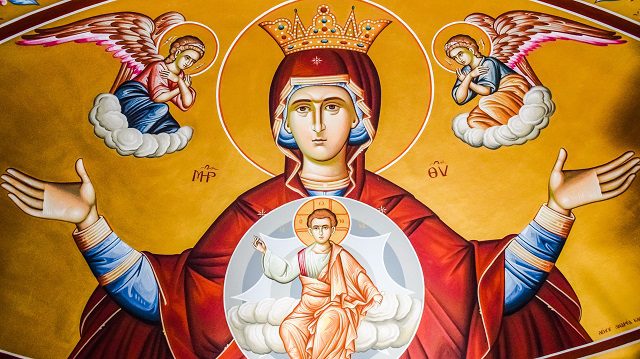
This is a rare disagreement with my very good friend and apologetics ally Paul Hoffer. He commented underneath my article, Was Mary Sinless? (vs. 3 Church Fathers & Jason Engwer) [11-9-21]. His words will be in blue.
*****
As I commented on your wonderful earlier article, everything we teach about Mary is really teaching something about Christ. The teaching about Mary’s sinlessness really is about Jesus’ sinlessness. Most Christians today supposedly believe that Jesus was fully human, yet fully divine-what we call the Hypostatic Union. We teach and the Scriptures state that Jesus was like us in all things but sin. Now, Jesus received His human nature from Mary. If Mary was a sinner, Jesus would have received her sin nature. If she was sinless as the Church teaches, then Jesus would not have received a sin nature which confirms what the Scriptures teach.
The ECFs, beginning with St. Irenaeus, taught that just as Jesus was the New Adam, Mary was the New Eve, What Adam injured by his sin, Jesus healed by His sinlessness applied though His death on the cross. What Eve bound by her sin, Mary loosed by her life of sinlessness and bearing Our Lord (which was perfected by the special application of Jesus’ death on the Cross-which is the basis of the Immaculate Conception).. Irenaeus refers to this as the Recapitulation.
This could not have happened if Mary had or retained a sinful nature. Of course, Mary’s role in God’s plan of salvation is purely secondary and dependent on Her Son’s perfect sacrifice, but her role reminds us that all of humanity participates in God’s plan of salvation. WE all have a part to play in making it happen.
Now 21st century science confirms this theological teaching. During pregnancy, children and mothers share cells which remain within both the child and the mother during their entire life. If Mary sinned she would have shared her sinful nature with her Son and if Jesus was sinless, He would have shared His sinless nature with her. God can not abide the presence of sin so how could Our Lord abide the intimate presence of Mary’s sinful nature within Him if her sinful nature was within Him?
Where Protestants go wrong here is their assumption that human beings are totally depraved and that human feelings or weakness are the result of sin. We know this is not true as Jesus got sad, wept, argued, cursed, scolded, got angry, felt anguish, satisfaction, happiness, and expressed love for His family and friends. He had a body that experienced hunger, fatigue, pain, and death. He expressed the full range of human emotions and physicality. In other words, human weakness is not the result of sin; it is the result of us being human.
I believe Church teaching does not hold that Mary had to be sinless, lest Jesus become infected with her sin. The Church teaches that her Immaculate Conception was, rather, “fitting.”
As far as I understand, it’s not possible for Jesus to inherit original sin [i.e., only created, fallen, rebellious human beings were ever subject to that in the first place], since He is God (anymore than it was possible for Him to commit actual sin [impeccability] ). His conception was sui generis, having been from the Holy Spirit.
Sin can never enter God’s nature, and this includes Jesus’ human and divine natures. Therefore, Mary could possibly have been a sinner and still bear Jesus. He wouldn’t and couldn’t inherit sin in any event.
I wrote about this twice:
“Was Mary’s Immaculate Conception Absolutely Necessary?” (12-8-17).
Mary’s Immaculate Conception: Necessary or “Fitting”? (4-26-18)
Hi Dave, I think this is only the second time I have ever disagreed with you (the other about Chief Wahoo).
Of course, you are right to say that Mary did not have to be conceived without sin or to be sinless. I suppose God, being God, could have figured something else out to save us besides coming to us through the Incarnation. I would note that Saints Irenaeus and Athanasius would disagree with that and argue that since sin came into the world through man, our salvation had to come though man as well – any other way would have violated God’s own nature by self-denying His own justice or His mercy.
While it is certainly “fitting”, as in proper, appropriate, just, or right that God chose to save us in this manner, once He chose to save us in this way, it would have been necessary for Mary to be sinless. (Of course, this depends on whether one believes in the doctrine of original sin.) I would point out that the Catechism of the Catholic Church § 490 does use the word necessary as part of its definition of Mary’s maternity and Immaculate Conception:
To become the mother of the Savior, Mary “was enriched by God with gifts appropriate to such a role.” The angel Gabriel at the moment of the annunciation salutes her as “full of grace”. In fact, in order for Mary to be able to give the free assent of her faith to the announcement of her vocation, it was necessary that she be wholly borne by God’s grace.
There is a reason that Mary was conceived without sin. I was focusing on the purpose of her sinlessness-to give Jesus a sinless nature. While you stated that you believed that “Church teaching does not hold that Mary had to be sinless, lest Jesus become infected with her sin” I would suggest that the implications of the Immaculate Conception and the notions of Mary as the New Eve and the New Ark of the Covenant indicate Mary was sinless was so Jesus would inherit a sinless human nature from her.
To argue otherwise would separate the divine Jesus too much from the human Jesus. Jesus was fully man as well as fully divine. If Jesus did not fully inherit His human nature from Mary, then He can not be fully human. And if Jesus truly took His flesh from Mary, then He would have also received the same human nature she had. Since Jesus is like us in all things but sin, if Mary was not preserved from sin through the Immaculate Conception, then Jesus would have inherited her sinful nature as well.
Further as the New Eve, Mary was able to undo what Eve did, which is why Mary is called the Undoer of Knots. She cooperated with God, having that perfect free will that Eve surrendered in sin.
Similarly, the analogy that the early fathers made to Mary being the Ark of the Covenant also was being made because just as the Ark of the Covenant had to be spotless without any defilement do the Glory/Presence of God could dwell there. The divine nature of Jesus Christ demanded that His mother be kept from the pollution of sin so that He, the Glory/Presence of God, could dwell within her.
Mary, as the New Eve, protects the dignity of Jesus’ human nature while Mary, as the Ark of the Covenant, protects the dignity of His divine nature.
Again, to emphasize the point I made that Marian doctrines all point to Christological doctrines, if God had simply created Jesus alone without sin in a sinful Mary’s womb, could we say He was fully human? To be fully human is to share the very flesh of one’s mother. That is the whole point of the Incarnation and why we say in the Creed that Jesus was born of the Virgin Mary. Unless you are a Docetist, Nestorian or some Protestant variation thereof, Chalcedonian Christianity teaches that Jesus inherits His human nature from his mother, not an abstract human nature separated from his mother.
Since God chose the Incarnation as the fitting means of our salvation, it then became “necessary” that Mary be sinless so that Jesus; human nature could be sinless. It was necessary that Jesus had to inherit her human nature in order to save humanity through His Incarnation. Or as Saint Athanasius puts it in his opus “On the Incarnation,” what is not assumed is not saved. The Immaculate Conception and Mary’s subsequent sinlessness were the means that God chose to make sure that Jesus did not inherit a sinful human nature, but a sinless perfect one.
Based on the above, Mary, in one sense, is a sinner because she too needed a savior. However if Mary bore Jesus, she could not have been a sinner in a different sense of the word. She gave Him her sinless human nature which was sinless only because of the special application of the grace of Her Son’s sacrifice on the cross. Jesus did not inherit a sinful human nature from Mary only because God chose to ensure that she did not have one through the Immaculate Conception. Thus, Mary’s sinlessness was a necessary part of God’s economy of salvation if God is to be both just and merciful.
It’s true we rarely disagree! I wrote in the second paper I linked to above:
*****
Blessed Pope Pius IX, in his 1854 declaration on the Immaculate Conception (Ineffabilis Deus) wrote:
For it was certainly not fitting that this vessel of election should be wounded by the common injuries, since she, differing so much from the others, had only nature in common with them, not sin. In fact, it was quite fitting that, as the Only-Begotten has a Father in heaven, whom the Seraphim extol as thrice holy, so he should have a Mother on earth who would never be without the splendor of holiness.
In his treatise “On the Virginal Conception,” St. Anselm expounded the principle on which the doctrine rests in the fallowing words: “It was fitting that the conception of that man (Christ) should be accomplished from a most pure mother. For it was fitting that that Virgin should be resplendent with such a purity, . . .”
The Catechism teaches the same:
#722 The Holy Spirit prepared Mary by his grace. It was fitting that the mother of him in whom “the whole fullness of deity dwells bodily” should herself be “full of grace.” She was, by sheer grace, conceived without sin as the most humble of creatures, the most capable of welcoming the inexpressible gift of the Almighty. . . .”
Facebook friend René Albert commented: “I agree that it’s ‘fitting’. But if we consider how a bad tree cannot produce good fruit (Matt 7:18), wouldn’t Jesus have inherited Original Sin through Mary?”
I reply:
It’s not possible because:
Jesus is God, and God cannot sin (He is impeccable), nor can He rebel against Himself (which is what caused original sin). This remains so whether Mary in fact sinned or not.
Jesus was not part of created humankind, which rebelled against God, bringing about original sin.
Jesus was not the offspring of a human father and mother. His was a miraculous conception through the Holy Spirit (virgin birth). This also bypasses any notion of “inherited sin” as a possibility in His case.
This gets into the doctrine of Jesus’ Two Natures and His impeccability. Fernand Prat, S. J. wrote: “Jesus, being by his nature impeccable, cannot be made a sinner by his contact with sinners, . . .” (The Theology of St. Paul, Westminster, Maryland: Newman Bookshop, 1952, Vol. II, 205).
Ludwig Ott (Fundamentals of Catholic Dogma, translated by Patrick Lynch, edited in English by James Canon Bastible, Rockford, Illinois: TAN Books and Publishers, Inc., fourth edition, 1960, p. 169) says that Christ “could not sin” and based that on the Hypostatic Union: “His human actions are actions of a Divine Person.” He adds: “From the Hypostatic Union there arises a physical impossibility of sinning and from the Beatific Vision a moral impossibility . . .” Ott classifies this as a sententia fidei proxima doctrine (regarded generally by theologians as a truth of revelation). He adds:
The Fifth General Council of Constantinople (553) condemned the teaching of Theodor of Mopsuestia, which asserted that Christ only became completely impeccable after the resurrection (Denzinger 224). It follows from this that He was already impeccable.
Likewise, Fr. John A. Hardon, S. J., in his Modern Catholic Dictionary (Garden City, New York: Doubleday & Co., 1980, “Impeccability of Christ,” 269), states that this means the “absolute impossibility of Christ committing any sin.”
The bishops have rendered their authoritative opinion as well:
Review of Fr. McBrien’s Catholicism, National Council of Catholic Bishops’ Committee on Doctrine, April 9, 1996:
A. Examples of Inaccurate or Misleading Statements
- The Impeccability of Jesus Christ
Catholicism insists that it is possible to hold the faith of the church while maintaining that Jesus Christ could have sinned. “It is not that Jesus Christ was absolutely incapable of sin, but rather that he was able not to sin and, in fact, did not sin” ( p. 547). The book argues that “both views – the one favoring impeccability and the one that does not – are within the range of Catholic orthodoxy” (p. 547). This position, however, cannot be reconciled with the Christology of the councils.
[Footnote 2: In the anathemas against the Three Chapters, the Second Council of Constantinople (553) condemned the opinion attributed to Theodore of Mopsuestia that Jesus attained impeccability only with the resurrection (Denzinger-Schonmetzer, Enchiridion Symbolorum 434).]
In two natures, Jesus Christ is only one hypostasis (or person), the hypostasis of the Word. With Christ there is no possible subject of the verb to sin. There are indeed two wills in Christ, but only one person, one subject. The contention that Jesus could have sinned, if followed to its logical conclusion, inevitably implies a Nestorian or an adoptionist Christology, though it must be said that Catholicism does not draw such extreme conclusions.
Fr. William Most, Comments on Richard McBrien, Catholicism, 3rd Edition:
The sinlessness of Jesus
He admits that Jesus did not sin, yet He was capable of sinning (p. 547). He was not immune to sexual desires (pp. 562-63).
McBrien grants that the Church does teach, as does the NT, that Jesus was without sin. But he has trouble about the impeccability, inability to sin, of Jesus. He quotes the Third Council of Constantinople (381) saying that His human will is “compliant, it does not resist or oppose, but rather submits to the divine and almighty will.” We grant this does not explicitly state impeccability. McBrien continues saying it seems better to conclude that it is the “clear and constant belief and teaching of the Church that Jesus Christ was perfect in his humanity.” He seems then to think of the Council of Chalcedon which he cited earlier saying He was “like us in every respect apart from sin,” and the similar statement of Hebrews.
So McBrien says the NT does not go in for theological speculation. And the official texts do not formally teach impeccability. This is true.
Nor are there many patristic texts on impeccability, not enough to satisfy the requirement of being practically unanimous. St. Cyril of Alexandria wrote (R 2141): “they are stupid, who affirm, I do not know how, that even Christ could have sinned.” St. John Damascene is more helpful (R 2386): “Because there is one person of Christ, and in Christ, there is one who wills through each nature: as God, in approving, and as man, being made obedient.” (Cf. also St. Athanasius in R 798).
But we can sharpen this up a bit: We do not say it is nature that sins, but a person sins. But in Christ there was only one Person, even though two natures. If He had sinned, the sin would have been attributed to the one Person, a Divine Person. Which of course is impossible.
Finally we mention Canon 12 of the second General Council of Constantinople, in 553 (DS 434) which spoke of Theodore of Mopsuestia as “impious” because he spoke of Christ as “suffering from passions of soul and desires of the flesh, and gradually going away from the worse things, and so becoming better by advancing in works . . . merited divine sonship . . .”
The revised version of Ott, Fundamentals of Catholic Dogma (2018) deals with the impeccability of Jesus on pp. 183-185. The statement: “Christ was free from all sin, from original sin as well as from all personal sin” is De Fide dogma.
Ott, after citing DH 1347, states:
As original sin is propagated by natural generation, and since Christ entered life in a supernatural manner through conception, by the Holy Spirit . . . it follows that He was not subject to the general law of original sin.
From this it follows that Mary need not have been necessarily immaculate in order for Jesus to be free from original sin. He would have been in either case. We believe she was immaculate, of course, but because it was “fitting” rather than necessary for the sake of Jesus. Ott continues:
The Fathers and the theologians infer Christ’s freedom from original sin from the Hypostatic Union, which being a most intimate connection with God, excludes the condition of separation from God implied by original sin.
You cite the Catechism (#490) and state that it “does use the word necessary as part of its definition of Mary’s maternity and Immaculate Conception.” But I think you are misreading that. It uses the word “appropriate” which is a synonym of “fitting.” When it refers to something as “necessary” it is “for Mary to be able to give the free assent of her faith to the announcement of her vocation.” So it had to do with her fiat and undoing of Eve’s “no”; nothing to do with some supposed necessity of keeping Jesus from inheriting original sin.
Ineffabilis Deus: the proclamation of the Immaculate Conception, uses the word “fitting” three times. “Necessary” appears once, but again has nothing to do with the topic at hand:
[T]he Fathers proclaimed with particular and definite statements that when one treats of sin, the holy Virgin Mary is not even to be mentioned; for to her more grace was given than was necessary to conquer sin completely.
“Original sin” appears ten times in the document, but never is it in conjunction with this notion that Our Lady’s preservation from it was necessary in order to conceive a sinless, God-Man Jesus Christ. Certainly, if this were true, then the infallible ex cathedra proclamation making the dogma binding upon all Catholics would spell it out clearly, as the most important reason for the dogma and the reality it describes to exist in the first place.
Since it doesn’t do so, we can reasonably conclude that it is a non-issue (Christ’s Two Natures and impeccability making it so), having nothing to do with the dogma of the Immaculate Conception of Mary. In other words, this solemn proclamation would be the place of all places, to explain this supposed “necessity” if in fact it existed. It would be the central reason for it: yet another Christocentric emphasis. But it’s utterly absent.
The argument basically is this All Mariology is actually Christology. In a nutshell, I contend that there are implications of the dogma of the Immaculate Conception that adds to and enriches our understanding of our Chalcedonian Dyothelite Christology. The Incarnation means the Logos/Word was made flesh, meaning that the Divine Person of the Son took on a human body, a human nature, and a human will. When Mary conceived Jesus in her womb by the power of the Holy Spirit, the question becomes what did she contribute to the Incarnation? Did she only provide Him a Jesus suit that God put on, or did she give Him something more than that? If she did not provide Him His human nature or His human will, where did they come from? And how is it if she did give Christ His human nature and human will, His nature was not sinful and that His human would be fully conformable with His divine will?
if Mary was a sinner, it is a lot harder to refute a heretic’s argument that Jesus did not inherit her sinful nature as well if we are going to argue that Jesus was fully human. On the other hand, the Immaculate Conception resolves that because the implication of Mary being preserved from sin from the moment of her conception means she would have given her Son a human nature that also was not sinful.
The Orthodox do not have the same understanding of original sin that we Catholics do nor do they believe in the Immaculate Conception. Some Orthodox even question whether Mary sinned.
I will flesh this out (no pun intended) by next week.
I asked my friend, Catholic theologian Dr. Robert Fastiggi, to offer his opinion on this dispute. Here is his answer, sent to my email:
Reply on the necessity or fittingness of the Immaculate Conception
I read through your exchange with Paul Hoffer on whether it was necessary or fitting for Mary to be conceived without original sin. I think you both have good insights. Many of the Fathers and medieval theologians believed Mary was free from all sin at least by the time of the Annunciation. This is the position of most of the Eastern Orthodox today. It’s as if, by intuition, they sense that our Lord could not assume a human nature from a mother who is sinful. Is this a matter of necessity or fittingness? We need to understand, of course, that we must be very careful in stating that it’s absolutely necessary for God to do this or that. It was not absolutely necessary that God create, yet it was it in accordance with his goodness that He would create (cf. CCC, 296).
St. Thomas Aquinas, in the ST, p. III, q. 1 a. 2 raises the question whether it was necessary (necessarium) that the Word become incarnate for the reparation of the human race. He argues that something can be considered necessary in two ways: 1) in the absolute sense when the end cannot be achieved without it; and 2) in a secondary sense when the end is attained in a better and more convenient way, as a horse is necessary for a journey. The Incarnation was not absolutely necessary in the first sense because God, in his omnipotence, could have redeemed the human race in many ways; but it was necessary in the secondary sense. Aquinas then proceeds to give multiple reasons why the Incarnation was necessary in the secondary sense of congruity.
With regard to the Immaculate Conception of Mary a similar mode of analysis is in order. In terms of absolute necessity, the Word could have received a sinless human nature from a Mother who had been purified rather than preserved from original sin. In terms of secondary necessity, it seems altogether fitting that the Word would receive his human nature from a mother who was never under sin. As Pope Leo the Great says: “From the Mother of the Lord, nature, not guilt was assumed” (DH, 294). I think Paul Hoffer might do better to argue that the Immaculate Conception is necessary in the secondary sense of congruity. This is similar to the argument of Bl. John Duns Scotus: God could preserve Mary from original sin; it was fitting that He do so; therefore, He did it (potuit, decuit; ergo fecit).
We could also follow the reasoning of St. Louis de Montfort who, in True Devotion, 14, states that God never had any absolute need of Mary. In True Devotion, 15, however, St. Louis states that since God has decided to begin and accomplish his greatest works through Mary, He will not change his plans. This could be put in terms of God’s absolute will and his ordained will. In terms of his absolute will, the Immaculate Conception was not necessary. In terms of his ordained will, it was.
The question is speculative. I think it’s sufficient simply to affirm the fittingness of Mary’s Immaculate Conception. Because this privilege is fitting and congruous to God's ordained plan for redemption, it has a type of necessity to it. But this is a necessity in a secondary and not in an absolute sense.
I hope these thoughts are of some help.
If Paul replies further, I will include that here. I concur with Dr. Fastiggi and have nothing more to add.
***
Practical Matters: if any of my 3,850+ free online articles and 50 books have helped you (by God’s grace) to decide to become Catholic or to return to the Church, or better understand some doctrines and why we believe them, and/or if you believe my work is worthy to support for the purpose of apologetics and evangelism in general, please seriously consider a much-needed financial contribution. 1 December 2021 will be my 20th anniversary as a full-time Catholic apologist, and February 2022, the 25th anniversary of my blog.
*
PayPal donations are the easiest: just send to my email address: [email protected]. “Catholic Used Book Service” (which might be mentioned in conjunction with my address on PayPal) is my old side-business. To learn about the different methods of contributing, including 100% tax deduction, etc., see my page: About Catholic Apologist Dave Armstrong / Donation Information. Thanks a million from the bottom of my heart!
***
Photo credit: Orthodox icon of Mary and Jesus [Pexels.com / public domain]
***
Summary: Was Mary’s Immaculate Conception absolutely necessary in order for Jesus to not contract original sin at His conception? I maintain that the Church says “NO”.
fittingness of the Immaculate Conception
Previous Post
November 10, 2021
Pearce’s Potshots #52: No Tomb for Jesus?
Next Post

November 12, 2021 Debate: Historical Local Flood & Biblical Hyperbole
Browse Our Archives
Select a Category & Last Things About Me Anti-Catholicism Atheism & Agnosticism Baptism and Sacramentalism Bible and Tradition Blessed Virgin Mary Books by Dave Armstrong C. S. Lewis Calvinism & General Protestantism Catholic Apologetics Catholic Apologists Catholic conversion Catholic converts Christmas Church (Ecclesiology) Church History Conversion and Converts Development of Doctrine Eastern Orthodoxy Ecumenism & Christian Unity Eucharist & Liturgy Fathers of the Church French Translations G. K. Chesterton Hell Hell & Satan Hell & Satan & Last Things Heresies & Comparative Religion Holistic Health Inquisition & Crusades & Scandals James White Jews & Judaism & Old Testament John Calvin John Henry Newman Liberal / Modernist Theology Life Issues Literary Resume Lutheranism Mariology Martin Luther Music Orthodoxy Papacy & Infallibility Personal Page Philosophy & Science Political & Ethical & Moral Issues Protestant Persecution & Intolerance Protestantism Purgatory Purgatory & Penance Romantic & Imaginative Theology Saints & Purgatory & Penance Salvation Salvation & Justification Satan & Last Things Sexuality and Gender Issues Spanish Translations Traditionalism vs. Radical Catholic Reactionaries Traducciones al español / tradução para português Trinitarianism & Christology Uncategorized Videos
Select a Month October 2026 September 2026 August 2026 July 2026 June 2026 May 2026 April 2026 March 2026 February 2026 January 2026 December 2025 November 2025 October 2025 September 2025 August 2025 July 2025 June 2025 May 2025 April 2025 March 2025 February 2025 January 2025 December 2024 November 2024 October 2024 September 2024 August 2024 July 2024 June 2024 May 2024 April 2024 March 2024 February 2024 January 2024 December 2023 November 2023 October 2023 September 2023 August 2023 July 2023 June 2023 May 2023 April 2023 March 2023 February 2023 January 2023 December 2022 November 2022 October 2022 September 2022 August 2022 July 2022 June 2022 May 2022 April 2022 March 2022 February 2022 January 2022 December 2021 November 2021 October 2021 September 2021 August 2021 July 2021 June 2021 May 2021 April 2021 March 2021 February 2021 January 2021 December 2020 November 2020 October 2020 September 2020 August 2020 July 2020 June 2020 May 2020 April 2020 March 2020 February 2020 January 2020 December 2019 November 2019 October 2019 September 2019 August 2019 July 2019 June 2019 May 2019 April 2019 March 2019 February 2019 January 2019 December 2018 November 2018 October 2018 September 2018 August 2018 July 2018 June 2018 May 2018 April 2018 March 2018 February 2018 January 2018 December 2017 November 2017 October 2017 September 2017 August 2017 July 2017 June 2017 May 2017 April 2017 March 2017 February 2017 January 2017 December 2016 November 2016 October 2016 September 2016 August 2016 July 2016 June 2016 May 2016 April 2016 March 2016 February 2016 January 2016 December 2015 November 2015 October 2015 September 2015 August 2015 July 2015 June 2015 May 2015 April 2015 March 2015 February 2015 January 2015 December 2014 November 2014 October 2014 September 2014 August 2014 July 2014 June 2014 April 2014 March 2014 February 2014 January 2014 December 2013 November 2013 October 2013 September 2013 August 2013 July 2013 June 2013 April 2013 March 2013 February 2013 January 2013 December 2012 November 2012 October 2012 September 2012 August 2012 July 2012 June 2012 May 2012 April 2012 March 2012 February 2012 January 2012 December 2011 November 2011 October 2011 September 2011 August 2011 July 2011 June 2011 April 2011 March 2011 February 2011 October 2010 September 2010 August 2010 July 2010 April 2010 March 2010 December 2009 October 2009 August 2009 July 2009 June 2009 May 2009 March 2009 February 2009 October 2008 September 2008 April 2008 March 2008 February 2008 January 2008 December 2007 November 2007 October 2007 May 2007 March 2007 February 2007 January 2007 November 2006 October 2006 September 2006 August 2006 July 2006 June 2006 May 2006 April 2006 March 2006 February 2006 October 2005 June 2005 April 2005 February 2005 July 2004 May 2004 April 2004
Follow Us!
TAKE THE
Religious Wisdom Quiz
I am twelve stones taken from a riverbed and set up as a memorial to a miraculous crossing. What am I?
Select your answer to see how you score.
Altar stones The memorial stones The Stones of remembrance Bethel
Books by This Author Books by Dave Armstrong
Related posts from Biblical Evidence for Catholicism

Bible & Catholicism on Mortal Sin (vs. John...
Biblical Evidence for Catholicism

Dialogue on Eternal Security / Absolute Assurance
Biblical Evidence for Catholicism

Holy Ground: Why Mary Had NO Other Children...
Biblical Evidence for Catholicism
Protestant Confessions & "Ever-Virgin" Mary
Biblical Evidence for Catholicism
TRENDING AT PATHEOS Catholic

The Sermon on the Mount, Part I: Matthew...
The Sermon on the Mount, Part I (Matthew 4:12-5:12) St. Matthew moves...

What's up from Crossway: Reviewing some of their latest A few weeks...

Janie Learns the Way of the Cross: A...
Teaching children about Jesus' Passion can be challenging. Many parents and educators...

Looking For Good Catholic Writing - October 2026
He alone extends the heavens, and he walks upon the waves of...

In "Irreplaceable," our book on vocation and technology, Trevor Sutton and I...

I was strolling through the top floor of the brand new Parthenon...
view all Catholic blogs
Ad-Free & Subscriber Log-In Subscription Support
- About Us
- 2026 Calendar
- Videos
- Podcasts
- Library of World Religions
- Faith In Media Tracker
- Advertise With Us
- Write for Us
- Privacy Policy
- Terms of Service
- Do Not Sell My Data
- Contact Us
- Radiant Digital
- Manage Newsletter Subscriptions
- Unsubscribe From Notifications
- Sitemap
Copyright 2008-2026, Patheos. All rights reserved.
Subscription Support Ad-Free & Subscriber Log-In
Follow Patheos