
BuddhistCatholicContemplativeEvangelicalGeneral ChristianHinduJewishLatter-day SaintMuslimNew VisionsProgressive Christian
Beliefs
- Buddhist
- Catholic
- Contemplative
- Evangelical
- General Christian
- Hindu
- Jewish
- Latter-day Saint
- More Voices
- Muslim
- New Visions
- Pagan
- Progressive Christian
Topics
- Religion News
- Food and Religion
- Sports and Religion
- Religious Art
- Religious Music and Entertainment
- Religious Events
- History and Religion
- Style and Religion
- Politics and Religion
- Women in Religion
- Recreation Outdoors and Religion
- Business Finance and Religion
- Careers Workplace and Religion
- Education and Religion
- Family Parenting and Religion
- Health Fitness and Religion
- Home and Religion
- Relationships and Religion
- Technology and Religion
- Travel and Religion
Columnists
- Buddhist Columnists
- Business Finance and Religion Columnists
- Careers Workplace and Religion Columnists
- Catholic Columnists
- Contemplative Columnists
- Education and Religion Columnists
- Evangelists Columnists
- Family Parenting and Religion Columnists
- General Christian Columnists
- Health Fitness and Religion Columnists
- Hindu Columnists
- History and Religion Columnists
- Home and Religion Columnists
- Jewish Columnists
- More Voices Columnists
- Latter Day Columnists
- Muslim Columnists
- New Visions Columnists
- Nonreligious Columnists
- Pagan Columnists
- Politics and Religion Columnists
- Progressive Columnists
- Recreation Outdoors and Religion Columnists
- Relationships and Religion Columnists
- Religion News Columnists
- Religious Art Columnists
- Religious Events Columnists
- Religious Music and Entertainment Columnists
- Sports and Religion Columnists
- Style and Religion Columnists
- Technology and Religion Columnists
- Travel and Religion Columnists
- Women in Religion Columnists
Resource Library
- 2026 Calendar
- Library of World Religions
- The 100 Most Holy Places on Earth
- Patheos Answers
- Podcasts
- Videos
- Faith Leaders Database
- Anglican Episcopalian
- Bahai
- Baptist
- Buddhism
- Christianity
- Confucianism
- Eastern Orthodoxy
- Hinduism
- Holiness and Pentecostal
- ISKCON
- Islam
- Judaism
- Lutheran
- Methodist
- The Church of Jesus Christ of Latter-day Saints
- New Age
- Paganism
- Presbytarian and Reformed
- Protestantism
- Religion Behind the Scenes
- Roman Catholic
- Scientology
- Shia Islam
- Sikhism
- Sufism
- Sunni Islam
- Taoism
- Zen
- See all religions
Research Tools
 Ad-Free & Subscriber Log-In Subscription Support
Ad-Free & Subscriber Log-In Subscription Support
Follow Patheos 

- Trending:
- Forgiveness
- |
- Marriage
- |
- Consciousness
- |
- Death Penalty
- |
- Election
- |
- Halloween

-
About
-
Catholic Apologetics
-
Church History
-
Great Apologists
-
Christian Worldview
-
Protestantism & Misc.
- Home
- Catholic
- History and Religion
- Pearce’s Potshots #50: Obsession w NT Imitation (?) of Homer
Pearce’s Potshots #50: Obsession w NT Imitation (?) of Homer
Last updated on: June 5, 2026 at 11:59 pm by Dave Armstrong
Pearce’s Potshots #50: Obsession w NT Imitation (?) of Homer 2026-06-05T23:59:43-04:00 Dave Armstrong
Patheos Explore the world's faith through different perspectives on religion and spirituality! Patheos has the views of the prevalent religions and spiritualities of the world.
Once Again, Archaeology and Legitimate Historiography (i.e., Known Historical Facts) Refute These Ridiculous Claims
Atheist anti-theist Jonathan M. S. Pearce is the main writer on the blog, A Tippling Philosopher. His “About” page states: “Pearce is a philosopher, author, blogger, public speaker and teacher from Hampshire in the UK. He specialises in philosophy of religion, but likes to turn his hand to science, psychology, politics and anything involved in investigating reality.” His words will be in blue. Words of Dennis R. MacDonald that he cites, will be in green.
*****
Presently, I am responding to his article, Mark and Homeric Emulation (10-18-21).
Dave Armstrong took umbrage with such connections, and wrote some kind of attempted refutation. Ah well.
This is referring to my previous refutation of this novel, widely-panned thesis from NT scholar Dennis R. MacDonald. As is his increasing modus operandi (in the past he did actually attempt — albeit selectively — to directly reply to my critiques), Jonathan simply completely ignores my reply, and as an additional insult, doesn’t even grant me the courtesy of linking to it, so folks can see what I wrote.
So what I thought I would do here, because Armstrong has clearly never read a book by MacDonald in his life, is just detail some of the claims that he makes regarding specifically and only Jesus’ burial and Joseph of Arimathea, and how Mark is emulating previous Greek works he would have studied in order to have become a learned Greek writer.
One doesn’t have to read every book. If a novel thesis is believed to be nonsense (or at best, not plausibly established) by the consensus of other scholars in the field (as I documented last time), it deserves very little consideration (which is why I strongly considered not even bothering to write this reply). I don’t have to read books about, for example, young earth creationism or geocentrism or about a flat earth, or KKK racist theories, or Jewish banker or Masonic or Illuminati one world government conspiracy theories. I know enough about all of those topics (and about this one) to know that they are nonsense or conspiratorial gibberish, and as such, deserve no serious consideration.
Mark needs Joseph of Arimathea as a vehicle in which to introduce an empty tomb so he can have Jesus disappearing from it in order to provide a mechanism to argue for a bodily (i.e., not spiritual) resurrection. Or, at the very least, to provide supposed evidence for the Resurrection.
All he “needs” is a tomb to do that (which virtually all Jews in first-century Israel were buried in). There is no further need to “invent” a fictional character. The myths and fictional imagination here are in MacDonald’s and Pearce’s minds, not in the mind of the Gospel writer(s).
Once Joseph had offered this service, he vanished from the story.
Of course he did, because Mark’s story ended one chapter (20 verses) and four verses after Joseph entered into it (Mk 15:43). This ain’t rocket science. The need to find conspiracy theories under every rock is not widely renowned as a respectable attribute of scholarly work.
The evangelist portrayed him as a distinguished member of the very group of Jewish authorities that had condemned Jesus, but Joseph secretly sided with him or at least identified with “the kingdom of God.” His ambiguous status provides Jesus a silent patron with enough credibility to coax his body from Pilate and sufficient means to provided him a cave-tomb hewn from rock. As king of Troy, Priam, too, was distinguished and wealthy, able to offer Achilles an enormous ransom and provide for Hector a lavish funeral. Like Joseph, Priam was noted for his piety. 2
Priam began his journey at nightfall and arrived at Achilles’ camp at the dinner hour. 3 Joseph went to Pilate at the same time of day: “when evening had come . . . the day before the sabbath.”4 Apparently he wanted to bury Jesus before the sabbath meal.
It’s all well and good for MacDonald and his sycophant Pearce, who gobbles up his every word, to invent literary-based conspiracies and fables, with no “hard” supporting evidence at all. Serious thinkers and analysts of the New Testament prefer to see what actual archaeology and historiography can bring to bear on the topic. See, for example, “The Resurrection of Jesus in the Light of Jewish Burial Practices” (5-4-16), by Craig A. Evans, Distinguished Professor of Christian Origins and dean of the School of Christian Thought at Houston Baptist University, and a scholar with as many credentials as MacDonald. He prefers to stick to known facts:
In recent years a number of skeptics, including scholars who ought to know better, have charged that the story of the burial of Jesus itself is unhistorical, that Roman law did not in fact permit the burial of the crucified, and that the story of the burial is therefore simply part of early Christian apologetic, designed to confirm the story of the resurrection. A few of these scholars have suggested that in all probability the body of Jesus was not buried but left hanging on the cross or at best was cast into a ditch where it was mauled by animals. Skepticism regarding the burial of Jesus is ill-founded, in the light of Roman law and Jewish law, custom, and practice. The present essay will review both of these elements.
Roman law regarding the burial of the executed is far more nuanced —and lenient — than many suppose. In the Digesta, compiled by Roman emperor Justinian in the sixth century (AD 530–533) but comprising a great deal of law from the first and second centuries, we find important and relevant material in chapter 24 of book 48. All three of the paragraphs that make up chapter 24, the final chapter, entitled De cadaveribus punitorum (“On the bodies of the punished”), are helpful. I shall treat paragraphs §1 and §3, both of which directly bear on the question of the burial of the executed.
§1 Ulpian, Duties of Proconsul, book 9: The bodies of those who are condemned to death should not be refused their relatives; and the Divine Augustus, in the Tenth Book of his Life, said that this rule had been observed. At present, the bodies of those who have been punished are only buried when this has been requested and permission granted; and sometimes it is not permitted, especially where persons have been convicted of high treason. Even the bodies of those who have been sentenced to be burned can be claimed, in order that their bones and ashes, after having been collected, may be buried.
§3 Paulus, Views, book 1: The bodies of persons who have been punished should be given to whoever requests them for the purpose of burial.
More than forty percent of Justinian’s Digesta has been drawn from the writings of the jurist Ulpian (c. AD 170–223). One of his frequently cited works is his officio proconsulis (Duties of Proconsul). In the first paragraph of chapter 24 the Digesta quotes an opinion from the ninth book of officio proconsulis: “The bodies of those who are condemned to death should not be refused their relatives.” Ulpian supports his opinion by appealing to the precedent of the great emperor Augustus (ruled 31 BC – AD 14), which was expressed in his autobiography written near the end of his life. Ulpian goes on to say that “the bodies of those who have been punished are only buried when this has been requested and permission granted.” . . .
The Gospel narratives are fully consistent with Roman practice and legal opinion. . . .
[Jewish historian] Josephus (AD 37 – c. 100) himself makes such a request of Titus, son of Vespasian, and it is granted (Life 420–21).
It is clear from the early laws and opinions cited in the Digesta that in most cases the bodies of the executed, including those crucified, were permitted burial, if requests were made. We see this in the case of Jesus, whose body for burial was requested by Joseph of Arimathea, a member of the Jewish council (Mark 15:42–47 parr.). This is completely consistent with Jewish law and custom, which placed the burden of burial on the Jewish council (or Sanhedrin) when it condemned and executed someone. . . .
There is also archaeological evidence that corroborates the literary evidence. One thinks of the crucified remains of one Yehohanan, crucified under the authority of Pontius Pilate. Though crucified, he was nevertheless properly buried (with an iron spike still embedded in his right heel). The skeletal remains of at least three other executed persons have been recovered from tombs and ossuaries, as well as dozens of nails and spikes, many of which had been used in crucifixion.
So there you have it. The available evidence from actual practices in this time and place completely backs up Marks account (and that of the other three Gospels). There is, therefore, no rational basis for making up fables and legends about Mark “needing” to invent Joseph of Arimathea in order to line up with his alleged obsession with emulating Homer. Everything is precisely what we would expect, based on what we know, including Jewish burial practices and Roman law concerning such situations.
If MacDonald and Pearce were serious about scientifically established evidence, they would immediately concede this, but alas, it sadly appears that they are more interested in fictional inventions, so as to mock and cast doubt on the New Testament accounts. That’s not scholarship: it’s sophistry, intellectual dishonesty, and desperate special pleading conspiratorialism for the sake of a nefarious agenda.
Joseph’s request for the body was risky: “Joseph . . . dared to go to Pilate and asked for the body of Jesus.” The phrase “dared to go” . . . is similar to Homer’s description of Priam’s courage. Achilles . . . observed, “No man alive, not even a rugged young fighter, would dare . . . to come . . . into . . . our camp.”
As just shown, there was no particular risk involved in going to the Romans to request a body. This was routine and enshrined in Roman law (so much so that even Josephus did it). Hence, Pilate granted his request, seemingly without question or controversy (Mk 15:46). I submit, then, that the “risk” to Joseph of Arimathea was, rather, from his own comrades in the Sanhedrin. Since they had just played the key role in having Jesus killed, it’s only sensible (and perfectly plausible) that Joseph would have some fear of being a nonconformist among them, so that it required “courage” to do this act.
The same fear is perhaps implied in the Pharisee Nicodemus, who “came to Jesus by night” as an open-minded inquirer, to ask him questions (Jn 3:1-15). Cambridge Bible for Schools and Colleges (comment on Mk 15:43: “took courage and went to Pilate”: RSV) highlights another aspect of this move by Joseph:
He is no longer a secret disciple. He casts away all fear. The Cross transfigures cowards into heroes. “It was no light matter Joseph had undertaken: for to take part in a burial, at any time, would defile him for seven days, and make everything unclean which he touched (Numbers 19:11; Haggai 2:13); and to do so now involved his seclusion through the whole Passover week—with all its holy observances and rejoicings.” Geikie, ii. 576.
No longer being a “secret disciple” related to the Jewish leaders, not the Romans. He would likely be ostracized and outcast among them; regarded as a traitor, helping or sympathizing with an “enemy” etc. This scenario is actually stated in the Gospel of John: “Joseph of Arimathe’a, who was a disciple of Jesus, but secretly, for fear of the Jews, asked Pilate that he might take away the body of Jesus” (Jn 19:38).
All this being granted, the alleged parallel to Homer vanishes. And MacDonald and his slavish admirer Pearce could have figured this out. It ain’t rocket science.
Joseph here plays the role Homer gave to Hector’s father. Later gospels, of course, named Jesus’ father Joseph, and Mark surely could have known this tradition. Jesus’ father does not bury his son, but his namesake from Arimathea does. . . . By having Joseph of Arimathea assume Joseph’s responsibility for the burial of his son, Mark again may be criticizing Jesus’ family. . . .
It is not, indeed, his disciples, or his father, who takes him down from the cross but someone else called Joseph, . . . This is, to me, clearly symbolic, driving home a motif and point.
This is more self-serving, arbitrary ludicrosity. If the goal was to imitate Homer at every turn, then certainly Mark would have simply had Joseph, Jesus’ father, do this. That would be a parallel. But because that isn’t the case in mark, MacDonald (like all good tin foil hat conspiracy theorists) simply pivots to a scenario where Mark makes up another Joseph to take his place. This sort of mindless speculation is beneath contempt.
The fact of the matter is that all four Gospels and early Christian tradition hold that Joseph had died before Jesus began His public ministry. Wikipedia (“St. Joseph”) states:
The last time Joseph appears in person in any Gospel book is in the story of the Passover visit to the Temple in Jerusalem when Jesus is 12 years old, found only in Luke. No mention is made of him thereafter. The story emphasizes Jesus’ awareness of his coming mission: here Jesus speaks to his parents (both of them) of “my father,” meaning God, but they fail to understand (Luke 2:41–51).
Christian tradition represents Mary as a widow during the adult ministry of her son. Joseph is not mentioned as being present at the Wedding at Cana at the beginning of Jesus’ mission, nor at the Passion at the end.
Thus, there is no mention in the Gospels of Jesus’ “mother and father” after the time that He was twelve years old. It’s always Mary alone that is referenced: including at the time of the crucifixion. So there is no need to come up with more conspiracies. Joseph, the legal (not biological) father of Jesus was dead at the time of the crucifixion. Therefore, he couldn’t ask for His body. But as we have seen, the norm was that if the Sanhedrin had requested execution of a criminal, it was responsible for the burial of the body, as opposed to the family of the criminal. Hence, we also read of Nicodemus, another Pharisee sympathetic to Jesus, helping in the burial process (Jn 19:39).
I hate to befuddle MacDonald and Pearce with actual historical facts, but that is how many of us (this may shock them) go about determining matters of history, rather than contriving conspiracy theories in our own head (facts be damned!) next to a fire, Homer in hand, and imaginations running wild: oblivious to known facts. In this instance, again, the so-called parallel with Homer doesn’t exist in the first place.
A similar wordplay applies to Mark’s Simon Peter, who failed to fulfill his promise to die with his Lord. Two other Simons play roles one might have expected of him: Simon the leper entertained him, and Simon the Cyrenian carried his cross.
More fanciful nonsense. Known facts again explode the myths and conspiracy theories. Wikipedia (“Simon [given name]”) informs us that:
Simon is a common name, from Hebrew שִׁמְעוֹן Šimʻôn, meaning “listen” or “hearing”.[1] It is also a classical Greek name, deriving from an adjective meaning “flat-nosed”.[2]: 232 [3] In the first century AD, Simon was the most popular male name for Jews in Roman Judea.[4]
The Hebrew name is Hellenised as Symeon (Greek: Συμεών) in the Septuagint, and in the New Testament as both Symeon[5] and, according to most authorities, Simon. Some commentators on the New Testament say that it could be a Hellenised form of the Hebrew Shim’on, but if not then it indicates that Peter came from a “Hellenistic background”; this was not unheard of in this era, as contemporary Jews such as Andrew the Apostle (Simon’s brother) sometimes bore originally Greek names.
Sources cited: Ilan, Tal (2002) Lexicon of Jewish Names in Late Antiquity: Palestine 330 BCE–200 CE (Texts & Studies in Ancient Judaism, 91), Coronet Books, pp. 56–57; Hachili, R. “Hebrew Names, Personal Names, Family Names and Nicknames of Jews in the Second Temple Period,” in J. W. van Henten and A. Brenner, eds., Families and Family Relations as Represented in Early Judaism and Early Christianity (STAR 2; Leiden:Deo, 2000), pp. 113–115; apud Bauckham, Richard (2017). Jesus and the Eyewitnesses (2nd ed.). Wm. B. Eerdmans Publishing. pp. 68–72. ISBN9780802874313. Quote (p. 71): 15.6% of men bore one of the two most popular male names, Simon and Joseph; (p. 72): for the Gospels and Acts… 18.2% of men bore one of the two most popular male names, Simon and Joseph.
I submit that this data blows out of the water MacDonald’s fables regarding supposed fictional usage of the names Joseph and Simon by Mark. This Gospel precisely reflects what we know about the frequency of those name and others in this time and place. Simon was the most popular name, followed by Joseph.
We shall see a similar play on the name Mary for the women who came to the tomb to care for Jesus’ body.
Likewise, Mary was the most popular name among Palestinian Jews between 330 BC and 200 AD, according to a chart of the evidence produced by Richard Bauckham (ibid.) on his page 89, which can be accessed by the Amazon “Look Inside” feature (I searched “31 Most Popular Female Names”). He also noted:
28.6% of the women bore one of the two most popular female names, Mary and Salome. 49.7% of the women bore one of the nine most popular female names. (p. 72)
Interestingly, other names on the list, including Salome (#2), Martha (#4), Joanna (#5), Sapphira (#5), Anna (#13), Susanna (#16), Elizabeth (#21), Tabitha (#21), and Dorcas (#21) are also found in the New Testament. As usual, it accurately reflects the known historical facts for the time and place where they are found in the text.
Thus, in one verse in Mark, this reality is reflected by the appearance of Mary twice, and Salome (the second most popular name, which was also the name of the woman who betrayed John the Baptist): “There were also women looking on from afar, among whom were Mary Mag’dalene, and Mary the mother of James the younger and of Joses, and Salo’me,” (Mk 15:40; cf. 16:1). Facts is facts. This is not made-up fiction. It corresponds exactly to what we know (from serious research, not mere speculation) about frequency of male and female names in first-century Judaea / Palestine / Israel.
Judas and John were, according to Bauckham (p. 102), the fourth and fifth most common names. There are seven distinct Judas’s in the New Testament (New Bible Dictionary, 1962, “Judas”, p. 673, and at least three Johns (the Baptist and the Evangelist and “John called Mark”: Acts 15:37)
Mark makes a point of how unusually short and painless the death of Jesus was, especially for a mode of death that was supposed to be long and torturous. Origen even defended this short death on account of people thinking Jesus was some kind of weakling. The reason, one might suppose, was to keep his body intact for rising.
Yeah, it’s a huge supposition alright. Mark agrees with the other Gospels in asserting a six-hour length of time of Jesus on the cross before He died (having been brutally beaten even before that, to within an inch of His life). According to a medical article about crucifixion:
Death, usually after 6 hours–4 days, was due to multifactorial pathology: after-effects of compulsory scourging and maiming, haemorrhage and dehydration causing hypovolaemic shock and pain, but the most important factor was progressive asphyxia caused by impairment of respiratory movement. Resultant anoxaemia exaggerated hypovolaemic shock. Death was probably commonly precipitated by cardiac arrest, caused by vasovagal reflexes, initiated inter alia by severe anoxaemia, severe pain, body blows and breaking of the large bones.
Jesus was probably particularly singled out for extraordinary scourging and beating before the crucifixion, based on belief that He was falsely claiming to be the Messiah (i.e., that He was some kind of nut and someone who would cause the Romans to persecute the Jewish people). False Messiahs were absolutely despised. A crown of thorns was crammed onto His head (Mk 15:17; Mt 27:29; Jn 19:2). This alone would have caused extraordinary pain and loss of blood. He was struck on the head with a reed (Mk 15:19; Mt 27:30) and otherwise struck (Jn 19:3).
Even before His “punishment proper” from the Romans he was struck by various Jewish leaders (Mk 14:65; Mt 26:67-68; Lk 22:63-64; Jn 18:22) and temple guards (Mk 14:65). Moreover, Luke adds the report: “Herod with his soldiers treated him with contempt and mocked him” (Lk 23:11). As the article above states: “Death was probably commonly precipitated by cardiac arrest, . . . initiated inter alia by . . . severe pain, body blows . . .”
All of this suggests His being very weak and close to death even before He was crucified, leading to a relatively quick death for that method of execution. We can marvel that He even survived six more hours. Again, conspiracies need not be made up to explain this.
Achilles and Pilate both marveled at the requests of their uninvited guests; Achilles was astounded that Priam, the father of his slain enemy, dared to enter his home and kiss his murderous hands.
There is no analogy here. I’ve already shown that Joseph feared the Jews, not Pilate, from whom he requested the body. So it’s not a parallel at all. There is no indication whatever in the texts that Pilate was “astounded” that he made the request. Mark alone, of the four Gospels, states that Pilate “marvelled” or “wondered” if Jesus was dead yet. It’s all rather matter-of-fact. And that’s because this was part of Roman law and nothing unusual at all, as shown above. Hence, Greek linguist A. T. Robertson comments: “Perfect active indicative with ε after a verb of wondering, a classical idiom, a kind of indirect question just as we say ‘I wonder if.’ Usually death by crucifixion was lingering. This item is only in Mark” (Word Pictures in the New Testament). Vincent’s Word Studies in the New Testament concurs: “Wondered. This query and the asking the centurion are peculiar to Mark.”
For his part, Pilate marveled that Jesus already was dead.
All it says in Mark 15:44 is “And Pilate wondered [many translations: “marveled” or “surprised”] if he were already dead; and summoning the centurion, he asked him whether he was already dead.” It was a simple factual question, because oftentimes the crucified took longer to die.
Achilles sent two soldiers to get the ransom and summoned . . . maidservants to “wash and anoint” Hector. . . . Compare the shroudings of Hector and Jesus.
So what!? Lots of cultures wash and anoint dead bodies and cover it with a fresh shroud. Historians believe that Homer reflected ancient Greek practices, that were similar to not only Jewish customs, but those of many cultures around the world. None of this proves “copying” of Homer from the writer of Mark. Are we to believe that he singlehandedly “invented” Jewish burial customs, from copying Homer? These had been developing for many centuries! Sometimes there were similarities and differences.
For example, an article on funeral rituals in the ancient world observed that the ancient Hindus practiced “anointment with oils, incense” and that “The body was bathed, wrapped in a cloth . . .”. But then it was cremated rather than buried. Hector’s body, too, was burned. So much for the supposed parallels, again, huh (nor, we might add, was Hector crucified)? But this doesn’t bother MacDonald and his lapdog Pearce. They see only what they want to see and ignore any refuting anomalies.
***
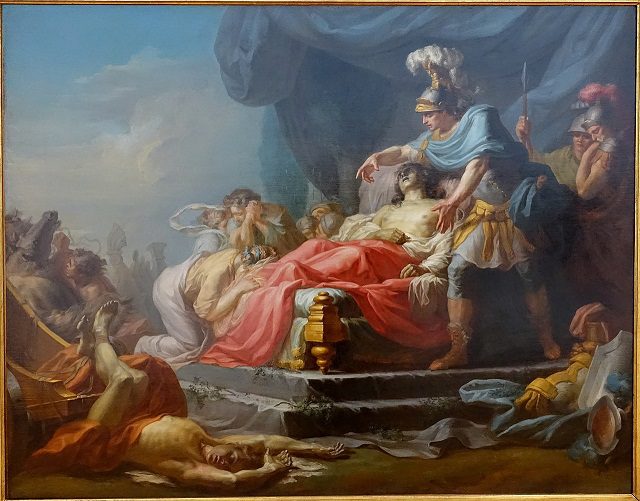
Photo credit: Achilles Displaying the Body of Hector at the Feet of Patroclus (1769), by Jean-Joseph Taillasson (1745-1809) [public domain / Wikimedia Commons]

***
Summary: Atheist anti-theist Pearce, drawing on fringe Christian scholar Dennis R. MacDonald, fails in trying to find exact parallels between Joseph of Arimathea & the Iliad.
Homeric Influence on the Gospels
Previous Post

October 17, 2021
Are Christians Uniquely Averse to Criticism?
Next Post
October 20, 2021 "Gospel of Thomas" Isn't an Authentic Gospel
Browse Our Archives
Select a Category & Last Things About Me Anti-Catholicism Atheism & Agnosticism Baptism and Sacramentalism Bible and Tradition Blessed Virgin Mary Books by Dave Armstrong C. S. Lewis Calvinism & General Protestantism Catholic Apologetics Catholic Apologists Catholic conversion Catholic converts Christmas Church (Ecclesiology) Church History Conversion and Converts Development of Doctrine Eastern Orthodoxy Ecumenism & Christian Unity Eucharist & Liturgy Fathers of the Church French Translations G. K. Chesterton Hell Hell & Satan Hell & Satan & Last Things Heresies & Comparative Religion Holistic Health Inquisition & Crusades & Scandals James White Jews & Judaism & Old Testament John Calvin John Henry Newman Liberal / Modernist Theology Life Issues Literary Resume Lutheranism Mariology Martin Luther Music Orthodoxy Papacy & Infallibility Personal Page Philosophy & Science Political & Ethical & Moral Issues Protestant Persecution & Intolerance Protestantism Purgatory Purgatory & Penance Romantic & Imaginative Theology Saints & Purgatory & Penance Salvation Salvation & Justification Satan & Last Things Sexuality and Gender Issues Spanish Translations Traditionalism vs. Radical Catholic Reactionaries Traducciones al español / tradução para português Trinitarianism & Christology Uncategorized Videos
Select a Month October 2026 September 2026 August 2026 July 2026 June 2026 May 2026 April 2026 March 2026 February 2026 January 2026 December 2025 November 2025 October 2025 September 2025 August 2025 July 2025 June 2025 May 2025 April 2025 March 2025 February 2025 January 2025 December 2024 November 2024 October 2024 September 2024 August 2024 July 2024 June 2024 May 2024 April 2024 March 2024 February 2024 January 2024 December 2023 November 2023 October 2023 September 2023 August 2023 July 2023 June 2023 May 2023 April 2023 March 2023 February 2023 January 2023 December 2022 November 2022 October 2022 September 2022 August 2022 July 2022 June 2022 May 2022 April 2022 March 2022 February 2022 January 2022 December 2021 November 2021 October 2021 September 2021 August 2021 July 2021 June 2021 May 2021 April 2021 March 2021 February 2021 January 2021 December 2020 November 2020 October 2020 September 2020 August 2020 July 2020 June 2020 May 2020 April 2020 March 2020 February 2020 January 2020 December 2019 November 2019 October 2019 September 2019 August 2019 July 2019 June 2019 May 2019 April 2019 March 2019 February 2019 January 2019 December 2018 November 2018 October 2018 September 2018 August 2018 July 2018 June 2018 May 2018 April 2018 March 2018 February 2018 January 2018 December 2017 November 2017 October 2017 September 2017 August 2017 July 2017 June 2017 May 2017 April 2017 March 2017 February 2017 January 2017 December 2016 November 2016 October 2016 September 2016 August 2016 July 2016 June 2016 May 2016 April 2016 March 2016 February 2016 January 2016 December 2015 November 2015 October 2015 September 2015 August 2015 July 2015 June 2015 May 2015 April 2015 March 2015 February 2015 January 2015 December 2014 November 2014 October 2014 September 2014 August 2014 July 2014 June 2014 April 2014 March 2014 February 2014 January 2014 December 2013 November 2013 October 2013 September 2013 August 2013 July 2013 June 2013 April 2013 March 2013 February 2013 January 2013 December 2012 November 2012 October 2012 September 2012 August 2012 July 2012 June 2012 May 2012 April 2012 March 2012 February 2012 January 2012 December 2011 November 2011 October 2011 September 2011 August 2011 July 2011 June 2011 April 2011 March 2011 February 2011 October 2010 September 2010 August 2010 July 2010 April 2010 March 2010 December 2009 October 2009 August 2009 July 2009 June 2009 May 2009 March 2009 February 2009 October 2008 September 2008 April 2008 March 2008 February 2008 January 2008 December 2007 November 2007 October 2007 May 2007 March 2007 February 2007 January 2007 November 2006 October 2006 September 2006 August 2006 July 2006 June 2006 May 2006 April 2006 March 2006 February 2006 October 2005 June 2005 April 2005 February 2005 July 2004 May 2004 April 2004
Follow Us!
TAKE THE
Religious Wisdom Quiz
Who asked Jesus, "What is truth?"
Select your answer to see how you score.
Caiaphas Pilate Nicodemus Herod
Books by This Author Books by Dave Armstrong
Related posts from Biblical Evidence for Catholicism

God, Modern Physics, & Dark Energy: An Analogy
Biblical Evidence for Catholicism

General Debate on Christianity with an Atheist
Biblical Evidence for Catholicism

Can Atheists Be Saved? Surprising Biblical Data
Biblical Evidence for Catholicism
Can Atheists Be Saved? YES! (Possibly Some ....
Biblical Evidence for Catholicism
TRENDING AT PATHEOS Catholic

I was strolling through the top floor of the brand new Parthenon...

What Does Gêvâh Mean For Kimberley Guifoyle &...
This week, a lot of the news is focused on Kimberly Guilfoyle....

INNER CIRCLE: Profound Mystery (Of Christ In All...
Ephesians 5:31-32 “For this reason, a man will leave his father and...

Do Not Rejoice When Your Enemy Falls: The...
Turning an execution into a public spectacle is a disturbing expression of...

'The Chosen' S6 Trailer: The Passion Gets Very...
Not many watching 'The Chosen' worry about spoilers, but just because they...

The purpose-driven labor priest
A labor activist reads Rick Warren and it gets me wondering about...
view all Catholic blogs
Ad-Free & Subscriber Log-In Subscription Support
- About Us
- 2026 Calendar
- Videos
- Podcasts
- Library of World Religions
- Faith In Media Tracker
- Advertise With Us
- Write for Us
- Privacy Policy
- Terms of Service
- Do Not Sell My Data
- Contact Us
- Radiant Digital
- Manage Newsletter Subscriptions
- Unsubscribe From Notifications
- Sitemap
Copyright 2008-2026, Patheos. All rights reserved.
Subscription Support Ad-Free & Subscriber Log-In
Follow Patheos